

The Modern Buyer: What 6,500+ B2B Buyers Actually Want in 2026
Your SDR sends 200 emails. Forty bounce. Eighty go to the wrong person. Of the 80 that land, 60 are irrelevant because the prospect chose their shortlist two months ago. That's not a pipeline problem - it's a timing and data problem.
We pulled from 6sense's 4,000+ buyer study, Gartner's 632-buyer survey, G2's 1,169-decision-maker research, and Inbox Insight's 800+ buyer dataset to build the most complete picture of the modern buyer in 2026. Most articles on this topic recycle stats from 2019. This one doesn't.
Key Takeaways
- The shortlist is locked before you show up. 95% of the time, the winning vendor is already on the buyer's Day One list. Buyers use AI to research you before you know they exist.
- They don't hate salespeople - they hate irrelevant ones. 61% prefer a rep-free experience, but hybrid deals close at 1.8x the rate of self-service alone. Meanwhile, 73% actively block or avoid suppliers who send irrelevant messages.
- Your outreach data is the bottleneck. Bounced emails, wrong titles, outdated companies - every bad touch trains the buyer to ignore you permanently.
Who Is the Modern B2B Buyer?
Millennials now represent 73% of all B2B buyers and 44% of final decision-makers, according to LinkedIn's 2026 B2B Buyer Report via Digital Commerce 360. Combined with Gen Z, younger buyers make up 64-71% of the total buyer pool. Even in deals over $1M, Millennials and Gen Z still represent 67% of the buying committee.
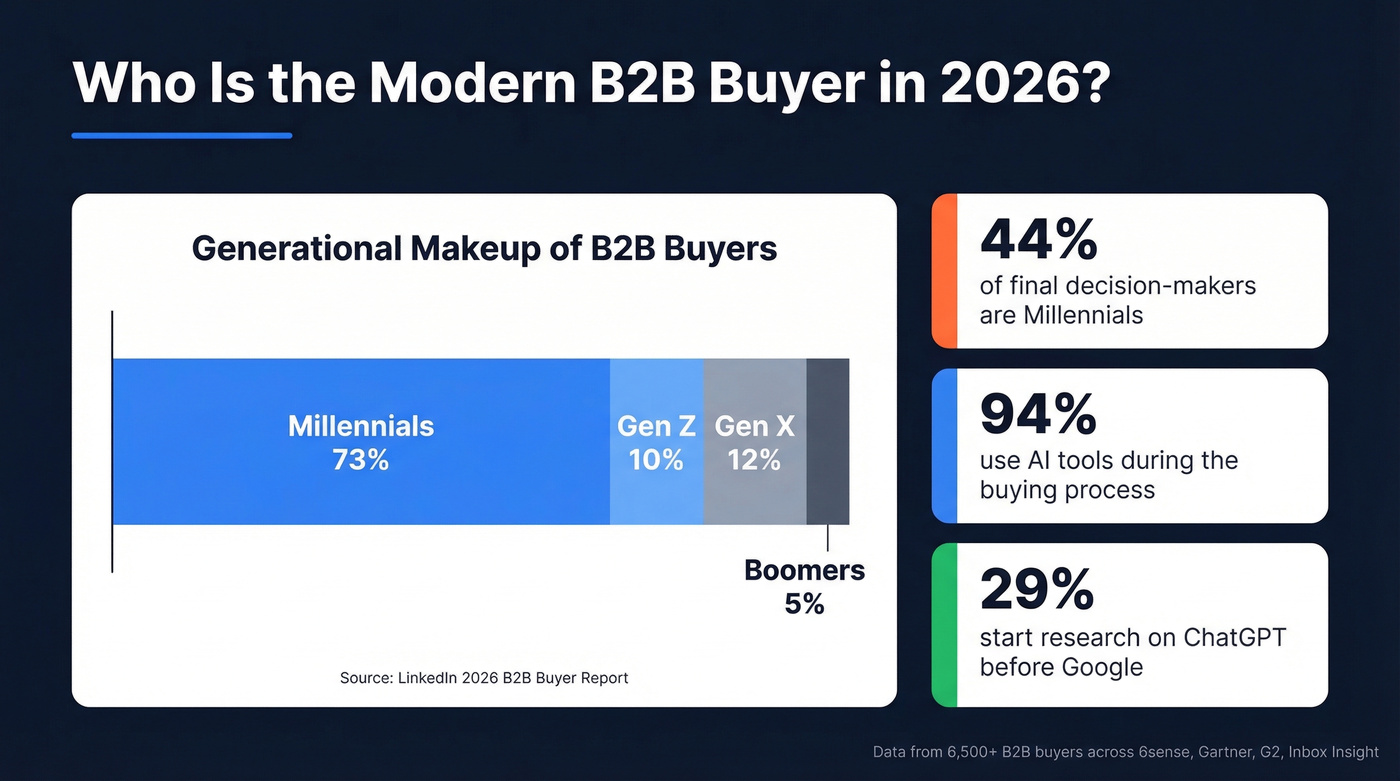
This isn't a demographic footnote. It fundamentally changes how buying happens. 68% of millennial B2B buyers prefer self-service research tools over speaking to a rep, 6sense found 94% use AI tools at some point during the purchasing process, and 29% now start their research via ChatGPT more often than Google - per a G2 survey of 1,169 decision-makers fielded in early 2026. The evolution from phone-first to digital-first has been gradual, but the tipping point is here.
The dissatisfaction gap is striking. 90% of millennial and Gen Z buyers report frustration with vendors in at least one area, compared to 71% of older buyers. These digital-first buyers grew up with consumer-grade experiences. They'll switch the moment enterprise vendors can't match them.
Then vs. Now
| Dimension | Previous Norm | 2026 Buyer |
|---|---|---|
| Research tool | Google + analyst reports | ChatGPT + AI search + peers |
| Engagement style | Phone/email with rep | Self-service first, rep later |
| Generational makeup | Boomer/Gen X majority | 73% Millennials + Gen Z |
| Shortlist formation | During evaluation | Before contacting vendors |
| Buying cycle | 11.3 months avg | 10.1 months avg |
| Committee size (software) | 5-8 members | 3-4 with stricter governance |
| Bad outreach tolerance | Low | Zero - 73% actively block |
How the Buyer Journey Actually Works
Gartner's framework breaks the B2B purchase into six buying jobs: problem identification, solution exploration, requirements building, supplier selection, validation, and consensus creation. What makes today's buyer different isn't the jobs themselves - it's that they loop through them non-linearly, revisiting stages as new stakeholders weigh in. The B2B customer journey was never a funnel. It's a maze.
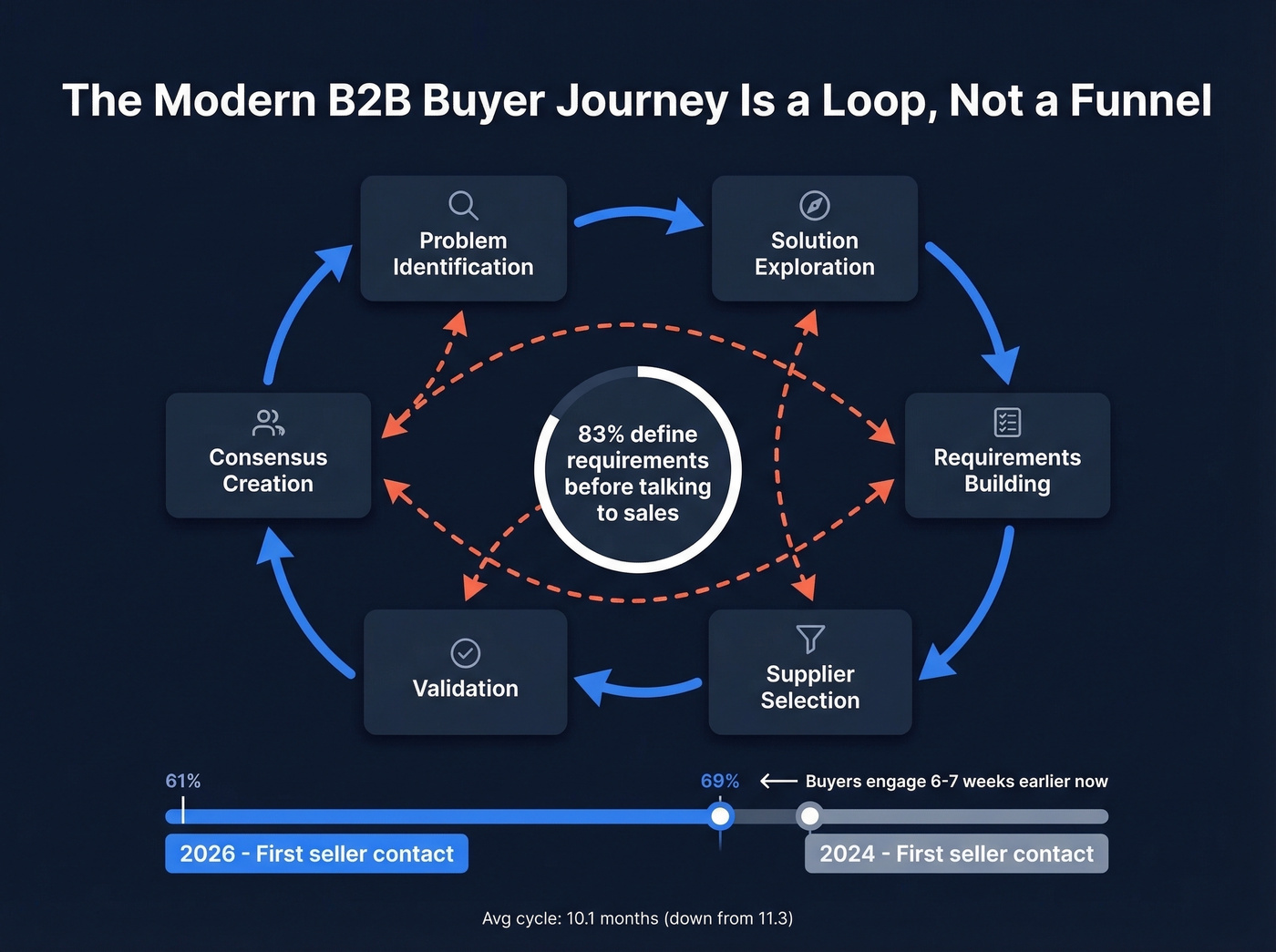
The 6sense 2026 Buyer Experience Report quantifies what this looping looks like. Buying cycles compressed from 11.3 months to 10.1 months between 2024 and 2026. The point of first contact with sellers shifted from 69% to 61% of the journey, meaning buyers are engaging roughly six to seven weeks earlier than they did a year ago.
But don't confuse earlier contact with earlier influence. 83% of buyers define their purchase requirements before speaking with sales. The pre-contact favorite wins roughly 80% of the time. A third of buyers spend 3-9 hours per month on research, with 23% spending 10-19 hours. The shift from linear to looping means sellers who only optimize for one stage miss the other five.
If you're not on the shortlist before outreach begins, you're fighting for the remaining 5%.
AI Is Rewriting the Discovery Phase
Your biggest competitor just got mentioned in a ChatGPT response. You didn't. The shortlist was set before the buyer ever saw your website.
That scenario plays out thousands of times a day. 29% of B2B decision-makers now start research via ChatGPT more often than Google, 94% use AI tools at some point during the purchasing process, and G2 reports AI search-driven leads convert 40% better than traditional search leads.
Google AI Overviews are accelerating this shift. 72% of buyers encountered AI Overviews during research, and 90% clicked at least one cited source - meaning the zero-click fear is overblown, but the curation of which sources appear is everything. If your content isn't structured for AI citation, you're invisible in the fastest-growing discovery channel. As the digital buyer's journey evolves, visibility in AI-generated answers matters as much as ranking on page one.
The AI layer also changes what buyers evaluate. 89% now purchase solutions with AI features baked in, forcing committees to assess AI impact on pricing, implementation complexity, and data security - evaluation steps that didn't exist two years ago.

95% of deals go to vendors already on the buyer's shortlist. You can't make that list if 40 of your 200 emails bounce and 80 hit the wrong person. Prospeo's 98% email accuracy and 7-day data refresh mean you reach real decision-makers while they're still researching - not after they've already chosen.
Stop losing deals to outdated data. Start reaching buyers who are actually in-market.
The Buying Committee Problem
An Inbox Insight survey of 800+ B2B buyers found that 80%+ of purchases involve four or more stakeholders, 29% involve 8-12, and 11% involve 20 or more. Meanwhile, G2's data shows software-specific committees are actually shrinking to 3-4 members - but with dramatically increased governance scrutiny. IT is now involved in nearly 50% of purchase decisions.
Smaller core committees, more gatekeepers. Consensus creation remains the hardest buying job. 86% of B2B purchases stall at some point, per Forrester. And even when deals close, 81% of buyers report dissatisfaction with the provider they chose.
Ask any SDR on r/sales and they'll tell you the same thing - the deal isn't dead, it's stuck waiting for a stakeholder you didn't know existed. In our experience, the teams that break through consensus limbo are the ones who arm their champion with the right content for every gatekeeper, not the ones who follow up harder.
What Today's Buyers Hate
They don't hate salespeople. They hate irrelevant salespeople. Here's what triggers the blocking and switching behavior:
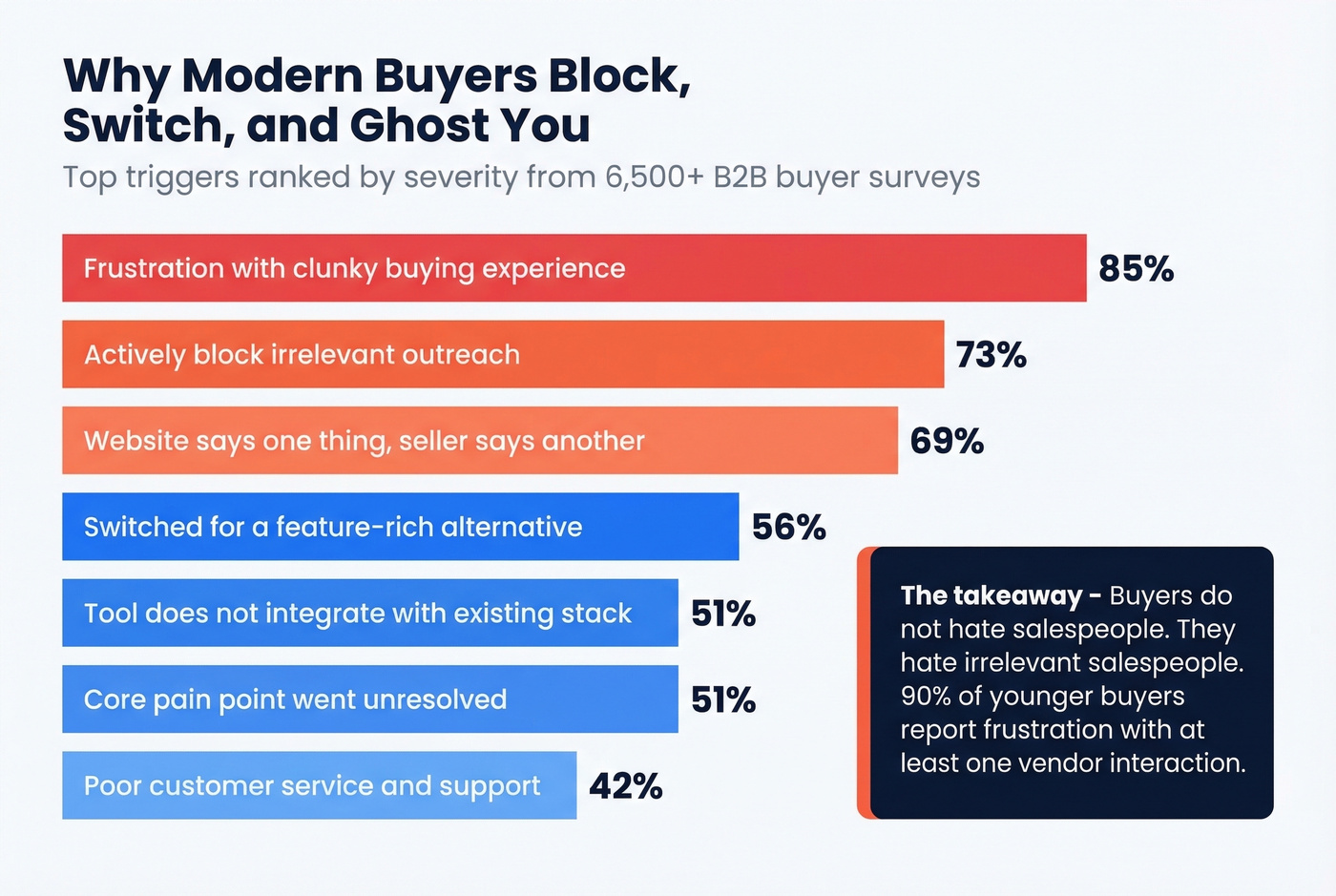
- Irrelevant outreach: 73% actively block or avoid suppliers who send messages that don't match their needs
- Inconsistent messaging: 69% report gaps between what the website says and what sellers tell them
- Feature gaps: 56% switch for a feature-rich alternative
- Poor integration: 51% leave because the tool doesn't work with their existing stack
- Unmet pain points: 51% switch because a core problem went unresolved
- Bad customer service: 42% cite poor support as the trigger
- Clunky buying experience: 85% report frustration with online ordering, and 75% would switch suppliers for a better experience
B2B buyer expectations are accelerating faster than most sellers can adapt. If your buying process is harder than your competitor's, you're losing deals you never even knew existed.
The Hybrid Advantage
Here's the contrarian take most articles get wrong: the narrative that buyers don't want to talk to you is half-true and fully dangerous.
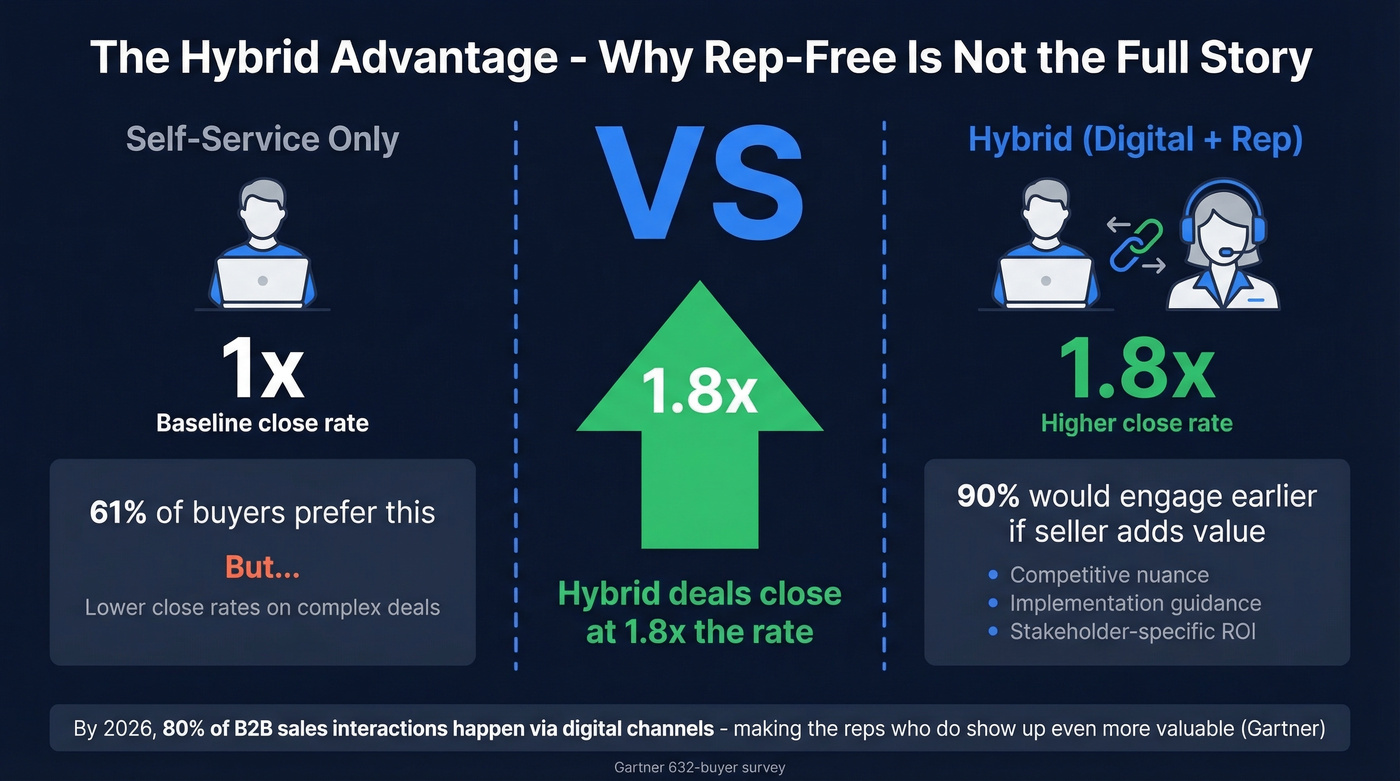
Yes, 61% prefer a rep-free experience. But hybrid deals - where buyers use digital tools in partnership with a rep - close at 1.8x the rate of purely self-service ones, per Gartner's 632-buyer survey. Gartner also predicts that by 2026, 80% of B2B sales interactions will occur via digital channels, which makes the reps who do show up even more valuable, not less.
Buyers want control over when they engage, not whether they engage. 90% would engage with sellers earlier if the seller provided enough value. The best buyer-seller digital interactions happen when the rep adds context that self-service can't - competitive nuance, implementation guidance, or stakeholder-specific ROI. The rep relationship still matters enormously. It just has to be earned through relevance, not forced through volume.
Let's be honest: if your deal size is under $25k, you probably don't need a 12-touch outbound sequence. You need three perfectly timed, perfectly relevant touches backed by verified data. More isn't better. Better is better.
How to Sell to the Modern Buyer
1. Get on the Day One shortlist. 95% of winning vendors are already there. Invest in content, brand visibility, and peer proof long before the buying cycle starts. 84% of B2B purchases start with a referral, and 85% of millennial buyers consult peer reviews before finalizing. Your brand needs to be in the conversation before the conversation starts.
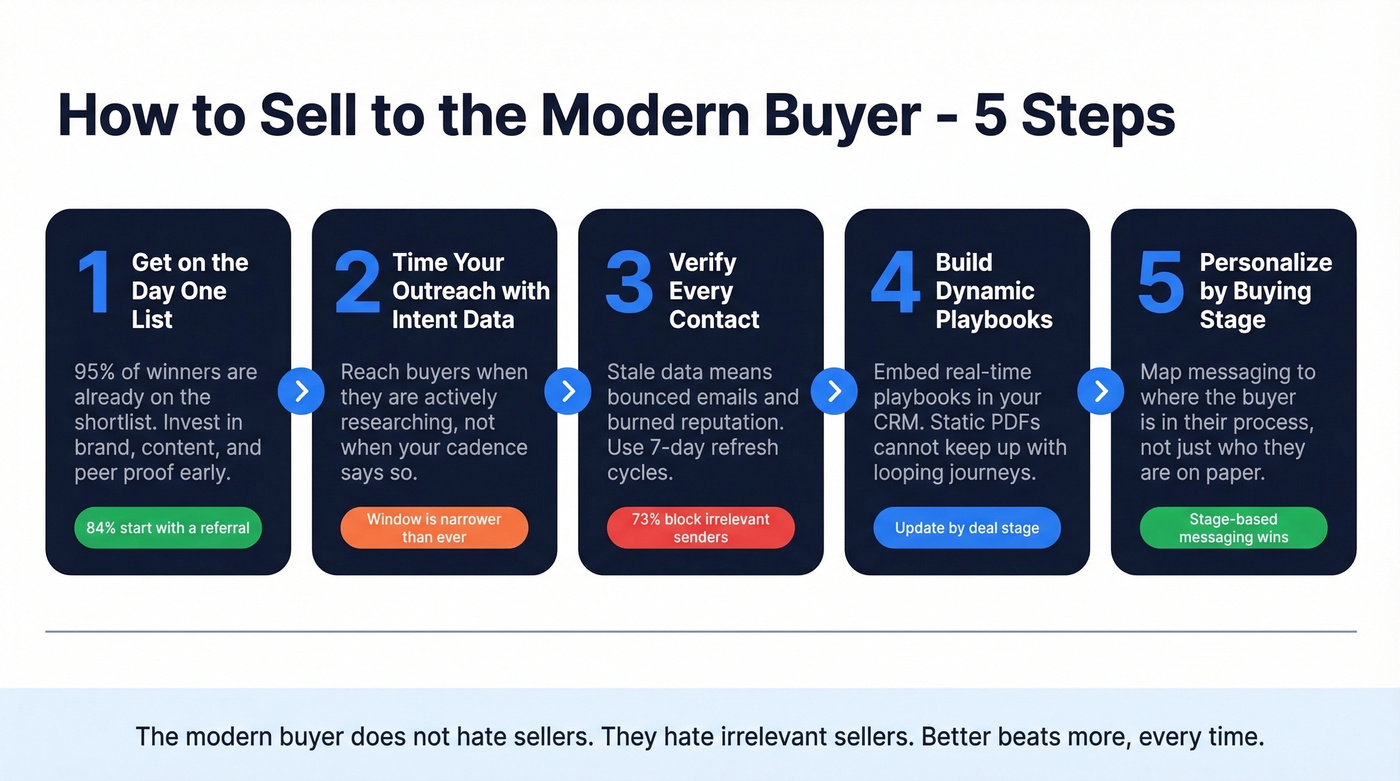
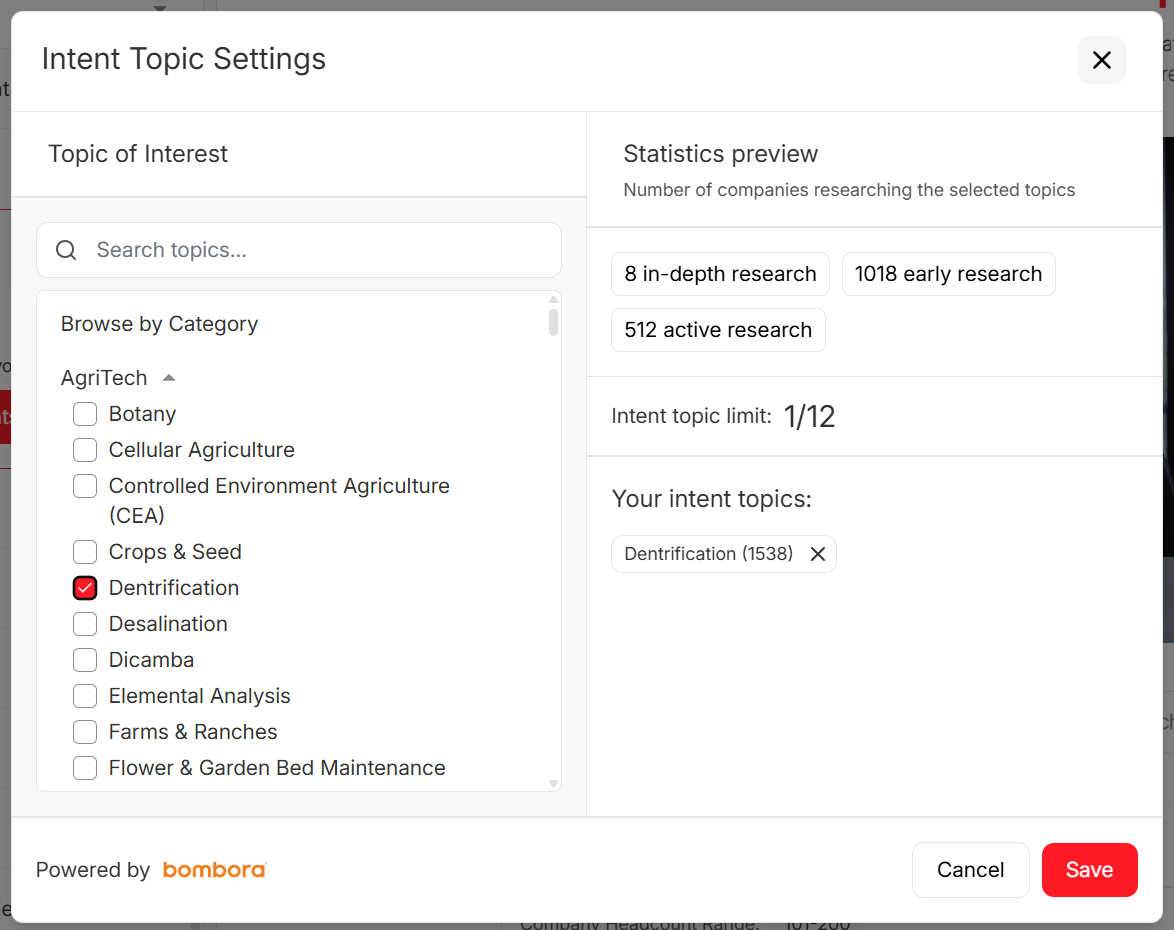
2. Use intent data to time outreach. Reaching buyers when they're actively researching - not when your cadence says so - is the difference between relevance and noise. The window for effective outreach is narrower than ever. Tools like Prospeo track buyer intent across 15,000 Bombora topics, layered with job change and headcount growth signals, so you can identify in-market accounts before they hit your inbound funnel.
3. Verify your contact data. If 73% of buyers block irrelevant outreach, stale data is a death sentence. We've seen teams cut bounce rates from 35% to under 4% just by switching to a platform with a 7-day data refresh cycle - the kind of improvement that compounds across every campaign you run. For benchmarks and fixes, see bounce rates and the full email deliverability stack.
4. Adopt dynamic playbooks. Static PDFs updated quarterly can't keep pace with a looping buying journey. Embed playbooks in your CRM with real-time updates and contextual personalization by deal stage. The modern sales playbook is an operating system, not a document. If you're building this into your process, start with sales process optimization and sequence management.
5. Personalize by buying stage. The same VP of Engineering needs different things during solution exploration than during consensus creation. Map your messaging to where the buyer is in their process, not just who they are on paper. Meet them in the digital channels they already prefer. Skip this step if you're selling a simple, low-ACV product - but for anything with a multi-stakeholder decision, stage-based messaging is non-negotiable. Use an ideal customer profile plus intent based segmentation to keep personalization scalable, and borrow proven sales prospecting techniques when you need new angles.
73% of modern buyers block vendors who send irrelevant messages. With 30+ filters - buyer intent, technographics, job changes, headcount growth - Prospeo lets you target the exact stakeholders on the buying committee, not just whoever's left in your stale CRM. At $0.01 per email, bad data is a choice.
Reach every stakeholder on the committee with verified contact data.
FAQ
What defines a modern B2B buyer?
A modern B2B buyer is typically a millennial - 73% of B2B buyers are - who uses AI tools like ChatGPT to research solutions before contacting any vendor. 95% of winning vendors are already on the buyer's Day One shortlist, which means sellers need to invest in brand visibility and content long before the first outreach.
Do buyers still want to talk to sales reps?
Yes, but on their terms. While 61% prefer a rep-free experience, hybrid deals close at 1.8x the rate of self-service alone. The rep who shows up with relevant context wins; the one with a generic pitch gets blocked by 73% of buyers.
How do you reach today's B2B buyers effectively?
Start with verified contact data - 73% of buyers block irrelevant outreach, so stale emails and wrong titles kill your chances before you say a word. Layer in intent data to time your outreach to active research windows, and personalize by buying stage rather than blasting the same message to everyone.
How is the B2B customer journey evolving?
The journey has shifted from a linear funnel to a looping, non-linear process where buyers revisit stages multiple times as new stakeholders weigh in. Cycles have compressed from 11.3 to 10.1 months, and 83% of buyers define requirements before ever contacting a vendor - making pre-contact visibility the most important investment a seller can make.