

The 20 Most Common Sales Objections - And What Top Reps Actually Say Back
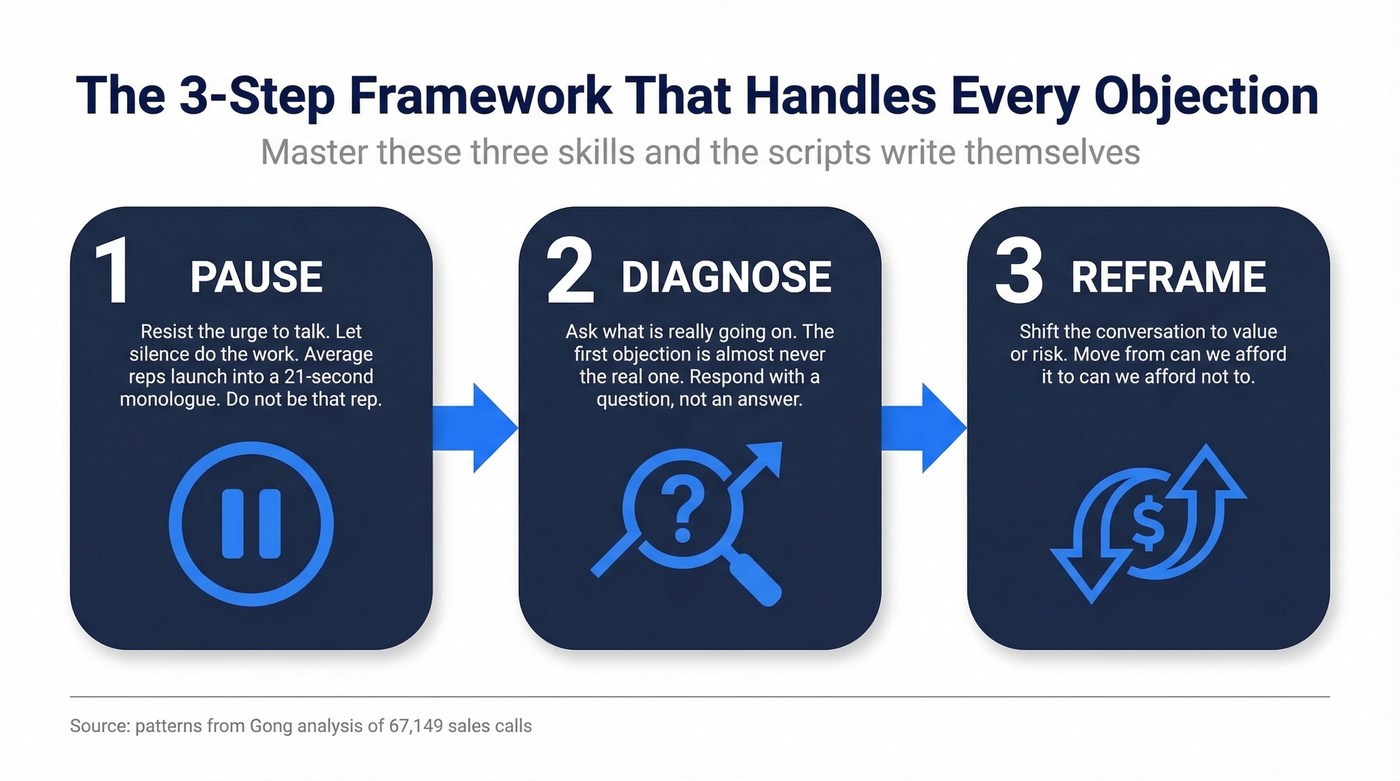
Every article about the most common sales objections gives you the same thing: a list of 44 scripted responses you'll never memorize, let alone use under pressure. Reps who close at rates as high as 64% don't do it by reading from a playbook. They've internalized three skills - and research across 67,149 sales calls proves exactly which skills those are.
Here's the stat that should bother you: after hearing an objection, the average rep launches into an uninterrupted 21.45-second monologue. Top reps do the opposite.
The Short Version
- Three skills handle every objection: pause (resist the urge to talk), diagnose (ask what's really going on), reframe (shift the conversation to value or risk). Master these and the scripts write themselves. Jump to the 20 objections → | What top reps do differently →
- The data backs this up. Gong analyzed 67,149 recorded demos and found top reps pause longer, maintain pace (173 WPM baseline vs. 188 WPM for struggling reps who speed up), and ask more questions after an objection.
- The single biggest mistake: treating the first objection as the real one. "It's too expensive" almost never means the price is actually the problem.
Objections vs. Brush-Offs
Not every "no" is an objection. Understanding the difference saves you from wasting energy on the wrong response.
An objection is a genuine concern. "We don't have budget until Q3" is an objection - there's a real constraint you can work with. A brush-off is a polite exit. "Just send me an email" on a cold call is almost never a request for information. It's a request for you to go away.
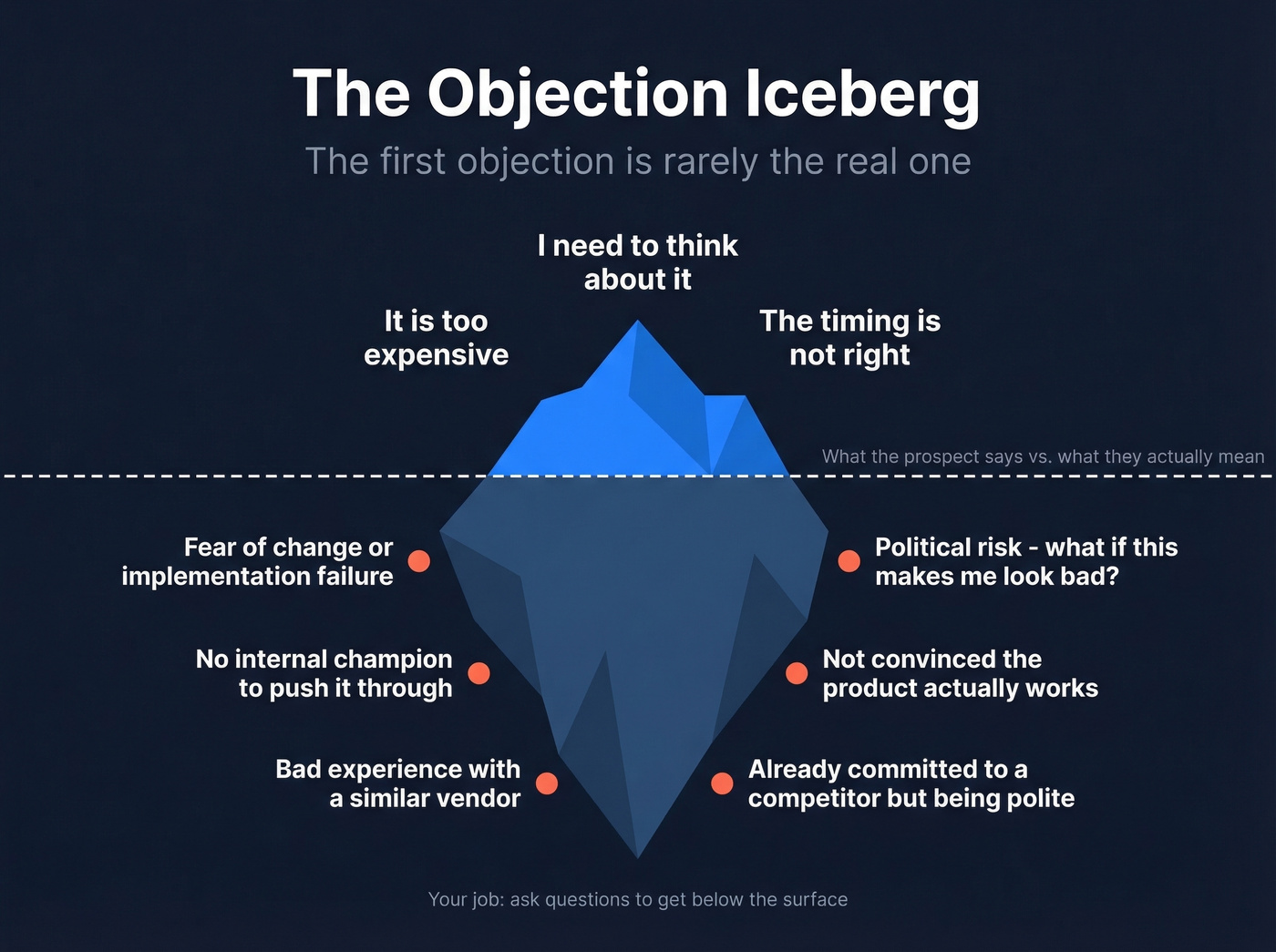
The first objection is rarely the real one. A prospect says "it's too expensive," and most reps sprint to justify pricing or offer a discount. But the real concern might be implementation fear, lack of internal buy-in, or doubt that the product actually works. Price is just the quickest thing to say.
Think of it like an iceberg. The surface objection - price, timing, "I need to think about it" - is the visible tip. Underneath sits the actual blocker: fear of change, political risk, a bad experience with a similar vendor. Your job isn't to answer the surface. It's to get below it.
The diagnostic move is simple. When you hear an objection, respond with a question, not an answer. "When you say it's too expensive, help me understand - is it the total cost, or is there a concern about whether you'd see the return?" That one question separates real objections from reflexive ones.
If you want more examples to train against, start with these examples of objections in sales and map them to your stages.
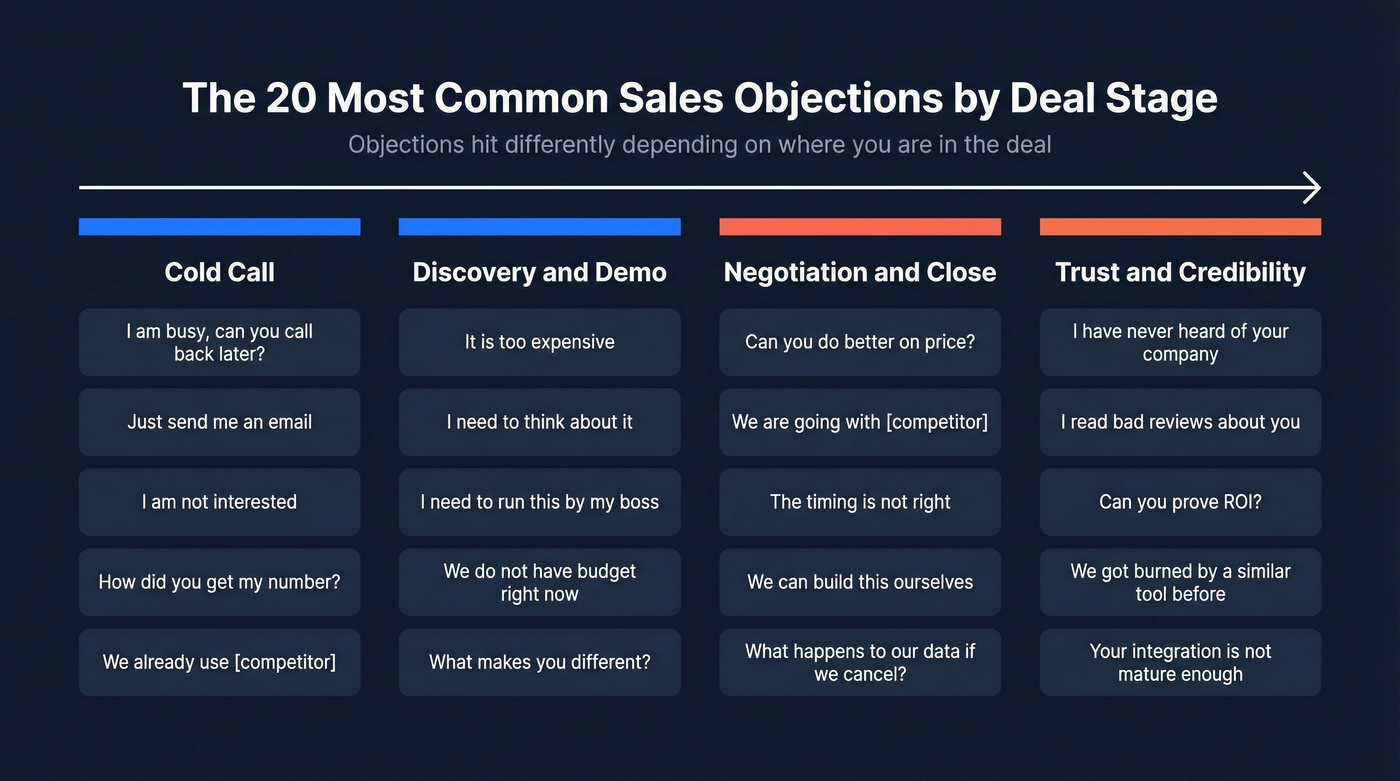
The 20 Objections Organized by Stage
Objections hit differently depending on where you are in the deal. A cold-call brush-off requires a completely different response than a negotiation-stage price push.
Cold Call Objections
"I'm busy / can you call back later?"
This is the most frequent cold-call pushback, and most reps fumble it by immediately offering to call back - which kills the conversation. The line that works, straight from r/sales: "I know I caught you cold - can I level with you briefly to see if it even makes sense to follow up?" It acknowledges the interruption and reframes the call as a quick filter, not a pitch. The OP of that thread says it moves the conversation forward about 80% of the time.
If you’re tightening your opener, these cold call questions help you earn the next 30 seconds.
"Just send me an email."
❌ Wrong response: "Sure, what's your email?" (You'll never hear back.)
✅ Right response: "Happy to. So I don't waste your time with a generic email, can I ask one quick question to make sure it's actually relevant to you?"
You're converting a dead-end into a micro-commitment. If they say no, you've lost nothing. If they say yes, you're in a conversation.
For the follow-through, use a proven cold calling follow up email instead of a generic recap.
"I'm not interested."
The worst response is arguing. The best is a ten-second reason and a permission ask: "Totally fair - most people aren't until they hear how [specific outcome] worked for [similar company]. Worth 30 seconds?" You're not fighting the objection. You're offering a low-cost reason to stay.
This lands best when you’re using buyer-focused selling instead of pitching features.
"How did you get my number?"
This one's increasingly common, and it's often a data-quality problem. If you're calling a verified direct dial from a platform like Prospeo, you can answer honestly: "Your number's in our business database - I'm reaching out because [specific reason tied to their role]." Confidence here matters. Stammering through this question signals you're spray-and-praying.
"We already use [competitor]."
Don't trash the competitor. Instead: "Good - that means you already see the value in solving this. Most of our customers used [competitor] before switching. What would need to be true for you to even consider an alternative?"
You're not asking them to switch. You're asking them to think about switching conditions - a much lower bar that keeps the conversation alive.
Discovery & Demo Objections
"It's too expensive."
The most frequent objection across all stages, and almost never about the actual price. Before you defend your pricing, diagnose: "Expensive compared to what? Your current solution, your budget, or what you expected?"
Each answer leads to a completely different conversation. Compared to current solution = ROI discussion. Compared to budget = business case discussion. Compared to expectations = packaging discussion.
If price pushback is a recurring pattern, keep a dedicated price objections playbook.
"I need to think about it."
Prospect: "I need to think about it." Rep: "Absolutely - what specifically do you want to think through? I might be able to help with that right now." Prospect: "Well, I'm not sure how we'd handle the migration." Rep: "That's the real question, isn't it? Let me walk you through exactly how that works."
See what happened? The "thinking" was never about thinking. It was about an unresolved fear. One question surfaced it.
"I need to run this by my boss."
This is often legitimate, not a stall. The move is to enable the internal sale: "Makes sense. What do you think their biggest concern will be? Let's build the case together so you're not doing this alone." You're turning the prospect into your champion.
If you’re building internal alignment, it helps to know what a sales champion looks like in practice.
"We don't have budget right now."
Budget objections are timing problems, not value problems. We've watched reps lose winnable deals by accepting this at face value and scheduling a "check back in Q3" call that never happens. The stronger move, adapted from a high-scoring r/sales thread: "Jordan, just so I'm clear - if this backlog compounds another quarter, what does that cost you operationally? ... If the answer is more than our annual contract, let's figure out the path to surface unplanned spend." You're shifting from "can we afford it" to "can we afford not to."
"What makes you different from [competitor]?"
Don't recite a feature list. Pick the one thing that matters most to their specific situation: "The biggest difference for someone in your role is [specific differentiator tied to their stated pain]. Want me to show you exactly how that works?" Generic differentiation is forgettable. Specific differentiation closes deals.
This is where consultative selling techniques outperform “feature dumping.”
Negotiation & Close Objections
"Can you do better on price?"
Every buyer asks this. Don't flinch, and don't discount immediately. "I can look at the structure - but help me understand what 'better' means for you. Is it the total annual cost, the per-seat price, or the payment terms?" Often the answer is terms, not total cost. And you can flex on terms without cutting margin.
If you want more structure here, borrow from these negotiation skills for sales.
"We're going with [competitor]."
Late-stage competitive loss hurts, but the deal isn't always dead. "I respect that. Can I ask - what tipped the decision? If it's [specific area], I'd love 10 minutes to show you something they can't match. If it's genuinely a better fit, I'll wish you well." Graceful persistence sometimes reopens doors.
"The timing isn't right."
Timing objections need a concrete anchor: "When would the timing be right? ... If we mapped out a start date of [their timeline], we could begin scoping now so you're not scrambling when the window opens." You're converting a vague stall into a scheduled next step.
A lightweight mutual action plan is often the easiest way to make timing real.
"We can build this ourselves."
The build-vs-buy objection is really about opportunity cost. "You absolutely could. The question is whether your engineering team's time is better spent on this or on [their core product]. Most teams we work with ran the math and realized building costs multiples more once you factor in maintenance."
"What happens to our data if we cancel?"
This is a trust objection disguised as a logistics question. Answer it directly: "Full export, standard formats, no hostage-taking. We'll walk you through the process before you even sign. Want me to send the data portability docs?"
Trust & Credibility Objections
"I've never heard of your company."
Fair. Don't get defensive. "That's expected - we're not spending heavily on brand ads. We're spending it on the product. Here's what [recognizable customer] said after switching from [known competitor]." Social proof carries the argument here.
"I read bad reviews about you."
❌ Wrong response: "Those aren't accurate." (Defensive. Increases resistance.)
✅ Right response: "Which ones? I want to know what you saw. Some of those are from older versions - we've rebuilt [specific area] since then. Happy to connect you with a current customer in your space."
Specificity beats defensiveness every time.
"Can you prove ROI?"
They're asking for a business case, not a testimonial. "Yes - let me build one with your numbers. What's your current [metric they care about]? I'll show you exactly what changes and by when." Co-created ROI beats a generic case study.
If you need a tighter way to quantify impact, use a simple sales ROI model.
"We got burned by a similar tool before."
This is emotional, not logical. Acknowledge it: "That's a real concern, and I'm not going to pretend it can't happen again. What specifically went wrong? I want to show you how our approach is structurally different on that exact point."
"Your integration with [tool] isn't mature enough."
Don't oversell. "You're right that it's not as deep as our [stronger integration]. Here's what it does today, here's what's on the roadmap next, and here's how customers bridge the gap in the meantime." Honesty on integration maturity builds more trust than vaporware promises.
What Top Reps Do Differently (67,149 Calls)
Gong's research across 67,149 recorded sales demos gives us the clearest picture of what separates reps who handle objections well from those who don't.
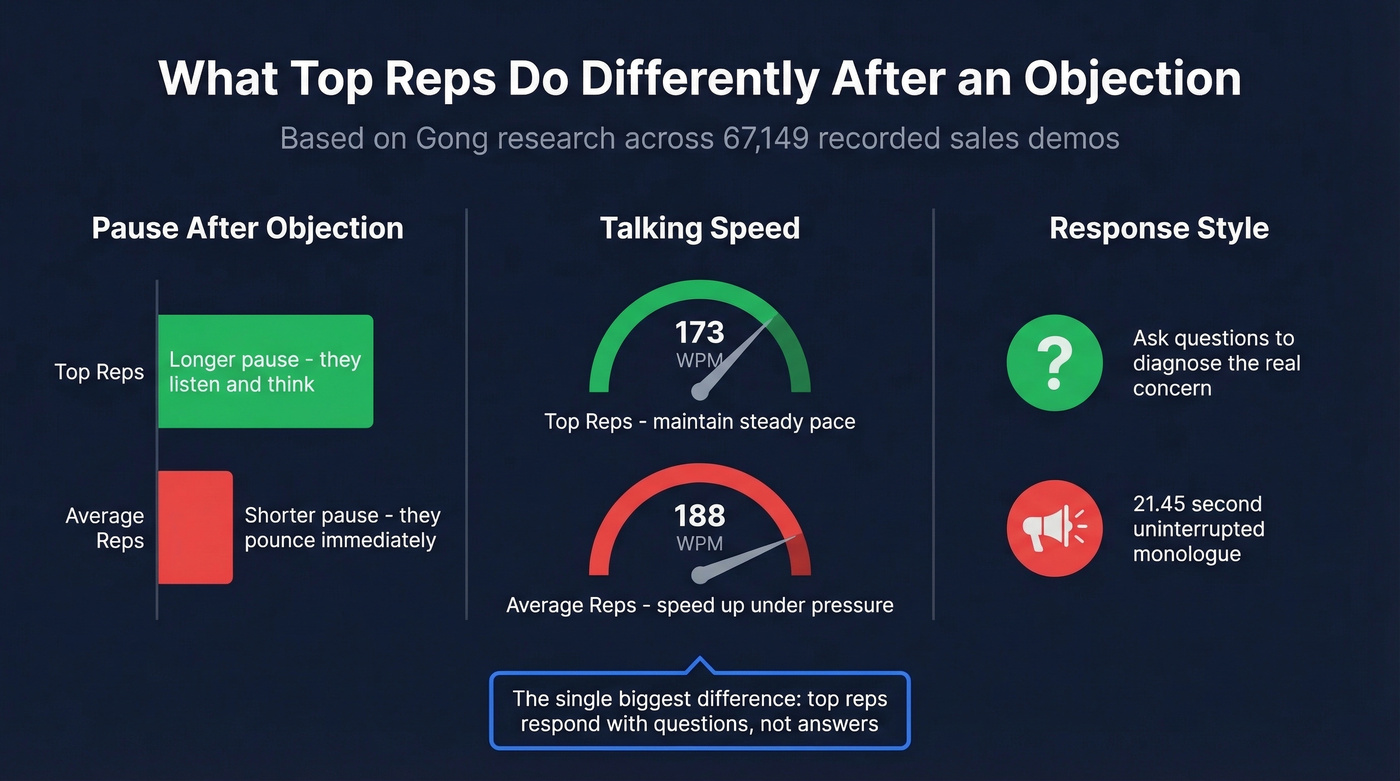
Top reps pause longer after an objection. Average reps do the opposite - their pause time actually drops, and they pounce with an immediate response. That instinct to fill the silence is the single most damaging habit in sales conversations. The pause gives you time to think and signals to the prospect that you're actually listening.
The baseline talking speed in a typical sales conversation is 173 words per minute. When flustered by an objection, lower-performing reps accelerate to 188 WPM. Top reps hold their pace. That 15 WPM difference is audible - it sounds like nervousness, and prospects pick up on it instantly.
The knee-jerk monologue is real - and measurable. After hearing an objection, average reps launch into an uninterrupted 21.45-second monologue. That's a lot of talking without checking whether you're even addressing the right concern. Top reps keep the conversation as a back-and-forth, maintaining speaker switches rather than lecturing.
They also close the loop. After addressing an objection, they ask "Does that make sense?" - not as filler, but as a genuine check. This phrase appears significantly more often during objection moments, agenda setting, and next-step discussions among high performers. And they clarify before they answer. Instead of assuming they know what the objection means, top reps ask a question first. Mirroring - repeating the prospect's last few words with an upward tone - is one of the most effective techniques. The data explicitly warns against asking "why," which can feel interrogative and put buyers on the defensive.

"How did you get my number?" is the one objection you can eliminate entirely. Prospeo gives you 125M+ verified direct dials with a 30% pickup rate - so you answer with confidence, not stammering.
Stop spray-and-praying. Start dialing verified numbers.
5 Mistakes That Make Objections Worse
1. Treating the first objection as the real one. When a prospect says "it's too expensive" and you immediately launch into ROI math, you're probably solving the wrong problem. The first objection is often a quick exit, not the real concern. Diagnose before you prescribe.
2. Rushing to respond. That 21.45-second monologue happens because reps feel pressure to have an answer immediately. Silence feels dangerous. It isn't. A two-second pause after an objection signals confidence and gives you time to formulate a real response instead of a reflexive one.
3. Asking "why." It seems like a natural follow-up - "Why do you feel that way?" - but it puts prospects on the defensive. It sounds like a challenge. Replace it with "help me understand" or mirror their words back. Same diagnostic intent, completely different emotional register.
4. Offering discounts too soon. We've watched reps cut price unprompted in the first five minutes of a negotiation call. The moment you discount without being asked, you've told the prospect your product wasn't worth what you quoted. Hold your price until you've fully diagnosed the objection. Often, the real concern isn't cost at all.
5. Getting defensive. When a prospect says "I read bad reviews," the worst response is "those aren't accurate." Defensiveness increases resistance and undoes whatever rapport you've built. Lean into the concern, ask for specifics, and address them directly. Arguing turns a conversation into a debate - and nobody buys from someone they're debating.
Which Framework Fits Your Sales Motion?
There's no shortage of frameworks. The question isn't which one is "best" - it's which one matches how you sell.
| Framework | Core Mechanic | Best For | Research Basis | Limitation |
|---|---|---|---|---|
| LAER | Listen, Acknowledge, Explore, Respond | General B2B (most versatile) | Practitioner-developed | Less structured for complex deals |
| SPIN | Situation → Problem → Implication → Need-Payoff | Long-cycle consultative | 35,000+ calls, 12 years | Slow for high-velocity sales |
| Challenger | Teach, Tailor, Take Control | Complex / disruptive solutions | 6,000+ reps studied | Requires deep industry knowledge |
| NEAT | Need, Economic Impact, Access to Authority, Timeline | Modern qualification + objection handling | Practitioner methodology | Less known, fewer training resources |
| Feel-Felt-Found | Empathize, normalize, redirect | Transactional / SMB only | Anecdotal / training lore | Patronizing in enterprise B2B |
| Sandler Reverse | Reverse psychology questions | Prospects who resist direct selling | Practitioner methodology | Can feel manipulative if overused |
BANT still gets mentioned everywhere, but it's a triage framework, not an objection-handling one. Use it to qualify inbound leads quickly. NEAT is its modern replacement - it starts with the buyer's need rather than your qualification checklist, which makes it far better for navigating pushback mid-conversation.
Here's the thing: Feel-Felt-Found is the framework most reps learn first, and it works fine for straightforward, lower-ticket sales. But try "I understand how you feel. Other customers felt the same way. What they found was..." on a VP of Engineering evaluating a $200k platform and watch their eyes glaze over. For enterprise deals, SPIN or Challenger gives you the depth you need. MEDDIC/MEDDPICC is also worth knowing if your team uses AI-powered CRM workflows - its structured fields map cleanly to automated deal scoring and pipeline analytics.
If you want real dialogue (not theory) for that approach, use these Challenger sales model examples.
LAER is the most versatile for most B2B reps. It's simple enough to internalize and flexible enough to adapt across stages. We've seen teams get the best results using LAER as the foundation and layering in Challenger techniques for enterprise accounts.
SaaS-Specific Objections Most Guides Miss
Generic objection lists skip the pushback that's specific to software sales. These four come up constantly in SaaS deals and rarely appear in standard training.
"Your uptime SLA isn't good enough." This is a procurement objection, not a product objection. The buyer's legal or IT team flagged it. Ask: "What SLA threshold does your team require? Let me pull our actual uptime data for the last 12 months - it's usually stronger than the contractual floor." Real performance data beats contractual language.
"We need SOC 2 / GDPR / [compliance] certification." Don't treat this as a blocker - treat it as a checkbox. "We're [certified/in process]. Here's the report. Who on your side needs to review it? I'll send it directly so it doesn't bottleneck with you." Remove friction by routing the document to the right person.
"We just signed with a competitor." This isn't a dead end - it's a timing signal. "When does that contract come up for renewal? Let's connect 90 days before so you can compare results." Plant the seed and move on.
"What's your roadmap for [feature]?" They're asking whether you'll solve a future problem. Be honest without overpromising: "That's on our roadmap for [quarter]. I can connect you with our product team if you want to influence the spec. In the meantime, here's how current customers handle it." Transparency plus a workaround beats a vague "it's coming soon."
How to Practice - 3 Drills for This Week
Knowing how to handle objections intellectually and doing it under pressure are completely different skills. Three exercises you can run this week:
1. Triad roleplay with back-to-back phone simulation. Form groups of three: a salesperson, a skeptical prospect, and a judge. Run three rounds, rotating roles. The twist that makes this realistic - the salesperson and prospect stand back-to-back so they can't read body language, just like a real phone call. The judge scores on pause length, question quality, and whether the rep diagnosed before responding.
2. AI roleplay for solo practice. AI-powered roleplay tools are increasingly common. As Visa University's Niyati Parikh put it, leaders are busy - one to two hours in live roleplays isn't scalable. AI tools give reps real-time feedback on pacing, question quality, and objection responses without needing a manager in the room.
If you’re evaluating tools for this, start with these sales coaching apps.
3. Call recording review. Pull three recent calls where objections came up. For each one, ask: Did the rep pause or pounce? Did they ask a question or launch into a monologue? Did they diagnose the real objection or answer the surface one? This takes 20 minutes and teaches more than an hour of theory.
The Preparation Edge
Let's be honest: the best objection handling is objection prevention. Half the resistance on a cold call - "How did you get my number?", "I'm not the right person," "Who is this?" - exists because the rep called the wrong person at a wrong number with no context.
Reps spend just 28% of their week actually selling. The rest goes to admin, research, and fixing bad data. And 96% of prospects research your company before engaging - so by the time you call, they already have opinions. You'd better be calling the right person with a relevant reason.
This is where data quality becomes an objection-handling strategy. When our team tested outbound sequences using Prospeo's verified mobile numbers, the "how did you get my number?" objection dropped dramatically - because the data was current (refreshed on a 7-day cycle) and verified, not scraped six months ago from a stale database. Skip this step if you enjoy burning through call lists where half the numbers are dead.
If you’re systematizing this, look at sales process automation tools that reduce admin drag and keep outreach consistent.

Every objection in this article assumes you're talking to the right person. Bad data means you never get that far - your emails bounce, your calls hit dead lines, and your pipeline stalls. Prospeo's 98% email accuracy and 7-day data refresh ensure every conversation starts with a real decision-maker.
Fix your data before you fix your objection handling.
FAQ
What are the 7 most common sales objections?
The top seven are: "It's too expensive," "I need to think about it," "I need to run this by my boss," "We don't have budget," "We already use [competitor]," "I'm not interested," and "The timing isn't right." Each requires a different response, but the core technique is identical - pause, diagnose the real concern with a question, then reframe around value or risk.
What's the single most frequent objection?
Price and budget objections appear most often across all deal stages, but they're rarely the real concern. "It's too expensive" typically masks unestablished value, implementation fear, or lack of internal buy-in. Diagnose what's underneath before defending your pricing.
How do I reduce the number of objections I get?
Better preparation eliminates objections before they happen. Using verified contact data removes "wrong person" and "how did you get my number?" pushback entirely. Researching the prospect's company, tech stack, and recent triggers before calling cuts objection volume significantly.
Do objection-handling frameworks actually work?
Yes, when matched to your sales motion. LAER works for most B2B reps as a versatile default. SPIN suits long-cycle enterprise deals with multiple stakeholders. Feel-Felt-Found handles transactional sales but falls apart in complex B2B. Pick one, internalize it through roleplay, and adapt from there.
What's the difference between an objection and a brush-off?
An objection signals a genuine concern worth addressing - it's a buying signal wrapped in resistance. A brush-off like "just send me an email" is a polite exit requiring a pattern interrupt, not a detailed response. Treating brush-offs as real objections wastes time and makes you sound tone-deaf.