

How to Handle Price Objections: Scripts, Frameworks, and Email Templates
Price objections show up in a huge share of late-stage B2B deals, and most reps handle them the same wrong way: they panic, discount, or feature-dump. You've read ten articles that all say "sell value, not price." But what do you actually say when procurement emails you at 4:47 PM on a Friday asking you to "sharpen your pencil"?
That's the gap most sales content leaves wide open. Here's how to handle price objections with data, scripts, and templates you can steal today.
The Short Version
Most price objections aren't about price. They're about certainty - the buyer isn't sure your solution delivers enough value to justify the spend. Until you diagnose which type of uncertainty you're dealing with, no script saves you.
You need three responses, not fourteen. One for budget issues, one for value gaps, one for competitive comparisons. Stop memorizing a dozen clever comebacks and master three.
Prevention beats reaction. Gong's data shows top reps introduce pricing at the 40-49 minute mark after building value. If you're fielding pricing pushback constantly, the problem is upstream - your discovery, your data, or your timing.
Why Buyers Actually Object on Price
Price objections feel personal, but they're almost never about the number on the page. Most frameworks break the drivers into three categories - not enough perceived value, weak urgency, and no budget - but in our experience there's a fourth that shows up constantly in enterprise deals: internal justification.
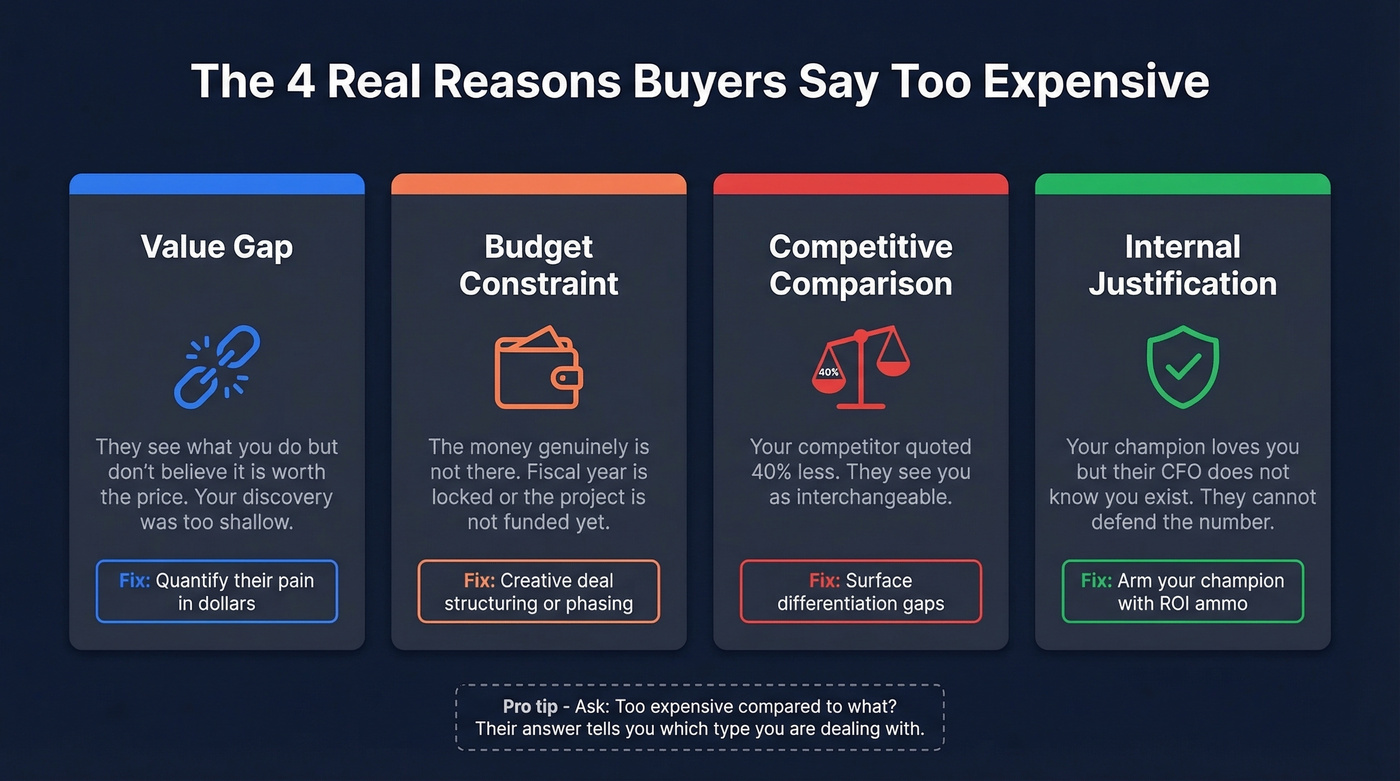
Value Gap. The buyer sees what you do but doesn't believe it's worth $45K. This means your discovery was too shallow - you didn't connect your solution to a specific, quantified pain they feel every day. (If you want to tighten this upstream, start with better discovery.)
Budget Constraint. The money genuinely isn't there. The fiscal year is locked, the department got cut, or the project isn't funded yet. Easiest to diagnose, hardest to overcome without creative deal structuring.
Competitive Comparison. "Your competitor quoted us 40% less." This is really about differentiation. If the buyer sees you and a competitor as interchangeable, the cheaper option wins every time. (This is where sales battle cards help.)
Internal Justification. Your champion loves you. Their CFO doesn't know you exist. The objection sounds like "it's too expensive," but what they're really saying is "I can't defend this number in a budget review." This requires arming your champion with ROI ammunition, not giving them a discount.
The consensus on r/sales reinforces this: pricing objections signal a lack of certainty - about value, ROI, or whether you understand their pain. Fix the certainty gap and the price conversation changes entirely.
What the Data Says
Gong analyzed over 25,000 B2B sales conversations and found patterns that should reshape how you approach pricing discussions.
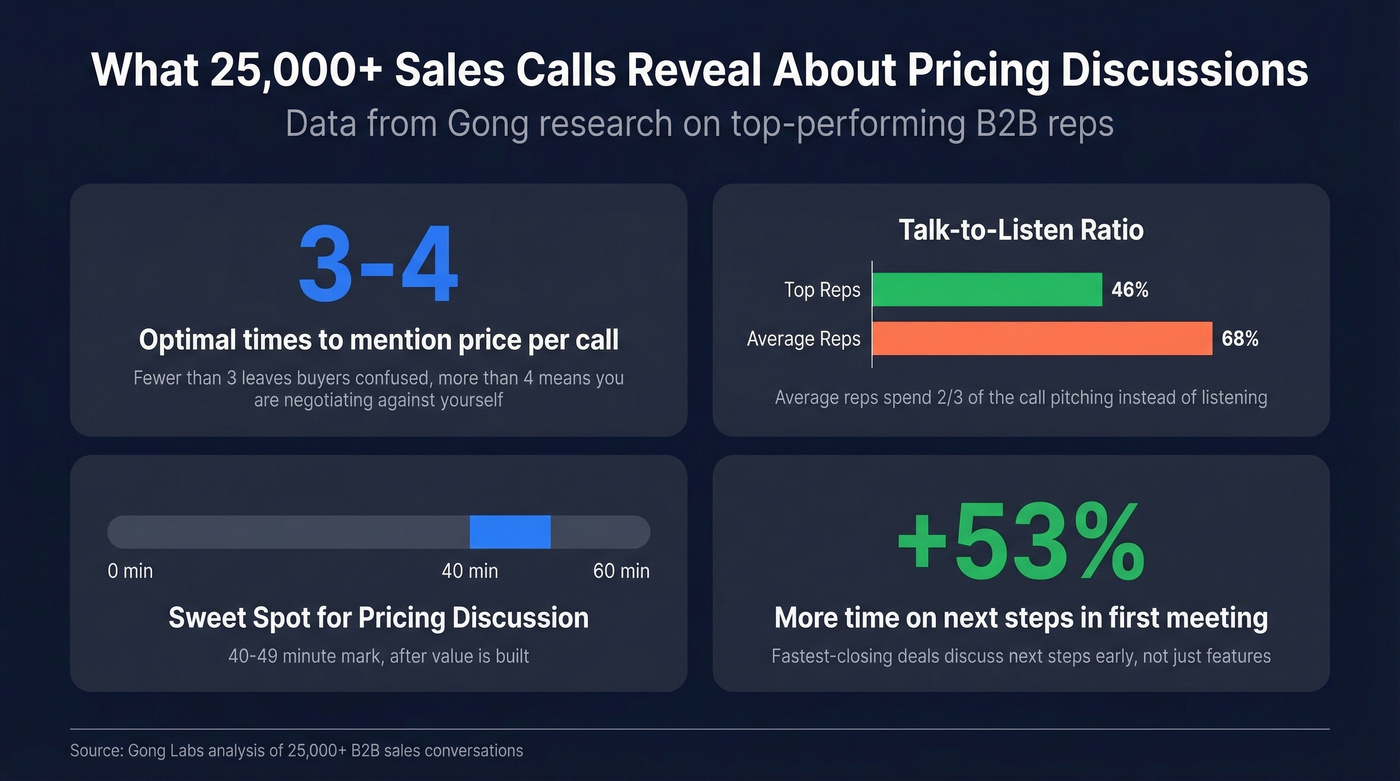
The sweet spot for mentioning price is 3-4 times per call. Fewer than three and the buyer leaves without clarity; more than four and you're negotiating against yourself. Top performers cluster pricing discussion at the 40-49 minute mark - after they've built value, not before.
Here's the thing: top reps talk about 46% of the time. Average reps? They're up in the high 60s, spending two-thirds of the call pitching instead of listening. That's feature-dumping - the fastest way to trigger pushback on cost because the buyer hears price without context. Meanwhile, the fastest-closing deals spent 53% more time discussing next steps in the first meeting, which tells you that better-structured calls don't just prevent objections but accelerate the entire pipeline. (If your pipeline is stalling, audit your sales pipeline challenges.)
One more stat worth internalizing: opening a cold call with "Did I catch you at a bad time?" drops your meeting-booking success by 40%. Opening with "How have you been?" produced a 6.6x higher success rate. If you're starting conversations on the wrong foot, you'll never get to a productive pricing discussion. (More on handling pushback early: cold call rejection.)
Preventing Pricing Pushback Before It Starts
The best price objection is the one that never surfaces. Prevention isn't a soft skill - it's a sequence of deliberate steps.
The Strategic Delay Checklist
Before you discuss pricing, confirm four things:
- Deep discovery is complete. You understand their pain, their metrics, and their cost of inaction.
- A business case exists. The buyer can articulate why solving this problem matters in dollar terms.
- The decision-maker is aligned. Don't talk price with someone who can't approve it.
- Executive sponsorship is secured. Someone with budget authority knows this deal is in motion.
If a prospect pushes for pricing before you've hit these milestones, give a wide range rather than a precise number. A range signals transparency without anchoring you too early.
Qualify Budget Early
Sandler's approach is direct: ask "Is this project funded?" or "Is there a budget range you're shooting for?" early in discovery. These questions feel blunt on paper, but in practice they save everyone time. If there's no budget, you know immediately - and you can either help them build a case internally or move on.
Fix Your Prospect Data First

Budget qualification only works if you're talking to someone with budget authority in the first place. Stale data means bounced emails, disconnected numbers, and conversations with people who lack purchasing power. When you finally reach a mid-level manager with no budget, "too expensive" is the polite way of saying "I can't approve this."
We've seen this play out repeatedly: teams that clean up their contact data before running outbound campaigns face fewer pricing objections because they're reaching the right people. Prospeo verifies emails in real-time with 98% accuracy and refreshes contact data every 7 days, so reps spend time with actual decision-makers instead of gatekeepers. Meritt saw their bounce rate drop from 35% to under 4% - and their pipeline tripled from $100K to $300K per week. (If you're fixing list quality, start with data enrichment services and email bounce rate benchmarks.)

Most price objections happen because reps never reached a budget holder. Prospeo's 300M+ profiles with 30+ filters - including seniority, department, and funding signals - put you in front of decision-makers who can actually say yes. Data refreshes every 7 days so you're never pitching someone who moved on.
Stop hearing 'too expensive' from people who can't approve anything.
Frameworks and Scripts That Work
The ACAC Framework (Best for Live Calls)
ACAC stands for Acknowledge, Clarify, Address, Confirm. It's the cleanest framework we've found for responding to pricing concerns in real time.
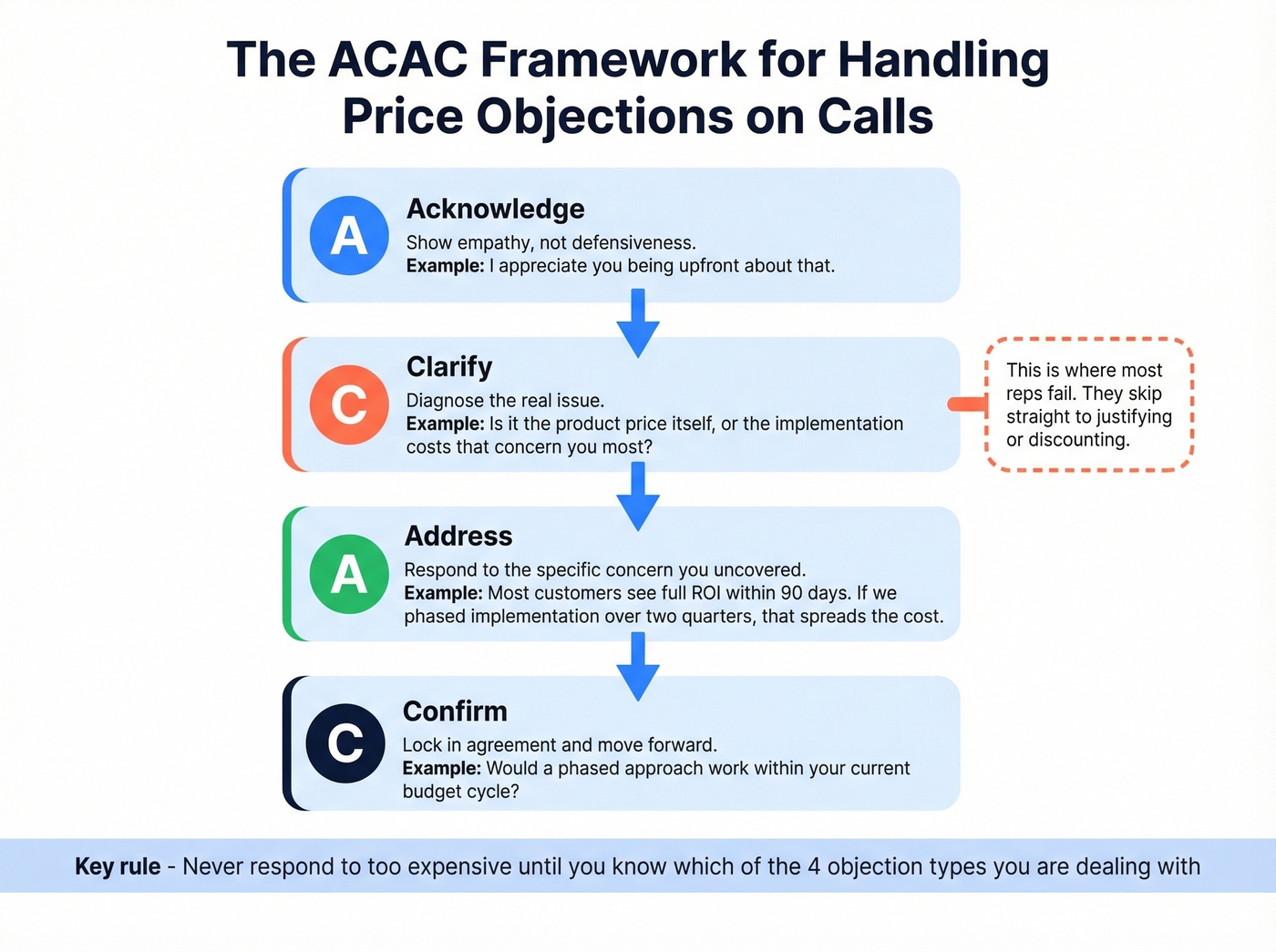
Prospect: "Honestly, this is more than we budgeted for."
You (Acknowledge): "I appreciate you being upfront about that."
You (Clarify): "Help me understand - is it the product price itself, or the implementation costs that concern you most?"
Prospect: "It's the total first-year cost."
You (Address): "Most of our customers see full ROI within 90 days. If we phased implementation over two quarters, that spreads the cost and gives your team more adoption time."
You (Confirm): "Would a phased approach work within your current budget cycle?"
The Clarify step is where a lot of reps fail. They hear "too expensive" and immediately start justifying or discounting. But "too expensive" can mean five different things, and you need to know which one before you respond.
Scripts for Budget Objections
When the issue is genuinely about money, think of it as a decision tree.
Start with: "If budget wasn't an issue, would this be the right fit?"
- If they say yes - the problem is financial. Explore phasing, payment terms, or a smaller initial scope.
- If they hesitate - it's not really about budget. Pivot to a value conversation.
If it's confirmed financial: "Is there a budget range you're comfortable with? I'd rather right-size the solution than lose you over a number." This invites collaboration instead of confrontation. You're not discounting - you're scoping.
Scripts for Value-Gap Objections
Picture this: your prospect just told you $45K is too much. Instead of listing features, you ask one question.
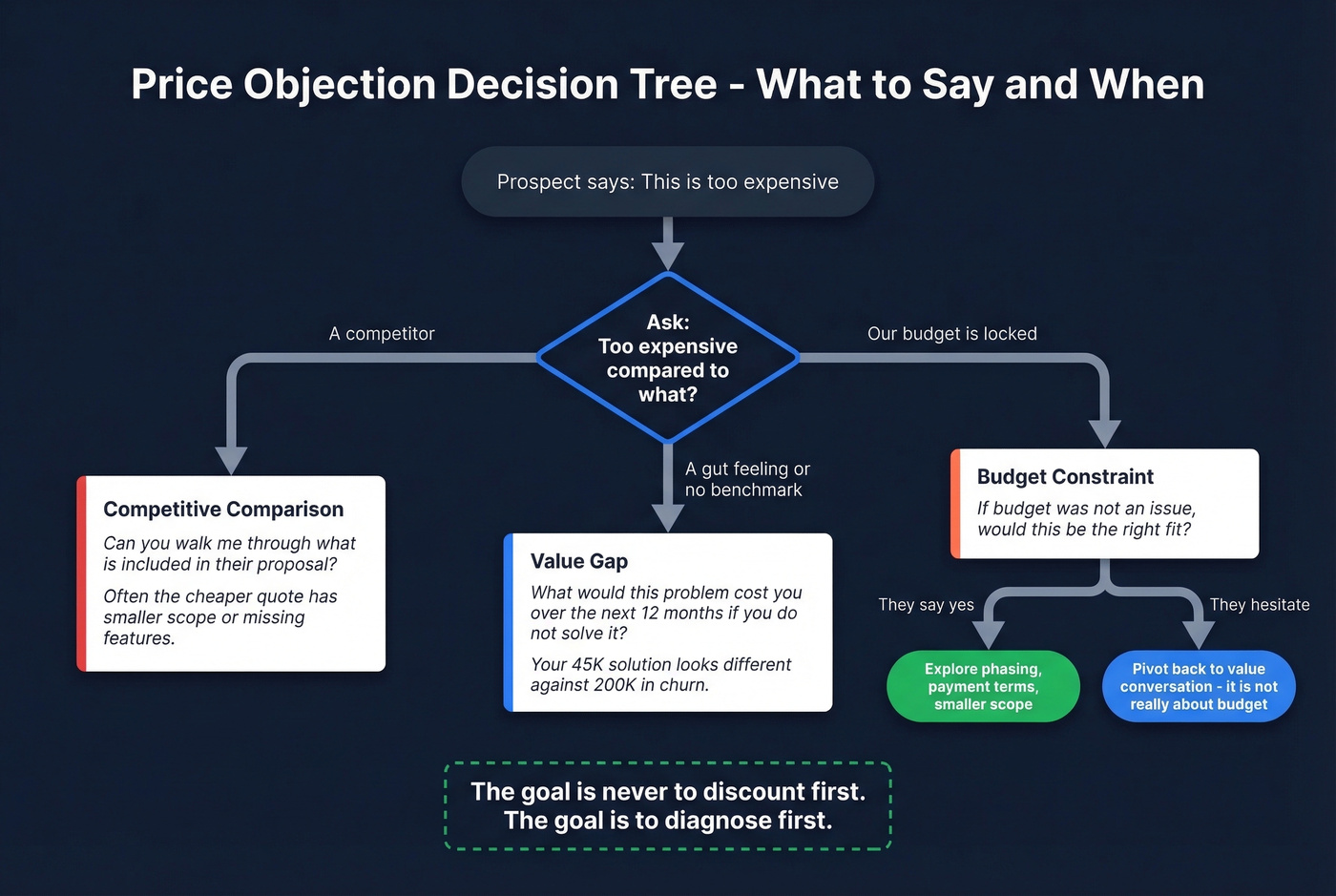
"Too expensive compared to what?"
That's the single most powerful question in pricing discussions. It forces the buyer to articulate their benchmark - a competitor, an internal solution, or just a gut feeling. Each answer requires a different response.
Then follow with: "What would this problem cost you over the next 12 months if you don't solve it?" Your $45K solution looks different when it's preventing $200K in churn. One Reddit practitioner put it perfectly: "$1,500/month sounds expensive until you realize it saves $10,000/month in churn. That's a 6x ROI." (If you need a tighter way to frame value, use a how to add value in sales structure.)
Scripts for Competitive Comparisons
"That's helpful to know. Can you walk me through what's included in their proposal?" Often, the cheaper quote has a smaller scope, fewer seats, or missing features the buyer actually needs. Let them discover that gap themselves rather than telling them they're wrong.
When to Walk Away
Look, not all business is good business. If you've completed discovery, presented a strong business case, and the buyer still wants a 40% discount, walk. Discounting signals you weren't fully behind your price - and it trains the buyer to push harder next time.
If you're giving double-digit discounts regularly, you don't have a pricing problem. You have a discovery problem. Fix your qualification process before you touch your price sheet. (To formalize this, define your walk away point negotiation.)
Overcoming Price Objections Over Email
Email objections are trickier because you can't read tone. One diagnostic question handles both absolute and relative objections: "Is it the investment itself, or whether the return justifies it?"
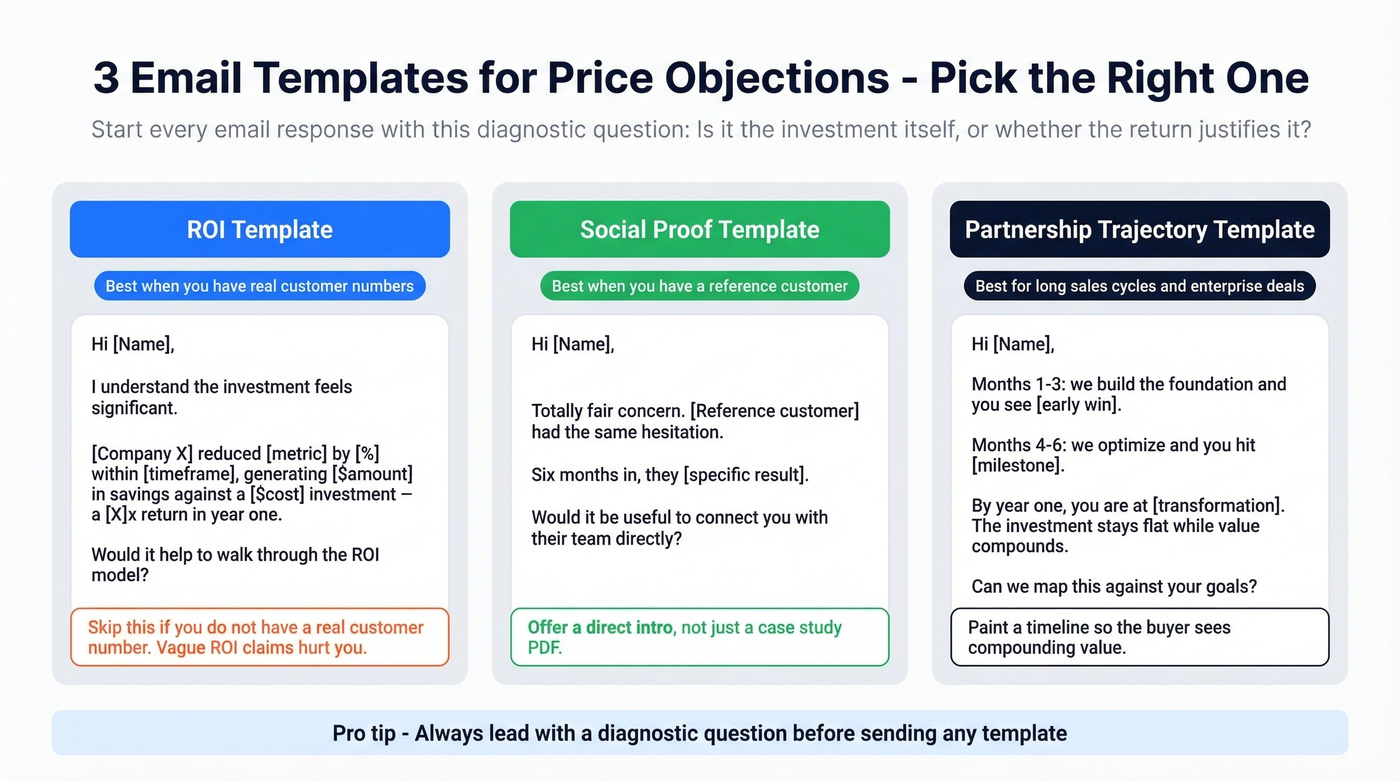
Here are three templates you can use immediately. (If you want more reply-driving options, pull from these sales follow-up templates.)
The ROI Template
Hi [Name],
I understand the investment feels significant. [Company X] reduced [specific metric] by [%] within [timeframe], generating [$amount] in savings against a [$cost] annual investment - a [X]x return in year one.
Would it help to walk through the ROI model we built for companies like yours?
The Social Proof Template
Hi [Name],
Totally fair concern. [Reference customer] had the same hesitation. Six months in, they [specific result]. Would it be useful to connect you with their team directly?
The Partnership Trajectory Template
Hi [Name],
Months 1-3: we build the foundation and you see [early win]. Months 4-6: we optimize and you hit [milestone]. By year one, you're at [transformation outcome]. The investment stays flat while the value compounds.
Can we map this out against your specific goals?
Skip the ROI template if you don't have a real customer number to plug in. Vague ROI claims ("significant savings") do more harm than good - they sound like every other vendor email in the buyer's inbox.
The Psychology Behind Pricing
Harvard's Program on Negotiation has published extensively on anchoring, and the findings translate directly to sales conversations. The first number spoken in a negotiation becomes the anchor around which everything else orbits. If the buyer anchors first with a lowball, you're negotiating upward from their frame. If you anchor first with a credible number, they're negotiating downward from yours. (For a deeper breakdown, see anchor in negotiation.)
Two tactical applications worth knowing. Loschelder et al. (2017) found that precise numerical anchors outperform round numbers - quoting $12,847 instead of $13,000 signals the price is calculated, not arbitrary, and leads to smaller counteroffers. Ames & Mason (2015) showed that range offers like "between $45K and $52K" claim more value while signaling flexibility. Use ranges when you want to appear collaborative; use precise numbers when you want to appear firm.
Anchor at the favorable end of the zone of possible agreement, use precise numbers, and never let the buyer set the first anchor.
Three Mistakes That Make It Worse
Discounting reflexively. You quote $12,800, the buyer pushes back, and you immediately offer $10,000. You've just created a credibility gap. Either the first price was inflated or the second solution is inadequate. Neither interpretation helps you.
Feature-dumping instead of diagnosing. When a buyer says "too expensive," the instinct is to list every feature that justifies the price. But if you're already talking 65% of the call, adding more talk time makes it worse. The single most underrated skill in sales is shutting up after the buyer objects. Let the silence work.
Pitching the wrong people. Bad prospect data leads to unqualified conversations, and unqualified conversations guarantee pricing pushback. Even verifying 75 emails/month with Prospeo's free tier can cut bounce rates enough to redirect rep hours toward real buyers. (If you want a system to reduce this across the funnel, use how to reduce sales objection rate.)
Meritt cut their bounce rate from 35% to under 4% and tripled pipeline to $300K/week. When your emails actually land with the right buyers, you spend calls building value - not defending price. Prospeo delivers 98% email accuracy at $0.01/lead.
Fix your data upstream and watch pricing objections disappear downstream.
FAQ
What's the best response to "your price is too high"?
Ask "too expensive compared to what?" This forces the buyer to reveal the real issue - budget constraint, competitor quote, or value gap - so you can respond specifically instead of guessing. Diagnose first, then respond with the matching script.
Should you discuss pricing early in sales calls?
Gong's data shows top reps introduce pricing at the 40-49 minute mark after building value. Delay until discovery is complete, but if asked directly, give a wide range and redirect to their priorities.
How do you respond to pricing concerns over email?
Lead with quantified ROI, not features. Show the cost of inaction, offer a reference customer call, and ask: "Is it the investment itself, or whether the return justifies it?" Specific numbers outperform vague value claims every time.
What causes most pricing pushback in B2B deals?
Weak discovery is the top driver. When reps skip deep qualification, buyers hear features and a number instead of "this solves your $2M problem for $65K." Mastering objection handling starts long before the pricing slide - it starts with asking better questions.
Is it ever okay to offer a discount?
Only as a last resort, and never without getting something in return - a faster close, a longer contract, or case study rights. If you're discounting more than 10% of deals, revisit your discovery and qualification process first.