

33 Examples of Objections in Sales (With Responses That Work in 2026)
It's 2pm on a Tuesday. You've made 40 dials, caught three live humans, and all three hit you with some version of "not interested" before you finished your second sentence. You're not bad at this - you're just running into the math. The average B2B deal now involves 7.4 decision-makers, 61% of buyers prefer a rep-free experience, and 73% actively avoid sellers who send irrelevant outreach. Objections aren't a sign you're failing. They're the default state of modern selling.
A typical mid-market deal surfaces 3-7 meaningful objections across the sales cycle. The question isn't whether you'll face them - it's whether you'll handle them well enough to keep the conversation alive.
The Short Version
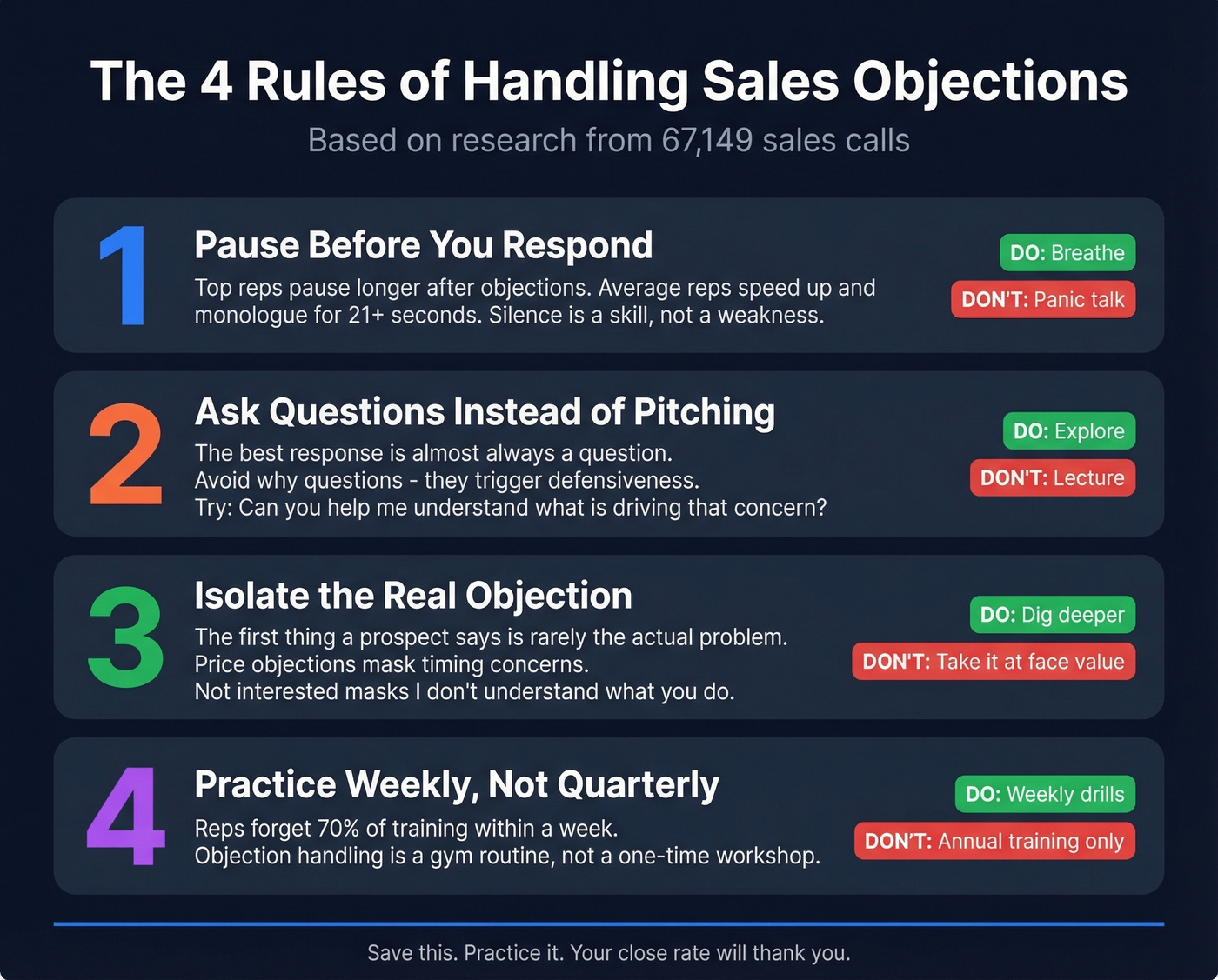
- Pause before you respond. Top reps pause longer after objections. Average reps speed up and monologue for 21+ seconds. Silence is a skill.
- Ask questions instead of pitching. The best objection response is almost always a question that uncovers the real blocker. One caveat: avoid "why" questions. They trigger defensiveness. "Can you help me understand what's driving that concern?" beats "Why is that a problem?" every time.
- Isolate the real objection. The first thing a prospect says is rarely the actual problem. Price objections mask timing concerns. "Not interested" masks "I don't understand what you do."
- Practice weekly, not quarterly. Reps forget 70% of training within a week. Objection handling is a gym routine, not a one-time workshop.
What 67,149 Sales Calls Reveal
Researchers analyzed 67,149 demo call recordings from a database of 1M+ calls. The findings are the closest thing we have to a science of objection handling.
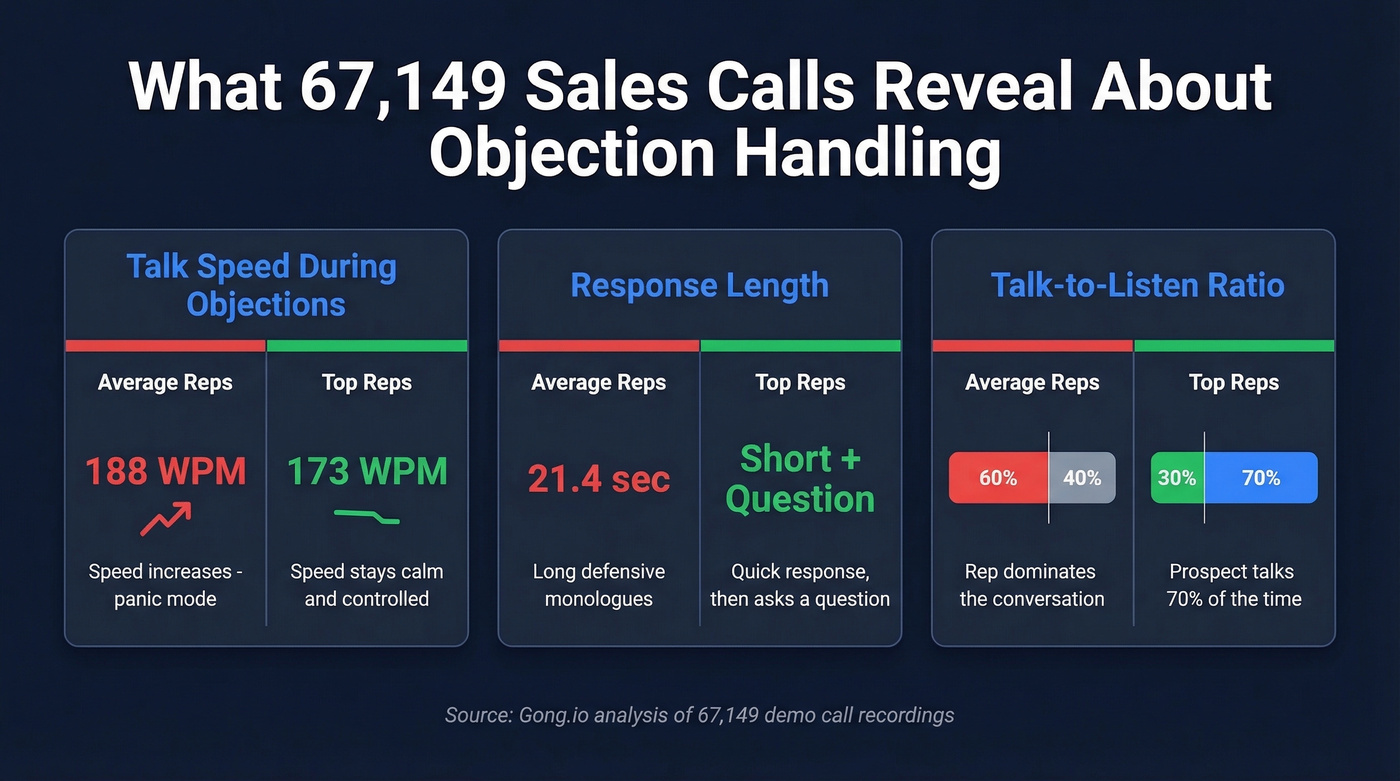
The first pattern: top reps slow down when objections hit. Average reps do the opposite - their talk speed jumps from 173 WPM to 188 WPM, a telltale sign of panic. This "Patience Score" is a strong predictor of deal progression.
The second pattern: monologues kill deals. Average reps respond to an objection with a 21.45-second wall of words - knee-jerk over-explaining that sounds defensive even when it isn't. Top reps keep the back-and-forth going. Speaker switches per minute stay high during objections for successful reps; for average reps, dialogue pace drops, signaling the prospect has mentally checked out.
Third pattern: the 70/30 rule. Your prospect should be talking 70% of the time. If you're doing most of the talking during an objection, you're losing. Top reps close their responses with "Does that make sense?" more often during objection moments - it's a micro-commitment that re-engages the prospect and confirms you've actually addressed the concern.
None of these behaviors are about having the perfect script. They're about staying calm, asking questions, and keeping the conversation alive. Every response below favors a question over a monologue.
33 Common Sales Objections, by Category
These aren't scripts to memorize - they're patterns to internalize. Each objection includes what the prospect says, what they usually mean, and a response designed to keep the conversation moving.
Price and Budget Objections
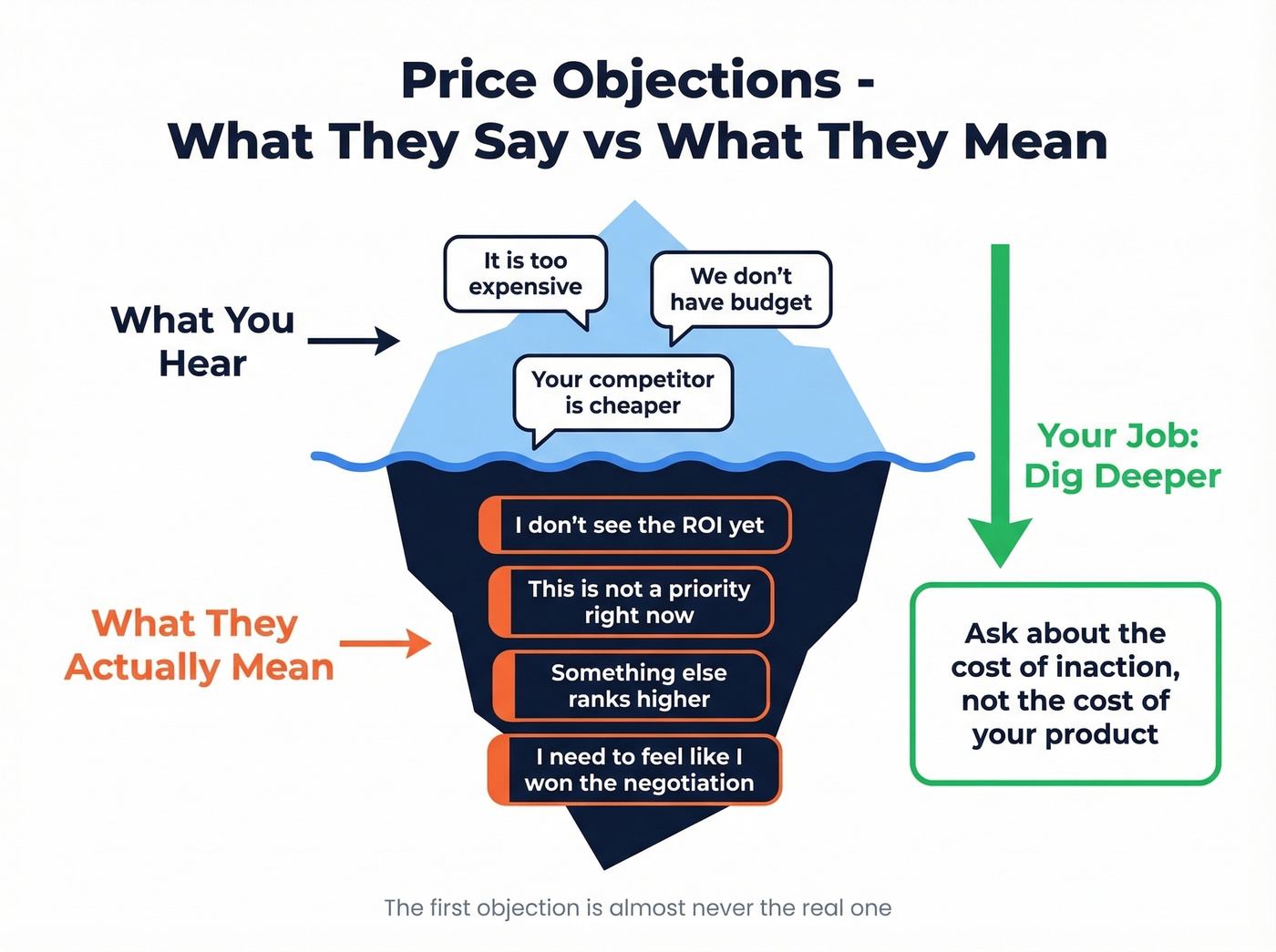
Price is the most common objection category, but it's almost never actually about price. When someone says "too expensive," they're really saying "I don't see enough value yet." (If you want a tighter value-first approach, borrow a few lines from these talk tracks.)
| Objection | What It Really Means | Response |
|---|---|---|
| "It's too expensive." | I don't see the ROI yet. | "Expensive compared to what - the cost of the problem staying unsolved?" |
| "We don't have budget." | This isn't a priority right now. | "If budget weren't a factor, would this solve the right problem?" |
| "We need this budget elsewhere." | Something else ranks higher. | "What's competing for that budget? Maybe we can align timelines." |
| "Your competitor is cheaper." | Convince me the premium is worth it. | "What matters more - sticker price or total cost after implementation?" |
| "Can you give us a discount?" | I want to buy but need to feel like I won. | "Let's nail the scope first - then we'll find a number that works." |
On Reddit, the highest-rated approach for "budget is locked" reframes to the cost of inaction and asks about the internal escalation path for operational risk. The weakest answers went straight to discounts. (If discounting is a recurring theme, it helps to understand the anchor effect in negotiation.)
Authority and Decision-Making
These objections mean you're talking to someone who can't sign - or who's using the decision-maker as a shield. If you want a cleaner way to prevent this category entirely, start with a tighter Ideal Customer Profile.
| Objection | What It Really Means | Response |
|---|---|---|
| "I need to run this by my boss." | I'm not sold enough to champion it. | "What questions will they have that I can help you answer?" |
| "We have a committee for this." | This will take months. | "Who on the committee cares most about [specific pain]?" |
| "I'm not the right person." | You targeted wrong. | "Who would be? I'll make sure I'm not wasting their time either." |
| "Send me something to share." | I need air cover to bring this up. | "What's the one thing that'd make your team say 'let's take a meeting'?" |
Need and Priority
When prospects say they don't need what you're selling, they're often right - you just haven't connected the dots to a problem they care about. Think of it like Kodak in 2005: their current process was "working" right up until it wasn't. Status quo bias is the silent killer of deals. (This is where better discovery questions do more than any rebuttal.)
| Objection | What It Really Means | Response |
|---|---|---|
| "We don't have that problem." | I don't see how this applies. | "That's great - what are you doing today that's working so well?" |
| "We're fine with our current process." | Change is risky and I'm comfortable. | "What would 'better' look like if it existed?" |
| "This isn't a priority right now." | Other fires are burning hotter. | "When does it become one? I'd rather follow up at the right time." |
| "We tried something like this before." | We got burned and I'm gun-shy. | "What went wrong? That'll tell me if we'd actually be different." |
Timing and Urgency
Timing objections are the easiest to accept and the hardest to overcome. The key is distinguishing real timing constraints from polite brush-offs. If you need a system for what happens after “next quarter,” use a few of these sales follow-up templates.
"Call me next quarter" is the classic. What it really means: I'm hoping you'll forget. Your move: "I will. What would need to change between now and then for this to make sense?"
"We're in the middle of another project" means zero bandwidth. Ask when it wraps and circle back with something specific to where they'll be then.
"Now isn't a good time" is literal - they don't want to talk right now. Don't fight it. "Is there a 15-minute window this week that works better?" respects their time and keeps the thread alive.
"We just signed a contract with someone else" means you're too late - for now. The contract lock-in objection comes up constantly in SaaS, where competitors lock in 1-2 year deals. Plant a flag for the renewal window. Don't fight the existing contract.
Trust and Credibility
Trust objections are personal. The prospect doesn't believe you, your company, or your product can deliver. These require proof, not persuasion. (If you’re building a repeatable proof package, a simple product demo checklist helps.)
| Objection | What It Really Means | Response |
|---|---|---|
| "I've never heard of your company." | You're unproven to me. | "We work with [similar company]. Want me to connect you with their team?" |
| "How do I know this will work?" | I need proof, not promises. | "What would proof look like - a pilot, a case study, a reference call?" |
| "Your reviews are mixed." | I'm skeptical. | "Which reviews concerned you? I'd rather address the specific issue." |
| "We got burned by a vendor last year." | My trust is low across the board. | "What happened? I want to make sure we don't repeat that." |
Competition
When a prospect brings up a competitor, they're usually further along in their evaluation than you think. That's not bad - it means they're actively buying. This is where sales battle cards pay for themselves.
| Objection | What It Really Means | Response |
|---|---|---|
| "We're evaluating [Competitor]." | You're late to the party. | "Where are they strong and where do you have concerns?" |
| "Your competitor has feature X." | I want to see if you'll panic. | "They do. Here's what we do instead - and why customers chose us." |
| "We're happy with our current vendor." | Convince me to switch. | "What would they need to stop doing for you to look around?" |
| "Another tool does this for free." | Why should I pay? | "Free tools work until they don't. What happens when your data's wrong?" |
Here's the thing: half the time "not interested" means you reached the wrong person entirely. Bad data wastes your best talk tracks. If your contact list is stale or unverified, even a perfect objection response can't save a call that never should've happened. Prospeo verifies emails and direct dials on a 7-day refresh cycle, so your reps spend time on conversations that actually matter. (If you’re cleaning up inputs, start with data enrichment and a reliable sales prospecting database.)
Contract and Commitment
These come up late in the funnel and signal real buying intent - the prospect is negotiating, not dismissing. (If you want a cleaner close process end-to-end, map it to these steps to close a sale.)
| Objection | What It Really Means | Response |
|---|---|---|
| "We don't want a long-term contract." | I'm afraid of being locked in. | "Neither do we. Here's how our terms work - and the exit if it's not right." |
| "What if we need to cancel?" | I need an escape hatch. | "Let me walk you through cancellation. No one should feel trapped." |
| "Implementation timeline is too long." | I need results faster. | "What's your target go-live? Let's phase it for value in week one." |
| "We need to see ROI before committing." | I can't justify this without proof. | "Let's define ROI for your team - then build a pilot around proving it." |
Cold Call Brush-Offs
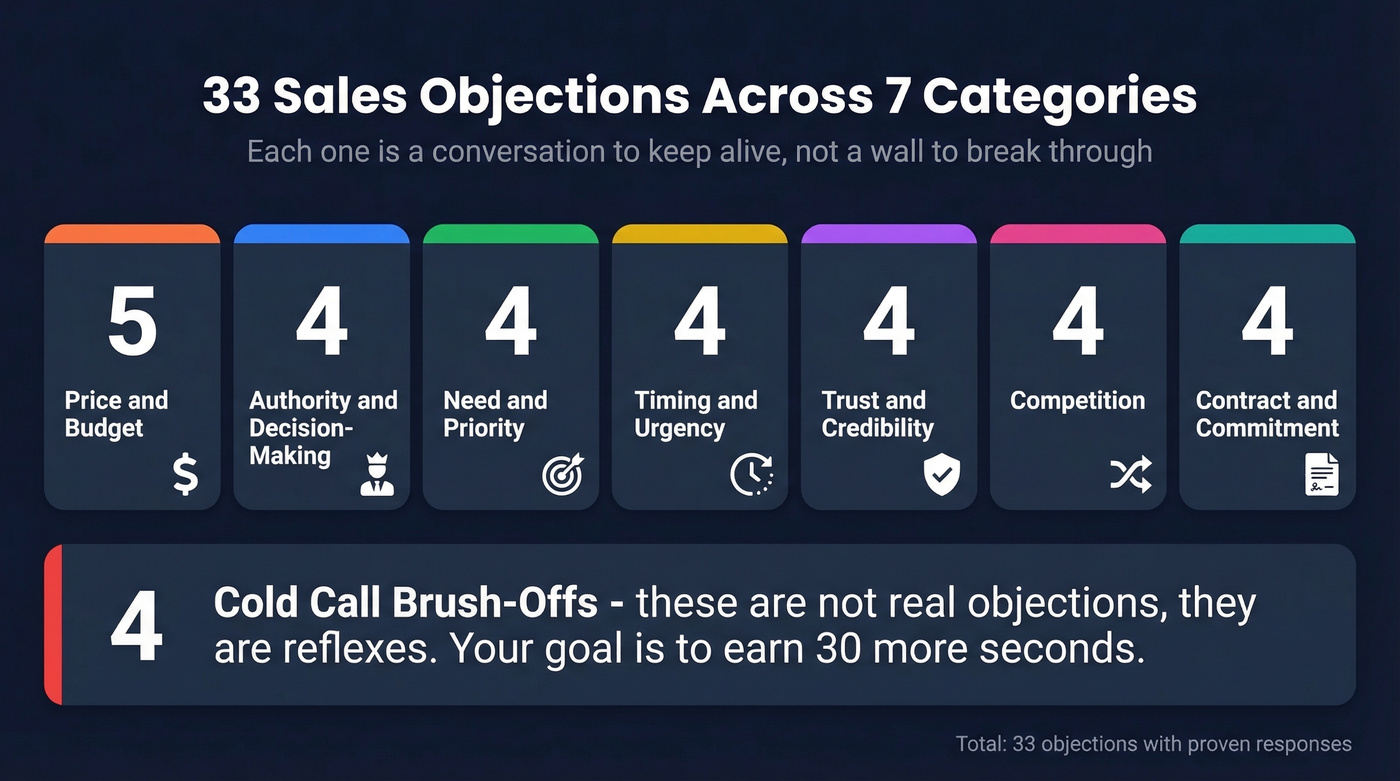
These aren't real objections. They're reflexes. The goal isn't to overcome them - it's to earn 30 more seconds. We've found that reps who treat brush-offs as information requests, rather than rejections, convert at roughly double the rate of reps who take them at face value. (For a full system, see this cold calling system.)
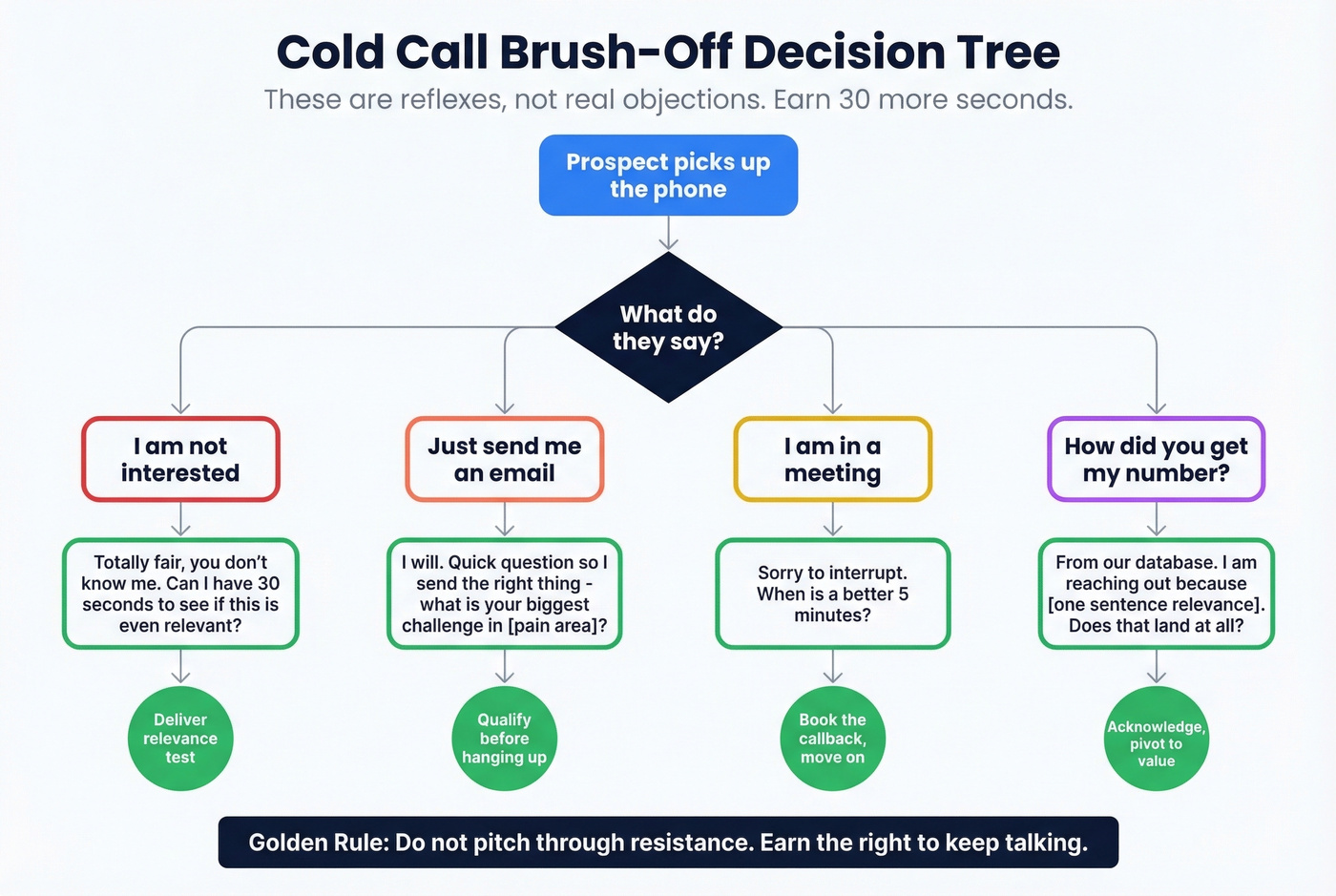
"I'm not interested." What it really means: I don't know what you do yet. "Totally fair - you don't know me. Can I have 30 seconds to see if this is even relevant?"
"Just send me an email." What it really means: I want you off the phone. "I will. Quick question so I send the right thing - what's your biggest challenge in [pain area] right now?"
"I'm in a meeting." Take it at face value. "Sorry to interrupt. When's a better 5 minutes?"
"How did you get my number?" What it really means: I'm annoyed and suspicious. "From our database. I'm reaching out because [one-sentence relevance]. Does that land at all?"
The "30 seconds" approach comes from Morgan J. Ingram's cold call framework: ask for 30 seconds, deliver a quick relevance test, and close with "Does that sound fair?" Don't pitch through resistance - earn the right to keep talking.

Half of sales objections happen because you reached the wrong person. Prospeo gives you 30+ filters - job title, buyer intent, department headcount - so you're pitching the actual decision-maker, not a gatekeeper who "needs to run this by my boss."
Skip the authority objection entirely. Start with the right contact.
Two Frameworks for Any Objection
Knowing 33 responses is useless if you can't adapt them in real time. These two frameworks give you a structure that works regardless of the specific objection.
LAER: The Most Versatile Framework
LAER stands for Listen, Acknowledge, Explore, Respond. It's the framework we've seen work most consistently across deal sizes and industries.
Here's what it sounds like on a price objection:
Prospect: "This is way over our budget."
Listen: Don't interrupt. Let them finish.
Acknowledge: "That's a fair concern - I don't want to waste your time on something that doesn't pencil out."
Explore: "Is it the total annual cost, or more about what's included at this tier? What would need to be true for the investment to make sense?"
Respond: "Most teams at your stage start with a smaller scope and expand once they've proven ROI internally. Here's what that looks like..."
The key is the Explore step. Most reps skip straight from Acknowledge to Respond and end up solving the wrong problem. The best objection-handling examples all share this trait: they diagnose before they prescribe.
Feel-Felt-Found (With an Isolation Step)
Feel-Felt-Found is the classic empathy framework, but it works best when you add an isolation step upfront. Before you empathize, confirm you're addressing the actual blocker. Here's how it plays out when a prospect says "We're leaning toward [Competitor] - they seem more established."
Isolate: "Beyond the brand recognition piece, is there anything else that would keep this from moving forward?"
Feel: "I get it - going with the bigger name feels safer, especially when you're the one signing off internally."
Felt: "The team at [similar company] felt the same way. They'd used [Competitor] for two years and were nervous about switching to a smaller vendor."
Found: "What they found was that our onboarding took half the time, their reps actually adopted the tool, and they hit quota 40 days faster than the previous year."
Ask permission: "Would it be helpful to connect you with their VP of Sales so you can hear it directly?"
That last step - asking permission - keeps you from steamrolling. It signals respect and gives the prospect agency in the conversation.
Five Mistakes That Kill Deals
Treating the first objection as real
The first objection is almost always a smoke screen. "It's too expensive" might mean "I don't have authority to approve this" or "I don't understand what this replaces." The surface objection is the symptom - your job is to diagnose the disease. Ask "Is there anything else?" at least once before you start solving.
Rushing to respond
The call data is clear: average reps speed up to 188 WPM when flustered and launch into a 21-second monologue. Pause. Count to three. The silence feels longer to you than it does to the prospect.
Getting defensive
The moment you argue, you've lost. Objections aren't attacks - they're requests for more information wrapped in skepticism. "That's not true" or "Actually, we do have that feature" puts the prospect on the defensive right back. Mirror their concern, then redirect.
Discounting too soon
Here's my hot take: if you're closing deals under $10k ACV, discounting on the first ask is the single most expensive habit on your team. The second you offer a discount unprompted, you've told the prospect your price was inflated. Worse, you've trained them to object harder next time. Discounts should be the last tool, not the first.
Ignoring the emotional driver
Behind every rational objection is an emotional one - fear of making the wrong decision, fear of change, fear of looking bad internally. 57% of sales pros say cycles are getting longer, and a big reason is that buyers are terrified of committing. Address the feeling, not just the logic.
Industry-Specific Rebuttal Scripts
B2B SaaS
SaaS objections cluster around risk, integration, and switching costs. These sales objection rebuttal examples show how to address each without getting defensive. (If you’re building a repeatable motion, this SaaS sales guide helps.)
"Implementation seems too complex." Translation: I'm scared of the disruption. "What specifically worries you - data migration, team training, or timeline? Let's phase it so you see value in week one."
"We can build this ourselves." Translation: My engineering team thinks they can. "What's the three-year cost of engineering time plus maintenance? Most teams find it's 4-5x the subscription."
"How does this integrate with our stack?" Translation: I need technical proof. "What are the three systems that matter most? Let's get your technical lead on a call."
"What happens to our data if we cancel?" Translation: I'm afraid of vendor lock-in. "You'll want clear data export terms in writing. What formats do you need, and who owns the migration internally?"
"We just signed with [Competitor]." Translation: You're too late - for now. "When's the renewal? I'd love to be in the conversation 60 days before it auto-renews."
Insurance
Insurance objections are more personal and emotional. Prospects are evaluating trust as much as coverage. In our experience, the reps who win here are the ones who slow down the most - insurance buyers need to feel heard before they'll consider switching.
"I'm happy with my current provider" usually means they haven't compared rates in years. Most people find a 15-20% gap after two years without shopping. Ask when they last ran a comparison - the number does the selling for you.
"I can't afford this right now" is almost always a scope problem, not a budget problem. Look at what coverage they actually need versus what they're being quoted. There's usually room to adjust without leaving gaps.
"I need to talk to my spouse" is legitimate - don't fight it. Offer a one-page summary they can review together, or suggest a quick call with both of them. Make it easy to say yes.
"I'm worried about exclusions" means they've been burned before or they've heard horror stories. Send the full exclusion list in writing before they sign anything. Transparency kills this objection faster than any talk track.
How to Practice (5 Drills)
Reps forget 70% of training content within a week. Teams that run weekly objection drills see a 10-20% lift in conversion at objection-heavy deal stages. Here are five drills worth running every week. (If you want these to stick, build them into your sales training cadence.)
Objection Gauntlet - 15 minutes, pairs. One rep fires objections rapid-fire with no pauses between. The other responds in real time. Builds comfort under pressure and eliminates the deer-in-headlights freeze.
Roleplay + Debrief - 20 minutes, groups of three. One prospect, one rep, one observer. Run a 10-minute call, then debrief for 10. The observer catches what the rep missed.
"Why Behind the Objection" - 10 minutes, solo or pairs. Take five objections from this week's pipeline. For each one, write down three possible real reasons behind it. This trains the Explore muscle.
Competitor Drill - 15 minutes, team. Pick one competitor. List their top three strengths. Practice responding to "We're going with [Competitor] because of X" without trashing them.
Call Review Pause-and-Respond - 20 minutes, team. Pull a recorded call, pause at the objection moment, and ask "What would you say next?" before playing the rep's actual response. Skip this drill if your team doesn't record calls yet - get that infrastructure first. When you review calls where reps reached the wrong contact entirely, that's a data problem, not a skills problem.
"We tried something like this before" hits hardest when your emails bounce and your dials go to voicemail. Prospeo's 98% email accuracy and 30% mobile pickup rate mean your pitch actually reaches a human - so you can use these objection responses instead of talking to dead air.
You can't handle objections if nobody picks up the phone.
FAQ
What's an example of a sales objection?
A classic: "It's too expensive." But the first objection is rarely the real one - "too expensive" usually means "I don't see enough value yet" or "I can't justify this to my boss." The right response is a question like "Expensive compared to what?" - not a discount.
What are the four types of sales objections?
The four classic categories are price, authority, need, and timing - the BANT framework. Most modern sales teams add trust and credibility as a fifth. Every objection you encounter maps to one of these buckets, which makes choosing the right response framework faster.
How do you handle "I'm not interested" on a cold call?
Ask for 30 seconds, deliver a one-sentence relevance test tied to a specific pain point, and close with "Does that sound fair?" This is Morgan J. Ingram's approach. Don't pitch through resistance - earn the right to keep talking by proving you're relevant in under half a minute.
How do you reduce objections before they happen?
Better targeting. When you reach the right person with a relevant message, objections drop dramatically. That means verified contact data, intent signals that tell you who's actually in-market, and enough context on the prospect to make your opening line land. The consensus on r/sales is that bad data causes more lost deals than bad talk tracks.