The Multi-Channel Outbound Marketing Playbook You'll Actually Use
B2B decision makers now use [10.2 channels](https://www.mckinsey.com/capabilities/growth-marketing-and-sales/our-insights/five-fundamental-truths-how-b2b-winners-keep-growing) during a purchase - up from 5 in 2016. If your outbound strategy is still email-only, you're visible on one channel while your buyer lives on ten. That's not a minor gap. That's near-invisibility.
Buyers are already 61% through their journey before they ever talk to a rep, which means your outreach needs to land across multiple surfaces before that first conversation even happens. Running email, phone, and social in parallel works when you nail three things: clean data, a structured cadence, and a sequencing tool that ties it all together. Here's the cadence template, benchmarks, and tool stack to execute it for under $200/month.
Benchmarks That Actually Matter
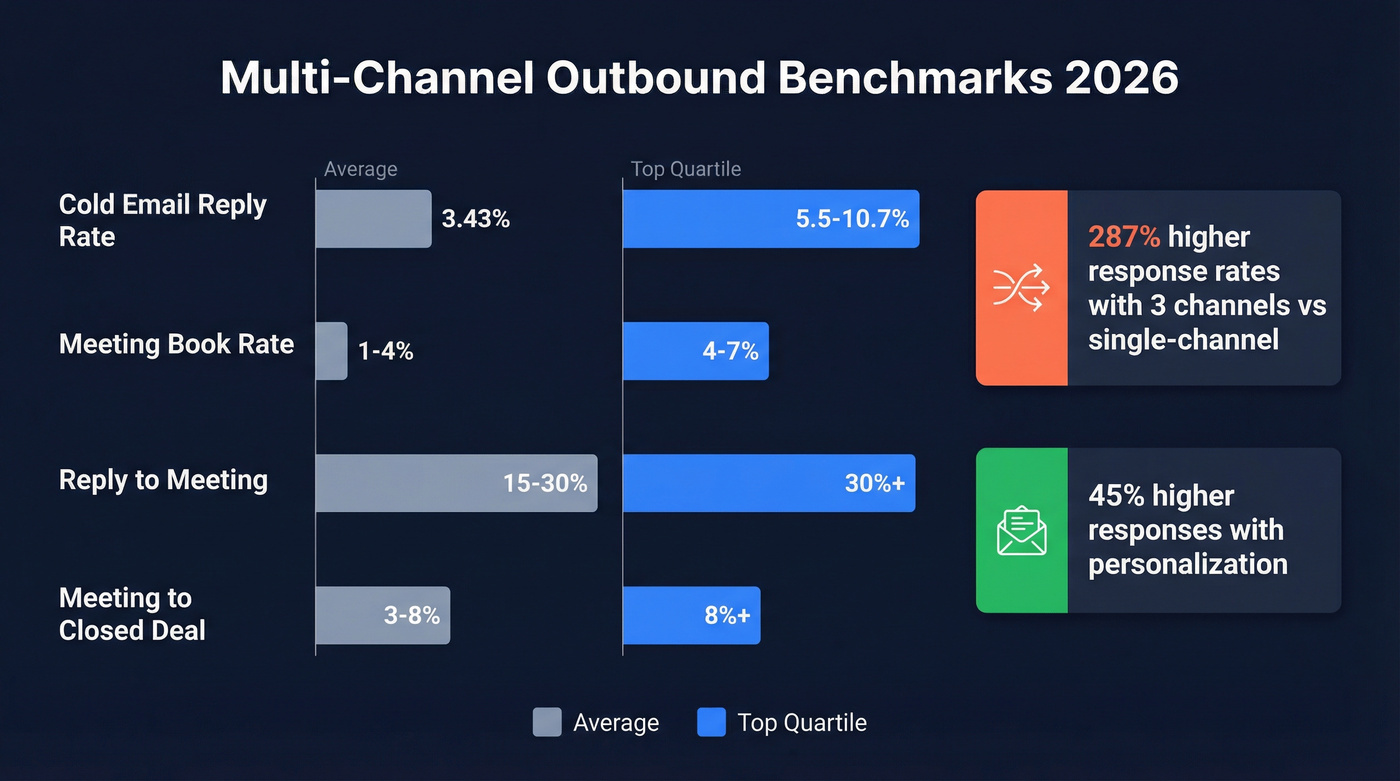
We've aggregated these numbers from recent benchmark reports across 100+ SaaS teams. They're directional, not gospel - but they'll tell you fast whether your cadence is performing or bleeding.
| Metric | Average | Top Quartile |
|---|---|---|
| Cold email reply rate | 3.43% | 5.5-10.7% |
| Meeting book rate | 1-4% | 4-7% |
| Reply to meeting | 15-30% | 30%+ |
| Meeting to closed deal | 3-8% | 8% |
Email alone converts at 1-3%. Phone alone converts at 5-8%. A coordinated multi-channel approach lands at 4-7%, and TOPO research shows three channels increase response rates by 287% versus single-channel. Personalized campaigns see 45% higher response rates on top of that.

Multi-channel sequences outperform email-only by 2-3x. That's not marginal. It's the difference between a pipeline that works and one that quietly dies.
The 17-Day Outbound Cadence Template
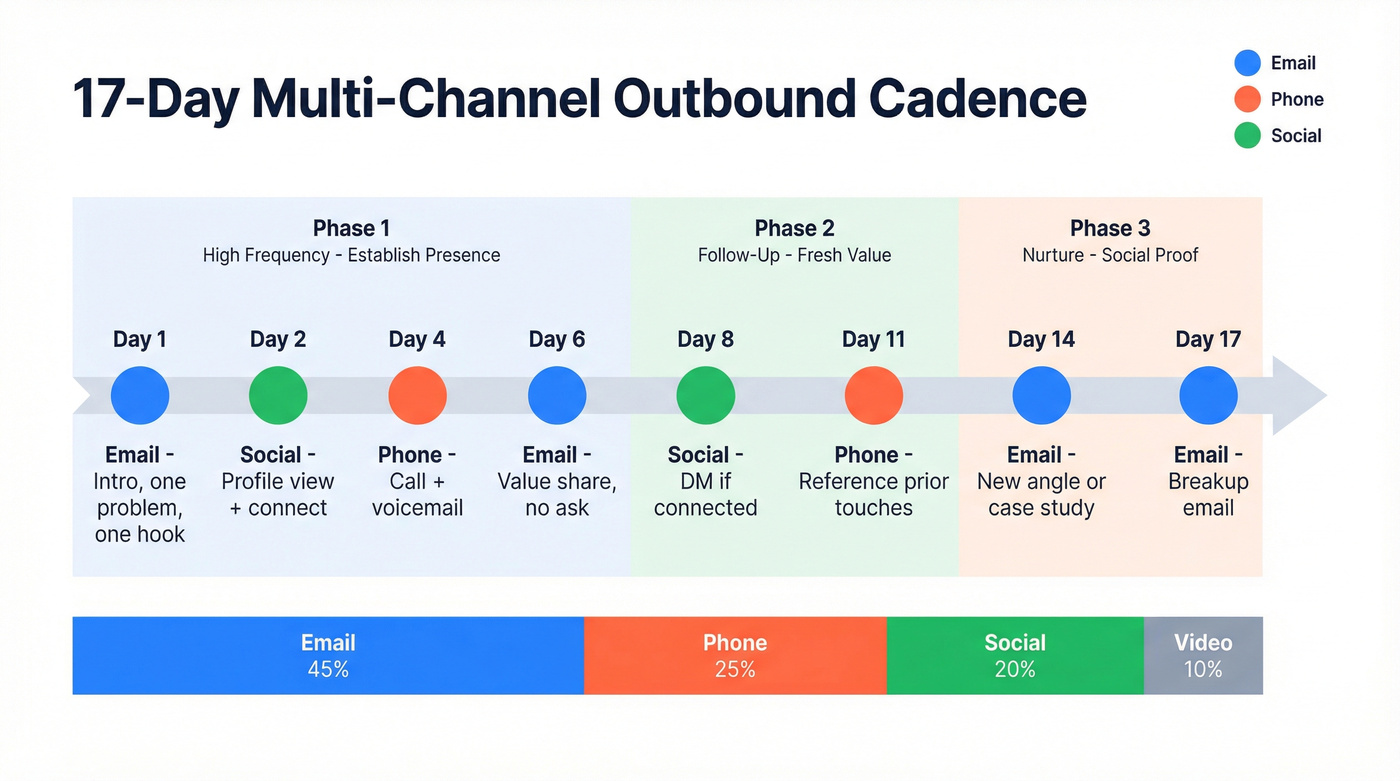
The sweet spot is 17-21 days with 8-12 touchpoints. RAIN Group confirms meetings require 8 touches on average. Here's the template we've adapted from Lunas' framework and the 11x.ai phased structure:
| Day | Channel | Action |
|---|---|---|
| 1 | Intro - one problem, one hook | |
| 2 | Social | Profile view + connect request |
| 4 | Phone | Call + voicemail |
| 6 | Value share (no ask) | |
| 8 | Social | DM if connected |
| 11 | Phone | Call referencing prior touches |
| 14 | Different angle or case study | |
| 17 | Breakup email |
Days 1-7 are high-frequency: 4-5 touches establishing presence. Days 8-12 shift to follow-up with fresh value props. Days 13-17 are nurture with social proof. For a 21-day version, Days 18-21 become your final push - a breakup email paired with one last call.
Start with 1-2 days between touches, then expand to 3+ days to avoid fatigue. Channel mix: email 40-50%, phone 20-30%, social 15-25%, video 5-10%. Don't skip phone. It's the channel reps dread most, but it generates disproportionate response rates. Each channel primes the prospect for the next - that's what separates orchestrated outbound from random acts of prospecting.
Here's the thing: if your average deal size is under $15k, you probably don't need a 21-day cadence. Seventeen days with 8 touches will close the deal or disqualify the prospect. Longer cadences just delay the feedback loop.
Messaging Rules That Drive 20%+ Reply Rates
The 30MPC framework produced 20%+ reply rates from cold prospects. Three core principles:
Sell one thing at a time. Each email focuses on a single problem. Don't cram three value props into one message. Rotate themes, not just subject lines. When you switch problems, switch everything - subject line, angle, proof point. Follow-ups on the same theme stay in-thread by replying to your own email. Phase out channels as returns diminish. Drop social touches by the second theme and reduce cold calls by the third.
58% of replies come from the first email. Follow-ups drive the remaining 42%, and a casual "bumping this" step-2 email generates roughly 30% lift. Don't overthink it.

A 17-day cadence with 8+ touches across email, phone, and social only works if every contact is real. Prospeo's 98% email accuracy and 125M+ verified mobiles with 30% pickup rates give your multi-channel sequences the foundation they need.
Stop orchestrating outbound on broken data - fix the foundation first.
Fix Your Data Before You Automate
Let's be honest - automating a broken process just scales the chaos faster. 37% of teams cite data quality as their top multi-channel challenge, and only 23% rate their strategy as best-in-class. The gap is almost entirely a data problem.
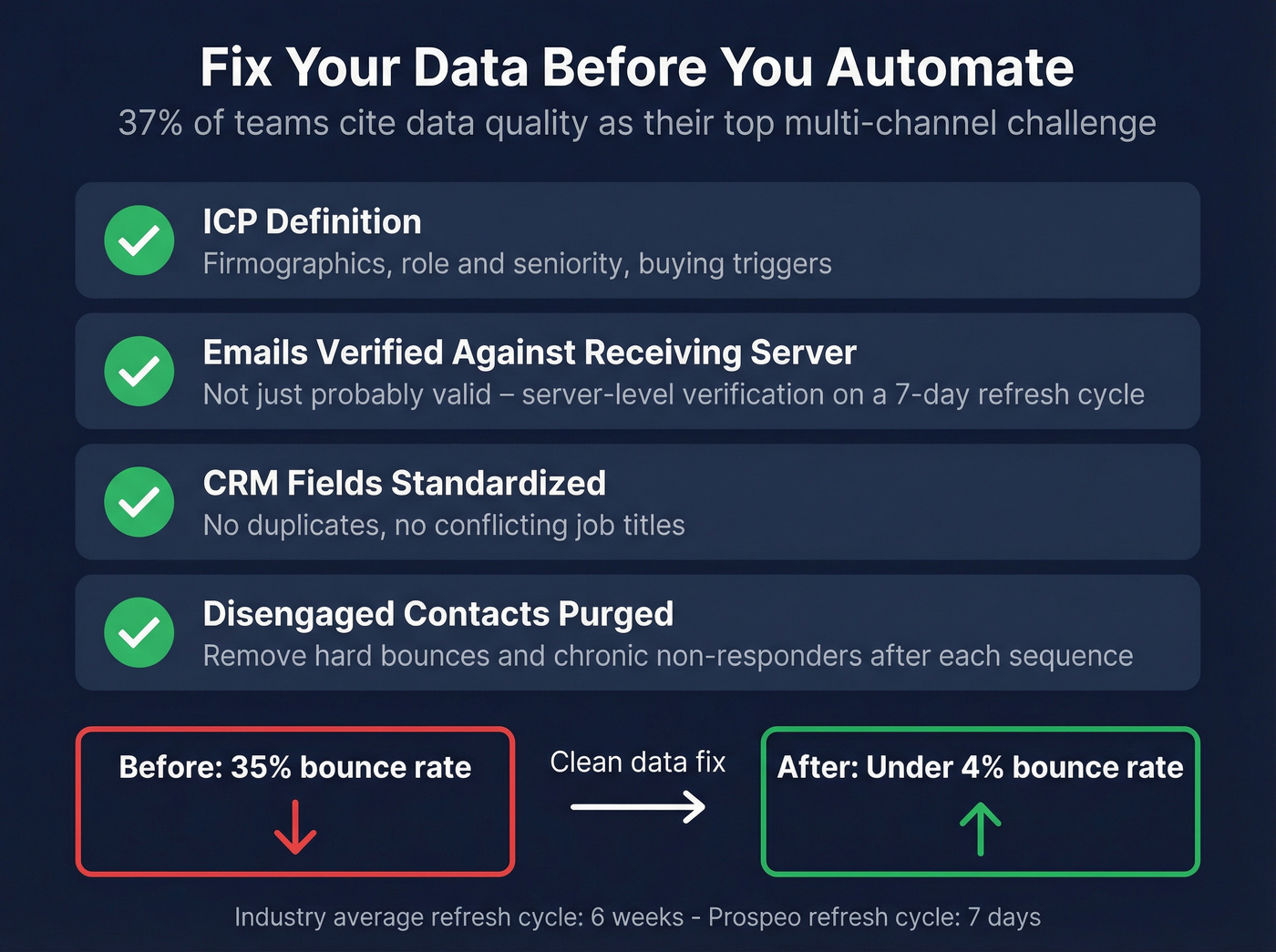
Before you turn on any automation, lock down four things:
- ICP definition - firmographics, role/seniority, buying triggers
- Emails verified against the receiving server, not just "probably valid" (email verification)
- CRM fields standardized - no duplicates, no conflicting job titles
- Disengaged contacts purged - remove hard bounces and chronic non-responders after each sequence (hard bounces)
Prospeo covers this foundation with 98% email accuracy on a 7-day refresh cycle - the industry average is six weeks, which means most teams are emailing stale data by week two. The 125M+ verified mobile numbers carry a 30% pickup rate, which matters when phone is 20-30% of your cadence. When Meritt switched, their bounce rate dropped from 35% to under 4%. Clean data isn't a nice-to-have for multichannel outbound. It's the prerequisite.
Meritt ran multi-channel outbound on bad data and hit 35% bounce rates. After switching to Prospeo's 7-day refresh cycle, bounces dropped under 4% and pipeline tripled to $300K/week - same team, same cadence, better data.
Build your under-$200/mo stack on data that actually connects.
The Tool Stack for Under $200/Month
You need three layers: data, sequencing, and CRM.
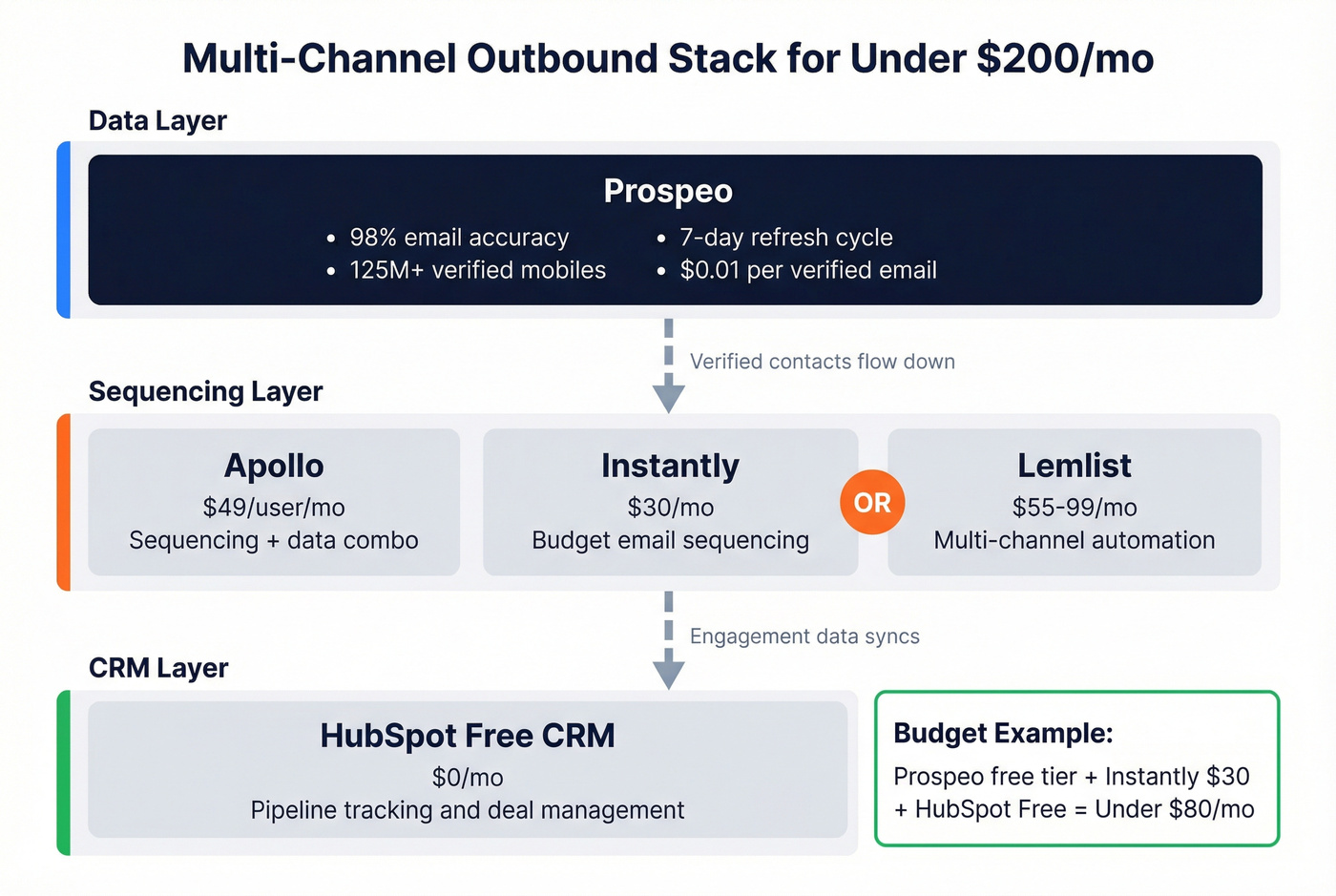
| Tool | Starting Price | Best For |
|---|---|---|
| Apollo | $49/user/mo | Sequencing + data combo |
| Instantly | $30/mo | Budget email sequencing |
| Lemlist | $55-$99/mo | Multi-channel automation |
| Reply.io | $60/user/mo | Multi-channel sequencing |
| HubSpot Sales Hub | $50/user/mo | CRM + sales engagement |
Skip Reply.io if you're already using Lemlist - the feature overlap isn't worth paying for both. And if your team is larger than five reps, Apollo's all-in-one approach starts making more sense than stitching together point solutions, though you'll want a separate verification layer since Apollo's email accuracy sits around 79% (prospect data accuracy).
Mistakes That Kill Campaigns
Blasting all channels at once. Stagger touches so each channel reinforces the last. Orchestration is a dance, not a mosh pit. (If you want the omnichannel version, see B2B omnichannel marketing.)
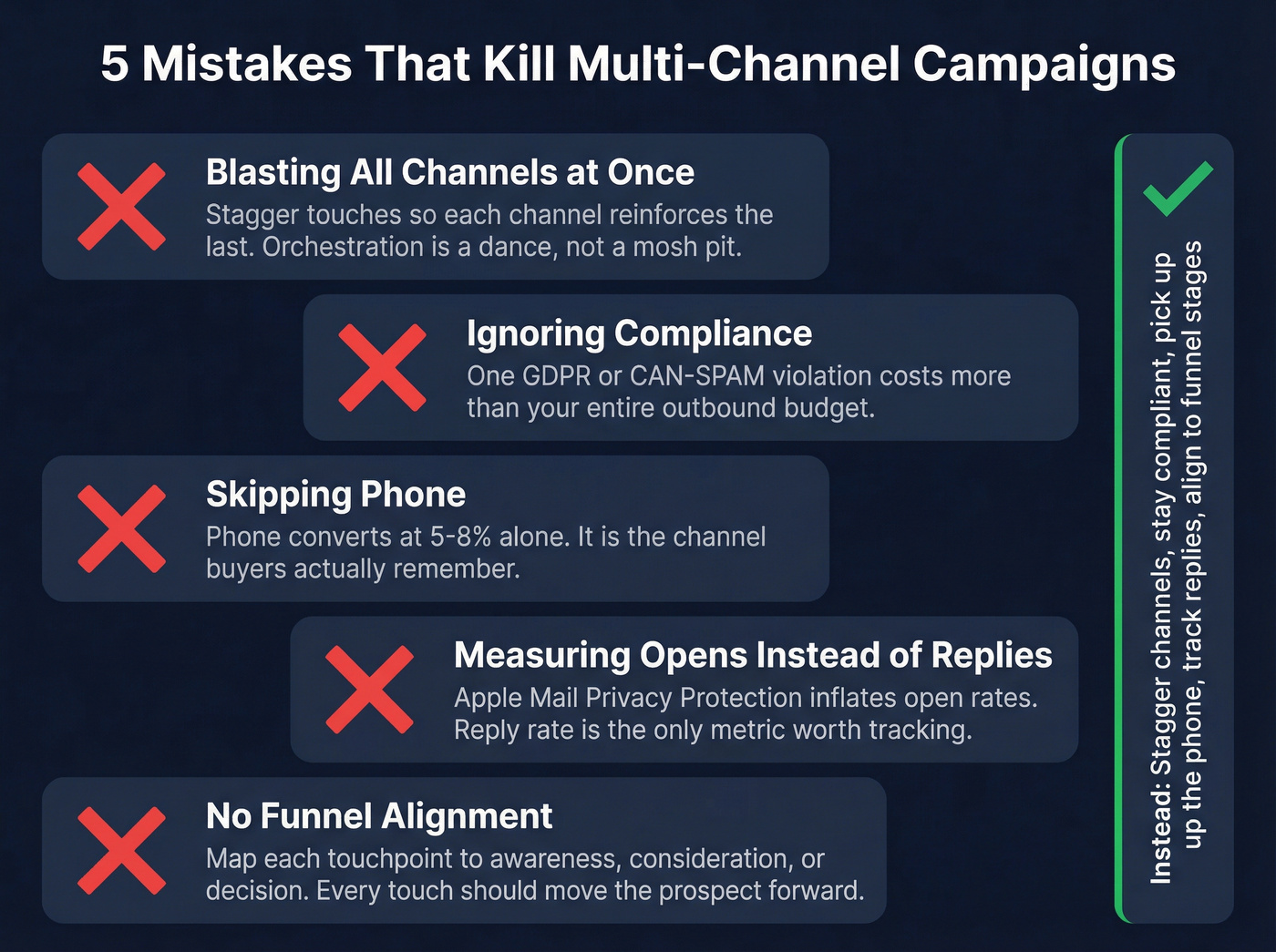
Ignoring compliance. One GDPR or CAN-SPAM violation costs more than your entire outbound budget. We've seen teams get burned by this - it's not theoretical. (GDPR for sales and marketing)
Skipping phone. Phone alone converts at 5-8% and it's the channel buyers actually remember. The consensus on r/sales is that cold calling isn't dead, it's just uncomfortable. There's a difference. (benefits of cold calling)
Measuring opens instead of replies. Apple Mail Privacy Protection inflates open rates to meaninglessness. Reply rate is the only cold outbound metric worth tracking. (best email open tracker)
No funnel alignment. Even the best cadence falls flat without mapping each touchpoint to a stage - awareness, consideration, decision. Every touch should move the prospect forward, not just add noise. (sales funnel tools)
FAQ
How many touchpoints should a multi-channel cadence have?
Eight to twelve over 17-21 days. Start with 1-2 days between early touches, then expand to 3+ days later to reduce fatigue. RAIN Group data confirms 8 touches as the minimum for booking meetings consistently.
What's a good reply rate for cold outbound in 2026?
Average is 3.43%, top quartile hits 5.5%, and elite performers reach 10.7%+. Multi-channel sequences push you into top-quartile range by default because each channel compounds recognition from the others.
What's the cheapest way to run multichannel outbound?
Prospeo's free tier plus Instantly at $30/month plus HubSpot free CRM covers email, phone, and social sequencing for under $80/month. Scale credits as volume grows - at $0.01 per verified email, data costs stay negligible even at high volume.
Why does multi-channel outbound outperform single-channel?
Buyers split attention across 10+ channels, so reaching them on only one is a gamble. A coordinated approach - email, phone, and social working together - creates multiple recognition points that build familiarity and trust before the first real conversation. Three-channel cadences see a 287% lift in response rates compared to email alone.