

How to Write a "Nice to Meet You" Email That Actually Gets a Reply
There's a thread on r/PetPeeves where someone describes the phrase "nice to e-meet you" as cringe-inducing. Over on r/britishproblems, the punchline to the same phrase is basically "No it isn't, go away." These people aren't wrong. Most nice to meet you email follow-ups fail because they lean on a hollow phrase instead of saying something worth reading.
We've sent hundreds of these follow-ups over the years, and the ones that get replies share exactly one trait: they prove you were paying attention.
The Short Version
Best go-to phrase: "It was great connecting with you at [event/context]."
Universal template skeleton:
Subject: Great connecting at [Event] - [Your Name] Hi [Name], it was great meeting you at [context]. I especially enjoyed [specific detail]. [One line of value or next step]. Best, [Your Name]
The one timing rule: Send within 24 hours. After that, you're competing with every other email in their inbox - and their fading memory of who you are.
When to Use It (and When Not To)
"Nice to meet you" works best when you've actually met someone - in person, on a video call, at an event - and you're following up afterward. It doesn't work as a cold introduction. If you've never interacted with someone, opening with "nice to meet you" feels fake. Lead with relevance instead.
It can also feel robotic as a reply if you don't add anything specific. When someone emails you first, mirror their tone and reference a detail so it sounds human.
And please, never write "nice to e-meet you." The Reddit consensus is clear: it's forced corporate-speak at best and insincere sales fluff at worst. You don't need to acknowledge that the internet exists.
Better Phrases for Every Tone
Swapping "nice to meet you" for something more specific instantly makes your email feel less templated.
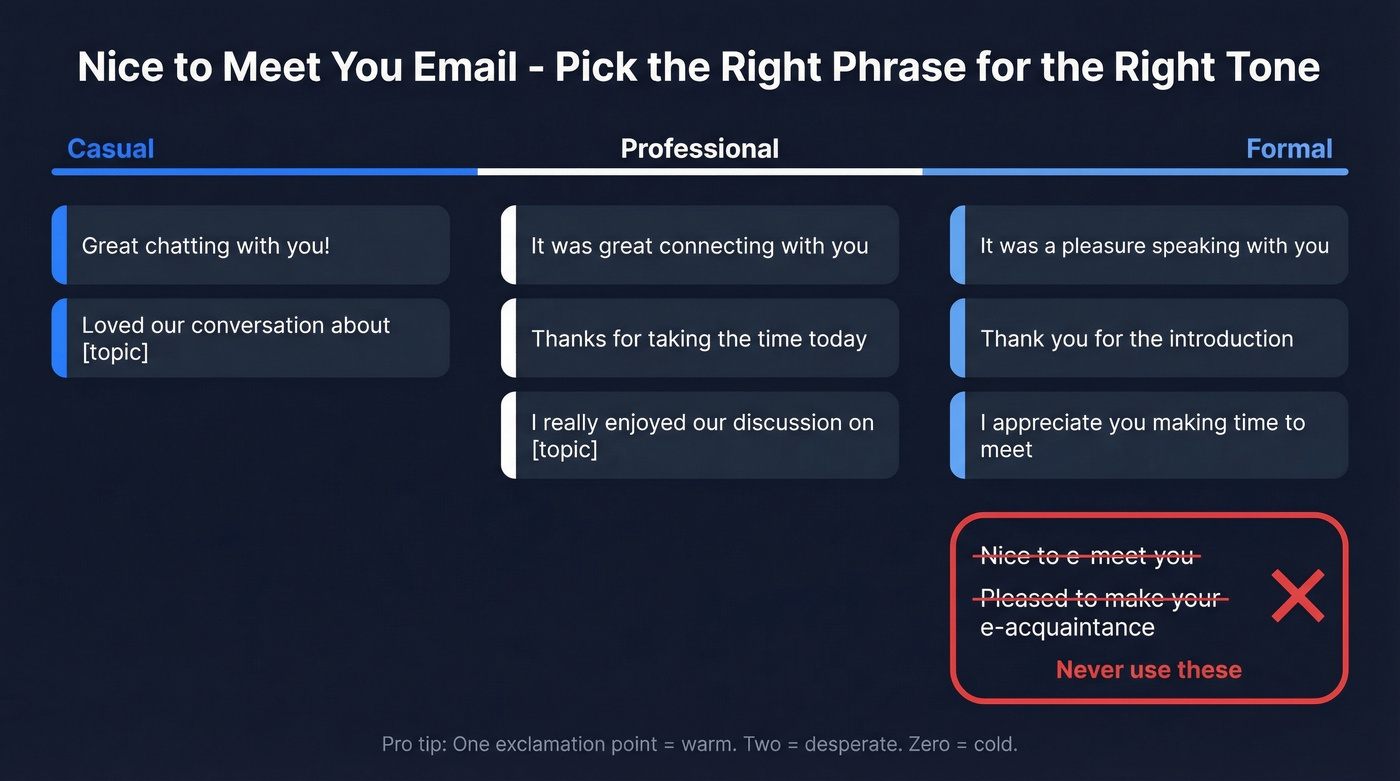
| Phrase | Tone | Best For |
|---|---|---|
| Great chatting with you! | Casual | Networking events, peers |
| Loved our conversation about [topic] | Casual | Conferences, meetups |
| It was great connecting with you | Professional | Default for most contexts |
| Thanks for taking the time today | Professional | Post-meeting follow-ups |
| I really enjoyed our discussion on [topic] | Professional | Interviews, panels |
| It was a pleasure speaking with you | Formal | Senior executives, clients |
| Thank you for the introduction | Formal | Referral-based intros |
| I appreciate you making time to meet | Formal | Board members, investors |
| Avoid | Never. Anywhere. | |
| Avoid | Also never. |
The best phrase is the one that references something specific. "Great chatting about your team's migration to HubSpot" beats any generic greeting because it proves you were actually listening.
One note on punctuation: a single exclamation point reads as warm and genuine. Two reads as desperate. Zero reads as cold.
If you want more variations that still sound natural, borrow a few openers from these email opening sentences and adapt them to your context.
Subject Lines That Get Opened
47% of recipients decide whether to open an email based on the subject line alone. Even more alarming: 69% report emails as spam based purely on the subject line.
If you’re stuck, swipe from a bigger list of email headline examples and tailor them to the meeting context.
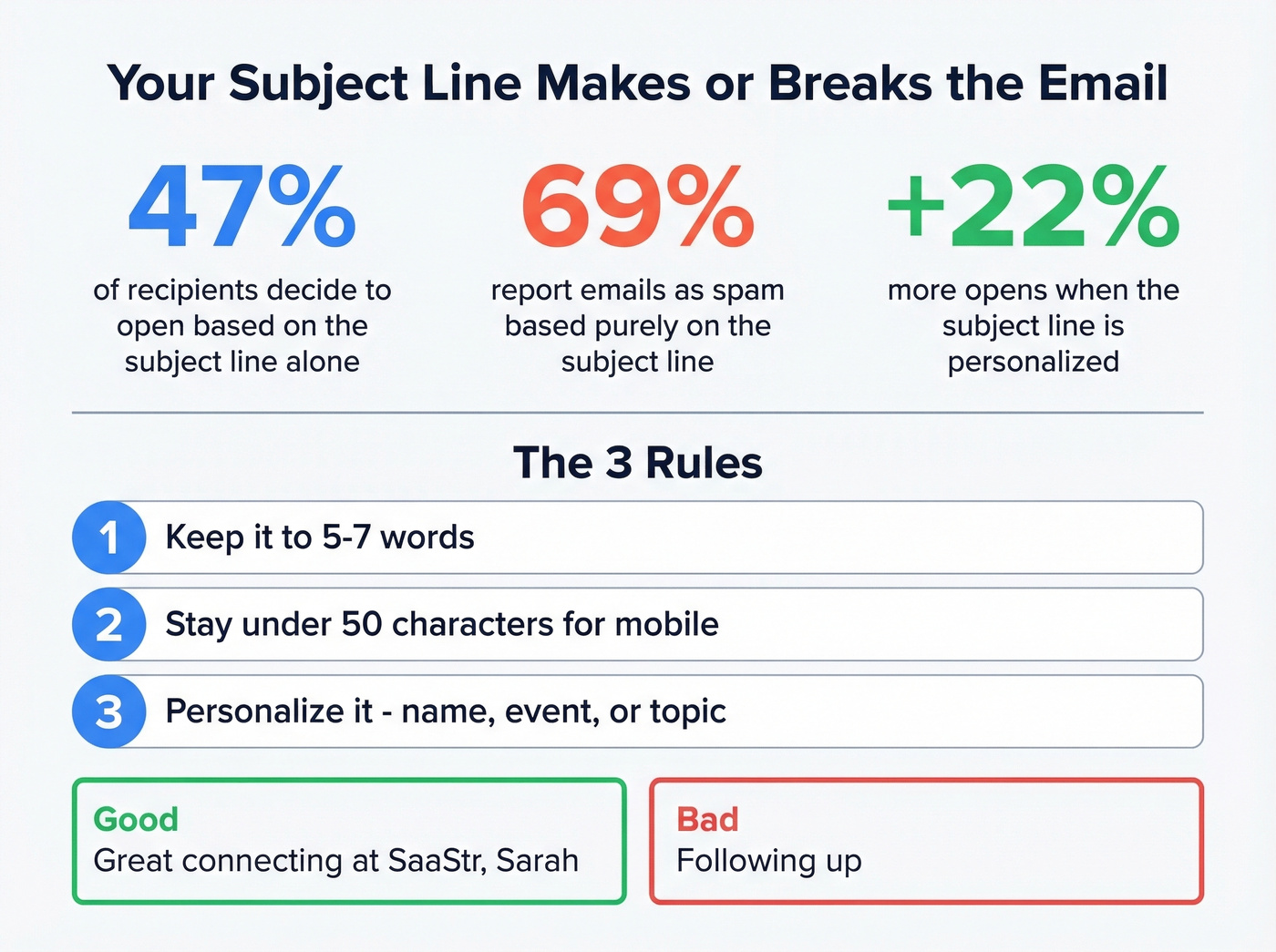
Three rules matter most. Keep it to 5-7 words. Stay under 50 characters so it displays fully on mobile. And personalize it - emails with personalization in the subject line get opened 22% more often.
Subject lines that actually work, by scenario:
- Networking: "Great connecting at [Event], [Name]"
- Interview: "Thank you - [Job Title] interview follow-up"
- Cold intro: "[Mutual connection] suggested I reach out"
- Post-demo: "Quick follow-up + the playbook I mentioned"
- Conference: "[Session topic] - loved your take on [detail]"
- Referral: "[Referrer's name] thought we should connect"
These share a pattern: they're specific, short, and give the recipient a reason to click. Vague subject lines like "Following up" or "Quick question" get buried. HubSpot recommends value-forward subject lines - ones that reference a shared conversation or promise something useful - over generic ones.
If you want a deeper breakdown, follow the same rules from B2B email subject line best practices and you’ll avoid most spam-trigger phrasing.

A perfect follow-up email means nothing if it bounces. Prospeo gives you 98% accurate emails so your "great connecting with you" actually lands in the right inbox - not a spam folder or dead address.
Stop crafting follow-ups that never arrive. Verify first.
Templates by Scenario
Every template below stays under 150 words and includes one specific detail that proves the email isn't mass-produced. That specificity matters: personalized follow-ups hit roughly 18% response rates compared to 9% for generic templates.
If you need more plug-and-play options, these networking email templates cover the most common post-event situations.
Networking Event Follow-Up
Subject: Great connecting at [Event] - [Your Name]
Hi [Name],
It was great meeting you at [Event] yesterday. I really enjoyed our conversation about [specific topic - e.g., "scaling outbound without burning your domain"]. Your point about [detail] stuck with me.
Would love to continue the conversation - are you open to a quick coffee or call next week?
Best, [Your Name]
Job Interview Thank-You
80% of hiring managers say thank-you notes influence their decision, yet only 24-57% of candidates send one. That's the easiest edge you'll ever get.
If you’re writing to a recruiter or hiring manager, these recruiting email examples can help you match the right tone.
Subject: Thank you - [Job Title] interview
Hi [Name],
Thank you for meeting with me today about the [Job Title] role. I'm excited about [specific aspect - e.g., "building out the EMEA pipeline from scratch"].
Our conversation about [topic discussed] reinforced my enthusiasm. I'd love to contribute to [specific goal mentioned in the interview].
Best regards, [Your Name]
Cold Business Introduction
Cold emails average a 1-5% reply rate. Keep it under 100 words and lead with relevance, not pleasantries.
If you’re doing true outbound, start with a tighter cold email etiquette checklist so you don’t accidentally sound like a template.
What most people send:
Hi [Name], I hope this email finds you well. I wanted to reach out because I think our companies could really benefit from connecting. Would love to set up a call to discuss how we can work together.
What actually works:
Subject: [Mutual connection] suggested I reach out
Hi [Name],
[Referrer] mentioned you're working on [specific challenge]. We helped [similar company] solve the same problem, cutting [metric] by [result].
Worth a 10-minute call this week?
[Your Name]
The difference is night and day. The first version is about you. The second is about them.
Replying to a "Nice Meeting You" Email
When someone sends you the follow-up first, don't overthink it. Mirror their warmth, add a specific detail, and suggest a next step.
Subject: Re: [Their subject line]
Hi [Name],
Great meeting you too! I really enjoyed our conversation about [topic]. Here's [that article/resource] I mentioned: [link].
Let's stay in touch - happy to [specific next step].
Best, [Your Name]
Post-Conference Recap
The strongest conference follow-ups share something useful - a resource you mentioned, a slide deck, an intro you promised. Be the person who delivers, not the person who collects business cards and disappears.
Subject: [Conference name] - the resource I mentioned
Hi [Name],
Great connecting at [Conference]. Here's [the article/deck/tool] I mentioned during our conversation about [topic]: [link].
Would love to hear how your team approaches [challenge]. Open to a quick call next week?
Best, [Your Name]
When to Send (and How Many Follow-Ups)
A Belkins study of 16.5 million cold emails found that the highest reply rate - 8.4% - comes from just one well-crafted email. Sending four or more emails triples your spam complaint rate. More isn't better. Better is better.
For a more complete playbook, see these follow up email best practices and adapt the cadence to your relationship stage.
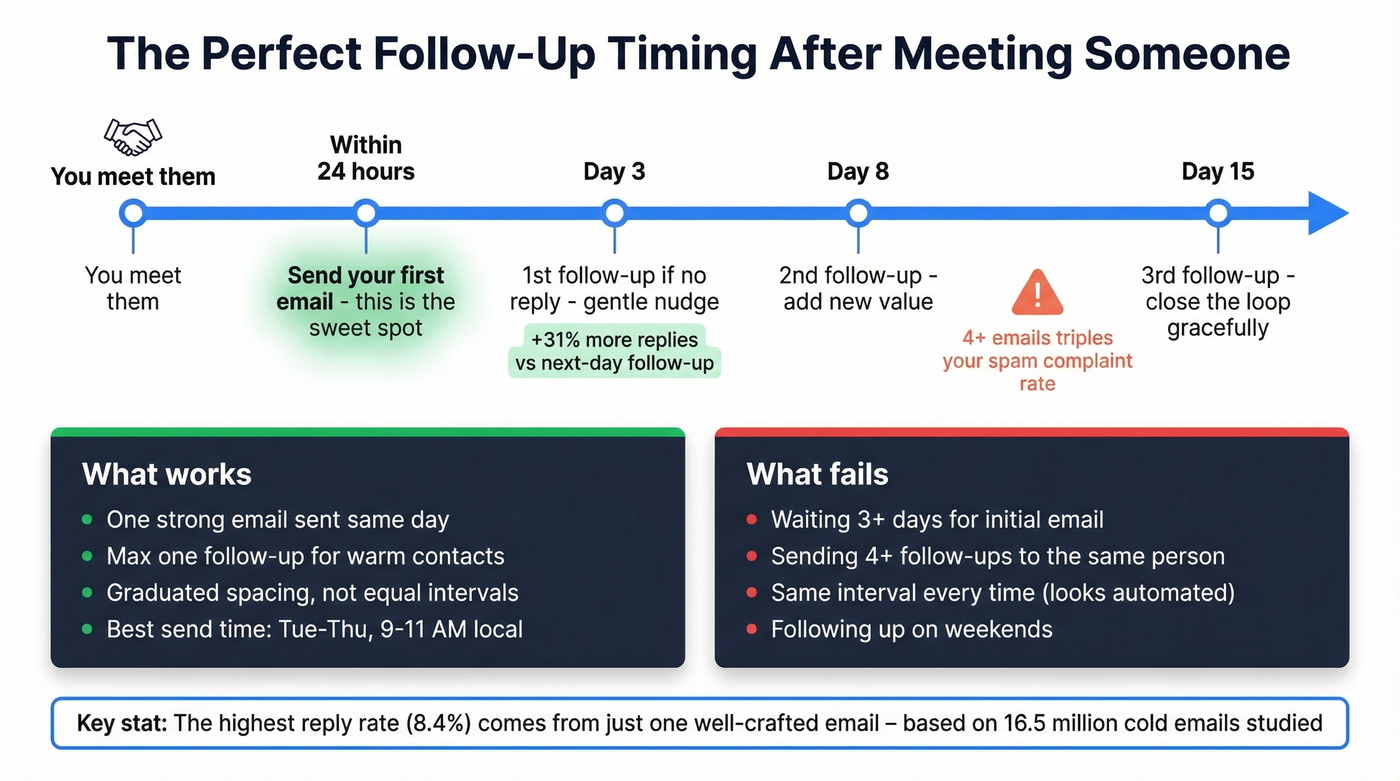
For warm follow-ups like networking and interviews, send within 24 hours. For business introductions, Tuesday through Thursday between 9-11 AM in the recipient's local time zone gets the strongest engagement.
Here's a stat that surprised us: waiting three days before a follow-up results in a 31% increase in replies compared to following up the next day. Your instinct to nudge quickly is wrong - give people breathing room. Belkins also found small businesses (2-50 employees) start around a 9.2% reply rate and tolerate more follow-ups than enterprise contacts (1,000+), who ghost quickly and punish persistence.
If you’re unsure what to say in the second touch, a simple chaser email structure usually beats “just checking in.”
If you do follow up more than once, use graduated spacing - not the same interval every time, which looks automated:
| Follow-Up | Wait Time | Purpose |
|---|---|---|
| 1st follow-up | 3 days | Gentle nudge |
| 2nd follow-up | 5 days | Add new value |
| 3rd follow-up | 7 days | Final check-in |
| Breakup email | 14 days | Close the loop |
Let's be honest: most people don't need four follow-ups for a post-meeting email. I've seen people agonize over follow-up cadences when one good email sent the same day would've done the job. One strong initial email and one follow-up is the sweet spot. Save the multi-touch cadences for sales sequences.
Mistakes That Kill Your Follow-Up
Misspelling their name. Nothing says "I don't care about you" faster. Double-check, especially with autocorrect - Mailchimp flags this as one of the most common unprofessional email mistakes.
If you want a quick checklist for structure and clarity, use this follow up email format as your final pre-send scan.
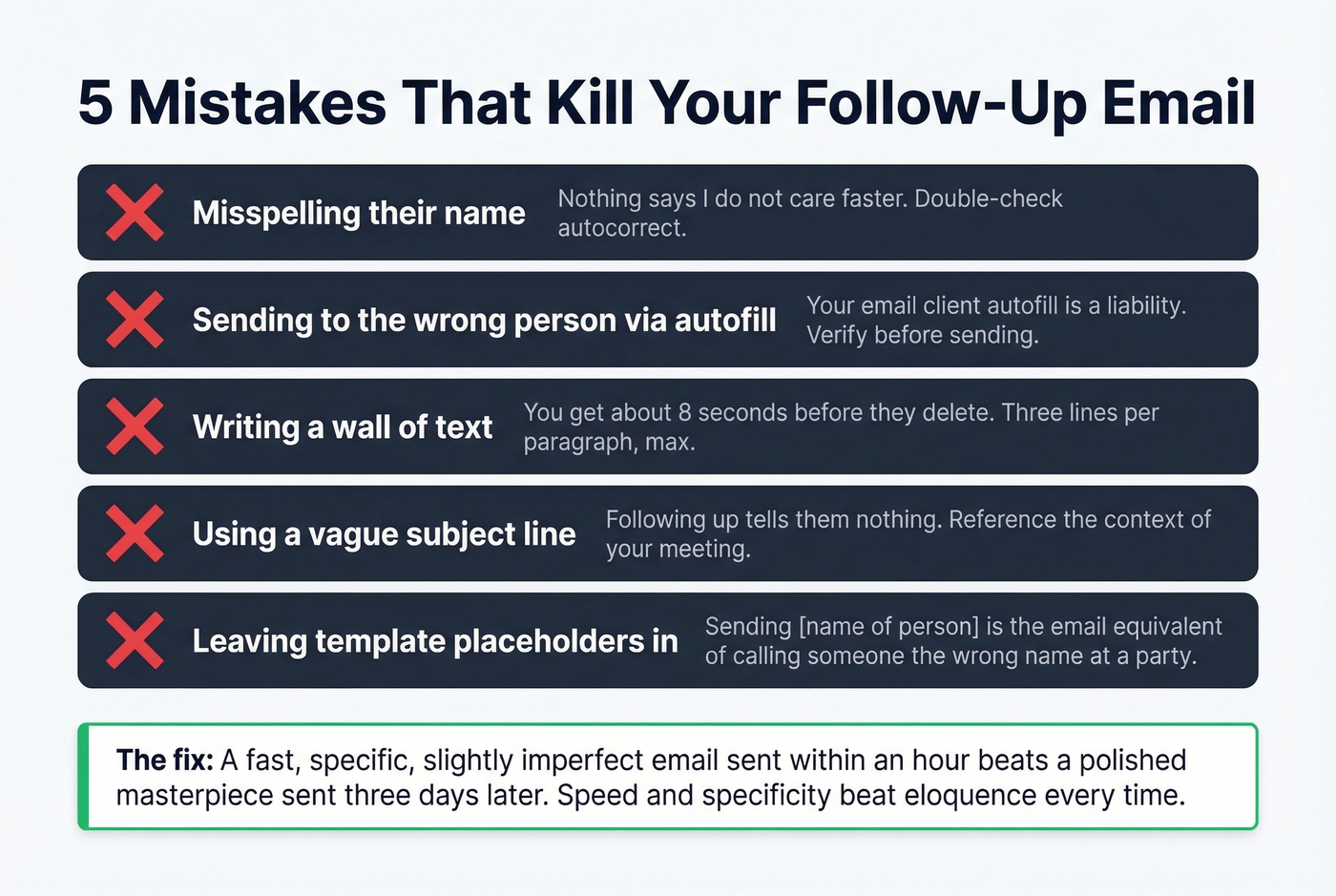
Sending to the wrong person via autofill. Your email client's autofill is a liability. Verify the recipient before hitting send.
Writing a wall of text. You get roughly eight seconds before someone decides to delete or engage. Three lines per paragraph, max.
Using a vague subject line. "Following up" tells the recipient nothing. Reference the context of your meeting.
Leaving template placeholders in the email. Sending "[name of person]" or "[specific detail]" without filling them in is the professional equivalent of calling someone the wrong name at a party. Always do a final read-through before hitting send.
Here's the thing: if you're closing deals under $15k and agonizing over the perfect post-meeting phrasing, you're optimizing the wrong thing. A fast, specific, slightly imperfect email sent within an hour beats a polished masterpiece sent three days later. Speed and specificity trump eloquence every time.
What If You Don't Have Their Email?
You met someone at a conference, had a great conversation, and realized afterward you only have their name and company. No email address. This happens constantly, and it kills momentum on promising connections.
Prospeo's email finder handles this in seconds - enter a name and company domain, and it returns a verified business email at 98% accuracy. Your first 75 lookups per month are free, no credit card required.
If you’re comparing approaches, this guide on how to find email by name breaks down the fastest methods (and when each one works best).
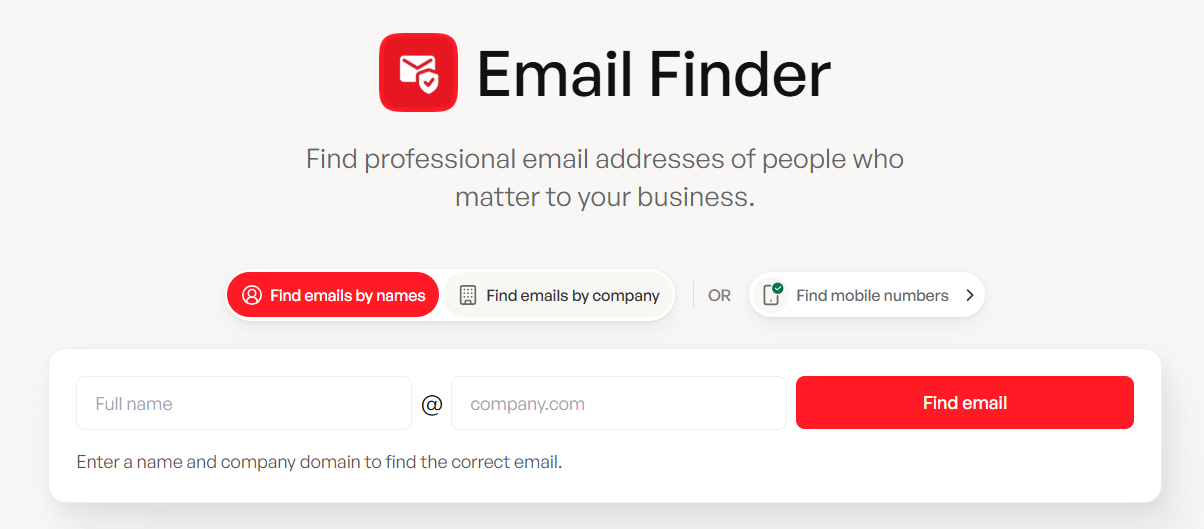
You nailed the subject line and personalized every detail. But did you even have the right email? Prospeo's 5-step verification and 7-day data refresh ensure your follow-ups reach real people - starting at $0.01 per email.
Great copy deserves a real inbox. Find theirs in one click.
FAQ
Can I say "nice to meet you" in an email?
Yes, but only after you've actually met - in person or on a call. For virtual-first introductions, "great connecting with you" sounds more natural. Skip "nice to e-meet you," which reads as forced corporate-speak.
How do I reply to a "nice to meet you" email?
Mirror the sender's warmth, reference one specific detail from your conversation, and suggest a concrete next step like a call or coffee. Keep the entire reply under five sentences - anything longer feels like a pitch.
How soon should I send a follow-up after meeting someone?
Within 24 hours for networking events and interviews. Data shows one specific, well-crafted email outperforms multiple generic follow-ups - Belkins found the highest reply rate (8.4%) comes from a single strong message.
What if I lost their contact info after a meeting?
Use an email finder tool like Prospeo - enter their name and company domain to get a verified business email at 98% accuracy. The free tier includes 75 lookups per month, enough to follow up on every conference conversation without paying a cent.