

12 Recruiting Email Examples That Actually Get Replies (2026)
It's Tuesday morning. You've got 14 open reqs, 2,500 applications piling up - 2.7x more than three years ago - and a hiring manager pinging you about that senior engineer role you sourced zero candidates for last week. You draft a recruiting email, hit send, and it bounces. The template was perfect. The data wasn't.
Sourced candidates are 5x more likely to be hired than inbound applicants. But recruiters today are managing 56% more open reqs with smaller teams, and time-to-hire has climbed 24% since 2021. Every email you send needs to count, which means you need templates backed by real data - not copy-paste jobs from a blog post that hasn't been updated since 2019.
Before You Touch a Template
Three things matter more than your word choice:
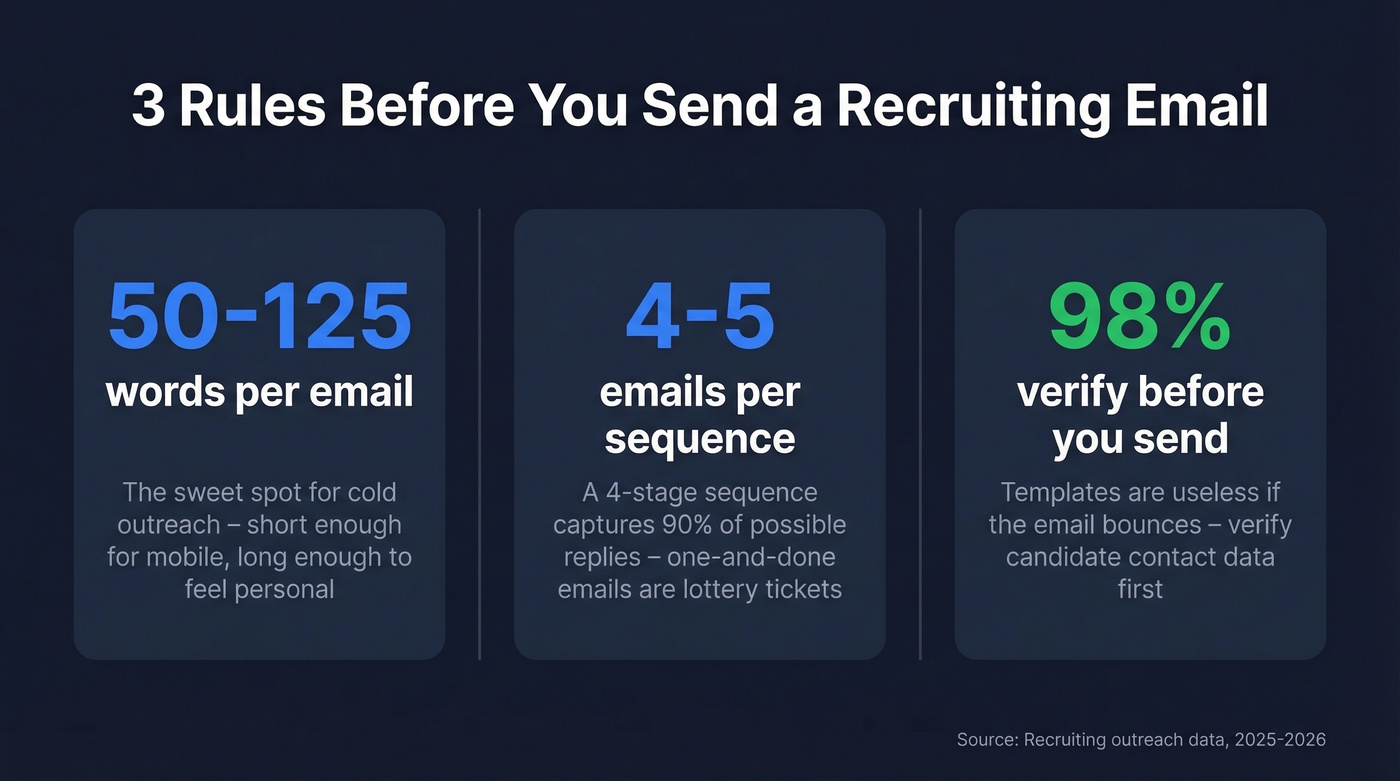
Keep emails between 50-125 words. That's the sweet spot for cold outreach: short enough to read on mobile, long enough to feel personal.
Send a 4-5 email sequence, not a single message. A 4-stage sequence captures 90% of possible replies. One-and-done emails are lottery tickets. (If you want a sales version of this, see follow-up templates.)
Verify contact data before you send. Templates are useless if the email bounces. We use Prospeo to verify candidate emails at 98% accuracy - the free tier gives you 75 verifications per month, which is enough to validate your highest-priority candidates before every sequence goes out. If you're troubleshooting bounces, start with email bounce rate.
How to Write Emails That Get Replies
We've reviewed hundreds of recruiter emails over the past year. The ones that work all share three things: tight length, human tone, and a specific ask.
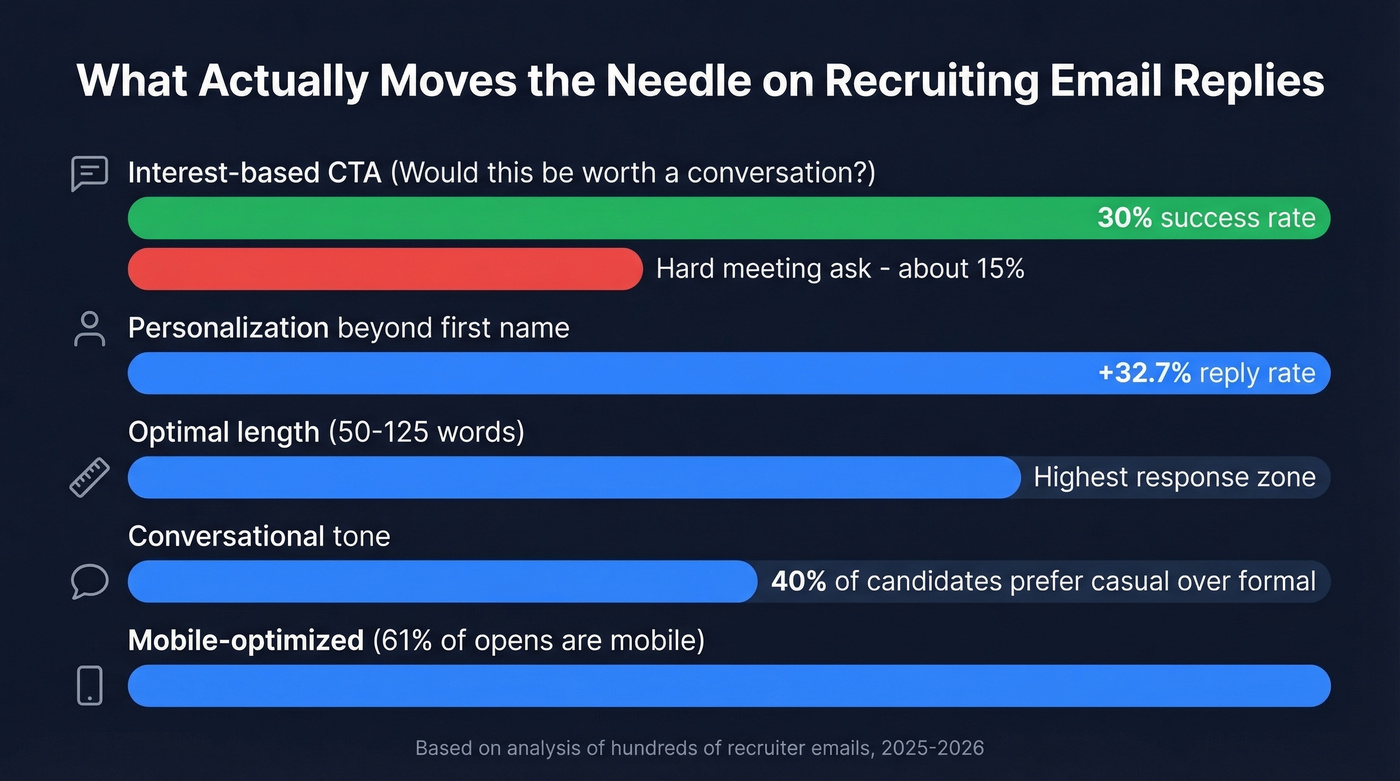
Length matters more than most recruiters think. Emails in the 50-125 word range get the highest response rates - about 5-8 sentences. That's enough to establish relevance, not enough to bore someone reading on their phone. And 61% of email opens happen on mobile.
Tone is the next lever. 40% of candidates prefer conversational messages over formal ones. Drop the "Dear Mr. Smith" and write like a human. "Hey Sarah, saw your work on the Kubernetes migration at Datadog - we're building something similar" beats "I am writing to inquire about your interest in a new opportunity" every single time. It's not even close. For more on this, use a simple email copywriting checklist.
Your CTA determines whether they reply. Interest-based CTAs like "Would this be worth a conversation?" hit 30% success rates - about 2x higher than hard meeting asks. Personalization beyond first name raises reply rates by 32.7%. Reference a specific project, skill, or mutual connection. If you're stuck, borrow a few patterns from email call to action.
Subject Lines That Get Opened
35% of recipients decide whether to open your email based on the subject line alone. Generic recruiting subject lines pull 20-22% open rates. Personalized, strategic ones hit 38-45%.
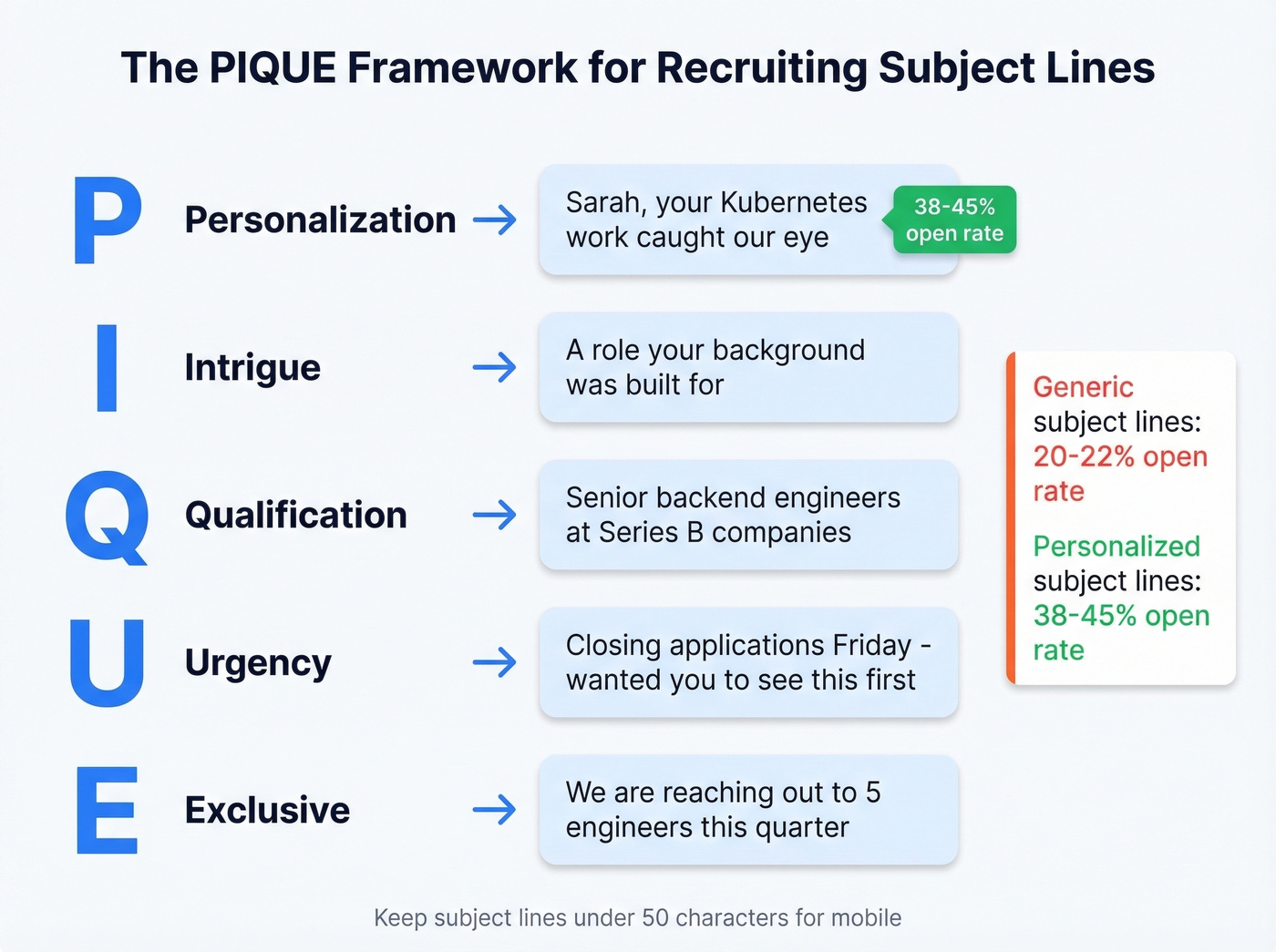
The PIQUE framework gives you a repeatable structure:
- Personalization - use their name, company, or skill. "Sarah, your Kubernetes work caught our eye."
- Intrigue - create a knowledge gap. "A role your background was built for."
- Qualification - signal fit. "Senior backend engineers at Series B companies."
- Urgency - imply timing. "Closing applications Friday - wanted you to see this first."
- Exclusive - make it feel selective. "We're reaching out to 5 engineers this quarter."
Mutual connection subject lines can hit 40-45% open rates. Subject lines with numbers see 17% higher open rates. Keep them under 50 characters for mobile - truncation starts around 40 characters on many devices. For more ideas, pull from email subject line examples.
One counterintuitive finding: emojis in subject lines correlate with 20% open rates versus 12% without. Use them sparingly, but don't dismiss them.
A few that work: "Quick question about [role] at [Company]," "Loved your talk at [Event]," "[Mutual connection] suggested I reach out."
12 Ready-to-Copy Recruiting Emails
Here's the thing - 70% of the workforce are passive candidates. They're not checking job boards. They're checking email. Each template below is built for that reality.
1. Cold Sourcing (Passive Candidate)
Subject: Your data platform work at Stripe
Hey Marcus,
I've been following what your team shipped with Stripe's real-time analytics pipeline - the latency improvements you wrote about were impressive. We're building the data infrastructure team at Vanta and need someone who's solved exactly those problems at scale.
The role is Staff Data Engineer, fully remote, $220-260k base. Would it be worth a 15-minute call to see if there's a fit?
Either way, happy to connect - always good to know strong data engineers.
Best, [Your name]
Why it works: Specific reference to their work (not just their title), comp range upfront, low-pressure CTA with an easy out. Under 100 words.
2. Referral Request
Subject: Know any strong product designers?
Hey [First name],
We're hiring a Senior Product Designer at [Company] - someone who's led end-to-end B2B SaaS design. Your name kept coming up when I asked the team who does great work in this space.
Anyone come to mind? Happy to make it worth your time - we offer a $2,500 referral bonus.
Thanks, [Your name]
Why it works: Flatters without being sycophantic. Specific about the profile. Mentions the incentive.
3. Application Acknowledgment
Subject: Got your application - here's what's next
Hi [First name],
Thanks for applying to [Role] at [Company]. We're reviewing applications this week and you'll hear back from us by [Date]. If you have questions in the meantime, just reply here.
Looking forward to it, [Your name]
Why it works: Sets a concrete timeline. Feels human, not automated.
4. Interview Invitation
Subject: Interview for [Role] - available next week?
Hi [First name],
Great news - we'd love to move forward with an interview for [Role]. It'll be a 45-minute conversation with [Interviewer name], our [Title], focused on [Topic].
Here are a few time slots: [Option 1], [Option 2], [Option 3]. Let me know what works and I'll send a calendar invite.
[Your name]
Why it works: Tells them who they're meeting, what to expect, and gives them control over scheduling.
5. Post-Interview Follow-Up
Subject: Thanks for chatting today
Hi [First name],
Thanks for taking the time to speak with [Interviewer] today. The team was impressed with your approach to [specific topic discussed]. We're wrapping up this round by [Date] and I'll be in touch with next steps.
If anything comes up in the meantime, don't hesitate to reach out.
[Your name]
Why it works: References something specific from the interview. Gives a timeline.
6. Re-Engaging Past Candidates
44% of sourced hires last year were rediscovered candidates - people who'd been in your pipeline before. Don't sleep on silver medalists.
Subject: Things have changed at [Company] - thought of you
Hey [First name],
We spoke about [Previous role] back in [Timeframe]. You were a strong candidate and the timing just wasn't right. We've since [grown the team / launched a new product / opened a new office] and have a [New role] that maps directly to what you were looking for.
Worth a fresh conversation?
[Your name]
Why it works: Acknowledges the history, explains what changed, keeps the ask frictionless.
7. Offer Email
Subject: Your offer from [Company] 🎉
Hi [First name],
We're thrilled to extend an offer for [Role] at [Company]. Attached is the full offer letter with compensation details, start date, and benefits overview.
Take your time reviewing - I'm available to walk through anything by phone or email. We'd love a response by [Date] if possible.
Welcome aboard (hopefully), [Your name]
8. Rejection Email
Subject: Update on your [Role] application
Hi [First name],
Thank you for the time you invested in interviewing for [Role]. After careful consideration, we've decided to move forward with another candidate whose experience more closely matched this specific role.
Your [specific skill/quality] stood out, and I'd genuinely like to keep in touch for future opportunities. Would you be open to that?
Best, [Your name]
Why it works: Specific compliment. Leaves the door open. Doesn't ghost.
9. Candidate-to-Recruiter Cold Email
This one's for candidates. It's based on a Reddit post that went viral because it actually got interviews.
Subject: Quick question about the Senior PM role at Notion
Hi [Recruiter name],
I've been following Notion's push into enterprise workflows - the recent Notion Projects launch is exactly the kind of product challenge I've spent the last 4 years solving at Asana, where I led the team that grew enterprise ARR from $8M to $22M.
I noticed you're hiring a Senior PM for the platform team. Would it make sense to chat, or could you point me to whoever handles hiring for that group?
Either way, appreciate your time.
[Your name]
Why it works: Specific interest in the company (not generic), a concrete win with numbers, low-friction ask with an easy out. Send it early morning or around lunch, not at 5pm.
10. Follow-Up After No Reply
Subject: Re: [Original subject line]
Hi [First name],
I know inboxes are brutal - just wanted to bump this in case it got buried. The [Role] is still open and your background is a strong fit.
If the timing's off, no worries at all. Just let me know either way.
[Your name]
Send this 5-7 days after your first email. In our experience, the second message in a sequence often outperforms the first - but only when it adds something new or shifts the angle. For more follow-up patterns, see cold email follow-up templates.
11. Diversity Sourcing Outreach
Subject: [First name], your work at [Company] stood out
Hey [First name],
I came across your [talk / article / project] on [Topic] and was genuinely impressed. We're building a [Team] at [Company] and are intentional about reaching people whose perspectives are underrepresented in our industry.
The role is [Title], [Location/Remote], [Comp range]. No pressure - happy to share more details if you're curious.
[Your name]
Why it works: Leads with their work, not their identity. Transparent about intent without being performative.
12. Executive Recruiting Outreach
Subject: [First name] - confidential VP Eng conversation
Hi [First name],
I'm reaching out about a VP of Engineering role at a Series C fintech ($85M raised, 200 employees) that's scaling from 30 to 80 engineers over the next 18 months. Your track record building engineering orgs at [Current company] - particularly the infrastructure overhaul you led - is exactly the profile we're looking for.
This is confidential and early-stage. Would a brief, discreet call make sense?
[Your name]
Why it works: Signals seniority through confidentiality, specificity, and a respectful tone. No fluff, no hard sell.

Every bounced recruiting email is a top candidate you'll never reach. Prospeo verifies candidate emails at 98% accuracy with a 7-day data refresh - so the passive talent you spent 20 minutes personalizing an email for actually receives it. Free tier includes 75 verifications/month.
Stop crafting perfect recruiting emails that bounce into the void.
Build a Full Outreach Sequence
Single emails are lottery tickets. A 4-stage sequence captures 90% of possible replies, and six to seven touchpoints can drive response rates up to 450% higher than a single message.
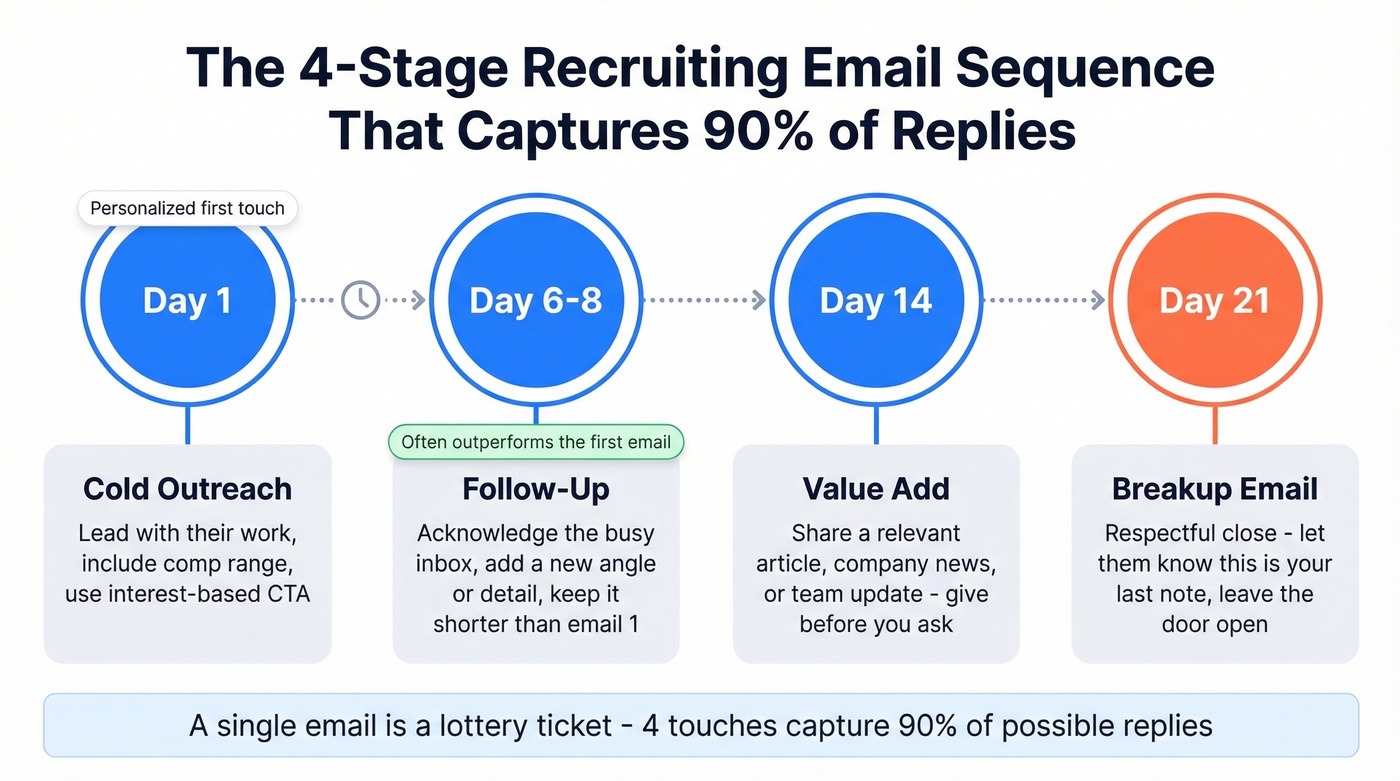
Here's a 5-email sequence with timing that works:
- Day 1 - The opener. Your strongest pitch. Personalized, specific, under 125 words.
- Day 4 - The value add. Share something useful: a blog post about your team's culture, a podcast your CTO did, comp benchmarks for the role. Don't just "check in." (More ideas: emails that get responses.)
- Day 9 - The angle shift. Try a different hook. If email 1 led with the role, email 3 leads with the team or the problem they'd solve.
- Day 16 - The social proof. Mention a recent hire's experience, a Glassdoor rating, or a team milestone.
- Day 25 - The graceful close. "Totally understand if the timing isn't right. I'll keep your info on file for future roles that match. Just say the word if anything changes."
Results flatten after stage 5. Don't be the recruiter who sends email #8. Recruiters on r/recruiting consistently report that the second and third follow-ups generate the most replies - but only when each message adds new value instead of just "bumping."
Personalize at Scale Without Losing Your Mind
Large-scale cold campaigns average 2.1% reply rates. Smaller, targeted sends hit 5.8%. The gap is personalization - but you can't write a custom email for every candidate when you're managing 14 open reqs.
Use a tiered model:
Tier 1 - top 10% of candidates. Deep personalization. Reference a specific project, publication, or career move. Write each email from scratch. This is your VP of Engineering outreach, your purple squirrels.
Tier 2 - next 30%. Template with dynamic fields beyond {First_Name}. Pull in current company, recent promotion, a mutual connection, or a specific skill. "Congrats on the move to [Company] - the [Department] team there is doing interesting work" takes 30 seconds and feels personal. If you're building a repeatable system, borrow from personalized outreach.
Tier 3 - remaining 60%. Well-segmented templates. Group candidates by role, seniority, and industry. A "Senior Backend Engineer at a fintech" template is far better than a generic "we have an exciting opportunity" blast.
Let's be honest about AI-written outreach for a second. We've reviewed hundreds of candidate emails this year, and the AI-generated ones all sound the same - vaguely complimentary, structurally identical, zero specificity. Candidates notice. The recruiters winning right now use AI to research faster, then write the actual email themselves. Stop optimizing your template. Start optimizing your data. If you're experimenting here, start with AI cold email outreach.
Mistakes That Kill Reply Rates
Typos and grammar errors are the fastest way to lose credibility. 59% of candidates say a single typo leaves a negative impression - and in recruiting, first impressions are the only impression you get.
Misaligned opportunities are the silent killer. 60% of candidates don't respond because the role doesn't match their interests. Targeted messages increase reply rates by 30%, which means the five minutes you spend checking whether someone actually wants a management role before pitching one pays for itself immediately.
Weak CTAs hurt more than you'd think. "Let me know your thoughts" reduces meeting booking rates by about 20% compared to a specific question like "Would a 15-minute call on Thursday work?"
Bad timing is an easy fix most people ignore. Stick to Tuesday through Thursday, 9am-5pm in the candidate's time zone. Weekend emails signal desperation, not urgency.
Skip the "spray and pray" approach entirely. Sending identical messages to 500 people without segmentation isn't a sequence - it's spam. And GDPR and CAN-SPAM aren't optional. Include an unsubscribe option and respect opt-outs. Even the best recruiting email examples won't save you if your messages land in the spam folder because of compliance issues.
Make Sure Your Emails Actually Land
Most recruiting email guides stop at the template. Here's the part they skip.
You wrote the perfect email. Personalized subject line, 90-word body, interest-based CTA. It bounced. Or worse - it landed in spam. 10.5% of all emails end up in spam folders. For recruiters sending high volumes from new domains, that number climbs fast.
Start with authentication. Set up SPF, DKIM, and DMARC on your sending domain - these protocols prove to inbox providers that you're legitimate. If those acronyms mean nothing to you, hand them to your IT team. It's non-negotiable. (If you're debugging, start with how to verify DKIM is working.)
Warm up your inbox. Start at 10-20 emails per day and increase weekly. Jumping straight to 100 sends on a fresh domain is a fast way to get flagged. Monitor your sender reputation through Google Postmaster Tools and Microsoft SNDS. Never send from a no-reply@ address. To keep volume safe, follow email velocity.
Your templates don't matter if the email never arrives. The lever most guides ignore is contact data quality - verify candidate emails before you send. Prospeo handles this at 98% accuracy across 300M+ profiles, and the free tier is enough to validate your top candidates before every sequence goes out. If you need a broader playbook, use this email deliverability guide.
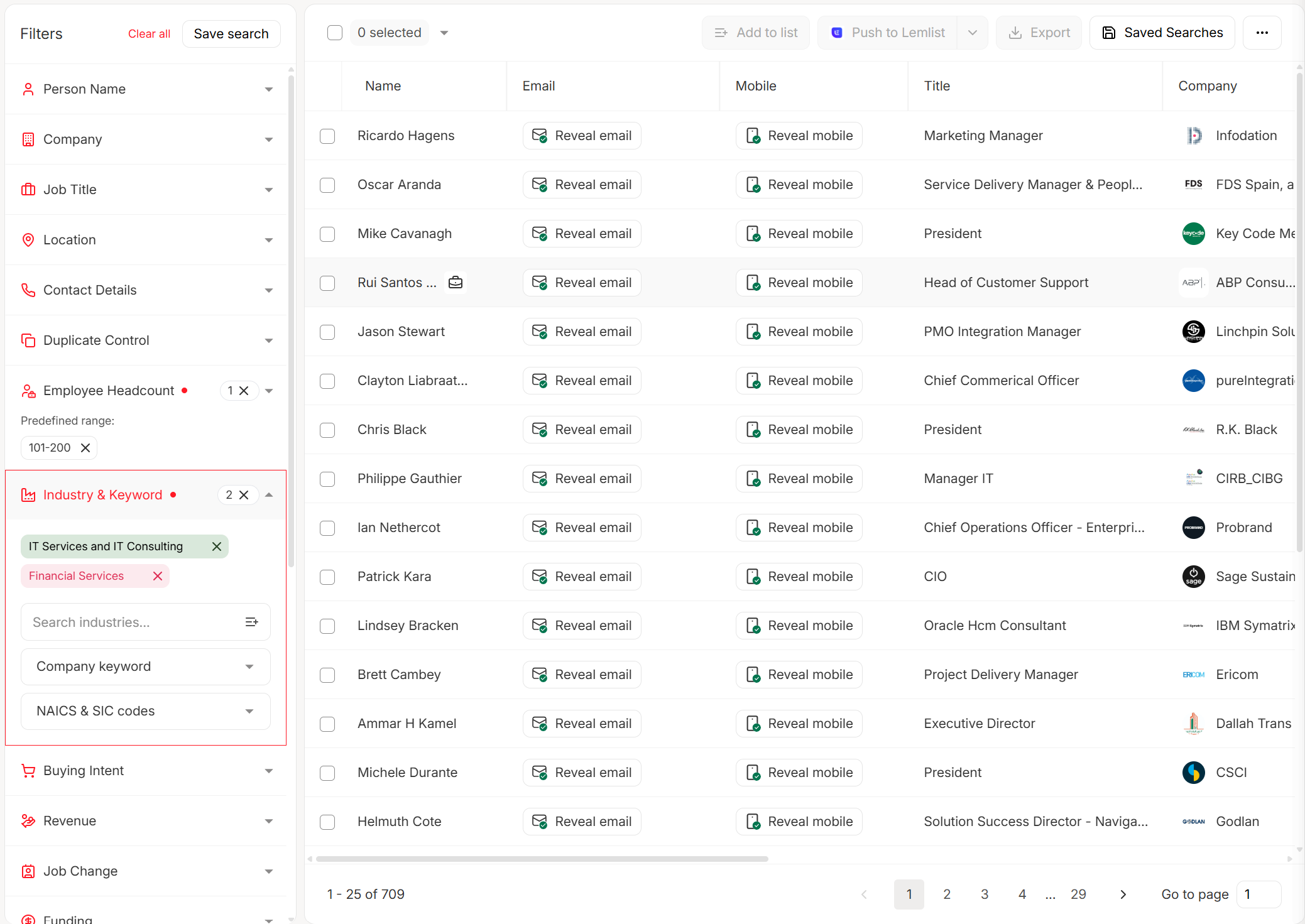
Sourced candidates are 5x more likely to be hired, but only if your outreach lands. Prospeo gives you verified professional emails for 300M+ profiles at ~$0.01 each - so your 4-5 email sequences hit real inboxes, not dead addresses that tank your domain reputation.
Find verified emails for every candidate on your sourcing list.
FAQ
How long should a recruiting email be?
50-125 words - roughly 5-8 sentences. That's enough to establish relevance and include a clear CTA without forcing the candidate to scroll on mobile, where 61% of emails are opened.
What's a good reply rate for cold recruiter outreach?
Cold recruiting emails typically land between 1-5%. With strong personalization, verified contact data, and a multi-email sequence, top recruiters report 10-15%+. The biggest variable isn't your template - it's whether you're reaching the right person at the right time.
How many follow-ups should I send?
Four to five emails total. A 4-stage sequence captures 90% of possible replies, and results flatten noticeably after stage 5. Each follow-up should add new value - a culture link, comp data, or a different angle - not just "bump" the previous message.
When's the best time to send recruiting emails?
Tuesday through Thursday, 9am-5pm in the candidate's local time zone. Avoid Monday mornings (inbox overload) and Friday afternoons (mentally checked out). Early morning and lunchtime slots tend to produce the highest open rates. Mailchimp's send-time research backs this up across industries.