

B2B Email Subject Line Best Practices: What 5.5M Emails Reveal
45% open rate, 1.2% reply rate. Your subject line "worked" - and your pipeline didn't move. Most B2B email subject line advice floating around is recycled from blog posts that optimize for a metric Apple broke in 2021. The data has shifted. If you're still A/B testing emoji placement, you're solving the wrong problem.
Why Most Subject Line Advice Is Outdated
Roughly 17% of cold emails never reach the inbox at all. That's before anyone reads your carefully crafted subject line.
Meanwhile, the top-ranking guides still recommend tactics - numbers in subject lines, urgency words, title case - benchmarked against datasets from 2019 or earlier. Tactics decay. A Yesware study of 1.2M cold emails in 2021 found numbers in subject lines boosted opens by 45%. Fast forward to Belkins' 2024 dataset of 5.5M emails, and numbers actually hurt performance slightly - 27% opens versus 28% without.
What worked three years ago is now noise. The consensus on r/coldemail mirrors this: practitioners report "Quick question" and "Hey {fname}" feeling noticeably less effective heading into 2026. If you want subject lines that get opened today, you need fresh data, not recycled playbooks.
The Quick Framework
Short on time? This holds up across every recent dataset we've reviewed:
- 33 characters or fewer - the only length that displays fully across all mobile clients
- Personalize with company or prospect-specific details - 46% opens vs. 35% without, and reply rates more than double (7% vs. 3%)
- Measure positive reply rate, not opens - Apple Mail Privacy Protection broke open tracking in 2021, and it's only gotten worse
- Send Tue-Thu, 9-11am in the recipient's timezone - Reddit practitioners consistently report this window outperforms Monday mornings and Friday afternoons (see our deeper breakdown on the best time to send cold emails)
What 5.5M Emails Tell Us
Belkins published the largest recent cold email subject line study - 5.5 million emails sent throughout 2024, with partnership data from Reply.io. Here's what the numbers actually say.
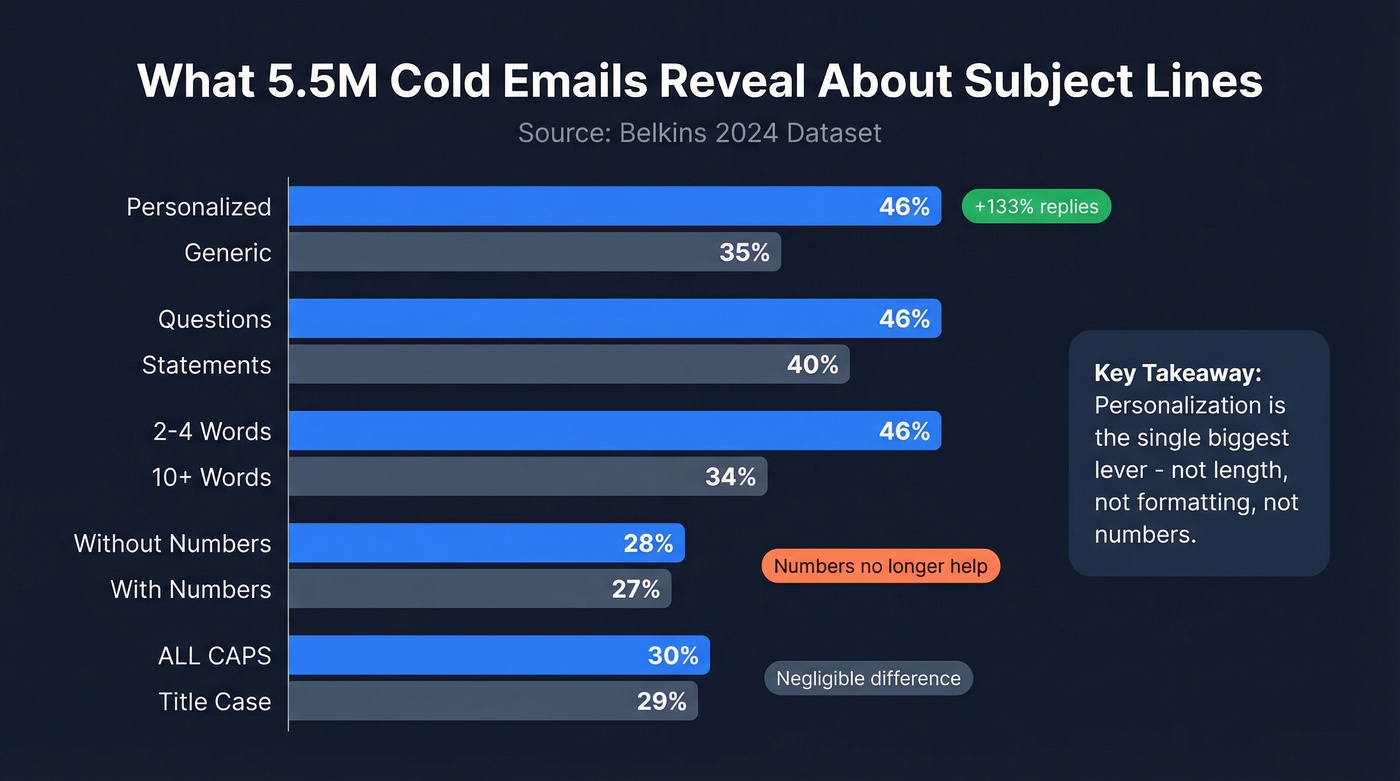
Personalization is the single biggest lever. Personalized subject lines hit 46% open rates versus 35% for generic ones. More importantly, reply rates jumped from 3% to 7% - a 133% increase. This isn't "Hi {FirstName}" personalization. It's referencing the prospect's company, a recent initiative, or a specific pain point. (If you want a system for doing this at scale, see personalized outreach.)
Questions outperform statements. Subject lines framed as questions averaged 46% opens, the top-performing format in the dataset. This tracks with what practitioners report on Reddit - curiosity-driven, slightly vague subjects feel like internal emails and get opened.
Shorter wins. Two to four words hit the highest open rates at 46%. One-word subjects underperformed at 38%, too vague without enough context. Performance drops steadily after seven words (39%), through nine words (35%), and by ten words you're down to 34%. Twilio SendGrid's Cyber Week analysis confirmed 2-4 word subjects as the top performers. The old "sweet spot" of 6-10 words that some guides still recommend? A relic.
Numbers no longer help. Subject lines with numbers averaged 27% opens versus 28% without. Compare that to Yesware's 2021 finding of a 45% lift from numbers. The tactic has been commoditized into irrelevance.
Casing is a minor factor - ALL CAPS edged out title case slightly (30% vs. 29%), though the difference is negligible and ALL CAPS can trigger spam filters. Don't overthink it. Natural first-letter capitalization is the safest bet. (If you're troubleshooting inboxing, start with an email spam checker.)
Character Limits, Settled
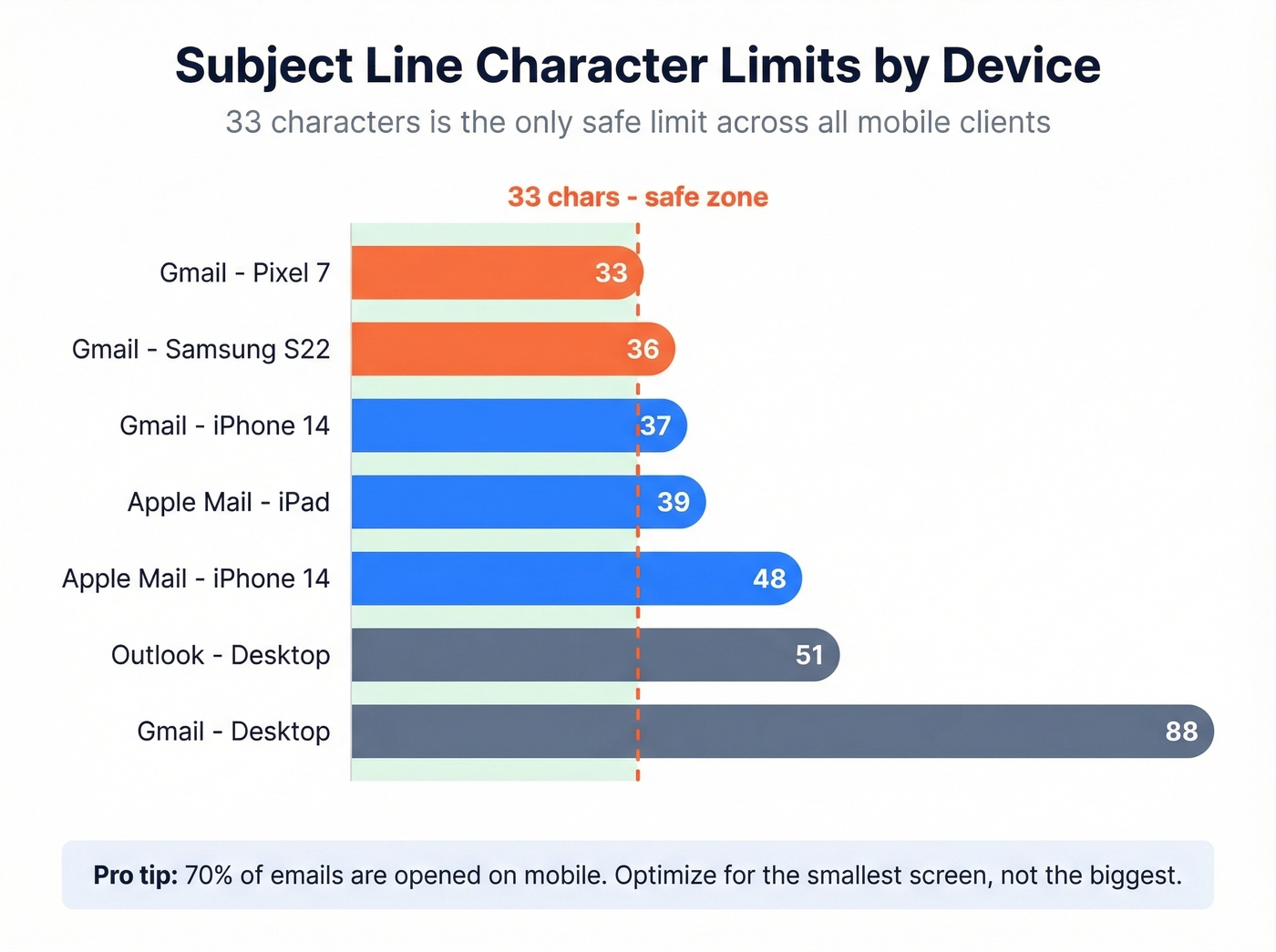
Every guide gives you a different number. Here's the actual device-by-device truncation data from EmailToolTester:
| Device / Client | Max Characters |
|---|---|
| Gmail - Pixel 7 | 33 |
| Gmail - Samsung S22 | 36 |
| Gmail - iPhone 14 | 37 |
| Apple Mail - iPad | 39 |
| Apple Mail - iPhone 14 | 48 |
| Outlook - Desktop | ~51 |
| Gmail - Desktop | ~88 |
The safe number is 33 characters. That's the floor - the only length guaranteed to display fully on every major mobile client. Since 70% of emails are opened on mobile, optimizing for desktop truncation limits means optimizing for the minority.
One nuance worth knowing: character width varies. A subject line full of "M"s and "W"s truncates sooner than one with "i"s and "l"s. Treat 33 as a practical ceiling, not a precise cutoff.
Don't forget preview text. The snippet that appears after the subject line on mobile is equally important and almost universally neglected. Keep it to 37 characters for full mobile display. Use it to extend the subject line's promise, not repeat it. If your preview text reads "View this email in your browser," you're wasting prime real estate. (More on this in email preview text A/B testing.)

Personalized subject lines drive 133% more replies - but only if your emails actually land. 17% of cold emails never reach the inbox because the address is wrong. Prospeo's 98% verified emails and 7-day data refresh mean your carefully crafted subject lines hit real inboxes, not bounce logs.
Stop perfecting subject lines for emails that bounce.
Subject Lines That Get Replies
Open rates are vanity. These patterns come from practitioners with actual reply rate data. (For more swipeable options, see our email subject line examples.)
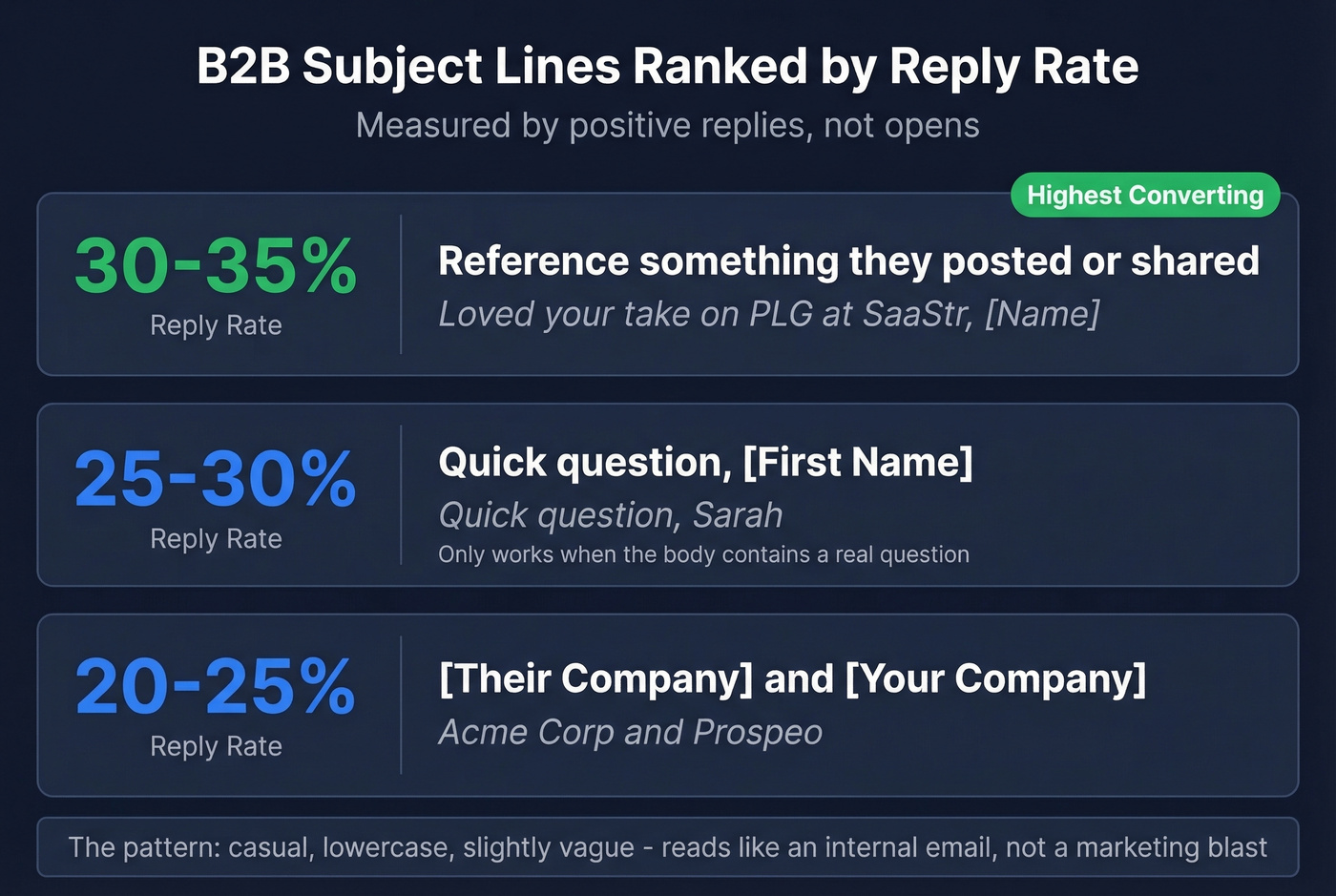
"Quick question, [First Name]" still pulls a 25-30% response rate - when the body delivers a genuine, specific question. It falls apart the moment the email pivots to a generic pitch. The subject earns a click; the body earns the reply. (If the body is the bottleneck, use this email copywriting framework.)
"[Their Company] and [Your Company]" lands around 20-25% response rate. The partnership frame feels relevant rather than salesy, and it works especially well when there's a logical connection between the two companies. It's also strong for networking emails - framing the relationship as mutual rather than transactional.
The hardest to scale but highest-converting pattern we've seen is referencing something the prospect actually posted or shared - a take they published, a conference talk, or a hiring signal. In our experience, this consistently hits 30-35% response rates. For high-value accounts, nothing beats it.
The underlying framework from r/sales practitioners is consistent: casual, lowercase, slightly vague. Think "Question about [COMPANY's] marketing stack" or "Idea for [COMPANY's] demo conversion rates." These read like internal emails, not marketing blasts - and they outperform polished copy because they mirror how colleagues actually communicate.
Here's the thing most teams miss: your subject line approach should change by sequence stage. Cold outreach needs curiosity and personalization. Follow-ups need brevity and a reason to re-engage ("Forgot to mention this"). Re-engagement after silence needs a pattern interrupt ("Closing your file" or "Wrong person?"). Most teams use the same formula across all three. It shows. (If you're building the full flow, start with a B2B cold email sequence.)
Patterns to Avoid
"Quick question" without an actual question is the fastest way to get archived. The pattern has been so widely adopted that it triggers the same fatigue as "Just checking in" did three years ago. (Alternatives here: how to say just checking in professionally.)
Skip these entirely:
- Marketing-speak - "Boost your ROI," "Transform your business." These get auto-deleted or filtered. They signal a mass blast, not a conversation.
- Deceptive subjects - Fake "RE:" prefixes, misleading leads like "Marketing firm needed." Some practitioners on r/coldemail admit these spike opens short-term, but they destroy trust and sender reputation. Not worth it.
- "Newsletter" in the subject - among the worst performers in a 2,500+ subject line analysis across 12 industries.
- ALL CAPS, excessive punctuation, emoji-heavy lines - these underperform in B2B contexts, signal promotional email, and can trigger spam filters.
- Passive, vague phrasing - action-oriented subject lines that imply a clear next step ("Feedback on [COMPANY's] demo flow?") consistently outperform passive ones ("Some thoughts about your company").
Stop Optimizing for Open Rate
Apple Mail Privacy Protection, launched with iOS 15, pre-fetches tracking pixels for every email - whether the recipient reads it or not. Campaign Monitor's analysis of 100B+ emails showed a 21.5% average open rate, but the jumps in that number align closely with MPP rollout dates. B2B tech averages around 22.7% opens; if your number is much higher, MPP inflation is the likely cause.
Let's be honest: if you're reporting a 45% open rate to your team, a meaningful chunk of those "opens" are Apple's servers, not humans. The north star metric for cold email is positive reply rate. Platform-wide averages sit around 3.4%. If you're consistently above 5%, your subject lines and messaging are working. Everything else is noise.
One more thing. Gmail's spam complaint threshold is 0.1% - exceed it and your entire domain gets filtered, regardless of how good your subject lines are. (If you're seeing issues, start with this email deliverability guide.)
How to A/B Test Properly
Most B2B A/B tests are coin flips with extra steps. We've watched teams run "tests" on 40-person segments and declare a winner based on two extra opens. Here's how to run one that actually tells you something:
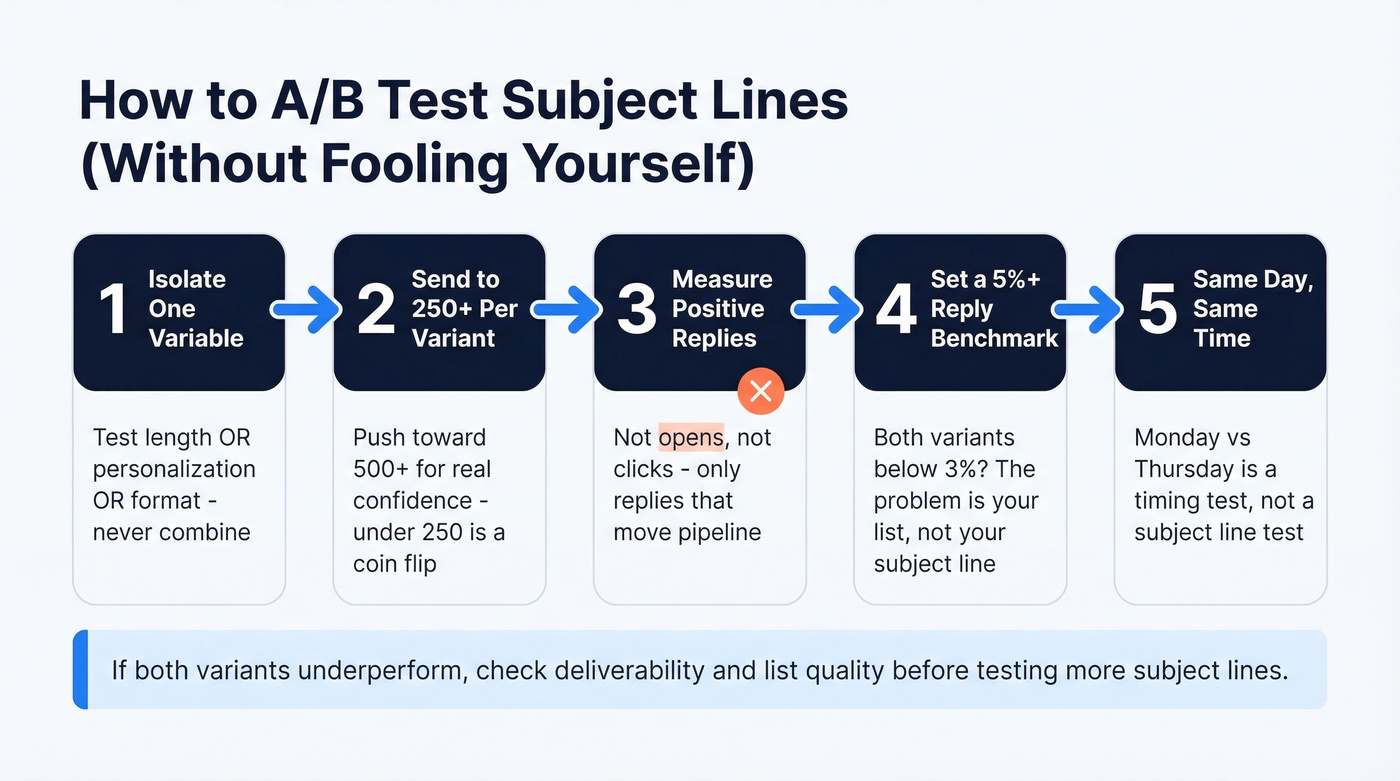
- Isolate one variable per test. Subject line length OR personalization OR question format. Never all three.
- Send to 250+ contacts per variant. Push toward 500+ for higher confidence. Anything under 250 is rarely conclusive.
- Measure positive reply rate. Not opens, not clicks. A clickbait subject can spike opens while tanking replies and hurting your sender reputation.
- Set a clear benchmark. Aim for 5%+ positive reply rate. If both variants are below 3%, the problem isn't your subject line - it's your targeting, your list quality, or your deliverability.
- Give timing a fair shake. Send both variants on the same day, same time slot. Sending Variant A on Monday and Variant B on Thursday isn't a subject line test - it's a timing test.
These principles apply whether you're running cold outreach, nurture sequences, or re-engagement campaigns. The methodology doesn't change; only the benchmarks do.
The Prerequisite Nobody Mentions
You can write the perfect subject line and it won't matter if 17% of your emails never reach an inbox. Follow-ups generate 42% of all campaign replies, yet 48% of reps never send a second email. The ones who do follow up are often wasting those touches on undeliverable addresses. (If you're tightening this part of the motion, use these cold email follow-up templates.)
We've seen teams spend weeks optimizing copy while sending to lists with 15-20% invalid addresses. That's not a subject line problem - it's a data quality problem. Even the strongest B2B email subject line practices can't salvage a campaign that bounces before anyone sees it.
Before you test a single subject line variant, verify your list. Prospeo runs 98% email accuracy with a 7-day data refresh cycle, so you're not sending to addresses that went stale six weeks ago. The free tier gives you 75 email verifications per month - enough to test whether your current list is the bottleneck. Pair clean data with the subject line framework above, and you're optimizing the thing that actually reaches inboxes.

The data is clear: referencing a prospect's company or recent activity in your subject line doubles reply rates. Prospeo returns 50+ data points per contact - job changes, tech stack, funding signals - so every subject line writes itself.
Build subject lines from real prospect data, not guesswork.
FAQ
How long should a B2B cold email subject line be?
Keep it to 2-4 words or 33 characters to display fully across all mobile email clients. Belkins' 5.5M-email study found 2-4 word subjects hit 46% open rates - the highest of any length bracket. Longer subjects get truncated on Gmail for Android, which cuts off at 33 characters.
Do emojis help B2B email subject lines?
No. An analysis of 2,500+ subject lines across 12 industries found emoji-heavy subjects among the worst performers. In B2B contexts, emojis signal marketing emails and can trigger spam filters. Save them for consumer brands.
Should I personalize every cold email subject line?
Yes - but with relevant details, not just first names. Personalized subjects get 46% opens versus 35% without, and reply rates more than double from 3% to 7%. Reference the prospect's company name, a recent post they wrote, or a specific pain point tied to their role.
What's a good reply rate for cold email?
Aim for 5%+ positive reply rate. The platform-wide average sits around 3.4%. If you're consistently above 5%, your subject lines and messaging are working. If you're below that, test your subject lines, verify your contact data, and check your deliverability before changing anything else.
What is a good professional email subject line?
The best-performing B2B subject lines are short (2-4 words), personalized to the prospect's company or situation, and framed as questions. Something like "Question about [COMPANY's] onboarding" outperforms "How We Help Companies Like Yours Grow" every time. Keep it casual, lowercase, and specific enough to feel like an internal email rather than a marketing blast.