

Follow Up Email Format: Structure, Rules, and Templates That Actually Get Replies
You've written the perfect cold email. Personalized opener, sharp value prop, clean CTA. Then silence. So you open a blank compose window and type "Just wanted to follow up on my previous email..." - and you've already lost.
Here's the reality: 42% of all cold email replies come from follow-ups, not the first message. But most follow-ups fail because they're formless - no structure, no new value, no reason for the recipient to care. The follow up email format is the problem, not the effort.
The short version: keep it under 125 words, plain text, one clear ask. Reply in the same thread - never start a new email. And every follow-up should address a different objection: need, cost, urgency, desire, or trust.
Below: the full 6-component anatomy, 8 templates, and the data behind every rule.
Anatomy of a Follow-Up Email
Most guides dump 20 templates on you and call it a day. Templates are illustrations, not the product. Learn how to structure a follow-up properly, and you can write any follow-up for any scenario without Googling templates ever again.
Every effective follow-up has six components. Some are one sentence. None are optional.
The 6 Components
Subject line. Short, specific, never generic. More on this below - but if your subject line says "Following up," you've already signaled that you have nothing new to say.
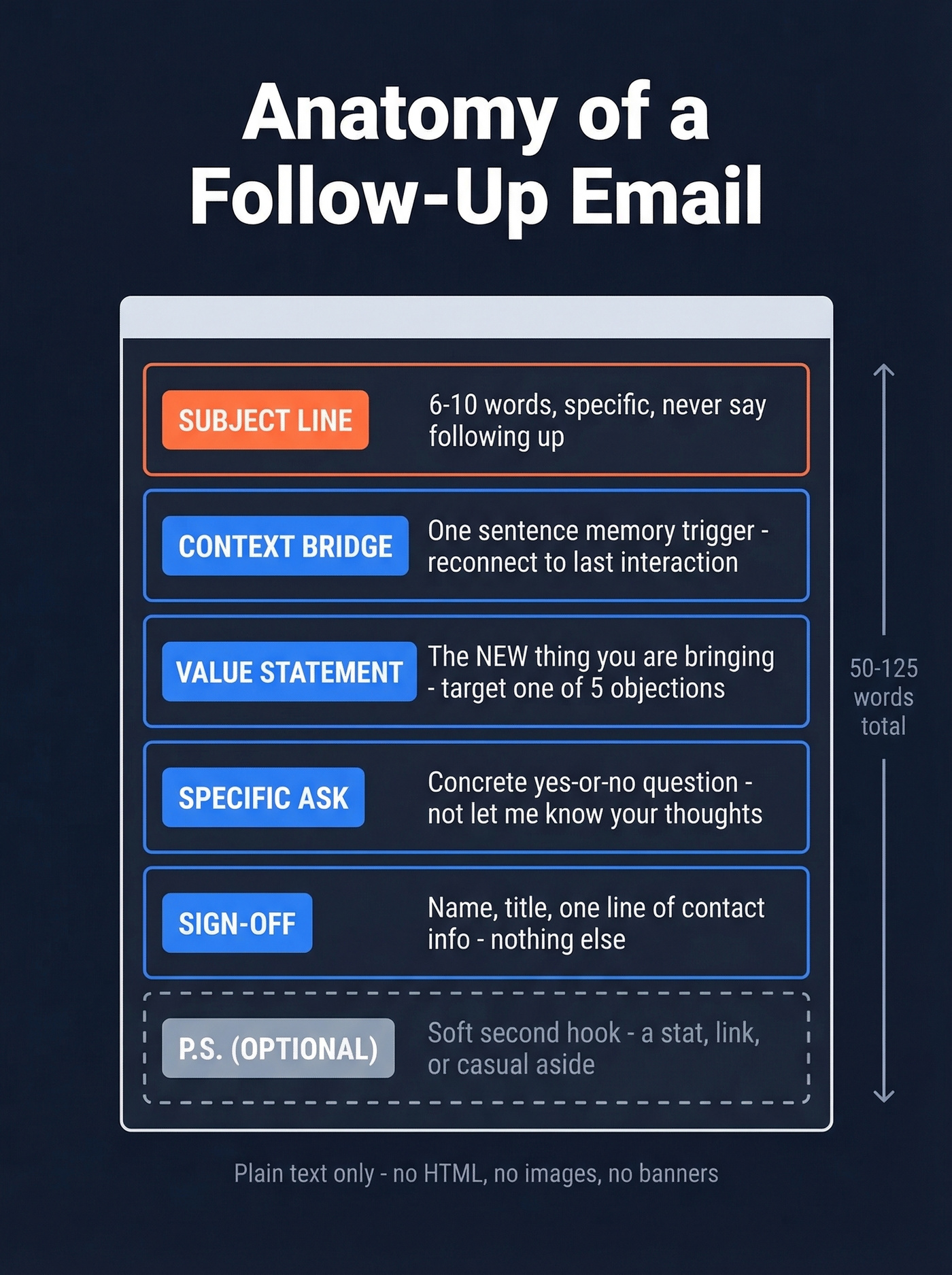
Context bridge. One sentence that reconnects the recipient to your last interaction. "We spoke on Tuesday about your Q3 pipeline targets" or "You downloaded our ROI calculator last week." This isn't a recap - it's a memory trigger.
Value statement. The new thing you're bringing. A relevant stat, a resource, a case study, a different angle on the problem. This is what separates a follow-up from a nag. If you can't articulate the new value in one sentence, you're not ready to send.
Here's the framework we use internally: every prospect who doesn't reply has one of five objections - they don't see the need, they question the value vs. cost, they feel no urgency, they don't want what you're selling, or they don't trust you yet. Each follow-up should target a different one. Your first follow-up might address urgency with a time-bound offer. Your second might build trust with a case study. Your third might reframe the need entirely. This single mental model will generate better follow-ups than any template library, because it forces you to think about the recipient's psychology instead of your own anxiety about not hearing back.
Specific ask. Not "let me know your thoughts" - that's a dead end. "Do you have 15 minutes Thursday at 2 PM?" or "Would it help to see how [Company X] solved this?" Give them something concrete to say yes or no to. (If you want more options, see these email CTA rules.)
Sign-off. Keep it simple. Your name, title, one line of contact info. No inspirational quotes. No 12-line signature blocks with social icons.
Optional P.S. A P.S. line gets read disproportionately often. Use it for a soft second hook - a relevant link, a quick stat, or a casual aside that adds personality.
Three Formatting Rules
50-125 words. That's the sweet spot based on 2026 cold email benchmark data. Anything longer and you're writing a proposal, not a follow-up. If your follow-up is over 125 words, cut it in half and see if you lost anything important. You probably didn't.
Limit multi-sentence paragraphs to one per email. This rule comes from NetHunt's formatting research, and it's the single best scannability hack for email. Your value statement might need two sentences. Everything else should be one line each. The email reads faster and feels like a message from a person, not a campaign.
Plain text beats HTML. No banners, no images, no fancy formatting. Plain text emails look like real emails from real people. HTML templates look like marketing. In a follow-up, you want to feel like a colleague, not a newsletter.
Subject Line Rules That Drive Opens
Your subject line does one job: get the email opened. 33% of recipients decide whether to open based on the subject line alone, and 69% use it to decide whether to mark you as spam.
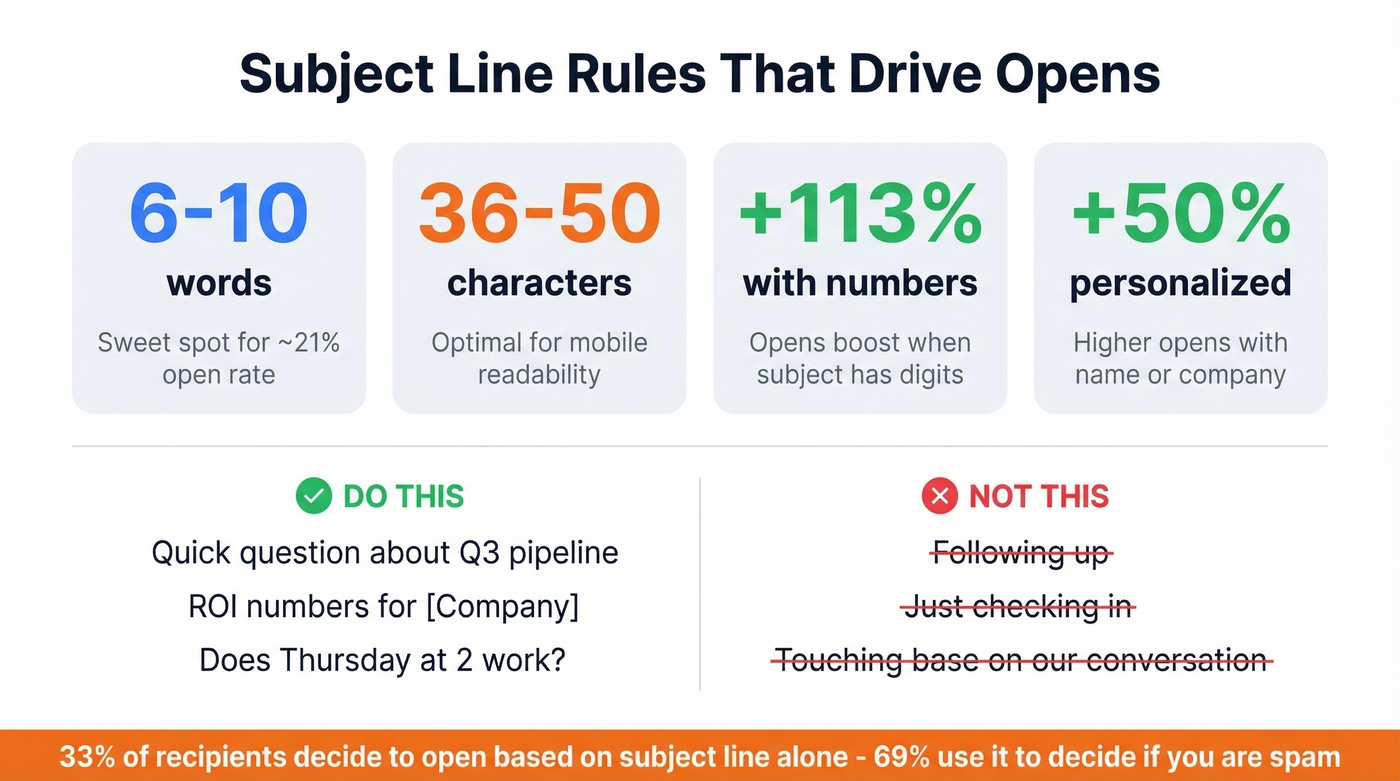
The formatting specs are clear: aim for 6-10 words (where open rates hit around 21%) and roughly 36-50 characters for mobile-friendly readability. Numbers in subject lines can boost opens by up to 113%. Questions lift opens by about 21%. Personalized subject lines - using the recipient's name, company, or a specific detail - drive 50% higher open rates than generic ones. (More examples: email subject line examples.)
One hard rule: never use the words "follow-up" or "checking in" in your subject line. They signal zero value and train recipients to ignore you.
| Scenario | Example Subject Line |
|---|---|
| Sales (no reply) | Quick question about Q3 pipeline |
| Sales (post-demo) | ROI numbers for [Company] |
| Meeting recap | Action items from Tuesday |
| Interview | Thank you - excited about the role |
| Invoice | Invoice #4821 - due Friday |
| Networking | Great meeting you at SaaStr |
| Value-add | [Company]'s competitor just did this |
| Breakup | Should I close your file? |
| Scheduling | Does Thursday at 2 work? |
| Re-engagement | Something changed since we spoke |
Mistakes That Kill Reply Rates
These are the errors we see most often across client campaigns - and every one of them is a format problem, not a copy problem.
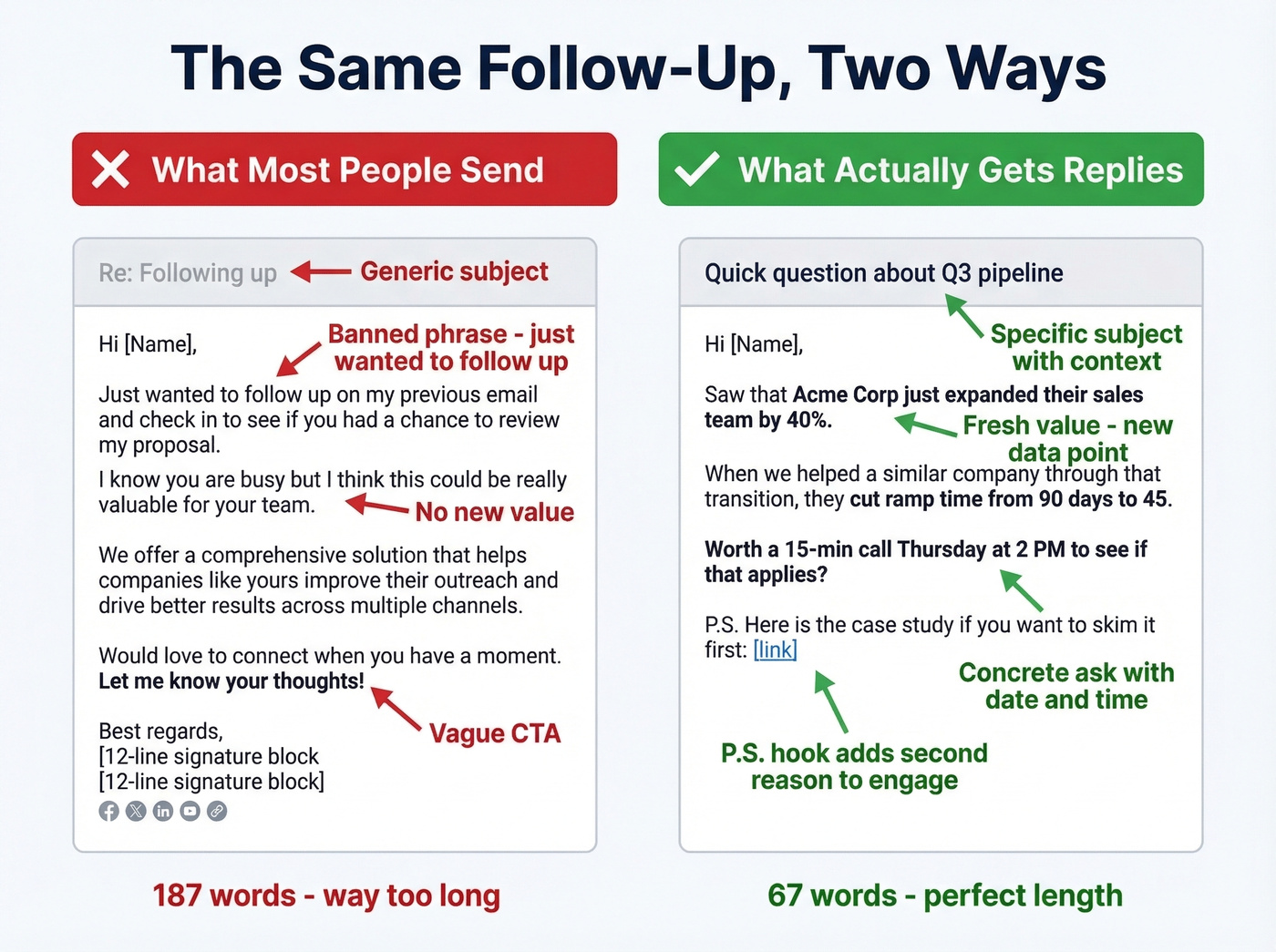
1. Bumping with no new information. "Just wanted to bump this to the top of your inbox" tells the recipient you have nothing new to say. Every follow-up needs a fresh value statement targeting one of those five objections. If you don't have one, wait until you do.
2. Starting a new thread. Always reply in the same email thread. It preserves context and keeps the conversation visible.
3. Using banned phrases. "Touching base," "checking in," "circling back," "per my last email." These are filler. They take up space where your value statement should be. The consensus on r/sales is that the best follow-ups don't sound like follow-ups at all - they sound like someone with a reason to write. (If you need alternatives, see how to say just checking in professionally.)
4. Writing too much. If your follow-up is three paragraphs, you've written a new cold email. Trim it.
6. Not varying your angle. Most reps send the same pitch reworded four times. That's not a sequence - it's repetition. Map each follow-up to a different objection and you'll cover more ground in fewer touches. (Related: AI sales follow-up.)

A perfect follow-up format means nothing if the email bounces. Prospeo's 98% verified email accuracy ensures every follow-up in your sequence actually reaches the inbox - not a dead address that tanks your domain reputation.
Stop crafting follow-ups for inboxes that don't exist.
Timing and Cadence by Context
Timing matters less than format, but it still matters. The general rule: Tue-Thu, 9-11 AM in the recipient's local time zone performs best across most studies. Some Yesware analyses point to 1 PM as a secondary peak - test both windows for your audience. Fridays and weekends consistently underperform. (Deep dive: best time to send cold emails.)
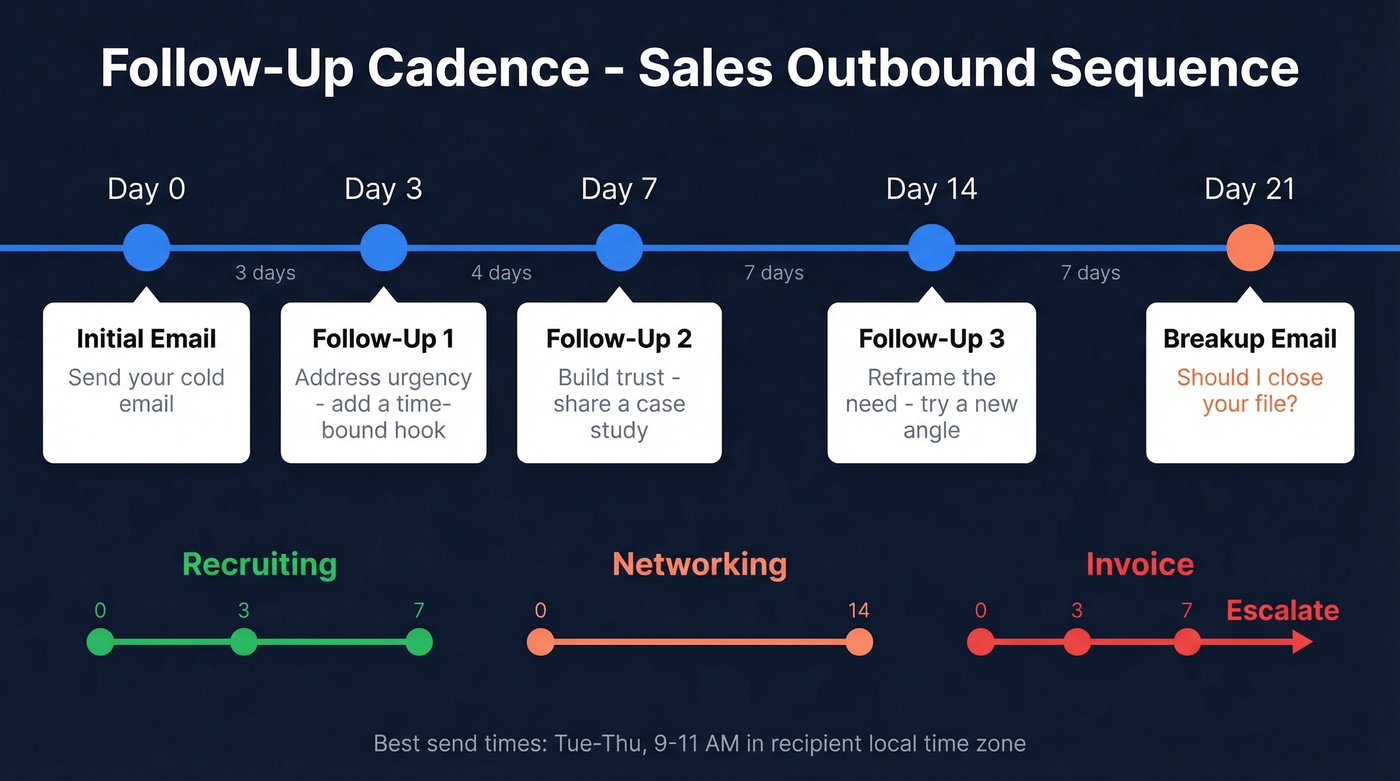
We've tested dozens of cadence patterns across client campaigns. The bigger question is always how long to wait between touches, and when to stop.
| Context | Cadence (days) | Max Touches | When to Stop |
|---|---|---|---|
| Sales outbound | 0, 3, 7, 14 | 4-5 | After 5 with no reply |
| Urgent/time-bound | 0, 2, 5, 10 | 3-4 | After deadline passes |
| Recruiting | 0, 3, 7 | 2-3 | After 3 - respect it |
| Invoices | 0, 3, 7 | 3 then escalate | Escalate to manager |
| Networking/event | 0 (within 48h), 14 | 2 | After 2 - don't push |
| Post-interview | Within 24h, then 5-7 | 2 | After 2 - read the room |
The key principle: space increases over time. Your first follow-up can come 2-3 days later. By touch four or five, you're waiting 10-14 days. Anything under 24 hours feels aggressive. Anything over 10 days between early touches loses context. (More guidance: when should I follow up on an email.)
If you're closing deals under $10k, you probably don't need more than three follow-ups. Save the longer cadences for enterprise deals where persistence actually pays off.
One more trigger worth building into your cadence: event-based follow-ups. When a prospect re-opens your email, visits your pricing page, or their company announces funding, that's a better signal than any calendar-based schedule. Most sequencing tools can fire a follow-up off these triggers - use them. (Related: how to track sales triggers.)
Templates by Scenario
These templates follow the 6-component structure. Adapt them - don't copy-paste blindly. The format is the point, not the exact words. (If you want a bigger library, use these sales follow-up templates.)
After No Response (Sales)
Subject: Does Thursday at 2 work?
Hi [Name], I'm trying to finalize my schedule for next week - wanted to know if Thursday at 2 PM works for a quick call about [specific topic]. If timing's off, just say when. I also pulled some data on how [competitor/peer company] handled [problem] - happy to share.
The "finalize my schedule" framing - borrowed from a popular r/sales thread - creates soft urgency without pressure. Specific time. New value offered. If you left a voicemail before sending this, reference it: "Left you a quick voicemail - here's the short version."
Post-Meeting Recap
Subject: Action items from Tuesday
Hi [Name], great conversation yesterday. Here's what we agreed on:
| Action Item | Owner | Deadline |
|---|---|---|
| Send pricing proposal | Me | Friday |
| Loop in IT for security review | You | Next Tuesday |
| Schedule follow-up call | Me | Week of [date] |
I'll have the proposal over by EOD Friday. Let me know if I missed anything.
The table format removes ambiguity. Clear owners and deadlines make it scannable. No fluff.
After an Interview
Subject: Thank you - excited about the role
Hi [Name], thank you for taking the time today. The conversation about [specific project or challenge discussed] reinforced my interest - it's exactly the kind of problem I've spent the last [X] years solving. Looking forward to next steps.
Specific reference to the conversation proves you were listening. Send within 24 hours while you're still top of mind. One r/interviews user reported getting a job offer 20 minutes after sending their follow-up. It won't always work that fast, but not sending one is leaving the door closed.
Networking or Event
Most networking follow-ups die because they're generic. Here's the format that actually converts a handshake into a relationship:
Subject: Great meeting you at [Event]
Hi [Name], enjoyed our conversation about [topic] at [Event]. You mentioned [specific challenge] - I just published a piece on exactly that. Here's the link: [URL]. Would love to continue the conversation over coffee or a quick call. No rush.
Send this within 24-48 hours of the event. Reference a specific detail. Offer value before asking for anything.
Overdue Invoice
The common mistake here: getting emotional. The moment your invoice follow-up sounds frustrated, you've made it harder for the recipient to respond. Keep it clinical.
Subject: Invoice #[number] - due [date]
Hi [Name], just a heads-up that invoice #[number] for $[amount] was due on [date]. I've attached a copy for convenience. Could you confirm this is in the queue? If there's an issue on your end, happy to sort it out.
Direct, professional, zero emotion. Specific invoice number and amount. Clear ask.
Post-Demo or Proposal
Subject: ROI numbers for [Company]
Hi [Name], following up on last week's demo. I ran the numbers based on what you shared about [specific metric] - looks like you'd save roughly [X hours/dollars] per quarter. Full breakdown attached. Worth a 15-minute call to walk through it?
New value in the form of a custom ROI calculation. Specific to their situation. Low-commitment ask.
The Value-Add Follow-Up
Subject: [Company]'s competitor just did this
Hi [Name], saw that [competitor or peer company] just [specific action - launched a product, raised funding, changed strategy]. Thought you'd want to know - it could affect [specific area of their business]. Happy to share what we're seeing across the space if it's useful.
Zero ask. Pure value. In our experience, value-add emails pull the highest long-term reply rates because they build trust - one of the five objections - without asking for anything in return. This is the follow-up that makes prospects think of you as an industry resource, not a quota-chaser.
The Breakup Email
This is your last shot. Make it count.
Before (what most reps send): "Hi [Name], I've reached out several times and haven't heard back. I don't want to be a bother, so I'll stop reaching out. Let me know if you'd ever like to chat."
After (what actually works):
Subject: Should I close your file?
Hi [Name], I've reached out a few times and haven't heard back - totally understand if the timing isn't right. I'll close this out on my end, but if things change, I'm here. One last thought: [single compelling stat or insight relevant to their problem].
The "close your file" framing triggers loss aversion. The final insight gives them a reason to re-engage. Skip this template if your sequence only had one or two touches - a breakup email after two messages reads as dramatic, not strategic.
Scaling Without Burning Your Domain
Once you've nailed the format, the temptation is to automate everything. Tools like HubSpot, Instantly, and Outreach make it easy to build sequences. But automation amplifies whatever you feed it - including bad data. (If you're comparing options, start with follow up email software.)
Let's be honest: the best follow up email format in the world is worthless if your email bounces. Before building any sequence, verify your list. We've seen teams go from 35% bounce rates to under 4% just by running addresses through Prospeo's real-time verification before hitting send. The free tier gives you 75 verifications per month, no credit card required. (More on benchmarks and fixes: email bounce rate.)
A few more scaling guardrails worth noting: stay CAN-SPAM and GDPR compliant by including an unsubscribe option in automated sequences, limit links to one or two per email, and disable open tracking if reply rate matters more than open rate. The Snov.io data on this is unambiguous - open tracking is associated with lower reply rates, and removing it more than doubles replies.
You've mapped objections, nailed the 125-word format, and timed every touch perfectly. But 35% bounce rates will destroy your sender reputation before any follow-up gets read. Prospeo keeps bounce rates under 4% with 5-step email verification and a 7-day data refresh cycle.
Great follow-up sequences deserve data that doesn't bounce.
FAQ
How many follow-ups should I send?
For sales outbound, 3-5 total emails is the sweet spot - 80% of deals require at least 5 touches before closing. For recruiting and interviews, cap it at 1-2 follow-ups. For invoices, send 2-3 then escalate to accounts payable.
Should I reply in the same thread or start new?
Always reply in the same thread. It preserves context, keeps the conversation visible, and avoids looking like a fresh cold email. Starting a new thread resets the relationship and drops your reply rate.
What's the best time to send a follow-up?
Tuesday through Thursday, 9-11 AM in the recipient's local time zone. Some data suggests 1 PM as a secondary peak. Fridays consistently underperform, and weekends are a dead zone for B2B outreach.
How do I follow up without sounding annoying?
Add new value every time - a resource, a data point, or a different angle on their problem. Map each message to a different objection so you never repeat yourself. If you have nothing new to say, wait until you do.
How do I make sure my follow-up reaches the inbox?
Verify email addresses before sending - bounce rates destroy sender reputation faster than anything else. Use plain text, limit links to two, and disable open tracking pixels. Those three changes alone can double your reply rate.