

20 Polite, Gentle Follow-Up Email Samples After No Response
You sent the email. It was good - clear, concise, relevant. And now... nothing. Three days of silence, and you're wondering if following up makes you look desperate.
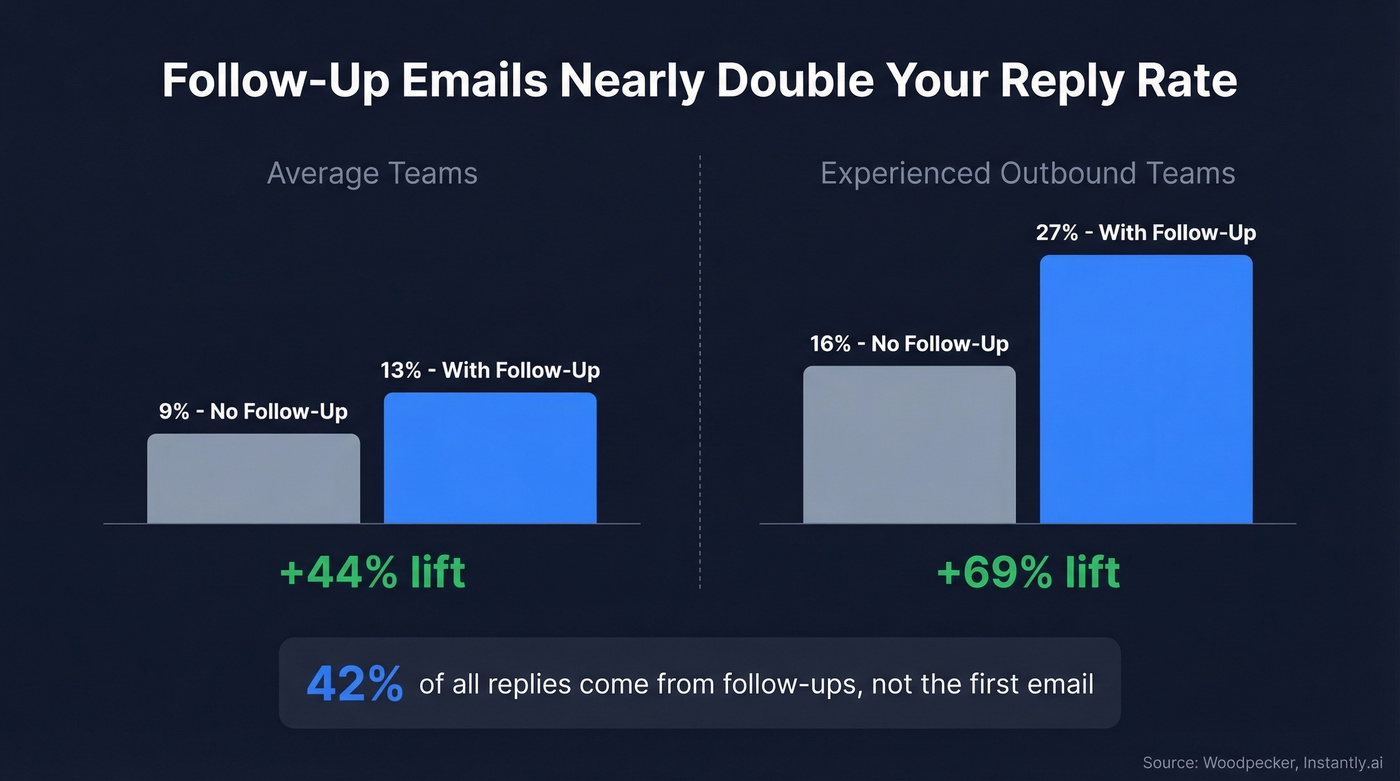
It doesn't. 42% of all replies come from follow-ups, not from the first email. The average single-email reply rate sits at just 8.4%. The people who don't follow up are leaving nearly half their replies on the table.
Your recipient gets 121 emails a day. Yours got buried, not rejected. But there's a real difference between a follow-up that earns a reply and one that gets archived on sight. Templates without strategy are spam with better formatting. Below: 20 samples organized by scenario, a day-by-day cadence map, and the exact phrases to use (and avoid).
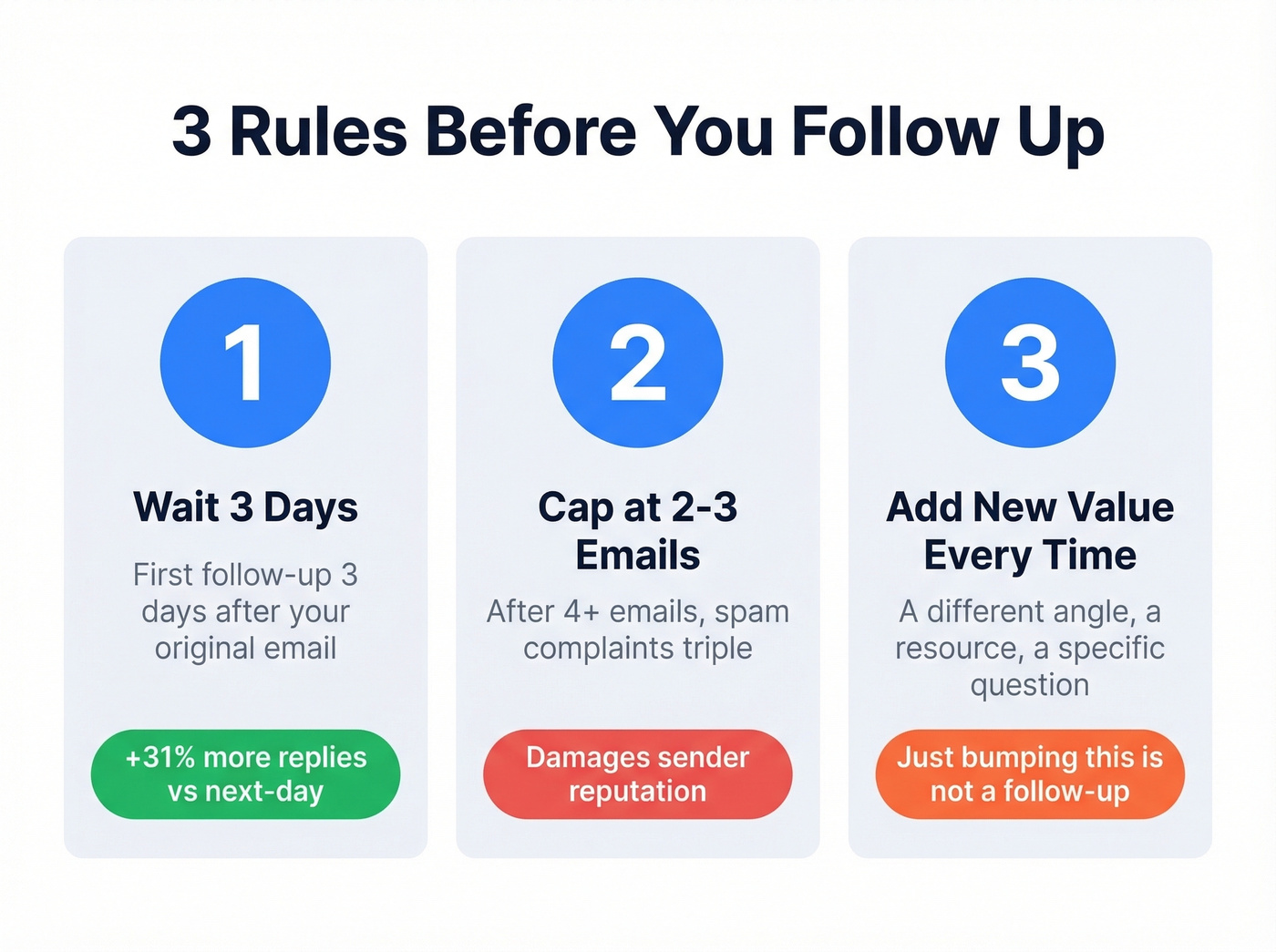
Three Rules Before You Touch a Template
- Send your first follow-up 3 days after the original email. This single timing shift lifts reply rates by 31% compared to next-day follow-ups.
- Cap your sequence at 2-3 follow-ups. After 4+ emails, spam complaints more than triple and you're actively damaging your sender reputation.
- Every follow-up must add new value. A different angle, a relevant resource, a specific question. "Just bumping this" isn't a follow-up - it's noise.
Why Polite Follow-Up Emails Work
The numbers are clear. Woodpecker's research shows teams averaging ~9% reply rates without follow-ups jump to ~13% with at least one. For experienced outbound teams, that gap widens - 16% without follow-ups versus 27% with them. One extra email can nearly double your responses.
A Belkins study of [16.5 million cold emails](https://belkins.io/blog/cold-email-response-rates) across 93 business domains fills in the details. Open rates hover around 45%, meaning many people see your email but don't reply. A gentle follow-up catches the ones who meant to respond but didn't. Each subsequent follow-up adds diminishing returns, and by the fourth email, you've crossed into territory where unsubscribes and spam complaints spike.
Here's a myth worth killing: send time doesn't matter nearly as much as you think. Woodpecker's data shows no meaningful difference between days of the week. That Tuesday-at-10am gospel everyone repeats? It's noise. What actually moves the needle is whether you follow up at all, and whether that follow-up adds something new.
In our experience, the biggest reply-rate lift comes from the first follow-up - everything after that is diminishing returns. Spend your energy making that first follow-up excellent rather than agonizing over a fourth.
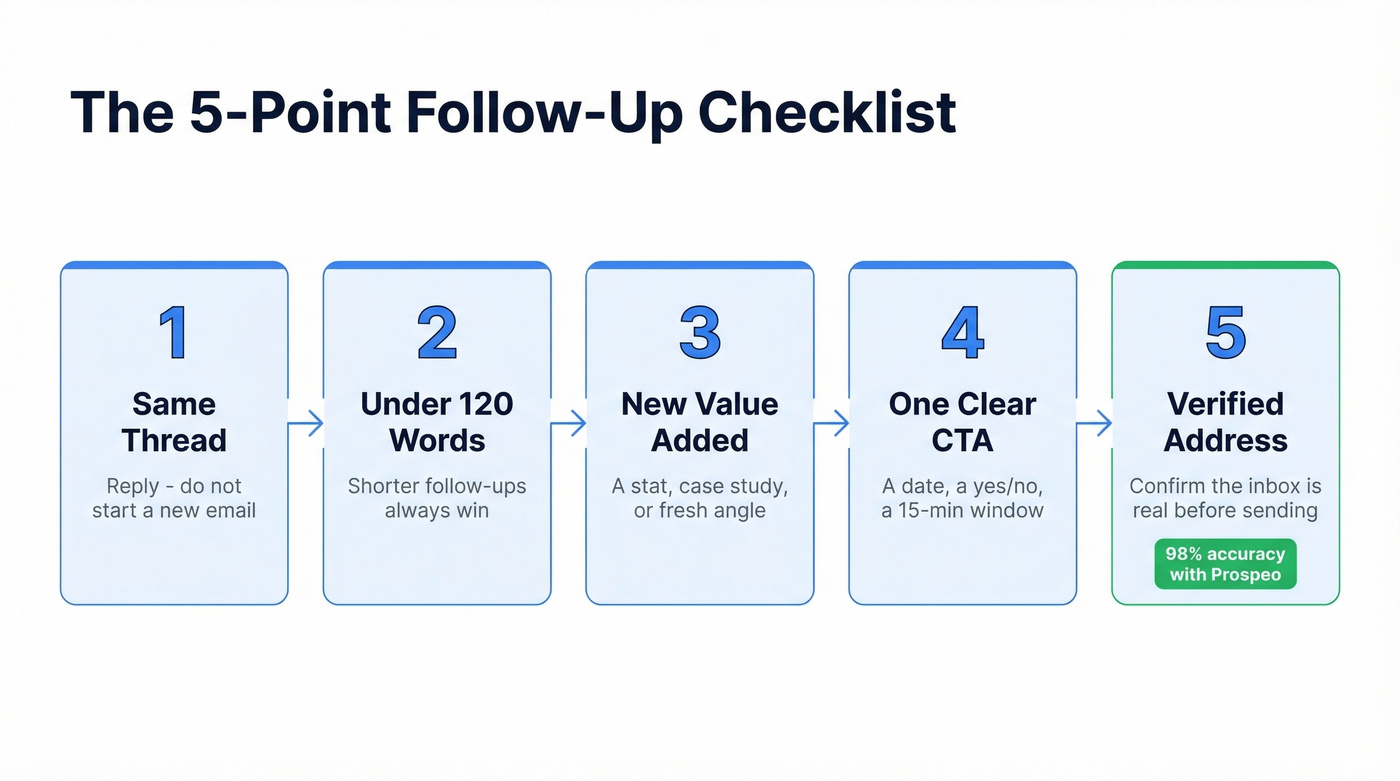
Before You Write: The 5-Point Checklist
- Reply in the same thread. Don't start a new email. Threading gives context instantly.
- Keep it under 120 words. Saleshandy's guidance is simple: shorter follow-ups beat long ones. Say what you need to say and stop.
- Add new value every time. A different stat, a relevant case study, a fresh angle on their problem. If you can't add something new, you're not ready to follow up yet.
- Include one clear CTA. Not three options. Not a vague "let me know your thoughts." One specific ask - a date, a yes/no question, a 15-minute window. (If you need options, borrow a few from these meeting request examples.)
- Verify the email address is real. If your first email bounced or hit a dead inbox, no follow-up wording will save it. Prospeo checks addresses in real time with 98% accuracy, and the free tier covers 75 verifications per month so you can validate your most important contacts before wasting a single send.
Phrases to Use vs. Phrases to Avoid
"Just following up" is the "thoughts and prayers" of professional email. It signals you've got nothing new to say. (More alternatives here: Stop Saying 'Just Following Up'.)
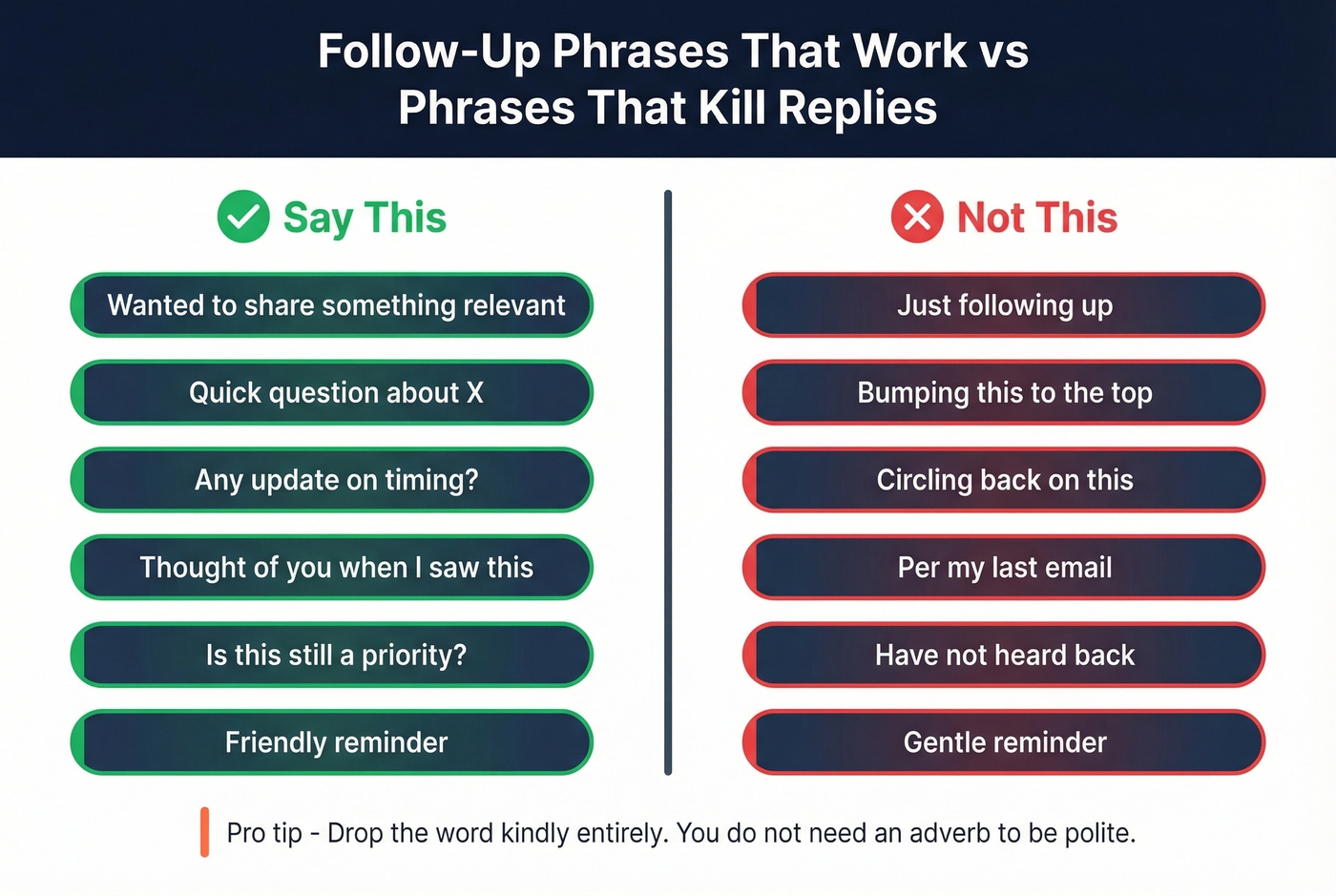
| Say This | Not This | Why |
|---|---|---|
| "Wanted to share something relevant" | "Just following up" | Promises value |
| "Quick question about X" | "Bumping this to the top" | Gives a reason to reply |
| "Any update on timing?" | "Circling back on this" | Specific and direct |
| "Thought of you when I saw this" | "Per my last email" | Feels personal, not passive-aggressive |
| "Is this still a priority?" | "Haven't heard back" | Forward-looking, not guilt-tripping |
| "Friendly reminder" | "Gentle reminder" | "Gentle" can read softer/more apologetic |
A note on "kindly" - as in "I kindly wanted to follow up." It often lands as stiff or condescending in modern business writing. Drop it entirely. You don't need an adverb to be polite. (If you’re looking for cleaner closers, see these alternatives to "Looking Forward to Hearing From You".)

42% of replies come from follow-ups - but only if your email actually reaches the inbox. Bad addresses kill your sender reputation and make every future follow-up harder to deliver. Prospeo verifies emails with 98% accuracy so your polite follow-up lands where it should.
Stop following up with dead inboxes. Verify first, send second.
Subject Lines That Get Opened
If you're replying in the same thread (and you should be), your subject line is already handled - it'll show as "Re: [original subject]." That's the best-performing option because it looks like a real conversation, not a new pitch.
When you do need a fresh subject line, keep it under 33 characters for mobile visibility and avoid spam triggers like "Free," "Guarantee," ALL CAPS, or excessive punctuation. Don't put "follow-up" in the subject line - it signals exactly what the recipient wants to ignore. For more patterns, use these email subject line formulas.
Ready-to-use subject lines:
- "Quick question about [project]"
- "Thought this might help"
- "[Mutual connection] suggested I reach out again"
- "Still relevant?"
- "One more idea for [their problem]"
- "[First name] - any update?"
- "15 min this week?"
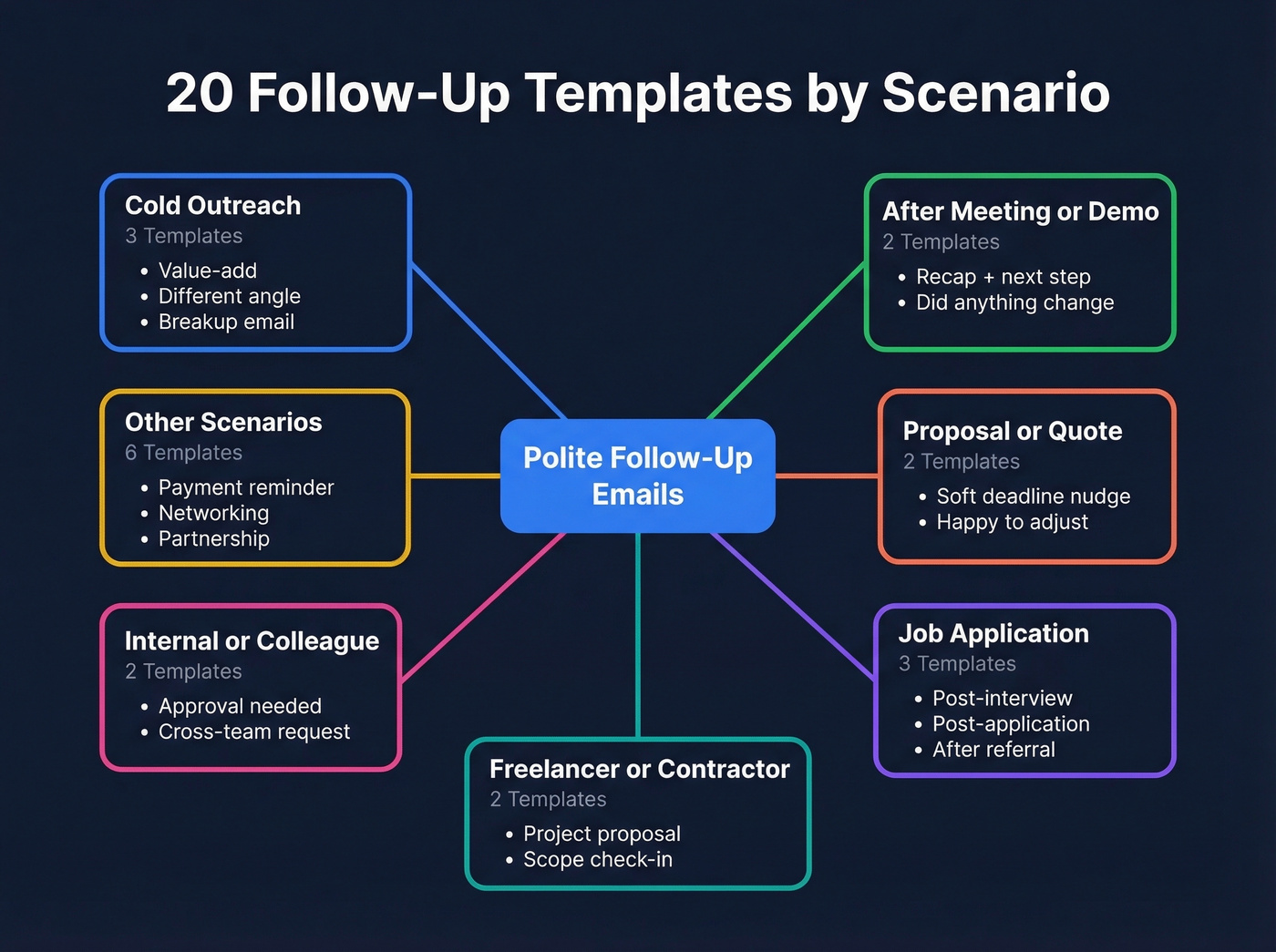
20 Gentle Follow-Up Email Samples
Cold Outreach (No Response)
Template 1 - Value-add follow-up
Subject: Re: [original subject]
Hi [Name],
I shared [specific thing] last week - wanted to add one data point. [Company similar to theirs] cut their [metric] by [X%] in [timeframe] using [approach]. We've helped [X companies in their industry] do the same.
Worth a 15-minute call this week?
[Your name]
Adds a concrete proof point and social proof instead of repeating the original pitch.
Tone variants:
Friendly: "Hey [Name] - one more thing I forgot to mention. [Similar company] saw [result]. Figured you'd want to know."
Direct: "[Name], quick stat: [Company] hit [result] with [approach]. Want to see if the same applies to [their company]? 15 min Tuesday?"
Template 2 - Different angle follow-up
Subject: Re: [original subject]
Hi [Name],
I realize my last email focused on [angle A]. But talking to other [their role] lately, the bigger pain point seems to be [angle B]. Is that closer to what you're dealing with?
Happy to share how we've approached it - or just point you to a resource.
[Your name]
Addresses a different objection - the original pitch may not have matched their actual pain.
Template 3 - Breakup email (final cold touch)
Subject: Should I close this out?
Hi [Name],
I've reached out a couple of times and haven't heard back - totally understand if the timing's off. I'll close this out on my end, but if [problem] comes back up, here's my calendar link: [link].
No hard feelings either way.
[Your name]
Removes pressure. The "closing the loop" framing triggers replies from people who've been meaning to respond. (If you want more options, use these final follow-up email templates.)
After a Meeting or Demo
Template 4 - Recap + next step
Subject: Re: [Meeting topic]
Hi [Name],
Great speaking with you on [day]. Quick recap: you mentioned [key pain point], and we discussed [proposed solution]. I've attached [resource/proposal/recording].
Would [specific date] work to loop in [stakeholder] and nail down next steps?
[Your name]
Proves you listened, provides value, and proposes a concrete next step. (More: after meeting follow up email.)
Template 5 - "Did anything change?" check-in
Subject: Re: [Meeting topic]
Hi [Name],
It's been [X days] since our demo - wanted to check if anything's shifted on your end. Sometimes priorities change, and I'd rather adjust than keep pitching something that's moved down the list.
What's the latest?
[Your name]
Acknowledges reality instead of pretending nothing has changed.
After Sending a Proposal or Quote
Template 6 - Soft deadline nudge
Subject: Re: [Proposal topic]
Hi [Name],
Wanted to flag that the pricing I sent over is locked through [date]. No pressure - just didn't want you to miss the window if this is still on the table.
Any questions I can answer before then?
[Your name]
Creates urgency without being pushy. The deadline is real and helpful.
Template 7 - "Happy to adjust" flexibility angle
Subject: Re: [Proposal topic]
Hi [Name],
Haven't heard back on the proposal - which often means the scope or pricing wasn't quite right. Happy to adjust either. What would make this work for your team?
[Your name]
Opens the door to negotiation instead of assuming rejection. (Related: proposal follow-up email.)
Job Application Follow-Up
Template 8 - Post-interview (5-7 business days)
Subject: Following up - [Role title] interview
Hi [Name],
Thank you again for the conversation on [date]. I've been thinking about [specific topic discussed] and I'm even more excited about the opportunity.
I'd love to hear any updates on the timeline when you have a moment.
[Your name]
References something specific from the interview - not a generic check-in.
Template 9 - Post-application submission
Subject: [Your name] - [Role title] application
Hi [Hiring manager name],
I submitted my application for [role] on [date] and just wanted to follow up to make sure it came through. [One sentence about why you're a strong fit, referencing something specific about the company].
Happy to provide anything else that'd be helpful.
[Your name]
Brief, specific, and gives them a reason to pull up your application. (More examples: recruiting email examples.)
Template 10 - After a referral introduction
Subject: [Referrer's name] suggested I reach out
Hi [Name],
[Referrer] mentioned you might be hiring for [role/team]. I'd love to learn more about what you're looking for - [one sentence about relevant experience].
Would you have 15 minutes this week?
[Your name]
Leads with social proof, which dramatically increases open and reply rates.
Freelancer or Contractor Follow-Up
Template 11 - After sending a project proposal
Subject: Re: [Project name] proposal
Hi [Name],
Wanted to check in on the proposal I sent [X days ago]. If the scope needs adjusting, I'm flexible - just let me know what'd work better for your budget or timeline.
[Your name]
Signals flexibility without desperation.
Let's be honest - a lot of freelancers wrestle with where the line is between persistent and desperate. The answer: it's about value, not volume. If your follow-up adds new information or opens a door, send it. If it just says "checking in," don't. Every message should earn its place in someone's inbox.
Template 12 - Scope/timeline check-in
Subject: Re: [Project name]
Hi [Name],
Quick check-in - are we still on track for [milestone/deadline]? I've got [deliverable] ready on my end and want to make sure we're aligned on timing.
[Your name]
Professional, forward-looking, and keeps the project moving.
Template 13 - Payment/invoice reminder
Subject: Re: Invoice #[number]
Hi [Name],
Friendly reminder that invoice #[number] ([amount], sent [date]) is now [X days] past due. I know things get busy - just want to make sure it didn't slip through the cracks.
Can you confirm when I should expect payment?
[Your name]
Assumes good intent, provides all the details they need, and asks for a specific commitment.
Internal Stakeholder Follow-Up
Template 14 - Waiting on approval
Subject: Re: [Approval topic]
Hi [Name],
Following up on [specific approval/decision]. We're holding on [downstream task] until this is finalized - any update on timing?
Happy to jump on a 5-minute call if it's easier to discuss.
[Your name]
Explains the downstream impact without being accusatory.
Template 15 - Cross-team collaboration nudge
Subject: Re: [Project/initiative]
Hi [Name],
We're moving into [next phase] on [project] and need [specific input/asset] from your team. Could you point me to the right person if it's not you?
Deadline on our end is [date].
[Your name]
Gives them an easy out while making the deadline clear.
Networking and Introductions
Template 16 - After a conference or event
Subject: Great meeting you at [event]
Hi [Name],
Really enjoyed our conversation about [specific topic] at [event]. You mentioned [specific thing they said] - I've been thinking about that.
Would love to continue the conversation. Coffee or a quick call next week?
[Your name]
Proves you were actually listening, not just collecting business cards.
Template 17 - After a warm introduction
Subject: [Introducer's name] connected us
Hi [Name],
[Introducer] thought we should connect - [one sentence about why]. I'd love to hear about [their work/challenge] and see if there's a way to help each other.
Free for 20 minutes this week?
[Your name]
Keeps it mutual rather than one-directional.
Customer Support or Service
Template 18 - Waiting on client materials
Subject: Re: [Project] - still need [specific item]
Hi [Name],
We're ready to move forward on [next step], but we're still waiting on [specific deliverable] from your side. Could you send that over by [date] so we stay on schedule?
Let me know if anything's blocking it.
[Your name]
Specific, deadline-driven, and offers to help remove blockers.
Template 19 - Support ticket follow-up
Subject: Re: Ticket #[number]
Hi [Name],
Following up on ticket #[number] ([brief description]). It's been [X days] without an update. Could you let us know the current status or expected resolution time?
Thanks, [Your name]
References the ticket number for easy lookup and asks for a specific piece of information.
The Breakup Email (Final Follow-Up)
Template 20 - Universal "closing the loop" email
Subject: Closing the loop
Hi [Name],
I've followed up a few times and understand if this isn't a priority right now. I'll assume we're tabling this for now.
If anything changes, I'm here - just reply to this thread. No need to start fresh.
[Your name]
Zero pressure, easy to re-engage later, and surprisingly effective. People respond to the feeling of a door closing.
When Email Fails, Switch Channels
Here's the thing: if your deal size is under five figures and you're sending four follow-up emails to the same person, you're overthinking it. A message on a professional network or a brief SMS after your second email can break through - especially for founders and C-suite contacts who live outside their inbox. Data from outbound campaigns shows that combining channels can push reply rates above 11%. Don't treat email as the only channel. Treat it as the first one.
The Follow-Up Email Cadence
Knowing what to write is half the equation. Knowing when to send it is the other half.
| Day | Action | Goal | Expected Outcome |
|---|---|---|---|
| Day 1 | Send initial email | Open the conversation | ~8.4% reply rate |
| Day 4 | First follow-up | Add new value | Biggest lift (~31%) |
| Day 8-9 | Second follow-up | Different angle | Diminishing returns begin |
| Day 14-15 | Breakup email | Close the loop | Last-chance replies |
Persona matters more than most people realize. Founders respond best by follow-up #2, with reply rates climbing from 6.64% to 6.94% before dropping sharply to 3.01% by the fourth email. Small businesses show a bounce-back effect - reply rates dip on the first follow-up then recover on the second. Two to three follow-ups is the sweet spot for virtually every audience. (If you’re planning a longer sequence, see multiple follow-up emails.)
5 Mistakes Killing Your Reply Rate
Mistake 1: Bumping with no new information. "Just wanted to make sure you saw my last email" tells the recipient you've got nothing new to offer. Instead of "checking in," try: "Since I last reached out, [relevant company] published [stat]. Thought it was relevant to [their situation]."
Mistake 2: No clear call to action. "Let me know your thoughts" isn't a CTA - it's a homework assignment. Ask for something specific: "Does Thursday at 2pm work?" or "Would a 2-minute case study be helpful?" (More CTAs here: how to close a follow-up email.)
Mistake 3: Wrong tone for the relationship. A formal "I trust this message finds you well" to someone you met at a happy hour is jarring. Match your tone to the relationship. When in doubt, err slightly casual - even a polite follow-up email should sound like a real person wrote it.
Mistake 4: Too many emails too fast. Four or more emails in a sequence more than triples spam complaints. Space your follow-ups 3-5 days apart and stop at three. Your sender reputation is worth more than one reply.
Mistake 5: Emailing the wrong address. Look - stop obsessing over the perfect wording. One of the biggest reasons your follow-up gets no response isn't your tone. It's that you're emailing the wrong address. Bounced emails, dead inboxes, and role-based addresses like info@ or sales@ silently kill your campaigns. We've seen teams rewrite their entire follow-up sequence three times when the real problem was a contact list full of invalid addresses. Cleaning your list before launching a sequence can lift reply rates overnight. (If you’re building lists, start with a B2B email finder.)
The perfect follow-up email is worthless if you're emailing the wrong person. Prospeo's database of 300M+ profiles with 30+ filters helps you find the real decision-maker - with a verified email - so your first send and every follow-up actually reaches someone who can say yes.
Find verified emails for the people worth following up with.
FAQ
How long should I wait before following up?
Three business days for most scenarios; 5-7 for job applications. Woodpecker's data shows the 3-day gap lifts reply rates by 31% compared to next-day follow-ups. After that, space subsequent touches 4-5 days apart.
How many follow-up emails is too many?
Cap at 2-3 total follow-ups. After 4 emails in a sequence, spam complaints triple and reply rates crater. Send a breakup email as your final touch and move on.
What's the difference between "gentle reminder" and "friendly reminder"?
"Friendly reminder" reads warmer and more confident in professional contexts. "Gentle reminder" can sound overly apologetic. Either works, but match the phrase to your relationship - use "gentle" with contacts you've already built rapport with.
What if they never respond at all?
Send a breakup email after your third follow-up - "I'll assume we're tabling this" often triggers a last-minute reply. If silence continues, move on. For cold outreach, try a different channel before closing the loop entirely. The consensus on r/sales is that a breakup email is your highest-converting touch after the first follow-up, and our own data backs that up.
Are my follow-ups landing in a dead inbox?
More common than you'd think. Bounced and invalid addresses silently kill follow-up campaigns. Skip this worry entirely by verifying your list before you send - tools like Prospeo catch bad addresses, spam traps, and catch-all domains so every follow-up reaches a real person.