

"Now Is Not a Good Time" - What It Really Means and How to Respond
It's 2 PM on a Tuesday. You've made 22 calls, left 17 voicemails, and three people hit you with the "now is not a good time" objection before hanging up. Zero meetings booked. With reps averaging 40 calls per day and only about 2% converting to an appointment, every brush-off stings - you're running out of at-bats fast.
Here's the thing: most of those "bad timing" objections have nothing to do with timing.
Why This Objection Is Rarely About Timing
Loss aversion and status quo bias do most of the heavy lifting here. Prospects aren't rationally evaluating whether Tuesday at 2 PM works - they're subconsciously protecting themselves from change. Research suggests 95% of purchasing decisions are subconscious before the logical brain even kicks in.
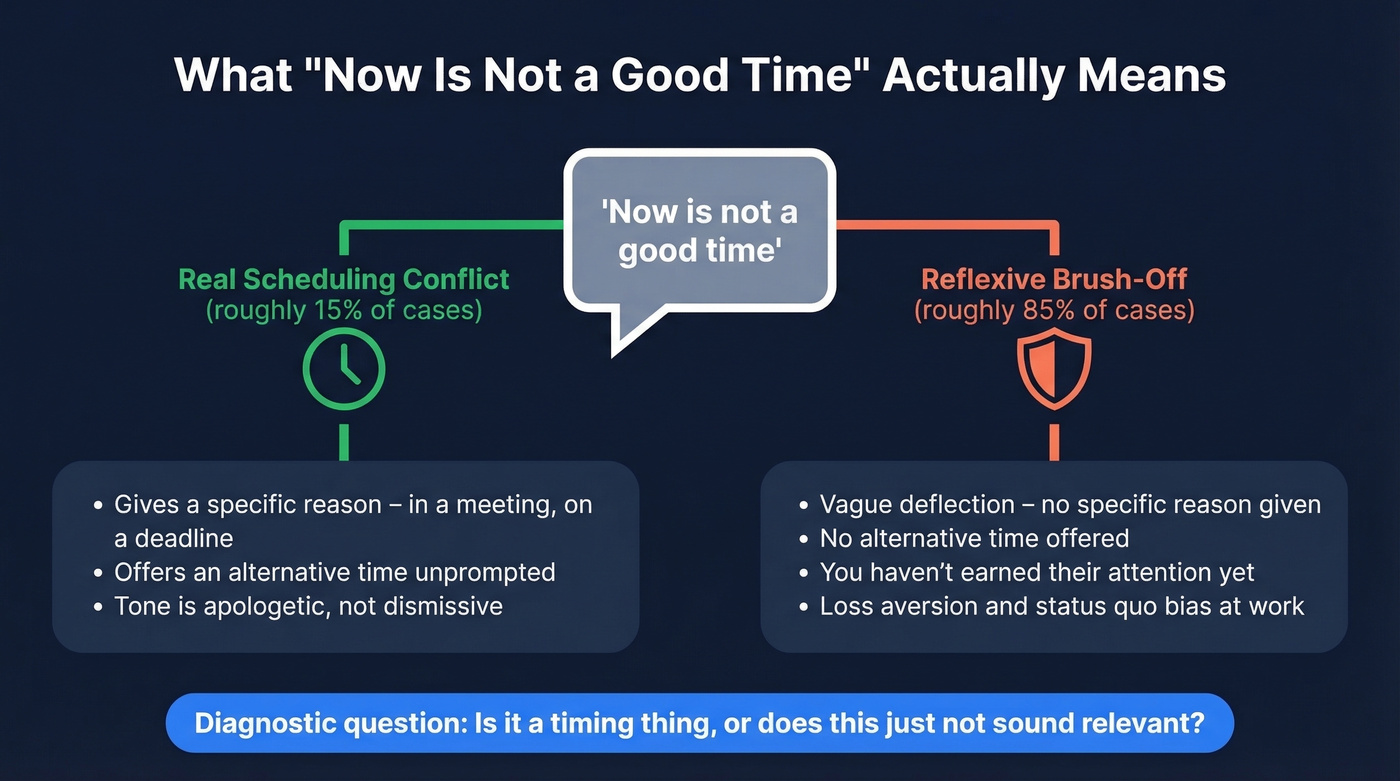
"Now is not a good time" almost always means "you haven't given me a reason to care." And it hits on warm calls too - it's not just a cold calling problem. The way to tell the difference between a real conflict and a reflexive dismissal is a simple diagnostic: "Is right now just hectic, or is this not something that fits your focus?" A real scheduling conflict gets a specific answer. A brush-off gets vague deflection.
Stop Causing the Objection - Fix Your Opener
Most guides jump straight to rebuttals. That's backwards.
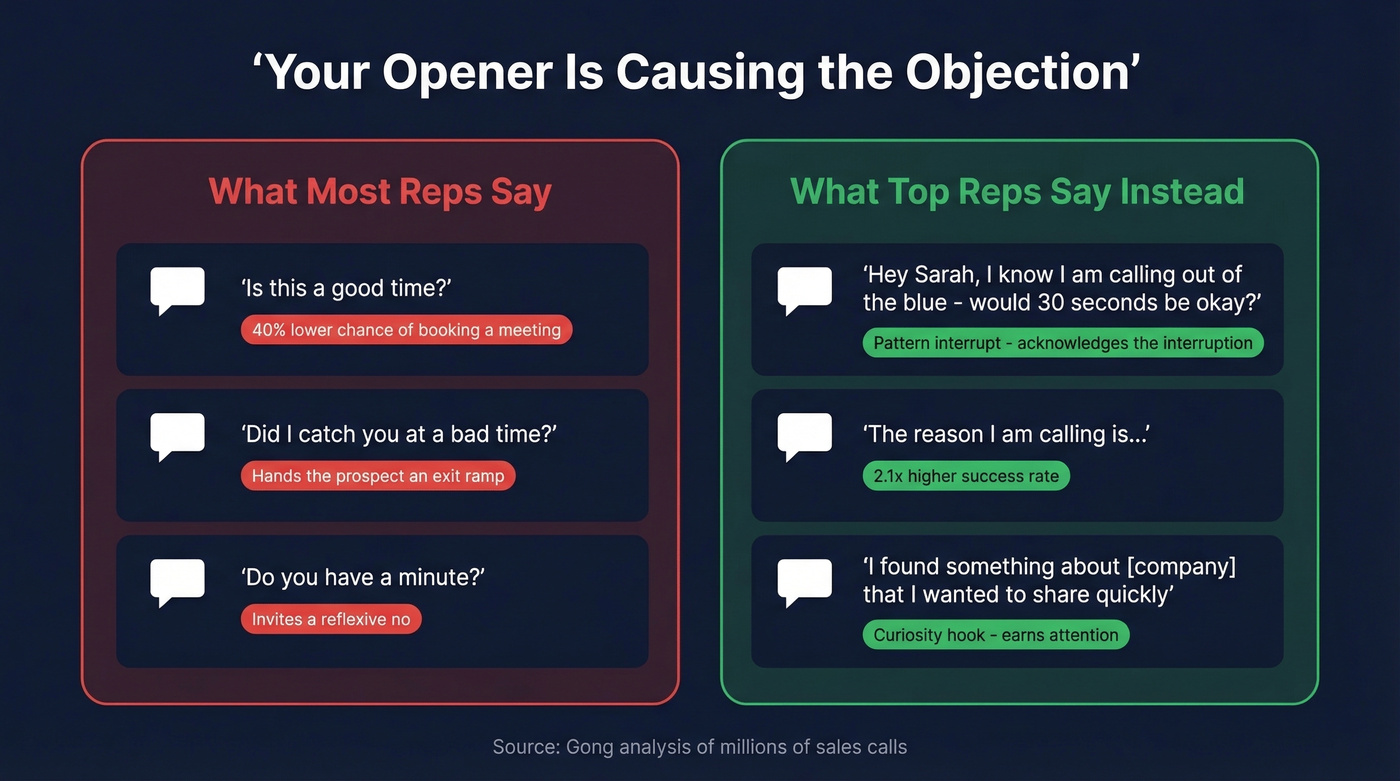
The best way to handle this objection is to stop triggering it. Gong's analysis of millions of sales calls found that asking "is this a bad time?" decreases your chances of booking a meeting by 40%. You're literally handing the prospect an exit ramp. If you're still wondering about the best "did I catch you at a bad time" response, the answer is simple: don't ask the question in the first place.
One rep on r/sales shared that the moment they stopped asking "is this a good time?", brush-offs dropped noticeably - and the one time they slipped back into the habit, the prospect deferred to "call back later" and never picked up again.
Explaining why you're calling yields a 2.1x higher success rate. Try a pattern interrupt instead: "Hey Sarah, I know I'm calling out of the blue - would 30 seconds be okay?" This acknowledges the interruption without inviting a timing objection.
If you want to systematize this, build a repeatable cold calling system and keep your talk track tight with a few proven talk track examples.

Your opener matters, but so does who you're calling. When 27% of selling time is lost to bad data, you're triggering brush-offs before you even speak. Prospeo refreshes 300M+ profiles every 7 days - so you reach the right person, at the right number, every time.
Stop rehearsing rebuttals for calls that never should have been made.
7 Responses That Actually Work
When prevention fails, your next move matters. Gong data shows top reps respond with questions 54% of the time after an objection - the goal is to extend the conversation, not win an argument. Here are seven responses, ranked from "try this first" to "last resort."
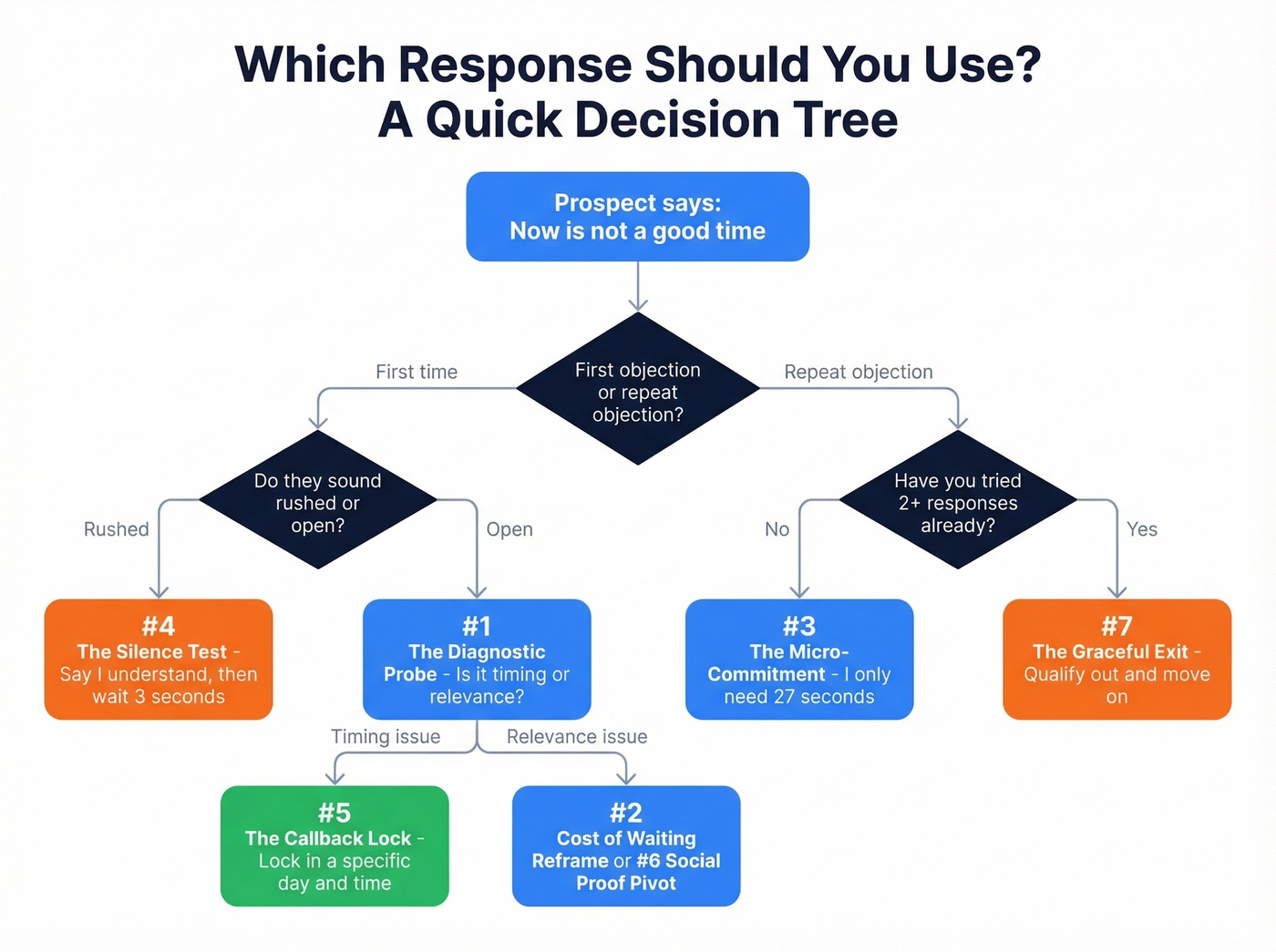
1. The Diagnostic Probe
"Totally fair - is it a timing thing, or does this just not sound relevant to you?"
This forces a binary answer. In our experience, it's the single most effective response because either answer gives you something concrete to work with. Real timing conflict? You schedule a callback. Relevance issue? Now you know what to address.
2. The Cost-of-Waiting Reframe
Don't argue about timing - reframe the cost of delay.
"Quick question - if [specific problem] is costing you $X every month you wait, does next quarter actually help?" Loss aversion does the selling for you. In real estate, the equivalent sounds like: "If property values shift before you're ready, wouldn't you want to know what yours is worth today?"
3. The Micro-Commitment
"I only need 27 seconds - can I tell you why I called, and you can tell me if it's worth a longer conversation?"
The oddly specific number acts as a pattern interrupt. It signals you're not reading from a script. We've tested round numbers vs. odd numbers on calls, and the odd number consistently gets a longer pause before the prospect responds - which is exactly what you want.
4. The Silence Test
Say "I understand" - then stop talking.
Mute yourself and wait three full seconds. Most prospects will fill the silence by either explaining the real objection or asking what you're calling about. It feels uncomfortable. Do it anyway. Silence is a diagnostic tool that reveals intent faster than any question you could ask.
5. The Callback Lock
"No problem - when's a better time? I'll put it on both our calendars right now."
This is the minimum viable response. Hanging up without a specific day and time means you're relying on luck, and luck isn't a pipeline strategy.
6. The Social Proof Pivot
"Just so you know, [similar company] gave us 10 minutes and ended up [specific result]. Would Thursday work?"
Social proof gives the prospect a reason to reconsider without feeling pressured. The key is specificity - name a real company and a real outcome, not "companies like yours."
7. The Graceful Exit
"Got it - sounds like this isn't a fit right now. If anything changes, I'm easy to find."
Sometimes the right move is to qualify out. Ask yourself: "If this prospect had unlimited budget and no timing constraints, would they still say no?" If the answer is yes, move on. But remember - 60% of customers say no four times before saying yes. Skip this if you haven't tried at least two of the responses above first.
What to Do in the Next 48 Hours
The follow-up is where most reps fail. They log "call back next month" in the CRM and forget about it. Reps who handle objections well achieve close rates as high as 64% - largely because they follow up with discipline, not hope.
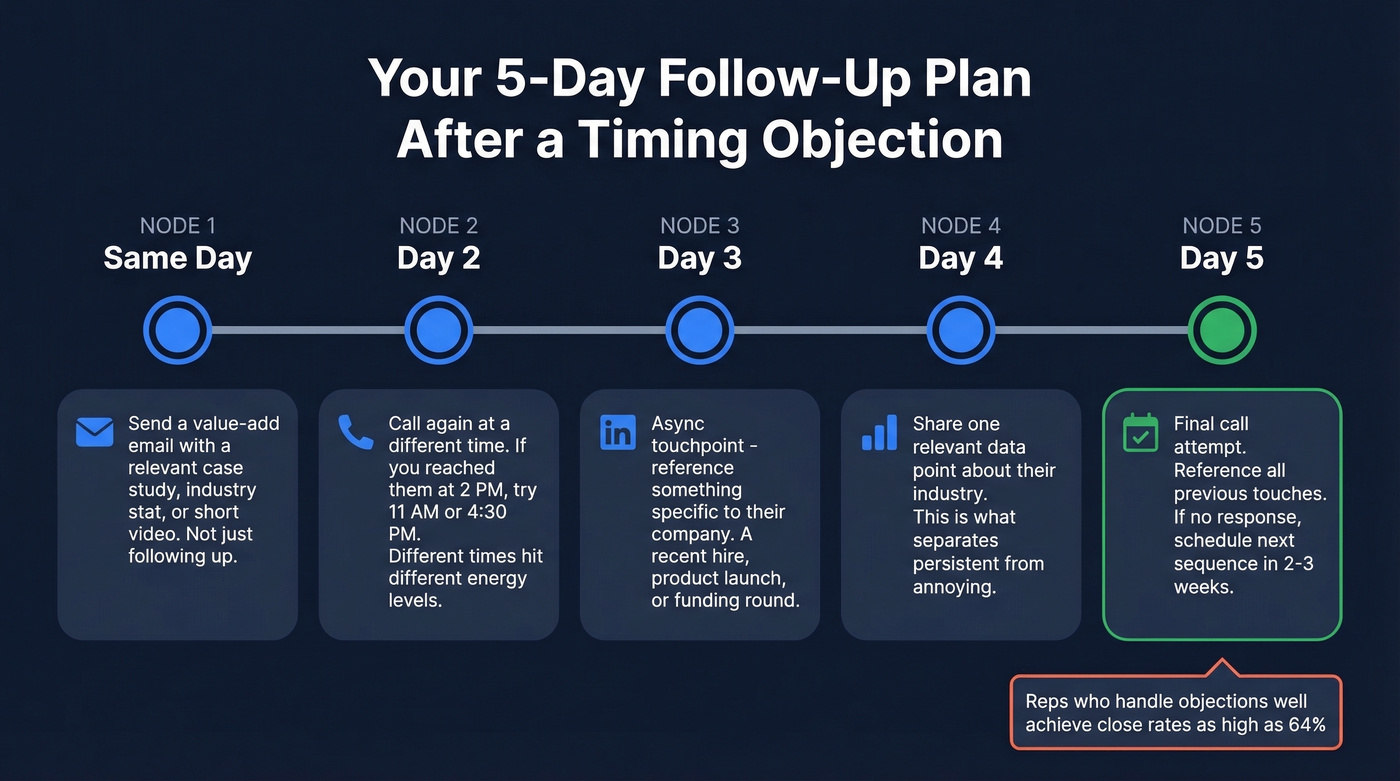
Same day: Send an email with genuine value - a relevant case study, an industry stat, a short video. Not "just following up." If you need copy you can swipe, use these sales follow-up templates.
Day 2: Call again at a different time. If you reached them at 2 PM, try 11 AM or 4:30 PM. Different time slots hit different energy levels and meeting schedules.
Day 3-5: Async touchpoint referencing something specific to their company - a recent hire, a product launch, a funding round. This is what separates "persistent" from "annoying."
We've seen reps cut brush-off rates in half just by switching from generic "following up" emails to sending one relevant data point about the prospect's industry. Three touches in five days isn't aggressive - it's professional persistence. (More on the importance of follow-up in sales.)
Fix the Root Cause: Your Data
Let's be honest about something most objection-handling guides ignore entirely.
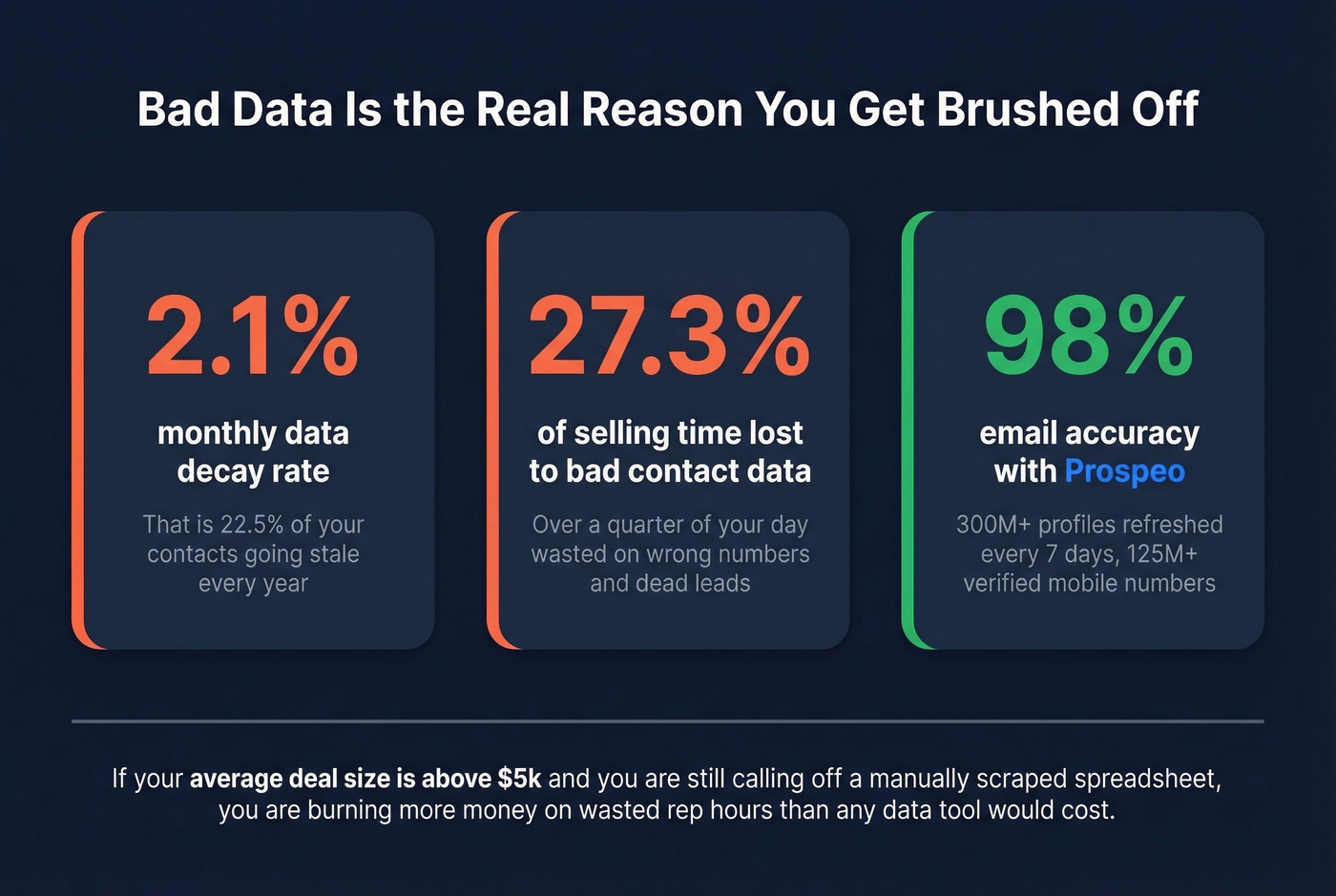
B2B contact data decays at 2.1% per month - roughly 22.5% per year. Sales reps lose 27.3% of their selling time to bad contact data. If a quarter of your dials hit dead numbers or wrong contacts, no script saves you. Calling the wrong person is the fastest path to a "not a good time" brush-off because it literally isn't - you've interrupted someone who was never your prospect.
If your average deal size is above $5k and you're still cold calling off a manually scraped spreadsheet, you're burning more money on wasted rep hours than any data tool would cost. Prospeo gives you 300M+ professional profiles with 98% email accuracy on a 7-day refresh cycle, plus 125M+ verified mobile numbers that deliver a 30% pickup rate. The free tier includes 75 verified emails per month and 100 Chrome extension credits - enough to test whether cleaner data actually reduces your brush-off rate before you commit a dollar.
If you're evaluating vendors, start with data enrichment services and compare options across B2B company data providers. You can also reduce wasted dials by tightening your Ideal Customer Profile and using better sales prospecting techniques.
No script fixes a wrong number. B2B data decays 2.1% per month - but Prospeo's 7-day refresh cycle and 98% email accuracy mean your reps spend time selling, not chasing dead leads. 125M+ verified mobiles with a 30% pickup rate at ~$0.01 per email.
Replace bad data with direct dials that actually connect.
FAQ
What does "now is not a good time" really mean on a cold call?
It almost always means you haven't earned the prospect's attention in the first few seconds. Weak openers - especially "is this a good time?" - trigger this reflexive response far more often than genuine scheduling conflicts. Fix the opener before you fix the rebuttal.
Should you call back when a prospect says "not a good time"?
Yes - but lock in a specific day and time before you hang up. Follow up with a value-add email the same day to give them a reason to pick up next time. Reps who schedule concrete callbacks convert at significantly higher rates than those who say "I'll try again sometime."
How do you reduce timing objections on cold calls?
Call during optimal windows like 11-12 PM or 4-5 PM, use a pattern-interrupt opener instead of asking permission, and verify your contact data is current. Stale numbers inflate brush-off rates because you're interrupting people who were never the right target.