

How to Build a Nurturing Email Sequence That Actually Converts
You ran a webinar. 500 people registered. You delivered the lead magnet, patted yourself on the back, and then... nothing. Two months of silence. By the time you email those leads again, they've forgotten your name, your product, and why they signed up.
That's not a nurturing email sequence. That's a graveyard.
A nurture sequence is a planned series of emails that moves leads from "vaguely interested" to "ready to buy" by delivering the right content at the right time. In B2B, decisions are made by buying committees, not one inbox - and your sequence needs to account for that. Let's build one that works.
What Separates Real Sequences from "Just Sending Emails"
Three things:
- A cadence map matched to B2B or B2C. Timing and content types differ dramatically between the two.
- Branching logic. Behavior-based paths outperform linear drips every time.
- A verified list. None of this matters if your emails bounce. A 5% bounce rate will quietly destroy your sender reputation.
Below: the complete playbook with templates, cadence maps, and 2026 benchmarks.
Why Lead Nurturing Emails Still Matter
Only 3% of your market is actively buying at any given time, according to Forrester research. Another 40% are poised to buy but need nurturing. If you're only talking to the 3%, you're leaving the majority of your future revenue on the table.
Klaviyo's 2026 benchmarks across 183,000+ brands show automated flows hitting a 5.58% click rate and a 2.11% placed order rate - compared to just a 1.69% click rate for one-off campaigns. That's a 3.3x difference in clicks from the same audience, simply because the emails are sequenced and timed to behavior. Segmented nurture campaigns can drive a 760% increase in revenue versus non-segmented blasts.
Even your opt-in rates feed the machine. Popup benchmarks across 14.7M impressions show a mean 3.2% conversion rate, with top performers hitting 8.5%+. If you're below median, your lead nurturing sequence is starving for leads before it even starts.
B2B vs B2C: How Sequences Differ
The biggest mistake we see is teams applying B2C tactics to B2B sequences, or the other way around. They're fundamentally different engines.
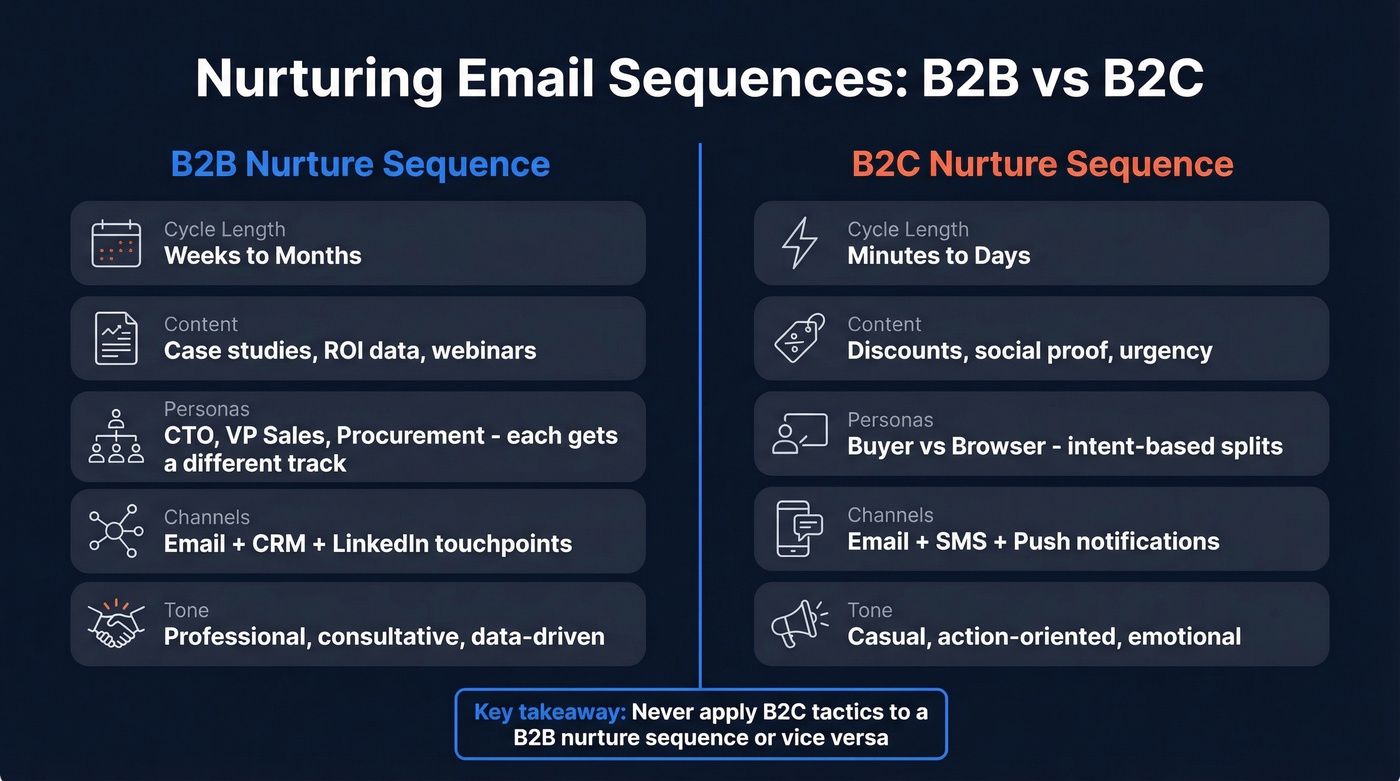
| Dimension | B2B | B2C |
|---|---|---|
| Cycle length | Weeks to months | Minutes to days |
| Content types | Case studies, webinars, ROI data | Discounts, social proof, urgency |
| Persona tracks | CTO ≠ sales manager | Buyer ≠ browser |
| Channels | Email + CRM-synced touchpoints | Email + SMS + push |
| Tone | Professional, consultative | Casual, action-oriented |
A CTO needs technical documentation and architecture diagrams. A sales manager wants ROI comparisons and competitive battlecards. Sending both the same nurture emails is how you end up in the "generic email graveyard" that r/marketing threads constantly complain about.
Multi-channel outreach - email plus CRM-synced touchpoints - can boost response rates by 35%. B2C sequences lean on cart abandonment, limited-time offers, and SMS/push. B2B lead nurturing sequences sync with CRM data, layer in professional networking touchpoints, and space emails across weeks rather than days.
Anatomy of a High-Converting Sequence
Before you write a single email, nail these five principles.
1. The 48-hour golden window. Your first email needs to land within 48 hours of lead capture. Leads contacted within 5 minutes are 100x more likely to qualify. Two months of silence after a lead magnet download isn't nurturing - it's neglect.
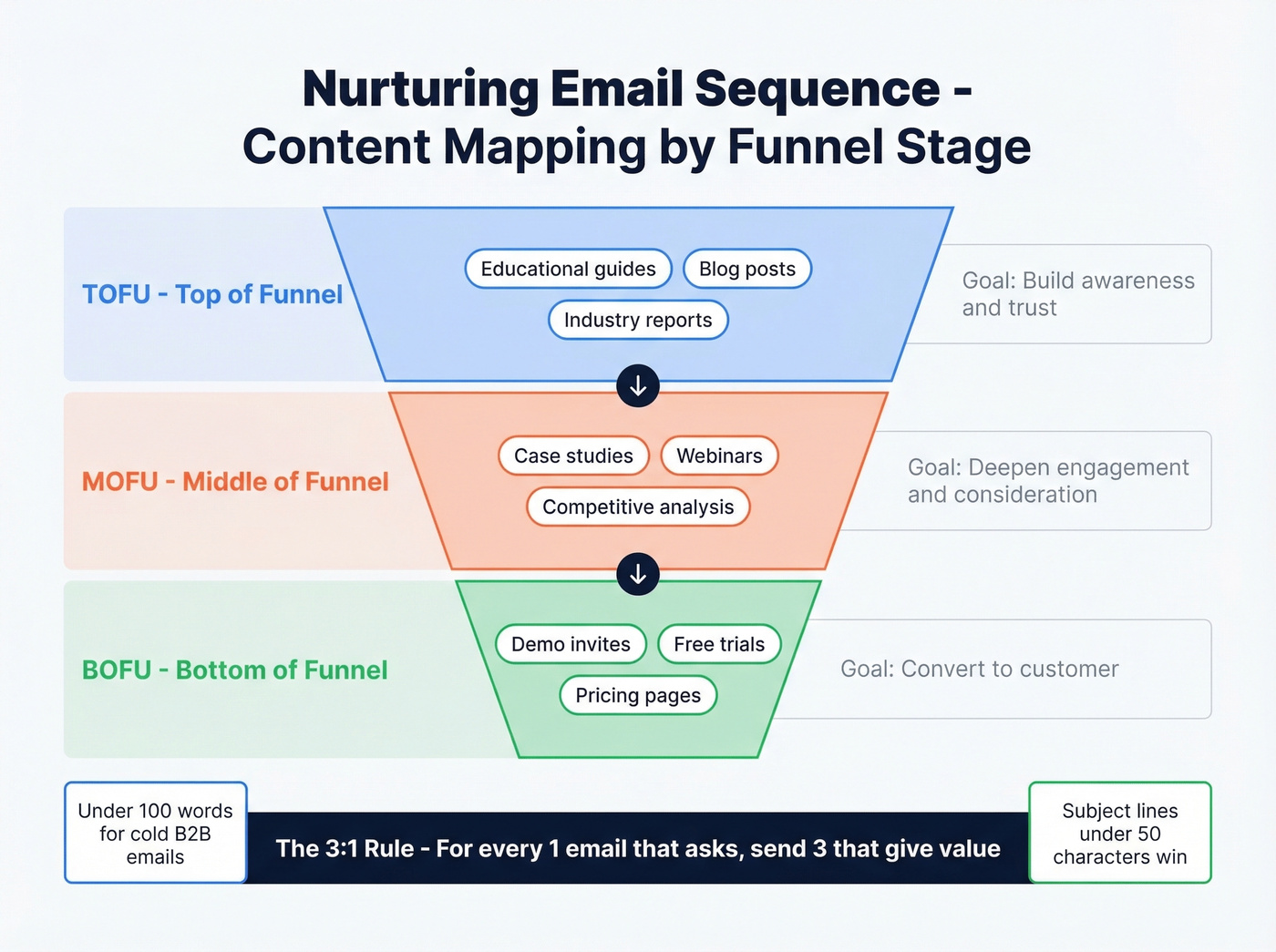
2. The 3:1 give-to-get ratio. For every email that asks for something (a demo, a call, a purchase), you need three that give something valuable. Guides, frameworks, data, templates. Build trust before you spend it.
3. TOFU to MOFU to BOFU content mapping. Early emails deliver educational content like guides and blog posts. Middle emails introduce comparison content - case studies, webinars, competitive analysis. Late emails make the ask with demos, trials, and pricing. The consensus on r/Emailmarketing is clear: map content to funnel stage and measure pipeline influence, not opens.
4. Under 100 words for cold sequences. Especially in B2B outbound, brevity wins. One clear CTA per email. One angle per email - social proof, pain point, or value prop. Never all three crammed together. (If you need a separate outbound flow, start with a B2B cold email sequence.)
5. Every email earns its spot. Each message needs a different angle. If email #3 says the same thing as email #1 with different words, delete it. Even unopened emails create "air cover" - brand familiarity that surfaces during internal buying committee discussions - but that only works if each touch adds something new.
Here's the thing: if your average contract value is under $5k, you don't need a 12-email nurture sequence. Four emails with one branch point will outperform a complex drip that nobody on your team maintains. Complexity should match deal size.
Subject lines matter too. Lines under 50 characters with a specific benefit outperform vague ones. "Your [resource] is ready" beats "Don't miss this!" every time. (If you want swipeable options, pull from these email subject line examples.)

A 5% bounce rate quietly kills your nurture sequence - and your sender reputation. Prospeo's 5-step verification delivers 98% email accuracy, so your carefully crafted sequences actually reach the inbox.
Stop nurturing bounced addresses. Start with verified data.
Two Complete Sequence Blueprints
B2B 4-Week Lead Nurture Sequence
This framework works for webinar leads, content downloads, and inbound demo requests that aren't ready to buy yet.
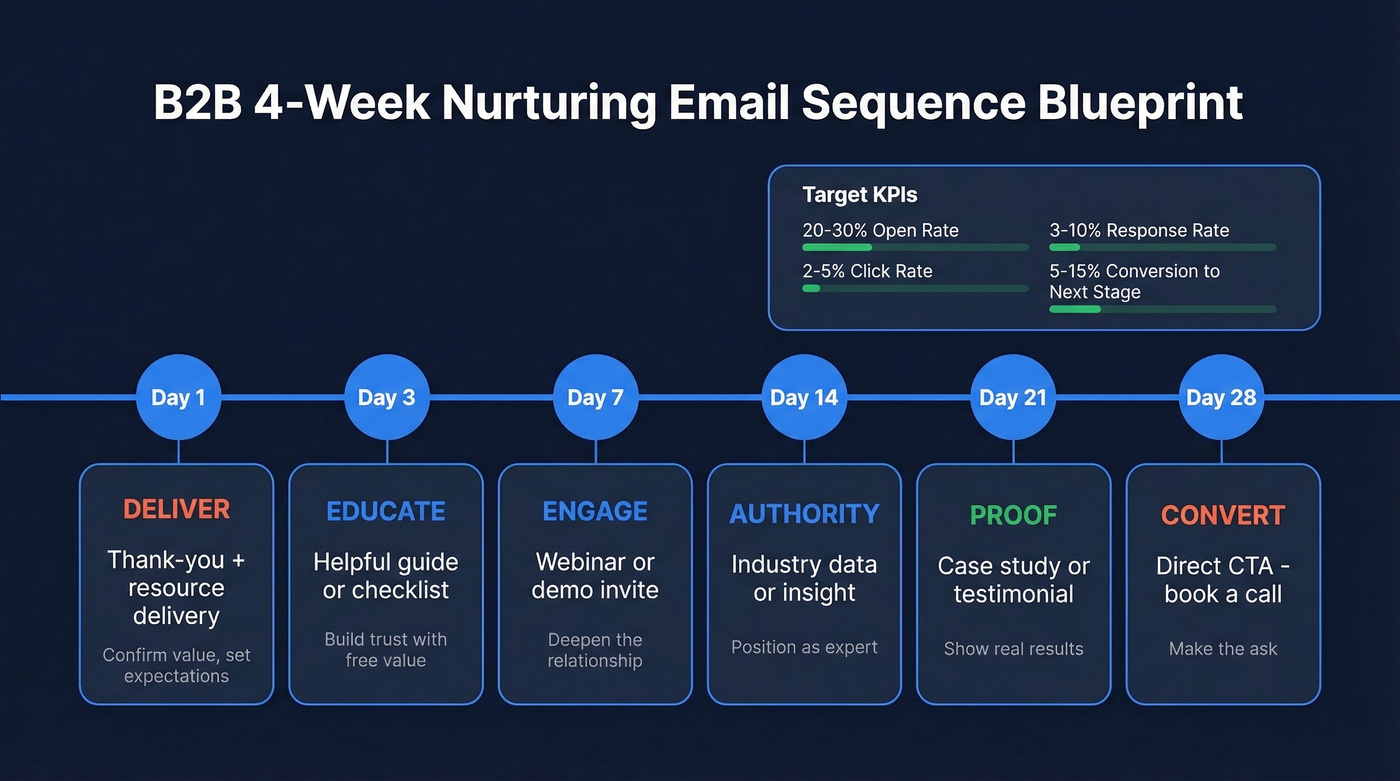
| Day | Content Type | Goal |
|---|---|---|
| Day 1 | Thank-you + resource delivery | Confirm value, set expectations |
| Day 3 | Helpful resource (guide/checklist) | Educate, build trust |
| Day 7 | Webinar or demo invite | Deepen engagement |
| Day 14 | Industry data or insight | Establish authority |
| Day 21 | Case study or testimonial | Social proof |
| Day 28 | Direct CTA (book a call) | Convert |
Target KPIs for a well-targeted B2B email nurturing series: 20-30% open rate, 2-5% CTR, 3-10% response rate, and 5-15% conversion to next stage. If you're below these ranges, the problem is usually list quality or content-persona mismatch, not timing. (To sanity-check your funnel, compare against the average B2B lead conversion rate.)
B2C / Creator 6-Day Sequence
This structure works for lead magnet funnels, course launches, and creator businesses.
| Day | Content Type | Goal |
|---|---|---|
| Day 0 | Re-intro + expectations | Remind them who you are |
| Day 1 | Exclusive template or resource | Immediate value |
| Day 2 | Framework or methodology | Teach something actionable |
| Day 3 | Case study + soft CTA | Social proof, light pitch |
| Day 4 | Common mistake + fix | Problem-aware content |
| Day 5 | Hard pitch + limited offer | Convert |
The pace is faster because B2C buying cycles are shorter. Notice the soft CTA on Day 3 - you're testing intent before the hard pitch on Day 5. If someone clicks the Day 3 CTA, they should branch into a sales-focused path immediately.
Templates You Can Steal
Template 1: Lead Magnet Delivery
Subject: Your [resource name] is ready
Hi {{ person.firstName | default: "there" }},
Here's the [eBook/checklist/guide] you requested: [link]. It covers [one-sentence summary of what they'll learn]. Most people start with Section 2 - that's where the actionable frameworks live.
Talk soon, [Your name]
Template 2: Quick-Win Follow-Up
Subject: Make [resource name] work for you
Hi {{ person.firstName | default: "there" }},
Did you get a chance to look at [resource]? Here's one thing you can implement today - [specific tip from the resource]. Takes about 10 minutes and most teams see results within a week.
[Your name]
Template 3: Case Study + Soft CTA
Subject: How [company] solved [specific problem]
Hi {{ person.firstName | default: "there" }},
[Company name] was dealing with [problem your audience has]. They [one-sentence description of what they did]. Result: [specific metric - e.g., "pipeline tripled in 90 days"].
If you're dealing with something similar, I'd love to walk you through it. [Soft CTA - e.g., "Want me to send over the full playbook?"]
[Your name]
Branching Logic and Lead Scoring
Linear drips treat every lead the same. Branching logic treats them like individuals - and that's what separates a basic drip from a revenue-driving system.
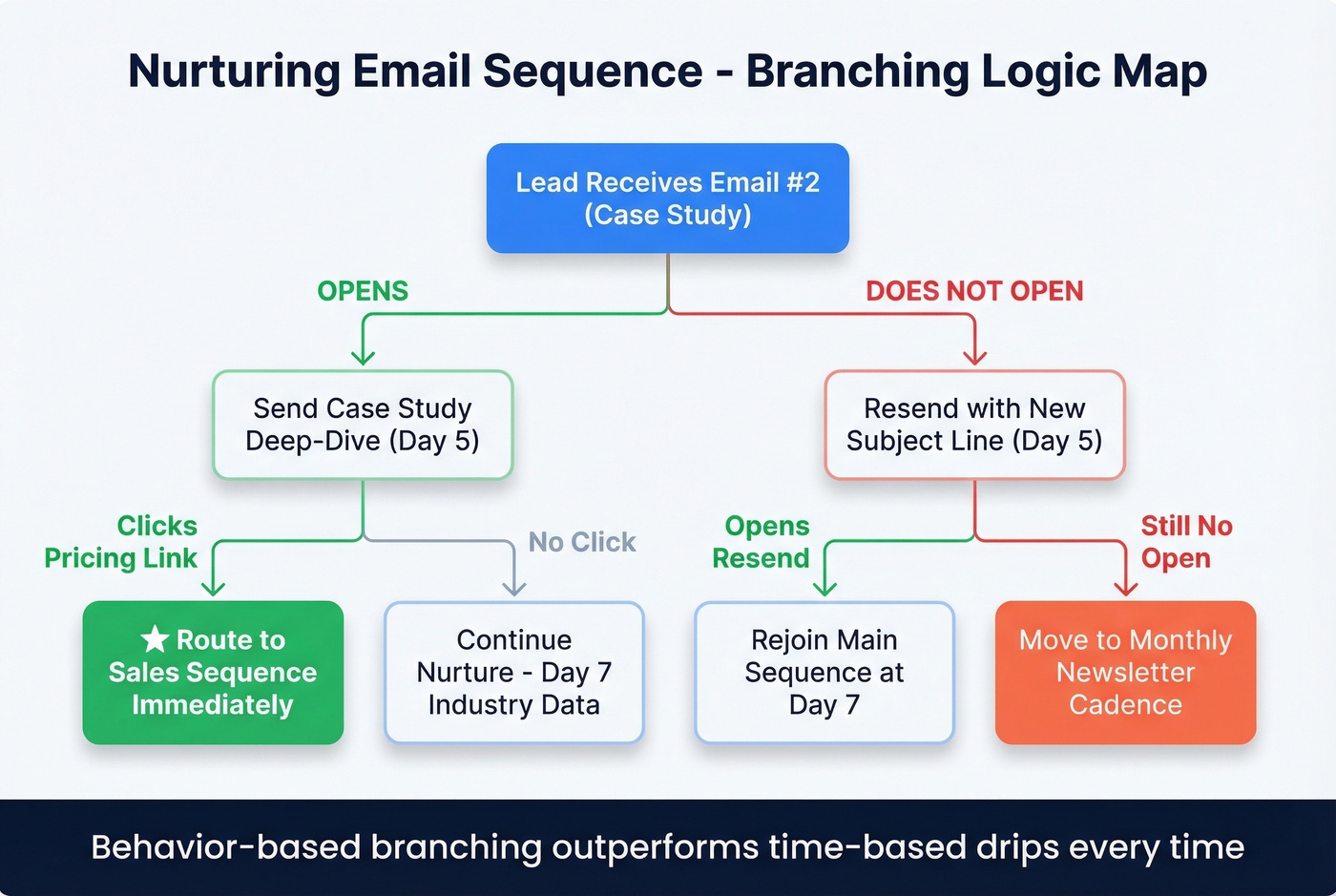
Two types of triggers: time-based (send email #3 on Day 7 regardless) and behavior-based (send email #3 only if they opened email #2). Behavior-based branching consistently outperforms time-based drips because it responds to actual engagement signals.
Lead receives Email #2 (case study)
├── OPENS → Send case study deep-dive (Day 5)
│   ├── CLICKS pricing link → Route to sales sequence immediately
│   └── No click → Continue nurture (Day 7: industry data)
└── DOESN'T OPEN → Resend with new subject line (Day 5)
    ├── OPENS resend → Rejoin main sequence at Day 7
    └── Still no open → Move to monthly newsletter cadence
For lead scoring, assign points based on firmographics and behaviors. When a lead crosses a threshold - say 100 points - they automatically move from the general nurture track to a sales-focused sequence. Skip this complexity if you're generating fewer than 50 leads per month; a simple linear sequence with one branch point is plenty. (If you want a scoring model you can copy, use this lead scoring guide.)
Deliverability - The Silent Killer
You can write the perfect nurture sequence, nail the cadence, and build beautiful branching logic. None of it matters if your emails land in spam.
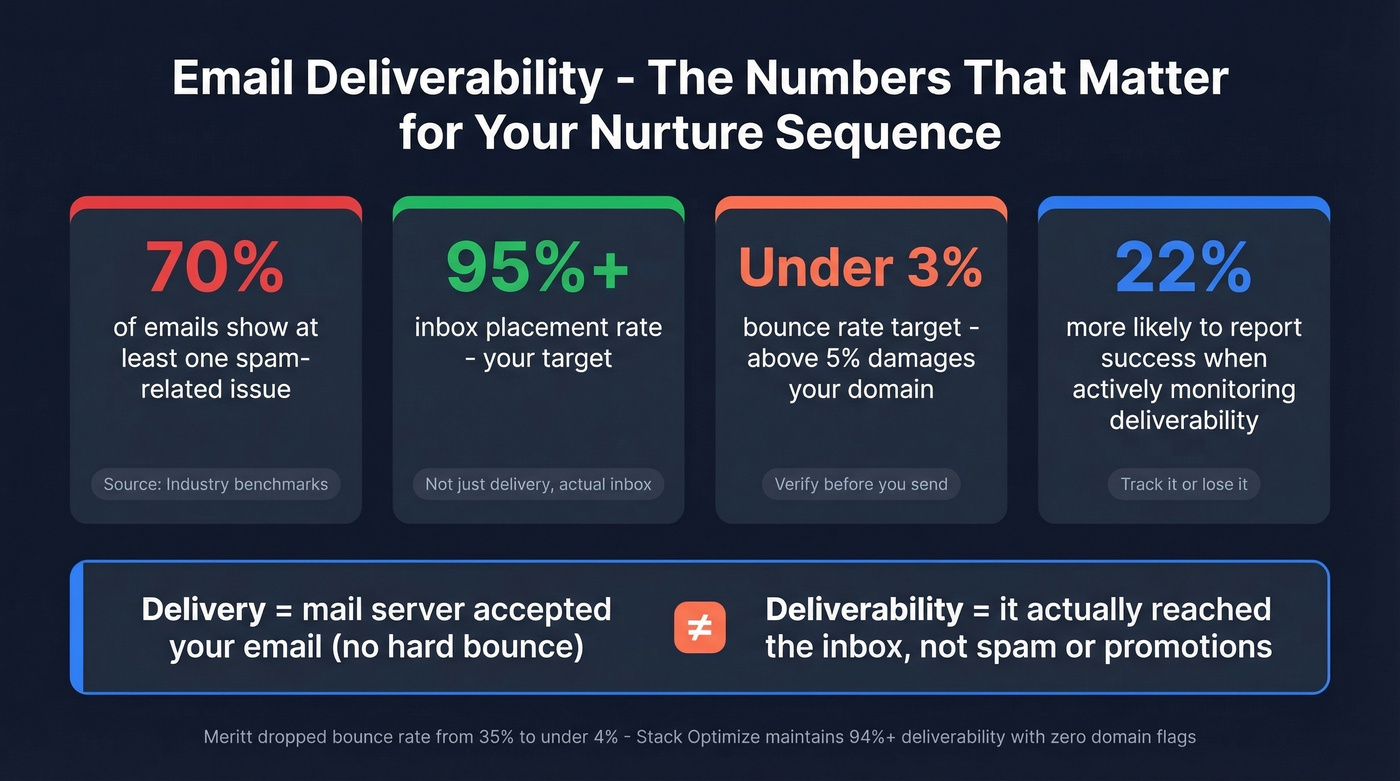
Delivery means the mail server accepted your email (no hard bounce). Deliverability means it actually reached the inbox, not the spam folder or promotions tab. You need both, but most teams only track the first. 70% of emails show at least one spam-related issue, and marketers who actively monitor deliverability are 22% more likely to report program success. Your target: 95%+ inbox placement and bounce rate under 3%. (For a full checklist, see our email deliverability guide and email bounce rate benchmarks.)
The results are measurable: Meritt dropped their bounce rate from 35% to under 4% after switching, and Stack Optimize maintains 94%+ deliverability with zero domain flags across all clients. Include a plain-text version and alt-text on images - accessibility isn't optional, and it helps inbox placement.
Mistakes That Kill Conversions
We've seen these patterns destroy otherwise solid sequences:
- Going silent after lead capture. The 48-hour window is real. Two months of silence means you're re-introducing yourself to someone who's already moved on.
- Same sequence for every persona. A CTO and a sales manager have different pain points and different content needs. One nurture track for both is lazy and it shows.
- Pitching too early. Break the 3:1 ratio and you'll train your list to ignore you.
- CTA overload. One email, one CTA. A second competing link tanks click rates.
- Not responding when leads reply. Radio silence on a warm reply burns your best lead. (If you need reply-safe copy, use these sales follow-up templates.)
- Measuring opens instead of pipeline. Opens are inflated by Apple Mail Privacy Protection. Track meetings booked and sales cycle length.
- Skipping list verification. A 5% bounce rate damages your domain reputation and drags every future email closer to spam. (If you're troubleshooting domain health, start with how to improve sender reputation.)
Building persona-specific nurture tracks for CTOs vs. sales managers means nothing if your contact data is stale. Prospeo refreshes 300M+ profiles every 7 days - not the 6-week industry average - so your sequences reach the right person at the right company, every time.
Fresh data means your Day 1 email actually lands on Day 1.
FAQ
How many emails should a nurture sequence have?
Four to six emails with branching logic outperform 12-email linear drips. For B2B, plan six touches across four weeks. For B2C, four to six emails over one to two weeks. Only add more if engagement data shows leads are still clicking at the tail end.
What's a good click rate for nurture emails?
Aim for 5.58% CTR on automated flows - that's the 2026 benchmark across 183,000+ brands. Top performers hit 10.48%. Open rates (20-30% B2B) are increasingly unreliable due to Apple Mail Privacy Protection, so click rate is the better signal.
How do I keep nurture emails out of spam?
Verify your list to keep bounce rate under 3%, authenticate your domain with SPF, DKIM, and DMARC, and monitor inbox placement after every send. Prospeo's 5-step verification catches invalid addresses, spam traps, and honeypots before they damage your sender reputation.
What's the difference between a drip campaign and a lead nurturing sequence?
A drip campaign sends pre-written emails on a fixed schedule regardless of recipient behavior. A lead nurturing sequence adapts - branching based on opens, clicks, replies, and lead score changes. The performance gap widens as your list grows. Post-purchase sequences also drive retention and expansion revenue, which most drip campaigns ignore entirely.