

One-to-Few ABM: A Practitioner Playbook for 2026
There's a Reddit thread that nails the skepticism: "Isn't ABM just detailed B2B marketing with a fancy name?" Fair question. The answer is yes - until you add cluster discipline and buying committee targeting. That's where one-to-few ABM becomes operationally distinct from "good marketing," and where most teams either get it right or waste six months running glorified email blasts.
71% of B2B practitioners now run some form of ABM. The strategy isn't new. But most teams skip the middle tier entirely, jumping from spray-and-pray to hyper-personalized 1:1 programs they can't sustain. The 1:few tier is where the real value lives for teams without six-figure platform budgets.
What Is One-to-Few ABM?
One-to-few ABM - sometimes called ABM Lite or Cluster ABM - sits between hyper-personalized 1:1 programs and broad-reach 1:many campaigns. The framework originated with ITSMA (now Momentum ITSMA), which defined the three tiers most B2B teams still reference today. In a 1:few program, you work clusters of 5-50 accounts that share enough in common to justify segment-tailored messaging. It's more specific than generic nurture, but you're not building bespoke content for every single account.
When to Choose 1:Few Over 1:1 or 1:Many
| 1:1 | 1:Few | 1:Many | |
|---|---|---|---|
| Accounts | 1 | 5-50 | 100+ |
| Pipeline fit | Late-stage, high-value | Mid-stage, ICP-aligned | Top-of-funnel |
| Personalization | Bespoke | Segment-tailored | Light / automated |
| Timeline | 9-18+ months | 6-12 months | Ongoing cycles |
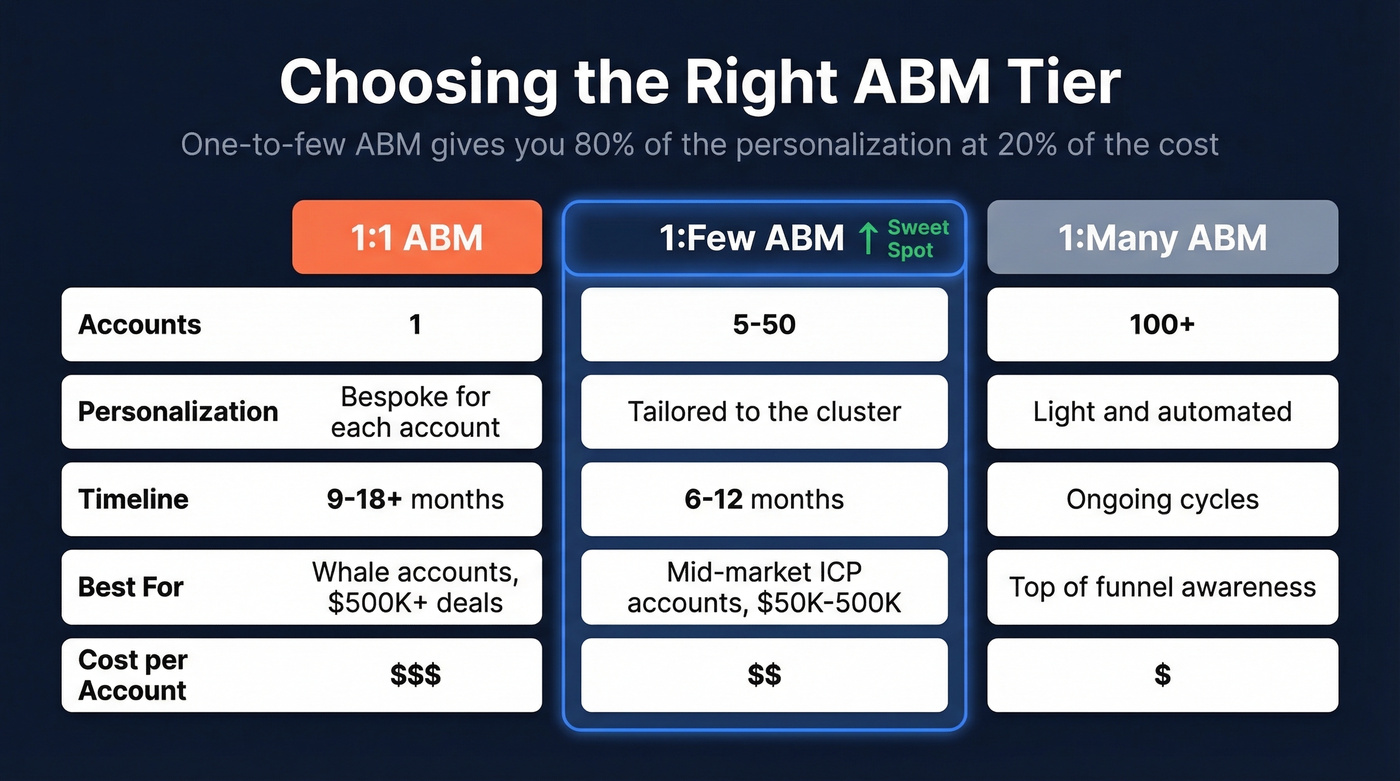
The widely cited 6-10 stakeholders per B2B deal is the reason 1:few exists. You can't build bespoke campaigns for every account, but you can't ignore the buying committee either. Clustering covers more accounts without sacrificing the multi-threading that moves deals forward.
Here's my honest take: if your average contract value sits below $50k, you almost certainly don't need 1:1 ABM. One-to-few ABM gives you 80% of the personalization at 20% of the cost. I've watched teams burn entire quarters building bespoke programs for accounts that would've closed faster with a well-run cluster motion.
How to Build Your Clusters
Step 1: Layer your segmentation. The Factors.ai framework gets this right - stack firmographic, behavioral, intent, and lifecycle layers. "200-1,000 employees, Series B-D, running Salesforce + HubSpot" is a cluster. "Mid-market tech companies" isn't.
Step 2: Disqualify aggressively. Have more disqualification criteria than qualification criteria. This prevents the "let's just add them" creep that turns 1:few into 1:many. If you can't articulate why an account belongs in a specific cluster, it doesn't belong there.
Step 3: Size your clusters. ZenABM recommends 50 accounts in 5 clusters of 10 - enough volume to learn from, small enough to personalize.
Step 4: Map the buying committee. This is where programs stall. Industry data shows 42% of teams can't identify the right buyers, and without verified contacts for 6-10 decision-makers per account, your cluster strategy stays theoretical. We use Prospeo for this step because the 98% email accuracy and 7-day data refresh cycle mean outreach hits real people, not dead inboxes. You can also layer intent data across 15,000 Bombora topics to prioritize clusters showing active buying signals.
Channels and Sequencing
Email dominates - 92% of ABM practitioners use it as a primary channel, followed by in-person events at 72%. But what matters is the sequence, not any single channel.
To keep the motion sustainable, treat this like sequence management rather than a one-off campaign.
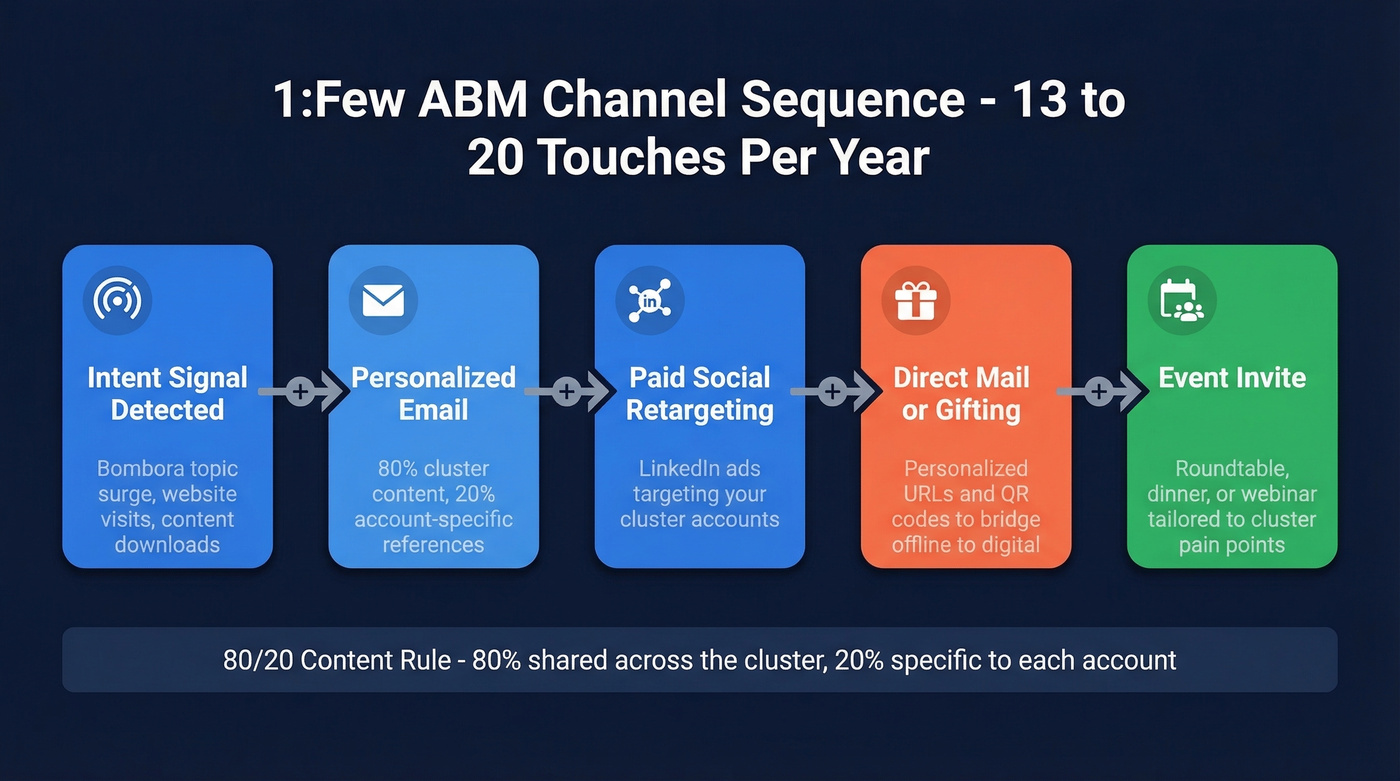
A solid 1:few cadence runs 13-20 touches per year per account. Intent signal triggers outreach, then personalized email, then paid social retargeting, then direct mail or gifting, then an event invite. Use the 80/20 content model: 80% shared cluster content, 20% account-specific touches referencing their tech stack, funding round, or a specific initiative you've spotted. For offline touches, personalized URLs and QR codes bridge engagement tracking - a tactic Snowflake uses effectively to connect physical mailers to digital behavior. If you’re leaning into physical touches, a dedicated direct mail for lead generation workflow helps keep attribution clean.

Your 1:few clusters are only as good as the contacts behind them. Prospeo gives you verified emails and direct dials for every member of the buying committee - across all your target accounts. 98% email accuracy, 125M+ verified mobiles, and intent data across 15,000 topics to prioritize which clusters to activate first.
Stop running cluster ABM against dead inboxes. Start with real contacts.
Measuring Cluster ABM Performance
Let's be honest: 47% of ABM teams struggle to prove ROI. The problem isn't ABM itself. It's measuring clicks and impressions instead of account progression.
If you want a clean measurement model, align your ABM dashboard to funnel metrics and pipeline health, not channel vanity stats.
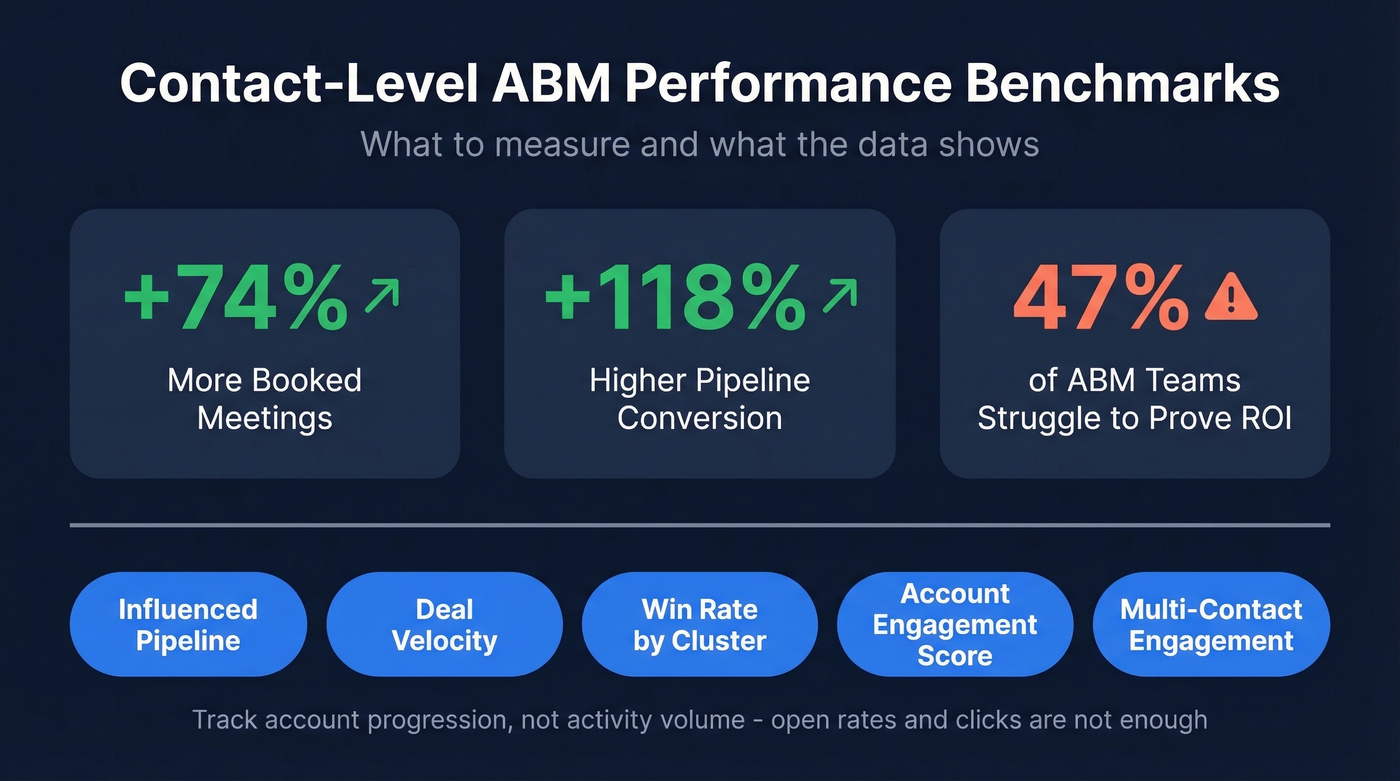
Track influenced pipeline, deal velocity, win rates by cluster, account engagement scores, and multi-contact engagement within buying committees. Contact-level ABM programs see up to 74% more booked meetings and 118% higher pipeline conversion. Those numbers only show up when you measure progression, not activity volume. If your dashboard is full of open rates and click-throughs but empty on "accounts that advanced a stage this month," you're tracking the wrong things.
Mistakes That Kill 1:Few Programs
Short-term thinking. Commit to 6-12 months minimum. ABM is a motion, not a sprint. Teams that pull the plug at 90 days never had a real program - they had a pilot they didn't believe in.
Gut-feel account selection. Use firmographic + intent + behavioral data. If you can't articulate why an account is in a cluster, remove it. (If your ICP is fuzzy, start with an ideal customer profile template and score clusters from there.)
Shallow personalization. Swapping a company name into a template isn't personalization. Reference cluster-specific pain points and tech stack challenges. "We noticed you're running Marketo alongside a custom CDP" beats "Hi {{company_name}}" every time. If your team needs a baseline, borrow structure from proven sales follow-up templates and adapt them to cluster context.
Misaligned metrics. We've seen teams implode because sales measured meetings while marketing measured MQLs. Agree on shared KPIs before launch - not after the first QBR turns into a blame session. (Helpful: a shared definition of QBR meaning and what gets reviewed.)
Ignoring multi-contact engagement. Build an account engagement score that tracks activity across contacts and channels over time. A single champion opening emails doesn't mean the account is engaged.
Skip the six-figure ABM platform until you've proven the model works with basic tooling. Don't be the team that buys Demandbase before they've closed a single cluster-sourced deal.
What It Actually Costs
ABM platform spend ranges from $35k to $1M+ annually, with implementation timelines of 6 weeks to 4 months before you've sent a single email.
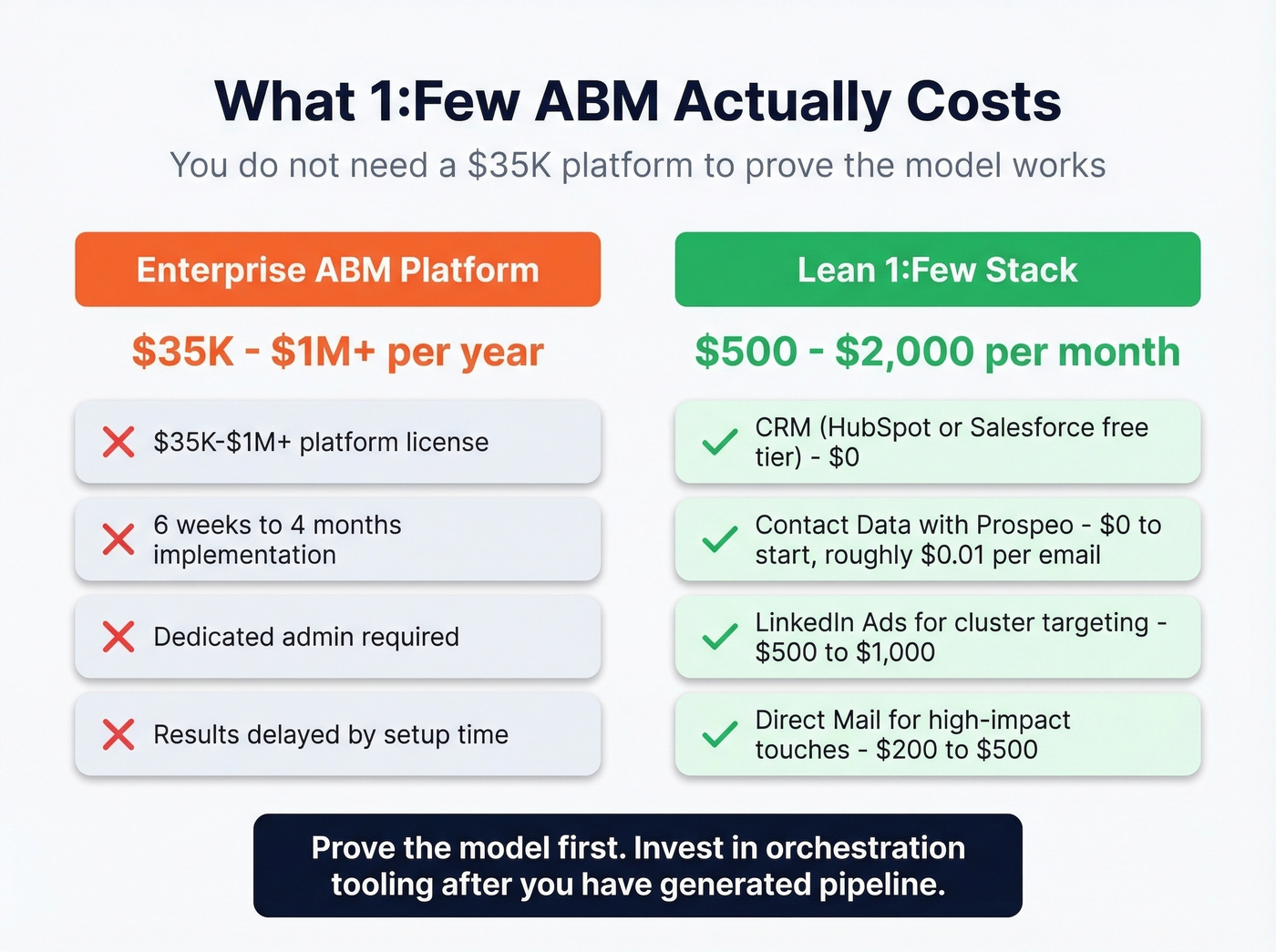
You don't need that to start. In our experience, most teams can run a credible 1:few program for $500-$2,000/month:
- CRM: HubSpot or Salesforce free tier - $0 (see real examples of a CRM if you’re comparing options)
- Contact data: Prospeo's free tier for buying committee emails and direct dials - $0 to start, roughly $0.01/email to scale (if you’re evaluating vendors, compare data enrichment services)
- Paid social: $500-$1,000 in LinkedIn ads targeting your clusters
- Direct mail: $200-$500 for high-impact physical touches
Prove the model first. Invest in orchestration tooling after you've generated pipeline.
You don't need a $35K ABM platform to prove the model works. Prospeo starts free - 75 verified emails/month - and scales at $0.01/email with a 7-day data refresh cycle. Layer intent signals, build buying committee lists, and enrich your CRM with 50+ data points per contact. The budget math for 1:few ABM just got a lot simpler.
Run a credible cluster ABM program without the enterprise price tag.
Real Examples With Numbers
Snowflake generated $50M in pipeline from 200 accounts with a 1:few program combining premium direct mail and tailored digital experiences. They used personalized URLs on physical mailers to bridge offline and online engagement, hitting 85% open rates. That's not a typo - physical mail with a digital hook outperformed their email-only campaigns by a wide margin.
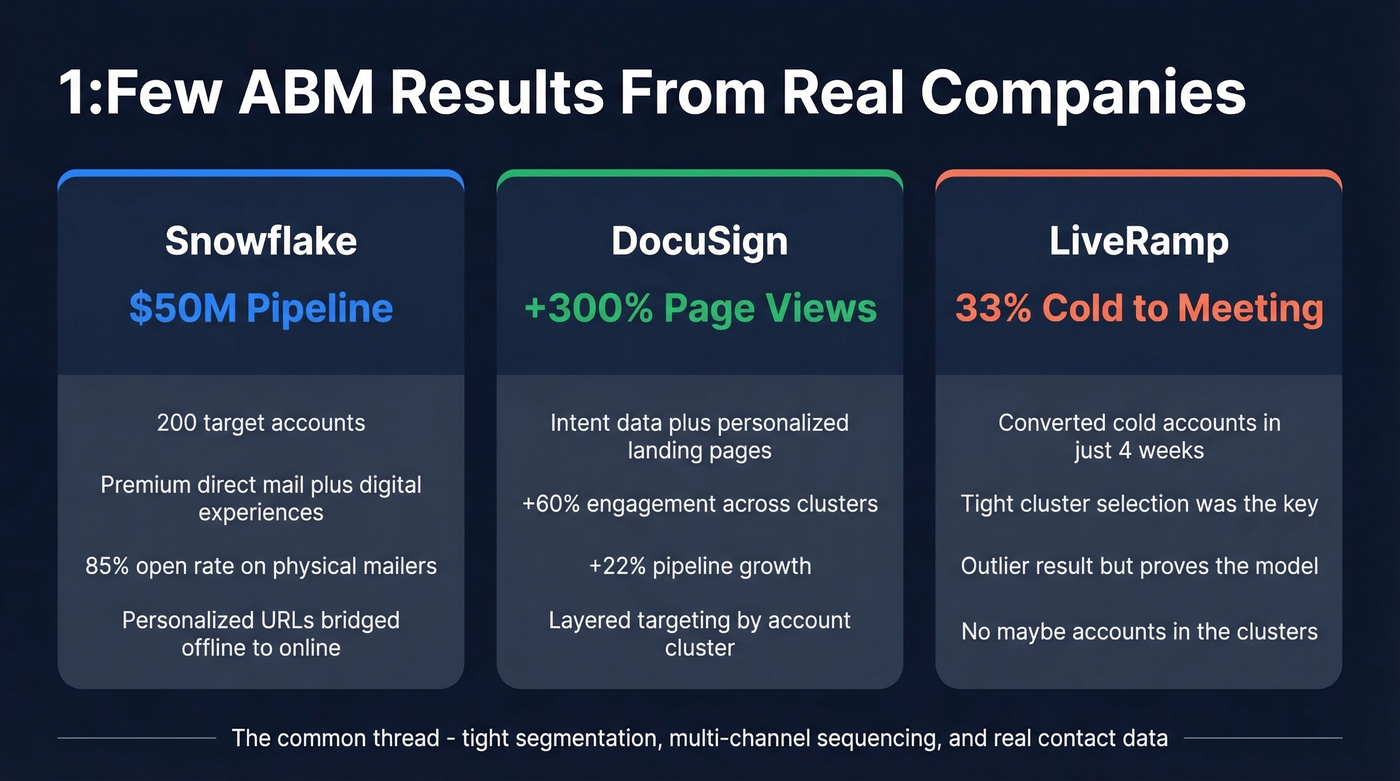
DocuSign took a different angle, layering intent data with personalized landing pages across target account clusters. The results: +60% engagement, +300% page views on targeted content, and +22% pipeline growth.
LiveRamp proved velocity is possible when cluster selection is tight - they converted 33% of cold accounts to meetings in just four weeks. That's an outlier, but it shows what happens when you nail the segmentation and don't dilute your clusters with "maybe" accounts.
FAQ
How many accounts should be in a 1:few cluster?
Start with 5-15 accounts per cluster grouped by shared pain point or buying trigger. ZenABM recommends 5 clusters of 10 - 50 accounts total - as a practical starting point that balances personalization with statistical learning. Go smaller if you're just getting started; you can always expand clusters that show traction.
Can you run one-to-few ABM without a dedicated platform?
Yes. A CRM, a contact data provider, email, and paid social are enough to launch. Add a dedicated orchestration platform once you've proven pipeline impact - most teams don't need one in the first two quarters.
How long before a 1:few program shows results?
Expect 3-6 months for early engagement signals like account-level page views and multi-contact opens, and 6-12 months for meaningful pipeline impact. LiveRamp's 33% cold-to-meeting conversion in four weeks is an outlier - plan for a longer ramp and celebrate the early wins along the way.