

One-to-One ABM: How to Run It Without a 10-Person Team
Every ABM guide assumes you have a dedicated strategist, two copywriters, a designer, a data analyst, and a campaign manager. Traditional guidance says you need 7-10 people for proper one-to-one ABM. That's not your reality.
Here's how to run strategic 1:1 account-based marketing with a lean team and AI-powered workflows that actually scale - plus how to solve the contact data problem that most guides conveniently skip over.
What 1:1 ABM Actually Means
A practitioner on r/b2bmarketing put it best: "If I swapped the logo on the deck or the landing page, it would break." That's the standard.
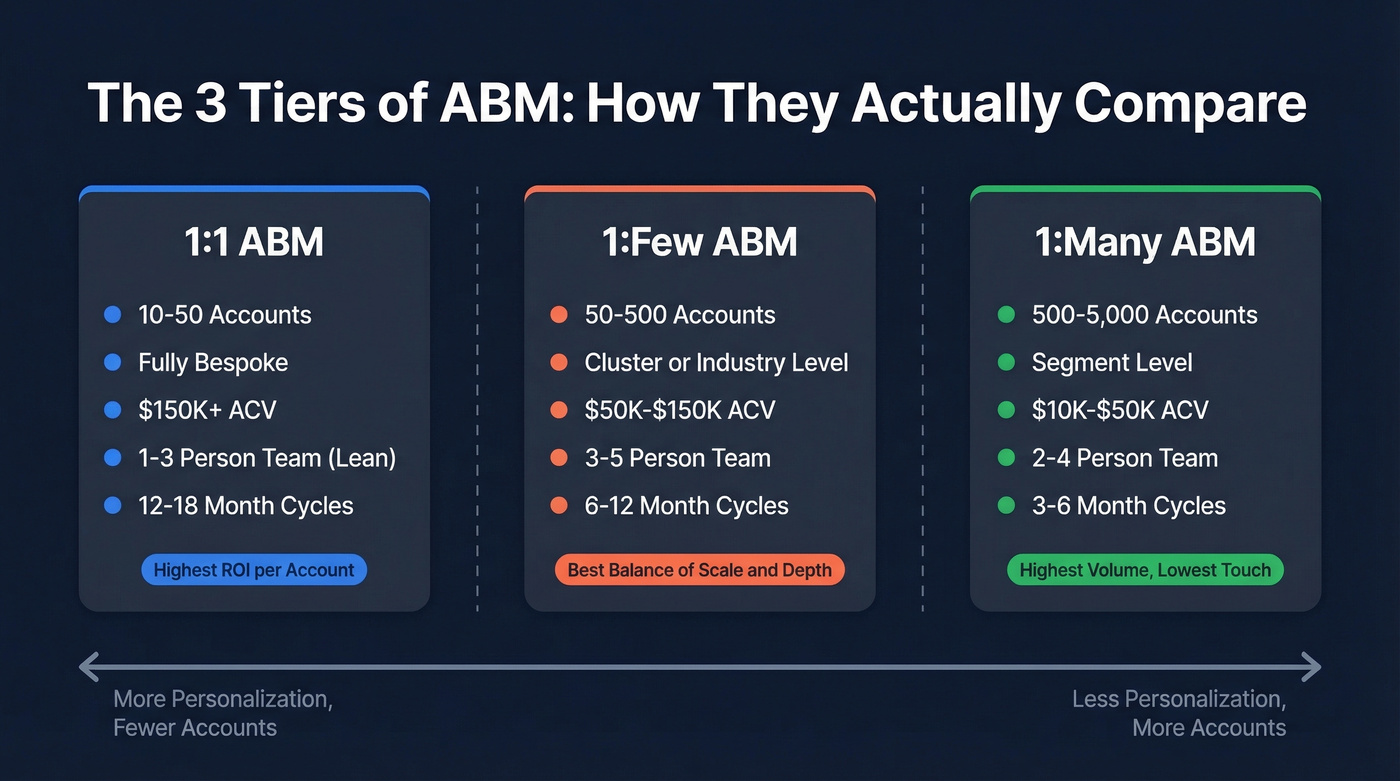
Every asset, every message, every touchpoint is built for a specific account's context, pain, and buying committee. In enterprise deals, buying committees regularly include 12+ stakeholders. You're targeting 10-50 accounts max - this isn't scaled demand gen with a fancy label.
| Tier | Accounts | Personalization | Team Size | Typical ACV |
|---|---|---|---|---|
| 1:1 | 10-50 | Fully bespoke | 1-3 lean / 7-10 trad. | $150K+ |
| 1:Few | 50-500 | Cluster/industry | 3-5 | $50K-$150K |
| 1:Many | 500-5,000 | Segment-level | 2-4 | $10K-$50K |
Expect 12-18 month cycles for 1:1 campaigns. 1:Few runs about 6-12 months. 1:Many compresses to 3-6.
Is It Worth the Investment?
The numbers are unambiguous. A survey of 771 marketers found an average ABM ROI of 137%, with 71.2% of organizations already running some form of ABM. Demandbase's benchmark reported 81% higher ROI from ABM compared to traditional marketing. Inverta generated $1.3M in pipeline from a 50-account campaign. CipherHealth saw $122.70 in influenced revenue per every $1 spent, and Bonterra doubled its win rate with 2.5x deal value.
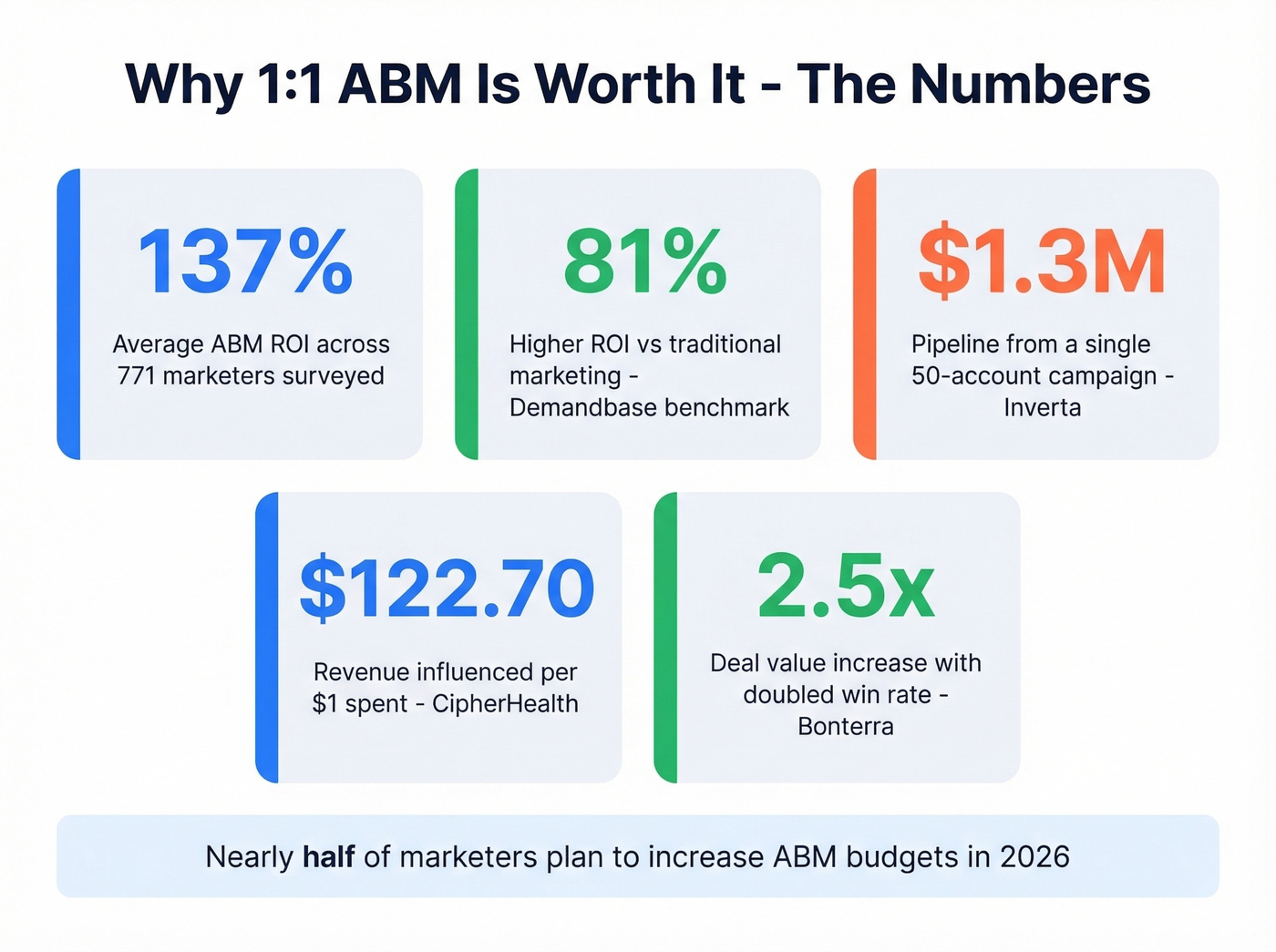
Nearly half of marketers plan to increase ABM budgets in 2026.
Let's be honest though: if your average deal is under $50K, you almost certainly don't need a 1:1 approach. Run 1:Few instead and save yourself six months of custom content production for deals that won't cover the cost.
Is This Account Worth 1:1 Treatment?
Not every account deserves the investment. Start with 5-10 accounts, not 50. Expect 6-8 weeks from account selection to first campaign activation. We've adapted this qualification framework from N.Rich's playbook:
ACV threshold: $50K-$150K is worth considering. $150K-$300K is a strong candidate. $300K+ - prioritize immediately.
Engagement signals: Are decision-makers visiting your site? Is the account showing intent on topics you solve? Intent data tracking across 15,000+ topics can confirm whether an account is actually in-market before you invest 1:1 resources - tools like Prospeo layer Bombora-powered intent signals directly into your prospecting workflow.
Strategic value: Is this a marquee logo that opens a new vertical? Enterprise account-based marketing works best when the deal size justifies deep research and bespoke assets.
Disqualifiers: No identifiable pain point, no budget cycle alignment, or a buying committee you can't map. Skip it.
The AI-Powered Workflow
In 2026, 78.7% of marketers already incorporate AI into their ABM programs. The solo-operator model is increasingly viable. Here's the workflow we recommend:
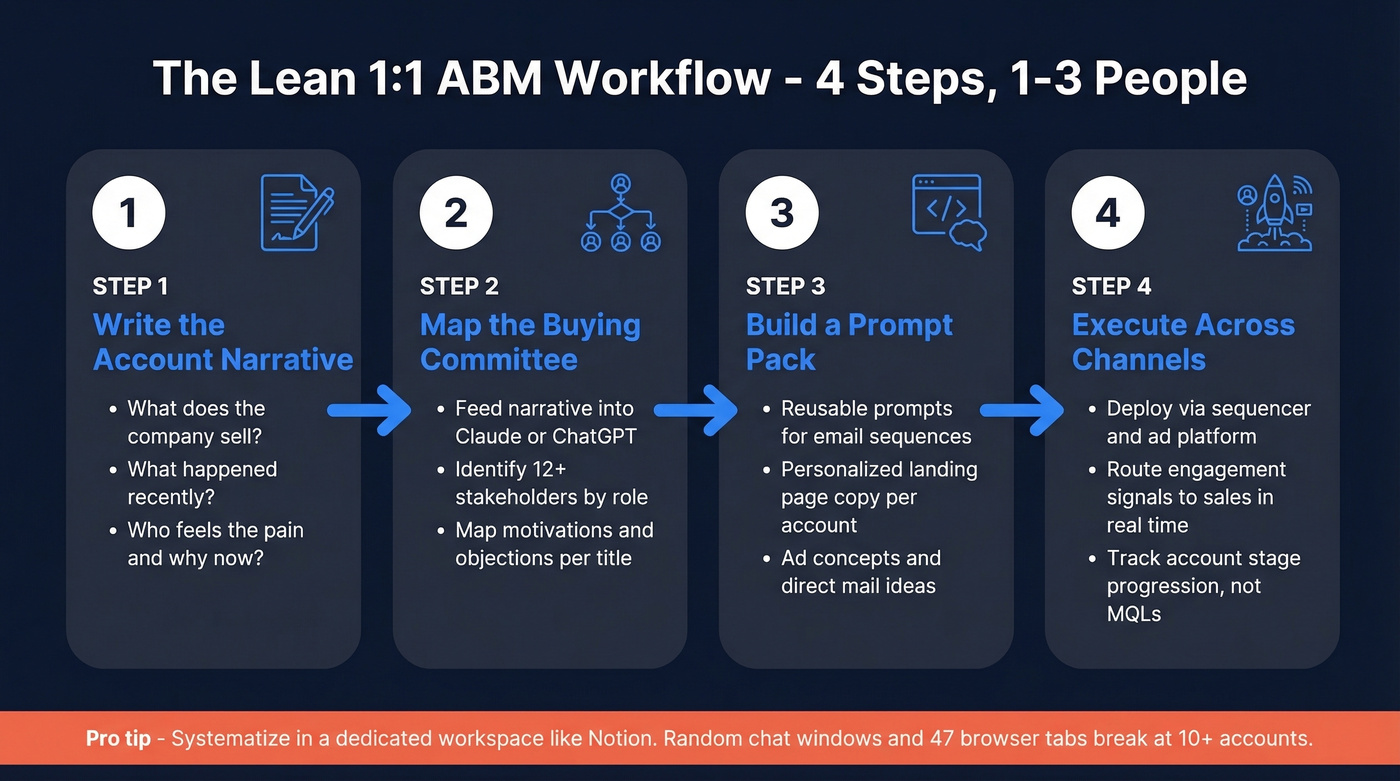
1. Write the account narrative. What does the company sell? What's happened recently? Who feels the pain? What's the "why yes now" and "why no now"?
2. Generate buying committee hypotheses. Feed your narrative into Claude or ChatGPT. Map likely roles, motivations, and objections. A VP of Engineering cares about different things than a CFO - and messaging for C-suite executives requires language around strategic outcomes, not feature lists.
3. Build a prompt pack. Create reusable prompts that generate per-account assets: email sequences by title, personalized landing page copy, ad concepts, direct mail ideas. Systematize this so it doesn't break at 30 accounts.
4. Execute across channels. Deploy assets through your sequencer, landing page builder, and ad platform. Route engagement signals back to sales in real time.
A practitioner on r/b2bmarketing nailed the operational pain: running this in "random chat windows and 47 browser tabs" breaks fast. You need a dedicated system - even a structured Notion workspace - to operationalize beyond 10 accounts.
If you're building outbound sequences to support 1:1 plays, keep a set of sales follow-up templates ready so you don't reinvent the wheel per account.

Running 1:1 ABM on a lean team means you can't waste cycles on bad contact data. Prospeo gives you the full buying committee - 300M+ profiles with 98% email accuracy, 125M+ verified mobiles, and Bombora intent data across 15,000 topics - so you know which accounts are in-market before you invest in bespoke assets.
Map the entire buying committee at $0.01 per verified email.
Personalization Beyond Name Tokens
Name tokens aren't personalization. Relevance is.
GumGum created a custom comic book for T-Mobile's CEO - he tweeted it, and they closed the deal. Intridea put a billboard outside Ogilvy's headquarters reading "Ogle this, Ogilvy" - it led to a meeting with the CEO. You don't need stunts at that scale, but you do need two parallel playbooks running simultaneously, and the interplay between them is what separates real one-to-one ABM from lead gen with a logo slapped on it.
Time-based touchpoints are planned quarterly: research reports, workshops, executive briefings. Signal-based touchpoints react to triggers - a key hire, a management change, a spike in intent visits. When you're targeting C-suite buyers specifically, executive engagement demands content that addresses board-level priorities like margin expansion, competitive positioning, and risk mitigation. Not product specs.
Measuring Without Fooling Yourself
If your ABM dashboard shows lead counts, you're doing lead gen with extra steps.
The right metric is account stage progression - how many target accounts moved from "interested" to "considering" to "selecting" to "closed won." Contact-level attribution will mislead you. Safari ITP and ad blockers kill cookies before they land, making ad clicks vanish from attribution entirely. Link shorteners and redirects strip UTMs, so campaigns lose credit. LinkedIn's 90-day attribution window misses 12-month enterprise sales cycles, and HubSpot's "Marketing Contact" gating excludes deals from ads dashboards.
Measure pipeline influence and deal velocity instead. When BioCatch's ABM program showed 41% faster deal velocity on accounts that consumed custom content, that was the signal that mattered - not click-through rates.
If you're trying to standardize what you track, align ABM reporting with core pipeline health metrics so sales and marketing use the same scoreboard.
The Lean 1:1 ABM Tech Stack
You don't need a $100K platform to run strategic account-based marketing at the 1:1 tier.
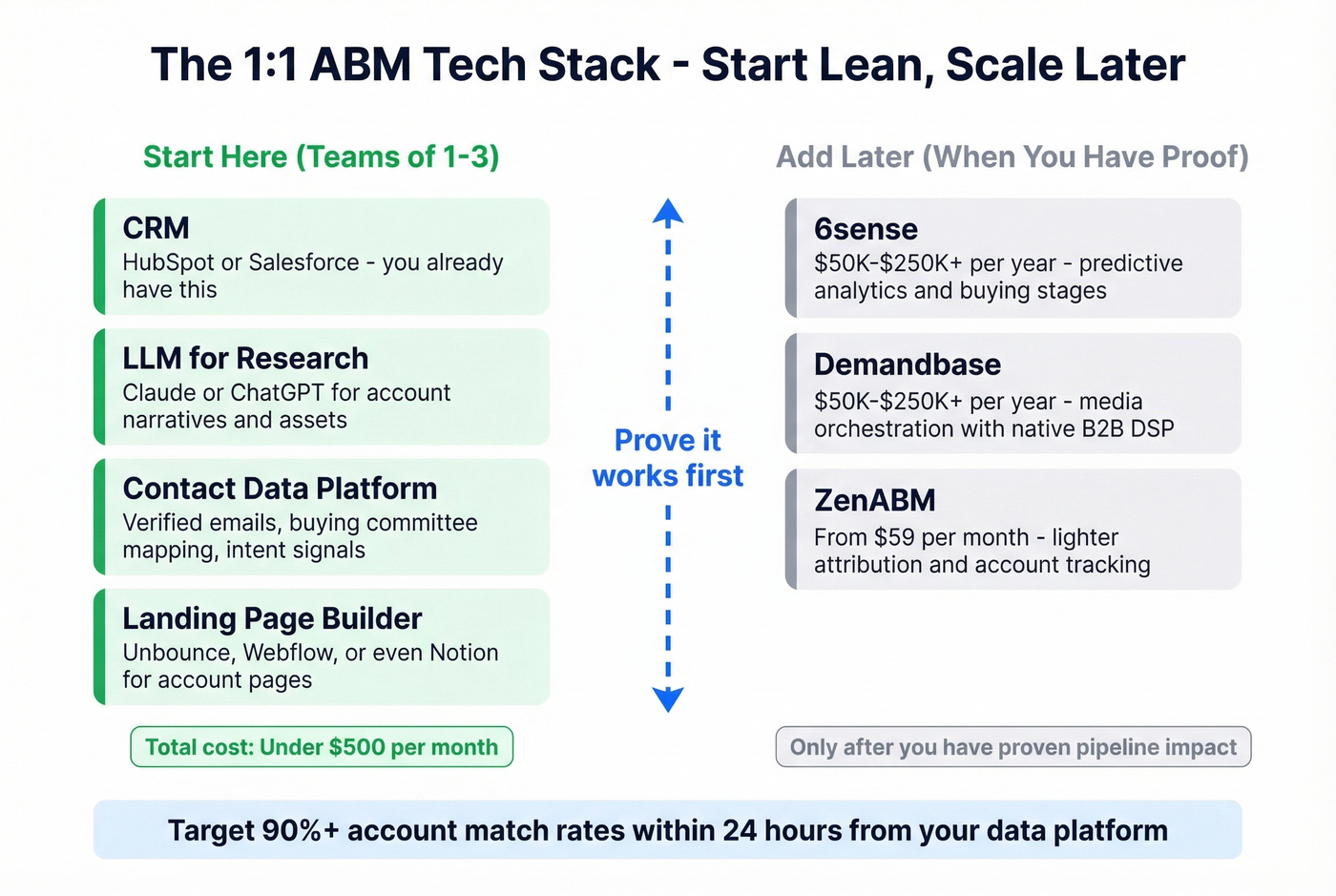
For teams of 1-3, use this:
- CRM - HubSpot or Salesforce. You already have this. (If you're still evaluating, here are a few examples of a CRM to sanity-check fit.)
- An LLM - Claude or ChatGPT for account research and asset generation.
- A landing page builder - Unbounce, Webflow, or even Notion for account-specific pages.
When evaluating any data platform, aim for 90%+ account match rates within 24 hours. That's a healthy operational target for identity and account matching. If you're comparing vendors, start with a shortlist of B2B company data providers. Skip these unless you're enterprise:
- 6sense ($50K-$250K+/year) - predictive analytics and buying stage scoring. Worth it at 100+ accounts with a dedicated team.
- Demandbase ($50K-$250K+/year) - media orchestration with a native B2B DSP.
- ZenABM (from $59/month) - a lighter option for attribution and account tracking.
Enterprise ABM platforms are optional until you've proven the motion works. Start lean, prove pipeline impact, then invest in orchestration.
Common Mistakes That Kill 1:1 Campaigns
Treating ABM like lead gen. If your goal is "generate 500 MQLs from target accounts," you've already lost the plot. ABM measures pipeline and revenue, not lead volume.
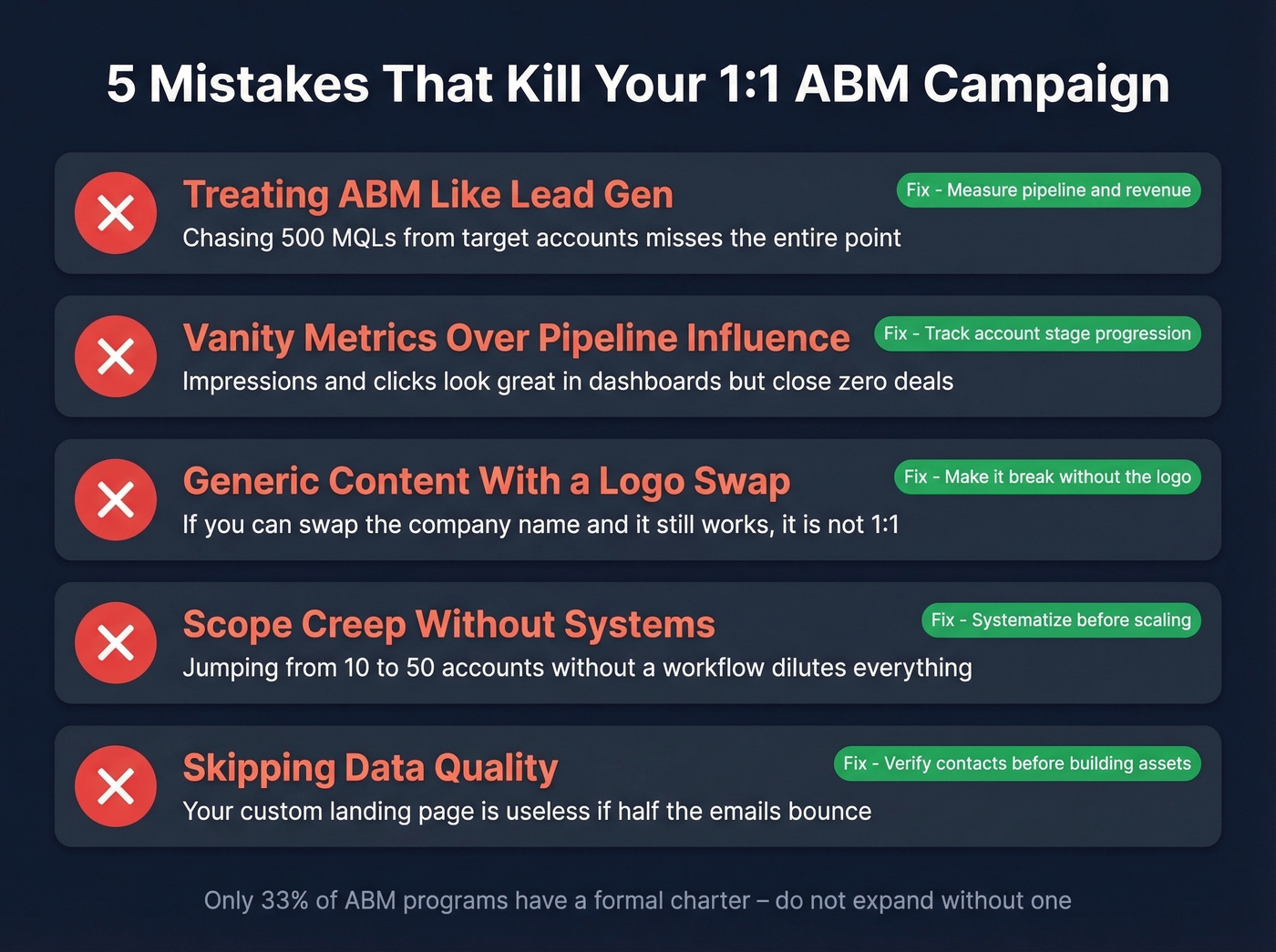
Vanity metrics over pipeline influence. Impressions and clicks don't close deals. Track stage progression.
Generic content with a logo swap. If you can swap the company name and the asset still works, it's not 1:1. Full stop.
Scope creep. Going from 10 to 50 accounts without systematizing the workflow dilutes everything. Only 33% of ABM programs even have a formal charter - don't expand without one.
Skipping data quality. Here's the thing: your custom landing page doesn't matter if the email bounces. This is especially true for programs where every contact in the buying committee needs to be reachable. We've seen teams spend weeks on bespoke content only to discover half their contact list was stale. Fix the data first. (If you're diagnosing issues, start with email bounce rate benchmarks and root causes.)
If you're cleaning and enriching records before outreach, consider a dedicated workflow for lead enrichment so personalization doesn't run on stale fields.
Your 1:1 ABM workflow breaks the moment you can't reach the 12+ stakeholders in an enterprise buying committee. Prospeo's 30+ search filters - including job changes, department headcount, funding signals, and technographics - let you identify and verify every decision-maker on a 7-day data refresh cycle. No stale contacts. No bounced emails killing your domain.
Stop building bespoke campaigns for contacts that bounce.
FAQ
How many accounts should I target with one-to-one ABM?
Start with 5-10 accounts. Experienced teams scale to 30-50 with a systematized workflow. Beyond 50 dilutes the personalization that makes 1:1 campaigns effective - you'll end up doing 1:Few with extra overhead.
What's the minimum deal size to justify a 1:1 approach?
$150K+ is the sweet spot where bespoke research and custom content pay for themselves. Below $50K, the revenue rarely covers the cost of hyper-personalized outreach across a full buying committee.
What tools do I need to start on a small team?
A CRM, a contact data platform with verified emails and buying committee mapping, an LLM for research and asset generation, and a landing page builder. Enterprise platforms like 6sense or Demandbase are optional until you've proven pipeline impact.
How does 1:1 differ from other ABM tiers?
The core difference is depth. Every asset is built for a single account's specific context - their industry challenges, recent news, and individual stakeholder motivations. 1:Few and 1:Many tiers use cluster-level or segment-level personalization, which works well for mid-market but lacks the precision needed for enterprise deals with 10+ person buying committees.