

Opportunity Management: A Practitioner's Guide With Real Numbers
Your pipeline says $2M. Your forecast keeps missing by 40%. Reps swear deals are "close," but close dates slide every week and nobody updates next steps. The problem isn't your sales team - it's that 76% of CRM data is inaccurate or incomplete, and every framework, forecast, and pipeline review you run sits on top of that broken foundation. Better opportunity management starts with fixing the data underneath it.
Deals closed within 50 days carry a 47% win rate. After 50 days, that drops to 20% or lower. This guide is about keeping deals moving through that window - and about stopping the self-deception around the ones that won't.
The Short Version
Sales opportunity management boils down to three things: stage discipline with exit criteria, a qualification framework that matches your deal complexity, and data you can actually trust. Under $10K ACV? Use BANT. Over $25K with multiple stakeholders? Use MEDDIC. And if your CRM data falls into that 76% inaccuracy bucket - which statistically, it does - fix that before you fix anything else.
What It Actually Means in Sales
In project management circles, "opportunity management" refers to pursuing positive risks - the upside of uncertainty. That's a valid definition, but it's not what we're covering here. In sales, it's the process of tracking deals as they move through pipeline stages, from first qualification to close. It's the system that tells you which deals deserve attention, which are stalling, and which should've been disqualified two weeks ago.
The distinction from lead management matters. Lead management focuses on the person or account. Opportunity management focuses on the deal itself - including deal value, which changes over time even when the contact doesn't. A lead becomes an opportunity when there's a real deal attached: a budget conversation, a timeline, a defined need.
You probably need tighter deal tracking if you can't prioritize which opportunities to work first, don't know your win/loss ratio by stage, or spend more time figuring out next steps than executing them.
Building Your Pipeline Stages
The biggest mistake teams make with pipeline stages is copying someone else's template without adapting it to their sales motion. Threads on r/salesforce flag stage design as a constant stumbling block - especially for enterprise and consulting cycles where generic "Discovery -> Demo -> Negotiation" stages don't capture the real buying process.
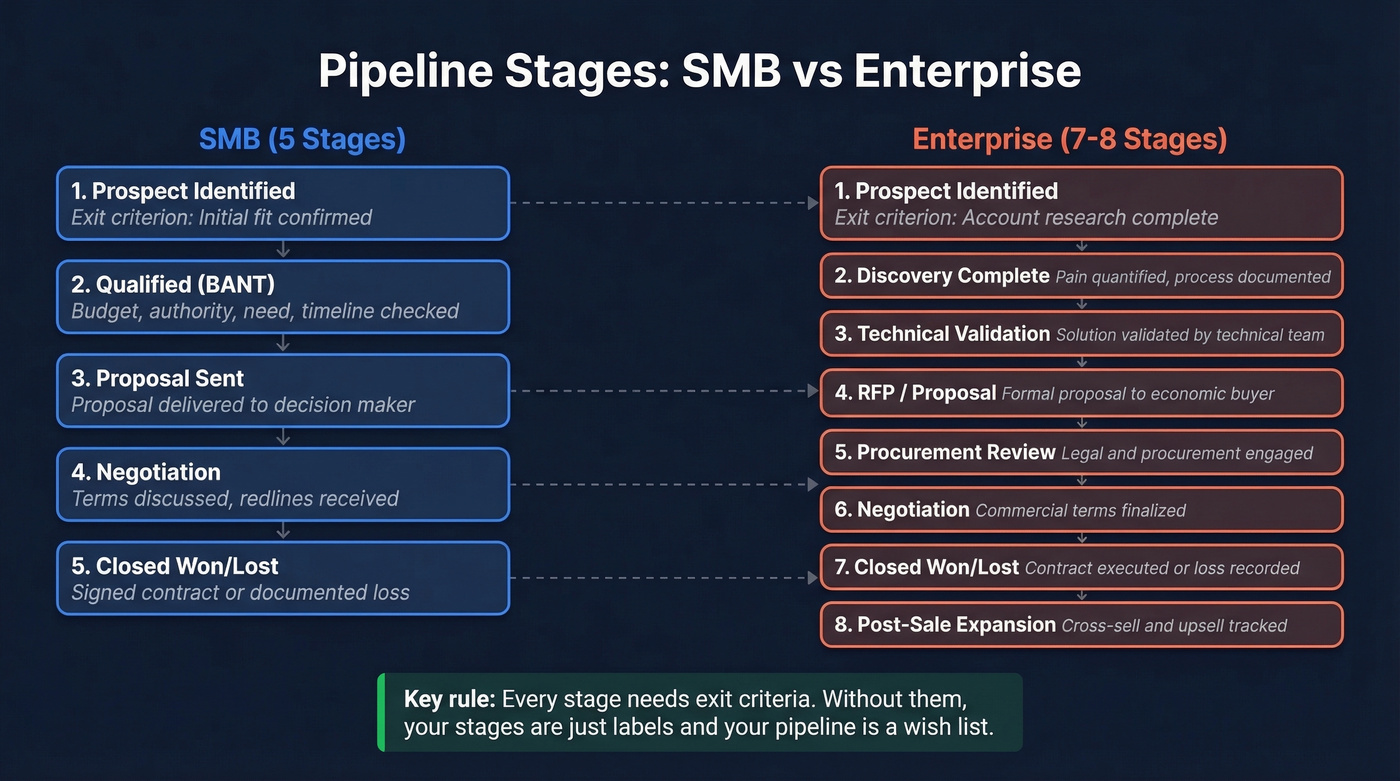
| Stage | SMB (5-Stage) | Enterprise (7-8 Stage) |
|---|---|---|
| 1 | Prospect Identified | Prospect Identified |
| 2 | Qualified (BANT) | Discovery Complete |
| 3 | Proposal Sent | Technical Validation |
| 4 | Negotiation | RFP / Proposal |
| 5 | Closed Won/Lost | Procurement Review |
| 6 | - | Negotiation |
| 7 | - | Closed Won/Lost |
| 8 | - | Post-Sale Expansion |
The critical piece most teams skip is exit criteria for each stage. A deal shouldn't advance from "Discovery" to "Proposal" just because a rep had a good call. It should advance because specific conditions are met - a decision-maker is identified, budget is confirmed, timeline is established. Without exit criteria, your stages are labels and your pipeline is a wish list.
For enterprise cycles, you'll often need stages that reflect RFPs and operational verification. A consulting firm selling six-figure engagements needs a "Technical Validation" stage that simply doesn't exist in a five-stage SMB pipeline. Stage 8 - Post-Sale Expansion - is where enterprise teams track cross-sell and upsell opportunities within existing accounts. Skip this stage and you're leaving the easiest revenue on the table.
Every stage should track three fields at minimum: next step (a specific action, not "follow up"), last activity date, and close date change count. If a deal's close date has moved three times, that's a signal, not just a data point. Consistent pipeline tracking depends on these fields being filled reliably, not just when reps remember.
Exit Criteria Template
| Stage | Required Fields | Who Confirms |
|---|---|---|
| Qualified | Need identified, budget range, authority mapped | AE |
| Discovery Complete | Pain quantified, decision process documented | AE + Manager |
| Proposal Sent | Proposal delivered to economic buyer, timeline agreed | AE |
| Negotiation | Redlines received, legal engaged | AE + Deal Desk |
| Closed Won | Signed contract, PO received | Manager |
Qualification Frameworks
32% of sales teams waste time on unqualified leads. The fix isn't qualifying harder - it's picking the right framework for your deal complexity and actually enforcing it.
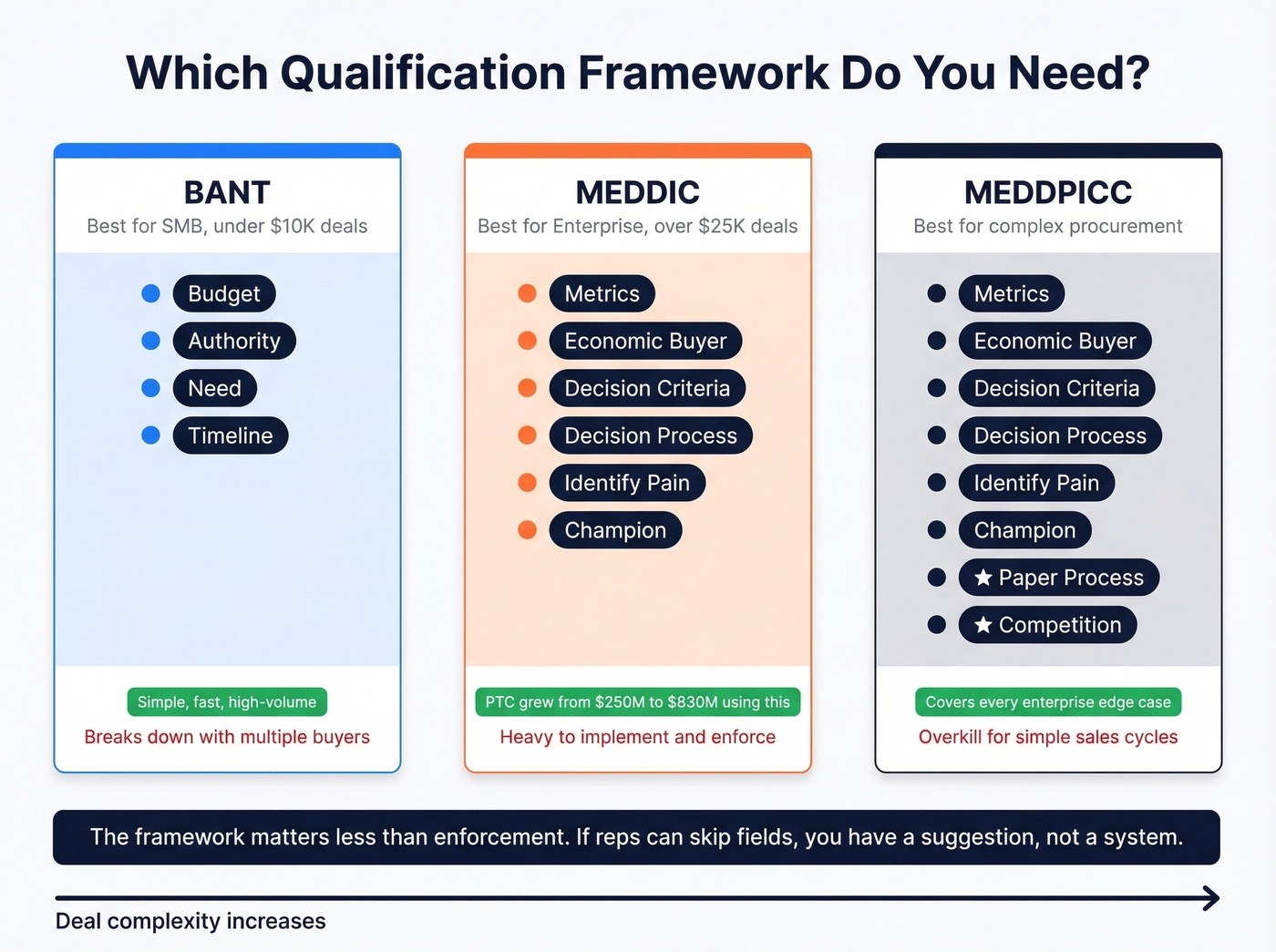
| Framework | Best For | Key Questions | Limitation |
|---|---|---|---|
| BANT | SMB, <$10K deals | Budget? Authority? Need? Timeline? | Assumes single buyer |
| MEDDIC | Enterprise, >$25K | Metrics, Economic Buyer, Decision Criteria/Process, Identify Pain, Champion | Heavy to implement |
| MEDDPICC | Complex procurement | Adds Paper Process + Competition to MEDDIC | Overkill for simple sales |
BANT works when you're running high-volume, shorter cycles. One decision-maker, clear budget, fast timeline. It falls apart in enterprise deals where there are six stakeholders and a procurement process that takes longer than your entire SMB sales cycle.
MEDDIC earns its complexity. After implementing MEDDIC, PTC grew revenue from ~£195M to ~£650M (~$250M to ~$830M) in four years. That's not just a framework win - it's a cultural shift toward deal rigor. Deals without an identified decision-maker are 80% less likely to close.
Timing matters as much as framework choice. Qualification fails in three ways: teams don't use it, they apply it too late after resources are already committed, or they apply it too early before enough information exists to qualify meaningfully. The sweet spot is right after initial discovery - enough signal to qualify, early enough to walk away cheaply.
Here's the thing: the framework matters less than enforcement. If reps can advance deals without filling in qualification fields, you don't have a framework - you have a suggestion. For complex procurement, Use MEDDPICC when paper process and competition are real variables.
Benchmarks Worth Tracking
The single most useful metric in your opportunity management process is pipeline velocity:
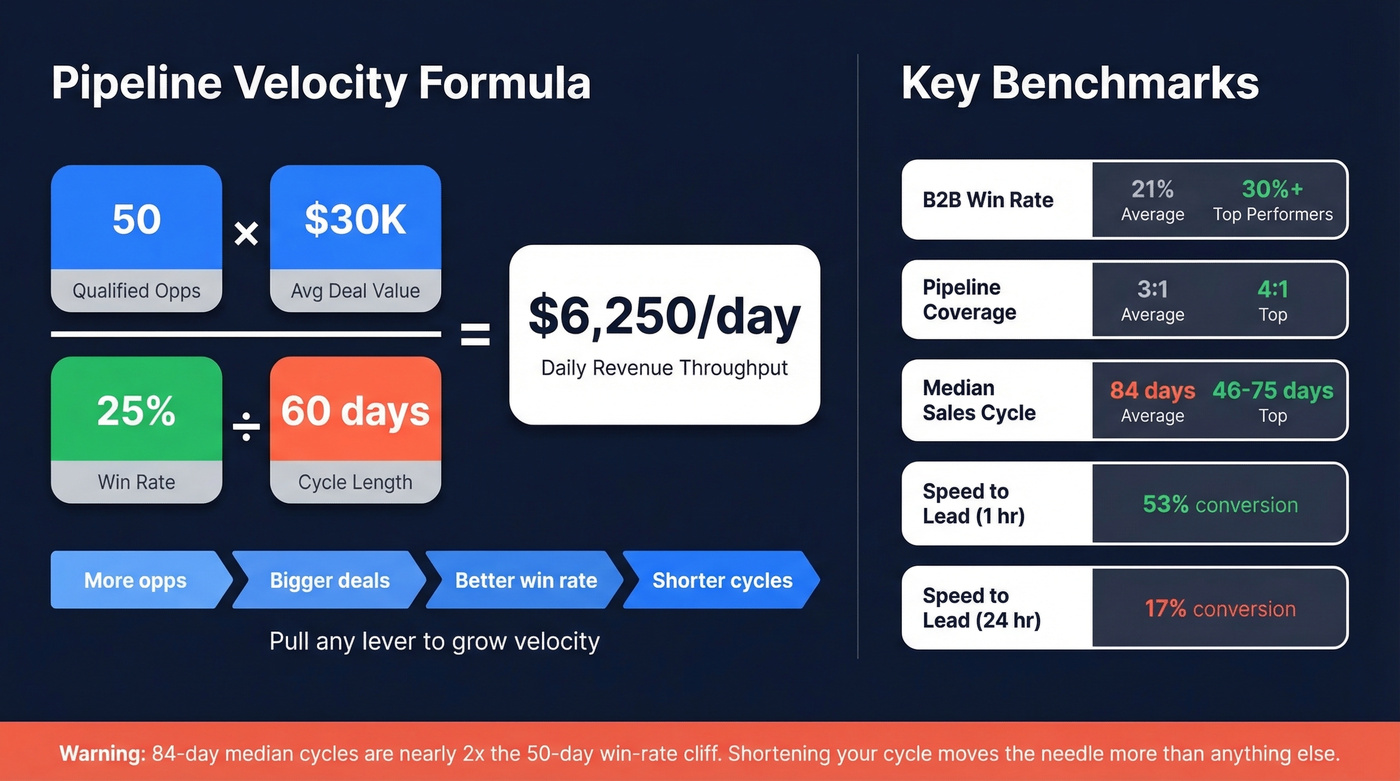
(Number of Opportunities x Average Deal Value x Win Rate) / Sales Cycle Length = Daily Revenue Throughput
Worked example: 50 qualified opportunities, $30K average deal value, 25% win rate, 60-day average cycle. That's (50 x $30,000 x 0.25) / 60 = $6,250/day. Now you know exactly which lever to pull: more opportunities, bigger deals, better win rate, or shorter cycles.
Key benchmarks from industry data and pipeline statistics:
| Metric | Average | Top Performers |
|---|---|---|
| B2B win rate | 21% | 30%+ |
| Pipeline coverage ratio | 3:1 | 4:1 |
| Median sales cycle | 84 days | 46-75 days |
| Speed-to-lead (1 hr) | 53% conversion | - |
| Speed-to-lead (24 hr) | 17% conversion | - |
That 84-day median cycle is sobering when you pair it with the 50-day win-rate cliff. Most teams are running cycles that are almost twice the optimal length. If your cycle exceeds 75 days, shortening it will move the needle more than any other lever.
Stage conversion rates by segment:
| Stage | SMB/Mid-Market | Enterprise |
|---|---|---|
| Lead -> MQL | 41% | 39% |
| MQL -> SQL | 39% | 31% |
| SQL -> Opp | 42% | 36% |
| Opp -> Close | 39% | 31% |
The biggest bottleneck for most teams is MQL-to-SQL conversion. Enterprise teams see a steep drop here - 31% versus 39% for SMB. That's where lead scoring and qualification frameworks earn their keep.

Your qualification framework is only as good as the data underneath it. 76% of CRM data is inaccurate - which means your MEDDIC fields, champion mapping, and deal scoring all sit on a broken foundation. Prospeo's CRM enrichment fills in 50+ data points per contact at a 92% match rate, refreshed every 7 days.
Stop running pipeline reviews on stale data. Enrich your CRM now.
Common Mistakes That Kill Deals
We've seen the same pipeline failures across dozens of teams. They're predictable, and they're fixable.
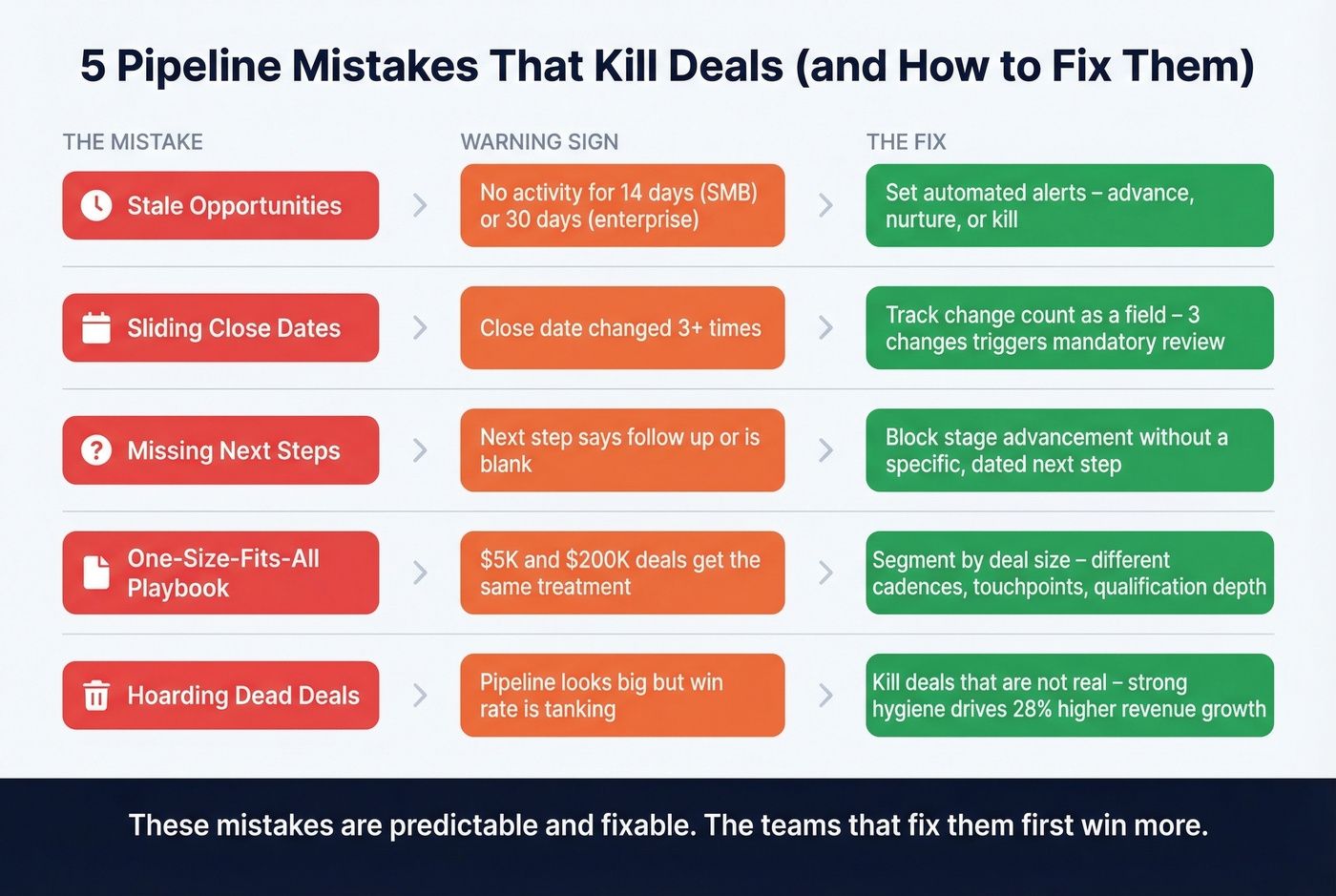
Stale opportunities sitting in the same stage for months. If a deal hasn't had activity in 14 days for SMB or 30 days for enterprise, it's not a deal - it's a memory. Set automated alerts that flag stale opportunities and force a disposition: advance, nurture, or kill.
Close dates that keep sliding. This is a perennial complaint on r/salesforce. Every pushed close date erodes forecast accuracy and trains leadership to distrust the pipeline. Track close date change count as a field. Three changes = mandatory review.
Missing next steps. If the "Next Step" field says "follow up" or is blank, you don't have a pipeline - you have a contact list. Enforce validation rules that block stage advancement without a specific, dated next step. If you need a starting point, use proven sales follow-up templates to standardize what "next step" looks like.
Treating every deal the same way. A $5K deal with one buyer and a $200K deal with a procurement committee need fundamentally different cadences, touchpoints, and qualification depth. Teams that run one-size-fits-all playbooks lose enterprise deals to slower, more thorough competitors and waste enterprise-level effort on deals that should close in two calls.
Keeping dead deals to inflate pipeline. Strong pipeline management is linked to 28% higher revenue growth than weak pipeline management. A big part of that gap comes from honest pipeline hygiene - killing deals that aren't real, even when it makes the number look worse this quarter. The ability to manage active deals honestly, rather than hoarding dead weight, separates top-performing teams from the rest.
AI and Predictive Scoring
70% of companies use AI in CRM. Most of them are using it wrong.
AI-powered opportunity scoring works best as a prioritization tool - ranking deals within a cohort so reps focus on the right ones first. It doesn't work as prophecy. We've watched teams treat AI scores as deterministic truth, then lose deals the model rated at 90% because nobody actually talked to the economic buyer.
The data on AI coaching is more compelling. Outreach's Kaia assistant shaves 11 days off sales cycles and lifts win rates by up to 10 percentage points on deals over $50K. That's a real, measurable impact - but it's coaching assistance, not a replacement for sales judgment.
Predictive models degrade fast when data hygiene is weak. If your stage definitions are inconsistent and reps skip fields, the model is learning from garbage. Fix the inputs before you trust the outputs. If you want to go deeper on what actually works, start with predictive analytics in sales.
Skip AI scoring entirely if your average deal size is under $15K and your sales cycle is under 30 days. You don't need a model - you need reps who pick up the phone. AI scoring adds value when you have enough deal volume and complexity that human pattern-matching breaks down, roughly 100+ active opportunities per rep or deal cycles exceeding 60 days.
Data Quality: The Hidden Killer
Here's the uncomfortable math: reps waste 21% of their day researching or fixing bad data. Poor data quality costs businesses $700B annually. Every framework, stage gate, and AI model in this article is useless if the underlying contact and account data is wrong. You can't qualify a deal if the "decision-maker" in your CRM left the company six months ago.
The fix is an enrichment layer that sits on top of your CRM and keeps data fresh automatically. Prospeo handles this at 98% email accuracy with an 83% match rate, returning 50+ data points per enrichment. The 7-day refresh cycle means your CRM data doesn't decay between quarterly cleanups, and native Salesforce and HubSpot integrations mean enrichment runs in the background without reps changing their workflow. If you're evaluating options, compare data enrichment services before you commit.
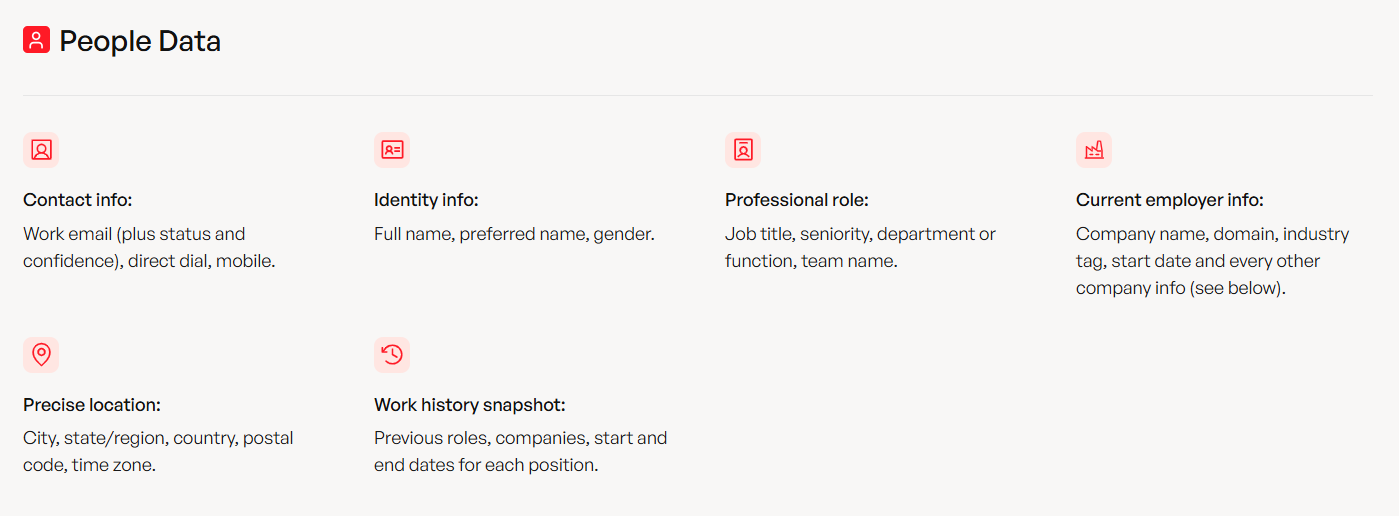
Deals without an identified decision-maker are 80% less likely to close. Prospeo gives you 30+ filters - including org charts, job changes, and department headcount - so you map every stakeholder before your deal stalls. 300M+ profiles, 98% email accuracy, $0.01 per lead.
Find the economic buyer before your close date slips again.
Best CRMs for Opportunity Tracking
The CRM you pick matters less than how you configure it. That said, some platforms make deal tracking easier than others:
| CRM | Starts At | Best For | AI Feature |
|---|---|---|---|
| Salesforce | $25/user/mo | Scale and ecosystem | Einstein AI |
| HubSpot | Free tier available | Ease of adoption | AI assistant |
| Zoho CRM | Free tier available | Customization and value | Zia AI |
| Pipedrive | $14/user/mo | Pipeline-first simplicity | AI assistant |
| Dynamics 365 | $65/user/mo | Microsoft ecosystem | Copilot |
| Freshsales | Free tier available | SMB with AI needs | Freddy AI |
| monday Sales | $12/user/mo | Visual workflow teams | Basic automation |
Salesforce is the default for teams that need deep customization. The cost: you'll need a dedicated admin, and implementation takes months, not days. HubSpot wins on adoption speed - reps actually use it, which matters more than any feature list. Zoho CRM, PCMag's Editors' Choice pick, punches above its weight on customization and AI through Zia, especially for budget-conscious teams. Pipedrive is built pipeline-first, making it the most intuitive option for deal-centric sales teams.
Regardless of which CRM you choose, pair it with an enrichment layer to keep contact data current. A CRM is only as good as the data inside it - so it helps to understand examples of a CRM and what “good data” looks like in practice.
Pipeline Reviews That Work
Let's be honest: if your pipeline review is just reps reading notes aloud, you have a status meeting, not a review.
Effective pipeline reviews happen weekly at minimum. For teams with sub-30-day sales cycles, daily standups focused on stage movement are worth the time investment. The format should be exception-based: which deals moved, which stalled, which need help.
Three things to check every review:
- Stage distribution. If 60% of your pipeline is in "Proposal" and 5% is in "Discovery," you have a bottleneck - or reps are skipping early stages.
- Timestamped deal notes. "IR 1/15: Met with VP Eng, scheduling technical review for 1/22" is useful. "Good call, following up" is not.
- Close date integrity. Any deal pushed twice gets a mandatory disposition: commit, push with justification, or kill.
The goal isn't to catch reps doing something wrong. It's to surface deals that need coaching or resources before they stall past the 50-day win-rate cliff. If you want a broader system around this, align reviews to your sales operations metrics.
FAQ
What's the difference between lead management and opportunity management?
Lead management tracks people through initial engagement. Opportunity management tracks deals - with changing values, multiple stakeholders, and pipeline stages - from qualification through close. A lead becomes an opportunity once budget, timeline, and need are confirmed.
How do you calculate pipeline velocity?
Pipeline velocity = (Opportunities x Deal Value x Win Rate) / Cycle Length. For example, 50 opps x $30K x 25% / 60 days = $6,250/day. It reveals which lever - volume, deal size, conversion, or speed - will have the biggest revenue impact.
How many pipeline stages should I have?
Five for SMB, seven to eight for enterprise. The count matters less than having clear exit criteria that prevent deals from advancing on gut feel alone. Every stage needs a defined gate with required fields before a rep can move a deal forward.
What's a good B2B win rate?
Average B2B win rate is 21%. Top performers hit 30%+. Below 15% means your qualification process is advancing deals that should've been disqualified earlier - tighten your BANT or MEDDIC enforcement.
How do I keep CRM data accurate for pipeline management?
Use an enrichment tool with automated refresh cycles. Prospeo's 7-day refresh and 98% email accuracy keep contact records current between quarterly cleanups. Then enforce CRM validation rules that block stage advancement without required fields like next step, decision-maker, and deal value.