

Outbound Lead Generation in 2026: Strategies, Benchmarks, and the Numbers Nobody Shares
A RevOps lead we know ran a 90-day outbound sprint last quarter. Three SDRs, a brand-new sequencing tool, 12,000 contacts from a "premium" database. The result? A 1.8% reply rate, a 23% bounce rate on the first send, and a CTO asking why they spent $14,000 on data that was half-dead on arrival. That tracks with what practitioners on r/b2bmarketing report - cold emails pulling around 2% reply rates, connection requests getting ignored, ads burning budget with nothing to show.
Outbound lead generation still works, but the margin for sloppy execution has completely disappeared.
The Short Version
This is a math problem. Know your conversion rates at each stage, fix your data before your copy, and run multi-channel cadences instead of single-channel blasts. The numbers that matter: cold email reply rates average 5.1% across 44M emails analyzed, cold calls convert to meetings at roughly 2%, and multi-channel prospecting runs about $188 per lead. Modern B2B deals involve roughly 266 touchpoints from first touch to closed-won - your 3-email sequence isn't persistence, it's barely an introduction.
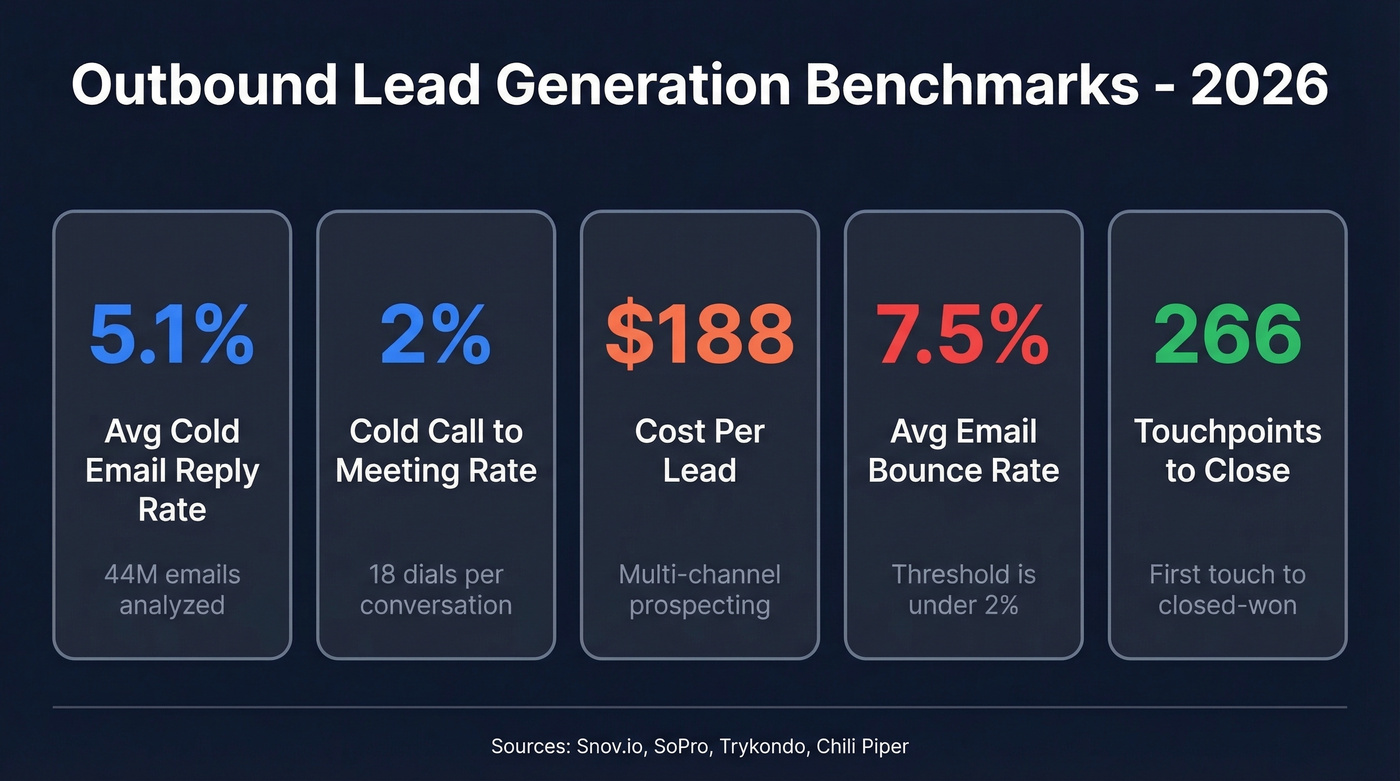
The single biggest lever most teams ignore? Data quality. The average cold email bounce rate is 7.5%, and bulk-sender deliverability thresholds put bounces at under 2%. That gap is where pipelines go to die.
What Is Outbound Lead Generation?
It's the process of proactively reaching out to potential buyers who haven't raised their hand. You identify prospects, find their contact information, and initiate conversations through email, phone, social channels, or some combination. The opposite of inbound, where prospects come to you through content, SEO, or ads.
The distinction matters less than it used to. 80% of B2B sales interactions now happen in digital channels, and buyers toggle between self-directed research and vendor conversations constantly. But the core hasn't changed: you're interrupting someone's day, so you'd better have a good reason and accurate contact data.
What's Changed in 2026
Reply rates dropped 12% year-over-year according to Chili Piper's outbound benchmarks report. That's not a blip - it's a structural shift driven by several forces hitting at the same time.
- 10 channels - that's how many the average buyer uses now, up from 5 in 2016. Your single-channel email blast is competing with a dozen other touchpoints they're already managing.
- 10-11 people sit on the average U.S. B2B buying committee, and 89% of those deals stalled at least once last year.
- 84% of reps missed quota last year per Salesforce research. That's not a skills problem - it's an environment problem.
- AI saturation is real but overhyped. The Reddit consensus on r/b2bmarketing is that roughly 90% of AI-generated outbound is still garbage - generic templates at scale. The teams winning aren't using AI to send more emails. They're using it to send fewer, better ones to narrower ICPs.
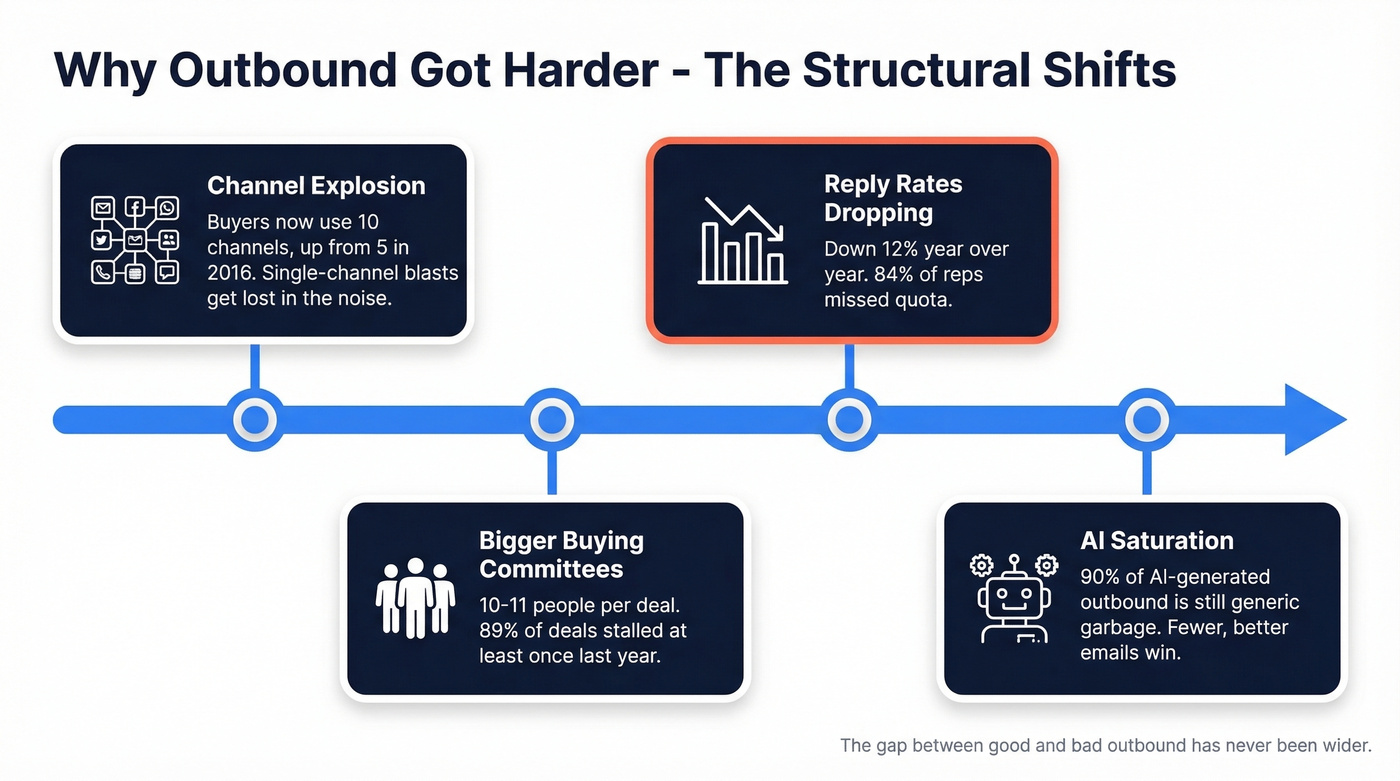
The gap between good and bad outbound has never been wider. Teams that have adapted - tighter targeting, verified data, multi-channel cadences - are still booking meetings. Everyone else is watching their domain reputation crater.
The Process in 5 Steps
Step 1: Define Your ICP
Everything downstream depends on this. A tight ICP means you're reaching people who actually have the problem you solve, the budget to fix it, and the authority to sign. A loose ICP means you're burning credits, burning domain reputation, and burning your SDRs' motivation.
Get specific: industry, company size, tech stack, funding stage, department headcount, and the job titles that map to your buying committee.
Step 2: Build Verified Lists
This is where most teams fail before they even start writing copy. You need accurate emails and direct dials for the right people at the right companies.
One sales team learned this the hard way - they were running a 35% bounce rate on their cold email campaigns, which was destroying their sender reputation. After switching to weekly-refreshed data with Prospeo, they cut that bounce rate to under 4%. Their pipeline tripled from $100K to $300K per week within a quarter. The difference wasn't messaging or sequencing - it was data quality.

Step 3: Execute Multi-Channel Outreach
Don't rely on a single channel. Combine email, phone, and social touches in a sequenced cadence. Hybrid inbound+outbound approaches can reduce lead costs by 31%, so think about how your outbound sequences complement your content and ad programs rather than operating in a silo.
Step 4: Qualify Ruthlessly
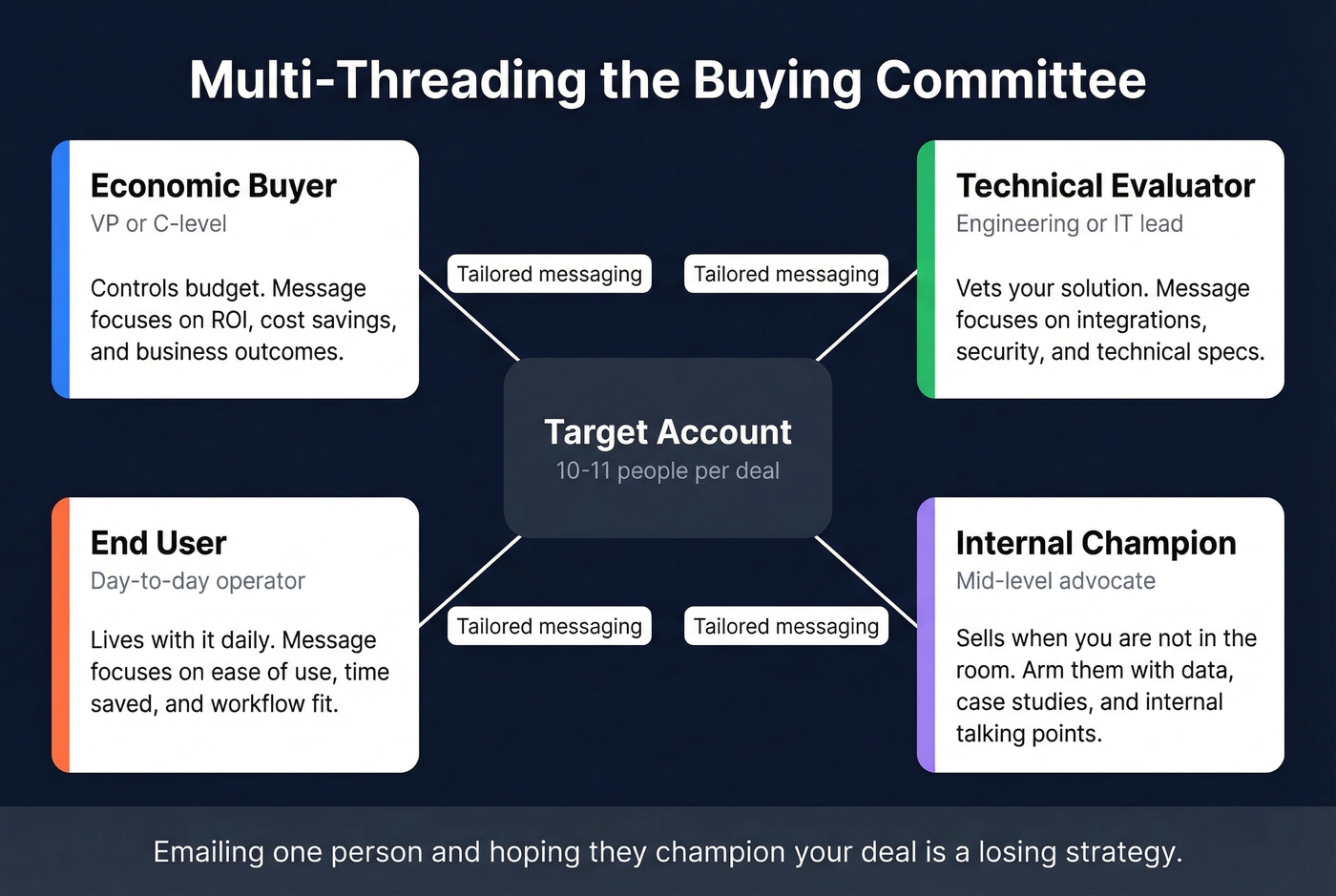
Not every reply is a lead. Use a qualification framework - BANT, MEDDIC for enterprise - to separate genuine opportunities from tire-kickers. With buying committees running 10-11 people deep, you need to identify four roles early: the economic buyer who controls budget, the technical evaluator who vets your solution, the end user who'll live with it daily, and the internal champion who'll sell it when you're not in the room. Multi-thread across all four.
Step 5: Measure and Optimize
Track conversion rates at every stage: list to reply to meeting to opportunity to closed-won. The average close rate is 29%, but that varies wildly by segment. If you're not measuring each handoff, you can't diagnose where the funnel breaks.

That 23% bounce rate from the intro? It's not a messaging problem - it's a data problem. Prospeo refreshes 300M+ profiles every 7 days and delivers 98% email accuracy with 5-step verification. Teams using Prospeo cut bounce rates from 35% to under 4% and tripled their pipeline.
Stop burning domain reputation on dead emails. Start with data that actually connects.
7 Strategies That Work
Cold Email
Cold email is still the backbone of most outbound programs, but the execution bar has risen dramatically. The average response rate across 44M emails analyzed is 5.1%. Top-performing teams with tight ICPs and multi-channel cadences hit 15-25%. If you're below 2%, don't rewrite your subject lines - check your data quality and deliverability setup first.
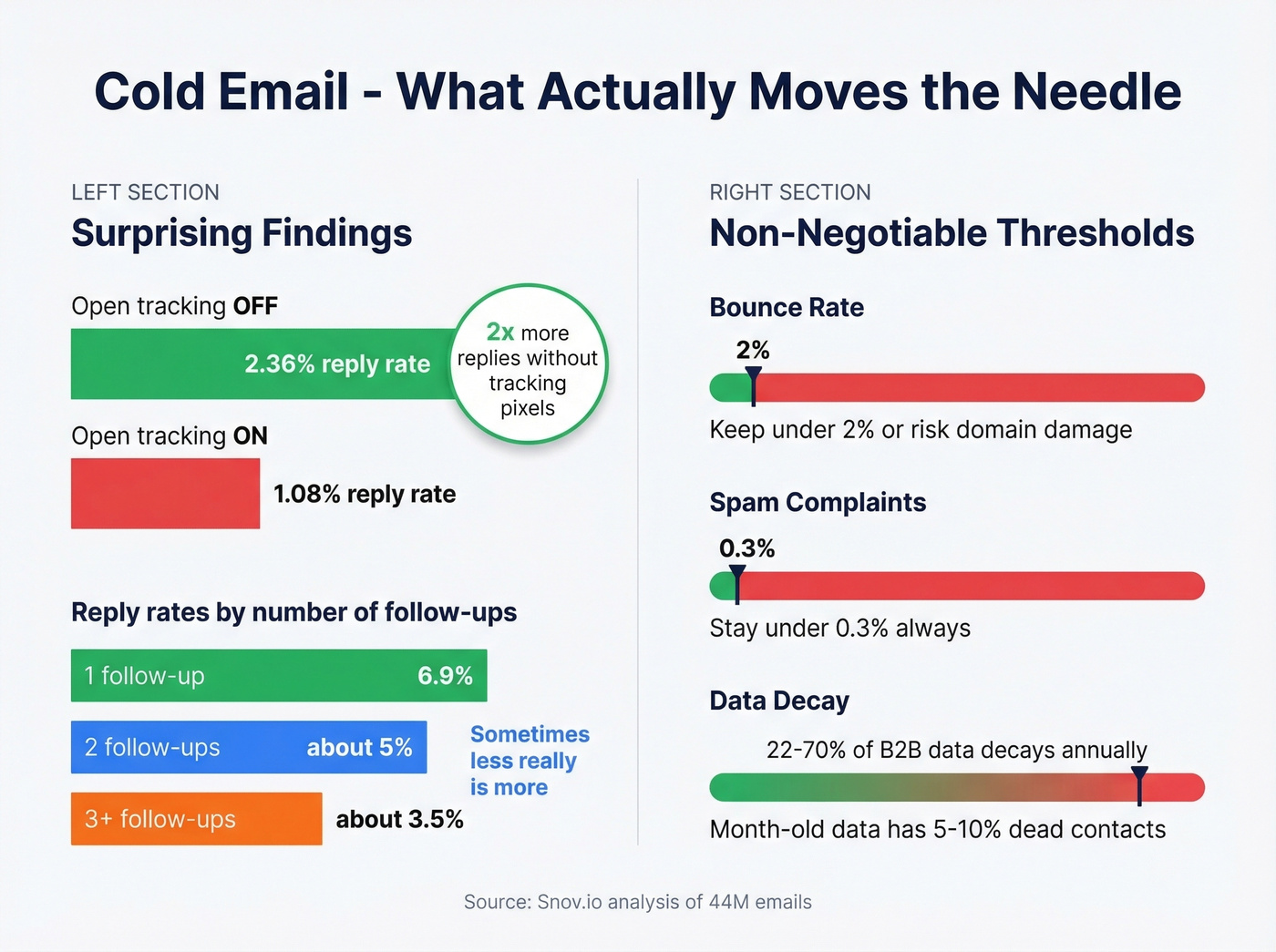
Two counterintuitive findings from that same dataset: turning off open tracking doubled reply rates (2.36% vs 1.08%), because open tracking pixels trigger spam filters. And a simple 2-email sequence - one initial email plus one follow-up - pulled the highest response rate at 6.9%. More follow-ups actually decreased performance.
Sometimes less really is more.
Deliverability checklist (non-negotiable):
- Set up SPF, DKIM, and DMARC on every sending domain
- Warm up new domains for 4-6 weeks, starting at 5-10 emails/day
- Keep spam complaints under 0.3% and bounces under 2%
- Include RFC 8058 one-click unsubscribe - Google, Yahoo, and Microsoft now require it for bulk senders
- Keep emails 25-100 words with one clear ask
- No caps, no excessive punctuation, no image-heavy templates
B2B data decays 22-70% annually. When your data is a month old, 5-10% of it is already dead, and every bounce chips away at your sender reputation. In our experience, teams that skip warmup spend 3x longer recovering their domain reputation than they would have spent warming up in the first place.
A Reddit user on r/coldemail shared what happens when you skip that step: awful open rates, immediate spam filtering, and a domain reputation that takes weeks to recover.
Cold Calling
Cold calling isn't dead - it's just expensive. Expect roughly 18 dials to get a live conversation and about a 2% conversion rate from call to meeting. That puts the CPL around $300, which is steep compared to email but delivers higher-intent conversations.
The real variable is list quality. Mobile direct dials connect at 3-5x the rate of HQ switchboard numbers. If your data provider only gives you main office lines, your reps are spending 80% of their time navigating phone trees and voicemail systems. A 30% pickup rate on verified mobiles versus single digits on office lines - that's the difference between a productive calling block and a wasted afternoon.
If you want a repeatable system, build a cold calling motion with defined lists, scripts, and QA.
Social Selling
Social selling works best as a warm-up channel within a multi-channel cadence, not as a standalone strategy. The frustration practitioners express on Reddit is real - connection requests get ignored, DMs feel spammy, and the signal-to-noise ratio keeps getting worse.
The teams that make social work use it to build familiarity before the email or call lands. Engage with a prospect's content, leave a thoughtful comment, then reach out through another channel. It's slower, but it primes the conversation.
Multi-Channel Sequences
This is where the real gains are. Multi-channel cadences convert 2-4x better than single-channel outreach.
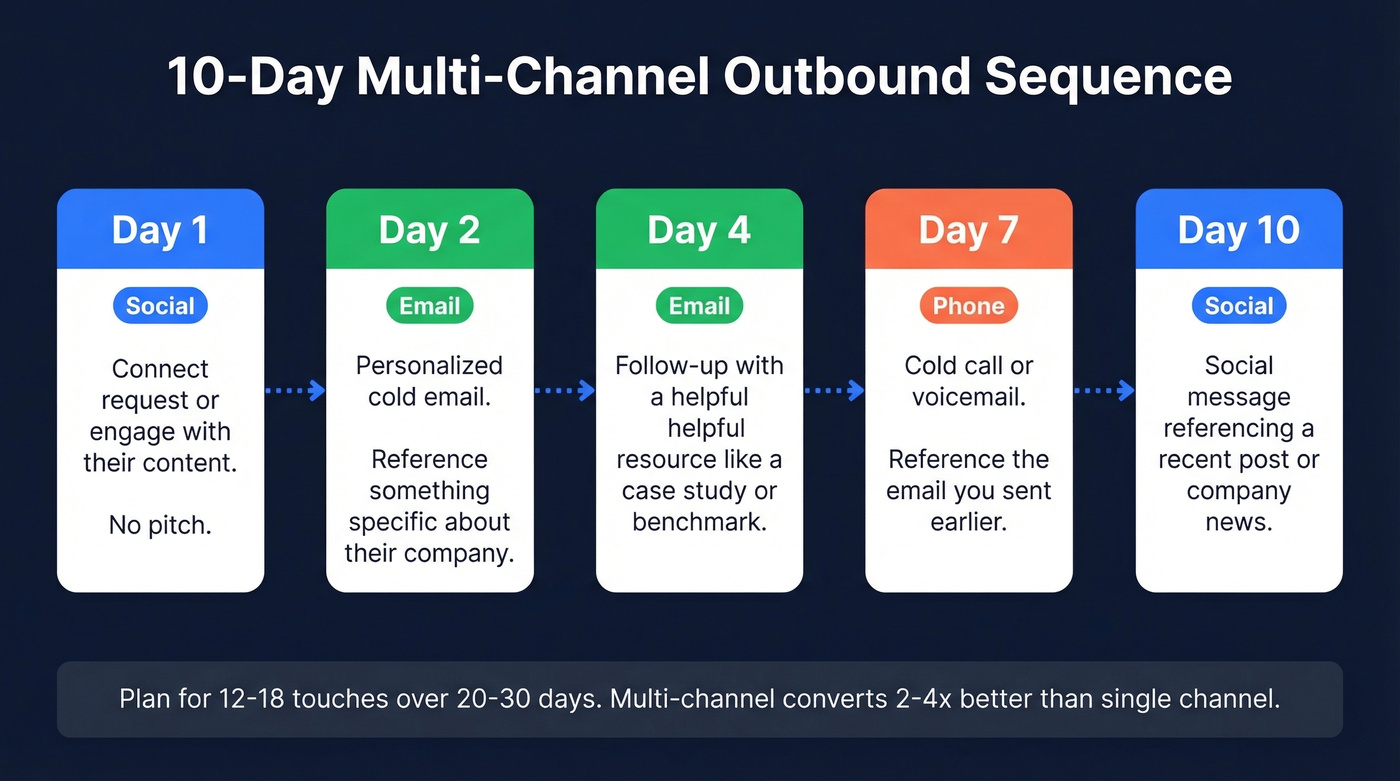
A 10-day starting framework:
- Day 1: Social connect - no pitch, just a connection request or content engagement
- Day 2: Personalized cold email - reference something specific about their company or role
- Day 4: Follow-up email with a helpful resource (case study, benchmark, relevant article)
- Day 7: Cold call or voicemail - reference the email you sent
- Day 10: Social message referencing a recent post or company announcement
Plan for 12-18 touches over 20-30 days as your baseline. That sounds aggressive until you see the data: modern B2B deals involve roughly 266 touchpoints from first touch to closed-won.
If you need a tighter structure, start with a B2B cold email sequence and layer calls + social on top.
Account-Based Outreach
When buying committees run 10-11 people deep, emailing one person and hoping they champion your deal internally is a losing strategy. Account-based outreach means multi-threading across the buying group - reaching the economic buyer, the technical evaluator, the end user, and the internal champion with tailored messaging for each.
Layer in intent data to time your outreach. When a target account starts researching topics related to your solution, that's your window. Cold outreach to an account that's actively evaluating is a completely different conversation than cold outreach to an account that isn't.
For a deeper playbook, use account-based selling principles to map stakeholders and messaging.
Referral Programs
Here's the thing: referrals are the most underrated outbound channel. At $25 per lead, they're the cheapest channel by a wide margin - and the leads convert at far higher rates because they come with built-in trust.
Most teams dismiss referrals as "not scalable." They're wrong. A structured referral program with clear incentives, easy mechanics, and consistent follow-up generates a steady pipeline. It won't replace your email program, but ignoring it because it doesn't fit neatly into your sequencing tool is leaving money on the table.
Paid Outbound (PPC/Retargeting)
Skip this if your deal size is under $10K. At $463 per lead for PPC and $408 for LinkedIn ads, the unit economics only work for higher-ACV deals or as retargeting layers on top of your direct outreach. Use them to stay visible to accounts you're already working - not as your primary pipeline engine.
Outbound Benchmarks Dashboard
These are the numbers you should pin to your wall. Use them to forecast your budget, set realistic expectations with leadership, and diagnose where your funnel is breaking.
Performance Benchmarks
| Metric | Benchmark |
|---|---|
| Cold email reply rate | ~5.1% |
| Cold call meeting rate | ~2% |
| Calls to connect | ~18 |
| Multi-channel lift | 2-4x vs single |
| Avg bounce rate | 7.5% (target: <2%) |
| Touches to meeting | 12-18 |
| Touches to closed-won | ~266 |
Cost Per Lead by Channel
| Channel | Avg CPL |
|---|---|
| Referrals | $25 |
| Affiliate | $73 |
| Multi-channel prospecting | $188 |
| SEO | $206 |
| Cold email | $225 |
| Cold calling | $300 |
| LinkedIn ads | $408 |
| PPC | $463 |
| Trade shows | $840 |
Industry context matters. B2B SaaS averages $188 per lead, but legal services run $650, IT and managed services hit $501, and staffing sits at $497. If you're benchmarking your SaaS outbound program against a legal firm's CPL, you'll either panic or get complacent - neither is useful.
Multi-channel prospecting at $188 CPL is the sweet spot for most B2B teams. It's cheaper than cold calling alone and far more effective than single-channel email.
The Outbound Tech Stack
You need 4-5 tools, not 10. We've seen teams stack a dozen platforms and spend more time managing integrations than actually prospecting.
If you’re evaluating options, start with a shortlist of outbound lead generation tools and work backward from your workflow.
Data & Verification
Prospeo is the strongest option for accuracy and freshness. 300M+ profiles, 143M+ verified emails, 125M+ verified mobile numbers with a 30% pickup rate. Email accuracy runs 98% at roughly $0.01 per email, with a 7-day data refresh cycle that keeps bounce rates under 2%. It integrates natively with Salesforce, HubSpot, Instantly, Smartlead, Lemlist, Clay, Zapier, and Make. The free tier gives you 75 emails plus 100 Chrome extension credits per month - enough to test before committing.

Apollo covers 275M contacts with a generous free tier and paid plans from $49/user/month. It's a solid all-in-one for smaller teams that want prospecting and sequencing in one platform, though email accuracy doesn't match dedicated verification tools.
ZoomInfo is the enterprise incumbent - 150M+ profiles, deep intent data, and a massive feature set. Expect to pay $15K-$40K/year depending on seats and modules. Overkill for most SMB teams, but hard to beat for large orgs that need everything under one roof.
Clay is the practitioner favorite on Reddit for a reason - threads on r/sales and r/coldemail regularly recommend it as the best enrichment and workflow automation layer. Plans start at $134/month for 2,000 credits. Pair it with a dedicated data provider for the underlying contact data and you've got a powerful enrichment engine.
If you’re comparing vendors, use this breakdown of data enrichment services to sanity-check features and pricing.
Sequencing & Outreach
For cold email at scale, Instantly starts at ~$30/month for sending and ~$47/month with the lead database add-on. It's the go-to for agencies and teams running high-volume campaigns. Smartlead occupies similar territory at ~$39/month with strong inbox rotation features. Lemlist starts at ~$39/user/month for email and ~$69/month for multi-channel sequences - the best option if you want email, calls, and social touches in one workflow. For enterprise, Outreach and Salesloft run ~$100-$150/user/month with deeper analytics and CRM integration.
If you’re scaling volume, follow sequence management best practices to avoid deliverability and ops debt.
CRM
HubSpot offers a free CRM with Sales Hub starting at $20/user/month. Salesforce starts at $25/user/month. HubSpot for simplicity, Salesforce for customization - pick based on your team size and how much you want to configure.
If you’re still deciding, here are a few examples of a CRM with real pricing and use cases.
Stack Pricing at a Glance
| Tool | Category | Starting Price |
|---|---|---|
| Prospeo | Data & verification | Free; ~$0.01/email |
| Apollo | Data & sequencing | Free; $49/user/mo |
| ZoomInfo | Data & intent | ~$15K-$40K/yr |
| Clay | Enrichment/workflow | $134/mo (2K credits) |
| Instantly | Email sequencing | ~$30/mo |
| Smartlead | Email sequencing | ~$39/mo |
| Lemlist | Multi-channel | ~$39/user/mo |
| Outreach | Enterprise sequencing | ~$100-$150/user/mo |
| HubSpot | CRM | Free; $20/user/mo |
| Salesforce | CRM | $25/user/mo |
For a Series A team running outbound, a clean stack looks like: Prospeo for data, Instantly or Lemlist for sequencing, and HubSpot for CRM. That's around $200/month total and covers everything you need to run multi-channel cadences with verified data.
Compliance - The Fines Are Real
Outbound isn't the Wild West. The penalties for getting compliance wrong are severe enough to sink a small company.
| Regulation | Max Penalty |
|---|---|
| CAN-SPAM | Up to $53,088 per email |
| GDPR | Up to EUR 20M or 4% of revenue |
| CASL | Up to $10M CAD |
What you need to do:
- Include an unsubscribe link in every outbound email
- Use a valid physical postal address in your email footer
- Honor opt-out requests within 10 business days
- Authenticate all sending domains with SPF, DKIM, and DMARC
- Maintain consent records for any GDPR or CASL-covered contacts
- Never use misleading sender names or subject lines
- For EU prospects, ensure your data provider is GDPR compliant and can provide DPAs on request
Let's be honest - most teams aren't going to get hit with a $53K fine per email. But domain blacklisting, deliverability collapse, and reputation damage are real consequences that happen every day. Compliance isn't just legal protection - it's operational hygiene that keeps your outbound engine running.
If you’re unsure about list sourcing, read up on Is It Illegal to Buy Email Lists? before you scale.
Multi-channel outbound demands accurate emails and direct dials for every stakeholder on a 10-person buying committee. Prospeo gives you both - 143M+ verified emails at $0.01 each and 125M+ verified mobile numbers with a 30% pickup rate. Layer in buyer intent data across 15,000 topics to reach prospects who are actively in-market.
Target the right buyers across every channel with data refreshed weekly, not monthly.
FAQ
What is outbound lead generation?
It's the process of proactively contacting potential buyers who haven't expressed interest - through cold email, calls, social selling, or multi-channel sequences. The average reply rate across 44M emails is 5.1%, while top teams with tight ICPs hit 15-25%. If you're below 2%, fix your data quality and deliverability before rewriting copy.
How many touches to book a meeting?
Plan for 12-18 touches over 20-30 days across multiple channels. Multi-channel cadences convert 2-4x better than email-only sequences. For context, modern B2B deals involve roughly 266 total touchpoints from first touch to closed-won - persistence is table stakes.
What's the cheapest outbound channel?
Referrals at roughly $25 per lead. Multi-channel prospecting averages $188, cold email runs about $225, and cold calling sits around $300. PPC ($463) and LinkedIn ads ($408) only make sense for deals above $15K ACV or as retargeting layers.
How do I stop cold emails landing in spam?
Set up SPF, DKIM, and DMARC on your sending domain, then warm up new domains for 4-6 weeks at 5-10 emails per day. Keep bounce rates under 2% and spam complaints under 0.3%. A data provider with a weekly refresh cycle keeps bounce rates well below the 7.5% industry average.
Is outbound lead generation worth it in 2026?
Yes, but the bar is higher than ever. Reply rates dropped 12% year-over-year and buyers use 10+ channels. The teams winning have narrower ICPs, verified data, multi-channel cadences, and realistic expectations - not bigger email blasts.