

Outbound Sales Conversion Rates: 2026 Benchmarks by Channel and Funnel Stage
There's no single outbound sales conversion rate. Anyone handing you one number is oversimplifying - or selling something. "Conversion" means something completely different at each funnel stage, and those stages produce wildly different numbers.
Cold email average reply rate: 3.43%. Cold call conversation-to-meeting rate: 4.82%. LinkedIn DM response rate: 10.3%. Below, we've broken down every stage with sourced data, practitioner benchmarks, and a worked example showing how data quality cascades through the entire funnel.
What "Conversion Rate" Actually Means in Outbound
The term is useless without context. A Ruler Analytics study across 100M+ data points puts the average marketing conversion rate at 2.9% across 14 industries, and Default's data shows fewer than 1% of website visitors request a demo once traffic exceeds 25K/month. But outbound is a different animal entirely.
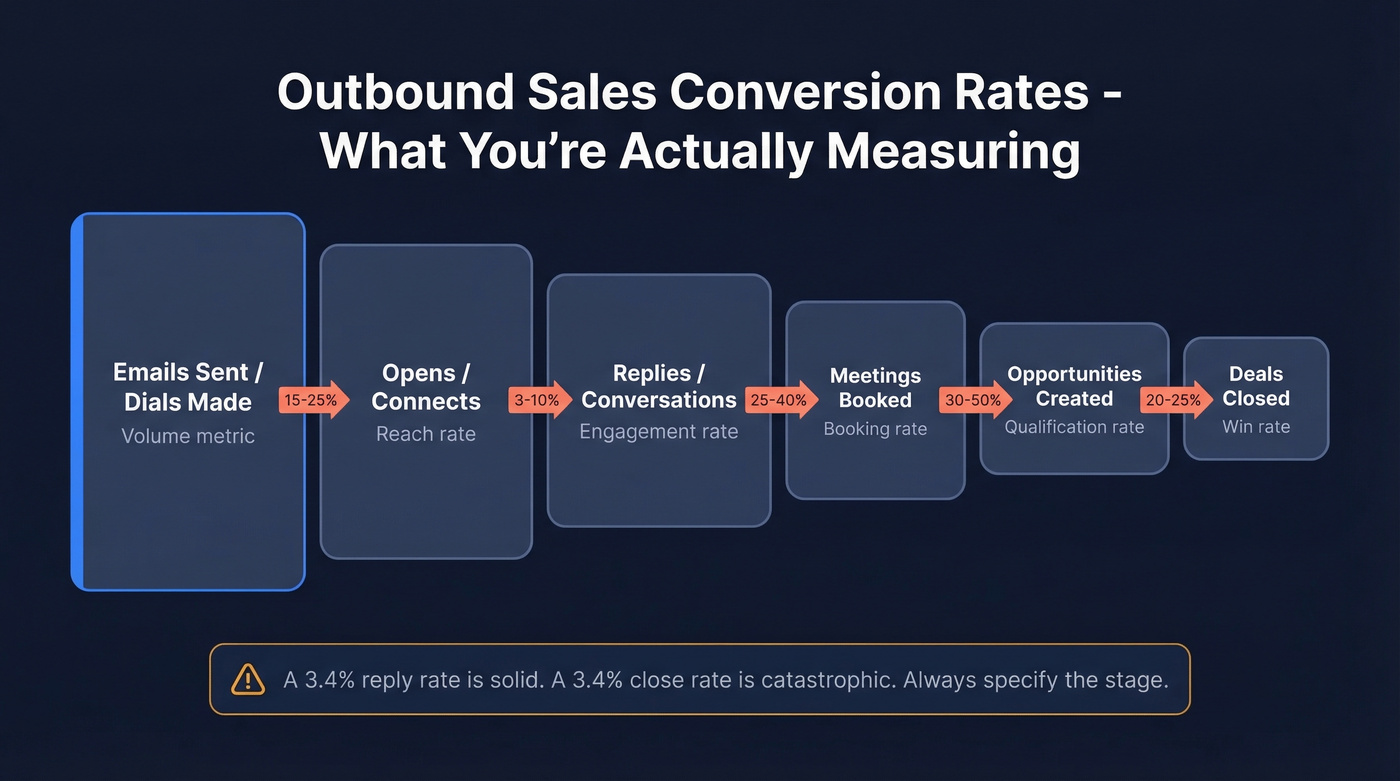
An email reply rate of 3.4% is solid. An opportunity-to-close rate of 3.4% would be catastrophic. You need to know which stage you're measuring before any benchmark is useful - a connect rate and a meeting-booked rate are two completely different numbers, and conflating them leads to bad forecasting every time.
Cold Email Benchmarks
Instantly analyzed billions of cold email interactions across thousands of active workspaces for their 2026 benchmark report:
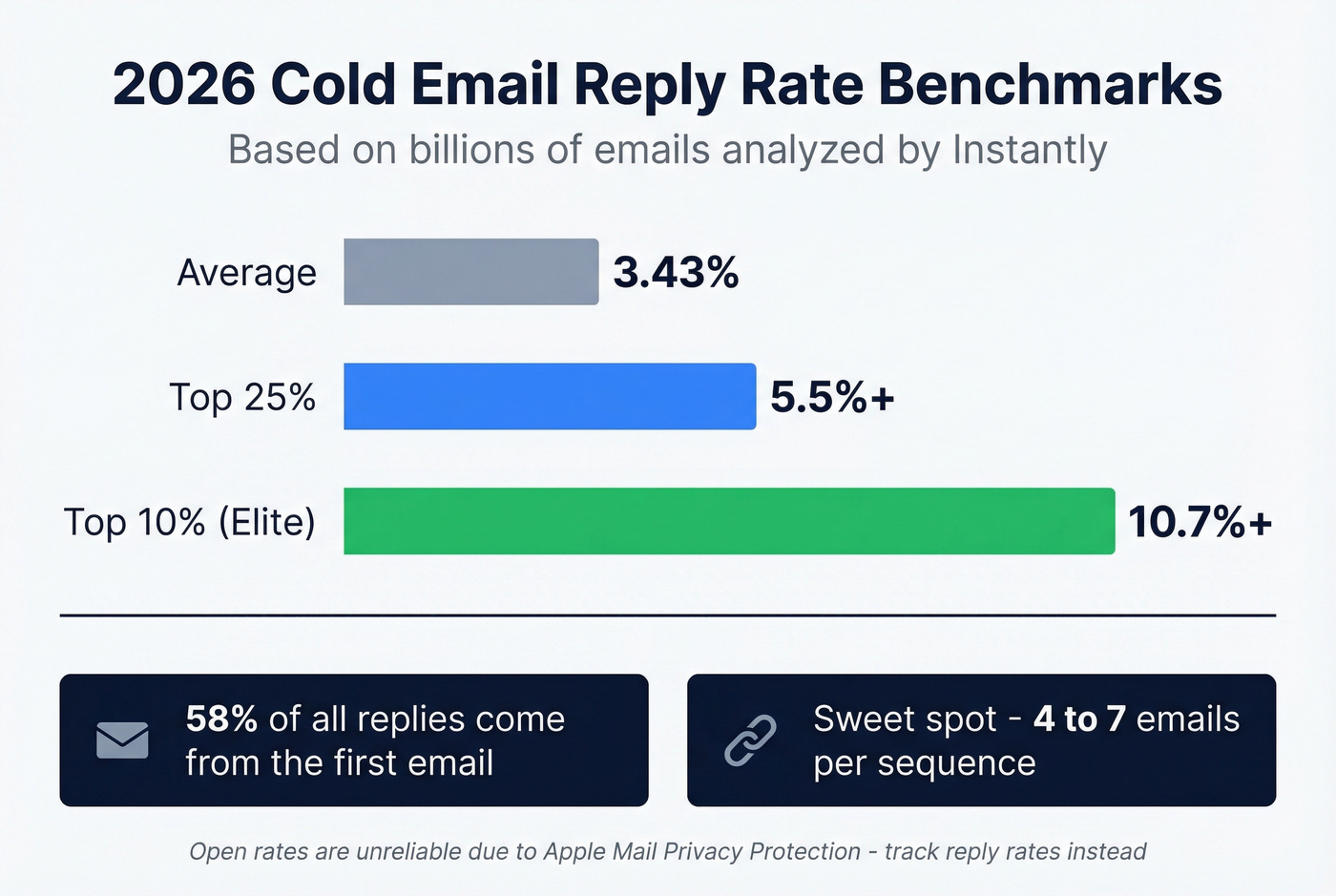
| Metric | Average | Top Quartile | Elite (Top 10%) |
|---|---|---|---|
| Reply rate | 3.43% | 5.5%+ | 10.7%+ |
| Open rate | 15-25% (top SDR teams) | - | - |
| Positive replies | 3% (Hubsell customer avg) | - | - |
| Best send days | Tue-Wed | Wed peak | - |
Open rates are largely broken. Apple Mail Privacy Protection inflates them significantly, so reply rate is the diagnostic metric now. Don't let anyone tell you a 60% open rate means your campaign is working.
58% of all replies come from the first email in a sequence. Follow-ups matter, but the first touch does most of the heavy lifting. The sweet spot for sequence length is 4-7 steps - beyond that, you're burning sender reputation for marginal returns. Hubsell's data draws a useful distinction: their customers average 3% positive replies, separating genuine interest from auto-replies and "remove me" responses.
If you're rebuilding your outbound motion, start with a B2B cold email sequence that matches your ICP and offer.
Cold Calling Benchmarks
Cognism's cold calling report, built on WHAM (We Have A Meeting) data, puts the conversation-to-meeting rate at 4.82%. The attempt decay math is particularly useful: 3 calls capture 93% of total conversations you'll ever get from a prospect, and 5 calls get you to 98.6%. Beyond that, diminishing returns hit hard.
Tuesday leads for bookings. One analysis of 55,000+ dials found that calling between 4-5 p.m. yields 71% better results than the 11 a.m.-noon slot. Friday is weak for bookings but surprisingly decent for conversations.
Here's how practitioners on r/sales tier their performance for B2B software, roughly covering mid-market deals in the $1K-$250K ACV range:
| Metric | Bad | Average | Good | Great |
|---|---|---|---|---|
| Connect rate | 2.5% | 5% | 7.5% | 9%+ |
| Connect-to-meeting | ≤3% | 4-5% | 6-8% | 9%+ |
| Hold rate | 50% | 60% | 70% | 80% |
| Dials per meeting | 250+ | 180 | 140 | ≤100 |
That dials-per-meeting number is the one your reps should track daily. If you're above 200, something's broken - usually data quality or talk track, sometimes both. Improving your connect-to-meeting rate often comes down to reaching the right person at the right time, not just dialing more.
If your team is still building fundamentals, a structured cold calling system helps standardize attempts, talk tracks, and follow-up.

If you're above 200 dials per meeting, data quality is the first thing to fix. Prospeo's 98% verified emails and 125M+ direct dials with a 30% pickup rate mean your reps connect with real buyers - not dead numbers. Data refreshed every 7 days, not 6 weeks.
Stop burning dials on stale data. Start every sequence with verified contacts.
LinkedIn Outreach Benchmarks
LinkedIn outperforms cold email on raw response rates, but volume constraints keep it from being a standalone channel. Expandi's analysis of 70,000+ campaigns shows a 29.61% connection approval rate and a 10.3% DM response rate - roughly double cold email's reply rate.
InMail sits in the 10-25% response range, with top performers hitting 30-40%. The practical constraint: messages under 400 characters get 22% higher response rates, and 57-70% of LinkedIn traffic is mobile, where subject lines truncate at 30-40 characters. Keep it short. Sales Navigator Core gives you 50 InMail credits per month, rolling over to a max of 150 - not enough for high-volume outbound on its own.
If you're running multi-touch, treat LinkedIn as a layer on top of personalized outreach, not a replacement for email and calling.
Meeting-to-Deal Funnel
This is where most benchmark articles stop. It's also where the real math starts.
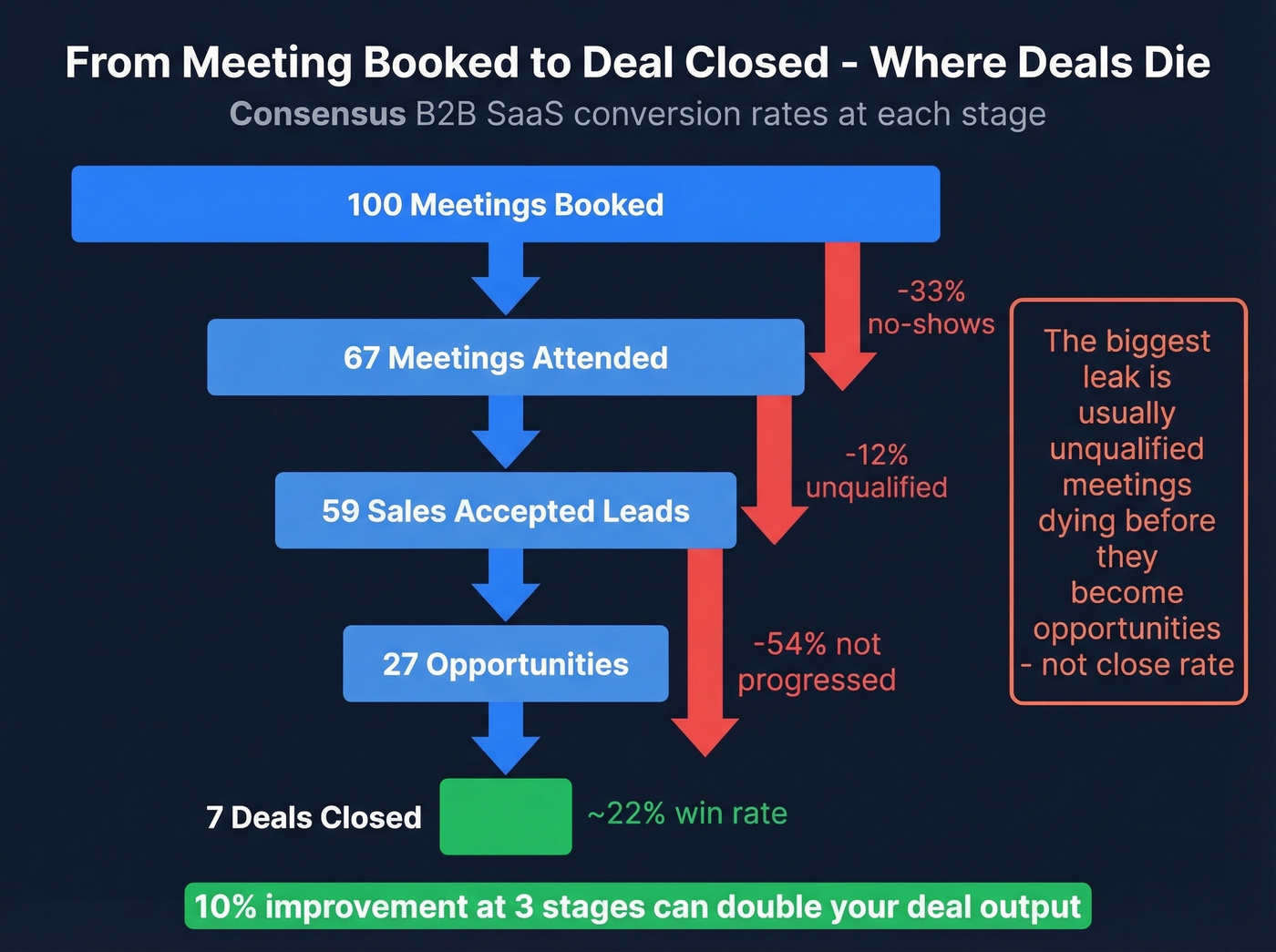
| Stage | EngageTech | PhoneWagon | Kalungi |
|---|---|---|---|
| Booked-to-attended | 67% | 75% | - |
| Attended-to-SAL | 88% | - | - |
| SAL-to-SQL/Opp | 46% | - | 55% |
| SQL-to-Opp | - | - | 50% |
| Opp-to-deal | 33% | 33% | 37.5% |
The consensus win rate for B2B SaaS lands around 20-25%, with Tendril pegging the SaaS average at 22%. Rates vary by vertical - FirstPageSage's B2B SaaS funnel data shows CRM companies closing at 38% while cybersecurity sits around 39%. In our experience, the biggest leak in most funnels isn't close rate. It's unqualified meetings dying before they ever become opportunities.
When teams track pipeline end-to-end - from first touch through closed-won - the compounding effect of small stage-by-stage improvements becomes obvious. A 10% lift at three stages can double your deal output.
Here's the thing: if your average deal size is under $10K, you probably don't need a 7-stage funnel. Compress it. Book the meeting, run the demo, close the deal. The more stages you add, the more conversion math works against you.
If you want a clean way to map stages and definitions, use a B2B sales funnel template so your team measures the same events.

Worked Example: Emails to Deals
Let's run 1,000 cold emails through a realistic funnel.
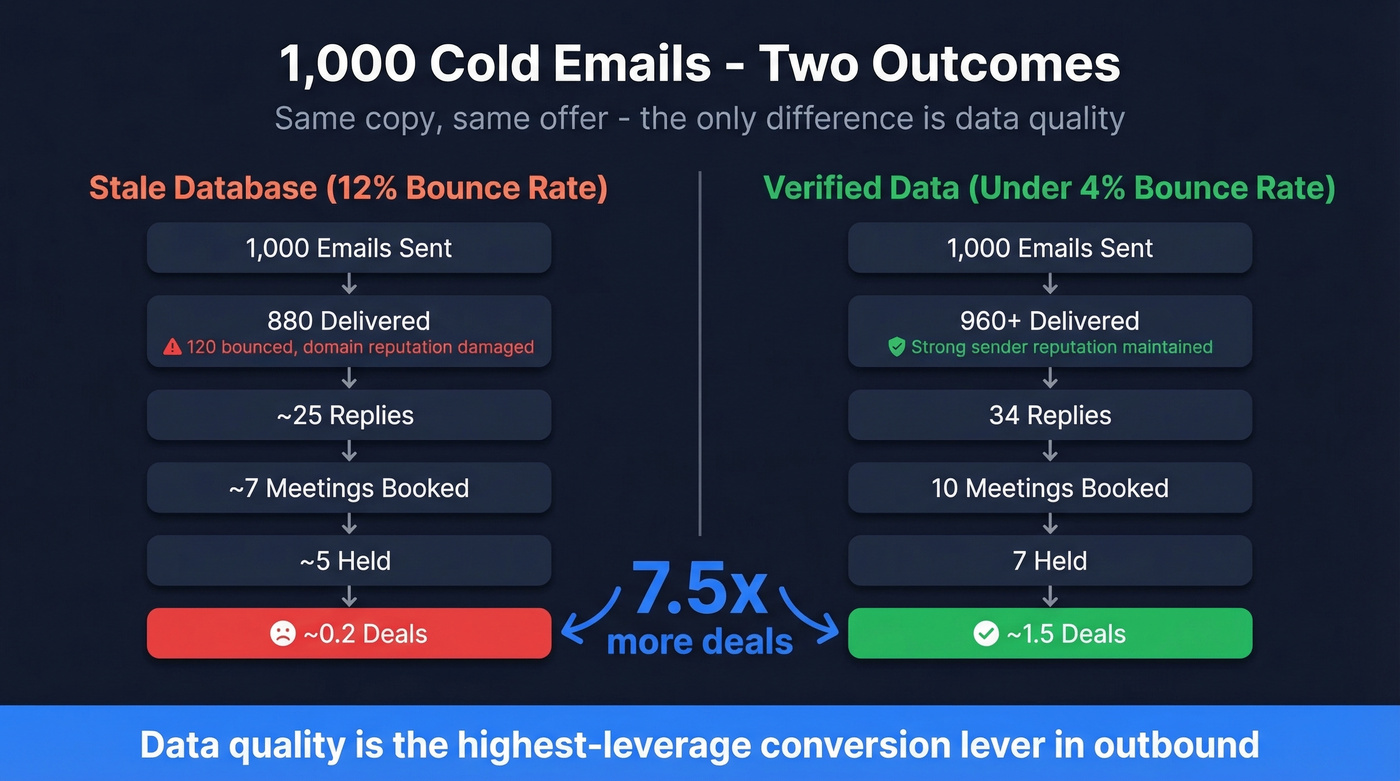
Assumptions: 3.43% reply rate (Instantly average), 67% meeting hold rate (EngageTech), ~22% win rate (Tendril SaaS average).
1,000 emails -> 34 replies -> 10 meetings booked -> 7 meetings held -> 2 opportunities -> ~0.4 deals closed.
That's why outbound is a volume game - and why small improvements at the top cascade hard.
Now run the same campaign with a stale database where bounce rate hits 12%. You lose 120 emails to bounces before anyone reads a word. Worse, your domain reputation takes a hit, dragging deliverability down on the remaining 880. Same copy, same offer - the only difference is data quality. We've watched this play out dozens of times with teams who come to us after burning a domain on bad lists.
If you're seeing this pattern, start by diagnosing email bounce rate and then fix the root causes in your email deliverability.
What Actually Moves the Numbers
Most "improve your conversion rates" advice jumps straight to copywriting. That's step five. Here are the first four.
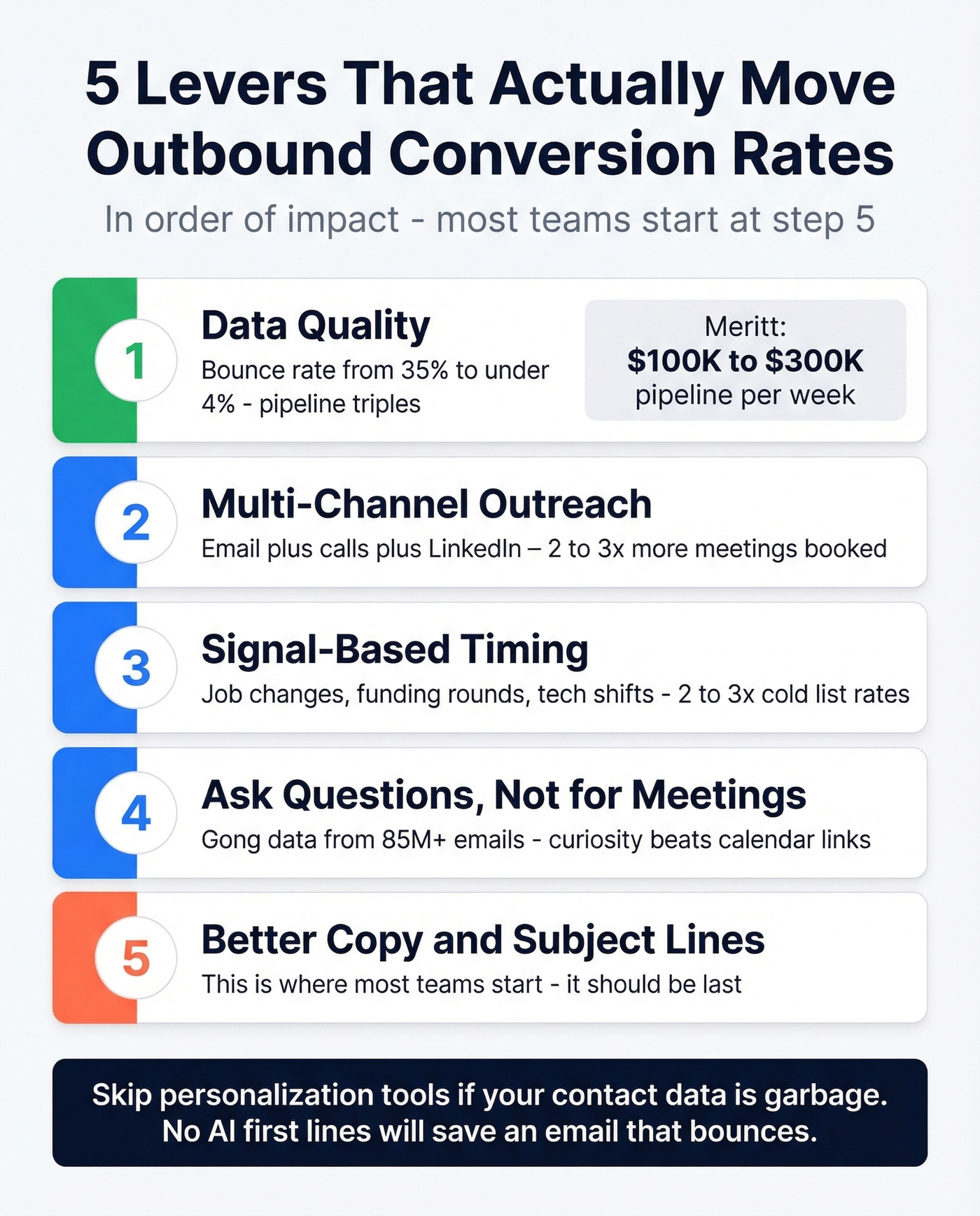
Data quality comes first. Meritt cut their bounce rate from 35% to under 4% using Prospeo and tripled their pipeline from $100K to $300K per week. Snyk dropped bounce rates from 35-40% to under 5% and generated 200+ new opportunities per month. If your bounce rate is above 5%, fix your data before rewriting a single subject line.
Multi-channel outreach compounds results. Email plus calling plus LinkedIn touches the same prospect across three surfaces. Each channel's prospecting conversion rates improve when it isn't carrying the full weight alone - the r/sales consensus backs this up, with reps consistently reporting that multi-touch sequences outperform single-channel by 2-3x on meeting-booked rates.
Signal-based timing beats batch-and-blast. Job changes, funding rounds, tech stack shifts - reaching out when something's changed converts at 2-3x the rate of cold lists. Layer buyer signals with job role and company growth filters before a single email goes out.
If you need a practical framework for this, build it into your sales prospecting techniques and your process for identifying buying signals.
Personalization that asks questions. Gong's analysis of 85M+ emails found that messages asking questions outperform meeting requests. Lead with curiosity, not calendar links.
Speed to follow-up. Companies responding to SQLs within the first hour report 53% conversion rates vs. 17% for slower follow-up. Every hour you wait, the number drops.
Skip the "personalize at scale" tools if your contact data is garbage. No amount of AI-written first lines will save an email that bounces.
That worked example showed 1,000 emails producing 0.4 deals. Now imagine cutting your bounce rate from 12% to under 4% - that's the difference Prospeo's 5-step verification makes. Better deliverability, more replies, more pipeline from the same send volume.
Same campaign size, more closed deals. Data quality is your highest-leverage conversion lever.
FAQ
What's a good outbound conversion rate?
A good cold email reply rate is 5%+, cold call conversation-to-meeting rate is 5-8%, and opportunity-to-close rate is around 20-25% for B2B SaaS. New-logo deals typically convert at roughly half the rate of expansion deals within existing accounts.
How many cold calls to book one meeting?
Average B2B software reps need roughly 180 dials per meeting booked. Top performers get there in under 100 - the gap is usually data quality (reaching verified direct dials vs. gatekeepers) and talk track strength.
Does data quality actually affect conversion rates?
Dramatically. Teams switching to verified contact data cut bounce rates from 35%+ to under 5% and see pipeline increases of 140-200%+. Bad data doesn't just waste sends; it damages sender reputation and drags down deliverability on every subsequent campaign.
What's a realistic email-to-deal conversion rate?
Most B2B SaaS teams see 0.3-0.5% of cold emails convert to closed deals end-to-end. That means roughly 200-300 emails per deal at average performance, or 100-150 for top-quartile teams with strong targeting and verified data.