

Outbound Sales Methodology: Frameworks, Benchmarks, and Cadence for 2026
We've watched teams roll out Challenger and get wildly different results. Some reps crushed it. Others kept pitching features on call one. The outbound sales methodology wasn't the problem - execution was. And before execution even mattered, a big chunk of their emails were bouncing because the list was garbage.
Every B2B sales framework boils down to need, budget, stakeholders, timeline. A popular take on r/sales is that Sandler, BANT, Challenger, and MEDDIC are the same skeleton wearing different suits. They're not wrong - but the difference is execution, and execution starts with picking the right framework for your deal shape, then backing it with data that doesn't bounce.
Here's the thing: most teams spend weeks debating Challenger vs. SPIN when the real pipeline killer is a 30%+ bounce rate. Fix the data first. The methodology debate is a luxury for teams whose emails actually land.
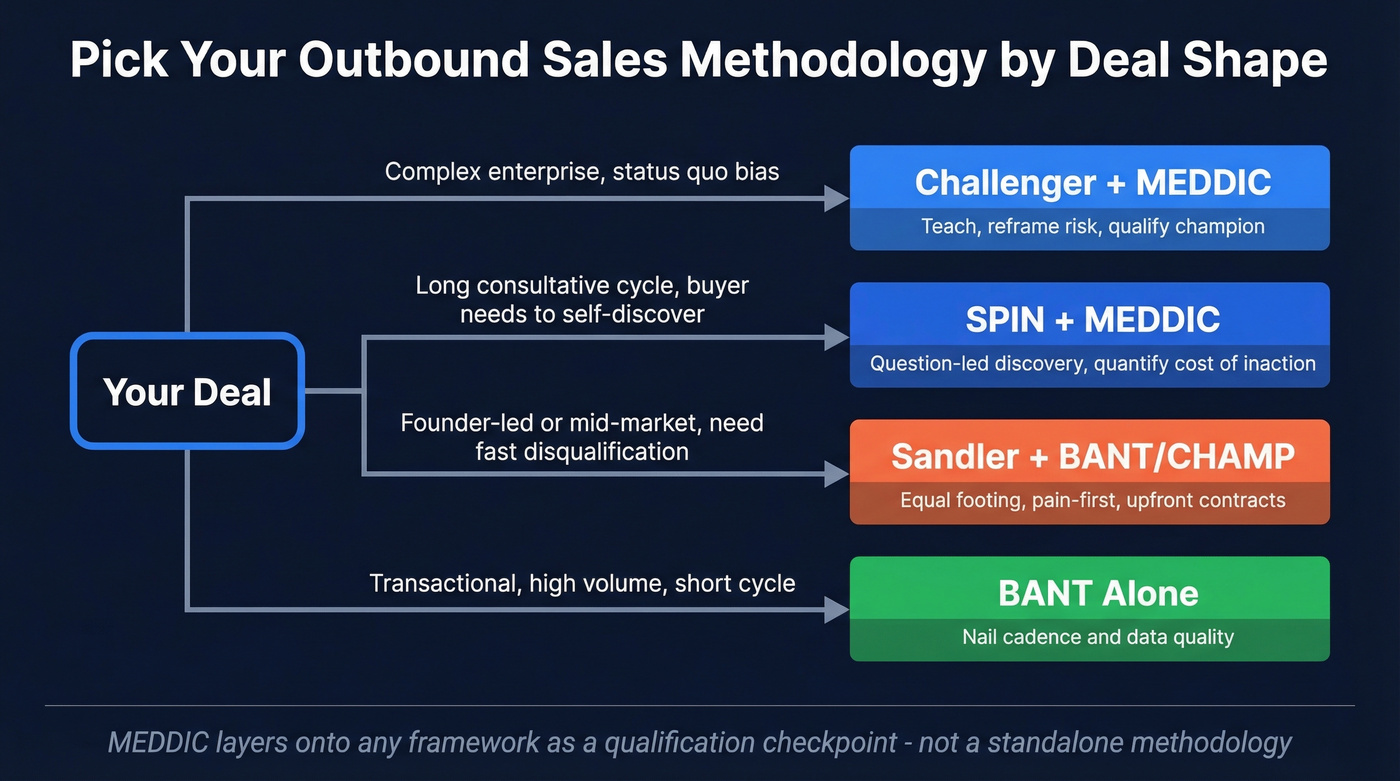
Quick-Match: Framework by Deal Shape
- Challenger + MEDDIC: Complex enterprise deals where buyers default to the status quo
- SPIN + MEDDIC: Long, consultative cycles where you need the buyer to quantify the cost of inaction
- Sandler + BANT/CHAMP: Founder-led or mid-market motions where early disqualification matters
- BANT alone: Transactional outbound - nail cadence and data quality
What Is an Outbound Sales Methodology?
A methodology is how you engage buyers. A process is what steps your team follows. A strategy is where you focus. Challenger tells reps to teach, tailor, and take control - that's methodology. "Prospect, qualify, demo, close" is process. You need all three in your outbound playbook, but methodology governs the discovery call itself.
Your outbound sales approach - the way you open, question, and advance a deal - is what separates teams that book meetings from teams that burn lists.
The 4 Frameworks Worth Knowing
| Methodology | Best For | Deal Size | Core Move |
|---|---|---|---|
| Challenger | Complex enterprise | Enterprise | Teach, tailor, control (+ MEDDIC) |
| SPIN | Long consultative | Mid-market+ | Buyer self-discovers cost (+ MEDDIC) |
| Sandler | Founder-led, mid-market | SMB/MM | Equal footing, early disqual (+ BANT/CHAMP) |
| MEDDIC | Any complex deal | Any | Rigorous qualification layer |
Challenger Sale
Skip this if you're selling something transactional or routine. Challenger shines when the prospect thinks their status quo is fine.
We saw this play out on a $350k ARR deal where the prospect's platform "worked fine." The rep reframed the conversation around revenue leakage and scalability limits, making staying put feel riskier than switching. Deal closed in about six months. One underrated tactic: use job listings to infer problems before the first touch. Three data engineer openings plus a VP of Infrastructure hire? That's your insight angle - and it's the kind of signal-based prep that turns a generic Challenger pitch into a specific one.
SPIN Selling
Neil Rackham's Situation-Problem-Implication-Need-payoff framework excels when the buyer needs to internalize the cost of inaction themselves. In our experience, SPIN works best when you resist the urge to present solutions early.
A $20k ARR rep used SPIN to walk a prospect through slow lead response times, quantified the revenue impact, and let the buyer connect the dots. The deal signed because the prospect convinced themselves. That patience is hard to teach, but it's what makes SPIN work.
Sandler: The Founder's Pick
Sandler flips the power dynamic - equal footing, pain-driven discovery, upfront contracts about next steps. For founder-led sales at $8-10k ARR, it's ideal: fewer demos, faster decisions, higher close rates. The early disqualification saves you from chasing deals that were never real.
Skip this for big enterprise contracts where buyers expect to be educated, not interrogated.
MEDDIC - The Qualification Layer
MEDDIC isn't a standalone methodology. It's a qualification framework that layers onto everything else: Metrics, Economic Buyer, Decision Criteria, Decision Process, Identify Pain, Champion.
Let's be honest - most pipeline bloat comes from deals that should've been disqualified weeks earlier. We watched a $72k ARR deal that looked solid until MEDDIC exposed the gaps: no economic buyer access, unquantified metrics, no champion. Pulling it from the forecast saved the quarter. Map MEDDIC onto Challenger to confirm your champion before challenging, onto Sandler to quantify pain with metrics, or onto SPIN to tie urgency to decision criteria and prevent stalling.

Challenger, SPIN, Sandler - none of it matters if 30% of your emails bounce. Prospeo delivers 98% email accuracy on a 7-day refresh cycle, so your reps spend time executing methodology instead of cleaning lists. Meritt tripled pipeline to $300K/week after switching.
Fix the data first. The methodology debate comes after your emails land.
Winning Cadence Techniques
The 3-7-7 follow-up pattern - Day 0, Day 3, Day 10, Day 17 - captures 93% of replies by Day 10. Here's a clean 12-day multi-touch sequence:
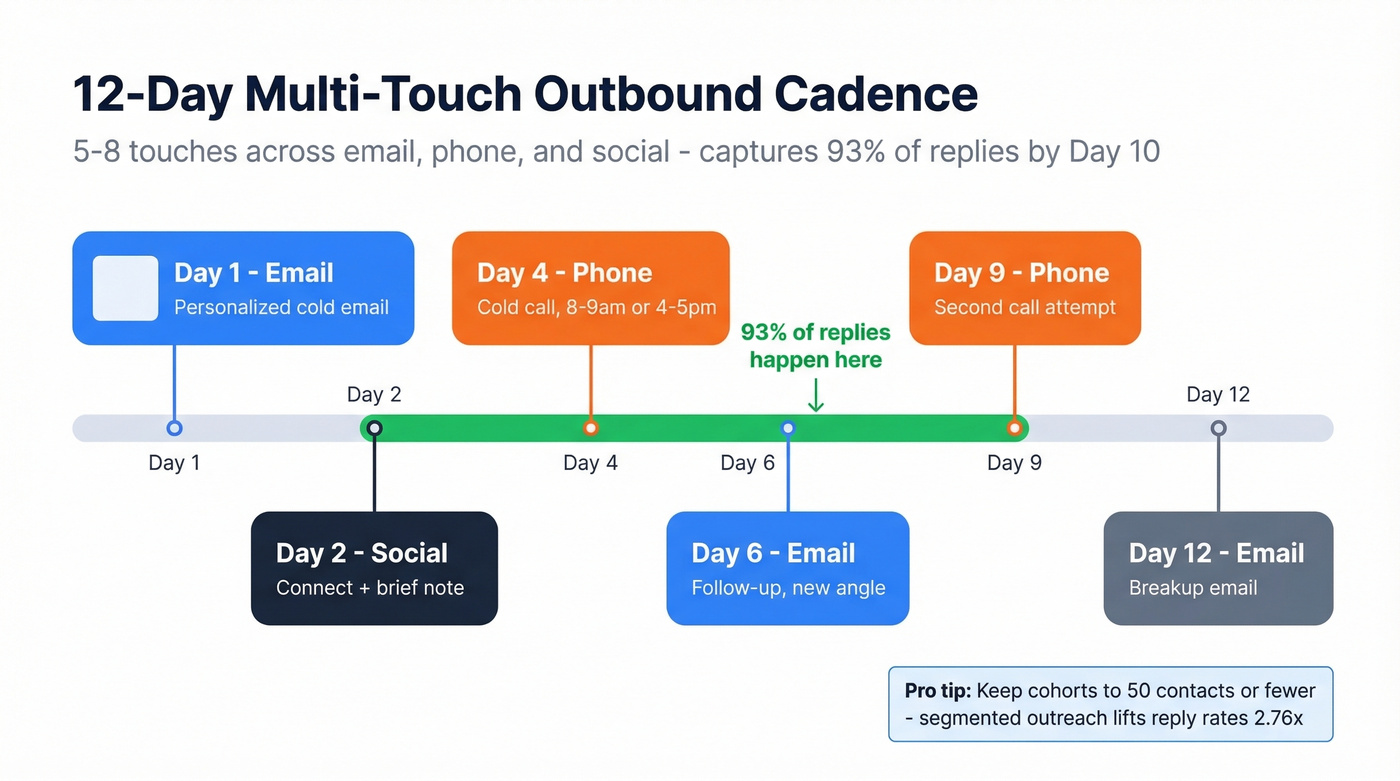
| Day | Channel | Action |
|---|---|---|
| 1 | Personalized cold email | |
| 2 | Social | Connect + brief note |
| 4 | Phone | Cold call (8-9am or 4-5pm) |
| 6 | Follow-up, new angle | |
| 9 | Phone | Second call attempt |
| 12 | Breakup email |
Segmented outreach lifts reply rates 2.76x compared to blasting a big list. Keep cohorts to 50 contacts or fewer. Five to eight touches over two to three weeks across email, phone, and social is the baseline - anything less leaves meetings on the table. Each outbound sales technique in your cadence should match the channel: emails teach, calls qualify, social warms.
If you need copy to support the sequence, start with proven follow-up templates and adapt by segment.
Outbound Benchmarks for 2026
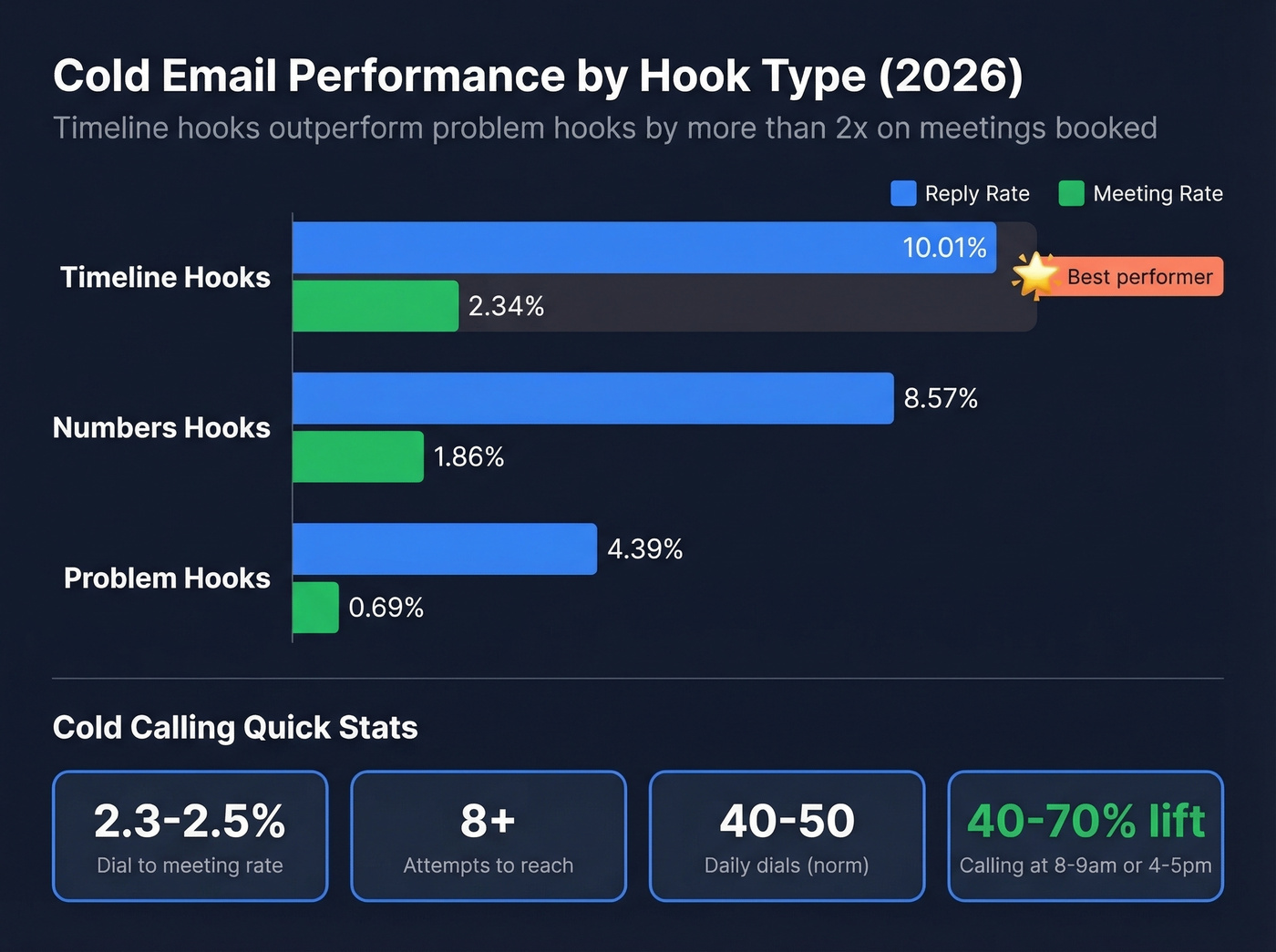
Cold email reply rates by hook type:
| Hook Type | Reply Rate | Meeting Rate |
|---|---|---|
| Timeline hooks | 10.01% | 2.34% |
| Numbers hooks | 8.57% | 1.86% |
| Problem hooks | 4.39% | 0.69% |
Timeline hooks outperform problem hooks by more than 2x on meetings booked. If your first line references a specific deadline or date-driven trigger, you're already ahead of most SDRs in your market.
To improve the top of funnel, pair these hooks with a tighter B2B cold email sequence and better email subject lines.
Cold calling benchmarks:
| Metric | Benchmark |
|---|---|
| Dial-to-meeting | ~2.3-2.5% (1 per 40-45 dials) |
| Connect rate | 3-10% typical |
| Attempts to reach | 8+ |
| Daily dials (norm) | 40-50 |
| Best call windows | 8-9am, 4-5pm (40-70% lift) |
Calling during optimal windows is the single easiest win you can automate. A 40-70% connect rate lift versus random timing means the difference between two conversations a day and four. If your team is rebuilding the phone motion, use a repeatable cold calling system and train for cold call rejection.
What Kills Outbound Before Methodology Matters
60% of prospects are lost to poor targeting. Another 44% disengage when messaging feels irrelevant. You can run Challenger perfectly and still fail if you're reaching the wrong people with stale data.
We've seen it repeatedly: single-channel reliance, a stale ICP that hasn't been updated in two quarters, and above all, bad contact data. Meritt cut bounce rates from 35% to under 4% and tripled pipeline from $100K to $300K per week after switching to Prospeo. That's not a methodology change - it's a data quality change. Even the most refined outbound sales techniques fall apart when half your emails never reach an inbox.
Before you debate frameworks, verify your list. If you're diagnosing deliverability, start with email bounce rate and the full email deliverability guide.

Your cadence calls for cold calls at 8-9am and 4-5pm - but only if you have real direct dials. Prospeo's 125M+ verified mobile numbers deliver a 30% pickup rate, turning your 40-50 daily dials into actual conversations with decision-makers.
Stop dialing switchboards. Reach buyers on their direct lines.
Signal-Based Prospecting: The 2026 Upgrade
Only 3-5% of your market is buying right now. Signal-based prospecting finds that slice before competitors do.
If you're building the motion from scratch, borrow from modern sales prospecting techniques and formalize your ICP with an ideal customer profile.
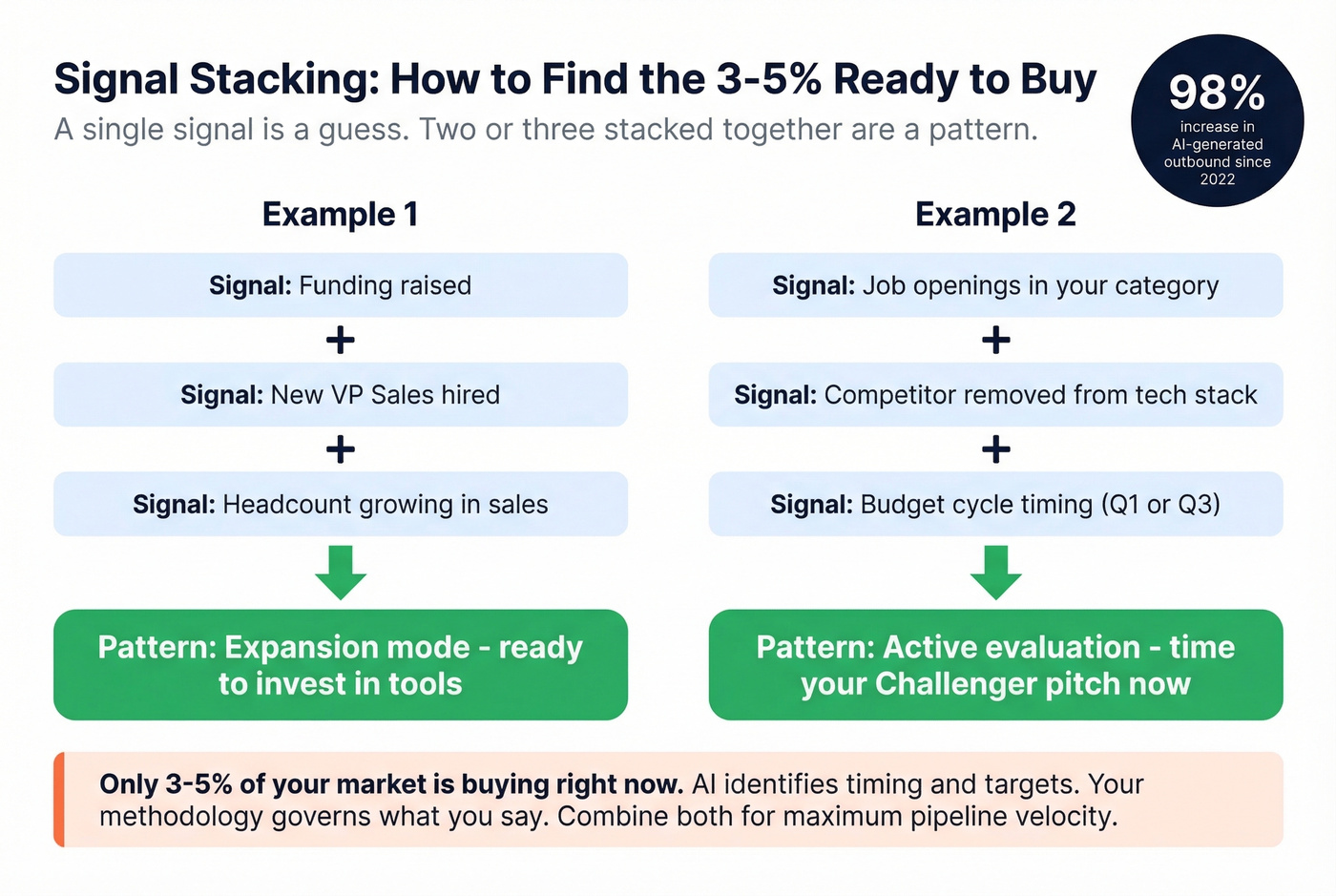
Stack signals rather than acting on one: funding raised plus a new VP Sales hire means expansion mode. Job openings in your category plus a competitor removed from the tech stack means active evaluation. A single signal is a guess. Two or three stacked together are a pattern.
By 2026, AI-generated outbound messages have surged - a 98% increase from 2022 levels. AI improves ICP identification, timing, and automation at scale. But your chosen methodology still governs what you say. AI governs when and to whom. Teams combining both see higher pipeline velocity than those relying on either alone. Intent data tracking buying signals across thousands of topics lets you time methodology-driven conversations to real demand instead of guessing - and that timing advantage compounds across every rep on your team.
FAQ
What's the difference between a sales methodology and a sales process?
A methodology is how you engage buyers - Challenger teaches, SPIN questions, Sandler equalizes. A process is the sequence of steps your team follows from prospecting through close. Methodology shapes the conversation; process shapes the workflow. You need both to run repeatable outbound.
Which outbound sales approach works best for startups?
Sandler works well for founder-led sales at sub-$15k deal sizes because its equal-footing stance and early disqualification save time. For larger enterprise contracts, pair Challenger with MEDDIC to compete against incumbents with structured qualification.
How many touches should an outbound cadence have?
Five to eight touches over two to three weeks across email, phone, and social. The 3-7-7 pattern captures 93% of replies by Day 10. Most reps give up too early - it takes 8+ attempts on average to reach a prospect.
Does outbound sales methodology still work with AI?
Yes - AI amplifies methodology, it doesn't replace it. Use AI for ICP identification, timing, and personalization at scale. Layer in intent data so you're timing methodology-driven conversations to buying signals rather than spraying cold lists and hoping something sticks.