

Outreach Business in 2026: The Data-Backed Guide That Actually Converts
A founder on r/SaaS sent 2,000 cold emails last year. Six replies. Zero customers. He declared cold outreach "basically dead" and pivoted to community-led growth. He wasn't wrong about his approach - but he was dead wrong about outreach as a channel. His list was junk, his sequence was a single blast, and he had no channel mix. Whether you're running outreach for your business or building an outreach business from scratch, the strategy isn't broken. The execution usually is.
Quick note before we get into it: this is about outreach as a business strategy - not Outreach.io, the enterprise sales engagement platform used by big sales orgs. If you're looking for that software, go straight to their site. If you're trying to generate pipeline or launch an agency, you're in the right place.
What You Need (Quick Version)
If you're doing outreach for your business: small, verified lists plus multichannel sequences beat mass blasts every time. Campaigns under 50 contacts earn 5.8% reply rates vs. 2.1% for large blasts. "Quality over quantity" isn't a vibe. It's the math.
If you're starting an outreach agency: expect roughly ~$53,500 in startup costs, a breakeven timeline around 9 months, and a positioning strategy built around outcomes, not "we send emails."
Either way, the #1 separator between outreach that works and outreach that doesn't is data quality. About 28% of B2B emails go invalid every year. If you're sending to a list you haven't verified recently, you're burning domain reputation before you write a single subject line.
What Is Business Outreach?
Business outreach is any proactive effort to start a relationship with someone who doesn't know you yet. That includes sales prospecting, PR pitches, partnership development, influencer collaboration, recruiting, and yes, showing up at a chamber of commerce event and actually talking to people.
The common thread: you reach out first, with a specific goal.
| Type | Goal | Primary Channel | Key KPI |
|---|---|---|---|
| Sales | Pipeline/revenue | Email + phone | Reply rate |
| PR/Media | Coverage/backlinks | Placement rate | |
| Partnerships | Joint GTM | Email + warm intro | Meetings booked |
| Recruiting | Talent pipeline | Email + messaging | Response rate |
| Community | Trust/inbound | Forums + social | Engagement |
The real distinction: outreach isn't spam. Spam is 10,000 identical emails to an unverified list. Outreach is 47 relevant messages to people who match your ICP, sent across multiple channels over 7-10 days, with a clear reason for the ask.
Outreach Performance in 2026
Reply rates have been sliding, and they haven't bounced back. A Belkins study across 16.5M cold emails found reply rates dropped 15% between 2023 and 2024, and inbox pressure's only gotten worse since then. Filters are stricter. Buyers are numb. The "spray and pray" era is over.
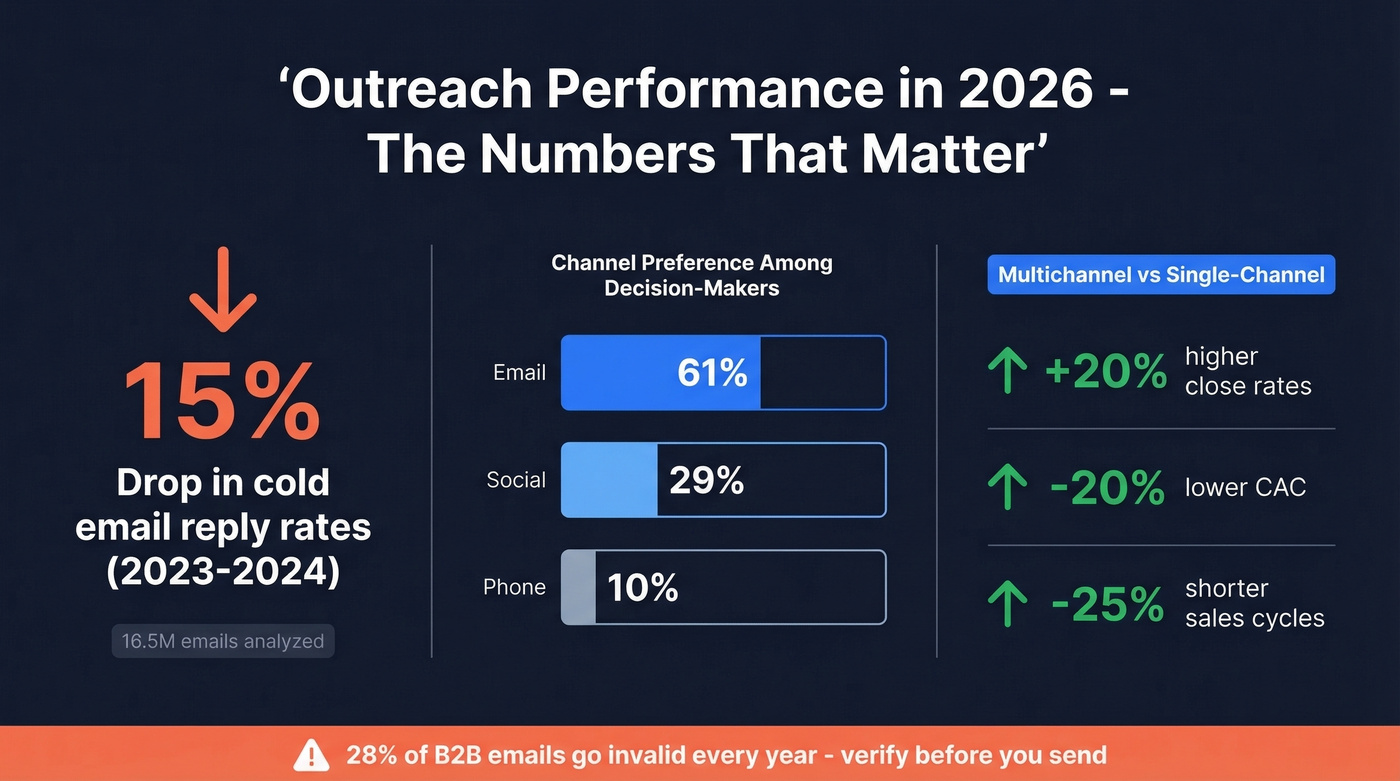
Here's the part people miss: multichannel outreach is doing fine. That same dataset shows multichannel campaigns deliver 20% higher close rates, 20% lower CAC, and 25% shorter sales cycles than single-channel. And decision-makers still tell you exactly how they want to be contacted: email leads at 61%, social at 29%, phone at 10%. The move isn't picking one channel. It's sequencing the right channels in the right order.
Data decay is the quiet killer. Roughly 28% of B2B email addresses become invalid annually due to job changes and org churn. That means a list you built six months ago can easily be ~14% dead if you don't re-verify, which is more than enough to spike bounces and drag your deliverability into the mud.
One bright spot: 67% of decision-makers don't mind AI-assisted outreach as long as it feels human and relevant. Let's be honest: the bar isn't "no AI." The bar is "don't sound like a template farm." If you're leaning into AI, use it to support personalized outreach, not replace it.

You just read that 28% of B2B emails go invalid every year and campaigns under 50 contacts earn 3x the reply rates. Prospeo's 300M+ profiles with 98% email accuracy and 7-day data refresh mean every list you build is tight, verified, and ready to send - not a domain reputation liability.
Stop burning domains on dead data. Start with lists that actually connect.
The 5-Step Outreach Framework
1) Build a verified prospect list
This is where most outreach fails, and it fails quietly. You don't realize your list is bad until open rates crater, bounces spike, and your domain starts getting treated like a repeat offender. Then you're stuck doing damage control for weeks. (If you're troubleshooting, start with email deliverability before you rewrite copy.)
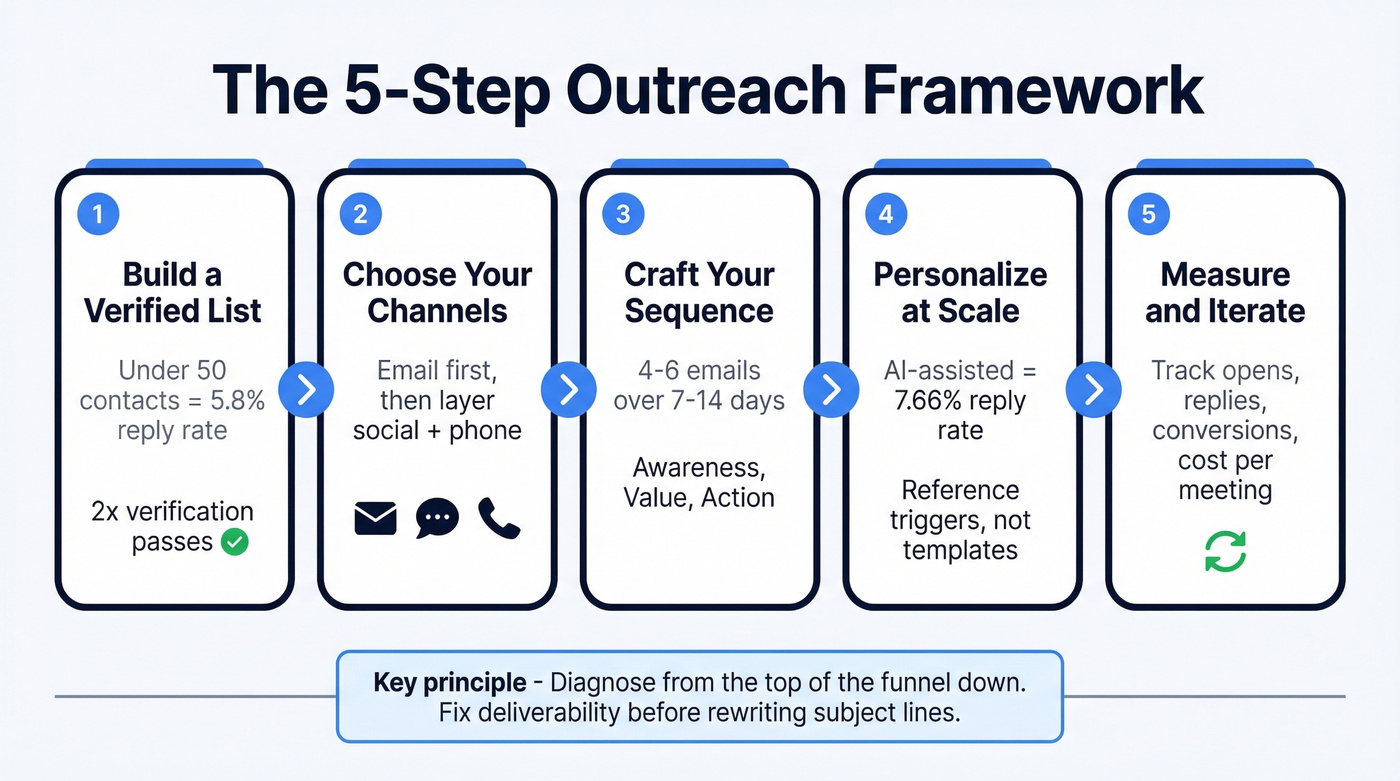
The data's blunt: campaigns targeting fewer than 50 contacts earn 5.8% reply rates - nearly 3x the 2.1% that large blasts generate. Smaller lists force better targeting. Better targeting makes personalization easier. And personalization is what earns replies in 2026.

One practice worth stealing from r/salesdevelopment: run your list through at least two verification passes before you send. Belt and suspenders. If that feels annoying, good - it should. Losing a domain because you wanted to save 20 minutes is the kind of mistake you only make once. (If you're shopping tools, start with data enrichment services and verification, not sequencing.)
2) Choose your channels
Email's still the workhorse. It's the first-touch preference for 61% of decision-makers, and 39% say cold email works best for initial contact.
But email alone leaves money on the table.
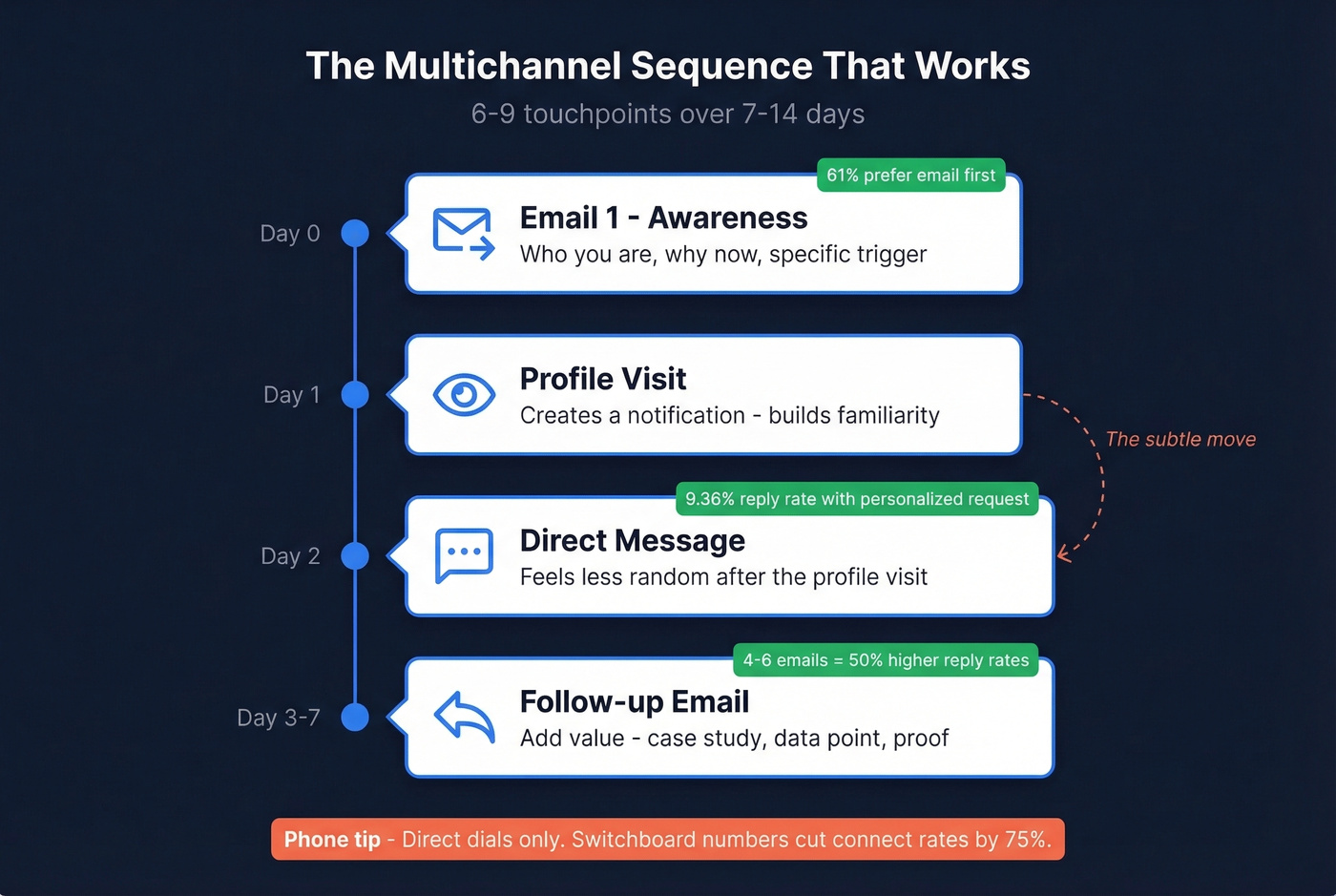
A simple, repeatable sequence we see work: email -> profile visit -> direct message -> follow-up email. Four touches across two channels in 48 hours, inside a broader 6-9 touchpoint journey over 7-14 days. The profile visit is the subtle move. It creates a notification, and that tiny "who's this?" moment makes your DM feel less random.
Phone still matters for high-value targets, but only if you're calling direct dials. Generic switchboard numbers reduce connect rates by as much as 75%. That's not a rounding error. That's the difference between "phone works" and "phone is a waste of time." If you're building a calling motion, borrow a real cold calling system instead of winging it.
3) Craft your sequence (so it doesn't feel like spam)
A practitioner on r/smallbusiness laid out a structure that's simple and effective:
- First email = awareness (who you are, why you're reaching out)
- Follow-up = value (proof point, case study, relevant insight)
- Final = action (clear CTA, specific ask)
Here's a skeleton you can steal:
Email 1 - Awareness Subject: [Specific trigger] at [Company] "Hi [Name], saw [Company] just [trigger event]. We helped [similar company] [specific result] in [timeframe]. Worth a 15-min call this week?"
Email 2 - Value (Day 3) Subject: Re: [original subject] "Quick follow-up - [one-line case study or data point]. Here's how it worked: [2-sentence breakdown]. Still open to connecting?"
Email 3 - Action (Day 7) Subject: Re: [original subject] "Last note - I know inboxes are brutal. If [problem you solve] is a priority this quarter, I've got a [specific resource/audit/demo] ready. If not, no hard feelings."
Don't pitch the full solution on touch one. The goal of email one is a reply, not a contract. If you need more angles, pull from proven sales follow-up templates and adapt them to your offer.
And yes, more touches help, as long as they're not copy-paste nags. Sequences with 4-6 emails see up to 50% higher reply rates than single-touch campaigns. Spread touches across 7-14 days, vary the channel, and make each message earn its spot by adding something new.
4) Personalize at scale (without writing novels)
Personalization doesn't mean writing every email from scratch. It means making the recipient feel like you did.
The Expandi dataset across 20M+ outreach attempts puts numbers behind it: AI-assisted messages generated a 7.66% reply rate vs. 6.50% without AI. Personalized connection requests hit 9.36% vs. 5.44% with no message. The lift isn't magic, but it's real, and it compounds across a sequence.
The micro-campaign principle is what makes this practical. Keep campaigns under 50 contacts so you can reference something specific: a new hire, a funding round, a product launch, a job post that hints at a priority. Generic "noticed you're growing" lines are dead.
One scenario we see constantly: a founder tries to sell a dev tool to mid-market teams, sends 1,500 emails to "CTO/VP Eng" titles, and gets nothing. Then we tighten the list to 38 companies hiring for a specific stack, reference the job post in the first line, and the replies show up within 48 hours. Same offer. Same sender. Different targeting.
5) Measure and iterate (so you don't guess)
Benchmarks for 2026, so you know what "good" looks like:
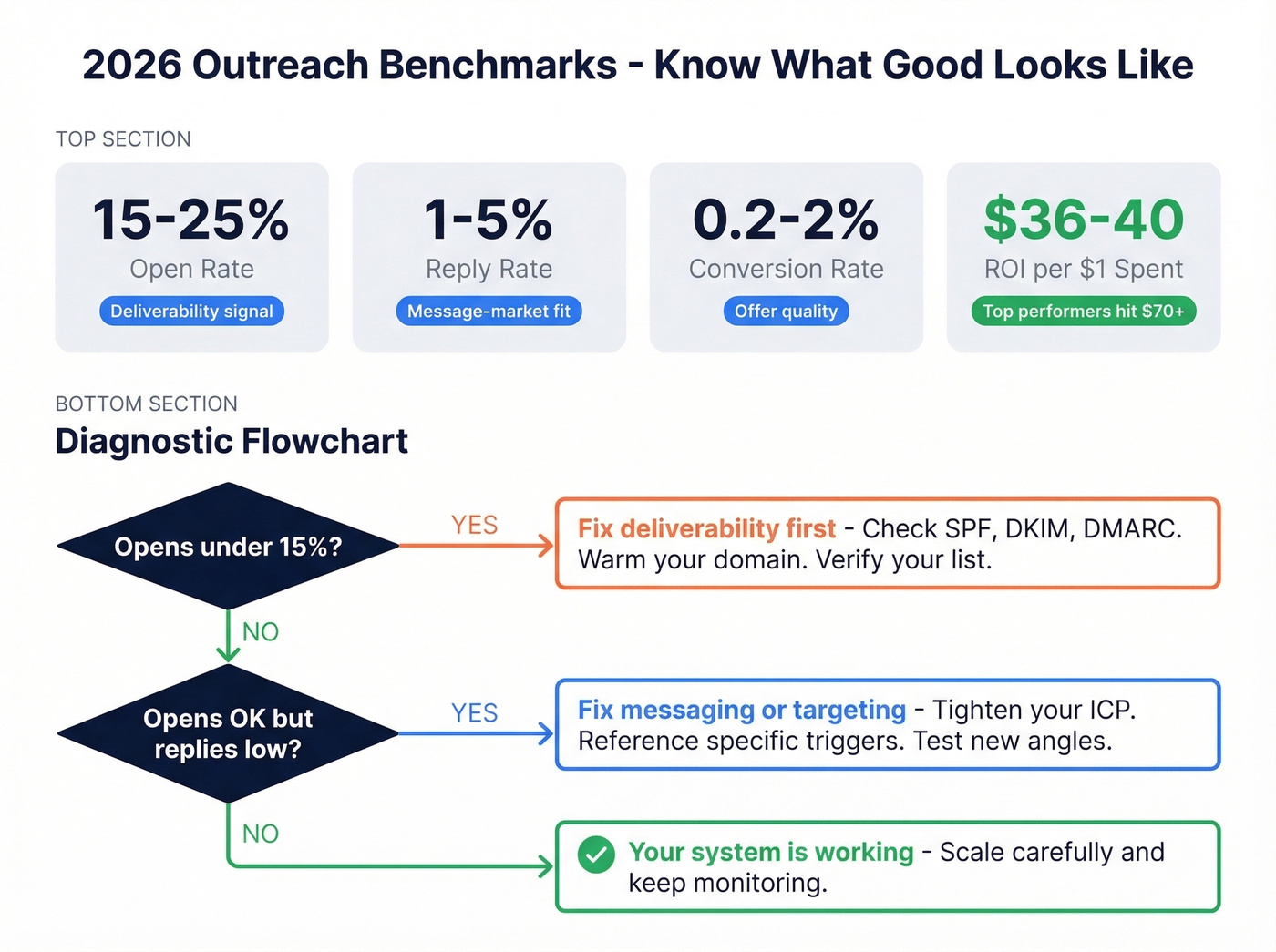
- Open rates: 15-25% (higher with strong subject lines and clean lists)
- Reply rates: 1-5%
- Conversion rates: 0.2-2%
Email ROI is still strong when you run it like a system. Email marketing returns $36-$40 per $1 spent on average, with top performers hitting $70+ per $1.
Track four KPIs:
- Open rate as your deliverability signal
- Reply rate for message-market fit
- Conversion rate for offer quality
- Cost per meeting for efficiency
If open rates are under 15%, your list or deliverability is broken. Check SPF, DKIM, and DMARC, and make sure you warmed the domain properly. If you need a quick reference, use these SPF record examples to sanity-check syntax. If opens are fine but replies are low, your messaging or targeting is off. Diagnose from the top of the funnel down, not by rewriting subject lines for a week and hoping.
Channel Deep-Dives
Email outreach
Email's still the highest-ROI channel for most B2B teams. Deliverability is also the #1 thing people complain about, and they're right to complain. It's frustrating to do the work, hit send, and realize half your volume never had a chance.
The fix starts before copywriting: use a custom domain (never webmail for cold outreach), warm it for at least two weeks, authenticate with SPF/DKIM/DMARC, and verify every address before sending. Compliance matters too. Include a physical address and a clear opt-out mechanism in every email to stay CAN-SPAM compliant. If you're selling into or from the EU/UK, take GDPR seriously and run a real legitimate-interest process.
Skip high-volume sending if you can't control bounces. You'll pay for it later. If you're scaling volume, learn your safe email velocity first.
Direct-message outreach
Tuesday is the best day to send, with a 6.90% reply rate. Monday's close at 6.85%. Weekends drop to 6.40%. Multi-action campaigns that combine DMs with profile visits and content engagement can reach up to 11.87% reply rates.
Regional differences are big enough to change your plan. Southern Europe responds at 11.81%, South America at 9.71%. If you're selling into Southern Europe, DMs deserve a bigger share of your sequence than they would in North America, where inbox competition is brutal.
Phone outreach
Phone is high intent and high friction. When it works, it works fast. When it doesn't, it wastes hours.
The direct-dial vs. switchboard gap is wild: generic numbers reduce connect rates by up to 75%. That's why teams that rely on "call the main line and ask for the VP" swear the phone is dead.
Community and content
The r/SaaS founder who declared cold outreach dead? His pivot is worth studying. By participating in niche communities, helping without selling, and publishing long-form content, he built to $4.7K MRR with ~50 signups per month.
It's not a replacement for outbound. It's a second engine.
Outbound creates conversations now. Community and content compound over months. The teams that win in 2026 run both, and they don't pretend one cancels the other out.
Best Tools for Your Outreach Business
You don't need 15 tools. You need three: a data provider, a sequencing tool, and a CRM. Everything else is optional.
| Tool | Category | Starting Price | Best For |
|---|---|---|---|
| Prospeo | Data & verification | Free (75 emails/mo) | Verified data, self-serve, no contracts |
| Apollo | Database + sequencing | Free (100 credits/mo) | All-in-one for SMBs |
| Smartlead | Email sequencing | $39/mo | Budget high-volume email |
| Lemlist | Multichannel | $69/user/mo | Email + social sequences |
| Instantly | Cold email at scale | ~$30/mo+ | Inbox rotation, volume |
| Woodpecker | Budget cold email | $24/mo | Simple email automation |
| QuickMail | Email sequencing | $9/mo | Bootstrapped teams |
| Mailshake | Email outreach | $29/mo | Straightforward email campaigns |
| Reply | Multichannel | $59/user/mo | AI-assisted sequences |
| Klenty | Sales engagement | $50/user/mo | CRM-heavy workflows |
| Heyreach | DM outreach | $79/mo | DM-focused teams |
| Gmass | Gmail-based | $25/mo | Gmail power users |
Data and verification (where the real wins come from)
Look, this is where people get cheap and then act surprised when deliverability falls apart.
Prospeo is the best pick if you care about email accuracy and data freshness. It has 300M+ professional profiles, 143M+ verified emails, and a 7-day refresh cycle (the industry average is about six weeks). Email accuracy is 98%, and pricing stays self-serve and transparent, including a free tier with 75 verified emails per month.
Apollo's the obvious all-in-one starting point for SMBs that want database + sequencing in one place. The free plan is genuinely useful for testing, and paid plans start around $59/month per user. The tradeoff is focus: all-in-ones are convenient, but they aren't always the best at the one thing that keeps your domains safe. If you're comparing sources, start with a shortlist of B2B company data providers.
Sequencing tools (send infrastructure matters)
Smartlead at $39/month is hard to beat for budget-friendly, higher-volume cold email, especially if you need inbox rotation. Lemlist costs more but earns it if you want multichannel sequences and a more guided workflow.
A quick "skip this if": if you're still figuring out your ICP and offer, don't buy an expensive sales engagement platform yet. You'll just automate bad targeting faster. If you want a broader shortlist, see these SDR tools.
What practitioners actually use
Beyond the mainstream tools, r/salesdevelopment threads consistently mention smaller options for specific needs: affordable inbox rotation, curated lead lists, and multi-sender management. If the big platforms feel heavy, those niche tools can be a better fit for a lean agency or a founder-led outbound motion.
For enterprise teams, Outreach.io and Salesloft are still the heavyweights for workflow automation and deep Salesforce/HubSpot integration, but you're in a different budget and governance conversation at that point.
Starting an Outreach Business (Agency Model)
Agency economics
Starting an outreach agency isn't cheap, but the unit economics get attractive once you stop reinventing the wheel for every client. Expect roughly $53,500 in startup costs including infrastructure, tooling, and initial operating expenses, with a breakeven timeline around 9 months.
Year 1 is often negative. Year 2 is where it gets interesting if you've built repeatable delivery and you aren't constantly fixing deliverability fires. Hourly rates for outreach services commonly land in the $120-$140/hr range, but retainers are usually the cleaner model because they align incentives around outcomes and consistency.
The retainer math is simple: with ~$5,550 in monthly burn and 80% gross margins, you need about $6,900/month in revenue to break even. That's roughly five retainer clients at $1,500/month. It's achievable in year one, but only if your own outbound is as disciplined as what you're selling.
Positioning and clients
Here's the thing: if your average client closes deals under $15K, they probably don't need $3,000/month tooling stacks or a fancy agency retainer. In 2026, the best opportunity is the mid-market: companies big enough to need outbound, too small to build an in-house SDR team, and tired of paying for bloated data contracts.
Sell outcomes, not services. "700 qualified leads per month" lands better than "we do cold email and DMs." Start with a targeted list of 100 potential clients and practice what you preach: run personalized multichannel sequences to land your first accounts.
When you don't have case studies yet, guarantees can work. "10 qualified calls per month at $3,000/month, or you don't pay" is risky, but it's how some agencies build a portfolio fast. Just be careful with definitions. If you don't define "qualified" in writing, you'll end up in an argument you can't win.
In our experience, a clean starter stack looks like Prospeo for data and verification, Smartlead or Instantly for sending infrastructure, and HubSpot's free CRM for pipeline management. Tool cost stays under ~$200/month to start, and you can scale it client-by-client instead of front-loading expenses.
One real scenario: a small two-person agency we worked with was getting hammered by bounces (8-12%) because they were recycling old lists across clients. They switched to verified, freshly refreshed contacts, cut bounces under 3%, and suddenly their "copy problem" turned out to be a targeting problem all along. That's why we keep coming back to data quality. It's not glamorous, but it decides whether anything else works.
Running an outreach business on bad data is like pouring money into a cracked funnel. Prospeo gives you 30+ filters - buyer intent, technographics, job changes, headcount growth - so you build hyper-targeted lists at $0.01/email. Stack Optimize built a $1M agency on it with sub-3% bounce rates across every client.
Your outreach is only as good as your data. Get the data agencies trust.
FAQ
Is cold outreach still effective in 2026?
Yes. Multichannel outreach delivers 20% higher close rates and 25% shorter sales cycles than single-channel approaches. Teams calling it "dead" are usually running mass blasts to unverified lists. Targeted campaigns under 50 contacts consistently outperform at nearly 3x the reply rate.
How many touchpoints should an outreach sequence include?
Plan for 6-9 touchpoints across email, DMs, and phone over 7-14 days. Sequences with 4-6 emails see up to 50% higher reply rates than single-touch campaigns, but only if each message adds something new.
What's the average ROI of email outreach?
Email returns $36-$40 per $1 spent on average, with top performers hitting $70+. Cold outreach trends lower than lifecycle email, but verified data and a disciplined sequence still beat paid ads for many B2B offers.
How much does it cost to start an outreach agency?
Roughly $53,500 in startup costs with a breakeven timeline around 9 months. You need about five retainer clients at $1,500/month to cover monthly burn. Tool costs can stay under ~$200/month using Prospeo for data, Smartlead or Instantly for sending, and HubSpot's free CRM.
What's the best free tool for outreach data?
Prospeo's free tier includes 75 verified emails per month and 100 Chrome extension credits per month, which is enough to run a real micro-campaign. Apollo also offers 100 free credits monthly. If you care most about data quality and freshness, Prospeo's 98% email accuracy and 7-day refresh cycle are hard to beat.