

Outreach Marketing: The Practitioner's Guide to Getting Replies in 2026
Your outreach marketing isn't working. You sent 500 emails last week - 42 bounced, three people replied, and one was an out-of-office. That's a 1.2% reply rate, and your manager wants answers.
Average cold email reply rates hit 5.8% in 2024, down 15% from the year before, and the trend shows no signs of reversing. The teams still getting results aren't doing anything magical - they're just ruthlessly disciplined about data quality, targeting, and follow-up. This guide is built on data from 16.5M+ emails, real campaign benchmarks, and the tools practitioners actually use to stay above the noise floor.
The Short Version
Outreach marketing works when you nail three things: verified data, genuine personalization, and disciplined follow-up. Everything else is optimization.
Emailing 1-2 contacts per company produces a 7.8% reply rate - more than double the 3.8% you get blasting 10+ people at the same org. Keep emails under 200 words. Follow up at least once (it lifts replies up to 49%). Verify every address before you hit send, because roughly 20% of cold emails get flagged as spam before anyone reads them.
What Is Outreach Marketing?
Outreach marketing is the practice of proactively contacting potential customers, partners, or influencers to build relationships and drive business outcomes. Unlike inbound marketing - where you create content and wait - outreach puts you in control of who sees your message and when.
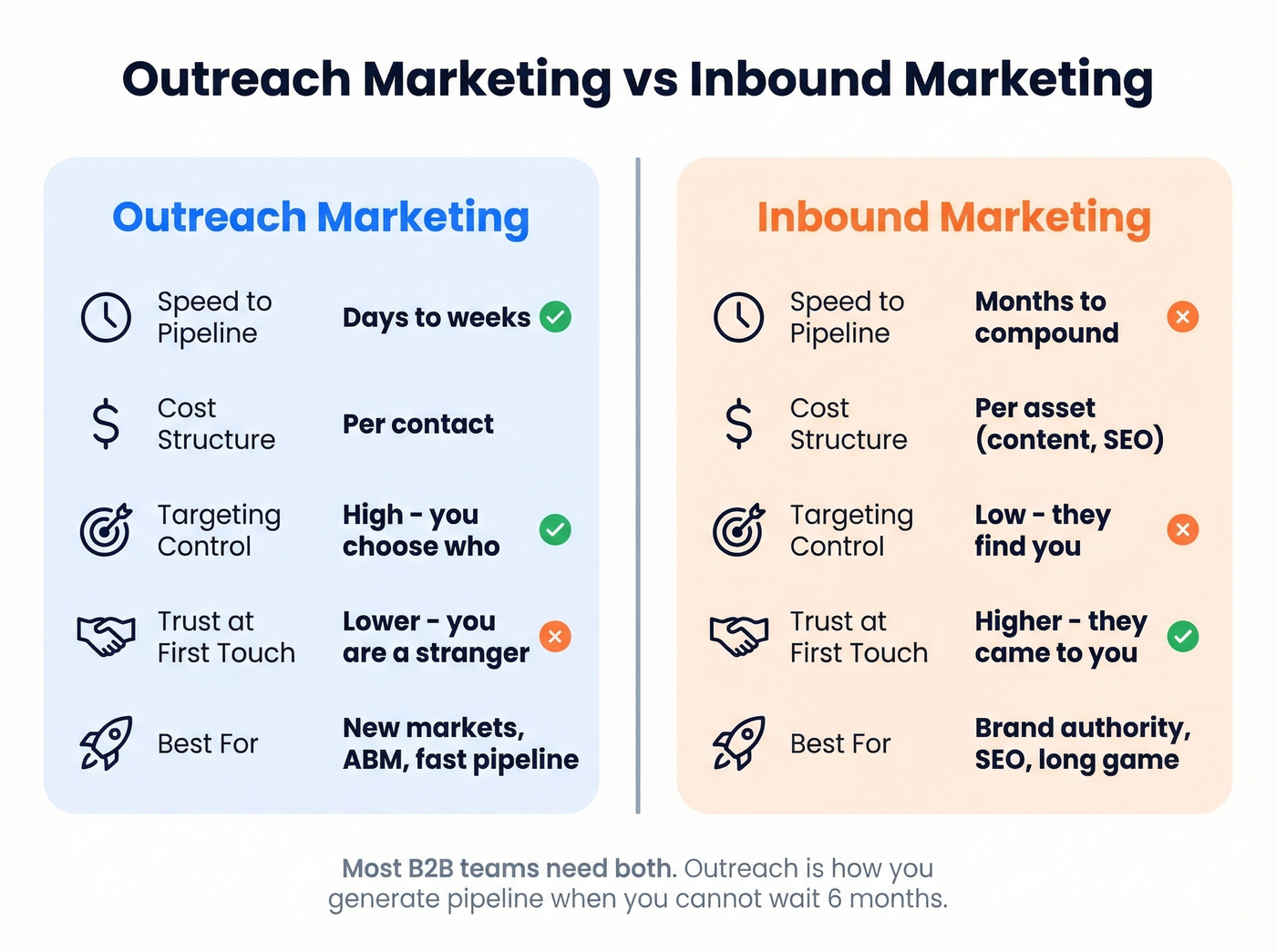
| Dimension | Outreach Marketing | Inbound Marketing |
|---|---|---|
| Speed to pipeline | Days-weeks | Months |
| Cost structure | Per-contact | Per-asset |
| Targeting control | High (you choose) | Low (they find you) |
| Trust at first touch | Lower | Higher |
| Best for | New markets, ABM | Brand authority, SEO |
Most B2B teams need both, but outreach is how you generate pipeline when you can't wait six months for organic traffic to compound.
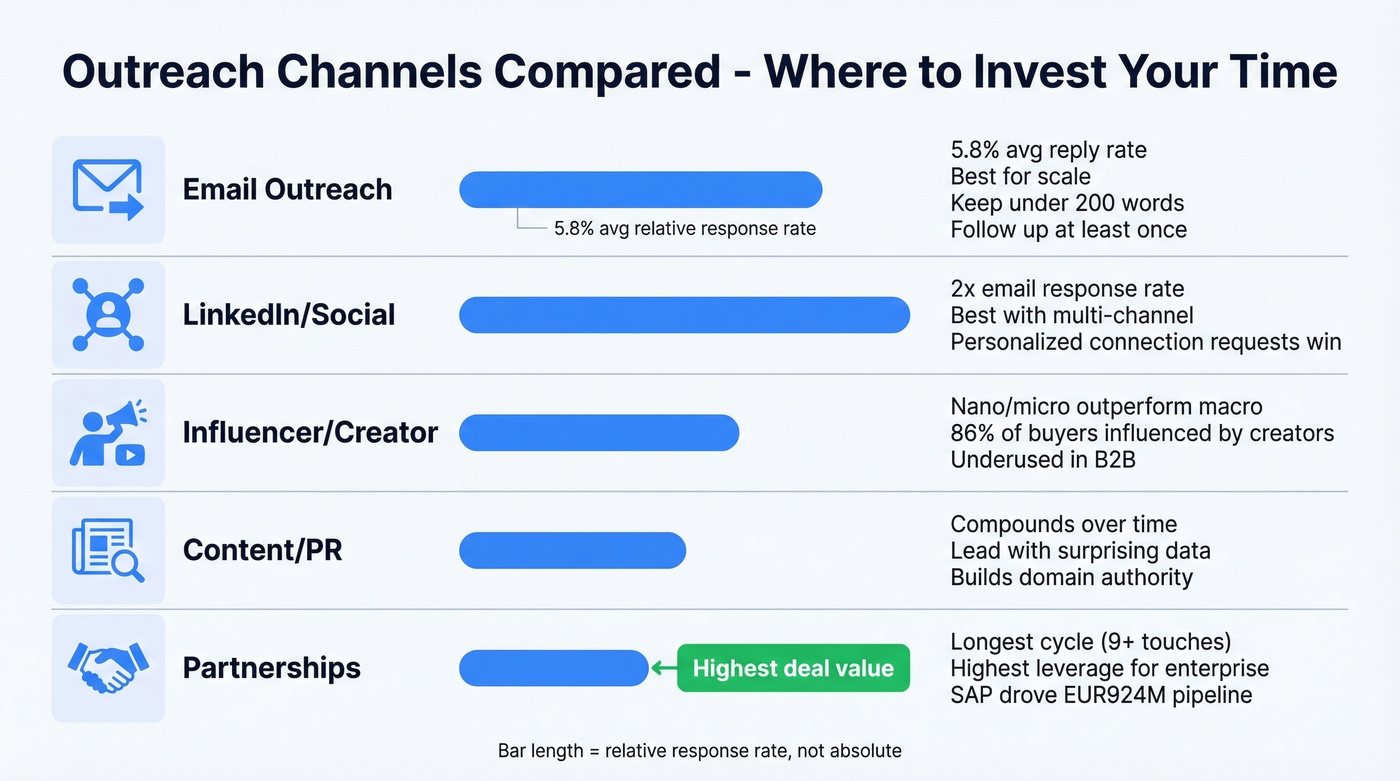
It spans six core channels: email outreach (cold emails, warm follow-ups, account-based sequences), social media outreach (connection requests, DMs, comment engagement), influencer and creator outreach, content and PR outreach (guest posts, journalist pitches, link building), partnership outreach (co-marketing, co-selling, referral programs), and offline outreach (phone calls, direct mail, handwritten notes). Each channel has different economics and response dynamics - the best campaigns coordinate across two or three simultaneously.
Here's the thing: if your average deal size is under $10K, you probably don't need a multi-channel orchestration platform. A verified list, a good sequencing tool, and a human who can write a decent email will outperform a $150/seat enterprise platform every time.
Why Outreach Still Works in 2026
Outreach is getting harder and more effective at the same time. The practitioners who do it well are pulling further ahead of the spray-and-pray crowd.
81% of sales and marketing decision-makers engage with cold outreach when it's tailored to their company and context. That's the majority of your target market willing to read your email - if it's relevant.
SAP's "Inspire the Future" campaign generated a EUR924.4M pipeline with 48% higher engagement than their other social campaigns. That result came from coordinated outreach across content, partnerships (including co-investment from Capgemini), and multi-channel distribution. It wasn't one email blast - it was orchestrated proactive engagement at scale.
On the analog side, personalized handwritten letters are making a quiet comeback. In a world drowning in digital noise, a physical piece of mail stands out precisely because nobody expects it. We've seen teams use direct mail as the first touch in ABM campaigns, followed by email and social, with strong results.
The declining reply rates everyone panics about? Those are averages dragged down by teams still sending generic templates to unverified lists.
Outreach Benchmarks Worth Knowing
Belkins analyzed 16.5 million cold emails across 93 business domains in 2024. Here's what the data says.
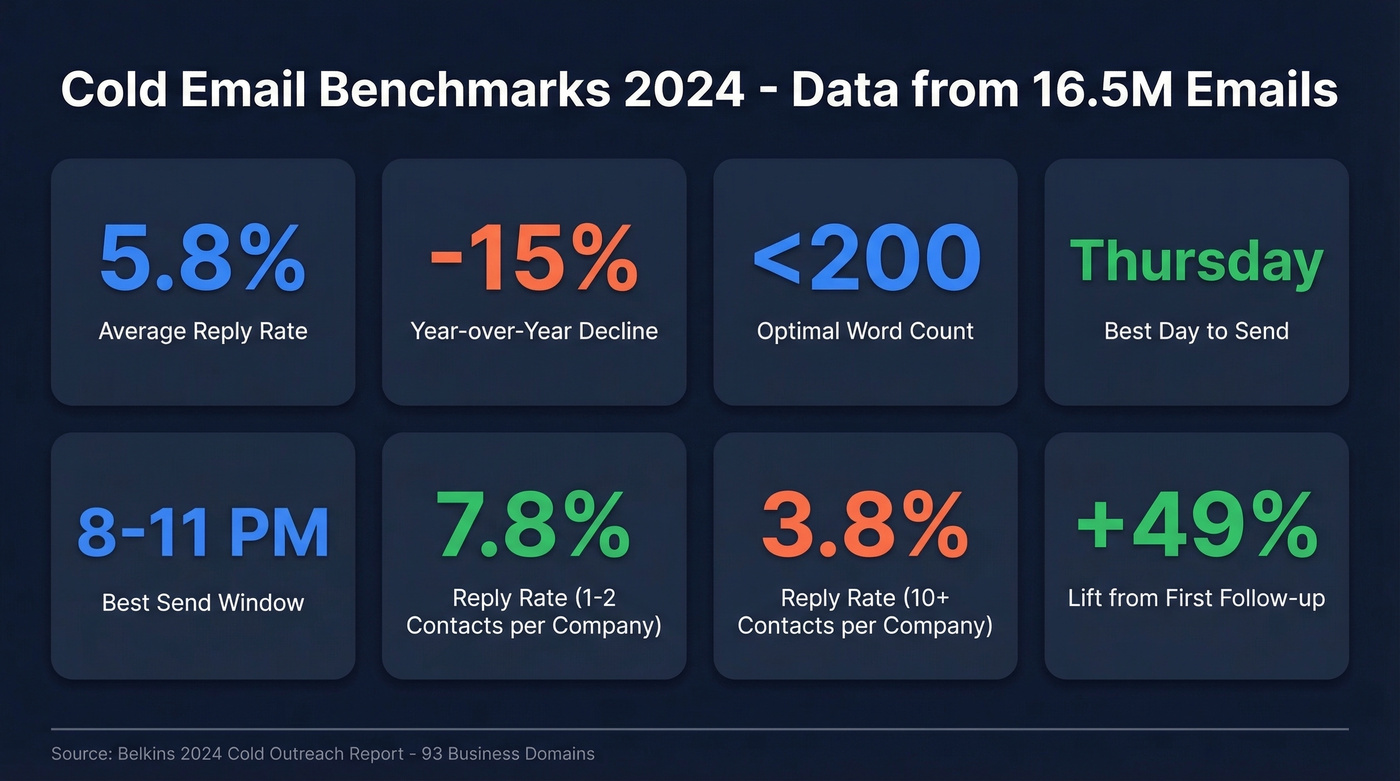
| Metric | Number |
|---|---|
| Avg. reply rate (2024) | 5.8% |
| YoY decline | -15% |
| Optimal email length | 6-8 sentences (<200 words) |
| Best day | Thursday (6.87% reply) |
| Best time | 8-11 PM (6.52% reply) |
| 1-2 contacts/company | 7.8% reply |
| 10+ contacts/company | 3.8% reply |
| First follow-up lift | Up to 49% |
| Spam flag rate | ~20%* |
\Sopro dataset, 151M outreach points*
The contacts-per-company finding is massive. Emailing 1-2 people at a target account doubles your reply rate compared to blasting the entire org chart. More isn't better - it's worse. In our testing, this held up consistently across industries.
The evening send-time data surprises people. Emails sent between 8-11 PM hit 6.52% reply rates, likely because they land at the top of the inbox the next morning. Thursday edges out every other day at 6.87%.
Turning off open-tracking pixels improved reply rates by 3%. Email providers penalize tracking pixels, and removing them keeps you out of the spam folder. The data you lose isn't worth the deliverability hit.
Sopro's dataset puts the baseline reply rate at 5.1%, with most campaigns landing between 1-5%. The gap between average and top performers is enormous, and it's almost entirely explained by data quality and targeting precision. Your data is the bottleneck, not your copy.
Strategies That Actually Drive Replies
Email Outreach
Case Study: Assembly Assembly narrowed hundreds of potential targets to five companies matching a tight ICP (B2B SaaS, Series A+, specific tech stack). They spent roughly an hour per email, including a mini SEO audit with quick wins for each prospect. The result: 5 emails sent, 3 responses, 3 meetings booked, 2 clients closed. A 60% reply rate and 40% close rate.
That doesn't scale to thousands of emails, but it illustrates the principle: hyper-personalization crushes volume plays for high-value deals.
For scalable email outreach, use a data-pitch format:
Subject: [Surprising stat] for [Company Name]

Hi [Name],

[One-line stat relevant to their industry or role.]
[One sentence on methodology or source.]
[Key finding or visual.]

Worth a 15-min call to walk through how this applies to [Company]?

[Your name]
Keep it under 200 words. Always send at least one follow-up - it lifts replies up to 49%. If you need a tighter system, start from proven sales cadence templates.
Social Media Outreach
LinkedIn outreach delivers roughly 2x the response rate of cold email when done well. But the channel is getting noisier. As one practitioner on r/b2bmarketing put it: "Fewer people are responding to cold DMs, and templated personalization isn't fooling anyone anymore."
The real power is multi-channel coordination. An email followed by a connection request followed by a comment on their recent post creates a compounding familiarity effect. We've seen teams lift reply rates 30-40% by adding just one social touchpoint to their email sequences. Personalized connection requests outperform InMail blasts by a wide margin because they feel human.
Influencer and Creator Outreach
Nano and micro-influencers (1K-50K followers) consistently outperform macro-influencers on engagement rate. For B2B, think newsletter operators, podcast hosts, and community moderators - not Instagram celebrities.
Selection criteria that matter: posting frequency, audience relevance to your ICP, and engagement rate (comments and shares, not follower count). With 86% of consumers reporting purchases influenced by creator recommendations, this channel is underinvested by most B2B teams.
Content and PR Outreach
Link building, guest posting, and digital PR compound over time. Every backlink improves domain authority, which improves organic rankings, which generates inbound leads indefinitely.
For journalist pitches: lead with your most surprising finding, provide 2-3 supporting takeaways, offer expert availability for quotes, and link to the full data. Journalists need stories with numbers - give them numbers.
Partnership Outreach
Co-marketing, co-selling, and referral programs are the highest-leverage outreach plays for established companies. SAP's partnership with Capgemini drove a combined EUR924.4M pipeline - proof that partnership outreach scales to enterprise levels. Expect longer cycles: reaching executives often requires around 9 touches across multiple channels, and partnership conversations involve multiple stakeholders. Plan your sequences accordingly.

The article says it clearly: your data is the bottleneck, not your copy. Teams using unverified lists lose 20% of emails to spam before anyone reads them. Prospeo's 5-step verification delivers 98% email accuracy on 300M+ profiles - refreshed every 7 days, not every 6 weeks.
Stop writing better emails to wrong addresses. Fix the data first.
Build Your Strategy Step by Step
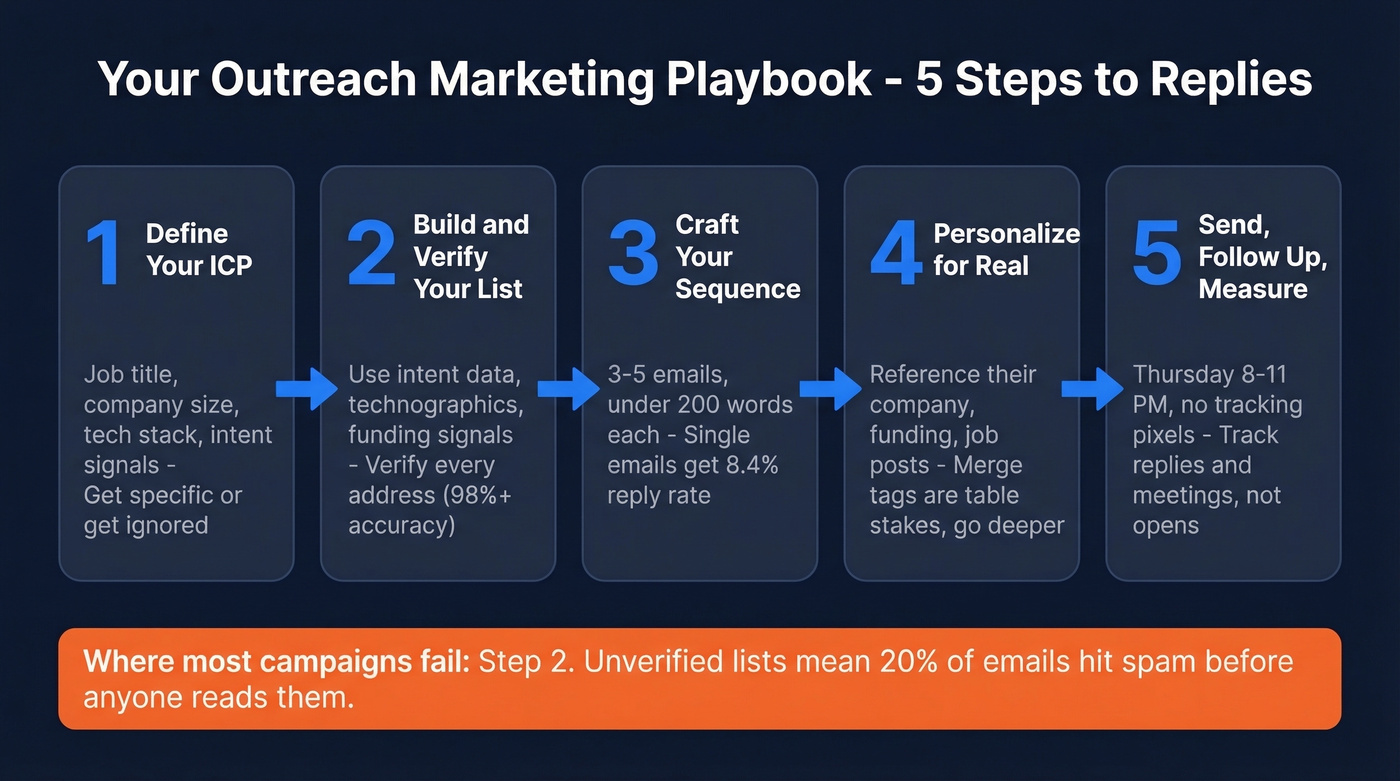
Step 1: Define Your ICP
Get specific. "VP of Marketing at Series B SaaS companies using HubSpot" is an ICP. "Marketing leaders" is not. Include job title, company size, industry, tech stack, and intent signals showing they're actively researching your category.
Step 2: Build and Verify Your List
Use buyer intent, technographics, job changes, headcount growth, funding rounds, and revenue ranges to narrow your universe. A smaller, targeted list always outperforms a massive generic one.
Then verify every address before you send a single email. This is where most campaigns silently die - you build a list of 500 contacts, 180 bounce, and your domain reputation tanks. We've audited campaigns where 40% of emails bounced because nobody verified the list. Prospeo's 5-step verification removes spam traps, honeypots, and handles catch-all domains, delivering 98% email accuracy on a 7-day data refresh cycle so you're not working with stale records. If you want a deeper breakdown of tools and process, see email list validation.
Step 3: Craft Your Sequence
Keep it to 3-5 emails, each under 200 words. Single-email campaigns actually have the highest per-email reply rate (8.4%), but follow-ups lift total responses significantly. The sweet spot is a short, focused sequence - not a 12-touch marathon. For examples you can copy, use these sales email sequence templates.
Step 4: Personalize Beyond {first_name}
Reference their company, a recent funding round, a job posting that signals a pain point, or a specific challenge in their industry. Merge tags are table stakes. Real personalization means the prospect can tell you wrote this email for them. If you’re rebuilding your approach, start with B2B personalization.
Step 5: Send, Follow Up, Measure
Thursday evenings (8-11 PM) consistently produce the highest reply rates. Disable open-tracking pixels - they hurt deliverability more than the data is worth. Make sure SPF, DKIM, and DMARC are configured per Google's bulk sender rules.
Track reply rate, bounce rate, and meeting rate - not just opens. If your bounce rate is above 3%, fix your data quality. If your reply rate is below 3%, your targeting or messaging needs work. For timing specifics, use this guide to the best outreach time.
The Outreach Tech Stack for 2026
Data and Verification
Bad data is the #1 silent killer of outreach campaigns. Bounce rates of 35-40% are common with low-quality providers, and every bounced email chips away at your sender reputation.

Prospeo covers 300M+ professional profiles with 143M+ verified emails and 125M+ verified mobile numbers with a 30% pickup rate. The 7-day data refresh cycle is genuinely unusual - most providers refresh around every 6 weeks, which means you're often emailing people who've changed jobs. With 30+ search filters and buyer intent across 15,000 topics powered by Bombora, you build targeted lists and verify them in one workflow. Snyk cut bounce rates from 35-40% to under 5% and grew AE-sourced pipeline 180%. Stack Optimize maintains 94%+ deliverability and zero domain flags across all clients. Pricing runs about $0.01 per email with a free tier of 75 emails/month. If you’re comparing options, start with the best email finding tools.
Apollo is a solid starting point for SMBs that want prospecting and sequencing in one tool. Free tier available, paid plans from $59/month per user. The database is large but email accuracy runs lower (around 79%), so expect more bounces.
ZoomInfo is the enterprise incumbent - 500M contacts, deep org-chart data, and intent signals. At $15,000-$40,000/year with annual contracts and roughly 87% email accuracy, it's overkill for most teams. Skip it unless you need the full GTM platform and have the budget to match.
Email Sequencing
Instantly ($30-$97/month) is the go-to for high-volume cold email with inbox rotation, warmup, and campaign management. Lemlist ($39-$159/month per user) wins on personalization - custom images, embedded videos, and dynamic landing pages. If your campaign strategy leans creative, it's worth the premium.
Reddit practitioners also recommend Smartlead ($39-$94/month), GMass ($25-$55/month), ReachInbox (freemium, paid from around $29/month), and ManyReach (from around $49/month). If you’re building from scratch, follow a proven B2B sales cadence.
Sales Engagement and Influencer Tools
Outreach.io (around $100-$150/user/month) and Salesloft (around $75-$125/user/month) are enterprise multi-channel orchestration platforms handling email, phone, social, and meeting scheduling. Real talk: most teams under 50 reps don't need this complexity. Start with a sequencing tool and graduate when your process demands it.
For influencer and PR discovery, BuzzSumo ($199-$999/month) is the standard for finding journalists and bloggers who cover your space. Upfluence (custom pricing, typically $500+/month for mid-market) handles campaign management at scale. Traackr (around $500+/month) and Klear (from around $250/month) serve enterprise influencer programs. For standalone email verification, Kickbox offers pay-as-you-go verification around $0.008-$0.01/email.
| Category | Top Pick | Price | Best For |
|---|---|---|---|
| Data & Verification | Prospeo | ~$0.01/email, free tier | Accuracy-first teams |
| Budget All-in-One | Apollo | From $59/mo | SMBs starting out |
| Enterprise Data | ZoomInfo | $15K-$40K/yr | Large sales orgs |
| Email Sequencing | Instantly | $30-$97/mo | High-volume cold email |
| Creative Sequences | Lemlist | $39-$159/mo | Personalized outreach |
| Enterprise SEP | Outreach.io | ~$100-$150/user/mo | Multi-channel orchestration |
| PR/Link Building | BuzzSumo | $199-$999/mo | Content-first prospecting |
Compliance: The Section Nobody Else Wrote
Most outreach guides skip compliance entirely. That's irresponsible - one mistake can cost more than your entire outreach budget.
| Regulation | Max Penalty | Scope |
|---|---|---|
| CAN-SPAM | $53,088 per email | US commercial email |
| GDPR | 4% global revenue or EUR20M | EU data subjects |
| TCPA | $500-$1,500 per incident | US calls, texts, and fax |
| CCPA | $2,663-$7,988 per violation | California consumers |
Let's put TCPA in perspective: 1,000 phone contacts without proper consent creates $500K-$1.5M in potential liability. That's not theoretical - it's a math problem. And yes, this applies to cold calling and SMS outreach, not just email.
Your compliance checklist for every campaign:
- Physical address in every commercial email (CAN-SPAM)
- One-click unsubscribe link that actually works
- 10-business-day opt-out processing (the legal max - do it faster)
- Legitimate interest documentation for EU data subjects (GDPR)
- SPF, DKIM, and DMARC authentication configured
None of this is optional. Build it into your process from day one. Compliance isn't a constraint on your outreach strategies - it's the foundation that keeps your domain and brand intact long-term.
Mistakes That Kill Outreach Results
I watched an SDR spend three hours crafting the perfect sequence. Subject lines A/B tested, personalization tokens everywhere, send time optimized for Thursday evening. Reply rate: 1.2%. The problem wasn't the copy - it was the list.
Before you send: Not verifying email addresses (bounces tank your domain), emailing 10+ contacts per company (3.8% reply rate - you're annoying the whole org), skipping ICP definition, and using outdated data from providers with 6-week refresh cycles. If you need a checklist, start with choosing targets for cold outreach.
In the email itself: Going over 200 words, leading with your product instead of the prospect's problem, using spam-trigger words ("guaranteed," "act now," "limited time"), and burying or missing a clear single CTA.
After you send: No follow-up (you're leaving up to 49% of replies on the table), ignoring bounce rates above 3%, ignoring unsubscribe requests ($53,088 per email), and over-automating without reviewing who's actually receiving your messages.
Every one of these is fixable - most of them before you send a single email.
Emailing 1-2 contacts per company doubles your reply rate to 7.8%. That only works when you reach the right 1-2 people. Prospeo's 30+ filters - buyer intent, technographics, job changes, headcount growth - let you pinpoint decision-makers instead of blasting org charts. At $0.01 per email, precision costs less than volume.
Target fewer contacts, book more meetings. That's the math.
Outreach Marketing FAQ
What's a good reply rate?
The average is 5.8% based on 16.5M emails analyzed in 2024. Anything above 8% is strong. Top practitioners hit 10-15% by combining verified data, genuine personalization, and 3-5 email sequences targeting 1-2 contacts per company.
How many follow-ups should I send?
Three to five total emails in a sequence. The first follow-up lifts replies up to 49%, and returns diminish after the third touch. For C-suite targets, plan up to 9 touches across email, social, and phone.
Is cold outreach legal?
Yes, with conditions. CAN-SPAM requires a physical address and one-click unsubscribe in every commercial email. GDPR requires legitimate interest documentation for EU contacts. Penalties reach $53,088 per email (CAN-SPAM) or 4% of global revenue (GDPR).
What's a good free tool to start with?
Prospeo's free tier includes 75 verified emails per month - enough to test a small campaign with 98% accuracy. Pair it with a free CRM like HubSpot and a sequencing tool's trial to run your first outreach without spending a dollar.
How does outreach marketing differ from cold email?
Cold email is one channel within the broader discipline. Outreach marketing also encompasses social selling, influencer partnerships, content and PR pitches, co-marketing programs, phone outreach, and direct mail - often coordinated in multi-channel sequences for compounding effect.