

Sales Email Sequence Templates + the Playbook That Makes Them Work
You launched a 7-email sequence last month. Open rates looked fine - 25%, maybe 30%. But reply rate? 0.8%. You tweaked subject lines, rewrote the CTA, shortened the copy. Nothing moved.
Then you checked your bounce rate: 12%. More than 1 in 10 of your emails never reached a real inbox.
Here's the thing: a sales email sequence template is only as good as the infrastructure behind it. Templates matter, but data quality, deliverability setup, and cadence architecture are what decide whether your sequence lands or dies. The average cold email reply rate in 2026 is 3.43%. Top performers hit 5.5%+. Elite senders exceed 10.7%. And 58% of replies come from Step 1, which means your first email has to be your best and everything after it needs to earn its place.
We've watched teams go from 0.8% to 4.2% reply rate by dropping their bounce rate from 12% to under 3% - without changing a single word of template copy. Most teams rewrite copy when they should be fixing their data.
2026 Cold Email Benchmarks
Before you touch a template, know what "good" looks like. Baseline sequence metrics from Outreach's customer benchmarks show a 27.2% open rate and 2.9% reply rate across their customer base. The table below pulls from Instantly's 2026 dataset alongside common SaaS outbound ranges.
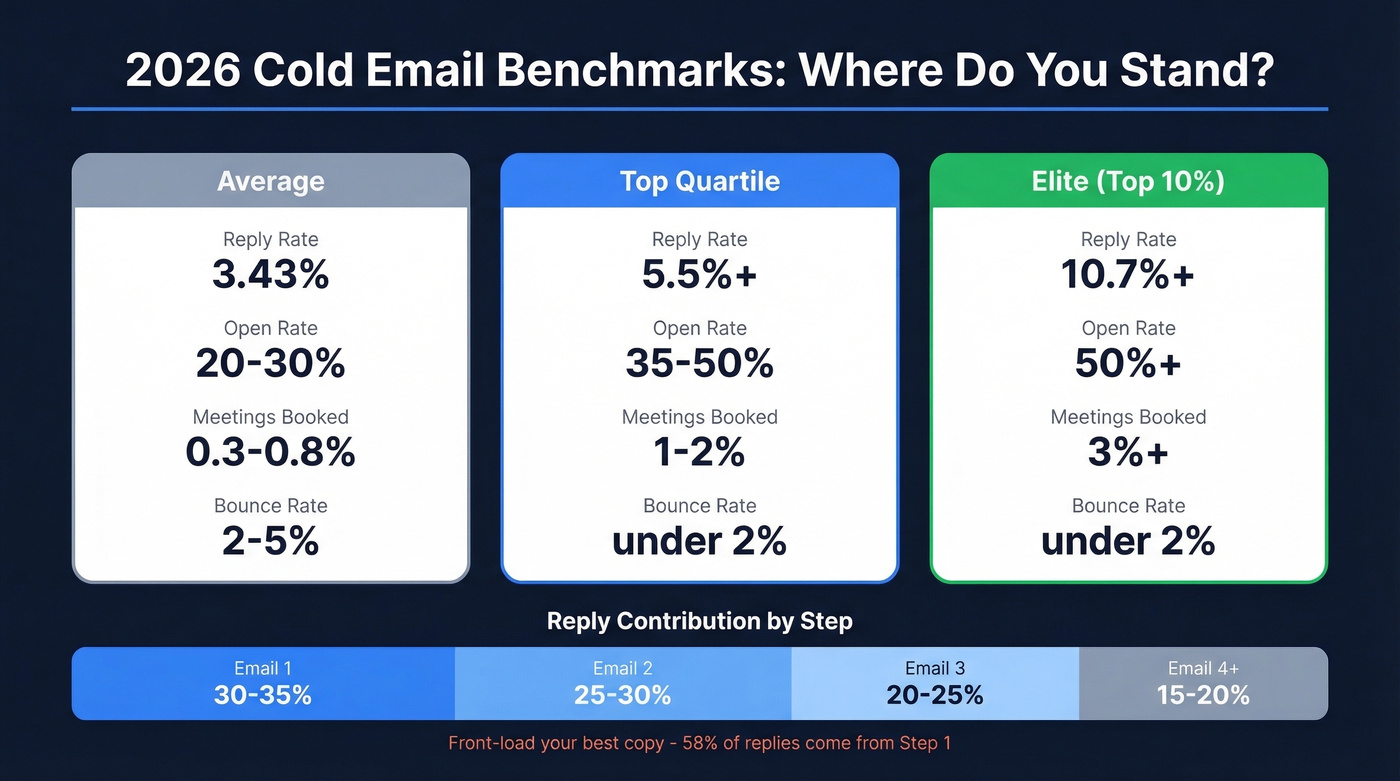
| Metric | Average | Top Quartile | Elite (Top 10%) |
|---|---|---|---|
| Reply rate | 3.43% | 5.5%+ | 10.7%+ |
| Open rate (SaaS) | 20-30% | 35-50% | 50% |
| Meeting booked | 0.3-0.8% | 1-2% | 3%+ |
| Bounce rate | 2-5% | <2% | <2% |
Reply contribution by step matters for design. Across multi-step email-only sequences, Email 1 drives 30-35% of total replies, Email 2 adds 25-30%, Email 3 adds 20-25%, and Email 4+ contributes the remaining 15-20%. Front-load your best copy.
Expected outcomes vary dramatically by sequence type:
| Sequence Type | Reply Rate | Meeting Rate |
|---|---|---|
| Cold outbound | 8-15% | 1-3% |
| Warm inbound | 20-30% | 8-12% |
| Win-back | 10-18% | 2-5% |
Open rates are increasingly unreliable post-Apple MPP. Focus on reply rate and positive reply rate as your north stars.
5 Sequence Templates That Convert
Stop copying templates verbatim from blog posts. Spam filters fingerprint commonly reused templates - the more popular a template, the worse it performs. Use these as structural frameworks, then rewrite every line in your voice.
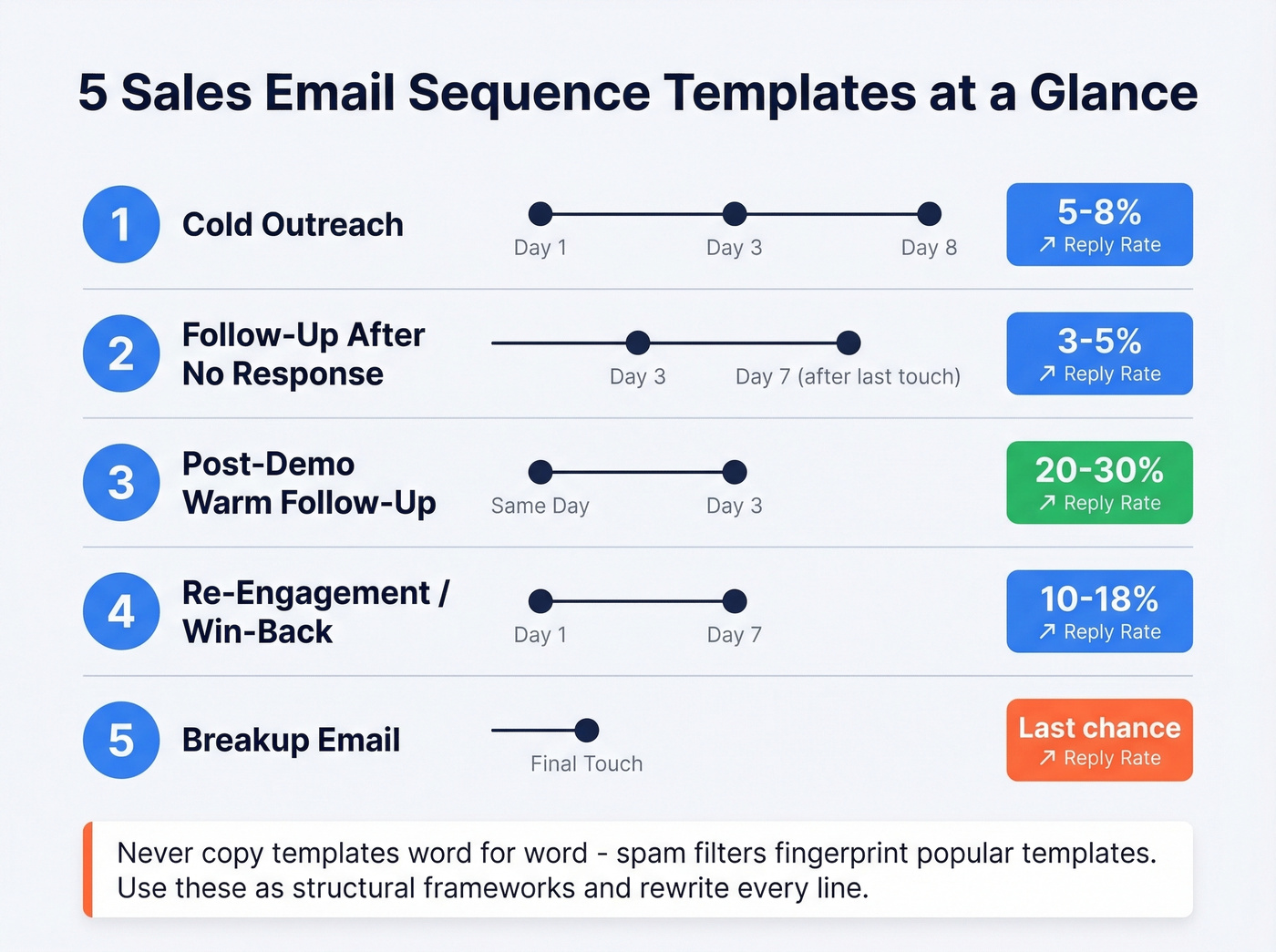
Cold Outreach (3 Emails)
Email 1 (Day 1)
Subject: {{pain point}} at {{company}}
Hi {{first name}},
{{Company}} is scaling {{department}} - which usually means {{specific pain point}} becomes a bottleneck fast.
We helped {{similar company}} cut {{metric}} by {{result}} in {{timeframe}}.
Worth a 15-min call this week to see if it applies?
Email 2 (Day 3) - Reply to original thread.
Subject: Re: {{pain point}} at {{company}}
Quick follow-up - any thoughts on the above? Happy to send a one-pager instead if a call feels premature.
Email 3 (Day 8) - New thread.
Subject: closing the loop
Hi {{first name}}, I'll assume the timing's off. If {{pain point}} comes back up, here's a 2-min case study: {{link}}.
No hard feelings either way.
One Redditor reported a 5.7% reply rate with a 3-step cadence, sending only on Tuesday-Wednesday at ~10 emails/day. Under 80 words per email. Problem-first framing. Question CTA. That's the formula.
Follow-Up After No Response
Email 1 (Day 3 after last touch) - Reply to original thread.
Subject: Re: {{original subject}}
Hi {{first name}}, bumping this up. 80% of cold email replies come after the second touch - so I'm not giving up yet. Same question: is {{pain point}} on your radar this quarter?
Email 2 (Day 7 after last touch) - New angle.
Subject: different angle
{{First name}}, instead of a call - want me to send the ROI breakdown we built for {{similar company}}? Takes 2 minutes to read.
The shift from "give me your time" to "let me give you something useful" is what makes this work. Micro-ask CTAs outperform vague ones every time. If you want more variations, pull from these sales follow-up templates and adapt the ask to your offer.
Post-Demo Warm Follow-Up
Email 1 (Same day as demo)
Subject: next steps from today
{{First name}}, great conversation. Three things stood out: {{takeaway 1}}, {{takeaway 2}}, and {{takeaway 3}}.
I've attached the deck with the pricing slide we discussed. Want to loop in {{stakeholder}} for a 20-min follow-up on {{day}}?
Email 2 (Day 3)
Subject: Re: next steps from today
Following up - does {{day}} work for the group call? Happy to adjust timing to fit {{stakeholder}}'s calendar.
Warm inbound sequences should hit 20-30% reply rates. Specificity from the actual conversation signals you're not blasting a template - that's the whole game here. For a tighter system, pair this with a sales meeting follow-up email framework.
Re-Engagement / Win-Back
Email 1 (Day 1)
Subject: things changed since we last spoke
Hi {{first name}}, we chatted {{timeframe}} ago about {{topic}}. Since then, we've shipped {{new feature/result}} that directly addresses {{their objection}}.
Worth a fresh look? I can send a 3-min video walkthrough.
Email 2 (Day 7)
Subject: the 3-min version
{{First name}}, here's the walkthrough I mentioned: {{link}}. If it resonates, I'll set up a live demo. If not, no worries.
Win-back sequences pull 10-18% reply rates when you lead with what's changed. "Checking in" emails get deleted. New information gets read.
The Breakup Email
Subject: should I close your file?
{{First name}}, I've reached out a few times and haven't heard back - totally fine. I'll close out your file on my end.
If {{pain point}} comes back up, here's a one-pager you can share with your team: {{link}}.
The "closing your file" framing creates gentle urgency without being pushy. We've tested both approaches - a resource link in the breakup outperforms a bare sign-off every time.

You just read it: teams go from 0.8% to 4.2% reply rates by fixing bounce rates - not rewriting copy. Prospeo's 98% email accuracy and 7-day data refresh mean your sequences hit real inboxes, not spam traps.
Stop rewriting templates. Start fixing the data behind them.
Cadence Architecture by Segment
Not every prospect gets the same sequence. Enterprise buyers need more touches over longer timelines, but the 50% rule applies across the board: no more than half your sequence steps should be email. Mix in calls, social touches, and video. Map your sales sequences and workflows to a persona matrix - high-touch prospects like CROs and VPs get more manual steps, while individual contributors get more automation.
If you're building this from scratch, start with an Ideal Customer Profile so your cadence matches buying context, not just job titles.
| Segment | Total Steps | Duration | Max Emails |
|---|---|---|---|
| SMB | 5-8 | ~30 days | 2-4 |
| Mid-market | 7-12 | 30-45 days | 3-6 |
| Enterprise | 10-18 | 30-60+ days | 5-9 |
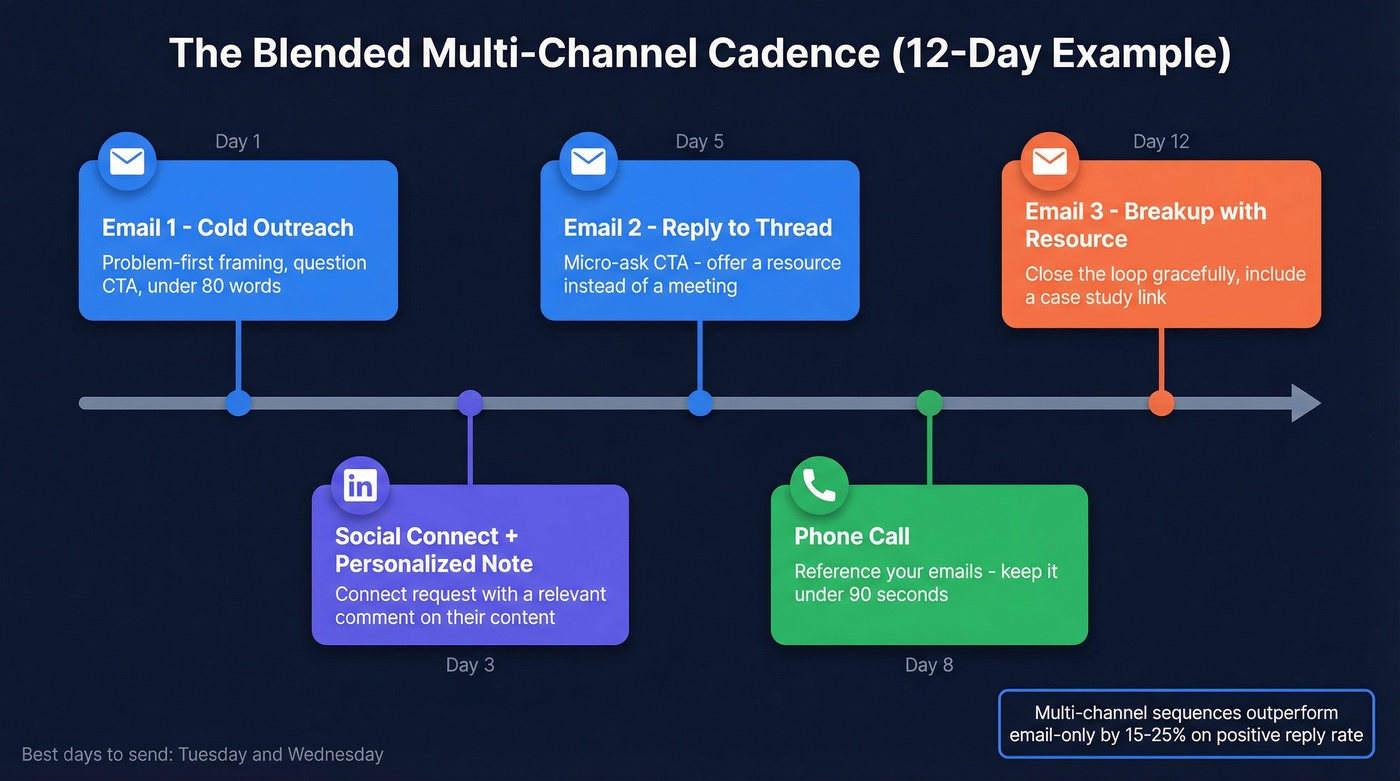
Multi-channel sequences outperform email-only by 15-25% on positive reply rate. Here's what a blended cadence looks like in practice:
- Day 1: Email 1 (cold outreach)
- Day 3: Social connect + personalized note
- Day 5: Email 2 (reply to thread)
- Day 8: Phone call
- Day 12: Email 3 (breakup with resource link)
Tuesday and Wednesday remain the peak sending days, with Wednesday edging out slightly for highest reply rates. If you want the data-backed breakdown, see the best time to send cold emails. Review full sequences quarterly and A/B test individual elements monthly.
Deliverability: The Make-or-Break Layer
Step zero before any sequence touches a prospect: verify your list. A 12% bounce rate doesn't just waste sends - it torches your domain reputation for months. Track your Bounce rate by mailbox and by campaign so you can spot list issues early.
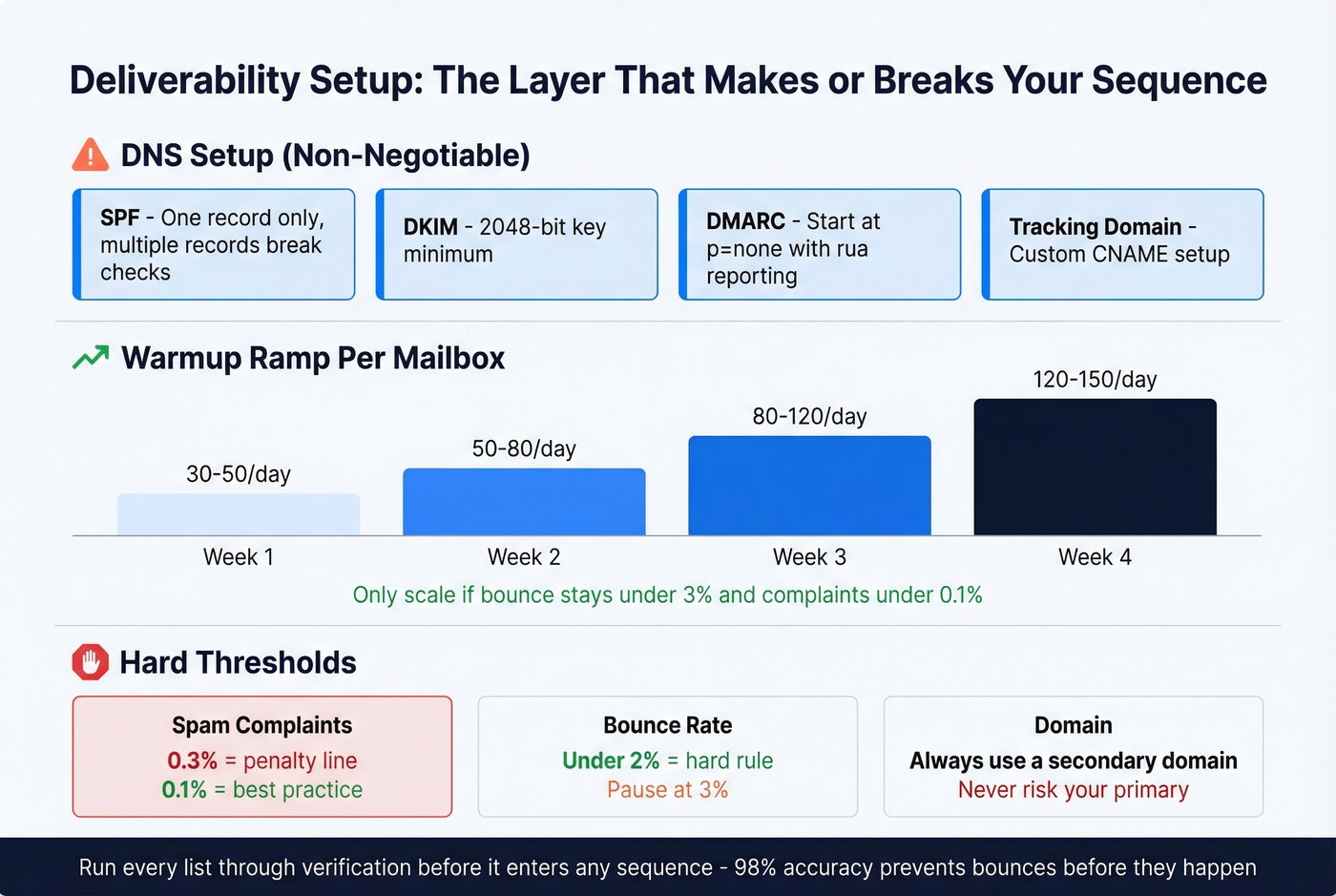
DNS setup (non-negotiable): one SPF record (multiple records often break SPF checks), 2048-bit DKIM key, DMARC starting at p=none with rua reporting, and a custom tracking domain via CNAME. (If you need a deeper walkthrough, use this email deliverability guide and a tracking domain checklist.)
Warmup ramp per mailbox: Start at 30-50/day in Week 1, scale to 50-80 in Week 2, 80-120 in Week 3, and 120-150 in Week 4 only if bounce stays under 3% and complaints under 0.1%. Keep an eye on email velocity so you don't scale faster than your reputation can handle.
Hard thresholds: ISPs enforce a 0.3% spam complaint rate as the penalty line. Best practice is to stay under 0.1% per mailbox. Keep bounces under 2% as a hard rule, and pause if you cross 3%. Use a secondary domain - never your primary. Plain text beats HTML. One link max. Include RFC 8058 one-click unsubscribe.
This is where list verification earns its keep. Run every list through Prospeo before it enters any sequence - the 5-step verification process catches invalid addresses, spam traps, and catch-all domains before they become bounces, delivering 98% email accuracy across 143M+ verified emails. Stack Optimize built from $0 to $1M ARR using this approach and maintained 94%+ deliverability, under 3% bounce, and zero domain flags across all clients. Native integrations with Instantly, Smartlead, and Lemlist mean verified contacts flow straight into your sequencer. If you're comparing vendors, start with these data enrichment services and email reputation tools.
Mistakes That Kill Your Sequence
If you're consistently below a 3% reply rate, the problem is almost certainly data quality or deliverability - not your copy. Let's be honest: we see this pattern constantly, and it's almost always the same handful of mistakes.
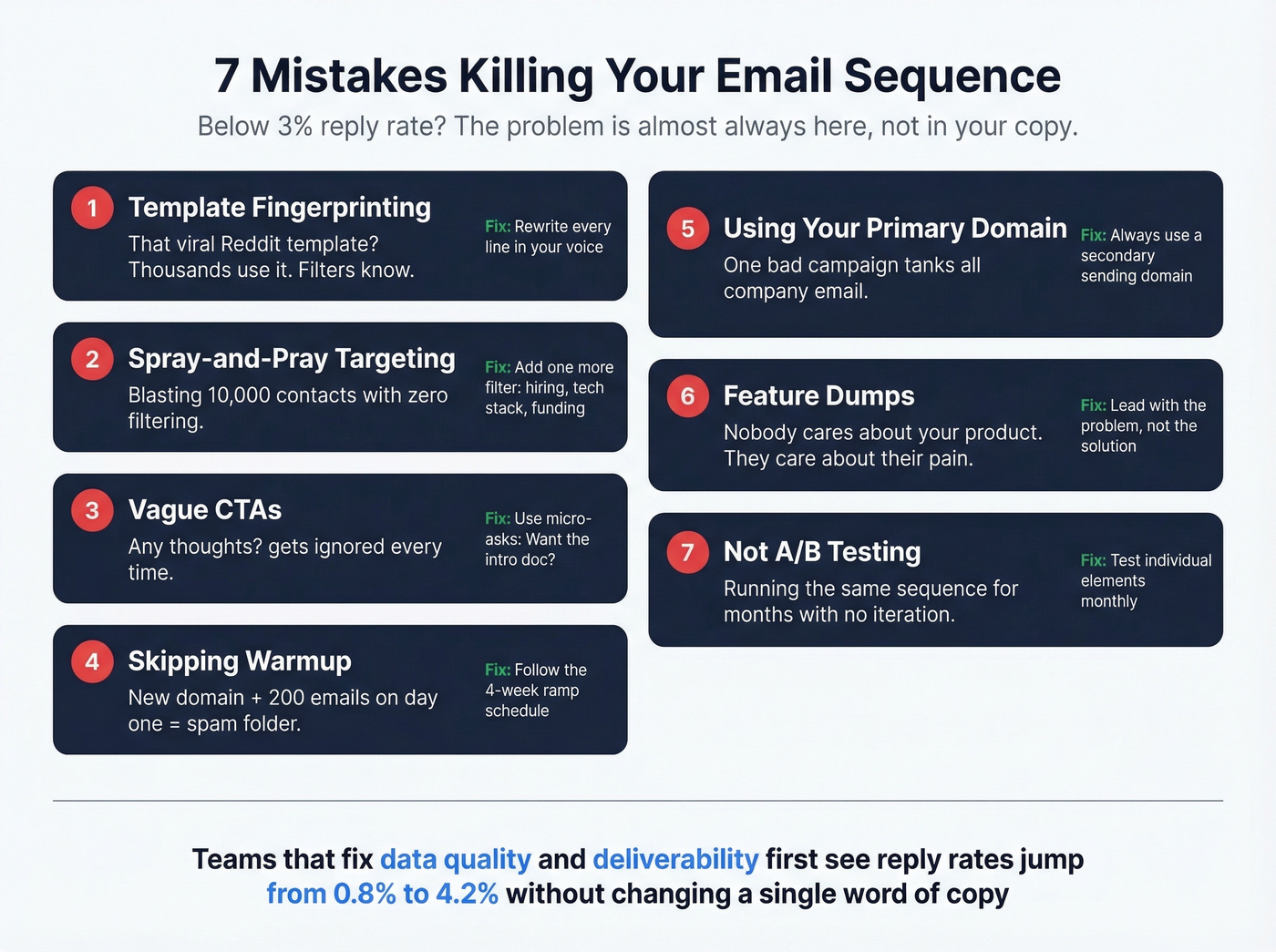
- Template fingerprinting. That viral cold email template from Reddit? Thousands of senders are using it. Spam filters recognize the pattern. Rewrite every line.
- Spray-and-pray targeting. Add one more filter: hiring activity, tech stack, funding round. Precision beats volume. (More ideas: sales prospecting techniques.)
- Vague CTAs. "Any thoughts?" loses to "Want the intro doc?" every time. Micro-asks convert. If you want a tighter framework, use these email call to action rules.
- Skipping warmup. New domain + 200 emails on day one = spam folder. Follow the ramp.
- Using your primary domain. One bad campaign can tank deliverability for your entire company's email. Skip this if you think "it won't happen to us" - it will.
- Feature dumps instead of problems. Nobody cares about your product. They care about their pain.
- Not A/B testing. The consensus from r/SaaS after analyzing 500+ cold email sequences: personalization beyond first name, problem-first framing, and question CTAs are what separate 42% open rates and 5-8% reply rates from the noise.
Every template above assumes you have the right contact for the right person. Prospeo's 300M+ profiles with 30+ filters - buyer intent, job changes, tech stack - let you build lists where Step 1 actually lands.
Build the list that makes your breakup email unnecessary.
FAQ
How many emails should a sales sequence have?
Four to seven emails is the sweet spot for cold outreach. 58% of replies come from Email 1, so front-load your best copy there. If your last step still pulls above a 3% reply rate, your sequence isn't long enough - add another step. Beyond seven, returns diminish unless each touch adds genuine new value.
What's a good reply rate for cold email in 2026?
The average is 3.43%. Top quartile hits 5.5%+. Elite senders exceed 10.7%. If you're consistently below 3%, fix your data quality and deliverability before rewriting a single subject line.
Should I use HTML or plain text for cold sequences?
Plain text. HTML with logos, banners, and multiple links signals "marketing blast" to spam filters and prospects alike. Keep emails under 80 words, include one link max, and use one clear CTA. The emails that get replies look like they were typed by a human, not designed by a marketing team.
Can I use a template without customizing it?
You can, but you shouldn't. Every sales email sequence template in this guide is a structural framework - not a copy-paste solution. Swap in your prospect's pain points, reference real results from similar companies, and rewrite the language in your own voice. Spam filters detect overused phrasing, and prospects can tell when an email wasn't written for them.