

Outside Sales Reps: What the Role Really Looks Like in 2026
Up to 70% of B2B sales reps missed their quota in 2024. That's not a typo, and it's not just an inside sales problem - field reps are getting crushed too. Most "outside sales reps" guides read like job descriptions copy-pasted from Indeed. This one covers what the role actually pays, what separates the reps earning $130K from the ones clearing $400K, and why the single highest-ROI habit has nothing to do with your pitch.
What Outside Sales Reps Need (Quick Version)
- Earnings: $130K-$265K OTE depending on segment. Enterprise AEs at the top clear $627K+.
- Activity benchmark: Top performers average 8-12 face-to-face visits per day. If you're at 3-4, you've got a route problem.
- Quota reality: Fewer than 45% of AEs hit quota. The role rewards preparation and discipline, not charisma.
- The role isn't dying - but lazy, unstructured field selling absolutely is. Hybrid models are the norm now.
- The single highest-ROI habit: verify your prospect's contact data before you leave the office. A bad number or a departed contact means a 45-minute drive for nothing.
What Is an Outside Sales Rep?
An outside sales rep - sometimes called a field sales rep or territory rep - sells face-to-face. They drive to client offices, run live product demos, show up at trade shows, and build relationships over handshakes and lunches rather than Zoom calls.
Core responsibilities include territory management, in-person prospecting, live demonstrations, contract negotiation, and relationship building with existing accounts. The job is fundamentally about trust, and trust builds faster when you're sitting across the table from someone.
Industries that rely heavily on outside sales representatives include SaaS (especially enterprise deals), pharmaceutical sales, medical devices, manufacturing, construction, and industrial supply. These are sectors where the product is complex and the deal size justifies travel costs. Buyers want to see a demo - or at least meet the person behind the proposal - before signing a six-figure contract. The common thread? High-value, relationship-driven sales cycles where a Zoom call doesn't cut it. If your average deal is $50K+ and involves multiple stakeholders, there's probably a field rep working it.
Outside Sales vs. Inside Sales
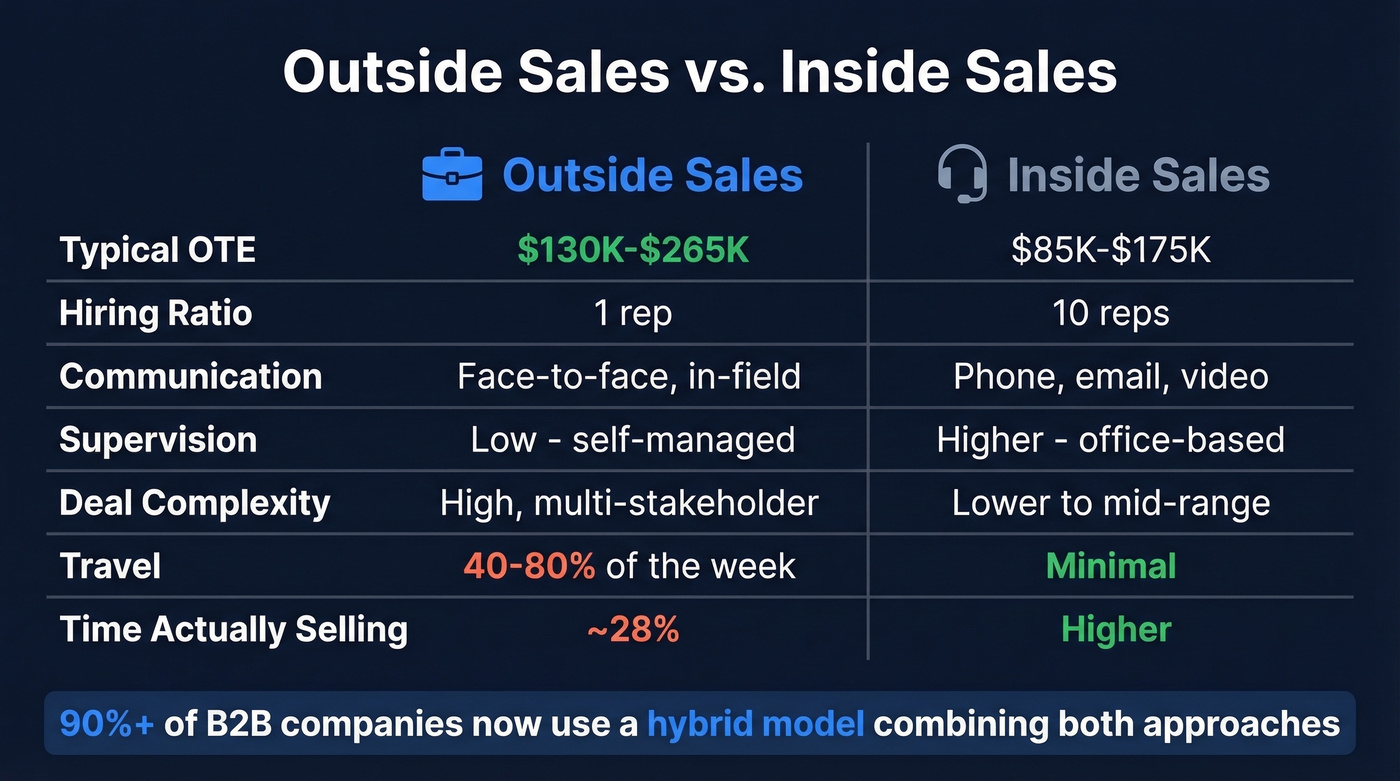
The 12-18% earnings premium for field reps over inside reps isn't free money - it comes with higher costs, more autonomy, and a fundamentally different selling motion.
| Dimension | Outside Sales | Inside Sales |
|---|---|---|
| Typical OTE | $130K-$265K | $85K-$175K |
| Hiring ratio | 1 hired for every... | ...10 inside reps |
| Communication | Face-to-face, in-field | Phone, email, video |
| Supervision | Low - self-managed | Higher - office-based |
| Deal complexity | High, multi-stakeholder | Lower to mid-range |
| Travel | 40-80% of the week | Minimal |
| Cost to employer | High (mileage, meals, etc.) | Lower |
| Selling time % | ~28% (rest is driving/admin) | Higher than outside sales |
That 1:10 hiring ratio tells you something important about the market. Companies hire far more inside reps because they're cheaper to employ and easier to manage. But when a deal requires a handshake, a live demo, or a relationship that can't be built over email, outside sales representatives are irreplaceable.
The real trend isn't "inside vs. outside" - it's hybrid. 90%+ of B2B companies have adopted a virtual or hybrid sales model. Most modern field reps do discovery calls on Zoom, then travel for key meetings, demos, and closes. Pure road warriors who refuse to touch a screen are a dying breed.
A Day in the Life of Field Reps
Here's what most people don't understand about outside sales: reps spend only 28% of their time actually selling. The rest disappears into driving, CRM updates, email, route planning, and the general friction of being a mobile worker.
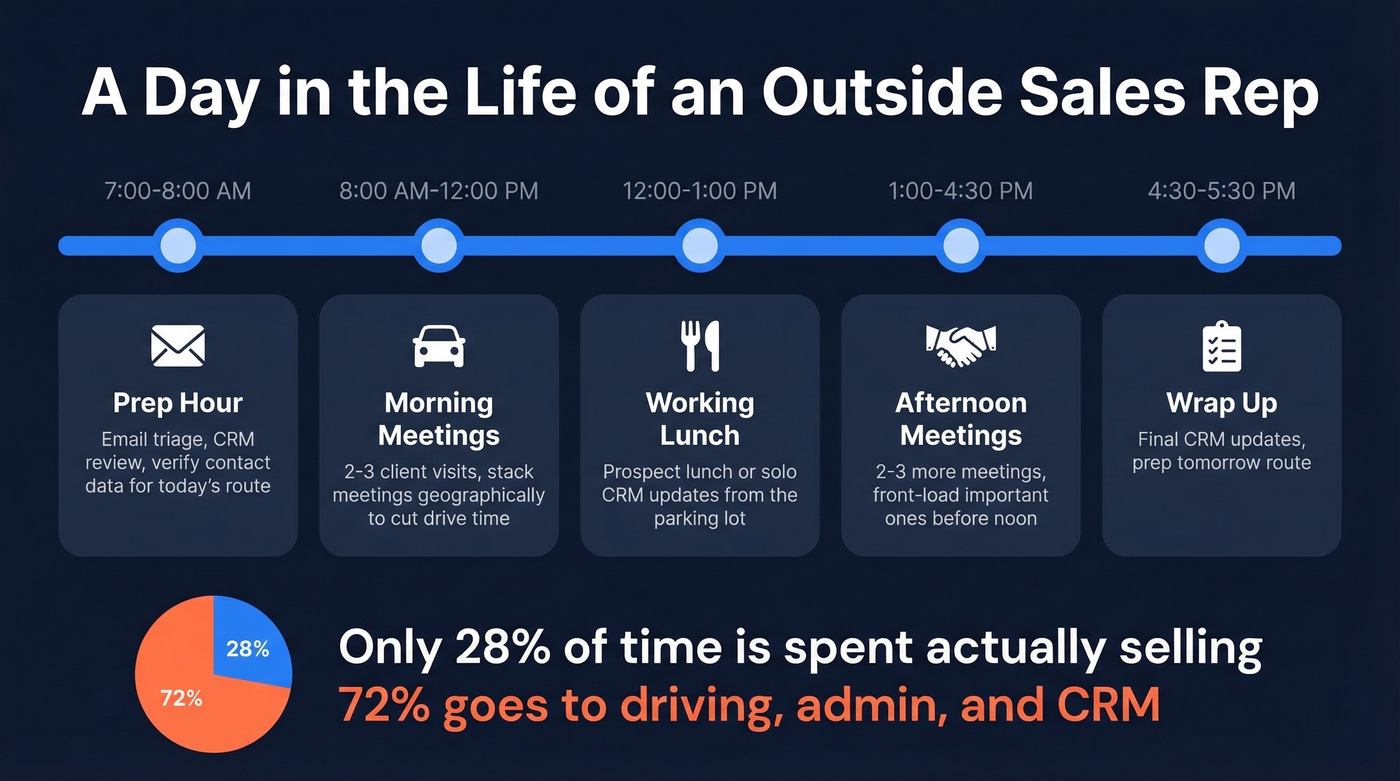
In most territories, a typical day lands around 3-5 customer meetings, with top performers pushing 8+ when density is high and routing is tight. A realistic day for a mid-market rep looks something like this:
7:00-8:00 AM - Coffee, email triage, CRM review. Check which prospects confirmed meetings, which ones went dark. Verify contact data for new prospects on today's route. This is the hour that separates prepared reps from the ones who show up and wing it.
8:00 AM-12:00 PM - Drive to first meeting, then two to three client visits. Mix of existing account check-ins and new prospect demos. The best reps stack meetings geographically to minimize windshield time. One field etiquette tip: keep your right hand free for the handshake. Small thing, but first impressions compound.
12:00-1:00 PM - Lunch meeting with a prospect, or solo lunch while updating CRM notes and sending follow-ups from the parking lot.
1:00-4:30 PM - Two to three more meetings. Afternoon meetings tend to run shorter - people are tired, attention spans shrink. Smart reps front-load their most important meetings before noon.
4:30-5:30 PM - Drive back, final CRM updates, prep for tomorrow's route.
Without route optimization, driving can consume 30-40% of your day. We've seen reps who think they're "busy" because they're in the car for five hours - but they only had three meetings. That's not busy. That's inefficient.
What Outside Sales Reps Earn
Let's talk money. Most guides throw out a single number. The reality is more nuanced - and more lucrative than most people realize.
Salary Database Comparison
| Source | Reported Figure | What It Measures |
|---|---|---|
| PayScale | $60,728 | Base salary only |
| Glassdoor | $137,000 | Total pay (base + commission) |
| US BLS | $74,100 | Median annual wage |
| Indeed | $88,962 | Average reported salary |
The gap between PayScale's $60K and Glassdoor's $137K isn't a contradiction - it's the difference between base salary and total compensation. Outside sales is a commission-heavy role. Base pay tells you what you earn when you're struggling. Total comp tells you what you earn when you're performing. TTEC pegs the entry-level range at $44,535-$62,098, which aligns with what junior reps in lower-cost markets see before commissions kick in.
OTE by Role Level
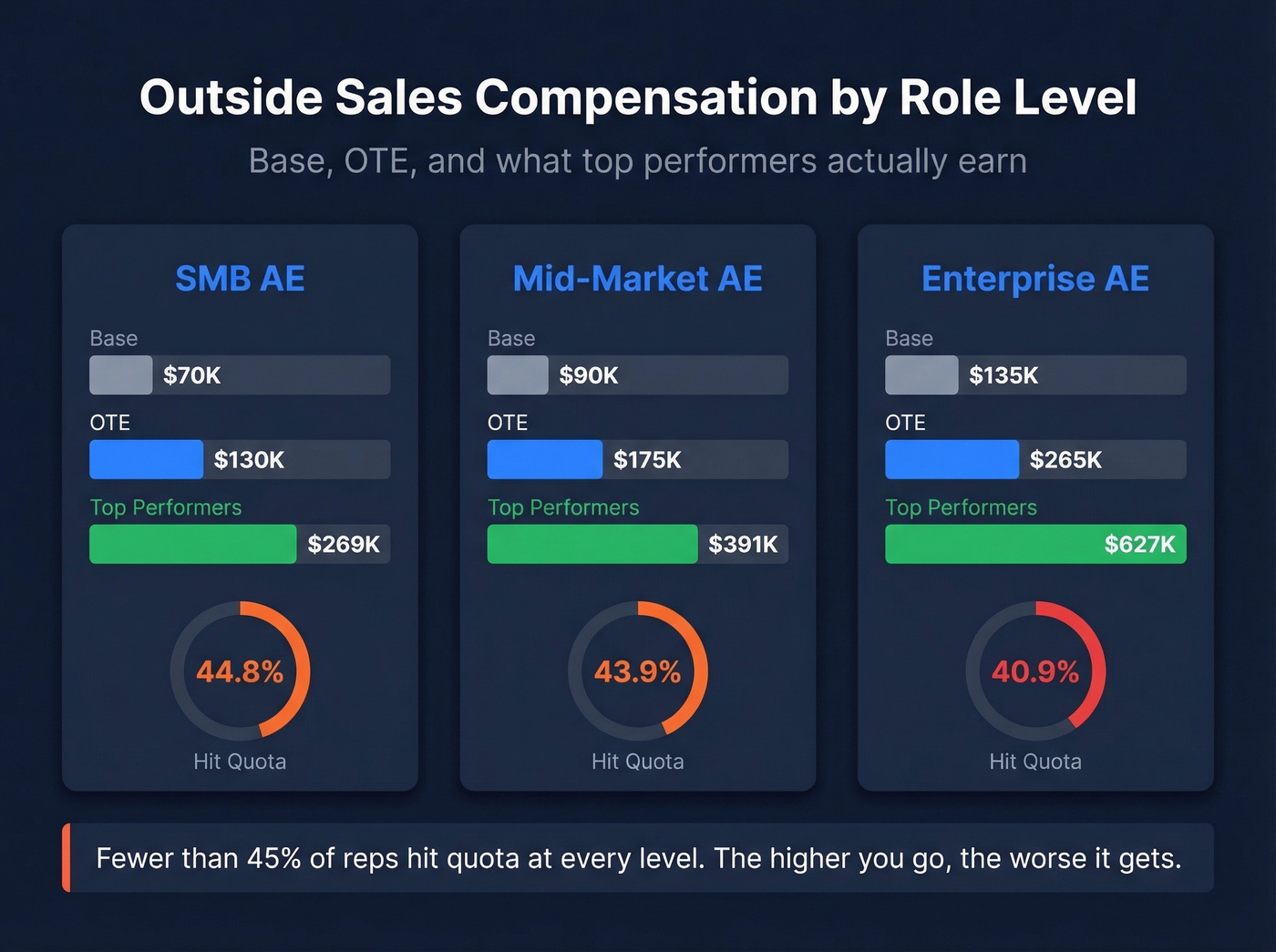
RepVue's salary benchmarks break down compensation by segment, and the quota attainment numbers are the uncomfortable truth nobody puts on the job posting:
| Role | Base | OTE | Top Performers | Quota Attainment |
|---|---|---|---|---|
| SMB AE | $70K | $130K | $269,489 | 44.8% |
| Mid-Market AE | $90K | $175K | $391,399 | 43.9% |
| Enterprise AE | $135K | $265K | $627,527 | 40.9% |
Read that last column again. Fewer than 45% of reps hit quota at every level. And the higher you go, the worse it gets - only 40.9% of Enterprise AEs make their number. This isn't a talent problem. It's a systemic one. Quotas are set aggressively, territories are uneven, and too many reps are winging it instead of preparing.
How Commission Plans Work
Nearly 50% of businesses use a base-plus-commission structure, and another 25% use base-plus-bonus. The standard SaaS commission rate runs about 10% of deal value.
Base + commission is the default. You get a livable base, usually 40-60% of OTE, and earn commission on every deal. Draw against commission gives you a guaranteed minimum that's later deducted from commissions - essentially a loan against future performance. Straight commission means no base at all. High risk, high reward, increasingly rare outside of real estate and insurance. Gross margin commission pays you a percentage of the profit on each deal, not the revenue.
Where it gets lucrative is accelerators. Hit 100% of quota and you earn 10% commission. Hit 120% and the rate jumps to 15%. Hit 150% and it could be 20%+. Annual commission examples vary by industry: retail reps average about $10,000, advertising sales reps around $15,000, and manufacturing reps closer to $30,000.
What Drives Pay Up or Down
| Factor | Range |
|---|---|
| Education: HS diploma | ~$51,798 base |
| Education: Bachelor's | ~$67,057 base |
| Education: Master's | ~$74,239 base |
| Experience: Junior | ~$48,344 base |
| Experience: Mid-level | ~$62,285 base |
| Experience: Senior | ~$99,493 base |
| Top-paying states | NJ ($69,256), MN ($68,770), ND ($67,722), MA ($67,477), CT ($66,453) |
Experience matters more than education. The jump from junior ($48K) to senior ($99K) is a 105% increase. The jump from a high school diploma to a master's degree? Only 43%. If you're debating between an MBA and two more years of quota-carrying experience, the experience wins every time.

Field reps spend 28% of their time selling. Don't waste a single meeting on a departed contact or wrong number. Prospeo gives you 98% accurate emails and 125M+ verified mobile numbers - so every stop on your route connects to a real decision-maker.
Verify your entire route list before you start the car.
KPIs - What Good Looks Like
Most outside sales teams track the wrong metrics. They look at revenue and pipeline, which are lagging indicators. By the time those numbers look bad, you've already lost the quarter.
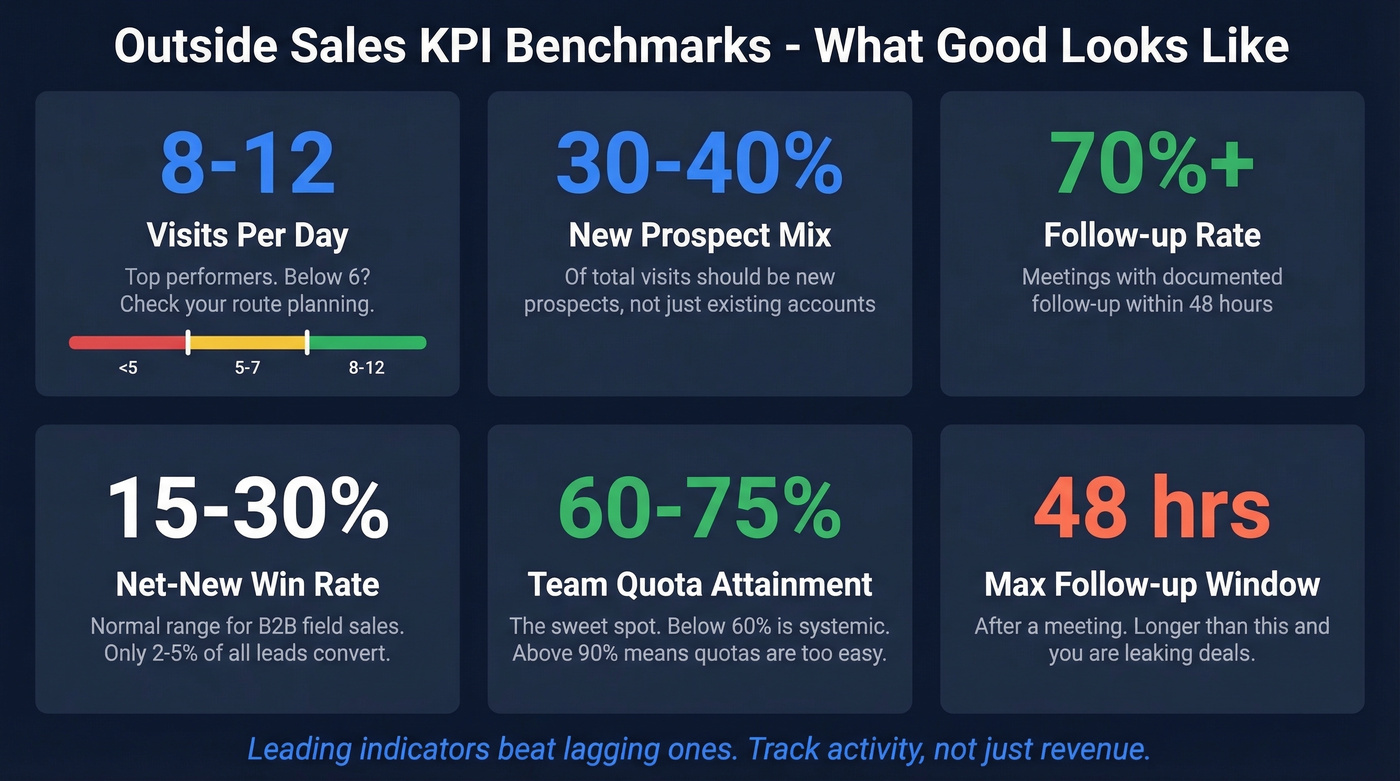
Visits per day: 8-12 for top performers. If your team averages 3-4, the problem isn't effort - it's route planning and territory design. Top-performing field reps consistently hit 8-12 visits per day. Below 6, and you need to ask whether the territory is too spread out or the rep is spending too much time per meeting.
New prospect mix: 30-40% of visits. When 100% of a rep's visits are existing accounts, they're farming, not hunting. A healthy mix is 30-40% new prospects, 60-70% existing accounts. Skew too far toward new and you're neglecting renewals. Skew too far toward existing and your pipeline dries up next quarter.
Follow-up rate: 70%+ or you're leaking deals. If fewer than 70% of meetings result in a documented follow-up action within 48 hours, opportunities are falling through the cracks. This is the easiest KPI to fix and the one most teams ignore. If you need a system, keep a set of follow-ups ready to send from the parking lot.
Win rate: 15-30% is normal for net-new B2B field sales. Forbes reports a ~40% close rate for outside reps across all deal types - but that includes warm leads, renewals, and upsells. For net-new B2B deals, 15-30% is the realistic range. Only 2-5% of B2B leads convert into paying customers overall, so don't panic if your top-of-funnel conversion looks brutal.
Quota attainment: if fewer than 60% of reps hit quota, it's systemic. If more than 90% hit it, your quotas are too easy. The sweet spot is 60-75% attainment across the team. Below that, look at territory balance, lead quality, and whether reps have the tools and data they need.
Here's the thing: most teams we've worked with don't even track visits-per-day. They track calls, emails, and pipeline - but the core activity metric for a field rep is how many doors they walk through. If you're not measuring it, you can't improve it.
How to Succeed in Outside Sales
The gap between a $130K rep and a $400K rep isn't talent. It's preparation. Here are the five habits that separate them.
1. Verify your data before you leave the office. Every wasted drive to a bad contact costs you 1-2 hours and at least one missed meeting. Spend 15 minutes verifying tomorrow's contacts tonight. A tool like Prospeo refreshes records every 7 days instead of the industry-standard 6 weeks, so you're working with current emails and direct dials - not stale records from last quarter. If you want to go deeper on the workflow, use a simple lead enrichment pass before you lock your route.
2. Hit 8+ visits per day through route discipline. Cluster your meetings geographically. Use a route planner. Fill gaps with drop-ins on nearby prospects. The difference between 4 visits and 8 visits isn't working twice as hard - it's driving smarter. If you're managing a bigger patch, sales mapping tools can help you spot density and dead zones fast.
3. Keep your prospecting mix at 30-40% new prospects. It's tempting to spend all your time on warm accounts. They're easier, friendlier, and more likely to close. But if you're not feeding the top of your funnel, you'll have a great Q2 and a terrible Q4. Borrow a few modern sales prospecting techniques so your "new" visits aren't random.
4. Update your CRM the same day. Not tomorrow. Not Friday. Today. Notes from a meeting you had 72 hours ago are worthless. The details that matter - the objection they raised, the competitor they mentioned, the timeline they gave - fade fast. Update in the parking lot before you drive to the next meeting. If your team is still debating tools, here are a few examples of a CRM with real pricing.
5. Personalize your outreach between meetings. Only about 34% of sales emails get opened, but personalized subject lines are 26% more likely to be opened. Use drive time (hands-free) to dictate personalized follow-ups. Reference something specific from the meeting. Mention a mutual connection. The reps who treat email as an afterthought lose deals to competitors who followed up faster. Keep a swipe file of email subject lines so you’re not improvising at 5:45 PM.
And here's the hot take that'll get pushback: if your average contract value is under $15K, you probably don't need an outside sales motion at all. The travel costs, the windshield time, the expense reports - they eat your margins alive on smaller deals. Field selling earns its keep on $50K+ deals where trust and complexity justify the investment. Below that threshold, a sharp inside rep with great data will outperform a territory rep every time.
Essential Tools for Field Reps
Your tech stack should solve five problems: finding the right contacts, managing your pipeline, optimizing your route, closing deals in the field, and tracking expenses.
Prospecting & Contact Data
Prospeo gives you 143M+ verified emails with 98% accuracy and 125M+ verified mobile numbers. The Chrome extension lets you pull verified contact data from any website in one click, and 40,000+ users already rely on it daily. The free tier gives you 75 emails + 100 Chrome extension credits per month, and paid plans run about $0.01 per email with no contracts. For field reps, the value is straightforward: verify every contact on tomorrow's route before you leave tonight. Bad data means wasted drives. Native integrations with Salesforce, HubSpot, Smartlead, Instantly, Lemlist, Clay, Zapier, and Make push verified contacts straight into your CRM. If you're comparing vendors, start with a shortlist of data enrichment services.
CRM - Salesforce / HubSpot
Salesforce runs about $25-$300+/user/month depending on edition and add-ons. HubSpot starts free and scales to ~$20-$150+/seat/month on paid Sales Hub tiers. What matters for field reps is mobile access - you need to update records from a parking lot, not a desk. Both have solid mobile apps, but HubSpot's is more intuitive out of the box. Salesforce is more powerful once configured. If you’re doing a deeper evaluation, see Salesforce pricing tradeoffs and hidden costs.
Route Planning - Badger Maps
Badger Maps runs $49-$99/user/month and solves the 30-40% driving time problem by optimizing your visit sequences on a map. You plot your accounts, it builds the most efficient route. For reps covering suburban or rural territories, this tool alone can add 2-3 extra visits per day.
E-Signature & Expense Tracking
DocuSign runs ~$10-$30+/user/month and lets you close deals in the field - get a signature on an iPad at the client's conference table instead of emailing a PDF and waiting three days. Expensify runs ~$5-$15/user/month and handles mileage tracking and meal receipts automatically. Neither is glamorous. Both save hours per week.
Call Intelligence - Gong
Skip this if your org doesn't already have it. Gong runs $100+/user/month on annual contracts with enterprise pricing that varies, and it's hard to justify for a single rep. But if your team already uses Gong, make sure it's capturing your field conversations on mobile, not just your Zoom calls. The coaching insights are valuable for self-improvement, and the call analytics help you spot patterns in what's working across your territory.
Outside Sales Career Path
The standard progression: SDR -> Account Executive -> Senior/Enterprise AE -> Sales Manager -> VP of Sales -> CRO. Each step can significantly increase your earning potential.
An SDR role is where most people start. OTE averages about $85K, and the promotion to AE typically comes after 12-18 months of hitting pipeline goals. The AE role is where outside sales really begins - you're carrying a quota, managing a territory, and traveling to close deals. SMB AEs earn around $130K OTE; mid-market AEs hit $175K.
The jump to Enterprise AE usually takes 2-3 years in an AE seat and is the single biggest compensation leap in the ladder. Enterprise OTE runs $265K, with top performers reporting $627,527. This is where the money is.
From there, the path splits. Some reps stay as individual contributors - a senior Enterprise AE earning $400K+ has no financial incentive to manage people. Others move into Sales Manager, then Director, then VP of Sales. Enterprise VPs in major metros command $500K-$650K total comp and are typically expected onsite at least three days per week.
The hiring pattern is clear: remote is standard for SDRs, hybrid dominates for AEs, and onsite is rebounding for leadership. If you're starting out, SaaS, medical devices, and manufacturing offer the highest OTEs and the clearest promotion ladders. If you want the comp math spelled out, use an OTE framework so you’re comparing offers correctly.
The Future of Outside Sales
57% of buyers prefer engaging via digital channels. That stat scares a lot of field reps. It shouldn't.
Buyer preference for digital doesn't mean buyers don't want to meet you. It means they don't want to meet you for things that could've been an email. Discovery calls, pricing discussions, basic demos - those happen on Zoom now. But when it's time to build trust with a C-suite buyer on a $200K deal, nothing replaces sitting across the table.
The reps who'll dominate in 2026 and beyond combine face-to-face trust-building with data-driven prospecting. They use intent data to know which accounts are in-market before they drive there. They verify contact data so every visit counts. They follow up with personalized digital touches between meetings. (If you’re building the system, data-driven selling is the baseline now.)
AI is reshaping the support structure around outside sales - better lead scoring, automated CRM updates, smarter route optimization, AI-generated meeting prep. But AI can't shake a hand, read a room, or build the kind of relationship that turns a prospect into a 10-year customer.
Outside sales isn't dying. Lazy outside sales is. The reps who show up unprepared, wing their demos, and treat their territory like a random road trip are getting replaced by inside reps who cost half as much. The reps who prepare obsessively, optimize their routes, and use every tool available to maximize face time are earning more than ever. By 2026, 65% of B2B sales organizations will outpace competitors by using data-driven strategies over gut instinct. The field reps who embrace that shift will thrive.
The difference between 3 meetings and 8 meetings isn't just routing - it's knowing who's still at the company and having their direct dial. Prospeo refreshes data every 7 days (not 6 weeks) so your territory list never goes stale. At $0.01 per email, bad data stops eating your windshield time.
Top field reps don't wing it. They verify first.
FAQ
How much do outside sales reps make?
Base salary ranges from $48K at entry level to $99K+ for senior reps. Total compensation including commissions runs $130K-$265K OTE depending on segment, with top Enterprise AEs reporting $627K+. Commissions can double or triple your base, which is why total comp varies so widely across sources.
What's the difference between outside and inside sales?
Outside reps sell face-to-face in the field; inside reps sell remotely via phone, email, and video. Field reps earn 12-18% more on average but cost significantly more to employ due to travel, meals, and mileage. Companies typically hire ten inside reps for every one outside rep.
How many meetings should a field rep have per day?
Top performers average 8-12 visits per day depending on territory density. Below 6 consistently means route optimization and territory planning need immediate attention. The difference between 4 and 8 visits is usually logistics - clustering meetings geographically - not effort.
Is outside sales a good career in 2026?
Yes - if you're self-motivated and data-driven. The career path leads to $265K+ OTE at the enterprise level and $500K+ in leadership roles. But fewer than 45% of AEs hit quota, so it rewards disciplined preparation over personality alone.
What tools do outside sales reps need most?
A mobile CRM like Salesforce or HubSpot, a route planner like Badger Maps, and a contact verification platform to prevent wasted drives to stale leads. The consensus on r/sales is that bad data is the single biggest time-killer for field reps - one wrong number can blow an entire afternoon.