

Partnership Selling: How to Build Partnerships That Actually Drive Revenue
A SaaS founder shared in an online community how he sent 47 partnership outreach messages last year. Three people replied politely. Zero turned into anything. He then took 12 coffee meetings with other founders - lots of enthusiasm, lots of "we should totally do something together," and exactly zero partnerships. His mistake wasn't effort. It was approach.
Partnership selling requires more than good intentions. It demands a system.
The Short Version
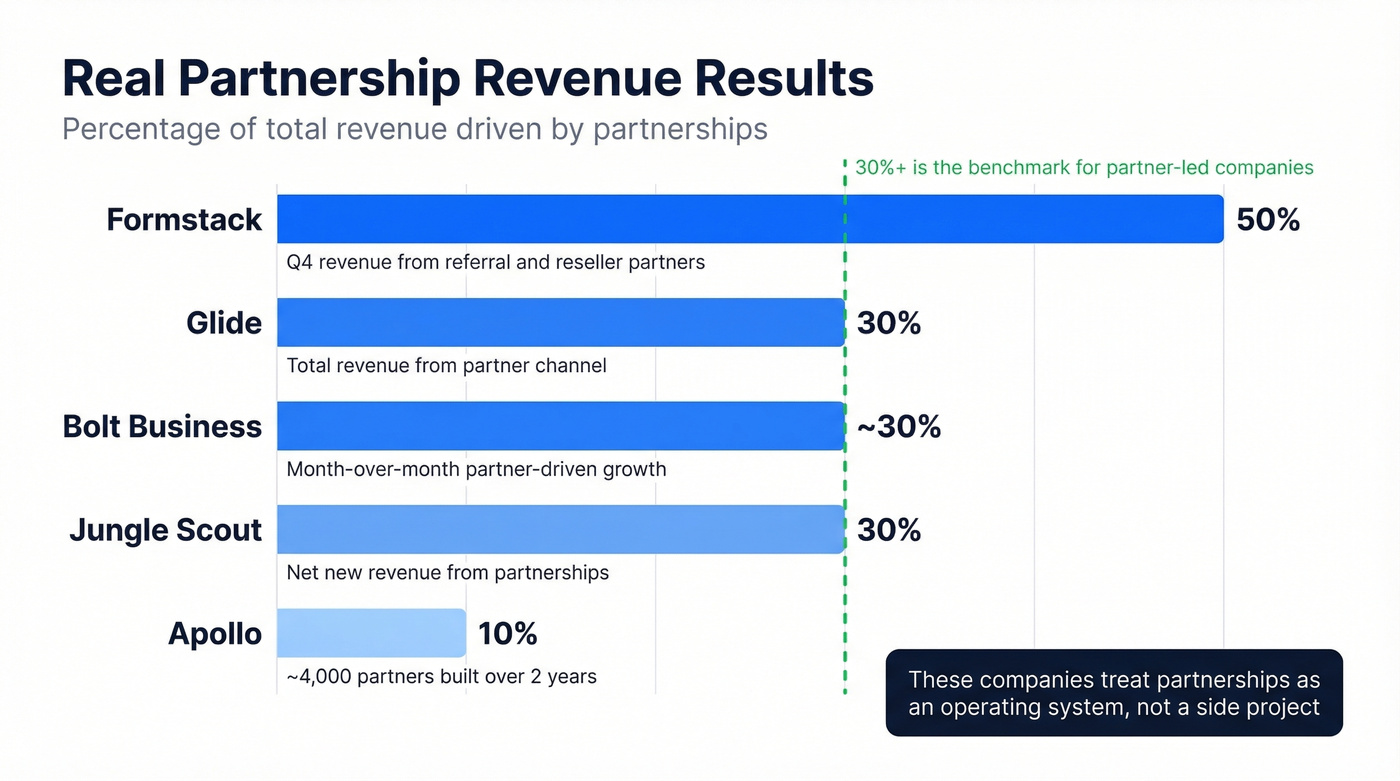
This collaborative sales motion works when you replace vague "cross-promo" handshakes with problem-first partner identification, explicit value exchange, and monthly accountability reviews with exit criteria. The companies driving 30%+ of revenue from partners all share one trait: they treat partnerships as an operating system, not a side project.
What Is Partnership Selling?
Partnership selling is a collaborative sales motion where two or more companies jointly engage a shared customer, combining their strengths to deliver more value than either could alone. It's not channel sales, affiliate marketing, or simple cross-selling - though people confuse these constantly.
In channel sales, a third-party reseller owns the customer relationship and sells your product independently. In a co-selling partnership, both companies stay involved: co-creating value, sharing pipeline data, and coordinating on deals together. Think of it as the difference between a peddler pushing a product and a partner solving a problem alongside you.
Co-selling partnerships also differ from cross-selling and reselling. Trust is the core driver - and trust requires real collaboration, not a logo swap on a landing page.
| Direct Sales | Channel Sales | Partnership Selling | |
|---|---|---|---|
| Control | Full | Low | Shared |
| Scalability | Limited | High | Moderate-High |
| Cost | High (own reps) | Commission-based | Shared investment |
| Relationship | Vendor-customer | Vendor-reseller | Peer-to-peer |
| Best for | Complex, high-ACV | Volume, reach | Trust-driven, mid-market+ |
ICONIQ Capital's "State of GTM" research found that many B2B SaaS companies already derive 20%+ of revenue from channel sales. A collaborative partner approach pushes that number higher by adding depth to every deal.
Why Co-Selling Partnerships Work
The data isn't subtle. Partner-involved deals show 40% higher average order value, 53% higher close rates, and 46% faster conversion. Top-performing companies derive 58% of their revenue from partners, and 72% report lower customer acquisition costs from partner channels.
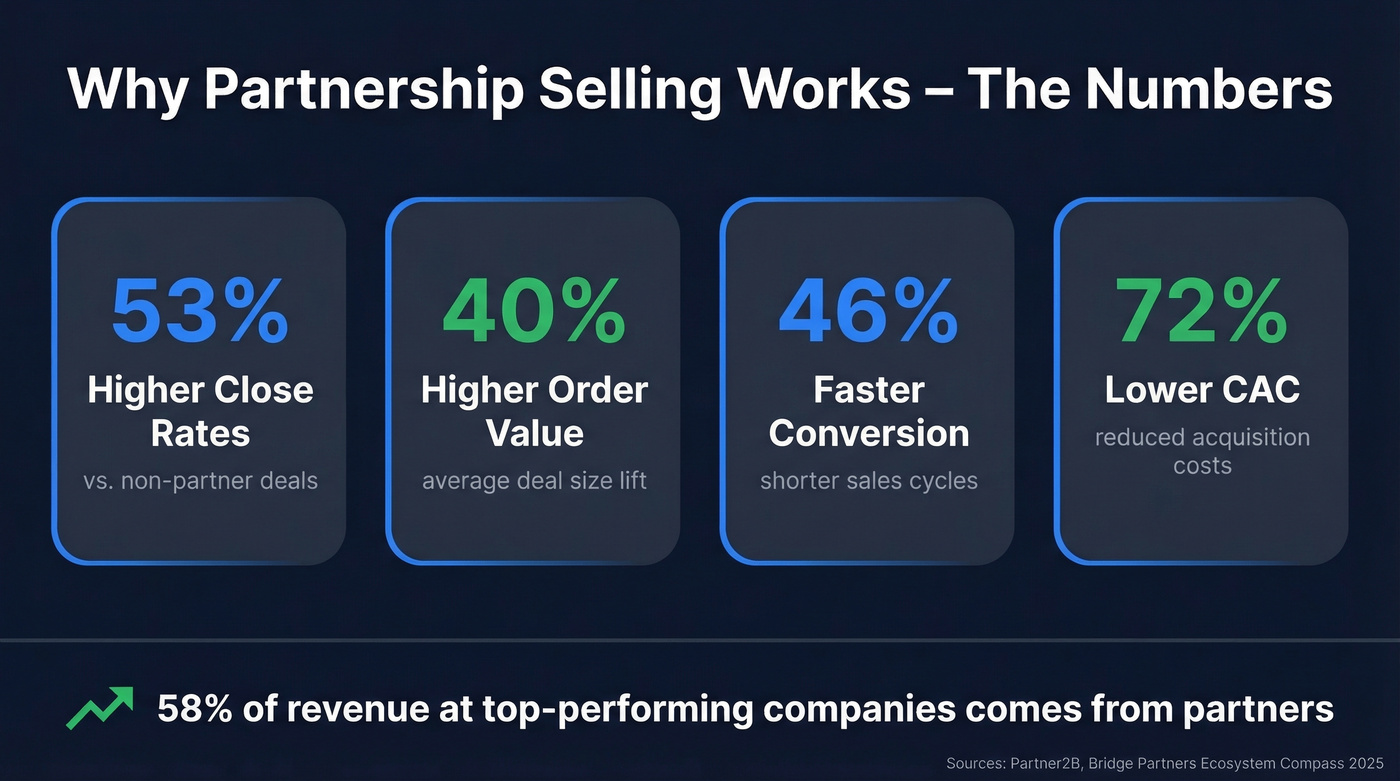
Bridge Partners' Ecosystem Compass 2025, based on data from 5,000+ partner programs, found that 68% of respondents report higher close rates when partners are involved. Even more striking: 64% say more than half of their new customers come through partner-influenced or co-sold deals.
The trend is accelerating. Forrester's 2026 Partner Ecosystem Marketing Survey found that 67% of B2B partner ecosystem decision-makers expect indirect revenue to grow more than 30% year-over-year, with the highest growth expected from technology partners, distribution partners, and digital routes to market.
Higher close rates, higher deal values, lower acquisition costs. That's the trifecta every revenue leader is chasing.
Why Most Efforts Fail
Roughly 95% of strategic partnerships die after the initial handshake - a number that tracks with what practitioners report in communities like r/EntrepreneurRideAlong and r/sales. The founder's story from the intro isn't unusual. It's the norm. Three failure patterns show up over and over.
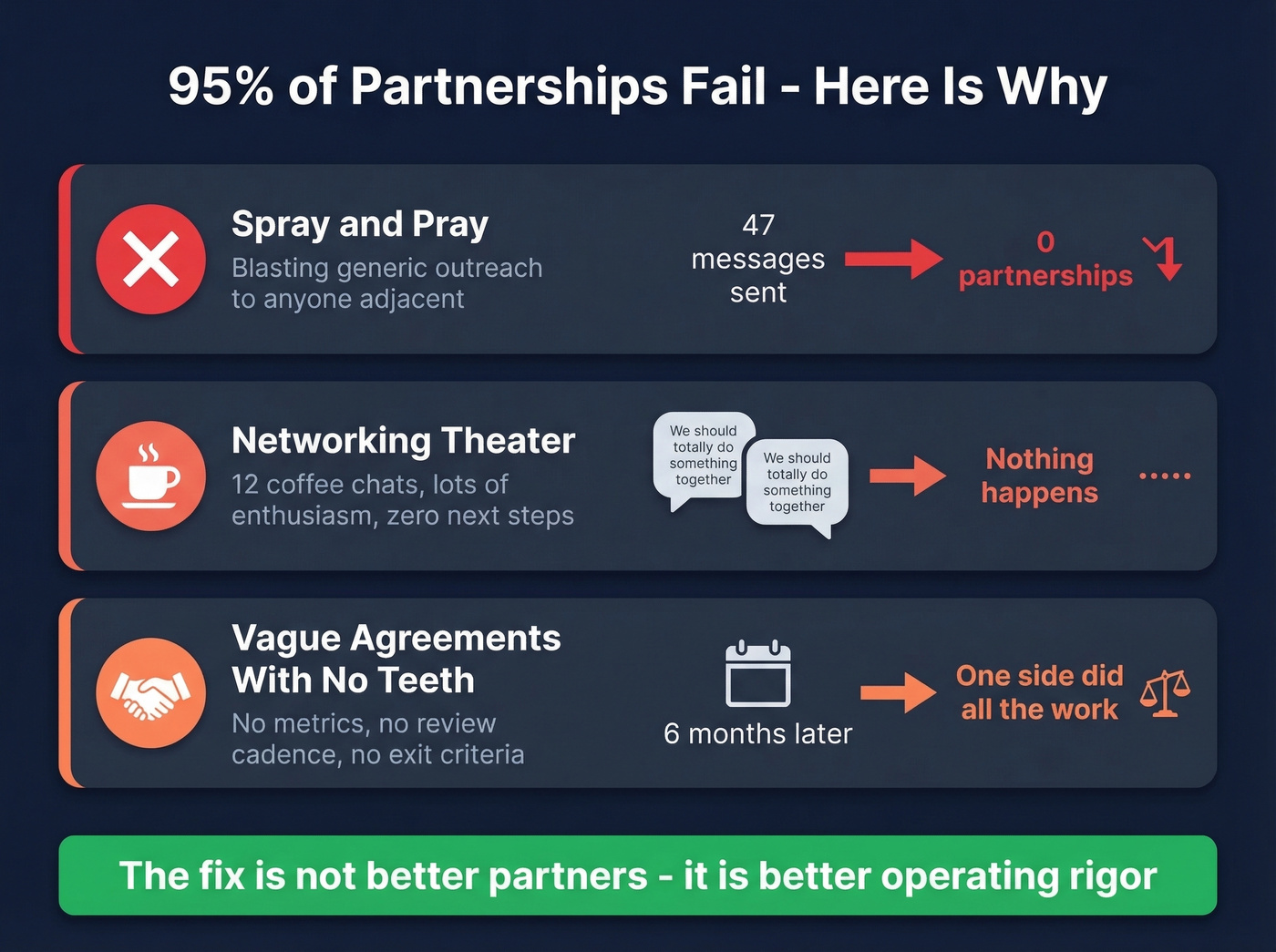
Spray and pray. You blast partnership outreach to anyone who seems adjacent. Forty-seven messages, three polite replies, zero follow-through. The problem isn't volume - it's that you haven't identified why a specific partner would care. Generic "let's explore synergies" emails get ignored because they deserve to be ignored. (If you need a starting point, borrow proven sales follow-up templates to keep momentum.)
Networking theater. You take the meetings. Twelve coffee chats, all enthusiastic, all saying the right things. Then nothing happens. No next steps, no accountability, no defined outcomes. Enthusiasm without structure is just socializing.
Vague agreements with no teeth. You shake hands on a "partnership" that has no metrics, no review cadence, and no exit criteria. Six months later, one side has done all the work and the other has contributed nothing but their logo. The killers are misaligned incentives, one-sided "exposure" deals where one partner gets leads and the other gets a blog mention, and outright neglect.
Here's the thing: most failures aren't caused by picking the wrong partner. They're caused by treating partnerships like a side project instead of a revenue channel with real operational rigor.
A Framework That Works
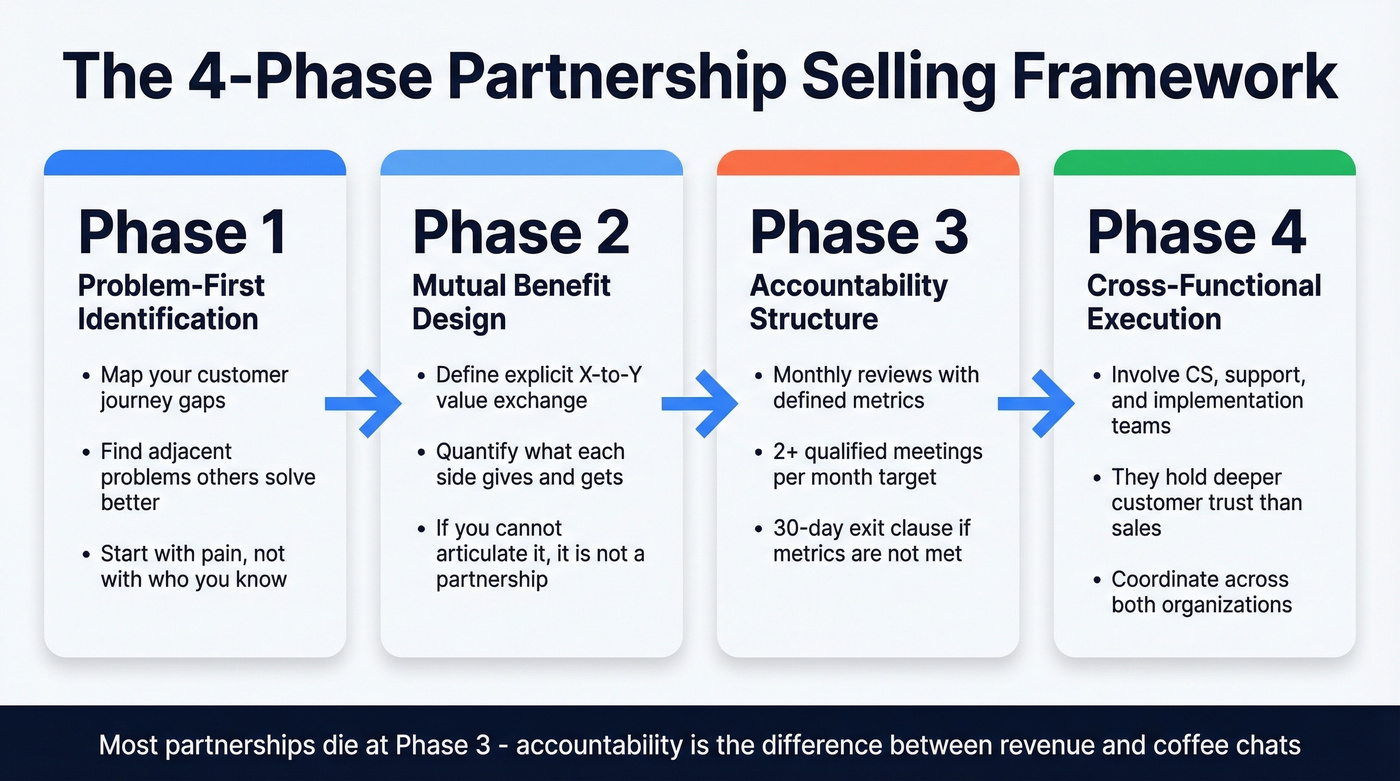
The founder who went 0-for-47 on outreach eventually cracked the code. After switching to a structured approach, 23% of his signups came through partner referrals. Here's the four-phase framework that separates revenue-generating partnerships from coffee-chat graveyards.
Phase 1: Problem-First Identification
Don't start with "who do we know?" Start with "where do our customers get stuck?" Map your customer journey and identify the gaps - capability gaps your product doesn't fill, distribution channels you can't access, and complementary problems your customers face that someone else solves better. (This is easiest when you define your ideal customer profile first.)
A CRM company doesn't need another CRM partner. It needs a data enrichment partner, an implementation partner, a training partner. The best partnerships solve adjacent problems for the same buyer.
Phase 2: Mutual Benefit Design
Every partnership needs an explicit X-to-Y value exchange. Not "cross-promo." Not "we'll share each other's content." Specific, measurable value flowing in both directions.
Will Taylor, formerly Head of Partnerships at Reveal, put it well: focus on a specific ecosystem and go deep rather than spreading thin across dozens of surface-level relationships. Examples that work: "You send us 5 qualified intros per month, we pay 20% commission on closed deals" or "We co-host a quarterly webinar targeting your customer base, you get first access to our new integration." The moment you can't articulate what each side gets in concrete terms, you don't have a partnership. You have a LinkedIn connection.
Phase 3: Accountability Structure
This is where most partnerships die.
You need monthly reviews with defined metrics: 2+ qualified meetings per month, specific intro targets, conversion tracking, and - critically - exit criteria. A 30-day notice clause if metrics aren't met keeps both sides honest and prevents zombie partnerships that drain time without producing results. Teams skip this step because it feels "too formal." Those are the same teams complaining six months later that partnerships don't work. (If you run these as structured business reviews, use a tight set of QBR questions to keep partners accountable.)
Phase 4: Cross-Functional Execution
Most people miss this: the most trusted relationships at your partner company often sit with implementation, customer success, and support teams - not just sales. An Impartner analysis found that implementation, account management, and support teams often hold deeper customer trust than partner marketing or sales reps. Get them involved early.
Once you've identified target partner companies, you need verified contact data for the partnerships lead or VP of BD - not the generic info@ address. We've found that reaching the wrong person, or bouncing on the first email, kills partnership momentum before it starts. Prospeo's 30+ search filters let you pinpoint the exact decision-maker and verify the email before you reach out. (If you're evaluating vendors, start with these data enrichment services.)

Partnership selling starts with reaching the right people. Prospeo's 300M+ profiles with 30+ filters - including buyer intent, technographics, and headcount growth - let you identify ideal partners and their decision-makers in minutes, not months. No more 0-for-47 outreach streaks.
Find the partners worth partnering with - starting with verified contact data.
Enterprise Co-Selling at Scale
Partnership selling at enterprise scale looks different. The hyperscalers - AWS, Azure, and Google Cloud - have built co-selling into their DNA.
AWS runs co-selling through the AWS Partner Network, using ACE for deal registration and ISV Accelerate for marketplace transactions. The key mechanic: AWS sellers receive quota credit when they co-sell your solution, so your deal contributes to their quota rather than competing with it. The results reflect this alignment - co-selling through AWS Marketplace yields 65% higher close rates and 51% faster average revenue growth.
Microsoft Azure requires a transactable marketplace offer generating at least $100K in Marketplace Billed Sales or Azure Consumed Revenue to qualify for IP co-sell status - a higher bar, but the co-sell benefits make it worthwhile for ISVs with enterprise traction. Google Cloud's Partner Advantage program reported a 200% increase in co-sell bookings in H1 2023. If you're selling into cloud-native buyers, these programs are table stakes. (This motion tends to work best when you already have an enterprise B2B sales motion dialed in.)
Scaling Beyond Ad Hoc
PartnerTap coined a phrase that captures where most companies get stuck: "Random Acts of Co-Selling." You have a few partnerships that work because specific people have good relationships. But it doesn't scale, and when those people leave, the partnerships collapse.
Turning this into a repeatable motion requires operational infrastructure: automated account mapping so you know which accounts overlap with which partners, real-time pipeline sharing between partner organizations, CRM/PRM closed-loop attribution for partner-sourced and partner-influenced deals, and updated roles for Partner Account Managers trained as data-driven pipeline developers rather than relationship babysitters. (If you're building the operating layer, this is classic RevOps work.)
Let's be honest about one thing, though. If your average deal size is under $15K, you probably don't need a formal partner program. You need three to five handshake partnerships with founders who serve your same buyer. Save the PRM software and the Partner Account Manager hire until you've proven the model with real revenue from real partners. Most companies over-invest in partnership infrastructure and under-invest in partnership execution.
Real Examples With Revenue
| Company | Partnership Result |
|---|---|
| Apollo | 10% of total revenue in 2 years; ~4,000 partners |
| Formstack | 50% of Q4 revenue from referral + reseller |
| Glide | 30% of total revenue from partners |
| Bolt Business | ~30% MoM partner-driven growth |
| Jungle Scout | 30% of net new annual revenue from affiliates |
| Omnisend | 200%+ YoY partner-attributed revenue growth |
| Freshworks | 300% increase in qualified sign-ups via partners |
The deal-level stories are equally compelling. Crossbeam documented cases where a partner revived a deal that had gone dark at the proposal stage - closed a couple of weeks later. In another, a multi-partner approach expanded deal size by adding implementation and tech partners to reduce buyer risk. In a third, a partner helped box out a competitor by clarifying capability gaps the prospect hadn't considered.
These aren't theoretical wins. They show up in closed revenue and shorter sales cycles.
Tools for Partner Sales
You don't need a massive tech stack, but you do need the right tools in three categories.
Account mapping. Crossbeam and Reveal handle overlap analysis - showing which of your prospects are already customers of your partners. Crossbeam offers a free tier for basic account mapping; paid plans for mid-market teams typically run in the mid-hundreds to low-thousands per month depending on seats and features.
Partner management. PartnerStack and Impartner handle PRM - onboarding, tracking, payouts, and partner portal management. Expect mid-market PRM pricing in the low-thousands per month, with enterprise packages higher.
Partner prospecting and outreach data. Partnership outreach lives or dies on contact data quality. In our experience, the biggest bottleneck isn't finding partner companies - it's finding the right person at those companies with a verified email that won't bounce. Prospeo covers 300M+ professional profiles with 98% email accuracy and a 7-day data refresh cycle, so you're never working with stale records. The free tier includes 75 emails plus 100 Chrome extension credits per month, which is enough to test your first batch of partner outreach. (If you're pressure-testing your outbound motion, use these sales prospecting techniques to improve reply rates.)

CRM. Salesforce (typically $75-300/user/mo) or HubSpot (free CRM tier available, paid plans ~$20-150/seat/mo) for attribution tracking. Tag partner-sourced and partner-influenced deals separately - the distinction matters for understanding true partnership ROI. (If you're comparing options, here are more examples of a CRM with real pricing.)
Co-selling partnerships fall apart when you can't reach the shared buyer. Prospeo delivers 98% email accuracy and 125M+ verified mobile numbers so both you and your partner connect with real decision-makers. At $0.01 per email, scaling joint pipeline costs less than a single coffee meeting.
Stop networking in the dark. Start every co-sell motion with verified data.
KPIs to Track
Seven metrics tell you whether your partnership program is working: partner-sourced revenue, partner-influenced revenue, close rate lift on partner-involved deals, CAC reduction through partner channels, deal velocity compared to direct sales, partner activation rate, and your attribution model (first-touch vs. multi-touch - pick one and be consistent). (If you're standardizing measurement, align on core sales operations metrics first.)
Partner activation rate is the one most teams ignore, and it's the most important. If you have 100 partners and 8 are active, you don't have a partnership program - you have 8 partnerships and 92 dead agreements. Skip the vanity metric of "total partners" and focus on how many are actually generating pipeline this quarter.
Partnership Selling FAQ
What's the difference between partnership selling and channel sales?
Channel sales uses third-party resellers who own the customer relationship independently. Partnership selling keeps both companies engaged - sharing pipeline data, co-creating value, and coordinating on deals together. Channel is transactional; the collaborative approach is relational and produces higher deal values.
How long before a partner program generates revenue?
Most programs take 3-6 months to produce measurable pipeline. Apollo scaled to 10% of total company revenue in two years with nearly 4,000 partners. Start with one or two partners, prove the model, then expand.
Can small companies do this effectively?
Yes - and they often outperform larger orgs because they move faster. One SaaS founder drove 23% of signups through partner referrals with just a handful of structured partnerships. You don't need 100 partners. You need three that actually deliver.
How do I find the right contact at a potential partner company?
Target VP of Partnerships, Head of BD, or CRO titles using a B2B data platform with job-title filters. Verify the email before you send - bouncing on your first outreach to a potential partner is a terrible first impression.
What should a partnership agreement include?
Specific deliverables like 5 qualified intros per month, compensation terms like 20% commission, a monthly review cadence, success metrics, and exit criteria with 30-day notice. If it doesn't have exit criteria, it's a handshake, not a partnership.