

Phone Cold Calling: The Complete 2026 Playbook
It's 2 PM on a Wednesday. You've made 47 dials. Three people picked up - one hung up before you finished your name, the other two said "send me an email" and vanished. Your CRM shows 47 logged activities and zero pipeline.
Phone cold calling isn't broken. Most reps are just dialing numbers that don't connect, at times that don't work, with no framework for the conversations that do happen. Meanwhile, 57% of C-level executives prefer phone over any other outreach channel. The gap between reps who book meetings and reps who burn through lists has never been wider. This playbook closes it.
What You Need (Quick Version)
- Verified mobile numbers - not switchboard lines. This is where the entire playbook starts.
- A dialer with local presence - prospects answer local area codes.
- A flexible script framework - not a word-for-word script you read like a hostage note.
- The discipline to make 8+ attempts - 80% of sales require five or more follow-ups, and most reps quit after two.
- Compliance awareness - TCPA violations run $500-$1,500 per call. One bad day can cost more than your quota.
Cold Calling by the Numbers
Let's ground this in data so you know what "good" actually looks like.
| Metric | Benchmark |
|---|---|
| Meeting-booking rate | 2-3% avg, 6-10%+ top performers |
| Live connect rate | 3-10% of dials |
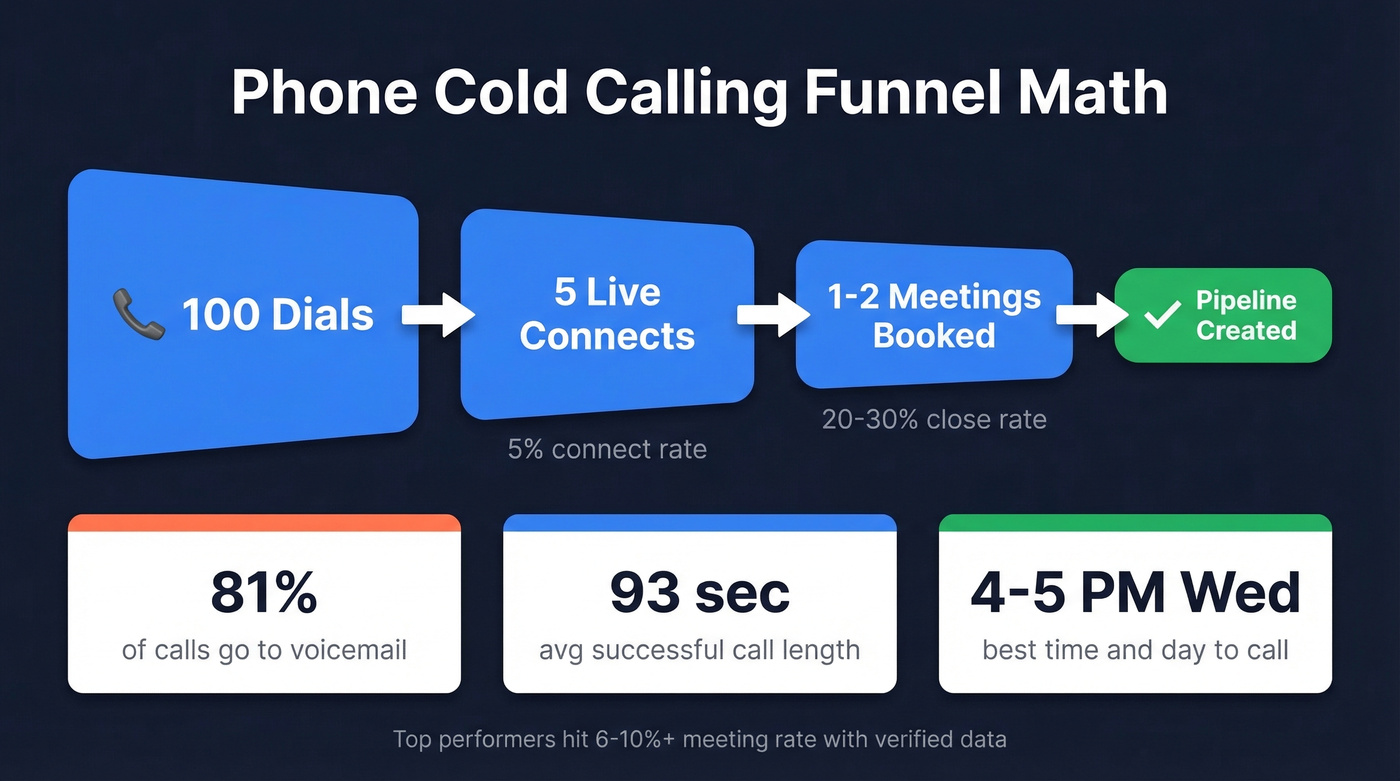
| Avg successful call | 93 seconds |
| Calls to voicemail | 81% |
| Best time to call | 4-5 PM (71% more effective) |
| Best day | Wednesday |
| Attempts to reach | ~8 average |
The most recent benchmark data puts the average cold calling success rate at 2.3%, down from 4.82% the prior year. That drop isn't because calling stopped working - it's because data quality got worse as databases aged and more reps flooded the same channels. With bad data, success rates crater to 0.3%. With verified numbers and focused targeting, top performers hit 6-10%+. The difference is entirely in what you dial.
Here's the funnel math: 100 dials produce roughly 5 live connects at a 5% rate, which converts to 1-2 meetings booked if you're closing 20-30% of those conversations. The economics work - if your numbers actually connect.
Cold email response rates sit around 1-5%. Calling gives you something email never will: real-time objection handling and the ability to pivot mid-conversation. That immediacy is why 49% of buyers still prefer being contacted via a cold phone call.
If your average deal size is under $10K, you probably don't need a $30K/year data platform. But you absolutely need verified mobile numbers. The data layer is the highest-leverage investment in your entire cold calling stack - more than your dialer, more than your script, more than your coaching program.
Get Verified Phone Numbers First
The entire playbook falls apart if you're dialing disconnected numbers and switchboard lines. 27.3% of rep time gets wasted on bad data, and 42% of salespeople say they don't have enough information before making a call.
The difference between cell phones, direct dials, and main lines is massive. A cell phone rings in someone's pocket. A direct dial hits their desk phone. A main line hits a receptionist who's paid to screen you out. With the right direct-dial data, you can cut "8-18 dials" down to 1.55 dials to connect. That's not a marginal improvement - that's a completely different job.
Prospeo's Mobile Finder covers 125M+ verified mobile numbers globally with a 30% pickup rate. The 7-day data refresh cycle means you're not dialing numbers that changed six months ago, and at roughly $0.01/lead, it's 90% cheaper than ZoomInfo on a per-lead basis. One customer, Meritt, tripled their connect rate to 20-25% after switching their data source, and their pipeline jumped from $100K to $300K per week.
| Provider | Pickup Rate | Refresh Cycle | Starting Price |
|---|---|---|---|
| Prospeo | 30% | 7 days | ~$0.01/lead |
| ZoomInfo | ~12.5% | 4-6 weeks | ~$15-40K/yr |
| Cognism | Not public | Varies | ~$1K-3K/mo |
| Apollo | ~11% | Varies | Free-$99/mo |
Don't pay $30K/year for a data provider when your connect rates are still terrible. Start with a free tier, test connect rates on 100 dials, and let the data decide. If you're comparing vendors, start with a shortlist of sales prospecting databases and B2B company data providers.
Scripts That Actually Book Meetings
A script isn't something you read. It's a framework you internalize. The goal of a first cold phone call is never to close - it's to qualify, book a meeting, or get permission to follow up.
The 10/10/10 Framework
Break your first 30 seconds into three blocks:
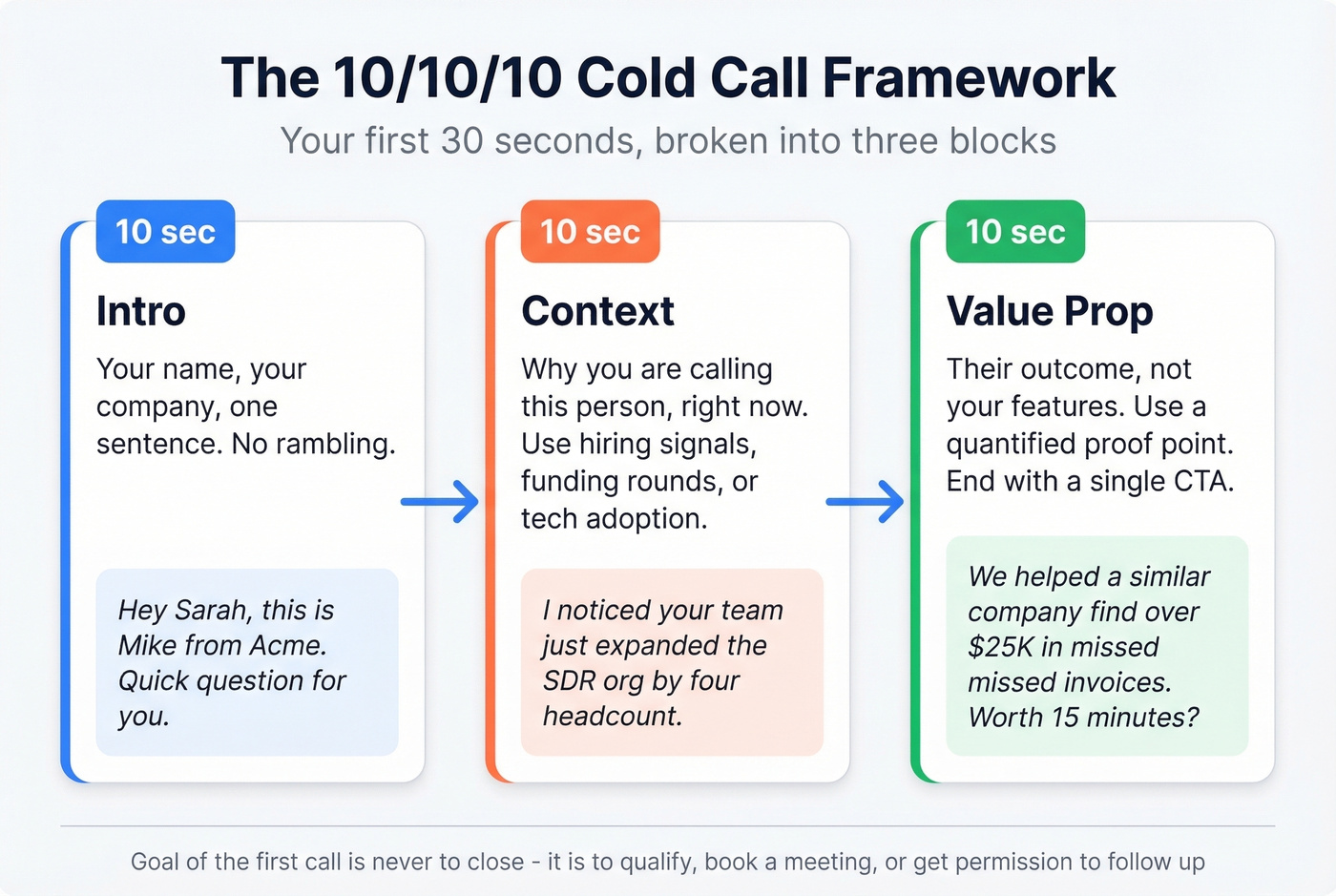
First 10 seconds - Intro. Your name, your company, one sentence. Don't ramble. "Hey Sarah, this is Mike from Acme. Quick question for you."
Next 10 seconds - Context. Why you're calling this person, right now. Use hiring signals, funding rounds, or tech adoption as your trigger - these are the modern inputs that separate research-driven reps from list-burners. If you need a system for this, borrow a few sales prospecting techniques. "I noticed your team just expanded the SDR org by four headcount, and companies in that growth phase usually hit a data quality wall."
Final 10 seconds - Value prop tied to their world. Not your features - their outcome. Use a quantified proof point: "We helped a similar company find over $25,000 worth of missed invoices from 45 customers." Then offer a single CTA - a 15-minute meeting, not a demo. You can also offer neutral value here: an industry report, a relevant event invite, or a benchmark study. Giving before asking builds trust faster than any pitch.
Openers That Work
87% of prospects feel salespeople don't understand their needs, which is exactly why research-based openers outperform generic pitches. A team of five SDRs shared openers they've actually tested on r/sales. Here are the four that translate best to B2B:
- Research-based: "I've been doing some research on [Company] and noticed [specific thing]. Quick question about that."
- Pain-point: "We're hearing a lot from [role] about [industry challenge]. Is that on your radar?"
- Opinion-seeker: "Could I get your opinion on something? It'll take 30 seconds."
- Direct intention: "Are you the right person to speak to about [specific function]?"
Delivery matters as much as wording. Confidence and friendliness beat a perfect script read in a monotone. Record yourself and listen back - you'll cringe, then improve. If you want more punchy positioning lines, keep a few sample elevator pitches handy.
Gatekeeper Handling
Gatekeepers respond to confidence and brevity. The approach is dead simple: "Is [first name] available?" No title, no company pitch, no explanation. You sound like someone who's expected.
If you get through, try the permission-based opener: "I appreciate I've called you out of the blue. Is now a bad time?" This disarms the prospect and gives them control - which paradoxically makes them more likely to listen. When they push back, escalate gently: "Give me two minutes, and if it isn't for you, I won't call again."

Your cold calling success rate lives or dies on your data. Prospeo's 125M+ verified mobile numbers deliver a 30% pickup rate - nearly 3x ZoomInfo's 12.5%. With a 7-day refresh cycle, you're never dialing numbers that went stale weeks ago. Meritt tripled their connect rate to 20-25% and grew pipeline from $100K to $300K/week.
Turn 47 dials and zero pipeline into real conversations that book meetings.
Handle Objections and Voicemail
Top 4 Objections
"Send me an email." This is a brush-off, not a request. Respond: "Happy to - what specifically should I cover so it's worth your time?"
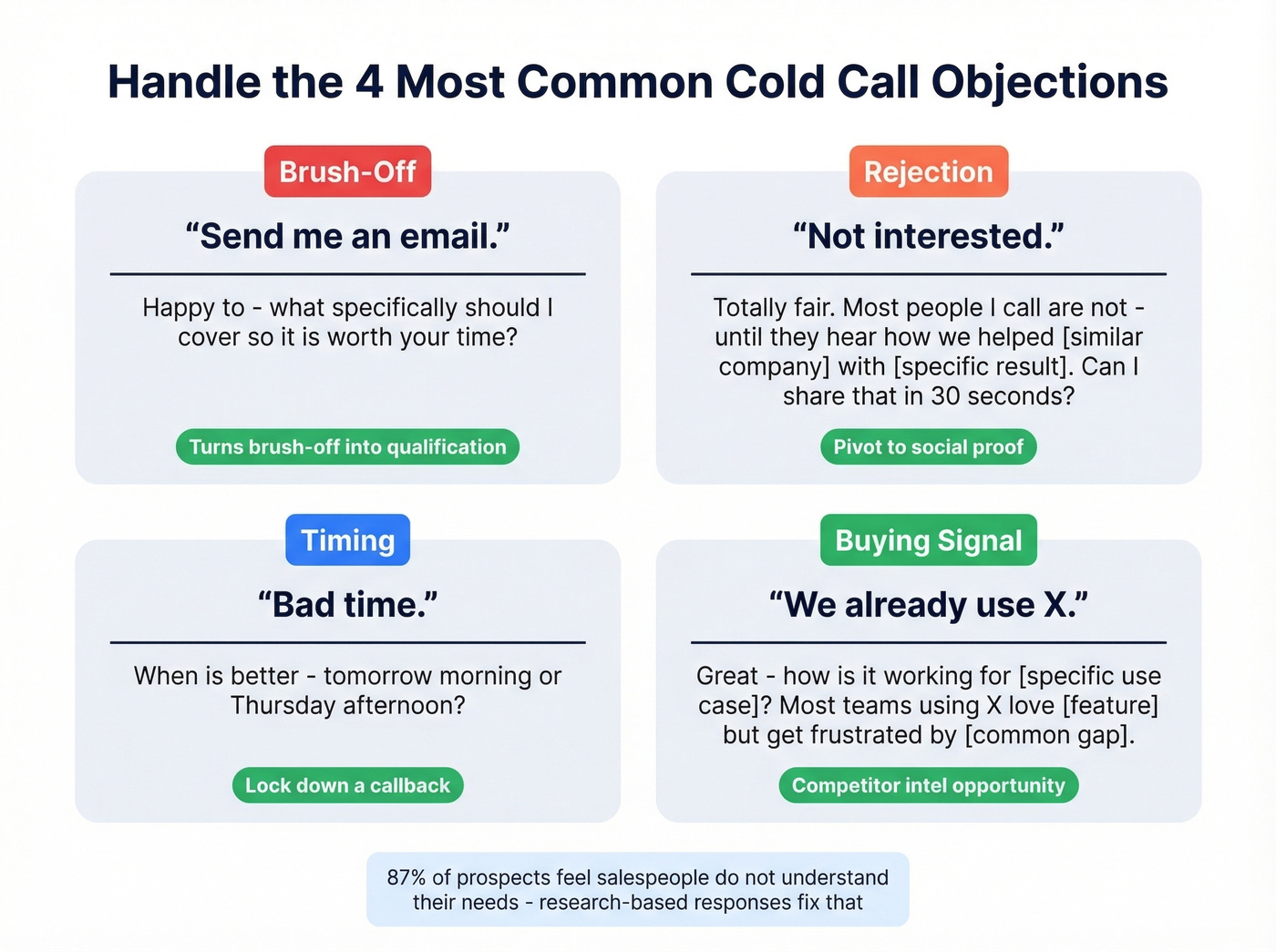
"Not interested." Don't argue. Pivot: "Totally fair. Most people I call aren't - until they hear how we helped [similar company] with [specific result]. Can I share that in 30 seconds?" If this comes up constantly, it’s usually a targeting issue - tighten your ideal customer profile before you rewrite your script.
"Bad time." Respect it, but lock down a callback: "When's better - tomorrow morning or Thursday afternoon?"
"We already use X." This is actually a buying signal. "Great - how's it working for [specific use case]? Most teams using X love [feature] but get frustrated by [common gap]."
Voicemail Strategy
81% of cold calls go to voicemail, but 67% of recipients check voicemail from unknown numbers. So voicemail isn't wasted effort if you do it right.
Keep it under 30 seconds. Include your name, one specific reason you're calling, and your callback number spoken slowly. "Hey Sarah, Mike from Acme. Calling because your team just posted three SDR roles and I've got data on how similar teams cut ramp time in half. My number is 555-123-4567. That's 555-123-4567."
Skip voicemail on attempts 1 and 2. Leave one on attempt 3. Then alternate.
Follow Up Relentlessly
80% of sales require five or more follow-up calls. Most reps give up after two.
That gap is where pipeline lives.
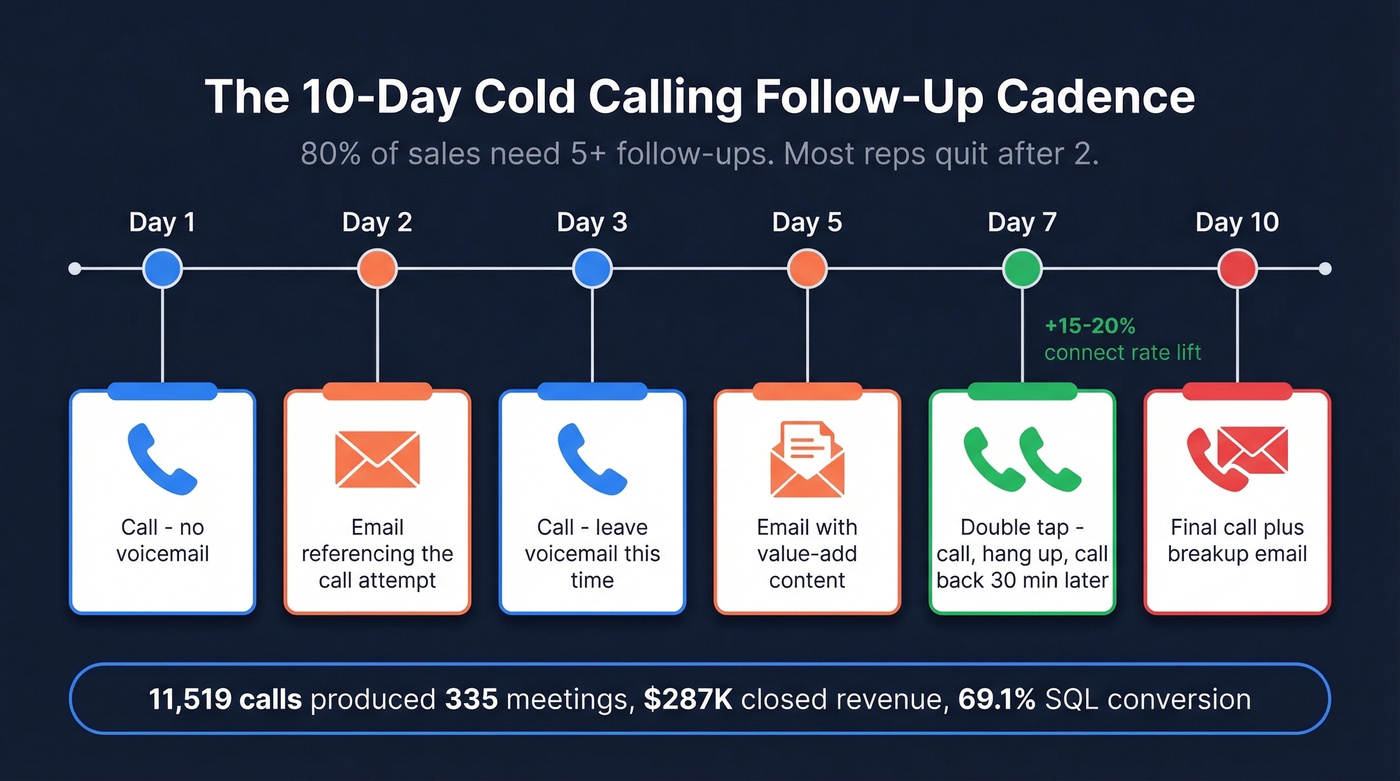
A HubSpot practitioner documented 11,519 cold calls that produced 335 meetings and $287K in closed revenue, with a 69.1% SQL conversion rate. The key was relentless, structured follow-up across channels. If you want plug-and-play copy for the email touches, use these sales follow-up templates:
- Day 1: Call (no voicemail)
- Day 2: Email referencing the call attempt
- Day 3: Call (leave voicemail)
- Day 5: Email with value-add content
- Day 7: Call - the "double tap" (call, hang up, call back 30 minutes later)
- Day 10: Final call + breakup email
The "double tap" works because a second call from the same number signals urgency and legitimacy. We've seen it lift connect rates by 15-20% on that specific attempt.
Tools and What They Cost
Dialers
Three types exist, and picking the wrong one wastes money. Manual dialers have you click to dial each number - best for high-touch, low-volume calling where research between calls matters. Progressive/power dialers automatically dial the next contact when you're free, and they're the sweet spot for structured B2B outbound. Predictive dialers dial multiple numbers simultaneously and are built for high-volume call centers, not consultative sales.
A good dialer doubles your calls per rep per day by eliminating manual steps. If you're evaluating calling stacks, it helps to start from a broader list of SDR tools.
| Dialer | Price Range | Best For |
|---|---|---|
| CloudTalk | $25-$50/user/mo | SMB, CRM integration |
| RingCentral | $20-$35/user/mo | Mid-market, reliability |
| Kixie | ~$35-$65/user/mo | Power dialing, local presence |
| Aircall | ~$30-$50/user/mo | Teams on HubSpot/Salesforce |
SMB teams should budget $25-$60/user/month. Enterprise dialers with predictive capabilities, compliance suites, and analytics run $100-$250+/user/month.
AI Call Coaching
This is the 2026 addition most teams are sleeping on. Tools like Gong ($100-$150/user/month) and Chorus ($80-$120/user/month est.) record your calls, generate AI summaries, and flag coaching moments - talk-to-listen ratio, filler words, objection handling patterns. If you're making 50+ dials a day, you can't manually review every conversation. AI coaching surfaces the 10% of calls that actually teach you something.
Pair a coaching tool with your dialer and you'll compress ramp time for new reps by weeks. In our experience, teams that review even three flagged calls per week improve connect-to-meeting conversion by double digits within a month. To operationalize this, build it into your 30-60-90 day plan.
Data Providers
Here's the thing: this is where most teams waste money. For teams doing serious phone cold calling, focus on three criteria when evaluating a data provider - refresh cycle (how often numbers are re-verified), verification method (does the provider actually call-test numbers or just scrape them?), and mobile vs. direct dial coverage. Refer back to the comparison table above for a side-by-side breakdown. If you need to clean and standardize what you already have, look at data enrichment services.
Skip this category if your team makes fewer than 20 dials a day. At that volume, manually sourcing numbers from professional profiles and company websites is fine.
Compliance - Don't Get Fined
Compliance isn't optional, and the penalties are brutal. Whether you're dialing a handful of prospects or running a full-scale outbound operation, the rules apply equally.
TCPA basics: The calling window is 8 AM-9 PM in the prospect's local time zone. Written consent is required for automated calls or texts to mobile phones. Penalties run $500 per violation, up to $1,500 per willful violation.
DNC rules: Scrub every list against the National Do Not Call Registry. Maintain an internal DNC list and honor opt-outs immediately. Fines reach $43,792 per infraction.
State mini-TCPA laws are the hidden landmine. Florida, Maryland, Oklahoma, and Washington have stricter rules that often don't exempt B2B calls. Some restrict calling hours to 8 AM-8 PM and require telemarketers to register and post bonds.
Call recording: Roughly 11-13 states require two-party consent - both you and the prospect must agree to be recorded. Announce recording at the start or don't record.
Ringless voicemail and AI voice calls are treated as prerecorded messages under current regulatory interpretations, meaning they require prior consent. Don't assume they're a loophole.
STIR/SHAKEN and caller ID: Use verified outbound numbers and a branded caller ID setup so your calls are less likely to be mislabeled. Avoid spoofing local numbers you don't own.
FAQ
Is cold calling legal in 2026?
Yes, but heavily regulated. Follow TCPA rules - call between 8 AM and 9 PM local time, get consent for automated calls to mobiles, and scrub against DNC lists. State-level laws in Florida, Maryland, Oklahoma, and Washington add extra restrictions. Penalties reach $43,792 per infraction for DNC violations.
What's a good cold call success rate?
The industry average is 2-3% for meeting bookings. Top performers consistently hit 6-10%+. The biggest lever isn't your script - it's whether you're dialing verified numbers for the right prospects.
How many cold calls should I make per day?
Most SDRs target 50-100 dials per day depending on research depth and dialer type. With a power dialer, 80-100 is realistic. Quality of numbers matters more than raw volume - 50 dials to verified mobiles will outperform 150 dials to switchboard lines every time.
How do I get phone numbers for cold calling?
Use a B2B data platform with verified mobile numbers. Sourcing accurate direct dials is the single highest-leverage step you can take - verified mobiles cut average attempts from 8-18 down to under 2, which fundamentally changes your daily math. Prospeo's free tier includes 75 emails and 100 Chrome extension credits monthly, enough to test connect rates on real dials before committing.
Every objection-handling framework in the world won't help if nobody picks up. At ~$0.01 per lead and 90% cheaper than ZoomInfo, Prospeo gives you direct mobile numbers that actually ring in your prospect's pocket - not a switchboard. Free tier included, no contracts, no sales calls required.
Fix your connect rate before you fix your script. Test 100 dials free.