

Phone Sales Tips Backed by 204,000+ Analyzed Calls
It's 2pm on a Tuesday. You've made 40 dials. Three people picked up. One hung up before you finished your name, one asked you to email them, and the third said "we're all set" before you got to your value prop. You're staring at your screen wondering if selling over the phone still works.
It does. But answer rates swing from 3% to 40% depending on your data source, and most reps are dialing numbers that haven't been verified in months. What follows are phone sales tips built on data from 204,000+ analyzed calls: copy-paste scripts, an 8-touch follow-up cadence, voicemail templates, and the compliance landmines that can get your company sued.
Quick Wins That Move the Needle
Short on time? These three moves have the biggest impact:
- Fix your opening line. The first 30 seconds determine whether you get a conversation or a click. Tested scripts are below.
- Adopt the 43/57 talk-to-listen ratio. Gong's updated analysis of 326K+ sales calls found the average rep talks 60% of the time, while won deals featured 57% talk time versus 62% on lost deals. Aim for 43% talk, 57% listen.
- Build a real follow-up cadence. 93% of conversations happen by the 3rd call. If you're one-and-done, you're leaving meetings on the table.
And here's the reframe most reps miss: if your connect rate is under 5%, the problem is almost certainly your data, not your pitch.
Phone Sales Benchmarks to Know
Before optimizing your technique, you need to know what "normal" looks like. Cognism's State of Cold Calling benchmarks draw from 204,000+ cold calls and 27,000+ conversations. Here are the numbers alongside widely cited ZoomInfo benchmarks:
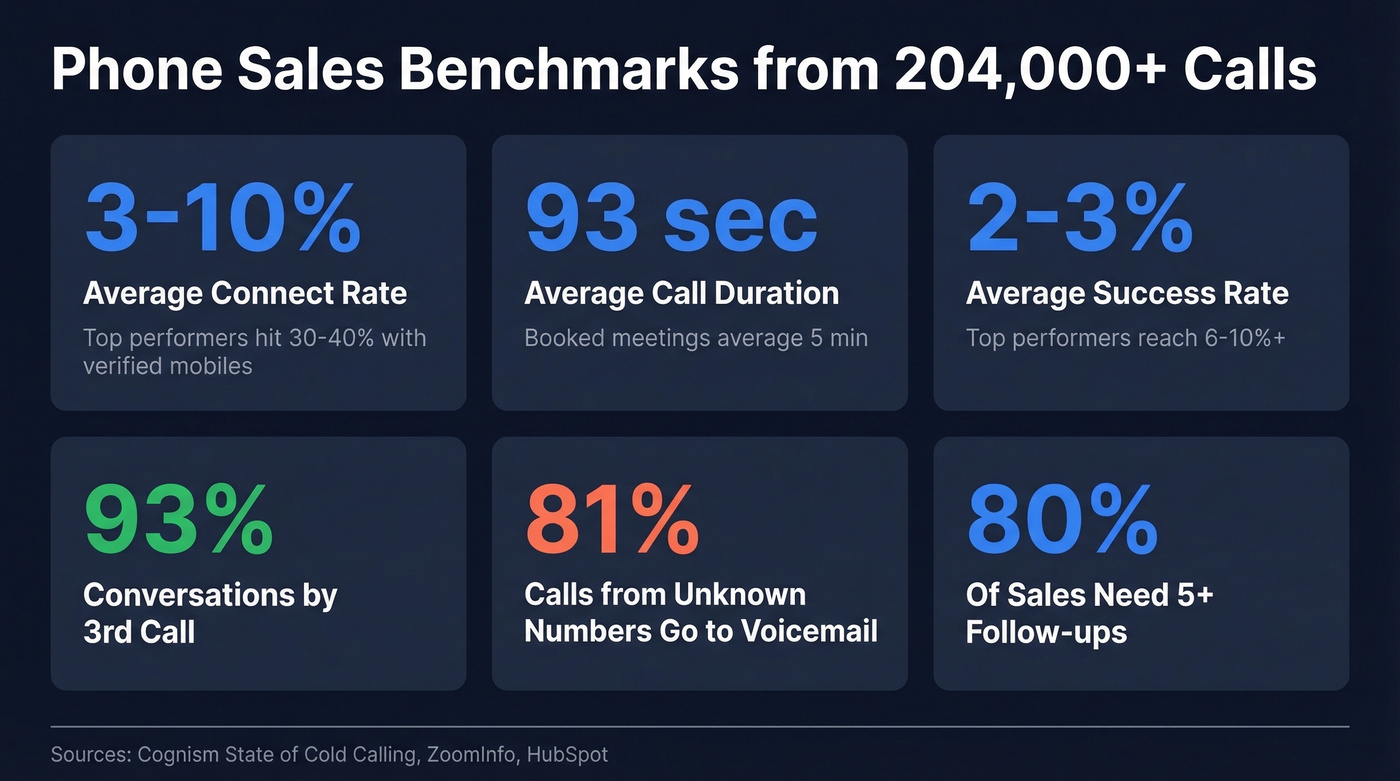
| Metric | Average | Top Performers | Source |
|---|---|---|---|
| Connect rate | 3-10% | 30-40% (verified mobiles) | ZoomInfo |
| Success rate (meeting) | ~2-3% | 6-10%+ | Cognism / ZoomInfo |
| Call duration | 93 seconds | ~5 min | Cognism / HubSpot |
| Attempts to connect | 3 | - | Cognism |
| Conversations by 3rd call | 93% | Same | Cognism |
| Conversations by 5th call | 98% | Same | Cognism |
| Follow-ups to close | 5+ (80% of sales) | Same | ZoomInfo |
A few things jump out. The average cold call lasts 93 seconds - barely enough to deliver a pitch, let alone have a conversation. Calls that actually result in a booked meeting run closer to 5 minutes. That's the gap you're trying to close.
The other number worth internalizing: 81% of calls from unknown numbers go to voicemail. You're fighting caller ID, spam filters, and basic human reluctance every single dial. Which makes everything that follows - timing, openers, objection handling, data quality - matter far more than raw dial volume.
Before You Dial
The five minutes before a call matter more than most reps think.
Research the prospect for 5 minutes. Recent company news, a job change, a funding round, a product launch. Hyperbound calls this the "5-minute research rule", and it turns a generic pitch into a relevant conversation. We've watched reps go from 2% booking rates to 6%+ just by spending those five minutes on context instead of jumping straight to the dialer. (If you want a tighter system, use this call prep checklist.)
Call on Tuesdays between 10-11am or 2-3pm. Analysis of 204K+ calls shows Tuesdays have the highest success rate for booking meetings, with those two windows performing best. Avoid 7-9am, noon, and 5pm. If you want the broader dataset, see the best time to make sales calls.
Watch for triggers, not just time slots. A prospect who just got promoted, hired a new team, or announced a product launch is warmer than someone you're calling because it's Tuesday at 10am. Trigger-based timing beats day-of-week timing every time. Threads on r/sales regularly debate whether cold calling is dead - the data says otherwise, but only when you're dialing the right person at the right moment.
Your First 30 Seconds
Most cold calls die in the opening. Two mistakes kill more calls than anything else.
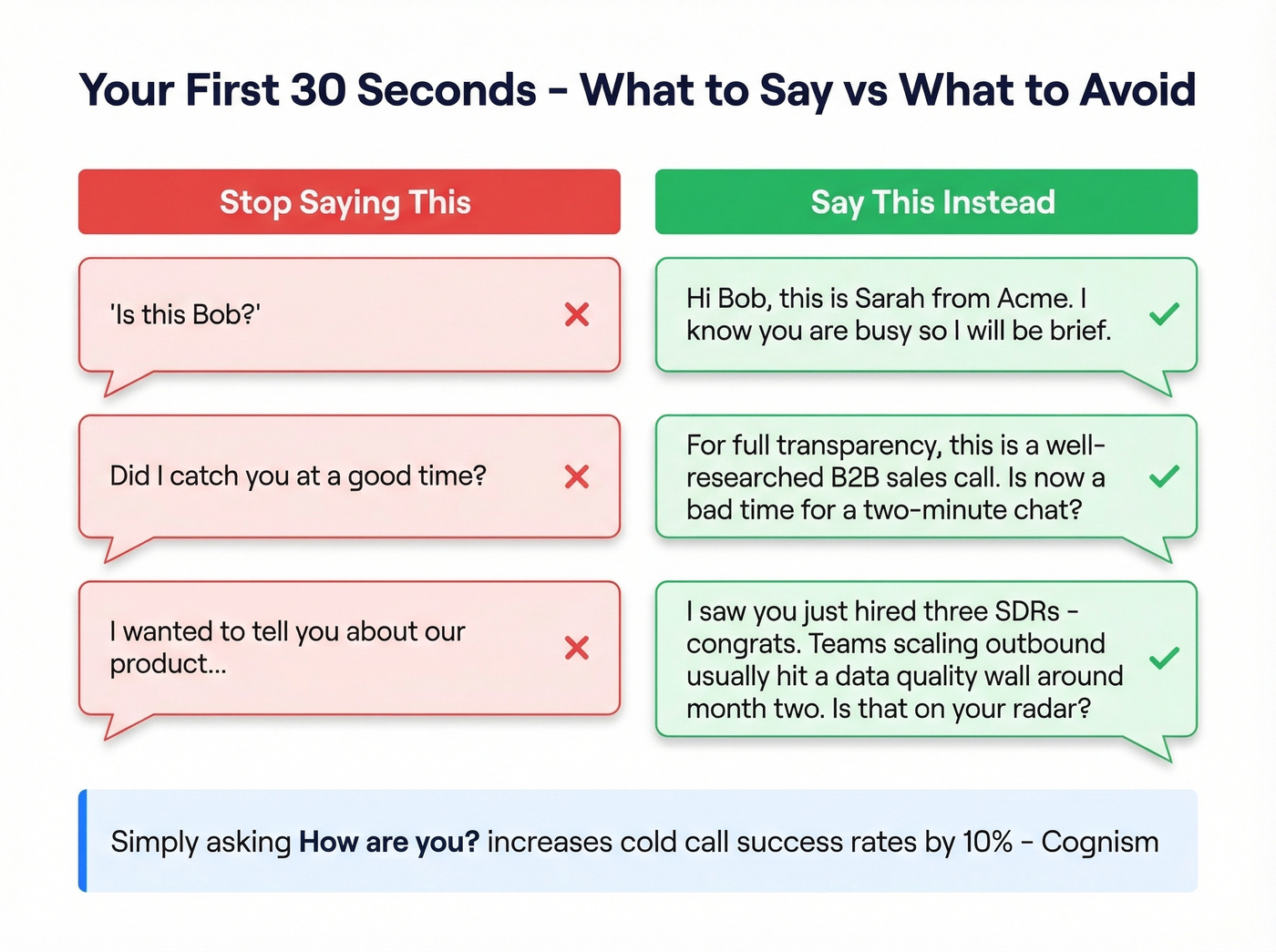
"Is this Bob?" sounds like a telemarketer. It immediately puts the prospect on guard. Use an assumptive opener instead: "Hi Bob, this is Sarah from Acme. I know you're busy, so I'll be brief." You've confirmed identity, shown respect for their time, and earned a few more seconds. (More options: best cold calling opening lines.)
"Did I catch you at a good time?" hands them an exit. The answer is always "no," and now they have social permission to hang up. Replace it with: "I know you're busy, so I'll be brief. I'm calling because..." and go straight into your reason.
Here are three openers that consistently perform:
The transparency opener (used by Cognism's own SDR team): "For full transparency, this is a well-researched B2B sales call. Is now a bad time for a two-minute chat?" This disarms because it's honest. Nobody expects a cold caller to admit they're cold calling.
The ask-for-help opener: "Could I get your opinion on something?" People are wired to help. This shifts the dynamic from "salesperson pitching" to "peer asking for input."
The context/trigger opener: "I saw you just hired three SDRs - congrats. I'm calling because teams scaling outbound usually hit a data quality wall around month two. Is that on your radar?" This proves you did your homework and makes the call feel relevant, not random.
One more data point: simply asking a prospect "How are you?" increases cold calling success rates by 10%. Small thing. Works.
Here's something scripts can't capture: how you sound. Slow your pace by 10-15% from your natural speaking speed, drop your pitch slightly at the end of statements (not questions), and stand up if you need more energy in your voice. Tonality carries more weight than word choice in the first 10 seconds. If you want to go deeper, use this guide on tonality in sales calls.
The 43/57 Talk-to-Listen Rule
Gong's earlier research established the 43/57 golden ratio - talk 43%, listen 57%. Their updated analysis of 326K calls confirmed the broader pattern: the average rep talks 60% of the time, won deals featured 57% talk time, and lost deals featured 62%.
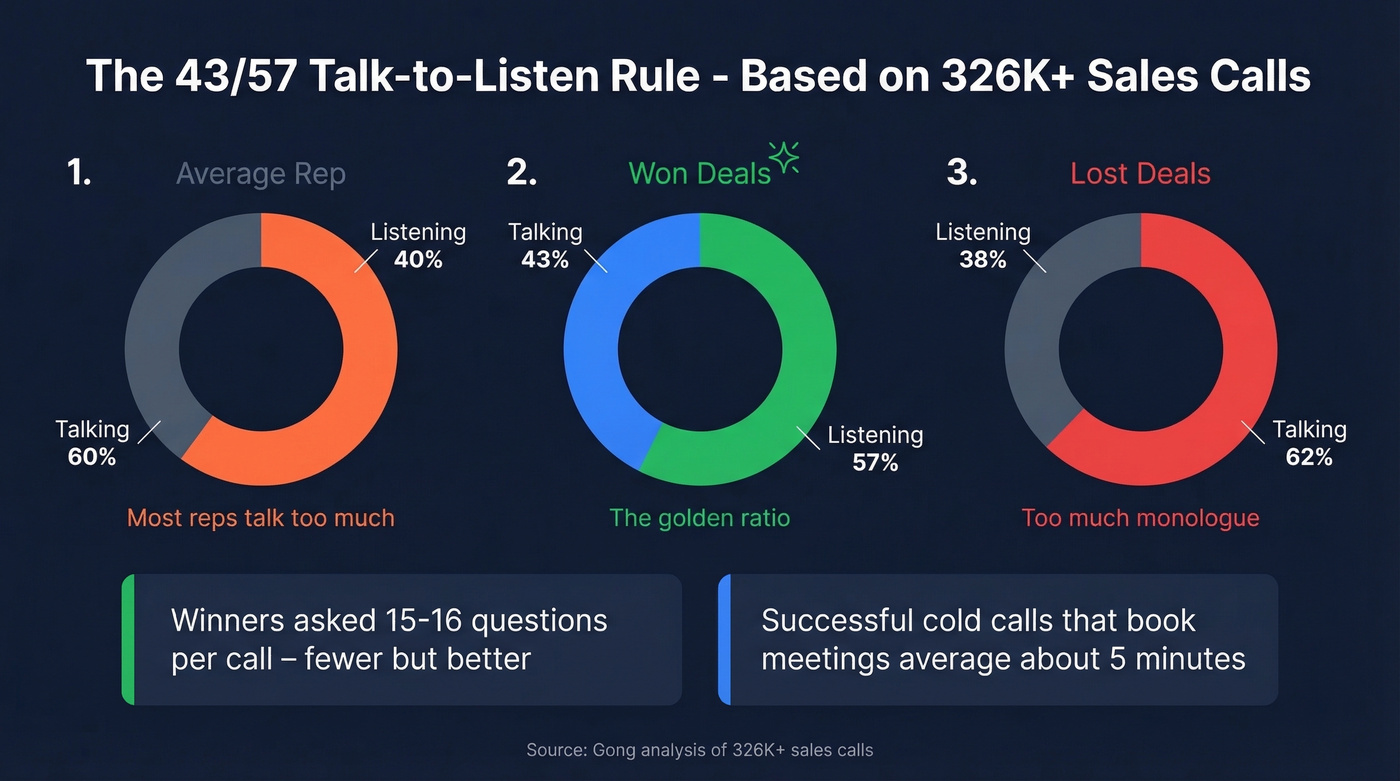
It's not just about talking less - it's about talking better. Lost deals featured long seller monologues, those 90-second stretches where you're explaining features nobody asked about. Winning calls had more back-and-forth, more interactivity, more genuine conversation. This is arguably the most important principle for selling over the phone: the best reps sound like curious peers, not pitching machines.
The question count data is equally counterintuitive. Winners asked 15-16 questions per call. Losers asked around 20. More questions doesn't mean better discovery - it means you're interrogating instead of conversing. Ask fewer, better questions and actually listen to the answers. (If you need prompts, steal from these questions to ask customers when selling a product.)
Two more tactical points. First, successful cold calls that result in a meeting average about 5 minutes. You don't need 20 minutes. You need 5 focused ones. Second, never bad-mouth a competitor. HubSpot cites "spontaneous trait transference" - when you describe a competitor negatively, the prospect subconsciously associates those traits with you. If they ask about a competitor, go neutral: "They're solid. Here's where we're different."
Set an agenda at the top of the call: "I'd love to ask you two quick questions about how you're handling X, share one idea, and if it makes sense, we'll find time for a deeper conversation. Sound fair?" This gives the prospect control while keeping you in the driver's seat.

You read the data: connect rates swing from 3% to 40% depending on your data source. Prospeo gives your reps 125M+ verified mobile numbers with a 30% pickup rate - refreshed every 7 days, not every 6 weeks. At $0.10 per mobile, bad data stops being the reason your team misses quota.
Stop perfecting your script on numbers that never connect.
Objection Scripts You Can Steal
Every cold call hits objections. Here are six you'll hear constantly, with word-for-word rebuttals. (For a bigger library, see these objection handling examples.)
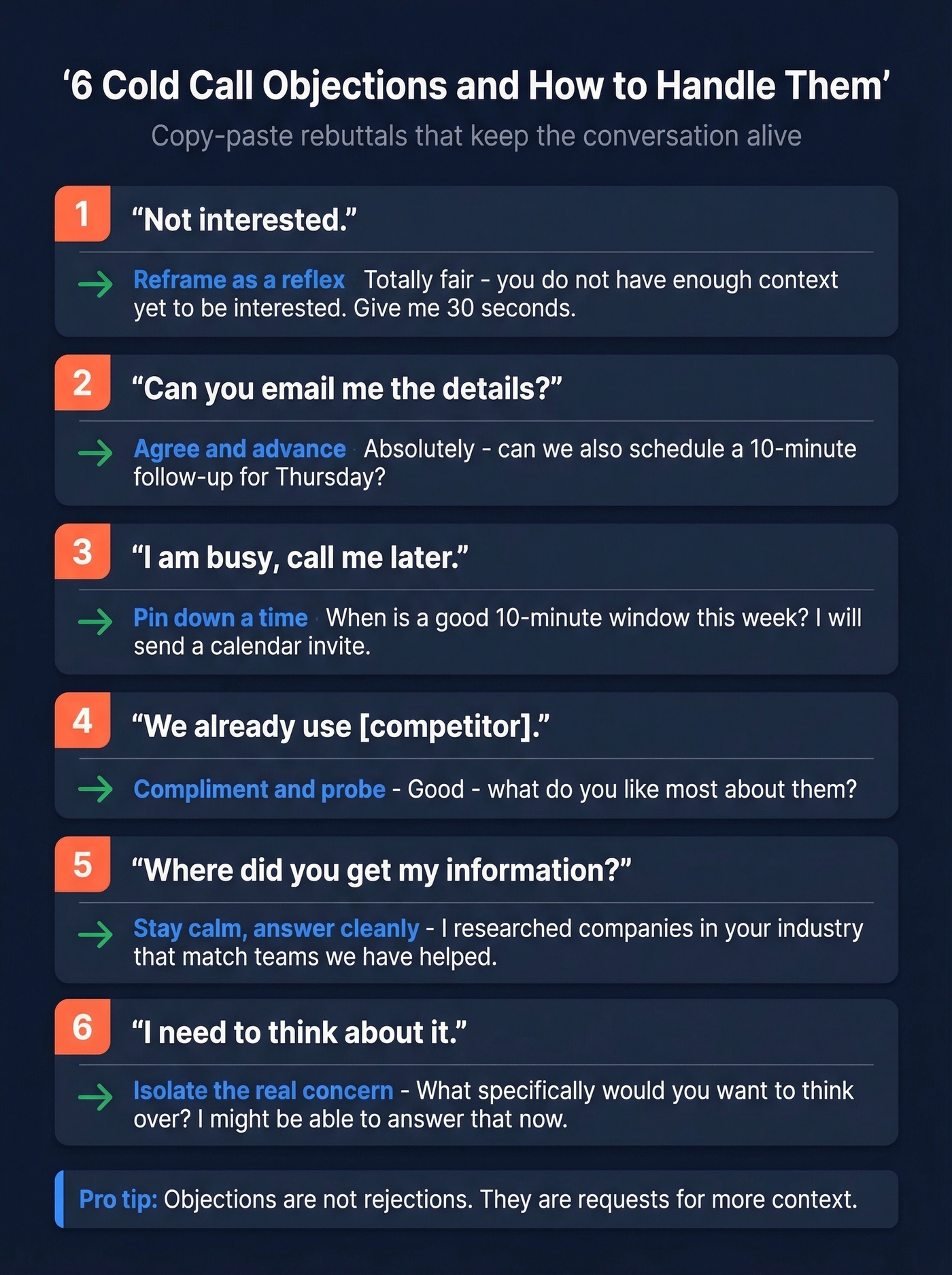
"Not interested."
The reason this objection feels fatal is that reps treat it as a verdict. It's not - it's a reflex. The prospect doesn't have enough context to be interested or disinterested.
"Totally fair - you don't have enough context yet to be interested. If you give me 30 seconds, I'll share why I reached out, and you can tell me if it's worth continuing."
"Can you email me the details?"
In our experience, this is the most recoverable objection - if you handle it right. The trick is agreeing and keeping the conversation alive:
"Absolutely - I'll send that over today. Can we also schedule a 10-minute follow-up for Thursday so I can answer any questions? I find the email alone usually raises more questions than it answers." (More scripts: "Send Me an Email" Objection.)
"I'm busy, call me later."
"Completely understand. When's a good 10-minute window this week?"
Pin down a specific window. "Later" means never unless you get a commitment. If they say "Thursday afternoon," respond with: "Great - I'll call you Thursday at 2pm. I'll send a quick calendar invite so it doesn't slip."
"We already use [competitor]."
"Good - that tells me you take this seriously. What do you like most about them?" Then listen. Position yourself as complementary or as solving the gap they inevitably mention. Don't attack their current vendor.
"Where'd you get my information?"
Stay calm. "I did some research on companies in [their industry] that match the profile of teams we've helped. Your business came up as a strong fit." This isn't an accusation - it's a reflex. Answer it cleanly and move on.
"I need to think about it."
Isolate the real concern: "That makes sense. Can I ask what specifically you'd want to think over? Sometimes I can answer those questions right now and save you the back-and-forth." "I need to think about it" almost always means "I have a concern I haven't voiced."
The Follow-Up Cadence Most Reps Skip
80% of sales require 5+ follow-up calls. Yet most reps give up after one or two attempts. The data is unambiguous: 93% of conversations happen by the 3rd call, and 98% by the 5th. If you aren't building a structured cadence, you're leaving the majority of your pipeline on the table.
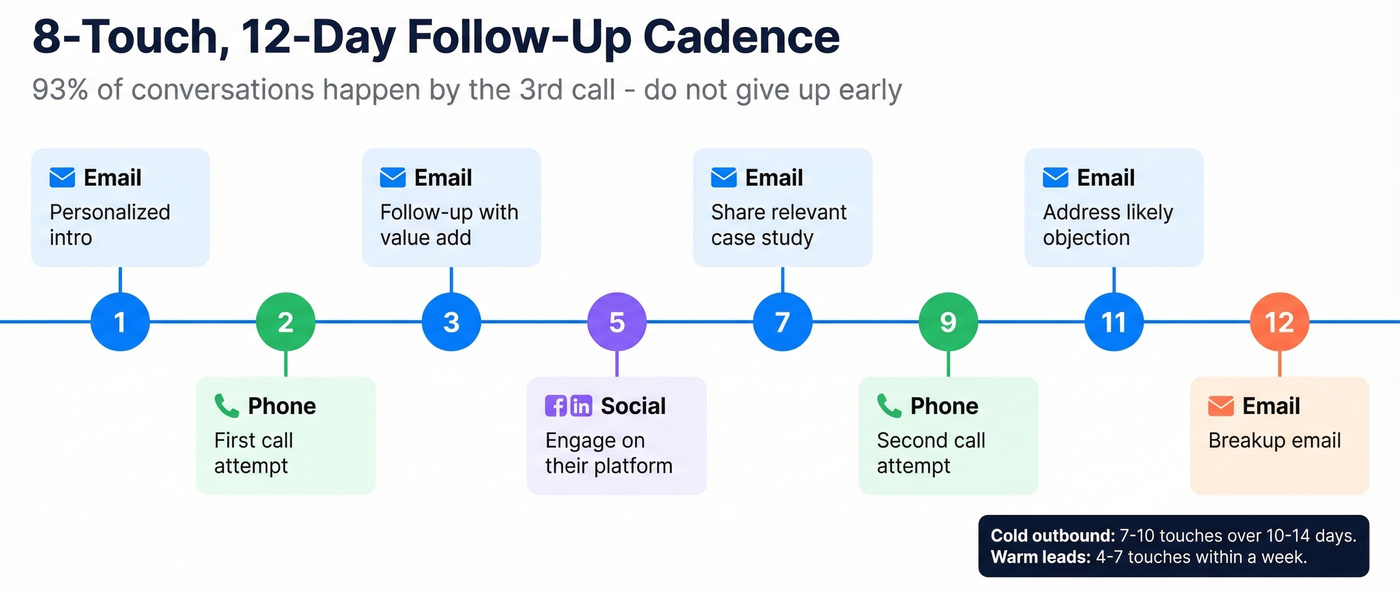
Here's an 8-touch, 12-day cadence that balances persistence with professionalism:
| Day | Channel | Action |
|---|---|---|
| 1 | Personalized intro | |
| 2 | Phone | First call attempt |
| 3 | Follow-up with value add | |
| 5 | Social | Engage on their platform |
| 7 | Share relevant case study | |
| 9 | Phone | Second call attempt |
| 11 | Address likely objection | |
| 12 | Breakup email |
For cold outbound, aim for 7-10 touches over 10-14 days. For warm leads who've raised their hand, compress to 4-7 touches within a week. Space touchpoints 2-3 days apart - any closer feels aggressive, any further and you lose momentum. (You can also plug-and-play these follow-up email templates.)
One principle that separates good cadences from great ones: trigger-based timing. If a prospect just posted about a challenge you solve, that's your Day 1 - not an arbitrary Monday morning.
Your Voicemail Template
Since 81% of calls go to voicemail, your voicemail is your pitch for most dials. Keep it under 20 seconds:
"Hi [Name], this is [Your Name] from [Company]. I noticed [one-sentence trigger - e.g., you just opened a new SDR team]. I have a quick idea about [value - e.g., cutting ramp time in half]. My number is [number] - I'll also send a short email."
That's it. No rambling, no feature dumps. The voicemail's only job is to make the follow-up email feel expected instead of cold. Repeat your phone number twice - slowly - at the end. Most reps rush through it and wonder why nobody calls back. (More options: sales voicemail scripts.)
Fix Your Data Before Your Pitch
Let's be honest: if your deal sizes are under five figures, you probably don't need better scripts - you need better numbers. Answer rates vary 3-40% depending on your data source. A rep dialing verified mobile numbers can connect on 30-40% of attempts. A rep dialing switchboard numbers from a stale database connects on 3%.
The math is brutal. At a 3% connect rate, you need 133 dials to get 4 conversations. At a 40% connect rate, you need 10. That's 13x fewer dials for the same result. The difference isn't technique - it's data. (Benchmarks and fixes here: cold call connect rate.)
We've seen this pattern over and over: teams invest in coaching, scripts, and call recording software while dialing numbers that haven't been verified in months. When 81% of unknown calls already go to voicemail, stale numbers make the problem exponentially worse.
Prospeo's mobile database covers 125M+ verified numbers with a 30% pickup rate, and every record refreshes on a 7-day cycle versus the 6-week industry average. Meritt, one of Prospeo's customers, saw their connect rate triple to 20-25% after switching - and their pipeline went from $100K to $300K per week. You can master every technique in this article, but if you're dialing dead numbers, none of it matters.
Compliance You Can't Ignore
Telemarketing compliance got riskier fast, and 2026 is where a lot of the newer rules start to bite.
TCPA lawsuits surged nearly 95% year-over-year, with class actions spiking 285% in September alone. This isn't theoretical risk - it's active litigation.
Your compliance checklist:
- Scrub against the National DNC Registry before every campaign. Mobile numbers on the registry are treated as residential regardless of business use.
- Maintain an internal DNC list and honor opt-outs immediately. No exceptions, no delays.
- Respect calling hours - 8am-8pm in the prospect's local time zone.
- Get prior express written consent for any AI-generated voices or prerecorded messages. The FCC's February 2024 ruling made this explicit - AI voices count as "artificial or prerecorded" under TCPA.
- Watch state mini-TCPA laws. Florida, Maryland, Oklahoma, Washington, and Texas (SB 140) have stricter rules that often don't exempt B2B calls.
- Track the April 2026 revocation rules. FCC rules allow consumers to revoke consent by any reasonable method, including replying "STOP," and the "revoke all" requirement takes effect April 2026.
The McLaughlin v. McKesson Supreme Court decision also changed the game: district courts aren't bound by FCC interpretations in civil TCPA cases, which means less predictability and more litigation risk. If you don't have a compliance process - DNC scrubbing, internal opt-out tracking, state-by-state rules - build one before your next campaign. Skip this section at your own peril. (Related: TCPA compliance.)
Multi-Threading and AI
Two data points that should change how you think about selling over the phone in 2026.
Analysis of 1.8 million opportunities found that closed-won deals have twice as many buyer contacts as lost deals. Strategic enterprise deals average 17 contacts. Multi-threading - calling multiple stakeholders within the same account - boosts win rates by 130% on deals over $50K. If you're only calling one person per account, you're playing with half a deck. (If you're building this motion, start with an account-based marketing solution.)
Second, sellers who regularly use AI generate 77% more revenue than those who don't, based on analysis of 7.1 million opportunities. The practical applications are straightforward: AI for call prep (summarizing account history and recent triggers), real-time note-taking during calls, and drafting personalized follow-up emails within minutes of hanging up. Top teams are already doing all three.
Every tip in this guide assumes one thing: you're actually reaching a live human. Prospeo's verified direct dials deliver a 30% pickup rate - 3x higher than ZoomInfo's 12.5%. Pair that with trigger-based filters like job changes, funding rounds, and hiring surges to call the right person at the right moment.
Turn your 3% connect rate into 30% with data that's verified weekly.
FAQ
What's a good cold call success rate?
The average cold call success rate is around 2-3% for booked meetings. Top performers hit 6-10%+. If you're consistently above 5%, you're outperforming most of the market. Below 2%, audit your data quality and opening scripts before investing in coaching.
How many times should I call before giving up?
Data from 204K+ calls shows 93% of conversations happen by the 3rd call and 98% by the 5th. After 5 attempts with no response, redirect energy to new prospects or different contacts within the same account.
What's the best time to make sales calls?
Tuesdays between 10-11am and 2-3pm consistently show the highest meeting-booked rates. Avoid early morning, lunch, and end-of-day windows. Trigger-based timing - calling right after a relevant event like a funding round or new hire - outperforms any fixed schedule.
How do I improve my connect rate?
Start with data quality. Answer rates vary 3-40% depending on your source. Verified mobile numbers on a short refresh cycle prevent you from dialing disconnected lines. Beyond data, call during optimal windows and use local caller ID.
Do I need to worry about TCPA for B2B calls?
Yes. TCPA lawsuits surged 95% year-over-year, and state mini-TCPA laws increasingly apply to B2B. Scrub against the National DNC Registry, maintain internal opt-out lists, respect 8am-8pm calling hours, and get written consent before using AI-generated or prerecorded messages.