

The Best Pipeline Sales CRM Tools in 2026
Opportunities closed within 50 days have a 47% win rate. After that threshold, it drops to 20% or lower. That gap is the entire argument for picking the right pipeline sales CRM - one that shows you where deals stall, not just where they exist.
Most teams pick a CRM based on brand name or whatever their last company used. That's how you end up paying Salesforce Enterprise pricing ($175/user/month on annual billing) when your 8-person team would've been fine on Pipedrive at $14/user/month. We've watched this play out dozens of times, and the fix is always the same: understand what each tool actually costs, where the hidden gotchas live, and which one fits your team size and sales motion.
Our Picks (TL;DR)
Three picks for three buyer profiles:
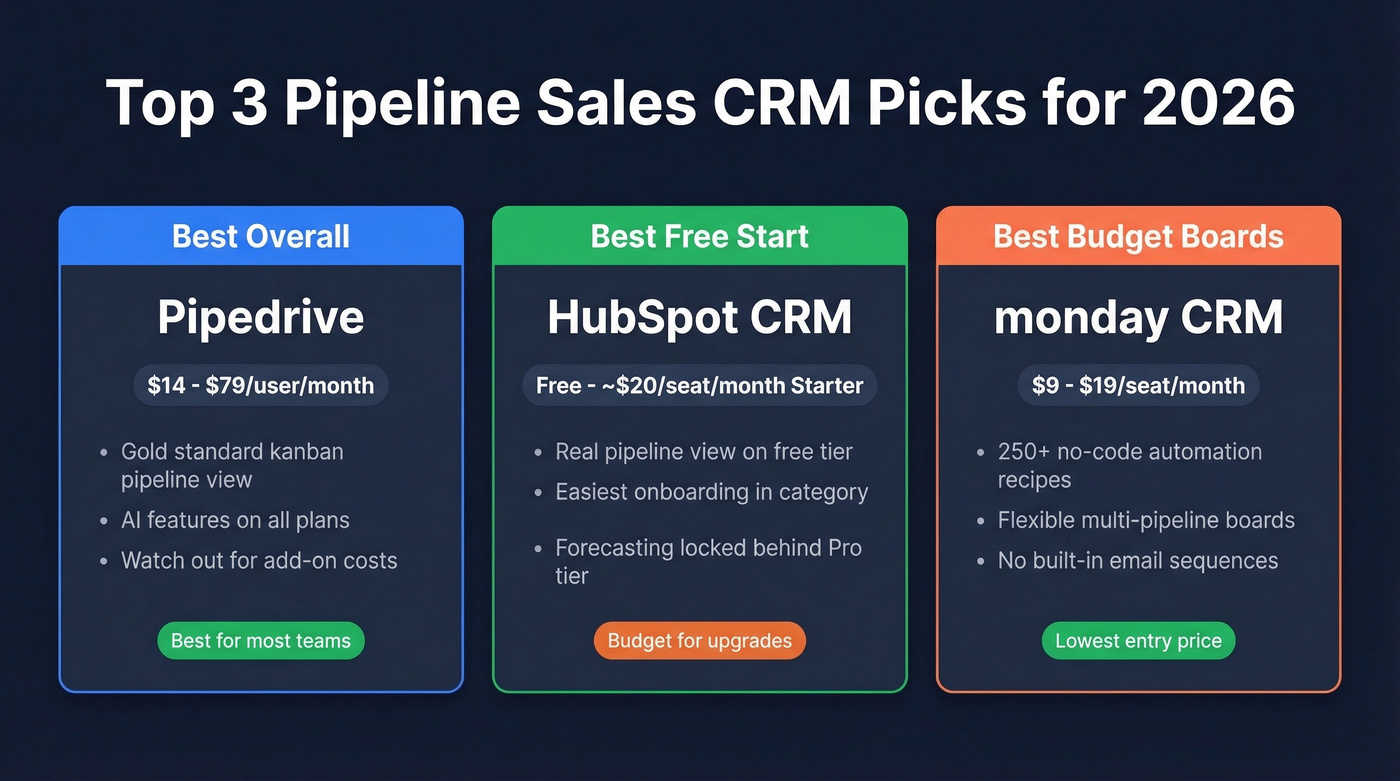
- Best overall pipeline CRM: Pipedrive - best balance of pipeline UX, pricing, and AI. $14-$79/user/month.
- Best free starting point: HubSpot CRM - genuinely useful free pipeline view, but budget for upgrades. Free to ~$20/seat/month Starter.
- Best for budget pipeline boards: monday CRM - flexible, customizable, and priced aggressively. $9-$19/seat/month (annual billing).
What to Look For in a CRM for Sales Pipeline
Six criteria separate good pipeline management tools from mediocre ones.
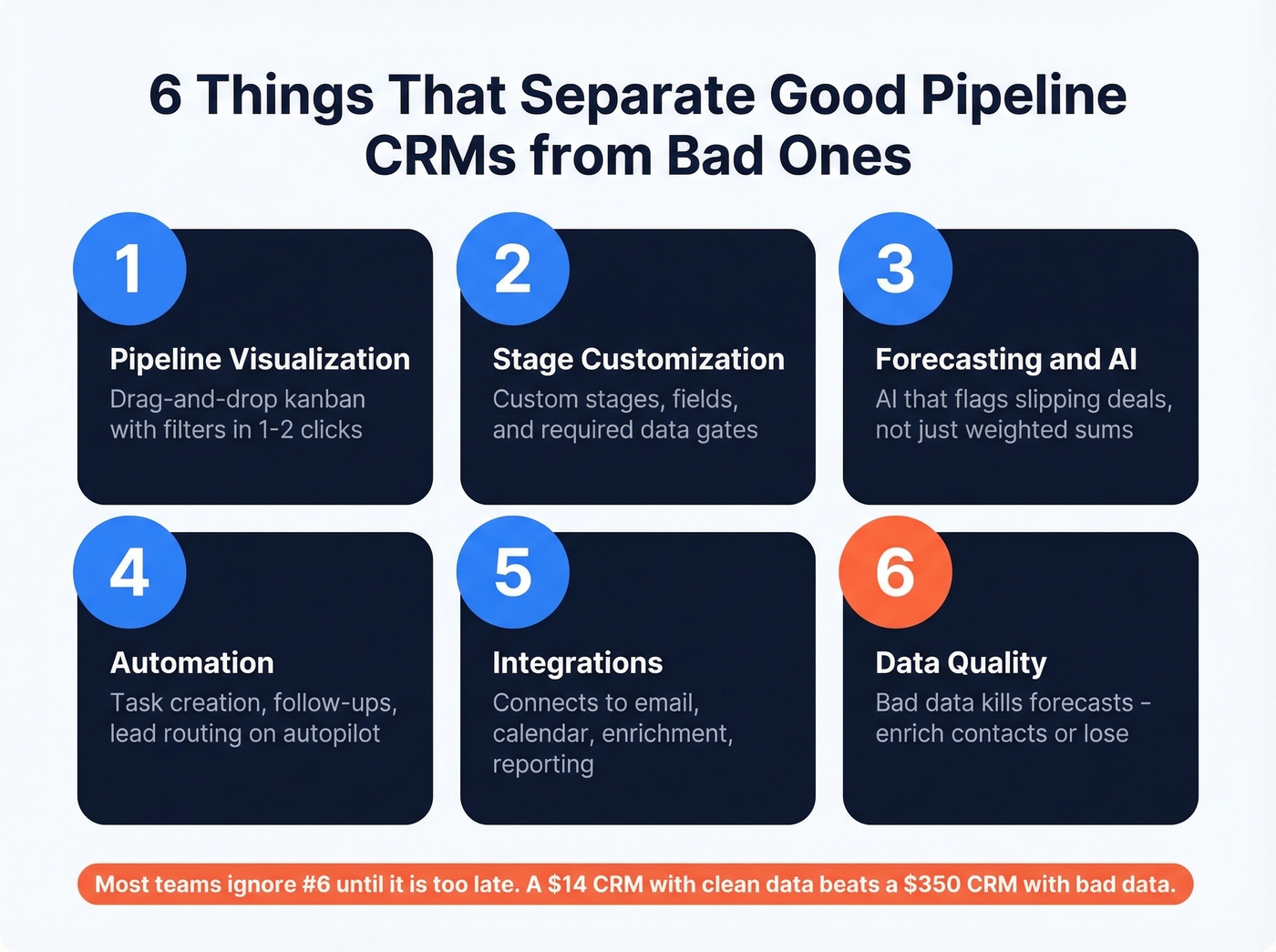
Pipeline visualization. Kanban boards are table stakes. What matters is whether you can drag deals between stages, see weighted values at a glance, and filter by rep, time period, or deal size without clicking through three menus. A strong CRM should surface these insights in one or two clicks, not bury them behind custom report builders that nobody has time to configure.
Stage customization. Your sales process isn't a SaaS template. You need custom stages, custom fields, and the ability to require certain data before a deal moves forward.
Forecasting and AI. Basic forecasting means summing weighted pipeline. Good forecasting means AI that flags deals likely to slip, suggests next actions, and adjusts projections based on historical patterns. Outreach reports their AI coaching tool cuts 11 days off sales cycles and lifts win rates by up to 10 points on $50K+ deals. That's the kind of impact to look for. (If forecasting is a priority, compare dedicated sales forecasting tools too.)
Automation. Task creation, follow-up reminders, stage-based email triggers, lead routing. The less manual work reps do on admin, the more time they spend selling. If you’re standardizing follow-ups, keep a set of sales follow-up templates handy.
Integrations. Your CRM needs to talk to your email sequencer, your calendar, your enrichment tools, and your reporting stack. A CRM that lives on an island is a CRM that gets abandoned. (If you’re building a full outbound stack, start with a ranked list of SDR tools.)
Data quality. Here's the thing: this is the criterion everyone ignores until it's too late. A $350/user/month Salesforce Unlimited seat with bad data produces worse forecasts than a $14/user/month Pipedrive seat with verified contacts. Pair your CRM with an enrichment layer that keeps contact data fresh - otherwise you're building pipeline on a foundation of bad numbers. For options, see the best data enrichment services.
Top CRM Tools for Pipeline Management
Pipedrive - Best Drag-and-Drop Pipeline CRM
Use this if you want the best pipeline UX on the market without enterprise complexity. Pipedrive's kanban view is the gold standard - clean, fast, and built around the visual drag-and-drop workflow that reps actually use. It's the tool most teams picture when they think about managing deals through stages.
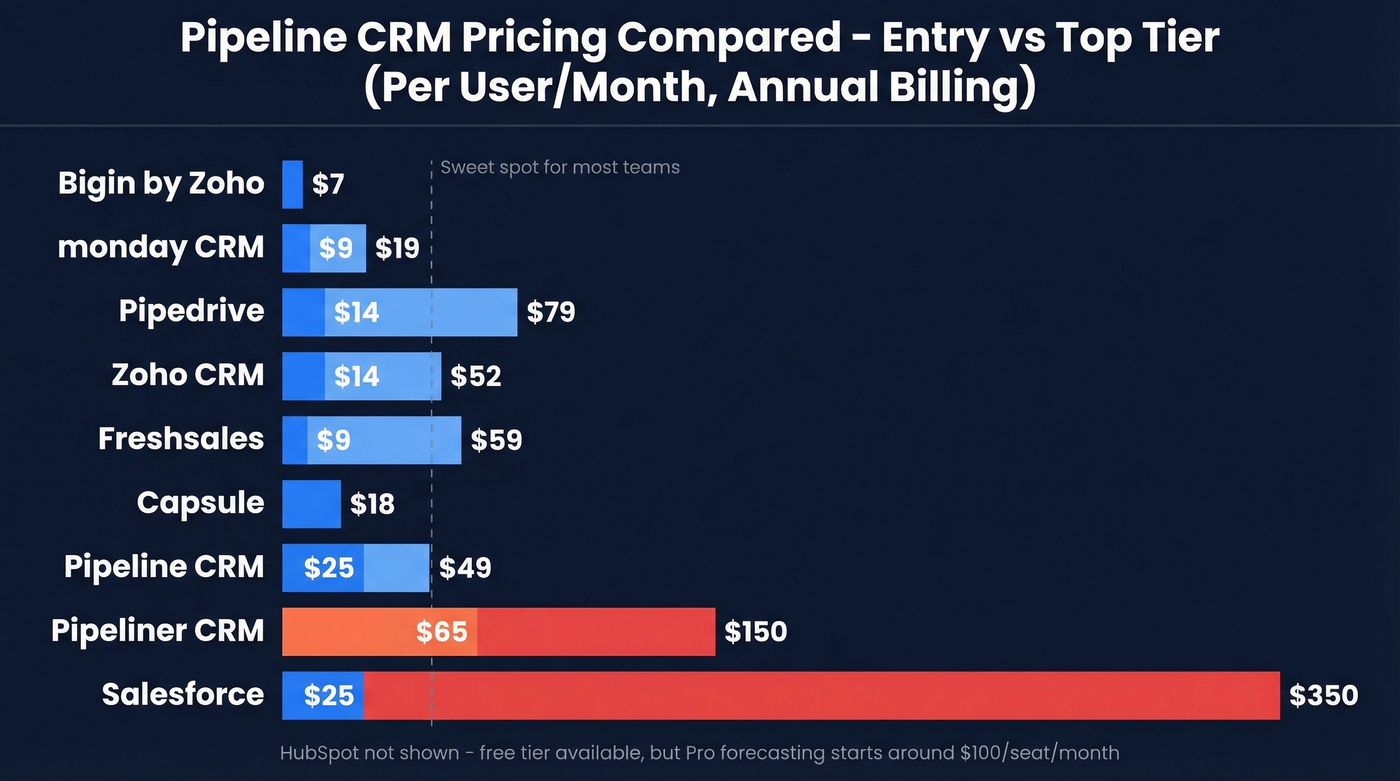
Pricing runs $14/user/month on Lite up to $79/user/month on Ultimate, billed annually. The plan restructuring bumped limits across the board - Lite now gets 2,500 leads+deals per user, up from 2,000 on the old Essential plan. AI features are available across plans, including AI-powered report creation on Lite.
Now, Pipedrive's add-on pricing is where it gets sneaky. LeadBooster starts at $32.50/month extra. Web Visitors starts at $41/month. Smart Docs starts at $32.50. A team that starts at $14/seat can easily double their cost once they bolt on the extras they actually need. We've seen teams budget for Pipedrive at $14 and end up at $30+ once they realize the core plan doesn't include everything they assumed it would.
Skip this if you need built-in calling and email sequences without paying for add-ons. Pipedrive makes many key extras beyond the core pipeline paid add-ons.
Best overall for most teams. No question.

HubSpot Sales Hub
Know the upgrade path before you commit. The free tier is a gateway drug.
HubSpot's free CRM gives you a real pipeline view, contact management, and basic deal tracking - no credit card, no time limit. For a team of 2-3 reps just getting started, it's genuinely useful. The onboarding is the easiest in the category, and the integration ecosystem is massive. (If you’re evaluating CRMs broadly, here are more examples of a CRM with real pricing.)
The problem is feature gating as you grow. Forecasting is a Professional-tier feature, which typically lands around ~$100/seat/month. Custom reporting sits in the same tier. Sequences start earlier, but anything sophisticated pushes you into Pro or Enterprise, often around ~$120/seat/month. A 10-seat team at ~$100/seat/month is ~$12,000/year - and that number sneaks up on people who started on free and assumed the upgrade would be gentle.
Use this if you're starting from zero and want the smoothest ramp. The free-to-Starter path at ~$20/seat/month is reasonable for early-stage teams.
Skip this if you need deal tracking and forecasting on a budget. HubSpot charges more for forecasting than tools like Pipedrive, where mid-tier plans cover more pipeline-focused functionality for less.
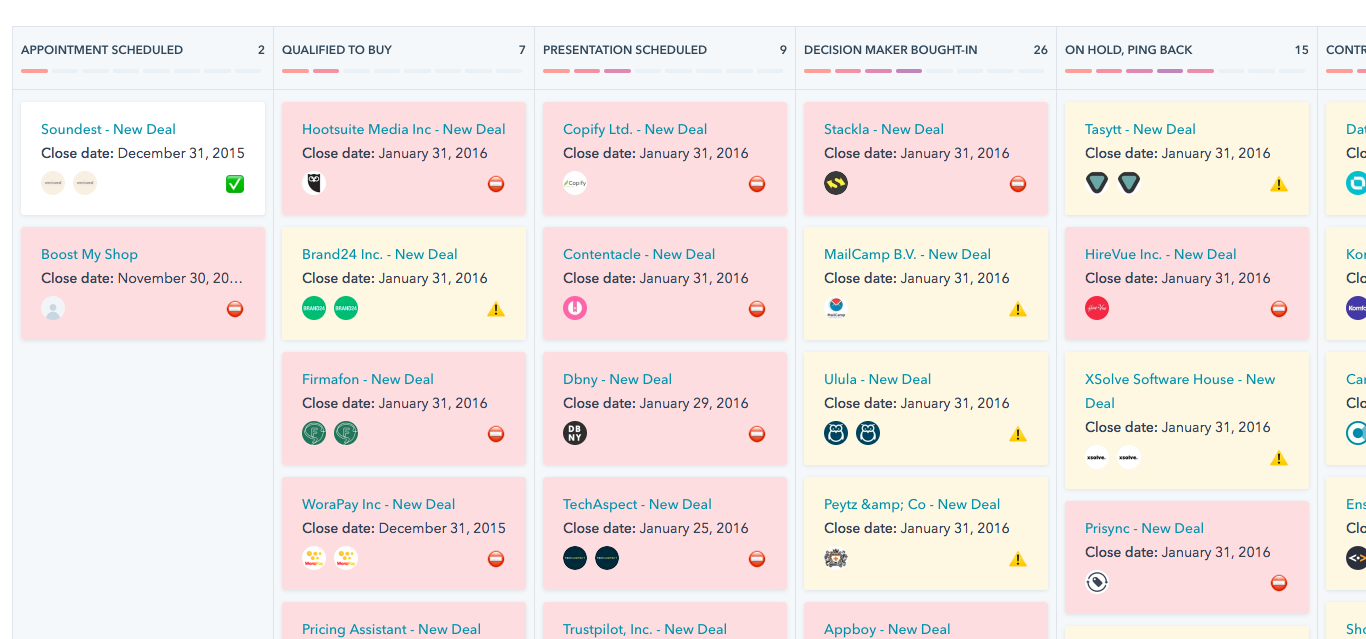
Salesforce Sales Cloud
Let's do the math first, because the math is the whole story.
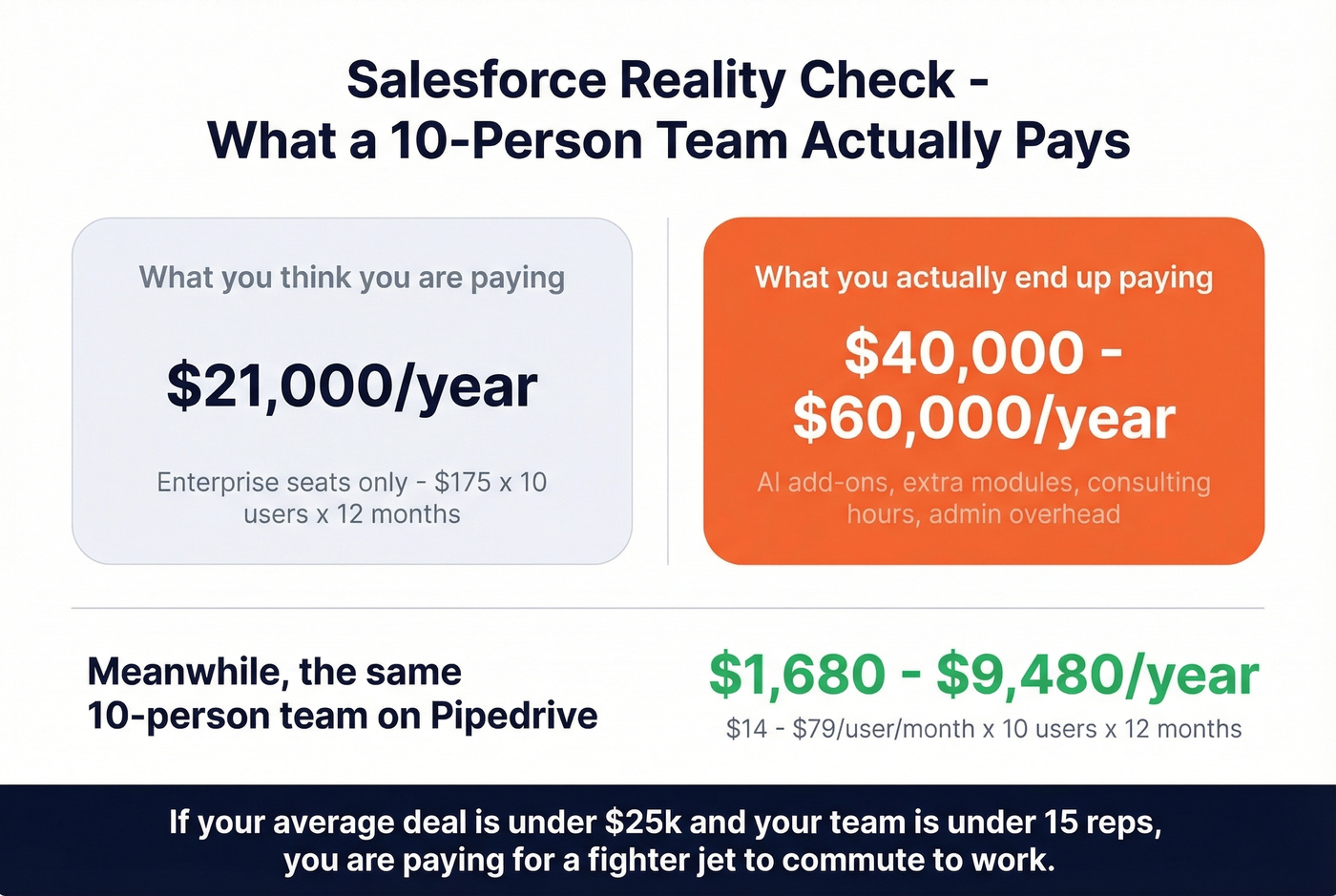
A 10-person sales team on Enterprise list pricing pays $21,000/year just for CRM seats ($175/user/month billed annually). Add higher-tier AI products, additional modules, and the inevitable consulting hours to configure everything, and you can easily land in the $40-60k/year range all-in. For a 50-person org with dedicated RevOps, that investment pays off. For a Series A startup, it's absurd.
Salesforce's pricing starts at $0 for up to 2 users (Free Suite), then jumps to Starter at $25/user/month, Pro at $100, Enterprise at $175, and Unlimited at $350. Advanced Pipeline Management and Deal Insights are included at the Enterprise tier. A common failure mode is buying Enterprise and only operationalizing a fraction of what you paid for.
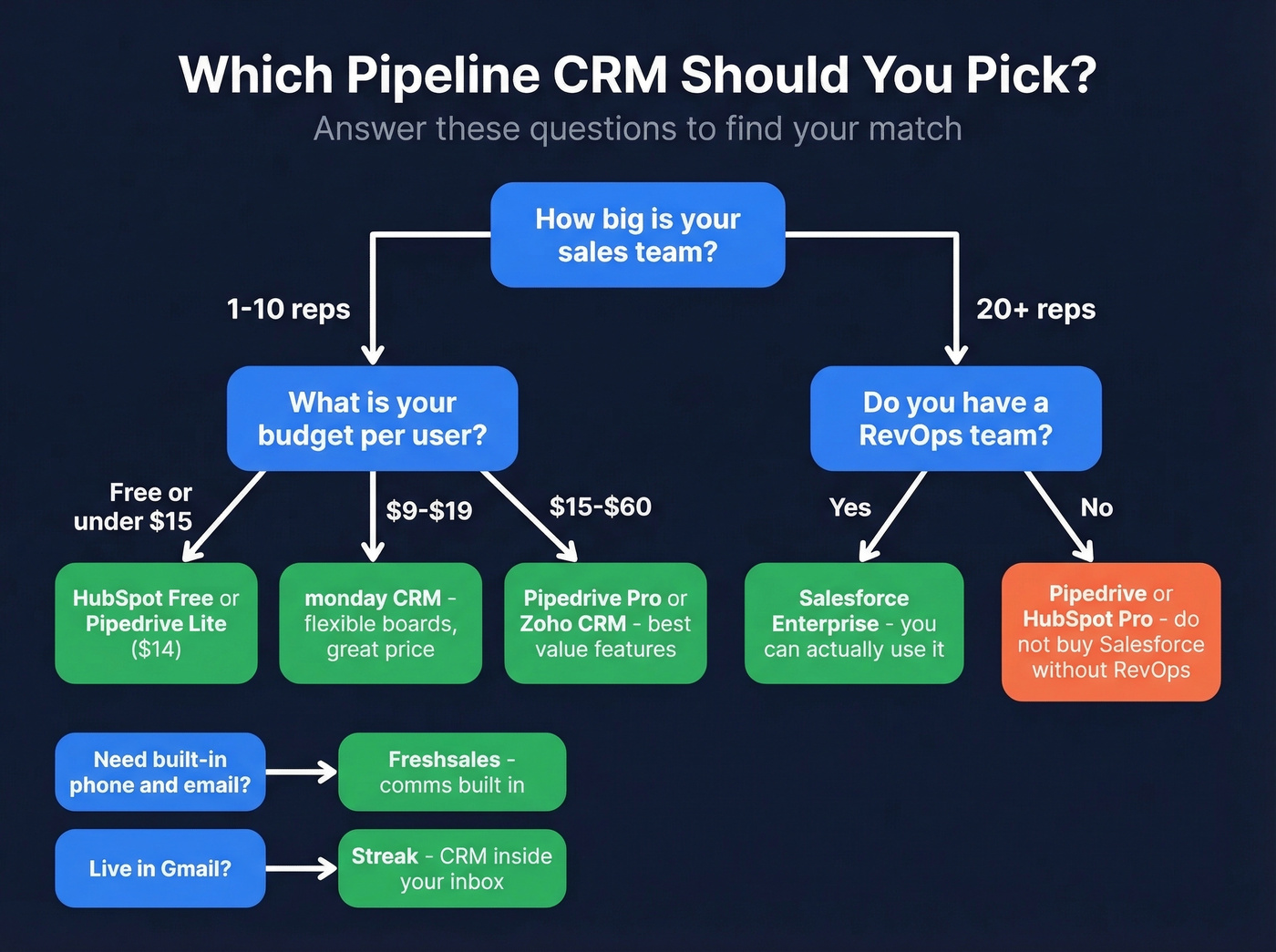
Use this if you have 20+ reps, a RevOps team to manage it, and workflows complex enough to justify the cost.
Skip this if your team is under 20 reps. You'll pay for power you can't operationalize.
Salesforce is still the most powerful CRM on the market. But most teams don't need the most powerful CRM on the market. If your average deal size is under $25k and your team is under 15 reps, you're paying for a fighter jet to commute to work.
monday CRM
At $19/seat, a 5-person team pays $95/month on Pro (annual billing) - less than a single Salesforce Enterprise seat.
monday is a Work OS first and CRM second, which means the pipeline boards are flexible, customizable, and backed by 250+ pre-built no-code automation recipes. Pricing runs Basic at $9, Standard at $12, Pro at $19/seat/month billed annually, with a minimum of 3 seats on paid plans. Enterprise is custom. Teams that need multiple pipelines will appreciate monday's ability to spin up separate boards for different products, regions, or sales motions without paying extra.
The tradeoff is that monday doesn't feel like a traditional CRM. There's no built-in email sequence engine, no native dialer, and the sales-specific features are thinner than Pipedrive or HubSpot. For teams that already have a separate outreach stack, that's fine. For teams that want everything in one place, it's a dealbreaker.
Use this if you want a structured pipeline board with automations and you'll handle outreach in a separate tool. Skip this if you want an all-in-one sales platform.
Zoho CRM
PCMag named Zoho CRM their "Best Overall" CRM for 2026, and the reasoning holds up: deep customization, strong AI via Zia, and pricing that undercuts Salesforce by a wide margin. Paid plans typically run $14-$52/user/month depending on edition and billing, with a free tier for up to 3 users.
The depth here is real - Zia handles lead scoring and predictions, multichannel tracking is built in, and the customization options rival Salesforce. But that depth comes with a steeper learning curve than Pipedrive and a UI that feels dated compared to newer tools. Small teams often find the configuration options overwhelming rather than empowering. If you want to go deeper on scoring, see this guide to lead scoring.
For teams that want enterprise features without enterprise pricing and are willing to invest in setup, Zoho is one of the best value-per-feature options on this list.
Freshsales
Freshsales bundles phone, email, and chat into the CRM itself, which means small teams don't need to figure out integrations for basic communication. Freddy AI handles lead scoring and deal forecasting. The pipeline UI is clean and intuitive. Free tier available, paid plans from ~$9-$59/user/month.
Use this if you want built-in communication channels without bolting on third-party tools. Skip this if you need a large integration ecosystem - Freshsales works best inside the Freshworks suite and gets limited outside it.
Pipeline CRM
Purpose-built for pipeline management (it's literally in the name). Pipeline CRM keeps things simple: spreadsheet-like interface, unlimited file/data storage, and free phone support. Pricing runs Start at $25, Develop at $33, Grow at $49/user/month. Enterprise is custom.
Use this if you want a no-frills pipeline tool with fast setup. Skip this if you need advanced AI or deep automation - Pipeline CRM is intentionally lightweight.
Pipeliner CRM
Rich visual pipeline with extensive features and offline access. But let's talk about the elephant in the room: Pipeliner starts at $65/user/month with a 3-user minimum. Plans run from Starter at $65 to Business at $85, Enterprise at $115, and Unlimited at $150/user/month on annual billing. That's $195/month minimum before you've tracked a single deal.
Their marketing pushes a "lowest TCO" claim, but at $65 minimum versus Pipedrive's $14 or monday's $9, that claim doesn't survive basic math.
Other Notable Options
Streak is a Gmail-native pipeline - your deals live inside your inbox. From $49/user/month billed annually. Best for solopreneurs who live in Gmail and don't want a separate CRM tab.
Capsule is a clean, simple CRM that does exactly what it says. From $18/user/month billed annually. Best for small teams wanting zero complexity.
Bigin by Zoho is a micro-CRM at $7/user/month billed annually. Best for tiny teams or freelancers who just need a deal board without the weight of full Zoho CRM. Copper is built for Google Workspace, from ~$23/user/month. Insightly blends CRM with project management, from ~$29/user/month.

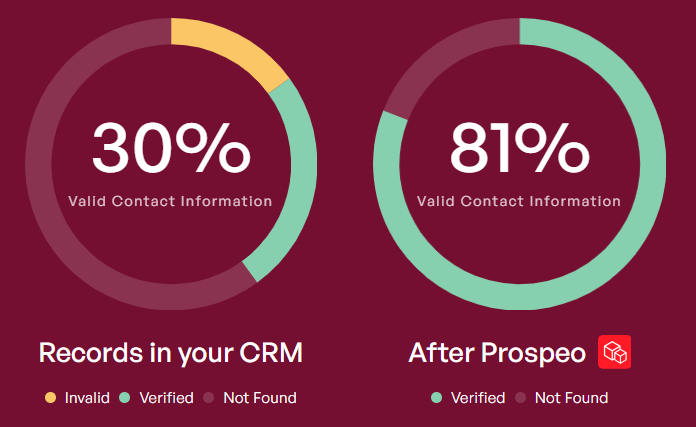
You just read it: bad data produces worse forecasts than a cheap CRM with verified contacts. Prospeo enriches your pipeline with 98% accurate emails, 125M+ verified mobiles, and 50+ data points per contact - refreshed every 7 days, not 6 weeks.
Stop building pipeline on a foundation of bad numbers.
Comparison Table
| Tool | Starting Price | Free Tier | Pipeline AI | Best For |
|---|---|---|---|---|
| Pipedrive | $14/user/mo | No | All plans | Overall pipeline UX |
| HubSpot | Free | Yes | Pro+ (~$100) | Free starting point |
| Salesforce | $25/user/mo | Yes (2 users) | Enterprise+ | Large orgs (20+ reps) |
| monday CRM | $9/seat/mo | No | Pro ($19) | Budget pipeline boards |
| Zoho CRM | ~$14/user/mo | Yes (3 users) | Zia (paid) | Deep customization |
| Freshsales | ~$9/user/mo | Yes | Freddy (paid) | Built-in comms |
| Pipeline CRM | $25/user/mo | No | Limited | Simple pipeline |
| Pipeliner | $65/user/mo | No | Yes | Visual pipeline (big budget) |
| Streak | $49/user/mo | Yes (basic) | No | Gmail power users |
| Capsule | $18/user/mo | Yes | No | Simplicity |
| Bigin | $7/user/mo | Yes | No | Micro teams |
Why Data Quality Trumps CRM Features
Every CRM on this list tracks deals. None of them guarantee the contacts inside those deals are real.
We've seen this pattern repeatedly: a team spends weeks configuring their pipeline stages, building automations, and training reps - then 180 emails bounce on the first outreach sequence. Forecasts collapse because half the "qualified" pipeline is built on stale data. The CRM isn't broken. The data is. (If you’re diagnosing bounces, start with email bounce rate benchmarks and fixes.)
This is where Prospeo fits in. With 300M+ professional profiles, 98% email accuracy, and a 92% API match rate for CRM enrichment, it handles the data layer that your CRM assumes someone else is managing. Most data providers refresh records every 4-6 weeks; Prospeo runs on a 7-day refresh cycle, so the contact who changed jobs last Tuesday doesn't show up as a bounced email next Monday. Native integrations with Salesforce and HubSpot mean enrichment runs automatically alongside your pipeline.
Your CRM is step one. Clean data is step zero.
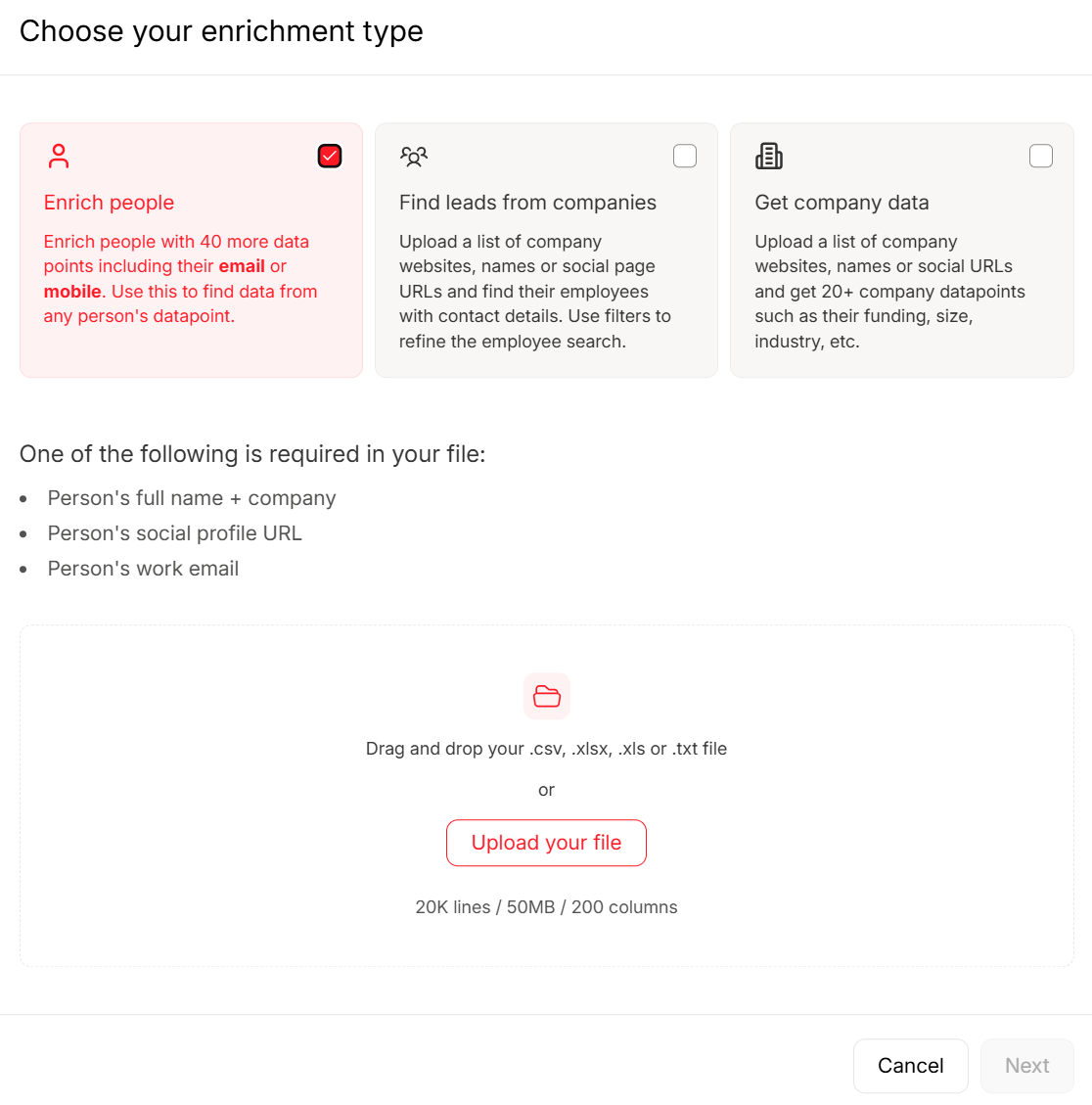
Every CRM on this list integrates with Prospeo - HubSpot, Salesforce, Pipedrive, and more. Push verified contacts directly into your pipeline at $0.01/email instead of paying $1/lead from legacy providers. 83% of leads come back enriched.
Fill every pipeline stage with contacts that actually connect.
Pipeline Benchmarks Worth Knowing
A few numbers worth pinning to your wall.
Opportunities closed within 50 days hit a 47% win rate. After 50 days, that drops to 20% or lower. If your CRM doesn't flag aging deals automatically, you're flying blind on the metric that matters most.
The average B2B win rate sits at 21% - roughly 4 out of 5 qualified opportunities don't close. Sales cycles have lengthened by 32% since 2021, which means deals that used to close in 45 days now take 60. And 34% of revenue teams report average sales cycles of 1-2 full quarters, so if your pipeline feels slower than it used to, you're not imagining it. For more context, see these sales pipeline benchmarks.
For high-velocity teams, the benchmark for rep book size is 100-300 active accounts. One case study showed that trimming books from 500+ accounts down to 300-400 correlated with win rates jumping from 13% to over 20% in under a year. Top teams refresh rep books every 30-60 days to keep pipeline current. Your CRM should surface these patterns, not bury them in custom reports you never build.

Pipeline Mistakes Your CRM Should Prevent
Inconsistent prospecting. Pipeline dries up when reps stop filling the top. Your CRM should track prospecting activity alongside deal progression - if new opportunities drop below a threshold, you see it immediately. A top-heavy pipeline with tons of early-stage deals and nothing near close signals a qualification problem; a bottom-heavy pipeline with only late-stage deals means prospecting dried up weeks ago. If you need a system, use these sales prospecting techniques.
Poor lead qualifying. Deals that shouldn't be in your pipeline inflate forecasts and waste rep time. Use required fields and stage-gate criteria to force qualification before a deal moves past discovery. This is the single most common pipeline mistake, and it's entirely preventable with the right CRM configuration.
Letting leads go cold. A deal that hasn't been touched in 14 days is dying. Set automated reminders and stale-deal alerts so nothing slips through the cracks.
Keeping stagnant leads. Dead-end deals sitting in your pipeline throw off every metric - win rate, cycle time, forecast accuracy. Run weekly pipeline reviews to purge them. Stale contact data is its own form of pipeline rot, too; automated enrichment on a short refresh cycle prevents contacts from decaying while they sit in your CRM. (To track this systematically, monitor pipeline health metrics.)
FAQ
What is a pipeline sales CRM?
It's a CRM built around visual deal tracking through defined stages - lead, qualified, proposal, negotiation, closed. Most modern CRMs include pipeline views, but the depth of visualization, automation, and forecasting varies dramatically between free tiers and paid plans.
When should I upgrade from a free CRM?
Upgrade when you need forecasting, workflow automation, or custom reporting. Free tiers from HubSpot, Salesforce, and Zoho handle basic pipeline tracking, but they gate the features that actually drive revenue improvement - like AI deal scoring and multi-pipeline views - behind paid plans starting at $14-$25/user/month.
How many pipeline stages should I set up?
Five to seven is the sweet spot for most B2B sales processes. Fewer than four hides where deals stall. More than eight creates friction, and reps start skipping stages, which defeats the purpose of tracking.
How do I keep CRM pipeline data accurate?
Pair your CRM with a data enrichment tool that verifies contact emails on a regular refresh cycle and returns detailed data points per record. Run weekly pipeline reviews to remove stagnant deals, and enforce required fields at each stage to prevent garbage data from entering.
The Bottom Line
For most teams, Pipedrive at $14-$79/seat billed annually is the right pipeline sales CRM - best UX, fair pricing, AI across plans. If you're starting from zero, HubSpot's free tier gets you moving, but budget for the upgrade. If you're running 20+ reps with dedicated RevOps, Salesforce earns its price tag. And whichever CRM you pick, verify your contact data before you build pipeline on it. A clean pipeline with accurate contacts will always outperform a sophisticated CRM full of bad emails.