

The Product Launch Email Sequence That Actually Converts
The average office worker gets 120+ emails a day. Your product launch is competing with every single one of them - plus Slack pings, calendar invites, and whatever dumpster fire just hit the group chat. Most launch sequences either blast one announcement into the void or drip so many emails that subscribers tune out by email three.
Here's the short version: build a product launch email sequence of 5 emails across 3 phases - pre-launch, launch, post-launch. Clean your list before you send anything. Target a 5.58% click rate on your automated sequence, the 2026 Klaviyo benchmark across 183,000+ brands. Let's break it down.
Clean Your List First
Your launch emails can't convert from the spam folder. A dirty list with outdated addresses and spam traps will tank your domain reputation on your most important send - the one you've been building toward for weeks. Stack Optimize built from $0 to $1M ARR running outbound campaigns and kept client deliverability at 94%+ with bounce rates under 3%, because they verified every list before sending.

We've seen teams pour weeks into launch copy only to watch 15% of their emails bounce on Day 0. Run your list through Prospeo's 5-step verification before launch day. It catches invalid addresses, spam traps, and honeypots at 98% accuracy, and the free tier gives you 75 verifications per month - enough to test the workflow before committing.
The 3-Phase Framework
The foundation is Jeff Walker's Product Launch Formula, which has generated $1B+ in sales since 2005. The core idea: don't just announce - build anticipation, deliver, then follow up.
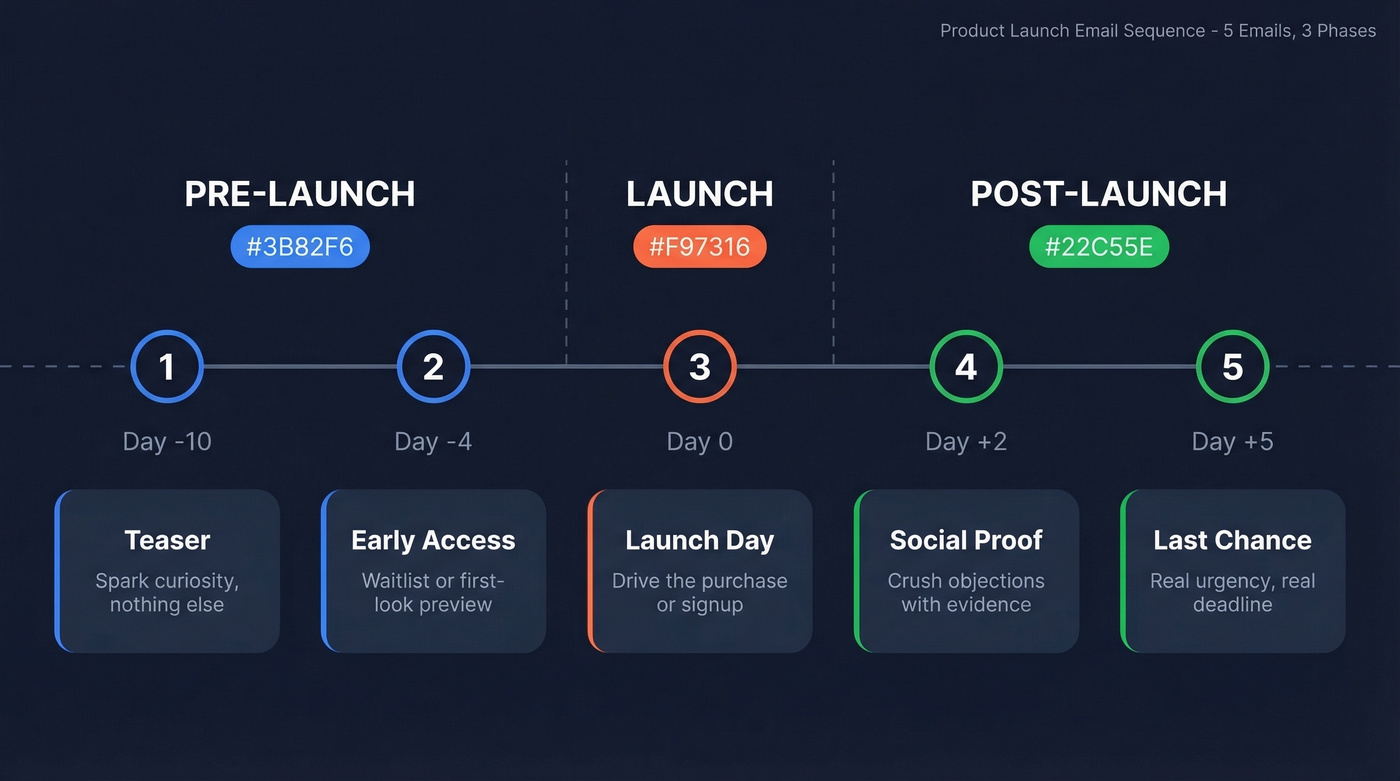
Adapted for modern email, the framework breaks into three phases:
- Pre-launch - 2 emails, Day -10 to Day -4. Create curiosity and segment your most engaged subscribers.
- Launch - 2 emails, Day 0 to Day +2. Drive the purchase or signup, then handle objections with proof.
- Post-launch - 1 email, Day +5. Final conversion push for anyone still on the fence.
Five emails total. That's the sweet spot for most businesses - enough to build momentum without burning out your list.
The 5-Email Sequence Breakdown
Email 1: Pre-Launch Teaser (Day -10)
Goal: Spark curiosity. Nothing else. Apple's legendary "See you on the 7th." subject line is the gold standard - no product details, no features, just a date and intrigue. Keep the body under 100 words with a single CTA like "Mark your calendar." If you need more options, pull from these email subject lines to match your brand voice.
Subject line: "Something new is coming Sept 15."
Email 2: Early Access Invite (Day -4)
Robinhood built a pre-launch waitlist that hit nearly 1 million users before launch - purely on exclusivity. That's the energy for this email. Offer a waitlist, early-bird pricing, or a first-look preview. Typology nails this with subject lines like "EARLY ACCESS: 3 new Typology products," sent only to engaged subscribers. Anyone who opens and clicks this email is your launch-day priority segment.
Subject line: "You're on the early list - first look inside."
Email 3: Launch Day (Day 0)
Drive the purchase or signup. This is your Peak Design moment - direct, visual, one CTA. Lead with the product, show one hero image, and make the buy button impossible to miss. Don't bury it under three paragraphs of backstory. If someone's been following since Email 1, they already know the context. Respect that.
Subject line: "It's live. [Product name] is here."
Email 4: Social Proof (Day +2)
The top objection two days after launch is almost always the same: "Do I really need this?" Address it head-on. In our experience, the social proof email at Day +2 consistently outperforms the launch-day email on click rate - because early adopters now have results you can show. Pull a testimonial, a usage stat, or a quick case study. Lead with the objection, then crush it with evidence. If you're selling B2B, this is where sales communication fundamentals matter most.
Subject line: "What 200 early users are saying."
Email 5: Last Chance (Day +5)
Reddit's r/SaaS community consistently flags "no tricks or timers" as what builds trust - and they're right. Use real urgency here: an actual deadline, a limited inventory count, or the end of a launch discount. Skip fake countdown timers. If the scarcity isn't real, your audience will smell it instantly.
Subject line: "Launch pricing ends Friday."
The Lean SaaS Alternative: 3 Emails
Not every launch needs five emails. If you're a SaaS company converting free users to paid, a tighter sequence works better. One SaaS founder on r/SaaS shared a 3-email structure worth stealing:
- Activation - get users to a result within minutes of signing up.
- Feedback - ask what worked and what didn't, designed to drive replies.
- Offer - after users test the free tier, introduce the paid plan with zero fake urgency.
Clay uses a similar philosophy with numbered subject lines - "Welcome to Clay! (1/6)", "Find your first leads (2/6)" - setting clear expectations for the sequence length. For SaaS, clarity beats mystery every time. If you want a parallel structure for outbound, compare it to a B2B cold email sequence.

A 5-email launch sequence is worthless if 15% of your list bounces on Day 0. Prospeo's 5-step verification catches invalid addresses, spam traps, and honeypots at 98% accuracy - so your launch-day email actually reaches the inbox. Start with 75 free verifications.
Clean your launch list before you waste your best copy on dead addresses.
Segment Before You Send
Sending the same launch email to your entire list is the fastest way to tank engagement. Segmentation lifts opens by 30% and clicks by 50% according to HubSpot's State of Marketing data. If you want to go deeper than basic engagement buckets, use intent based segmentation to prioritize buyers.
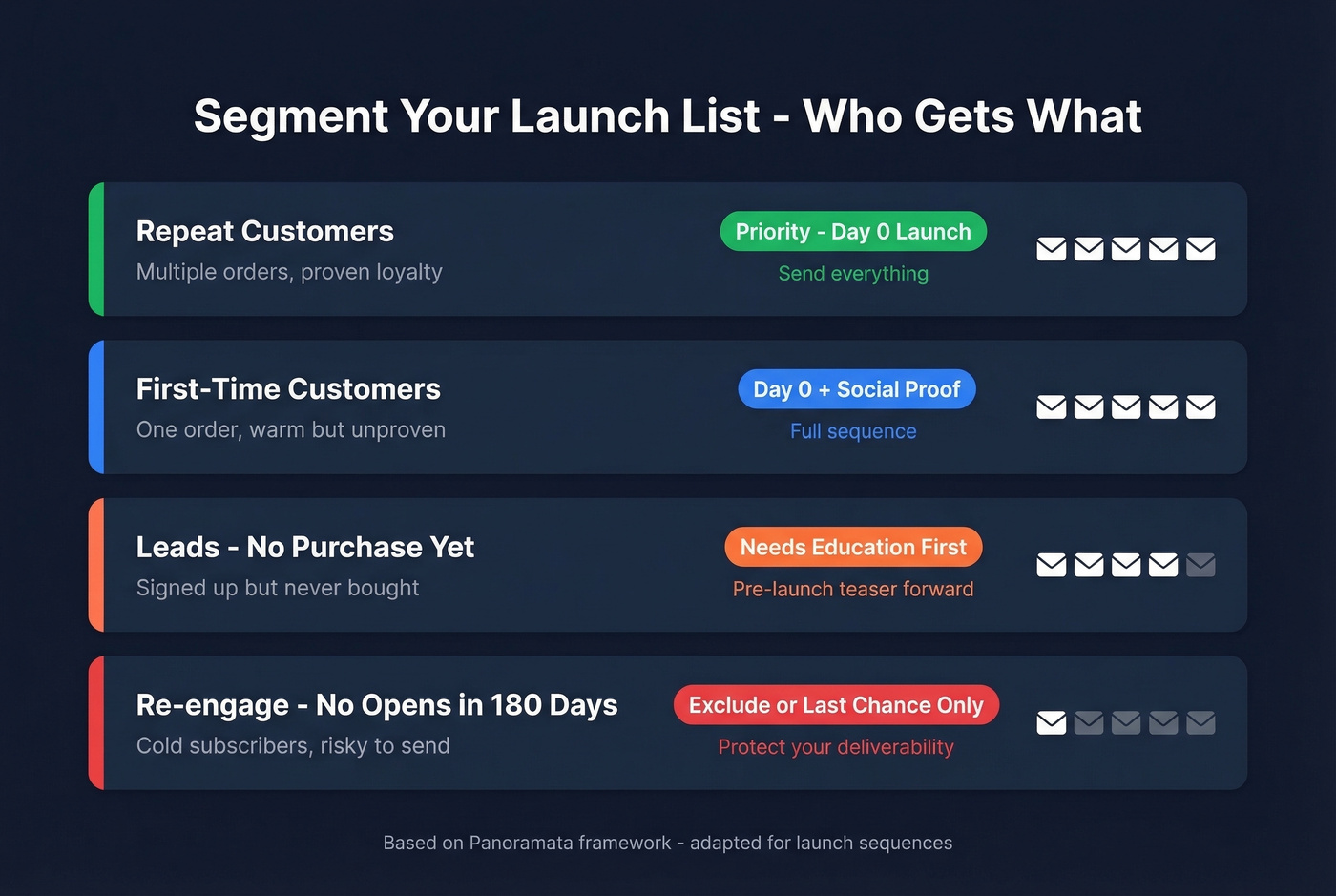
Panoramata's framework breaks it into four segments:
- Leads who haven't ordered yet - heaviest education needed
- First-time customers with one order - warm but unproven loyalty
- Repeat customers - your launch-day priority
- Re-engage subscribers with no opens in 180 days - exclude from early sends to protect deliverability
Don't email the re-engage segment on Day 0. Save them for the last-chance email at most, and even then, think twice. Those cold subscribers dragging down your open rate will hurt deliverability for everyone else on the list.
2026 Benchmarks Worth Knowing
Here's what "good" looks like, based on Klaviyo's 2026 data across 183,000+ brands:
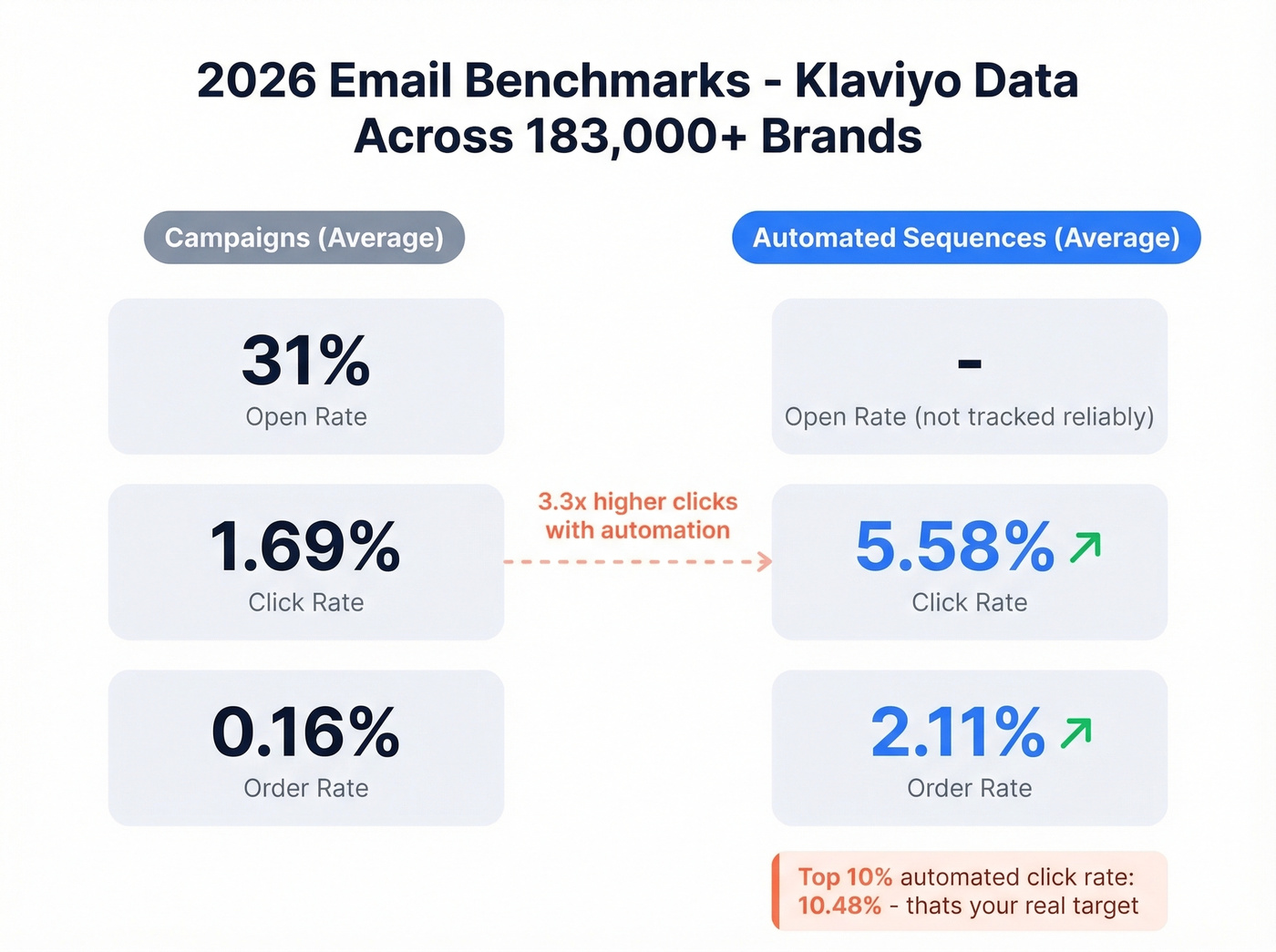
| Metric | Campaigns (avg) | Campaigns (top 10%) | Automated (avg) | Automated (top 10%) |
|---|---|---|---|---|
| Open rate | 31% | 45.1% | - | - |
| Click rate | 1.69% | 3.38% | 5.58% | 10.48% |
| Order rate | 0.16% | 0.36% | 2.11% | 4.3% |
Apple Mail Privacy Protection inflates open rates, so optimize for clicks regardless.
Your launch sequence is an automated flow, so benchmark against the Automated column. Hitting 5.58%+ click rate means you're at average. Aim for 10%+. To sanity-check your numbers, use a consistent click rate formula.
Look, if your launch sequence click rate is below 3%, the problem probably isn't your copy - it's your list. We've seen bounce rates above 10% tank sender reputation for weeks, dragging every metric down with it. Fix the data first, then optimize the words. If you’re diagnosing issues, start with email bounce rate benchmarks and root causes.
Mistakes That Kill Launch Sequences
Sending to your entire unsegmented list. Your re-engage segment will drag down deliverability for everyone else. Segment first, always.
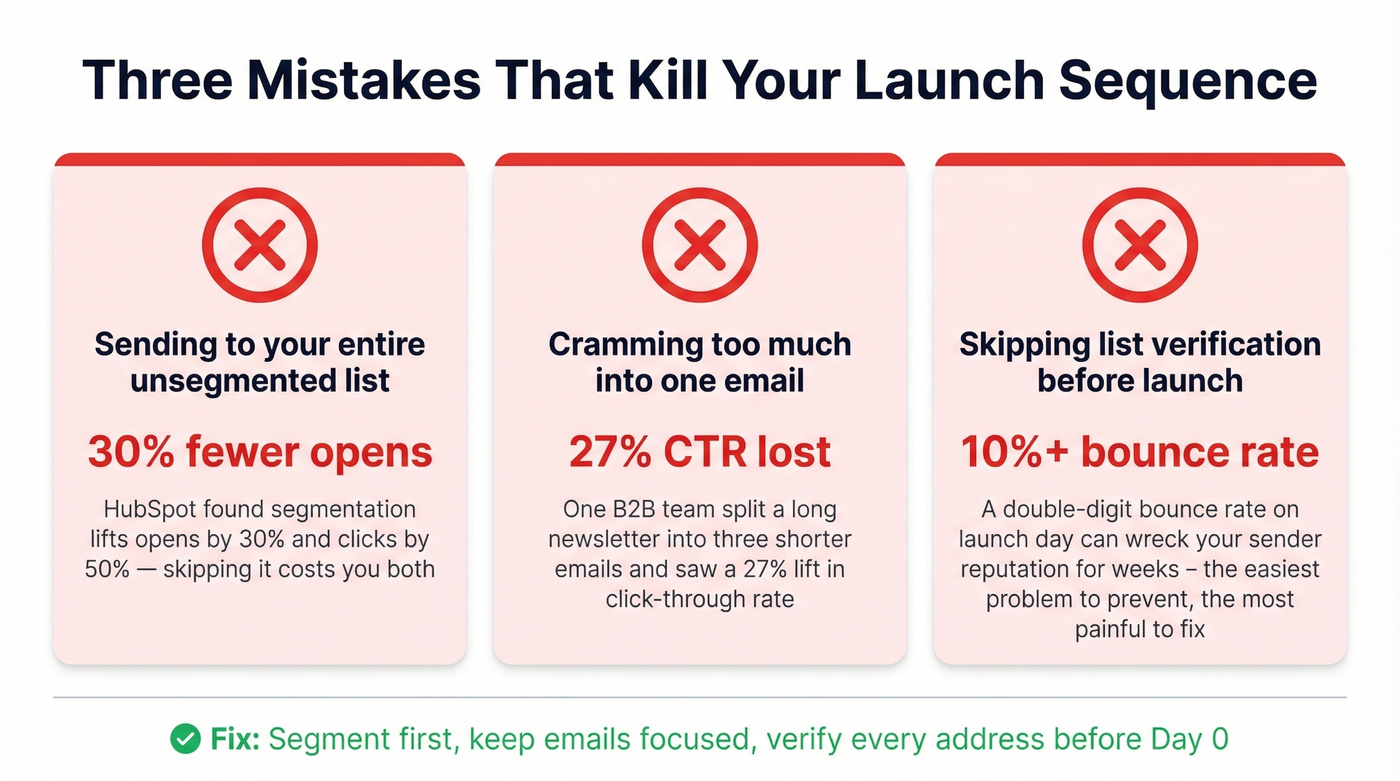
Cramming too much into one email. One B2B team split a single long newsletter into three shorter emails and got a 27% lift in CTR. Each launch email should have one job. One. If you need help tightening the message, use these email copywriting principles.
Skipping list verification. A 10% bounce rate on launch day can wreck your sender reputation for weeks. This is the easiest problem to prevent and the most painful to fix after the fact. Verify before you send. If you're rebuilding trust after a rough send, follow a deliverability guide and work on sender reputation.
Segmenting your launch list by engagement is step one. Step two is making sure every segment has verified contact data. Prospeo refreshes 300M+ profiles every 7 days - not every 6 weeks - so your early-access invites and Day 0 sends hit real inboxes at $0.01 per email.
Stop launching into the void. Start with data that's 7 days fresh.
Product Launch Email Sequence FAQ
How many emails should a launch sequence have?
Five emails across three phases - two pre-launch, two during launch, one post-launch - is the sweet spot for most DTC and B2B launches. SaaS companies converting free users to paid can trim to three: activation, feedback, offer.
What click rate should I target?
Aim for 5.58% or higher on automated sequences, per Klaviyo's 2026 benchmark across 183,000+ brands. Top 10% performers hit 10.48%. If you're below 3%, your list quality is likely the bottleneck - verify addresses before optimizing copy.
Should I use a different sequence for B2B vs DTC?
Yes. DTC sequences lean on urgency and scarcity across five emails. B2B focuses on activation and value first - three emails, no fake timers, and a feedback loop before the paid offer. B2B also benefits from tighter segmentation by role and intent.
How do I keep my emails out of spam during a launch?
Verify your list before sending - bounce rates above 10% wreck sender reputation for weeks. Also exclude subscribers with no opens in 180+ days from early sends, and warm up any new sending domains well before launch day.