

Product Qualified Leads: What They Are, Why They Convert 3x, and How to Score Them
Your product-led funnel is generating signups. Users are activating. But sales is still chasing MQLs who downloaded an ebook six weeks ago and can't remember your company name.
That's the gap product qualified leads are designed to close - and the number one reason PQL programs fail isn't bad scoring. It's bad data. PQLs convert at 25-39% trial-to-paid depending on deal size, compared to 1-7% MQL-to-close for SaaS. Let's break down how to build a PQL program that actually works.
What You Need (Quick Version)
A PQL is a user who's experienced real value in your product and matches your ICP. To use them, you need three things:
- A self-serve product with fast time-to-value - freemium or free trial where users can hit an "aha moment" without talking to anyone
- A scoring model combining fit + usage + intent signals - not just "logged in 3 times" (see lead scoring)
- Verified contact data so sales can actually reach the people your model flags (compare data enrichment services)
That third bullet is where most PQL programs quietly die.
What Is a Product Qualified Lead?
A PQL is someone who's done something meaningful inside your product - not just browsed your marketing site. The Pocus framework breaks it into three signal categories: customer fit, meaning they match your ICP; product usage, meaning they've activated key features; and buying intent, meaning they're signaling readiness to pay.
The canonical example is Slack. A workspace that hits 2,000 messages sent has demonstrated real adoption - that's a fundamentally different signal than someone who attended a webinar. As one r/SaaS practitioner put it: "interest doesn't equal intent." MQLs tell you someone's interested in your content. PQLs tell you someone's interested in your product. That distinction drives the entire conversion gap.
PQLs don't have to come from freemium usage alone, either. Interactive demo engagement - where a prospect completes a guided product walkthrough before ever signing up - can generate equally strong product-qualified signals. If someone configures a demo environment to match their workflow, that's behavioral intent data, not marketing engagement (use a product demo checklist).
PQLs vs MQLs vs SQLs
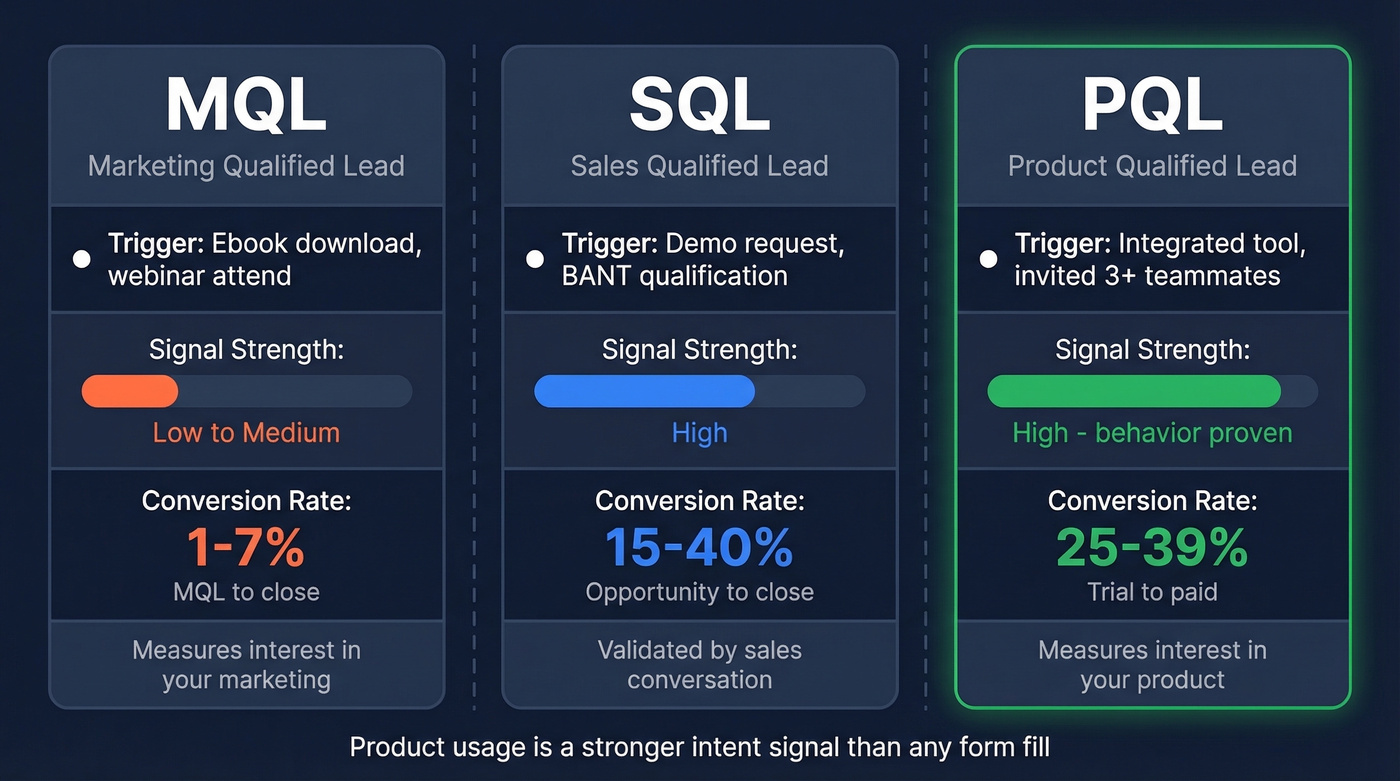
The differences come down to what triggered the qualification and how strong the intent signal is.
| MQL | SQL | PQL | |
|---|---|---|---|
| Trigger | Marketing engagement | Sales validation | Product usage |
| Signal | Ebook download, webinar | Demo request, BANT fit | Integrated tool, 3+ invites |
| Intent strength | Low-medium | High | High (behavior-proven) |
| Typical conversion | 1-7% to close | Opportunity to close: 15-40% | 25-39% to paid |
MQLs measure interest in your marketing. PQLs measure interest in your product. A user who's integrated Salesforce, invited three colleagues, and hit a usage threshold has shown you more about their buying intent than any form fill ever could.

You said it: PQL programs quietly die when sales can't reach the people your model flags. Prospeo delivers 98% verified emails and 125M+ direct dials so your reps contact PQLs within minutes, not days. Enrich signups with 50+ data points - company size, role, intent - to nail the fit score automatically.
Stop scoring leads you can't contact. Enrich every PQL with verified data.
Why PQLs Convert 3x Better
A ProductLed survey of 600+ SaaS companies found that only about 25% of product-led companies actually use PQLs - but the ones that do see roughly 3x higher conversion. Free trials using PQLs convert to paid at about 25% on average. For deals in the $1K-$5K ACV range, that jumps to 30%. At $5K-$10K ACV, it's 39% (see average B2B lead conversion rate).
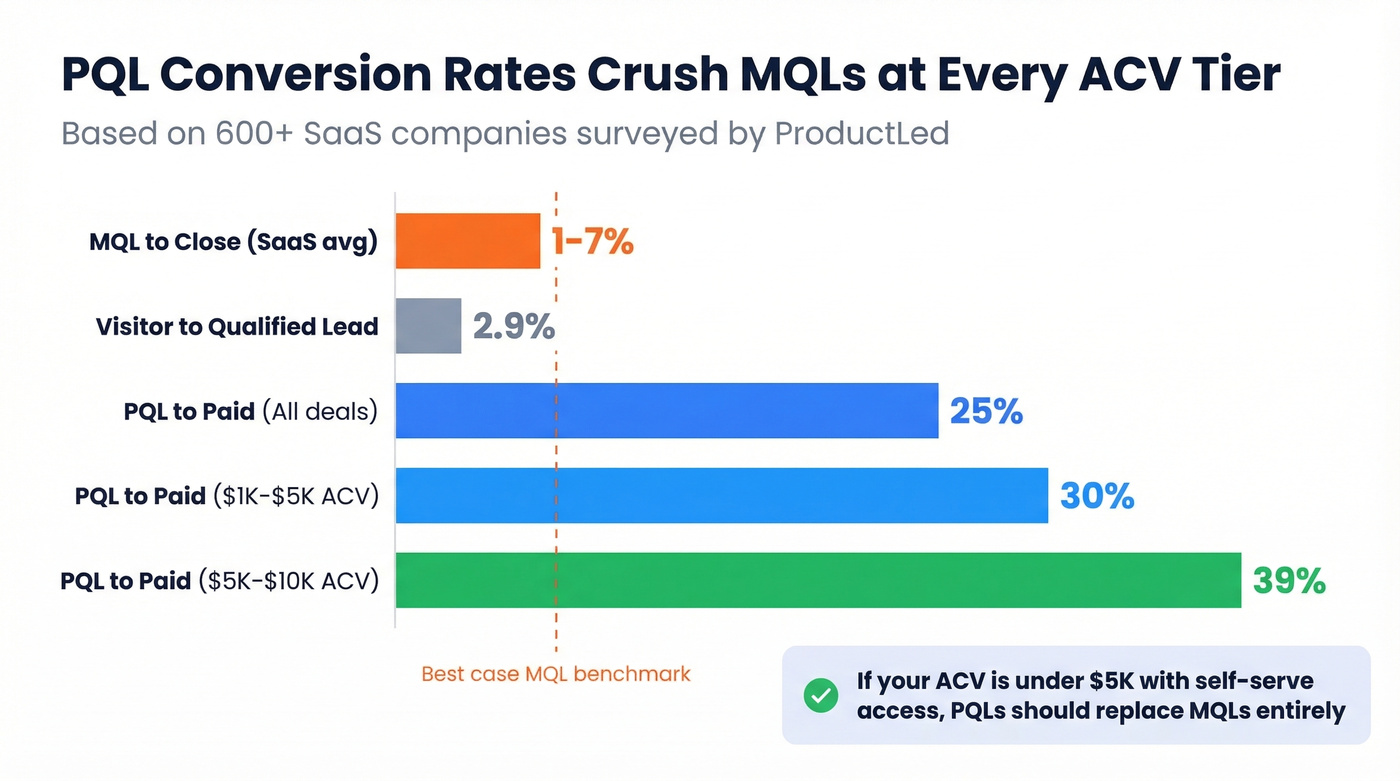
Compare that to the broader funnel. Across 100M+ datapoints, visitor-to-qualified-lead conversion sits at just 2.9%. MQL-to-close in SaaS runs 1-7% depending on company stage. PQLs aren't just outperforming - they're in a different league.
Here's the thing: the average B2B buying cycle runs 10.1 months, the pre-contact favorite wins roughly 80% of deals, and the winning vendor is on the buyer's Day One shortlist 95% of the time. When someone's already using your product, you're not fighting for shortlist position. You're already there.
If your ACV is under $5K and you've got a self-serve product, PQLs should replace MQLs entirely - not supplement them. Running both systems in parallel creates confusion about which leads sales should prioritize, and the answer is always the one who's already using your product.
How to Build a PQL Scoring Model
Only 34% of PLG companies even track activation. That means two-thirds of product-led teams are flying blind on the single metric that matters most for PQL identification.
Define Fit + Activation Signals
Start by writing your PQL hypothesis as a statement: "A [role] at a [company type] who has [done X action] within [Y days] is a PQL." This forces clarity. A VP of Engineering at a 200-person SaaS company who's invited teammates within 7 days is a very different lead than a student exploring your free tier.
Your lead grade captures fit - company size, industry, role, geography (use an Ideal Customer Profile). Your lead score captures behavior - feature adoption milestones, collaboration events like invites and shared workspaces, integration setup, usage frequency and recency, and paywall interactions.
Assign Weights and Thresholds
Not all signals are equal. Here's an example scoring model:
| Event | Points |
|---|---|
| Invited 3+ teammates | +30 |
| Integrated key tool | +25 |
| Hit paywall/usage limit | +20 |
| Visited pricing page | +15 |
| Daily active use (7+ days) | +20 |
| Exported data/report | +10 |
Set your threshold based on historical conversion data. If users scoring 60+ convert at 3x the rate of those below 60, that's your line. Recalibrate quarterly - we've seen scoring models drift significantly within two quarters as product features and user behavior evolve.
Build the Scenario Matrix
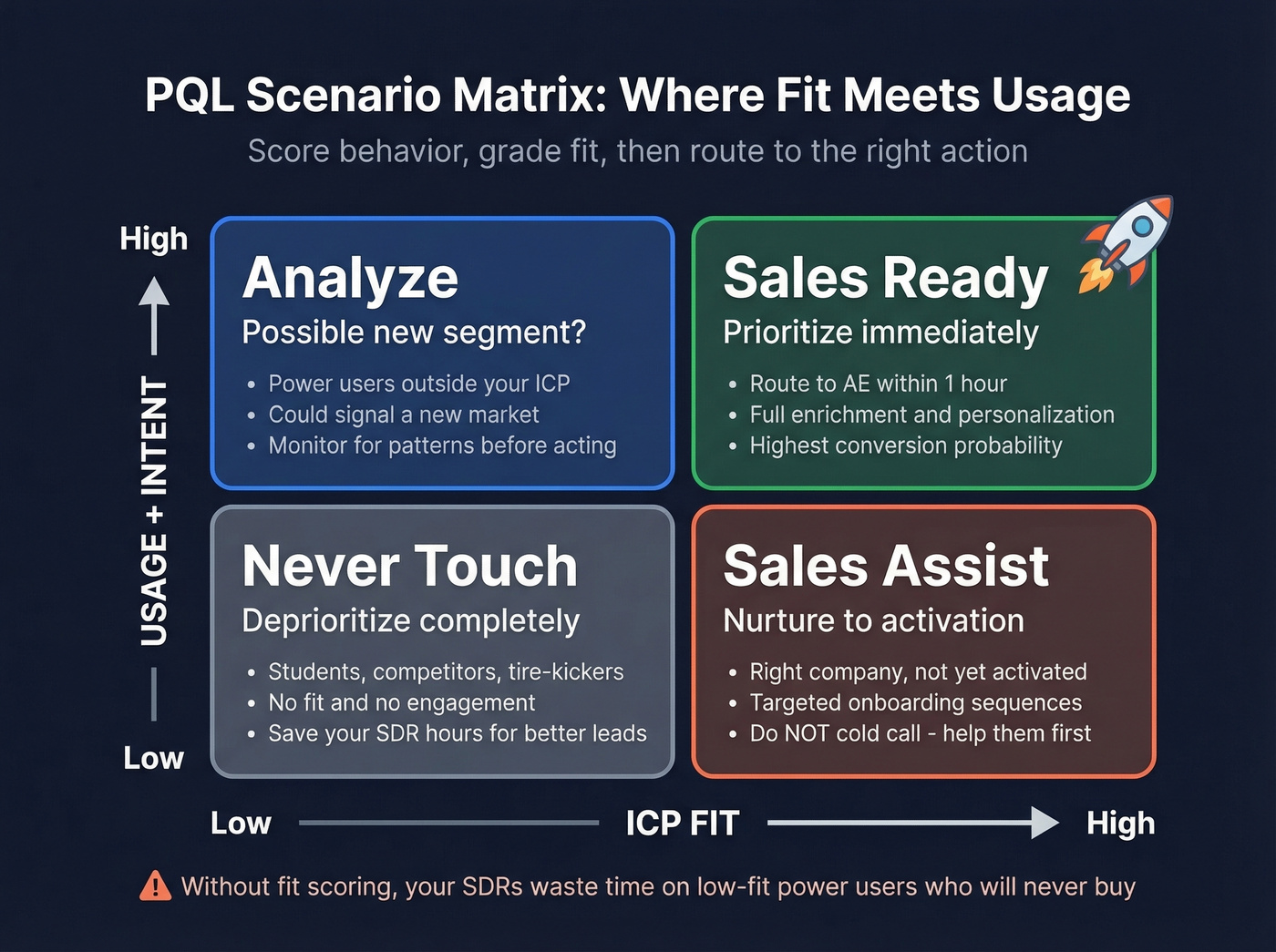
Once you've got scores and grades, segment into action buckets:
| High Fit | Low Fit | |
|---|---|---|
| High Usage/Intent | Sales Ready - prioritize | Analyze - new segment? |
| Low Usage/Intent | Sales-Assist - nurture | Never Touch - deprioritize |
This matrix prevents your SDRs from wasting time on low-fit power users like students and competitors. It also ensures high-fit accounts that need adoption help get the right touch - a targeted onboarding email sequence, not a cold call (see sales prospecting techniques).
When PQLs Don't Work
Skip PQLs if your product doesn't have self-serve access and fast time-to-value. If your implementation takes months - think enterprise Salesforce deployments or complex supply chain software - users can't reach an "aha moment" quickly enough to generate a meaningful product signal.
They also break down when your free tier attracts the wrong audience. Students, competitors, and tire-kickers can all look like activated users if your scoring model isn't filtering on fit. That's why the grade dimension matters as much as the score.
For mature PLG organizations, PQLs evolve beyond free-to-paid triggers. Atlassian uses expansion signals - Jira adoption correlating with Confluence cross-sell opportunities. That's PQL 201: paid-to-higher-tier, not just free-to-paid. PQL 301 layers in predictive signals, usage patterns that forecast churn or expansion before the user takes explicit action. Most teams aren't there yet, and that's fine. Nail the basics first (see churn analysis).
Bridging PQL Signals and Sales Outreach
Here's where most PQL programs quietly fail.
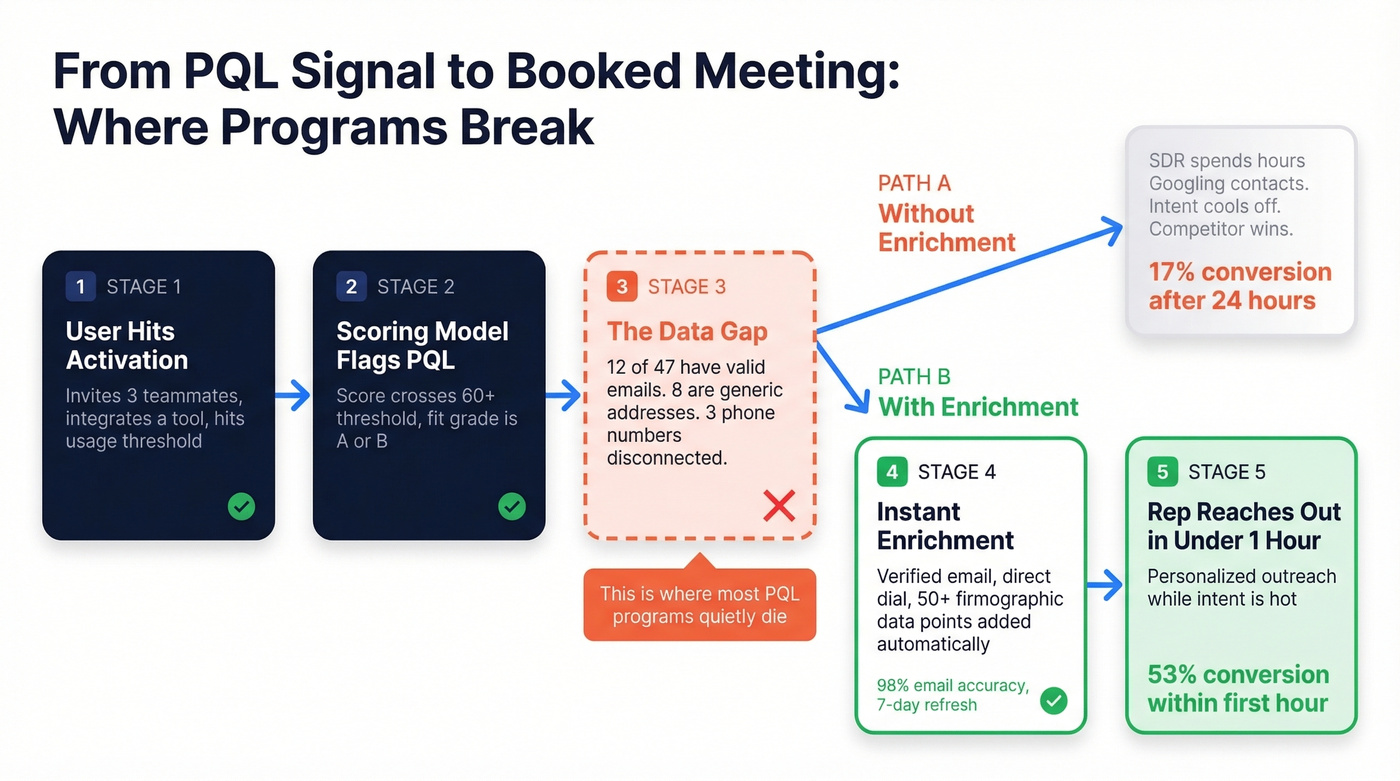
Your scoring model flags 47 users who've hit activation thresholds this week. Your SDR opens the list. Twelve have valid email addresses. Eight of those are generic role-based emails. Three phone numbers are disconnected. The model worked. The data didn't.
In our experience, the data quality gap kills more PQL programs than bad scoring ever does. Reaching out within the first hour increases conversion to 53%; after 24 hours, it drops to 17%. Every hour your SDR spends hunting for contact info is an hour that high-intent user is cooling off or evaluating a competitor.
This is where enrichment closes the gap. When your PQL model flags a user, tools like Prospeo can enrich that record instantly - verified email, verified mobile, 50+ data points - so your rep is reaching out while intent is still hot (see lead enrichment). With 98% email accuracy on a 7-day refresh cycle, the vast majority of your flagged PQLs become actually reachable instead of sitting in a queue while someone Googles their phone number.
Your scoring model separates high-fit power users from tire-kickers. But without accurate firmographic and contact data, your scenario matrix is just a spreadsheet. Prospeo's CRM enrichment returns verified emails, direct dials, and 50+ data points at 92% match rate - for $0.01 per email.
Turn your PQL scores into booked meetings with data that's refreshed every 7 days.
FAQ
What's the difference between a PQL and an MQL?
An MQL shows marketing engagement - they downloaded an ebook or attended a webinar. A PQL shows product engagement, meaning they've used your product and hit meaningful activation milestones. PQLs convert 3-5x higher because product usage is a far stronger intent signal than content consumption.
What conversion rate should I expect from PQLs?
Based on a 600+ SaaS company survey, PQLs convert to paid at roughly 25% on average. That jumps to 30% for $1K-$5K ACV deals and 39% for $5K-$10K ACV. Compare that to MQL-to-close rates of 1-7% in SaaS.
How do I start if I'm not tracking activation yet?
You're not alone - 66% of PLG companies don't track activation either. Start with one signal: the action most correlated with conversion to paid. For Slack it was messages sent; for Dropbox it was files synced. Identify your equivalent, set a threshold, and route those users to sales. You can layer in fit scoring and additional signals once the basic pipeline is working.
How do I make sure sales can actually reach flagged PQLs?
Enrich every PQL record the moment it crosses your scoring threshold. Speed matters more than perfection here - a good-enough email sent within an hour beats a perfect outreach sequence sent three days late. Pair your enrichment tool with your CRM so records update automatically, and set up alerts so reps know the moment a high-scoring PQL lands.