

How to Build a Product Sales Presentation That Actually Closes Deals
You're 20 minutes into a product walkthrough and the prospect hasn't asked a single question. Eyes glazed, camera off, polite nods. Something went wrong on slide 3 - the one where you listed 14 features nobody asked about.
Your product sales presentation just became background noise.
The Feature Dump Problem
Most sales pitch decks fail because they're product brochures disguised as slide decks. Terri Sjodin's multi-year study of 5,000+ business professionals found the #1 self-identified mistake: being overly informative instead of persuasive. Meanwhile, 86% of buyers say they're more likely to buy when they feel their goals are understood - not when they're buried in specs. Reddit threads in r/sales regularly debate whether decks should exist at all. They should, but only if yours isn't a feature dump.
Here's the short version: a product sales presentation is a business case in 8 slides. Lead with the buyer's problem, not your product. Include proof and pricing. Close with a specific next step, not "thanks for your time."
What Is a Sales Presentation?
A product sales presentation is a structured narrative - typically 8 to 15 slides - designed to persuade decision-makers that your product solves a specific business problem worth fixing. The buyer is the protagonist. Your product is the tool that helps them win.
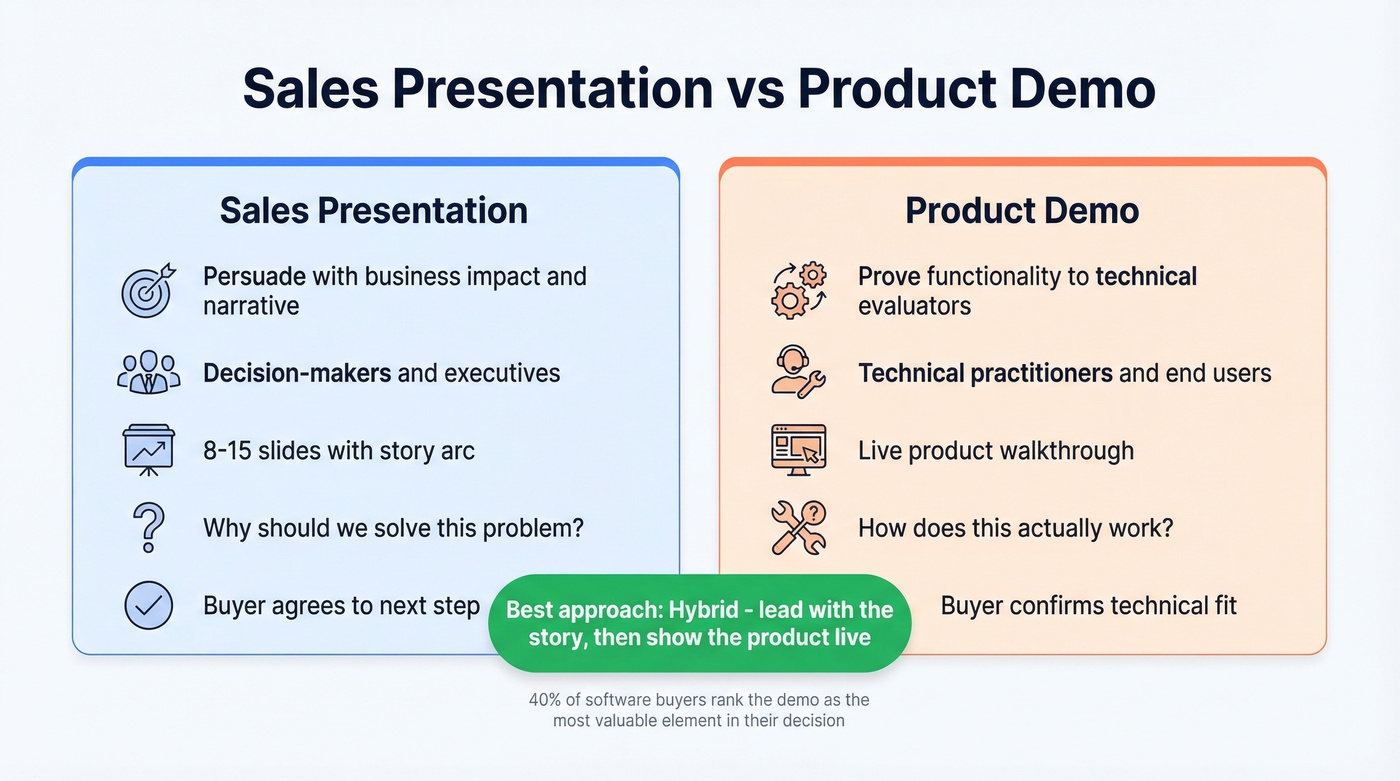
The distinction that matters: a sales presentation vs product demo persuades with business impact and narrative, while a product demo proves functionality to technical evaluators. Many teams use a hybrid - story first, then a live walkthrough - and that's often the right call. 40% of software buyers rank the demo as the most valuable element in their decision, and well-executed demos can cut B2B sales cycles by up to 30%.
One thing we see teams forget: 6-10 stakeholders typically evaluate 3-5 alternatives. Your champion will forward your deck to people you'll never meet. If your deck can't sell without you in the room, it isn't done.
The 8-Slide Framework
This structure works for first-call presentations. It draws from the Storydoc framework and Mailshake's hook-pain-value flow, refined with what we've seen close deals across hundreds of outbound campaigns. (If you want to go deeper on narrative structure, see sales deck storytelling.)
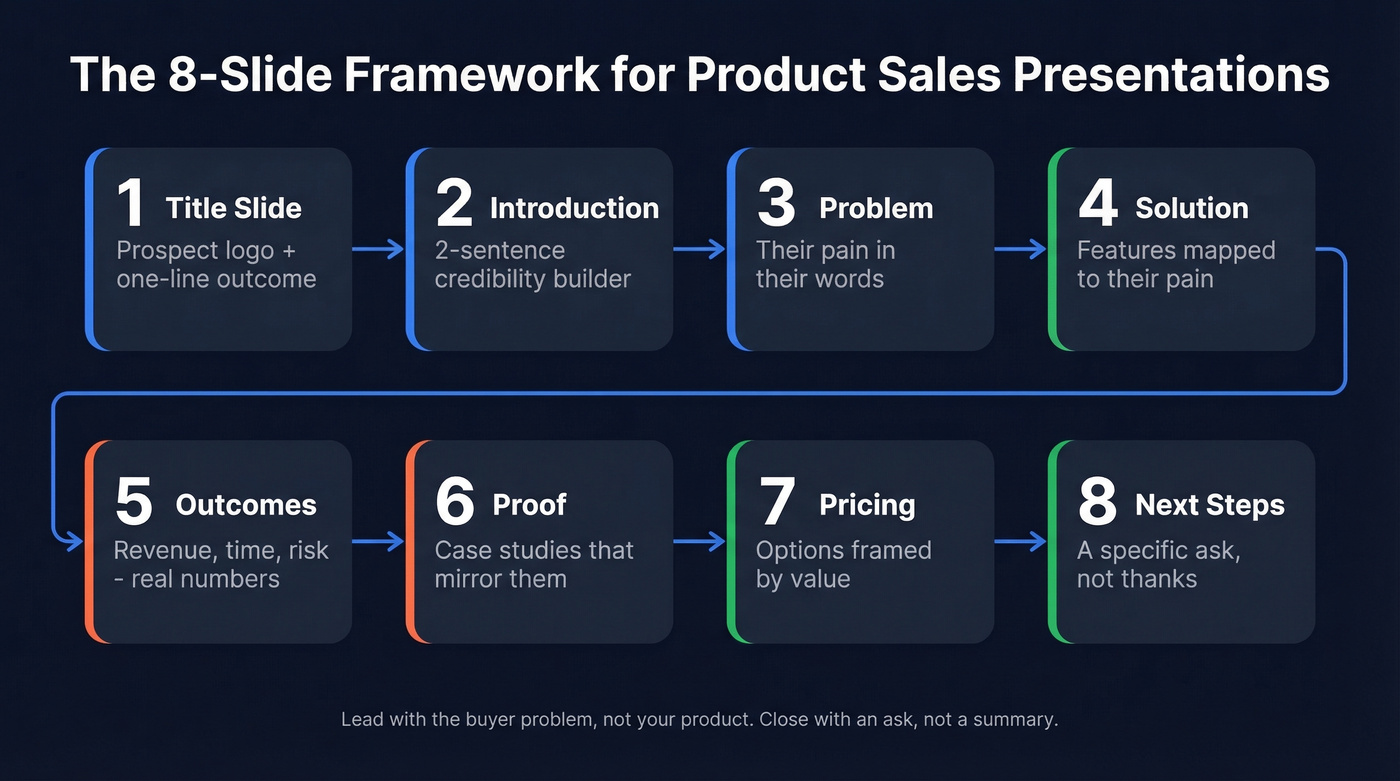
1. Title Slide - Prospect's logo, their name, a one-line outcome statement. Not your company tagline. Personalization starts here, and it requires accurate prospect data. Tools like Prospeo's Chrome extension pull 40+ data points per contact from any website, so the details on this slide are accurate rather than guesswork. (Related: data enrichment services.)
2. Introduction - Who you are in two sentences. Establish credibility fast with logos, a headline metric, or a relevant case study.
3. Problem - Articulate the buyer's pain better than they can. Use their language from discovery. This is where the 86% stat earns its keep - buyers need to feel understood before they'll listen to anything else. (Use better discovery prompts with discovery questions.)
4. Solution - How your product solves that specific problem. Not every feature. The features that map to the pain you just described.
5. Outcomes - Quantify what changes. Revenue gained, time saved, risk reduced. Real numbers from existing customers, not hypothetical projections. Only 37% of SQLs convert to closed-won in B2B SaaS - your presentation is often the difference between the two sides of that stat. (Benchmark your funnel with sales conversion rate.)
6. Proof - Case studies, logos, testimonials. Pick proof that mirrors the prospect's industry, size, or challenge. Specific proof closes deals; generic proof fills space.
7. Pricing - Don't hide it. Give them options. Frame pricing alongside outcomes so the buyer evaluates value, not just cost.
8. Next Steps - Not "thanks for your time." A specific ask: schedule a technical review, loop in the CFO, start a pilot. There's a critical difference between concluding and closing. A conclusion summarizes. A close asks for something. (If you need a tighter close, see steps to close a sale.)
Let's be honest: the "best sales presentation ever" doesn't exist. The best one is built for one specific buyer, one specific deal, one specific moment in their buying process. Stop hunting for the perfect template and start building for the person across the table. (This is also where account-based selling best practices pay off.)

Slide 1 says personalize with the prospect's name, company, and pain points. Slide 6 says prove it with real numbers. Both require accurate data. Prospeo gives you 40+ data points per contact, 98% verified emails, and intent signals across 15,000 topics - so every slide in your deck is built on facts, not guesswork.
Build presentations on real buyer data, not assumptions.
Mistakes That Kill the Deal
Four patterns destroy otherwise solid decks.
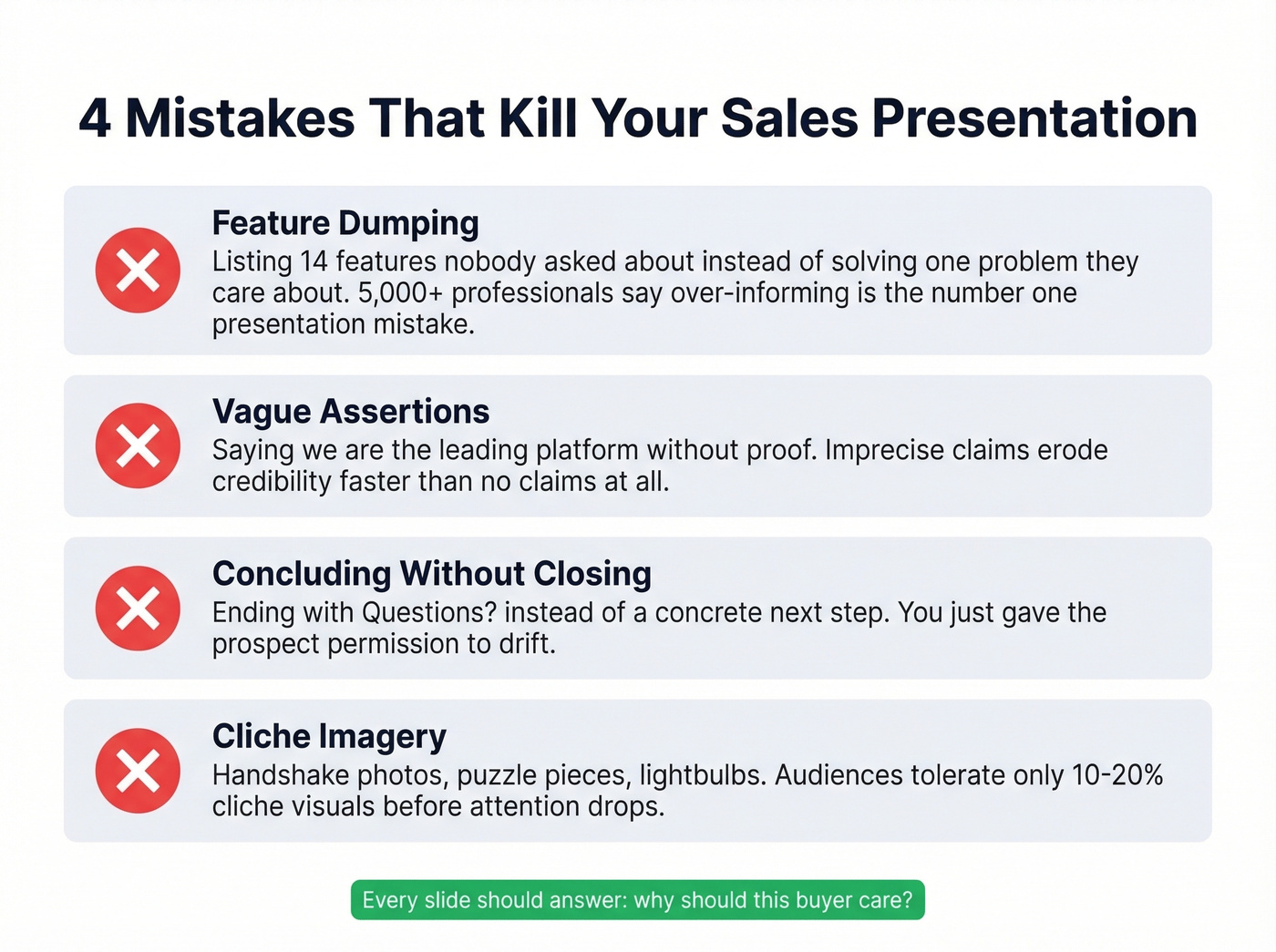
Feature dumping instead of persuading. Sjodin's 5,000-person study confirms it - reps over-inform because it feels productive. Every slide should answer "why should this buyer care?" If it doesn't, cut it.
Vague assertions. "We're the leading platform" means nothing without proof. Imprecise claims erode credibility faster than no claims at all.
Concluding without closing. Your last slide says "Questions?" instead of proposing a concrete next step. You just gave the prospect permission to drift. We've watched deals go cold because the rep ended with a summary instead of an ask - it's one of the most common and most preventable mistakes in sales. (Pair your close with a strong sales meeting follow-up email.)
Cliche imagery. Handshake stock photos, puzzle pieces, lightbulbs. Neuroscientist Carmen Simon's research shows audiences tolerate about 10-20% cliche imagery before it actively harms attention and memory. Use functional, unpredictable visuals instead.
Delivery Tactics From Neuroscience
The "short attention span" narrative is a myth. The real constraint is working memory. Carmen Simon's research shows customers retain new information for roughly 30 seconds and can hold 3-4 chunks before it gets replaced. (More tactics: virtual sales presentation tips.)
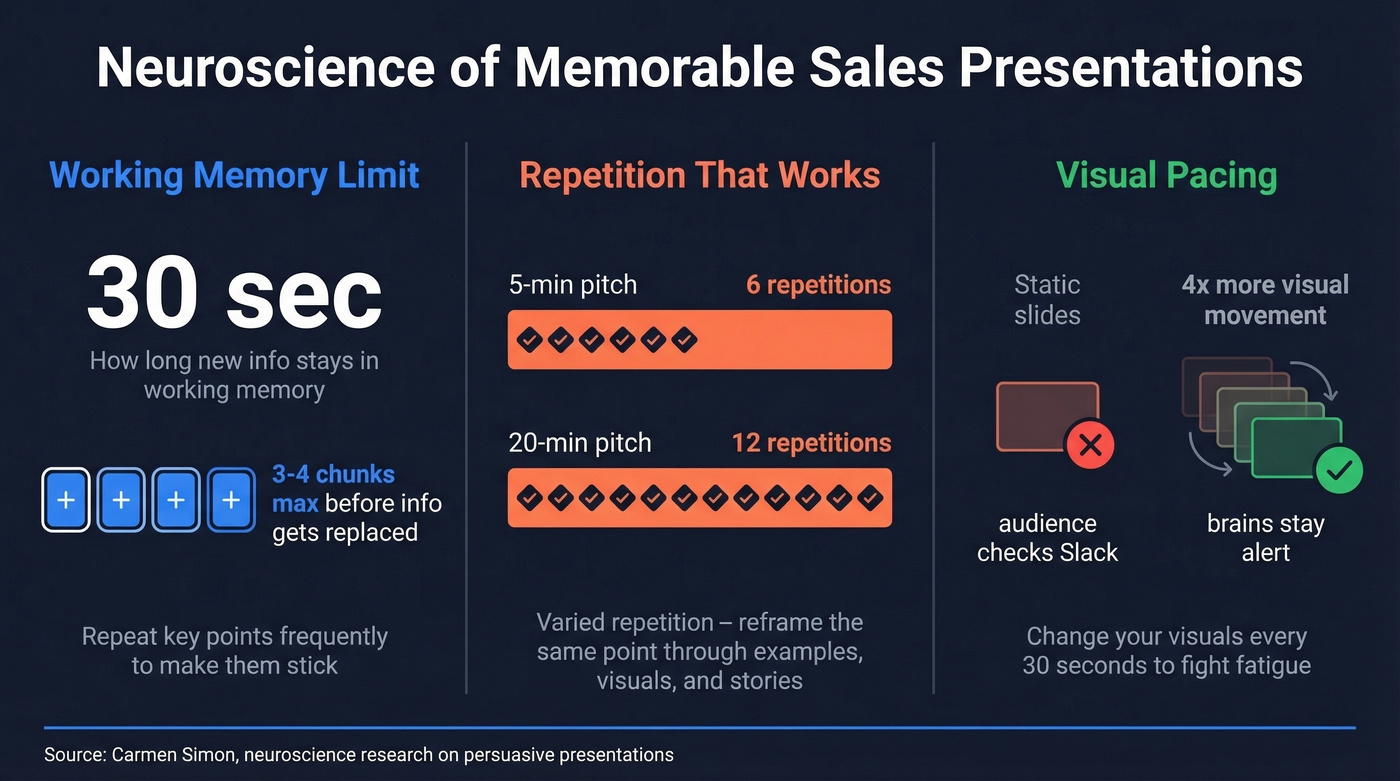
The practical takeaway: repeat your key points frequently. Simon's studies found 6 repetitions in a 5-minute presentation and 12 in a 20-minute pitch made messages stick. That sounds aggressive. But varied repetition - reframing the same point through different examples, visuals, and stories - is what separates memorable pitches from forgettable ones.
Change your visuals every 30 seconds. Increasing visual movement 4x made brains more alert and less fatigued. This doesn't mean gratuitous animation. It means pacing your slides so nothing stays static long enough for the audience to check Slack.
Best Tools for Sales Pitch Decks
PowerPoint or Google Slides handle most teams' needs. If you want async analytics - knowing who opened which slide and for how long - look at Storydoc or Pitch. Canva works if design is your bottleneck. Skip Prezi unless your audience genuinely responds to non-linear navigation; for most B2B deals, it's more distracting than helpful. (If you're building a full outbound stack, start with SDR tools.)
| Tool | Price | Best For |
|---|---|---|
| Google Slides | Free; ~$6/user/mo with Workspace | Collaboration-first teams |
| PowerPoint | $6-22/user/mo | Enterprise / Microsoft shops |
| Canva | Free; Pro ~$13/mo | Design-challenged reps |
| Keynote | Free on Mac/iOS | Apple-native teams |
| Pitch | Free; teams ~$10/user/mo | Async sharing + analytics |
| Storydoc | From ~$17/mo | Interactive / multimedia decks |
| Gamma | ~$8-20/mo | AI-assisted deck creation |
| Prezi | From ~$15/mo | Non-linear presentations |
Stop overthinking the tool. The deck that wins isn't the prettiest - it's the one that speaks directly to the buyer's problem.
The best product sales presentation targets the right person with the right message. But 6-10 stakeholders evaluate every deal - and you need verified contact data for each one. Prospeo's database covers 300M+ profiles with 30+ filters including job changes, buyer intent, and department headcount, so you reach every decision-maker in the room.
Stop presenting to the wrong people. Find every stakeholder now.
FAQ
How many slides should a product sales presentation have?
Eight slides for a first call - title, intro, problem, solution, outcomes, proof, pricing, and next steps. Add 5-7 supplementary slides for technical deep dives if the deal warrants it. Cut anything that doesn't answer "why should this buyer care?"
Presentation vs. demo - when do I use which?
A presentation persuades with business impact and narrative; a demo proves functionality to technical evaluators. Use a hybrid when both executives and practitioners are in the room - lead with the story, then show the product live.
How do I turn my deck into a leave-behind?
Strip out speaker-dependent slides, add brief context sentences so each slide stands alone, and export as a PDF. Your champion will forward it to stakeholders you'll never meet - make sure it tells the full story without your voiceover.
How do I personalize presentations at scale?
Add the prospect's logo, name, and specific challenge to slide 1. Verify contact data and job titles before building the deck so personalization is accurate rather than guesswork. From there, build 3-4 industry-specific versions of slides 3 and 6, and swap them per deal. That's enough customization to feel personal without rebuilding from scratch every time.