

Professional Email Sign-Offs: Data Shows Most People Pick Wrong
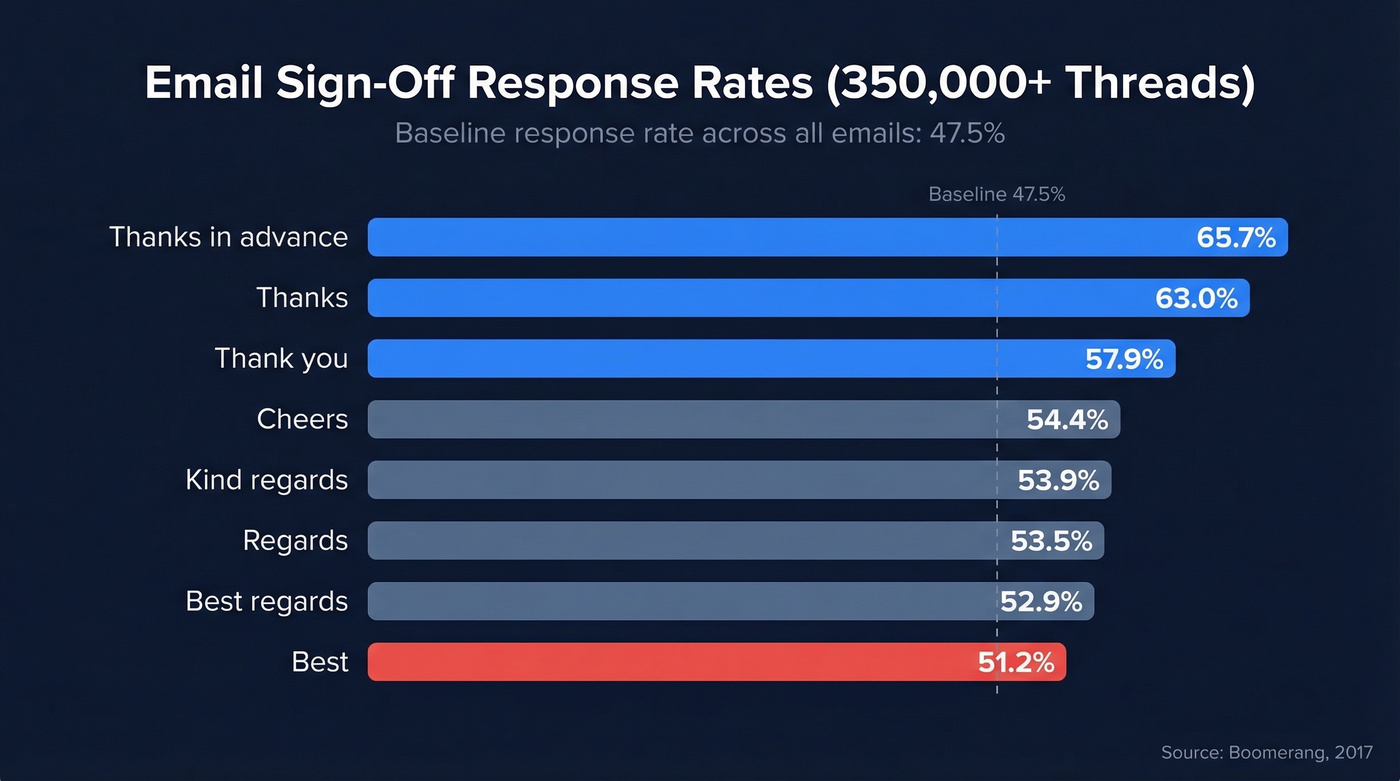
"Best" is one of the most common professional email sign-offs. It's also the worst performer in Boomerang's dataset. Across 350,000+ email threads, "Best" pulled a 51.2% response rate - dead last among the popular closings they measured. Meanwhile, "Thanks in advance" hit 65.7%.
The difference between a lazy default and a deliberate choice is real, measurable, and worth the three seconds it takes to fix.
The Short Version
Three rules. Gratitude-based closings ("Thanks," "Thank you") get 36% more replies than non-thankful alternatives - make them your default. "Best" is the lowest performer in Boomerang's dataset at 51.2%. And match formality to the relationship, not to some imagined corporate standard nobody actually enforces.
| Situation | Sign-Off | Why |
|---|---|---|
| Cold outreach | Thanks | High-performing, warm, not presumptuous |
| Job application | Kind regards | Formal and widely accepted |
| Client follow-up | Thank you | Clear gratitude without pressure |
| Your manager | Thanks | Warm, not stiff; signals respect |
| Internal team | Cheers | Casual, not sloppy (team-dependent) |
| International | Best regards | Safe, widely understood default |
Which Sign-Offs Get the Most Replies
Boomerang's study is one of the largest public analyses on this topic: 350,000+ email threads from mailing list archives of 20+ online communities. Every closing in the table below appeared at least 1,000 times. The baseline response rate across all emails was 47.5%.
| Sign-Off | Response Rate | vs. Baseline (47.5%) |
|---|---|---|
| Thanks in advance | 65.7% | +38% |
| Thanks | 63.0% | +33% |
| Thank you | 57.9% | +22% |
| Cheers | 54.4% | +15% |
| Kind regards | 53.9% | +13% |
| Regards | 53.5% | +13% |
| Best regards | 52.9% | +11% |
| Best | 51.2% | +8% |
Gratitude-based closings outperform everything else by a wide margin. Emails with any "thank" variant averaged a 62% response rate versus 46% without - a 36% relative increase.
A separate experiment supports a causal link. Grant & Gino (2010) tested gratitude directly: when a follow-up email included "Thank you so much!", 66% of recipients helped with a second request. Without it, only 32% did. Gratitude doubles compliance. The psychology isn't complicated - people who feel appreciated are more willing to act.
Best Closings by Situation
Formal and Business
"Kind regards" is a safe formal default at 53.9%. It reads as polished without being stiff. "Best regards" (52.9%) works similarly - the gap is small enough to be noise.
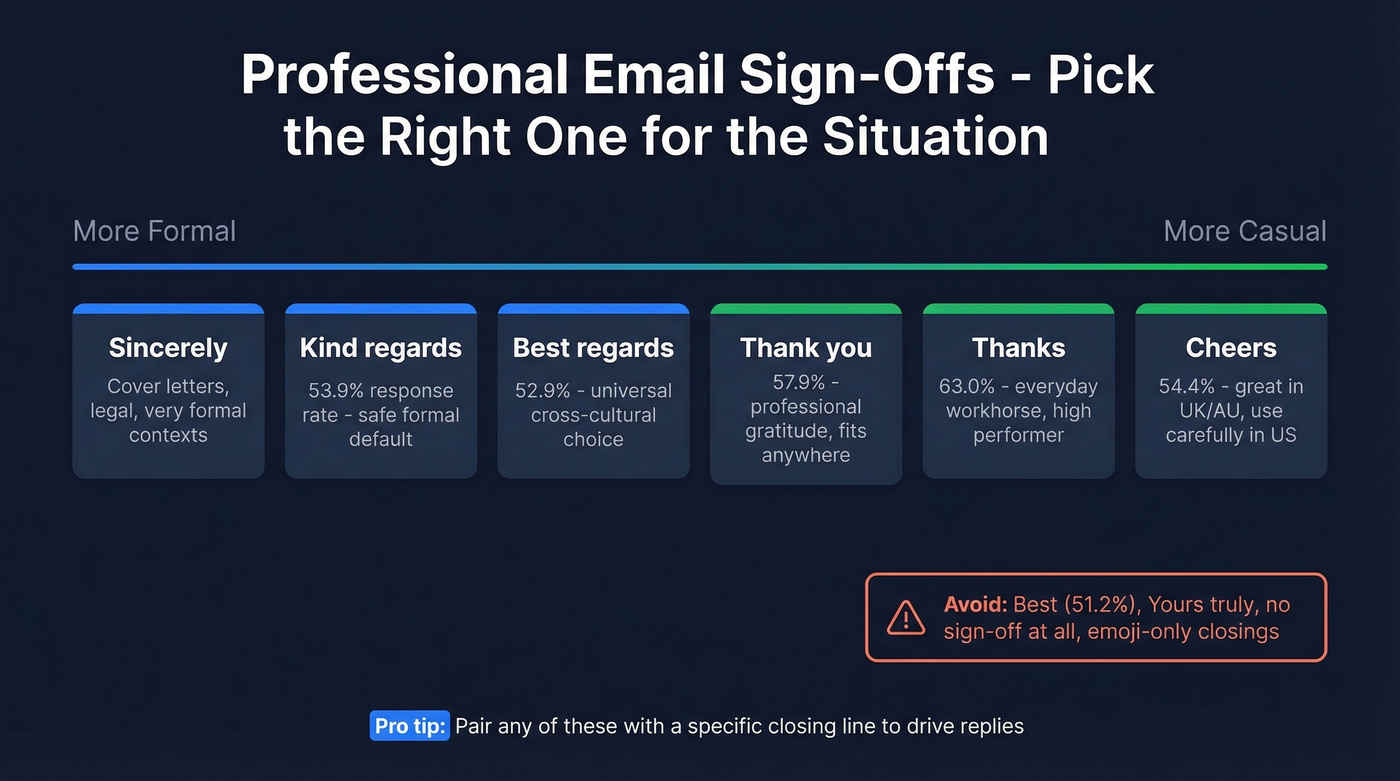
"Sincerely" still has a place in cover letters, legal correspondence, and any email where you'd also wear a tie. Outside those contexts, it reads dated.
Capitalize only the first word ("Kind regards," not "Kind Regards") and follow with a comma.
I've attached the revised proposal with the updated timeline. Let me know if you'd like to discuss before Thursday's call.
Kind regards, Sarah Chen
Gratitude-Based (Highest Performers)
"Thanks" at 63% and "Thank you" at 57.9% should be your everyday closings. They outperform every non-gratitude alternative by double-digit margins, and they fit virtually any professional context. We've used "Thanks" as our team default for years, and honestly, there's no reason to overthink it.
I appreciate you walking through the proposal. I'll send the revised scope by Friday.
Thanks, James Rivera
Warm and Friendly
"Cheers" pulls a respectable 54.4%, but it's regionally loaded. In the UK, Australia, and New Zealand, it's perfectly professional. In the US, it can read as affected if it doesn't match your normal voice. "Take care" and "Talk soon" work well for internal emails and warm relationships - skip them for first-touch outreach.
[Barclays LifeSkills (2023)](https://home.barclays/news/press-releases/2023/09/say-goodbye-to - yours-truly - three-quarters-of-brits-think-the/) found 97% of 18-24-year-olds want to express personality through workplace communication. Gen Z is pushing boundaries, but for external emails, the data still favors gratitude-based closings over personality plays.
Action-Driving
Here's the thing most people miss: the most effective email endings pair a closing line with a simple sign-off. The closing line drives the reply. The sign-off just sets the tone.
Would Tuesday at 2pm work for a quick walkthrough? Happy to adjust if another time is better.
Thanks, Priya Mehta

A perfect sign-off is wasted on a dead email address. Prospeo delivers 98% verified emails across 300M+ professional profiles - so your carefully crafted closing line actually reaches a real inbox.
Stop perfecting sign-offs for emails that bounce.
The "Thanks in Advance" Paradox
At 65.7%, "Thanks in advance" is the highest-performing sign-off in the dataset. It's also on nearly every "passive-aggressive phrases" list, including Melody Wilding's breakdown for CNBC, where she flags it as presumptuous - it assumes compliance before the person has agreed.
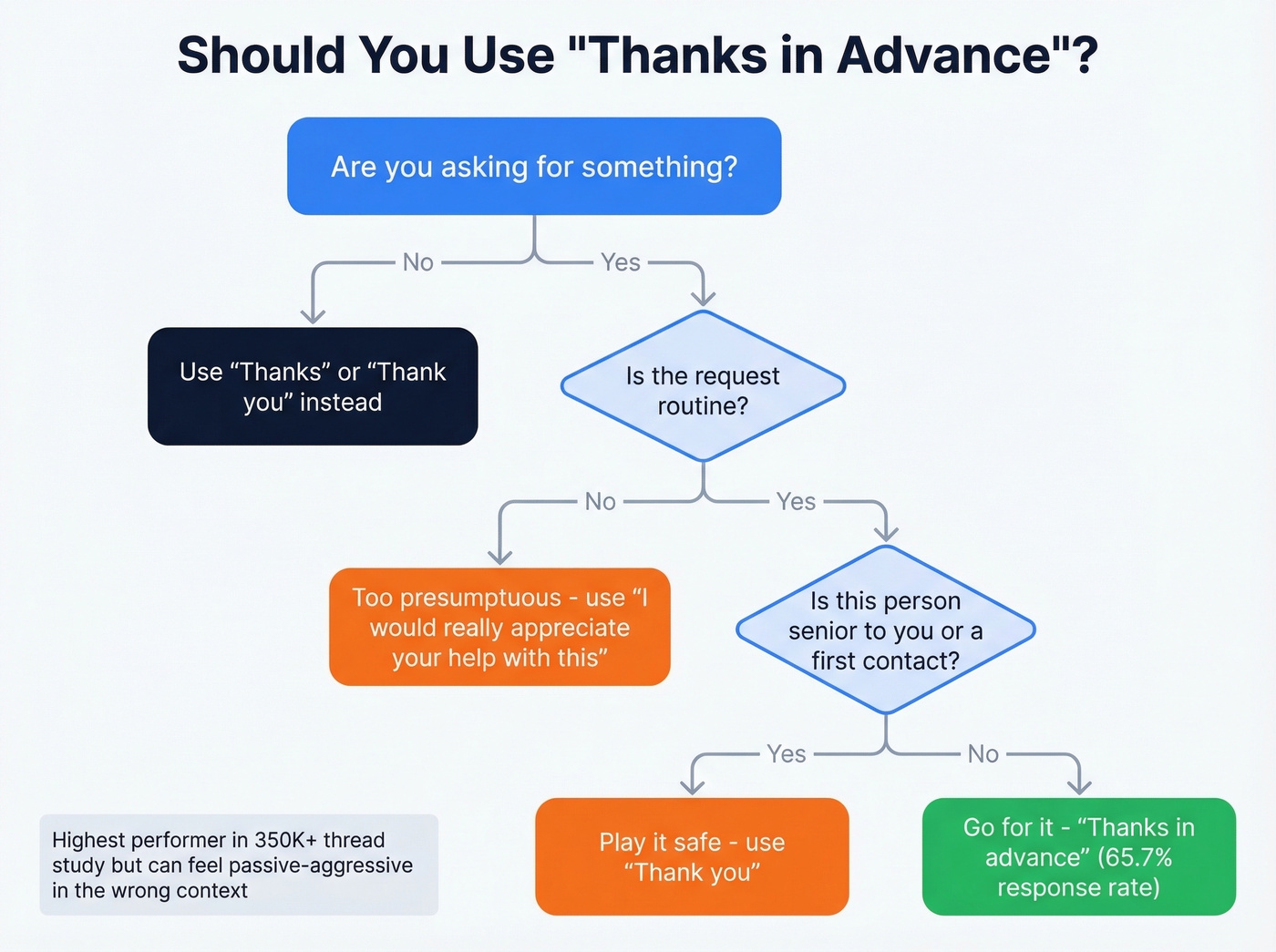
Both sides are right. "Thanks in advance" works because it creates a subtle obligation to follow through. That's exactly why it gets replies, and exactly why it annoys people.
Use it when you're asking for something routine and the person is likely to say yes anyway. For favors, first impressions, or emails to someone senior, "Thank you" is the safer bet. A cleaner rewrite for sensitive situations: "I'd really appreciate your help with this."
Sign-Offs That Hurt You
Some closings actively backfire. Grammarly's editorial guidance flags several:
- "Yours truly" - reads forced in business contexts outside formal letters
- No sign-off at all - feels brusque, especially on first contact
- "Respectfully yours" - overly stiff unless you're writing to a judge
- "Hope that makes sense" - passive-aggressive; if you're worried it doesn't make sense, rewrite the email
- Emoji-only closings - a smiley face isn't a sign-off
And then there's "Best" again. 51.2%. The lowest performer among every popular closing Boomerang measured. If you're still using it out of habit, just switch to "Thanks" and move on.
Let's be honest: if you're running outbound sequences and agonizing over "Kind regards" versus "Warm regards," you're optimizing the wrong variable. Swap in "Thanks," close the tab, and spend that energy on your closing line instead.
Email Etiquette Across Cultures
Email norms shift across borders. In the UK, "Regards" alone reads as cold or curt - "Kind regards" is the expected softener. A study comparing Korean and Australian academics found 40% of Korean respondents perceived Australian emails as impolite, versus 28% the other way around. Politeness is culturally calibrated, not universal.
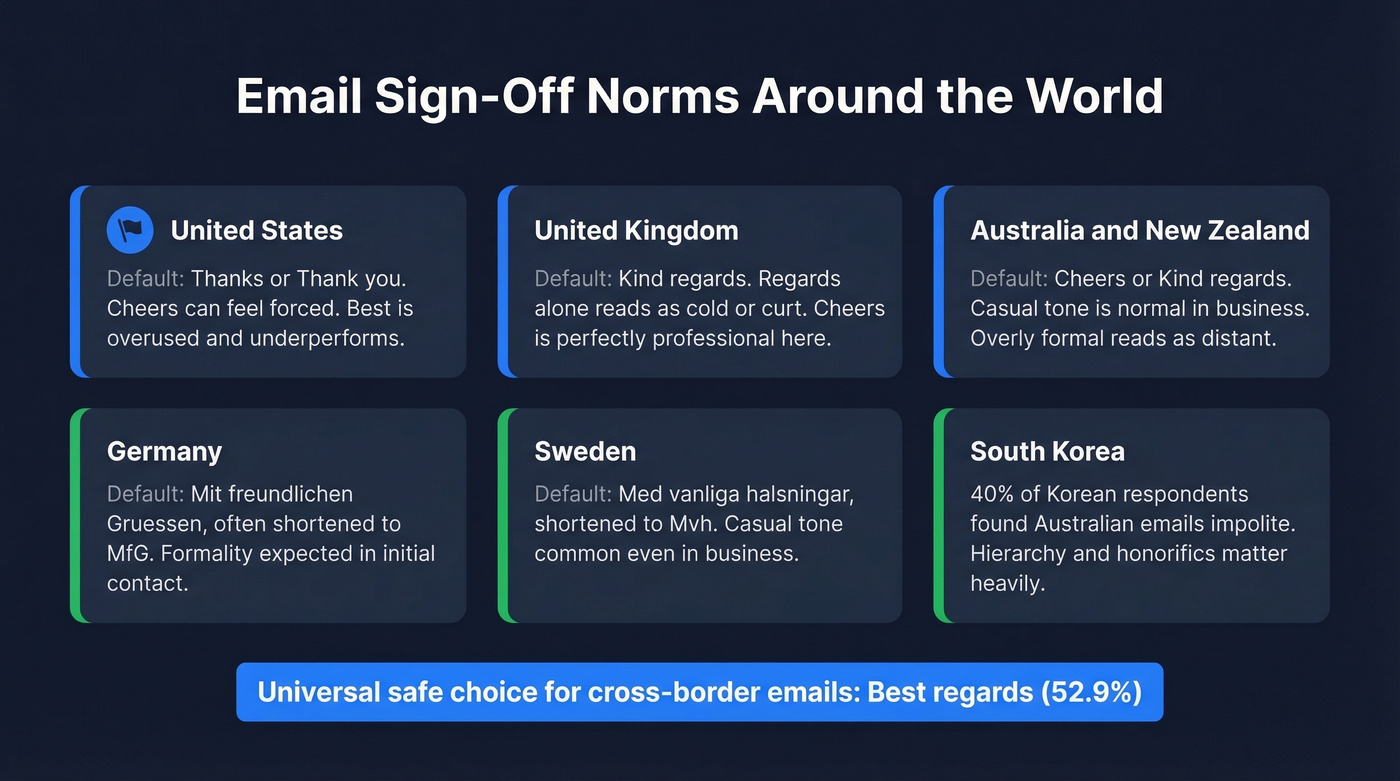
European languages have their own compressed defaults - Germany's "MfG," Sweden's "Mvh," Hungary's "Udv." When in doubt with cross-border emails, "Best regards" is the safest universal choice.
The Closing Line Matters More Than the Sign-Off
Most people obsess over the sign-off and ignore the sentence right above it. That's backwards.
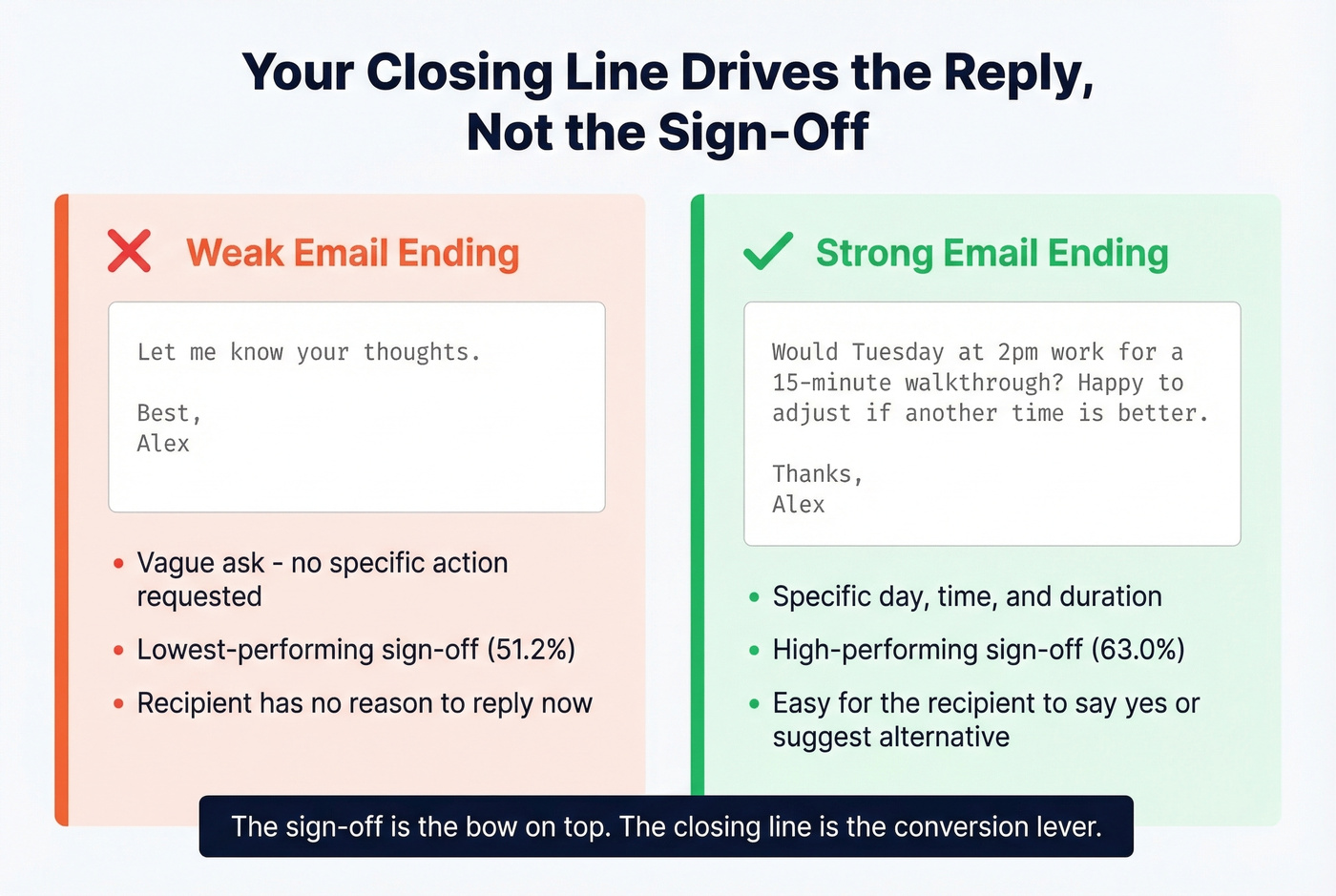
Your closing line is the conversion lever - it tells the recipient what to do next. The sign-off is just the bow on top. In our experience running outbound campaigns, a specific closing line paired with a plain "Thanks" outperforms a clever sign-off with a vague ask every single time.
Strong closing lines are specific:
- Cold outreach: "Would [day] at [time] work for a 15-minute call?"
- Professional follow-up: "Can you confirm by Thursday so I can loop in the team?"
- Casual internal: "Let me know if you want me to take a first pass."
If you want to push replies even higher, pair the right sign-off with better email subject lines and tighter sales follow-up templates.
Your closing line drives the reply. Your sign-off sets the tone. But none of it matters if the email bounces. If you're sending outreach at scale, verify your list first - tools like Prospeo check emails in real time with 98% accuracy across 143M+ verified addresses. And keep your signature block to name, title, company, and phone. Skip the inspirational quotes and logo salad.
If you're serious about deliverability, start with an email deliverability guide, keep an eye on email bounce rate, and protect your sender reputation.
You just learned which sign-offs drive replies. Now make sure those emails land. Prospeo's 5-step verification and 7-day data refresh keep bounce rates under 4% - ask the 15,000+ companies already using it.
Great closings deserve great deliverability. Start free today.
FAQ
What's the most professional email sign-off?
"Kind regards" is the safest formal default across industries and cultures. For higher response rates, "Thank you" outperforms it - 57.9% versus 53.9% in the 350,000-thread study. Match formality to the recipient and the relationship, not to a rigid corporate template.
Is "Best" a good email sign-off?
No. "Best" scored 51.2% in Boomerang's dataset - the lowest response rate of any popular closing they measured. Switching to "Thanks" (63%) is an instant, zero-effort upgrade.
Do email sign-offs actually affect response rates?
Yes. Emails with gratitude-based closings get 62% response rates versus 46% without - a 36% relative increase across 350,000+ threads. A separate experiment by Grant & Gino found adding "Thank you so much!" doubled help rates from 32% to 66%.
How do I make sure my outreach emails actually get delivered?
The best sign-off won't help if your email bounces. Use a verification tool before sending at scale, pair verified data with proper domain warmup, and monitor your sender reputation. For teams doing high-volume outreach, this isn't optional - it's the difference between landing in the inbox and landing in spam.