

How to Write a Professional Meeting Request Email That Actually Gets Replies
The average professional meeting request email gets a 3.43% reply rate. That's about 1 reply per 29 emails you send. Worse, 58% of all replies come from the first email - so if your opening message doesn't land, every follow-up is fighting uphill.
The problem isn't that people are too busy. It's that most meeting requests are too long, too vague, and too easy to ignore.
The Quick Version
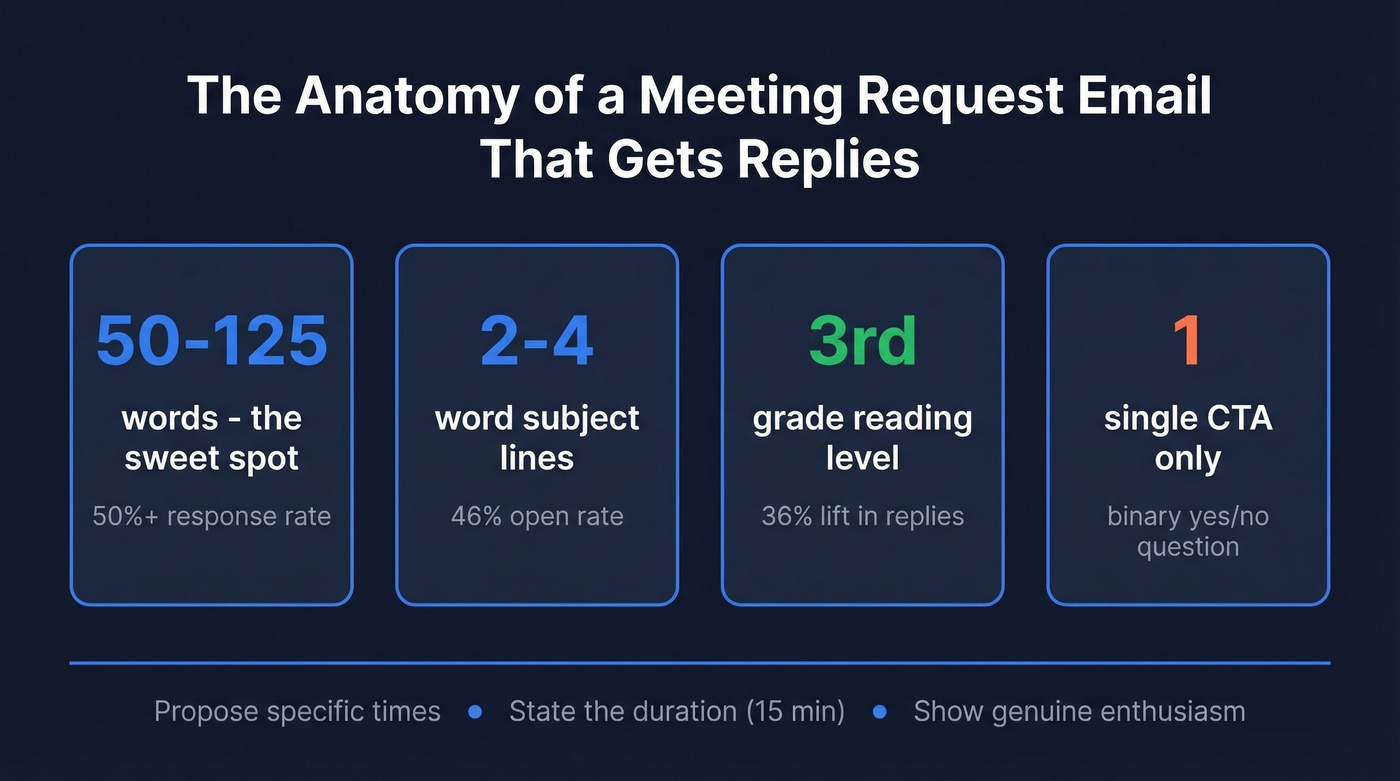
Keep your email between 50 and 125 words - that's the sweet spot for response rates. Write at a 3rd-grade reading level, which delivers a 36% lift over college-level writing. Propose specific times. Include one CTA. Done.
Writing a Meeting Request Email That Gets Replies
Nail the Subject Line
69% of recipients mark emails as spam based on the subject line alone. Mailmend's benchmark shows 2-4 word subject lines can hit 46% open rates, and personalized subject lines using the recipient's name or company pull 46% opens versus 35% without. Skip clever wordplay. "Quick question, {{first_name}}" or "{{Company}} + {{your company}} sync" outperforms anything elaborate. If you want more ideas, borrow from proven subject lines and adapt them to your offer.
Keep It Under 125 Words
Boomerang's analysis of 40 million emails found the 50-125 word range produces response rates above 50%. Once you cross 125 words, replies drop steadily. Write simply - short sentences, common words, no jargon. If you need a tighter structure, use a simple email copywriting framework.
And don't be afraid of tone. Emails with slightly positive or slightly negative sentiment get 10-15% more responses than neutral ones, so show genuine enthusiasm or acknowledge a real problem rather than writing like a press release.
Propose Specific Times
"Let me know when you're free" puts the work on the recipient. Instead, offer two or three options: "Tuesday at 2pm or Thursday at 10am - 15 minutes." A concrete option is psychologically easier to say yes to than an open-ended question. Always state the duration. Fifteen minutes is the magic number for a first meeting because it signals you respect their time and lowers the commitment bar. For more phrasing options, see email wording to schedule a meeting.
One CTA, Nothing Else
Top-performing cold emails use a single clear CTA. Don't ask for a meeting, share a case study, and request a referral in the same email. One ask.
We've tested dozens of CTA formats, and the binary question consistently outperforms everything else: "Worth a 15-minute call Tuesday?" Yes or no - that's all the recipient needs to decide. If you want to refine your ask, follow these email call to action rules.
Five Templates That Work
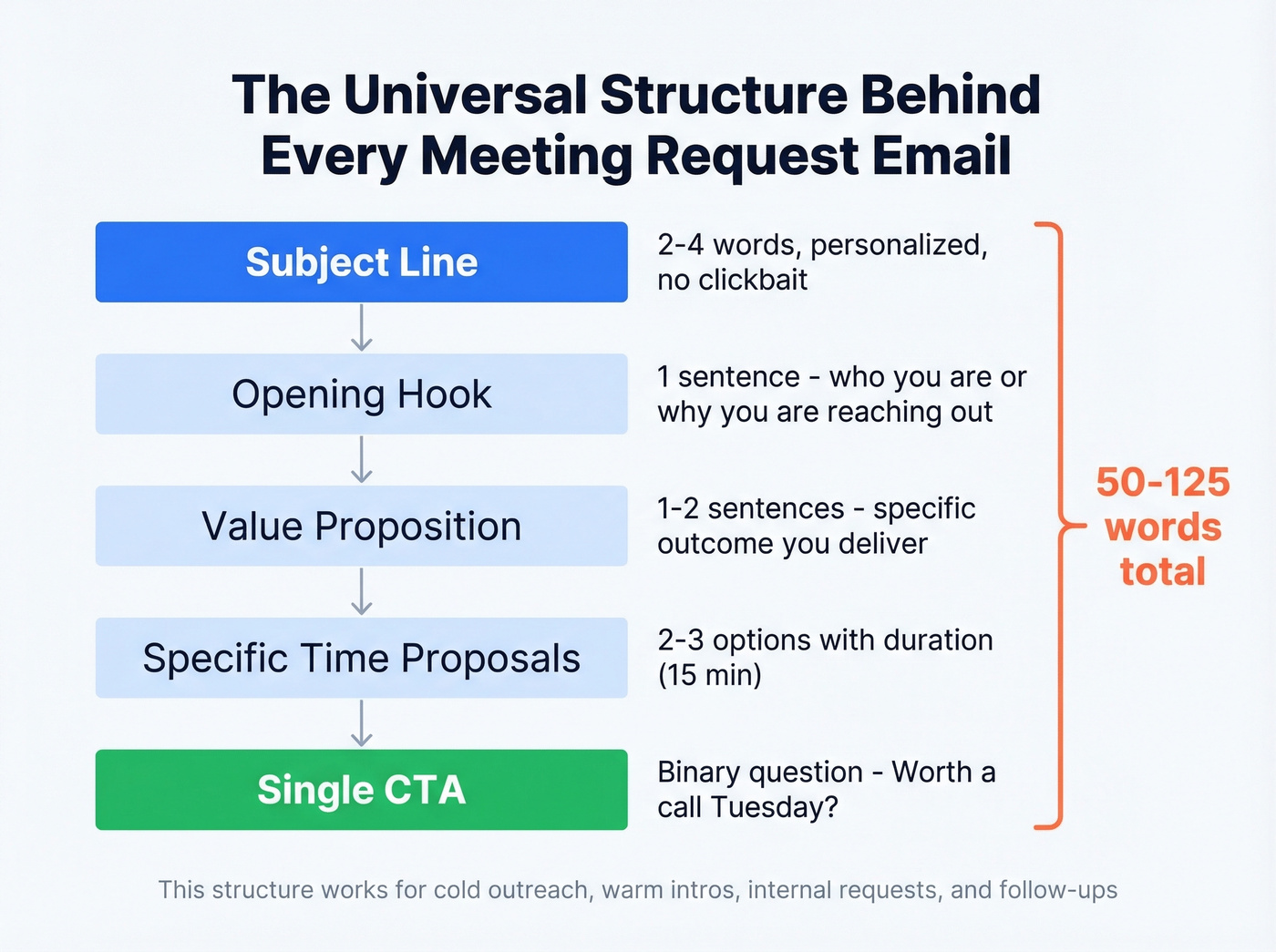
Each template follows what we just covered: under 125 words, specific times, one ask. Whether you're sending a formal request to a senior executive or a casual ping to a teammate, the structure stays the same.
Cold Outreach to a Prospect
Subject: {{Company}} + {{your company}}
Hi {{first_name}},
We help {{industry}} teams {{specific outcome - e.g., cut prospecting time by 60%}}. {{Company name}} caught my eye because {{one specific reason}}.
Worth a 15-minute call Tuesday at 2pm or Thursday at 10am to see if there's a fit?
- {{Your name}}
Warm Introduction
Subject: {{Mutual contact}} suggested we connect
Hi {{first_name}},
{{Mutual contact}} mentioned you're working on {{specific initiative}}. We recently helped {{similar company}} with {{relevant result}}.
Could we grab 15 minutes Wednesday at 3pm? Happy to work around your schedule.
- {{Your name}}
Internal Meeting Request
Subject: Sync on {{project/topic}}
Hi {{first_name}},
I'd like to align on {{specific topic}} before {{deadline or event}}. I have a few questions about {{specific detail}} that'll take about 15 minutes.
Does Thursday at 11am or Friday at 2pm work?
- {{Your name}}
Client or Partner Check-In
Subject: Quick check-in on {{project}}
Hi {{first_name}},
It's been {{timeframe}} since we last connected on {{project/initiative}}. I'd love to hear how things are tracking and share a few ideas for {{next quarter/phase}}.
Do you have 20 minutes next Tuesday or Wednesday afternoon?
- {{Your name}}
Follow-Up on No Reply
Subject: Re: {{original subject}}
Hi {{first_name}},
Bumping this up - I know things get buried. Still happy to do a quick 15-minute call if {{original value prop}} is relevant.
Would next week work better? I'm open Tuesday-Thursday.
- {{Your name}}

Every bounced meeting request email destroys your sender reputation and wastes a perfectly good template. Prospeo's 5-step verification catches invalid addresses, spam traps, and honeypots before you hit send - with 98% email accuracy and a 7-day data refresh cycle.
Clean your prospect list before your next campaign - 75 free verifications included.
Best Time to Send a Meeting Request
Timing matters more than most people think. An analysis of 85,000+ personalized emails found Monday is the best day for overall performance, with a 2.8% reply rate. The sweet spot is 6-9am PST (9am-12pm EST) - you land in inboxes right as people start their day. If reply rate is your only metric, Wednesday edges slightly ahead. For a deeper breakdown, use this best time to send cold emails playbook.
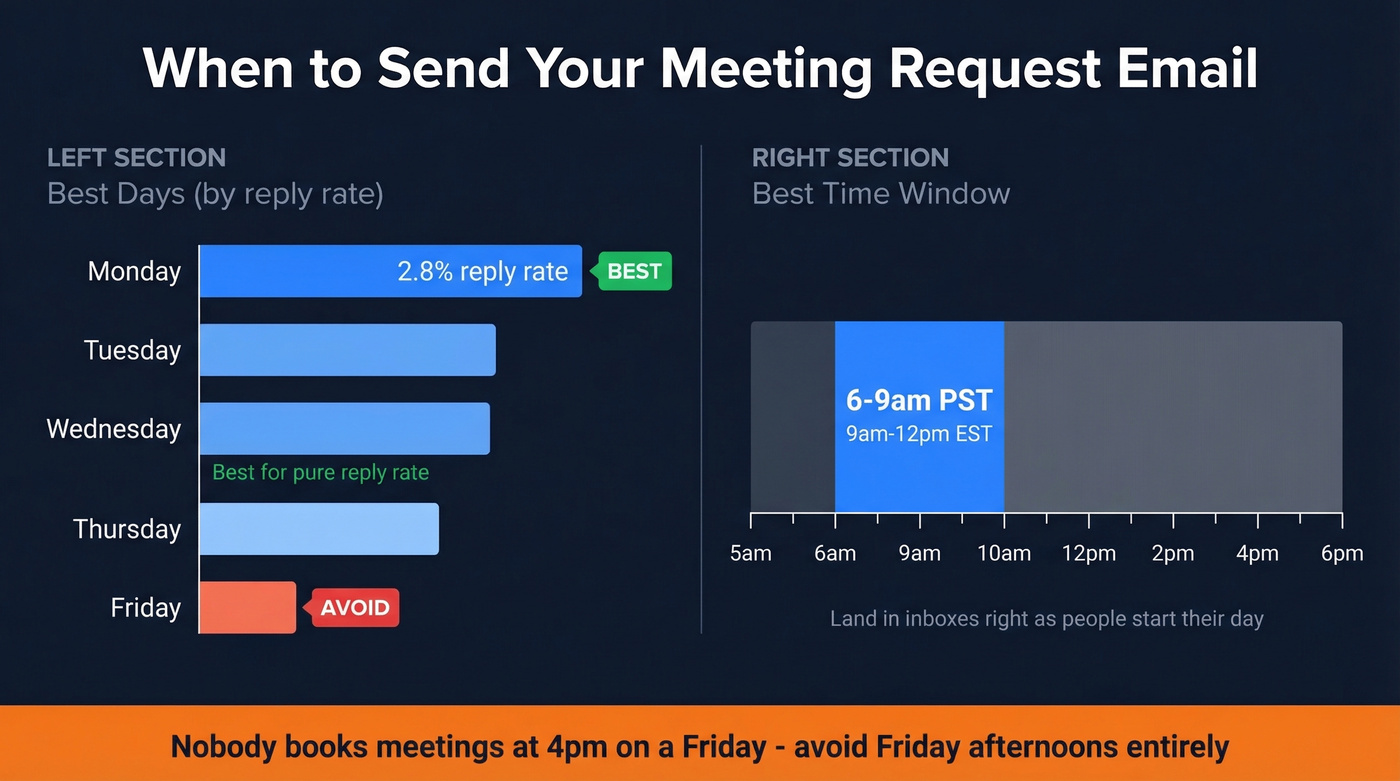
Avoid Friday afternoons. Nobody's booking meetings at 4pm on a Friday.
One thing practitioners on r/EmailMarketing consistently flag: poor mobile formatting is a silent killer of response rates. If your email looks broken on a phone, it doesn't matter how good the copy is.
Follow Up or Lose the Meeting
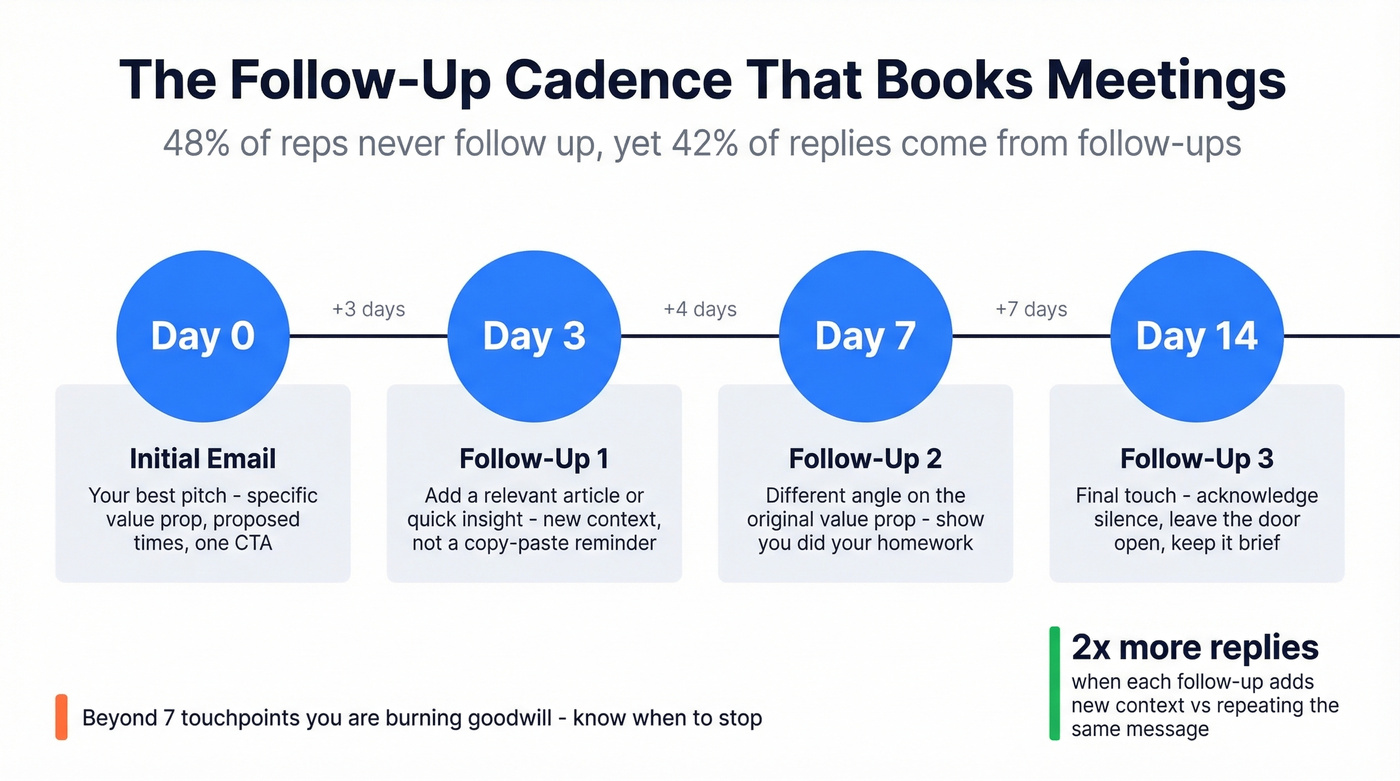
Here's the thing: 48% of reps never send a second message. Meanwhile, 42% of all replies come from follow-ups. The math is obvious. If you need a starting point, steal these sales follow-up templates.
It gets starker when you zoom out. A practitioner breakdown from r/LeadGeneration puts it bluntly: at a 2% reply rate, 1,000 emails yield roughly 20 replies, 4 positive responses, and about 1.2-1.6 booked calls. If you want 10 meetings per month that actually show up, you're looking at around 10,000 emails/month at that reply rate - which makes every percentage point of improvement worth fighting for.
Use a Day 0 / 3 / 7 / 14 cadence. Four to seven touchpoints is the sweet spot. Under four and you're quitting too early; beyond seven and you're burning goodwill. In our experience, follow-up sequences with new context in each message pull roughly double the replies of copy-paste reminders. Add a relevant article, a quick insight, or a different angle on the original value prop each time. For sequencing, follow a proven B2B cold email sequence structure.
Fix Your Data Before You Send
None of the above matters if your email never reaches the inbox. 17% of cold emails fail to deliver due to bad addresses, and every bounce damages your sender reputation. One bad batch can tank deliverability for weeks. Even the most polished professional meeting request email will go unread if it bounces before it arrives. If you're troubleshooting, start with email deliverability basics and then monitor your email bounce rate.
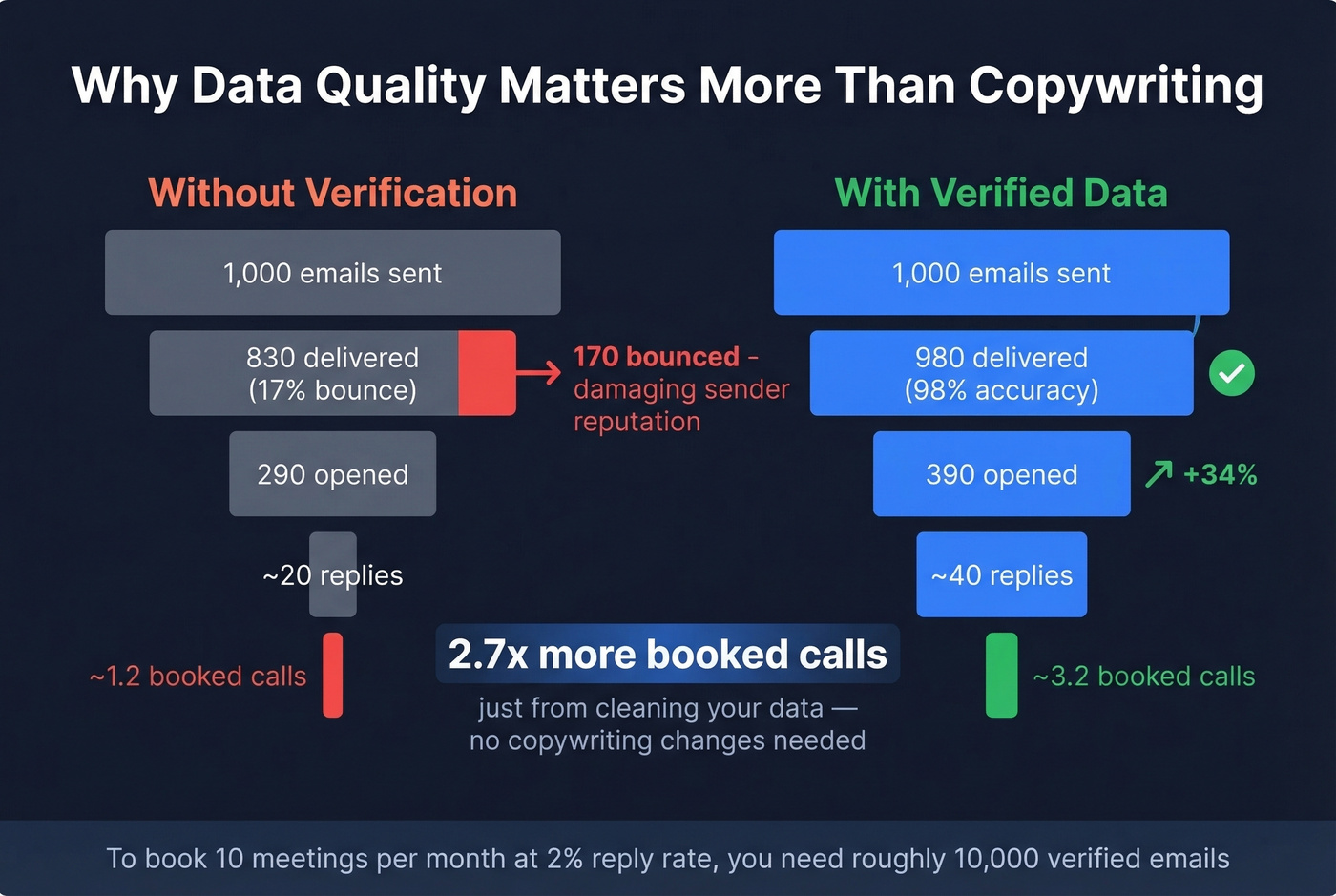
Verify before you send. Tools like Prospeo check emails with 98% accuracy using a 5-step verification process that catches invalid addresses, spam traps, and honeypots. The free tier covers 75 emails per month - enough to clean a targeted prospect list before every campaign.
I've seen teams double their reply rates just by cleaning their data - no copywriting changes at all. Most teams obsess over subject lines and templates while sending to lists full of dead addresses. The unsexy work matters most.
At 2% reply rates, you need thousands of verified emails to book 10 meetings a month. Prospeo gives you access to 143M+ verified emails with 30+ filters to target the exact decision-makers worth requesting a meeting with - at $0.01 per email.
Stop sending perfect meeting requests to dead inboxes.
FAQ
How long should a meeting request email be?
Keep it between 50 and 125 words. Boomerang's analysis of 40 million emails found this range produces response rates above 50%. Write at a 3rd-grade reading level - short sentences and common words, not dumbed-down content.
How many follow-ups should I send after a meeting request?
Send four to seven touchpoints total using a Day 0 / 3 / 7 / 14 cadence. 48% of reps never follow up at all, yet 42% of replies come from follow-up messages. Each one should add new value - a relevant insight or different angle - not repeat the original ask.
What's a good reply rate for meeting request emails?
The average cold email reply rate is 3.43%. Top quartile performers hit 5.5%+, and the top 10% reach 10.7%+. Personalized emails get more than double the replies of generic ones. Below 3% means your targeting, data quality, or messaging needs work.
Should I include a calendar link in my meeting request?
Yes - a Calendly or Google Calendar link reduces friction. But don't just drop a link. Pair it with two or three specific time proposals so the recipient has a concrete option without browsing an open calendar.
How do I verify email addresses before sending meeting requests?
Use a verification tool to check addresses before every campaign. A 5-step process that catches invalid addresses, catch-all domains, spam traps, and honeypots is the standard you should look for. Even a small list of 50-100 prospects is worth verifying - one bad batch can hurt your sender reputation for weeks.