

Prospect Nurturing in 2026: Benchmarks, Sequences, and the System That Converts
79% of marketing leads never convert into sales. Not because the leads are bad - because the nurturing is. Most teams blast the same drip sequence at every contact, regardless of whether that person is a cold stranger or a warm prospect who just attended a webinar. That's not prospect nurturing. That's noise.
Here's a distinction worth getting right early: a lead is any captured contact. A prospect is ICP-qualified - right company, right role, right buying signals. Nurturing prospects means moving qualified accounts through the funnel, not warming up every form fill in your database.
Why B2B Nurturing Matters in 2026
40.4% of B2B buyers take 6-12 months to reach a purchase decision, and 15.4% take over a year. During that window, 45.8% consume more than seven pieces of content. If you're not providing it, your competitor is.
The math is hard to argue with. Nurtured leads make 47% larger purchases and convert 23% faster. Companies with effective nurturing generate 50% more sales-ready leads at 33% lower cost. This isn't a marketing project - it's a revenue system.
Fix Your Data First
None of this works if you're nurturing contacts who don't exist. A bounce rate above 5% can tank your domain reputation, which means even your good emails land in spam.
We've seen this kill programs before they launch. Snyk was running 35-40% bounce rates before cleaning their contact data with Prospeo - they dropped under 5% and saw AE-sourced pipeline jump 180%. Meritt tripled pipeline from $100K to $300K per week after cleaning contact data and cut bounce rate from 35% to under 4%. Start with verified emails. Verify before you send.

The 3-Tier Segmentation Model
Not every prospect needs the same message. This framework comes from practitioners on r/b2bmarketing who've tested it in production:
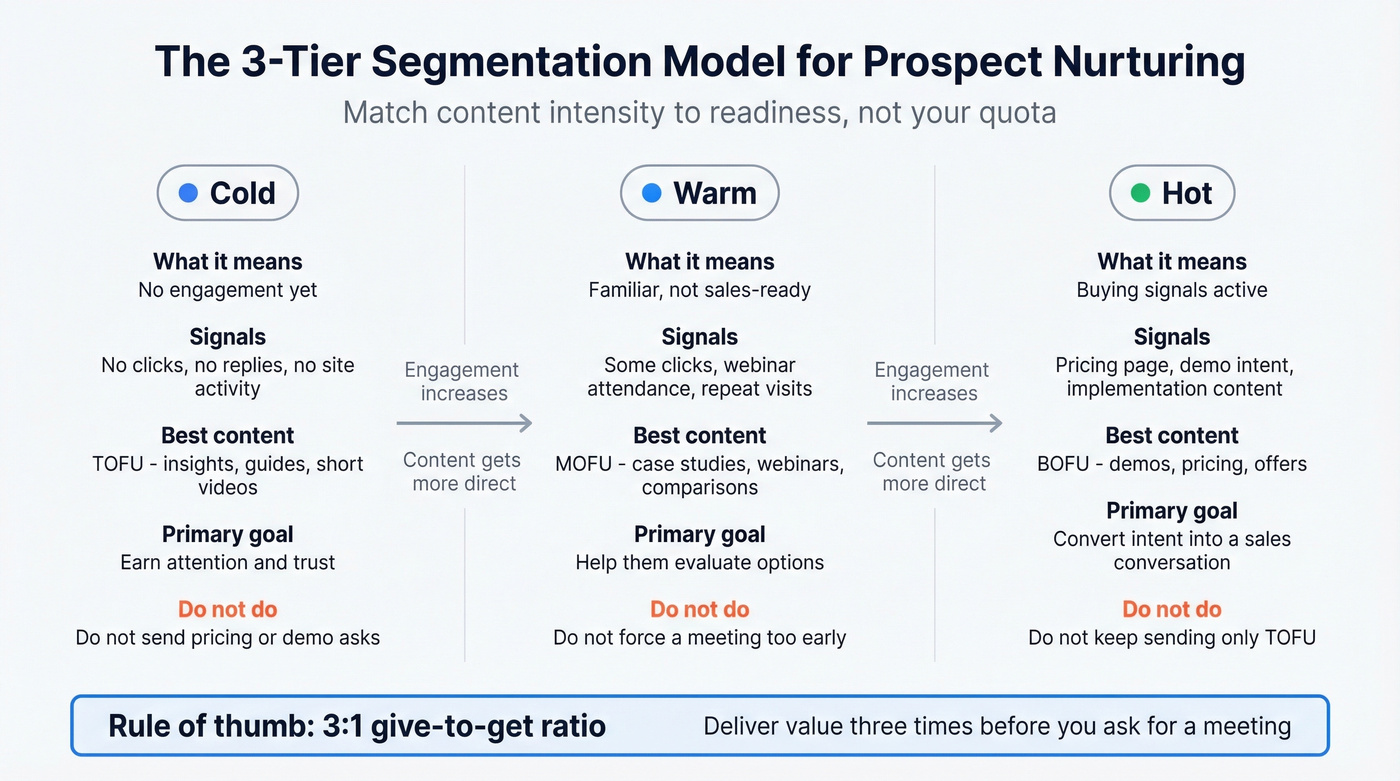
| Tier | Signal | Content Type |
|---|---|---|
| Cold | No engagement | TOFU: insights, guides, short videos |
| Warm | Familiar, not sales-ready | MOFU: case studies, webinars, comparisons |
| Hot | Buying signals active | BOFU: demos, pricing, offers |
Don't push BOFU content at cold prospects. Follow the 3:1 give-to-get ratio - deliver value three times before making any ask. The goal is to match content intensity to readiness, not to rush everyone toward a demo.
The 5-Email Nurture Sequence
Five emails. Spaced 3-4 days apart. Two to three weeks total.
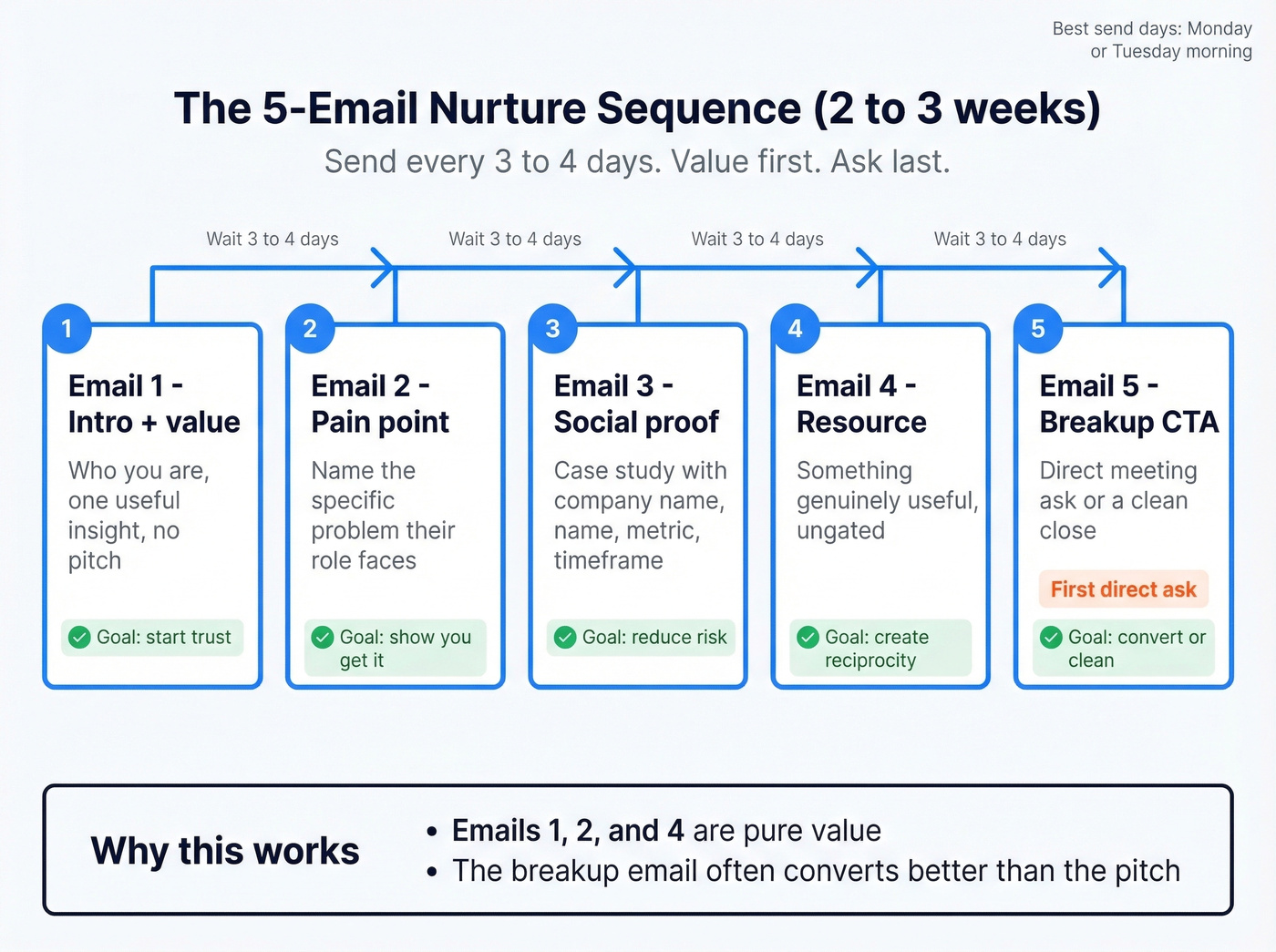
- Intro + value - who you are, one useful insight, no pitch.
- Pain point - name the specific problem their role faces.
- Social proof - case study with company name, metric, timeframe.
- Resource - something genuinely useful, ungated.
- Breakup CTA - direct meeting ask or a clean close.
Best send days are Monday and Tuesday mornings. In our experience, the breakup email converts better than the pitch email - scarcity works even in B2B. Emails 1, 2, and 4 are pure value. Only email 5 makes a direct ask.
If you want plug-and-play copy for the last touch, use these sales follow-up templates.

Every email in your nurture sequence that bounces damages your domain and kills deliverability for the emails that would have converted. Prospeo's 5-step verification delivers 98% email accuracy - the same data layer that took Snyk from 35% bounce rates to under 5% and drove 180% more pipeline.
Fix your data before you fix your sequence.
Multi-Channel Timeline (Days 1-14)
Email alone isn't nurturing. It's a newsletter. Real engagement creates "surround sound" across channels - the kind of consistent presence that turns hesitant buyers into customers.
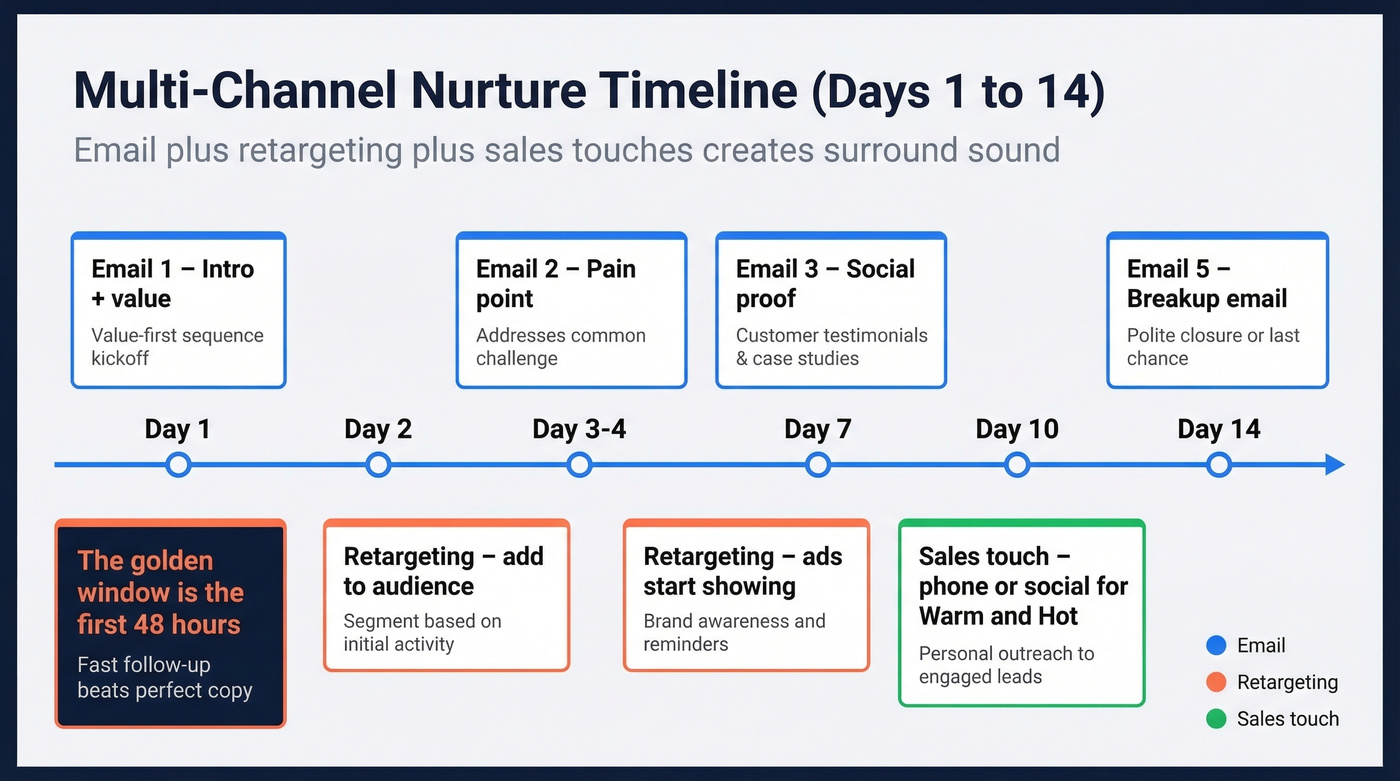
- Day 1: First email (intro + value)
- Day 2: Add prospect to retargeting audience
- Day 3-4: Follow-up email (pain point)
- Day 7: Retargeting ad triggers; third email (social proof)
- Day 10: Phone or social touch for warm/hot prospects
- Day 14: Breakup email
The golden window is the first 48 hours. Contacts reached within 5 minutes are 100x more likely to qualify than those left for 30 minutes. Make engagement data visible in your CRM so sales can time follow-ups based on real activity, not guesswork.
One underused tactic: interpret content engagement as intent signals. A prospect downloading implementation guides often signals they're planning to implement within the next year. Nurture them with MOFU content instead of rushing to BOFU. This "MQL+" approach separates teams that convert from teams that annoy.
If you want a more structured way to do this, build your tiers around intent based segmentation and formalize your lead scoring.
AI-Powered Nurturing in 2026
Let's be honest - AI isn't replacing your nurture strategy. It's handling the grunt work, and sellers spend only 28% of their time actually selling, so there's plenty of grunt work to reclaim.
Companies leading on AI adoption achieve 1.7x revenue growth and 40% greater cost reductions than laggards. The practical applications: behavior-based triggers that automatically move prospects between tiers, dynamic content that changes based on what the prospect clicked, and AI lead scoring that pushes alerts to sales when a prospect crosses the threshold. Omniplex Learning reported forecast accuracy within 5% after layering AI scoring into their nurture workflows - that's the kind of precision that turns guesswork into a system.
Layer in intent data to sharpen your triggers further. Prospeo tracks 15,000 intent topics via Bombora, so you can detect when a target account starts researching your category and automatically escalate them from Cold to Warm before they ever fill out a form.
If you're evaluating tooling, start with generative AI sales tools and a practical guide to AI sales follow-up.
Hot take: If your average deal size is under $15k, you probably don't need a six-figure AI nurturing platform. A clean contact list, a 5-email sequence, and disciplined segmentation will outperform a bloated tech stack with dirty data every time.
Benchmarks That Matter
Stop measuring open rates. They're vanity metrics inflated by privacy features and bot clicks.
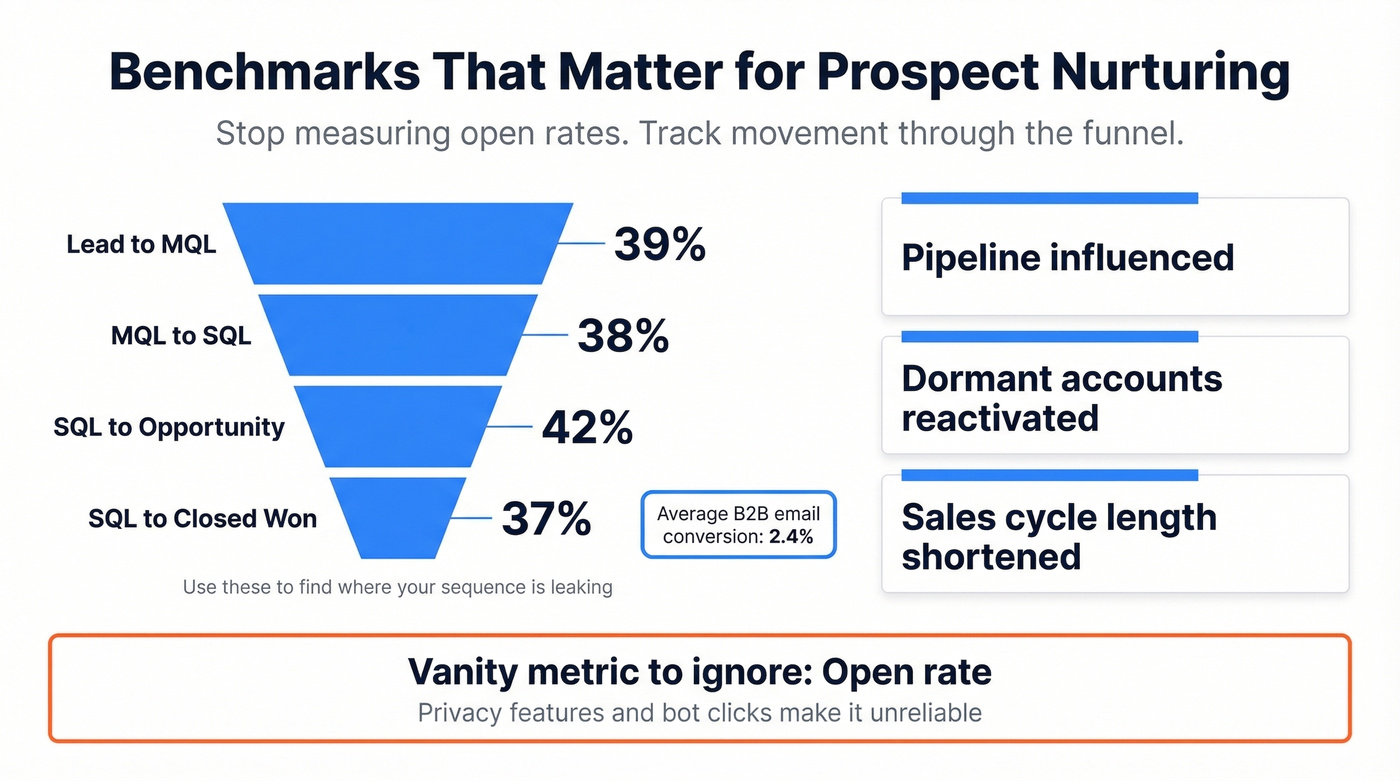
| Funnel Stage | Conversion Rate |
|---|---|
| Lead to MQL | 39% |
| MQL to SQL | 38% |
| SQL to Opportunity | 42% |
| SQL to Closed Won | 37% |
B2B email conversion sits at 2.4% on average. If you're below that, your segmentation or data quality needs work.
To go deeper on what to track (and what to ignore), use these funnel metrics and compare against sales pipeline benchmarks.
The KPIs that actually matter: pipeline influenced, dormant accounts reactivated, and sales cycle length shortened. These connect nurturing directly to revenue - everything else is a distraction.
Five Mistakes That Kill Pipeline
1. Email-only nurturing. Go multi-channel. Email plus retargeting plus phone often drives 3-5x better conversion rates than email alone.
2. Generic messaging. Segment Cold/Warm/Hot. One sequence for everyone is the fastest way to get ignored.
3. Pushing for the sale too early. MOFU prospects are researching, not buying. Respect the 3:1 ratio. We've watched teams burn through perfectly good prospect lists by sending pricing on day two - don't be that team.
4. Stopping after purchase. Your best prospects are existing customers. Nurturing doesn't end at the closed-won stage. Add renewal and upsell cadences.
5. Ignoring data quality. A 35% bounce rate doesn't just waste emails. It destroys your sender reputation for months, and rebuilding it takes far longer than preventing the damage in the first place. If you need a remediation plan, start with this email deliverability guide and then improve sender reputation.
Skip the mistake-fixing entirely if your contact database hasn't been verified in the last 30 days. Clean your list first. Everything else is downstream.
Tier-based nurturing only works when you know who's actually in-market. Prospeo tracks 15,000 intent topics via Bombora so you can auto-escalate prospects from Cold to Warm the moment they start researching your category - before they ever fill out a form.
Stop guessing which prospects are ready. Let intent data tell you.
FAQ
What's the difference between prospect nurturing and lead nurturing?
A lead is any captured contact; a prospect is ICP-qualified - right company, right role, right buying signals. Prospect nurturing targets only qualified accounts, focusing resources on contacts most likely to convert rather than warming every form fill in your database.
How many emails should a nurture sequence include?
Five to six emails spaced 3-4 days apart over two to three weeks is the sweet spot for most B2B teams. Follow the 3:1 give-to-get ratio - three value-first touches before making a direct ask in the final email.
How do you measure nurturing success?
Track pipeline influenced, dormant accounts reactivated, and sales cycle length - not open rates. Use funnel benchmarks (Lead to MQL at 39%, MQL to SQL at 38%) to pinpoint exactly where your sequences move the needle.
What tools help with prospect nurturing data quality?
Start with a verification layer that catches bad emails before they hit your sequences. From there, pair your CRM with a sequencing tool like Smartlead or Instantly to automate the multi-channel timeline we outlined above. The consensus on r/sales is that data quality matters more than which sequencer you pick - and that's been our experience too.