

How to Build a Prospecting Sequence That Actually Gets Replies
Most prospecting sequencing guides obsess over subject lines and call scripts. They skip the part that actually determines whether your outreach works: infrastructure and data quality. Fix those first, and mediocre copy still books meetings. Ignore them, and the best copywriter alive can't save your sequence.
Here's the short version. Fix your infrastructure - verified data, SPF/DKIM/DMARC, warm-up. Most sequences die here. Use the cluster+bump structure: 3 clusters of 3 touches over 14 days, spread across multiple channels. Target a 5%+ reply rate. Below 3%? Start with data quality and deliverability before you even think about rewriting copy.
What Is a Prospecting Sequence?
A prospecting sequence is a pre-planned series of multi-channel touches - emails, calls, social - designed to start a conversation with someone who doesn't know you yet. The math is simple but brutal: 80% of successful sales require 5+ follow-ups, yet 48% of reps never send a second message. A good sequence closes that gap systematically, turning a sales engagement platform into a pipeline machine instead of a spam cannon.
Why Most Sequences Fail
Your SDR just ran a 500-contact sequence. Three replies. A 12% bounce rate. A sending domain that's now flagged.
The sequence didn't fail because the copy was bad - it failed because half the emails never arrived. Every guide you'll read focuses on copy, timing, and subject lines. None of that matters if your emails bounce. The average bounce rate across Outreach customers is 2.8%, and anything above roughly 2% signals a data or deliverability problem. These problems compound fast. Bounces damage your sender reputation, which tanks inbox placement on the emails that are valid, which kills reply rates across the board. One bad list can poison a domain for weeks. If you spend time in r/sales or r/coldemail, you'll see practitioners talking about deliverability failures constantly - domains getting throttled after a bad list or a sudden volume spike.
This is where most teams underinvest. Before you write a single email, you need verified contact data flowing into your sequencer. We've seen teams fix nothing but their data source and watch reply rates double overnight. Prospeo runs every email through a 5-step verification process - catch-all handling, spam-trap removal, honeypot filtering - and delivers 98% email accuracy on a 7-day refresh cycle, so you're not sending to someone who changed jobs last month. One customer, Meritt, switched and watched their bounce rate drop from 35% to under 4%, tripling pipeline from $100K to $300K per week.

The Infrastructure Checklist
Before you load a single contact, run through this:
- SPF, DKIM, and DMARC configured and passing on all sending domains (use a SPF record example to sanity-check syntax)
- Dedicated sending domains - never send cold outreach from your primary domain
- 4-6 week warm-up starting at 5-10 emails/day, ramping gradually (see email velocity limits)
- Bounce rate under 2% - verify every email before it enters your cadence (benchmarks: email bounce rate)
- Spam complaints under 0.3% per Gmail Postmaster Tools thresholds for bulk senders
- One-click unsubscribe header per RFC 8058 - required for bulk-sender compliance with Google and Yahoo
- Custom tracking domain via CNAME to isolate reputation from shared infrastructure (more on tracking domain setup)
- Target 80%+ inbox placement as your operational goal (use email reputation tools to monitor)
Get these right and even average copy performs. Get them wrong and nothing else you do matters.

Every sequence in this guide assumes your emails actually arrive. Prospeo's 5-step verification delivers 98% email accuracy on a 7-day refresh cycle - so you're never sequencing stale contacts. Meritt switched and dropped their bounce rate from 35% to under 4%, tripling pipeline to $300K/week.
Stop sequencing dead emails. Start with verified data at $0.01 per lead.
How to Sequence Prospects Step by Step
1. Define your ICP and build a tight list. A good targeted list is 10-25 prospects - small enough to personalize, large enough to generate signal. Resist the urge to blast 500 contacts. SDR productivity comes from precision, not volume. If you need a scoring rubric, start with an ideal customer profile template.
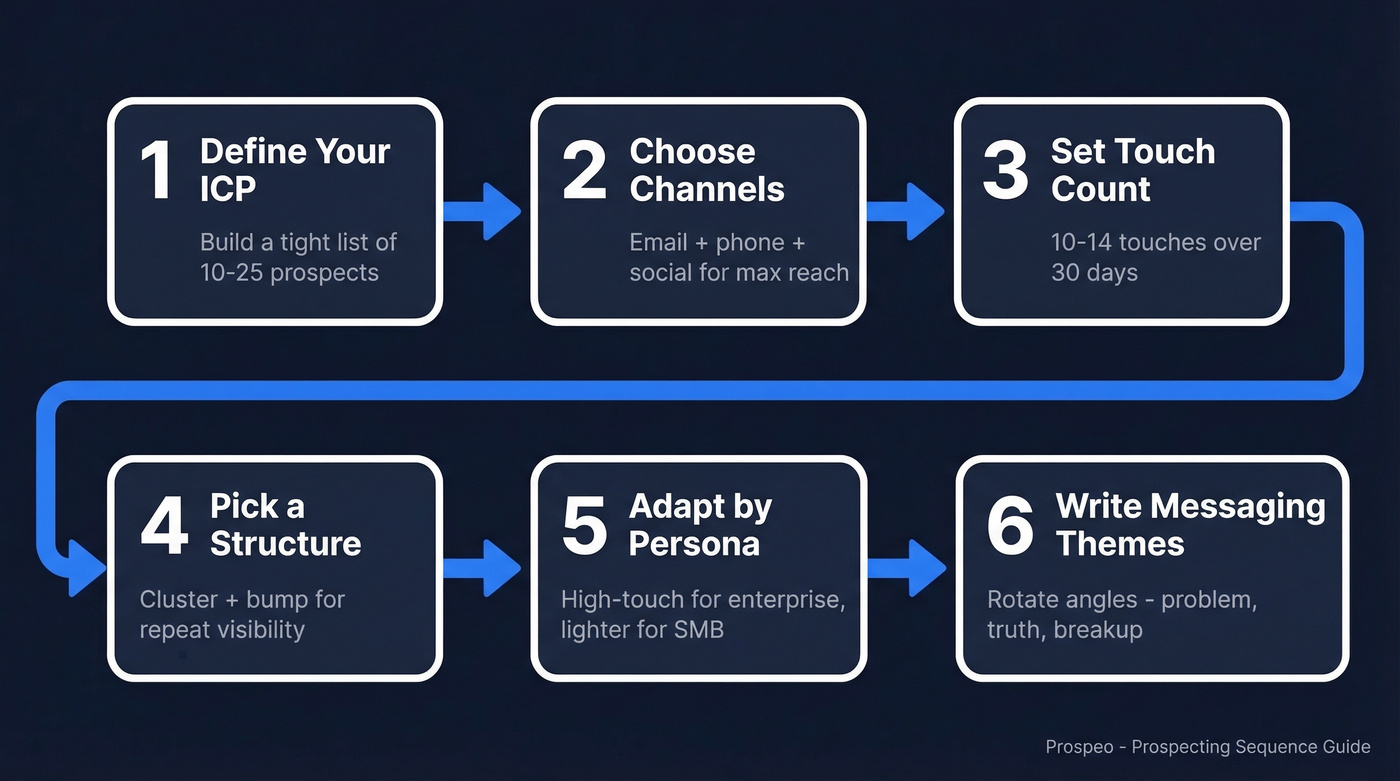
2. Choose your channels. Email alone isn't enough. Multi-channel outreach - email, phone, social - can double email reply rates by driving attention back to the inbox from other surfaces. Some practitioners advocate social-first sequences, but at scale, email remains the highest-volume channel for cold outbound. Social touches amplify email. They don't replace it.
3. Set your touch count. For cold outbound, plan 10-14 touches over roughly 30 days. The email sweet spot is 4-7 steps; beyond that you hit diminishing returns unless each touch adds genuine new value.
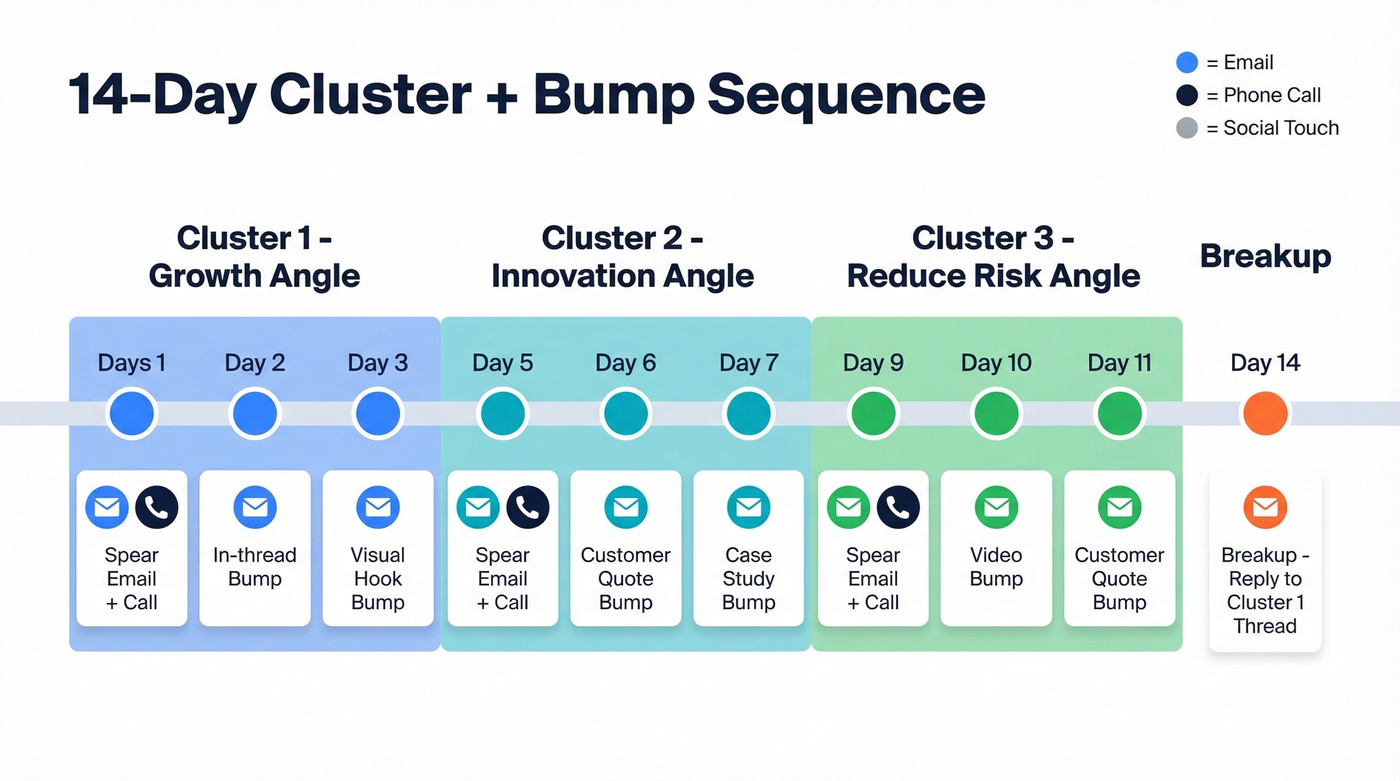
4. Pick a structure. We recommend the cluster+bump approach: three themed clusters, each with one "spear" email and two in-thread bumps. This gives your best emails multiple chances to be seen without flooding the inbox with new threads.
5. Adapt by persona. Not every prospect deserves the same sequence. High-ACV enterprise targets warrant a high-touch cadence with personalized research and direct dials on every cluster. Mid-market and SMB prospects can run lighter - fewer calls, more automated bumps. Match your outbound motion to the deal size.
6. Write messaging themes. Rotate through distinct angles - problem 1, problem 2, truth/breakup. Change your subject line when the theme changes. Same subject across all emails is a rookie mistake that signals automation to anyone paying attention. (If you want a swipe file, see prospecting email subject lines.)
14-Day Cluster+Bump Template
This template draws from a practitioner framework shared on r/sales. We've refined it based on what we've seen work across dozens of outbound campaigns. Treat it as a starting point and adapt the timing and channels to your market.
| Day | Channel | Action | Content Type |
|---|---|---|---|
| 1 | Email + Call | Spear email #1 | "Growth" angle + CTA |
| 2 | Bump (reply in-thread) | "Any thoughts?" | |
| 3 | Bump (reply in-thread) | Diagram or visual hook | |
| 5 | Email + Call | Spear email #2 | "Innovation" angle |
| 6 | Bump | Customer quote | |
| 7 | Bump | Screenshot or case study | |
| 9 | Email + Call | Spear email #3 | "Reduce risk" angle |
| 10 | Bump | GIF or short video | |
| 11 | Bump | Customer quote | |
| 14 | Breakup | Reply to Cluster 1 thread |
Pair cold calls within seconds of sending emails on Days 1, 5, and 9 - the timing overlap drives engagement. On social, send blank connection requests; notes signal you're selling, which lowers acceptance rates. The Day 14 breakup should be professional and direct - a simple yes/no, never cheeky.
2026 Benchmarks
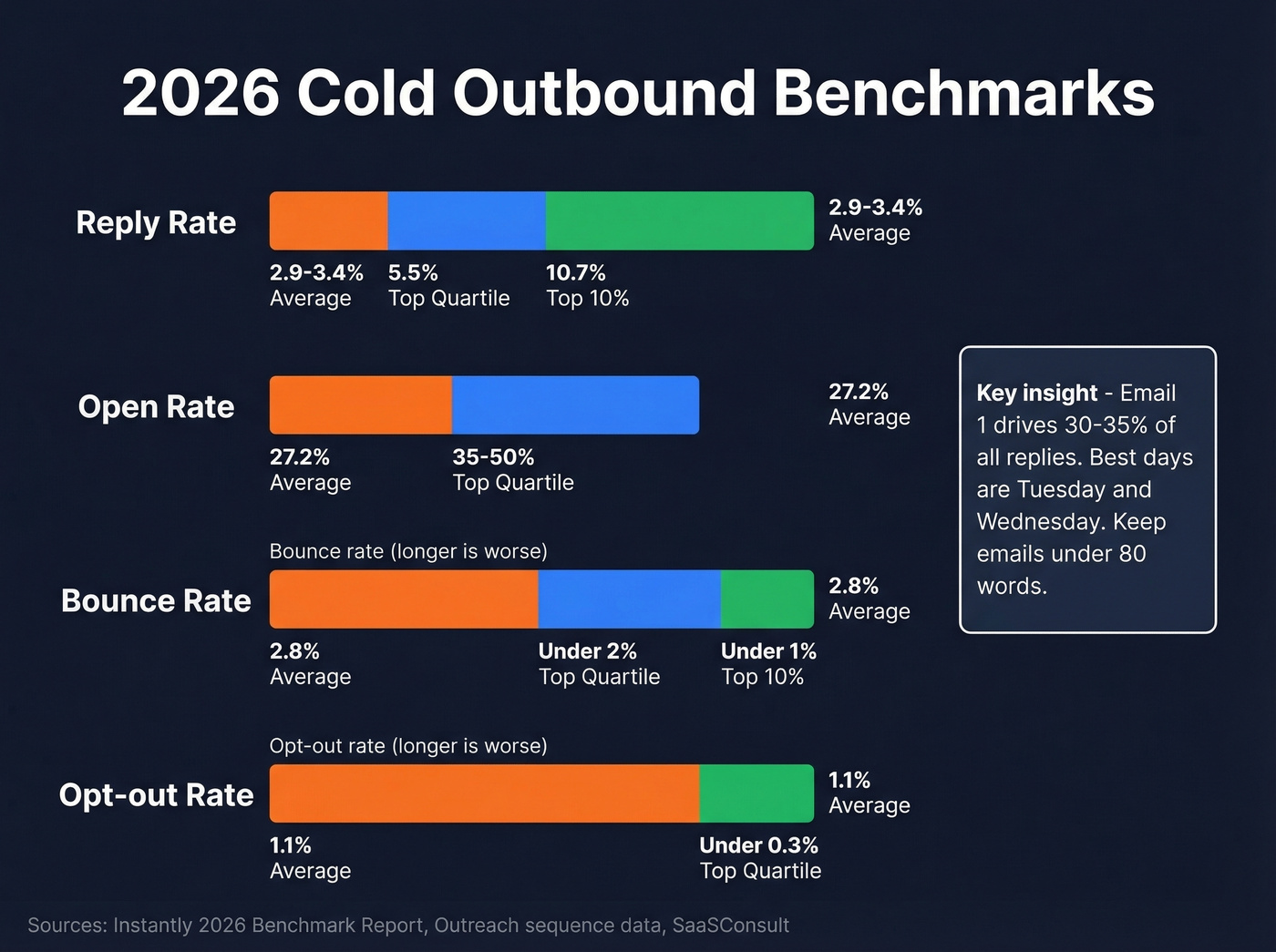
Here's what good looks like, based on Instantly's 2026 benchmark report and Outreach's sequence data:
| Metric | Average | Top Quartile | Top 10% |
|---|---|---|---|
| Reply rate | 2.9-3.4% | 5.5%+ | 10.7%+ |
| Open rate | 27.2% | 35-50% | - |
| Bounce rate | 2.8% | <2% | <1% |
| Opt-out rate | 1.1% | <0.3% | - |
| Type | Reply Rate | Meeting Rate |
|---|---|---|
| Cold outbound | 8-15% | 1-3% |
| Warm inbound | 20-30% | 8-12% |
Where do those replies actually come from? SaaS-specific data from SaaSConsult breaks it down: Email 1 drives 30-35% of total replies, Email 2 adds 25-30%, Email 3 contributes 20-25%, and Email 4+ adds 15-20%. Best days are Tuesday and Wednesday. Keep emails under 80 words. And prioritize reply rate over open rate - opens are inflated by bots and privacy features, making them an unreliable signal in 2026.
Let's be honest about something most guides won't say: if your average deal size is under $10K, you probably don't need a 14-touch, multi-channel sequence at all. A tight 3-email cluster with verified data and a strong first email will outperform a bloated cadence that your reps abandon after Day 5. Complexity is the enemy of execution for most SDR teams.
Optimization and Iteration
Test one variable at a time - subject line OR CTA OR send time, never all three. A/B test weekly; review results monthly with a cross-functional content committee. Plan a full sequence overhaul every 6 months because messaging goes stale faster than you think.
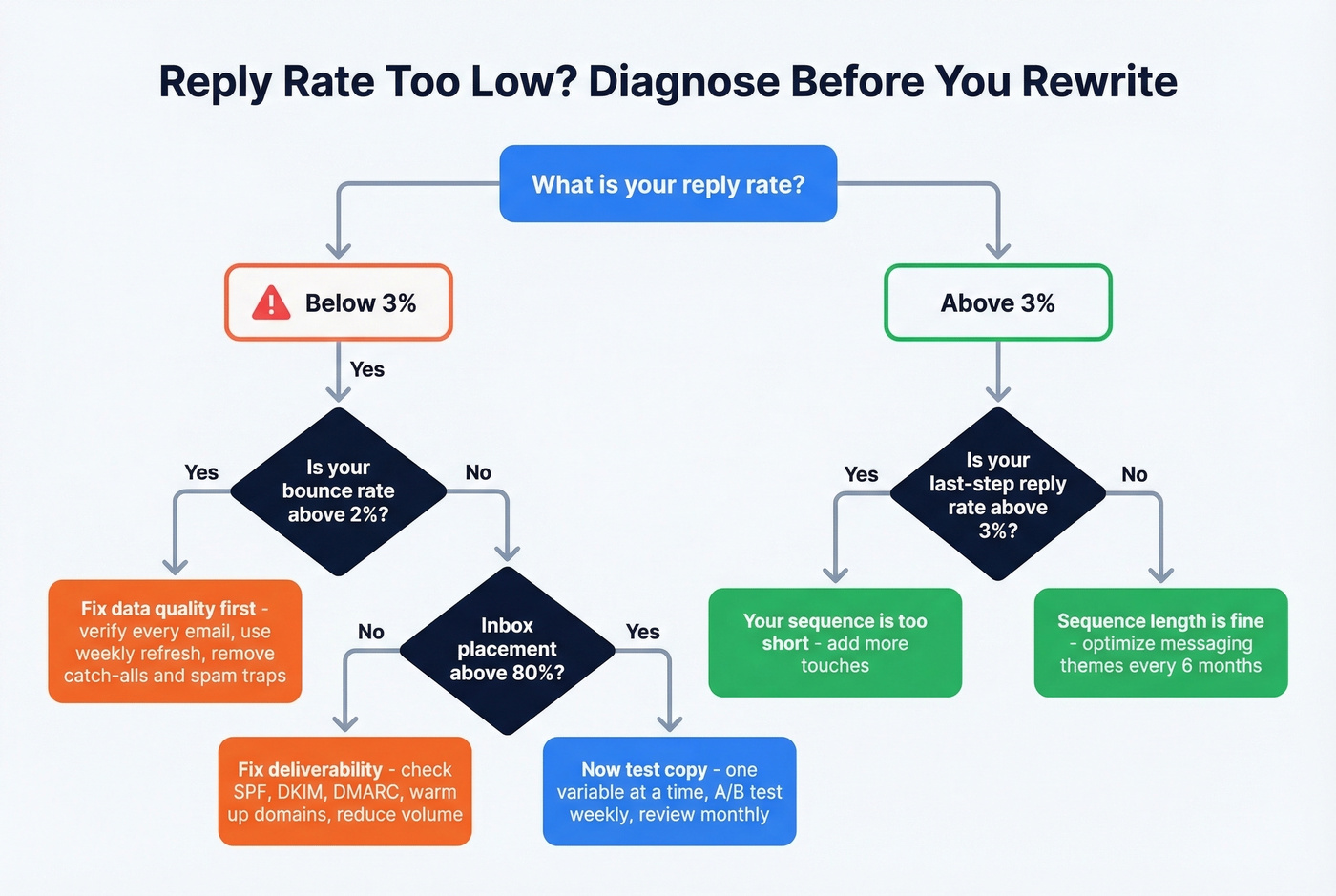
If your last-step reply rate is still above 3%, your sequence is probably too short. Add touches. When reply rate drops below 3%, investigate data quality and deliverability before rewriting copy - in our experience, bad data is the culprit far more often than bad messaging. If you need a deeper diagnostic, use an email deliverability guide to isolate the root cause.
Skip the optimization rabbit hole entirely if you haven't nailed the infrastructure checklist above. We've watched teams spend weeks split-testing subject lines while sending to a list with a 9% bounce rate. That's rearranging deck chairs. Document your prospect sequence workflow in a shared playbook so new reps can ramp without reinventing the cadence from scratch.
You just built a 14-day cluster+bump sequence. Now fill it with contacts that actually pick up. Prospeo gives you 143M+ verified emails and 125M+ verified mobiles with a 30% pickup rate - so your Day 1, 5, and 9 call+email combos connect with real buyers, not voicemails at old numbers.
Build your next sequence on data that books meetings, not bounces.
FAQ
How many touches should a prospecting sequence have?
Plan for 10-14 touches over roughly 30 days for cold outbound, with 4-7 email steps as the sweet spot. Multi-channel touches like calls and social extend the sequence without fatiguing the inbox. You can compress the same logic into a 14-day sprint using the cluster+bump template if you need faster iteration cycles.
What's a good reply rate for cold outbound?
The 2026 average sits between 2.9% and 3.4% depending on the platform, and top-quartile teams hit 5.5%+. Below 3%, investigate data quality and deliverability before rewriting copy - the majority of replies come from Step 1, so inbox placement is your biggest lever.
What's the difference between prospecting sequencing and a sales cadence?
They're the same thing with different labels. "Prospecting sequence" emphasizes the outbound, cold-contact use case, while "sales cadence" covers warm follow-ups and inbound nurturing too. The mechanics - timed multi-channel touches with escalation logic - are identical.
How do I keep bounce rates low across my sequences?
Verify every email before it enters your cadence and aim for under 2% bounce rate. A 5-step verification process that handles catch-all domains, spam traps, and honeypots is the baseline. Pair that with a data source that refreshes weekly rather than monthly - job changes are the silent killer of outbound lists, and stale data is the number one reason sequences crater after a strong start.