

10 B2B Psychographics Examples (With Messaging You Can Steal)
We ran the same sequence to two lists last quarter. Same ICP - mid-market SaaS, director-level and above. One list was CTOs. The other was CFOs. The CTO list pulled a 14% reply rate. The CFO list? Under 3%. Same company size, same industry, same product. The difference was entirely psychographic - what these people care about when they evaluate vendors. These psychographics examples in B2B aren't theoretical. They're the gap between a 3% reply rate and a 14% one.
You've probably read five articles on this topic already, and they all say "values, attitudes, interests, lifestyle." Great. Now what?
Quick Navigation
If you already know what psychographics are, skip straight to the 10 named B2B segments with messaging angles. Need to build segments from scratch? Jump to the step-by-step survey methodology. Need to make segments filterable in your CRM? Go to the activation section.
What Are B2B Psychographics?
Psychographics measure why people make decisions - their attitudes, values, risk tolerance, and priorities. The foundational model is the IAO framework: Interests, Activities, and Opinions. As Alexandra Samuel argued in HBR, marketers over-index on demographics when psychographics provide the deeper insight that actually moves deals.
The critical distinction in B2B: you're not measuring yoga preferences or Netflix habits. You're measuring vendor evaluation criteria, risk appetite, decision-making style, and how someone justifies a purchase internally. A CFO's psychographic profile revolves around cost-per-outcome thinking and payback periods - not lifestyle choices.
| Dimension | Demographics | Psychographics |
|---|---|---|
| Measures | Who they are | Why they buy |
| B2B example | VP Sales, 50-200 employees | Revenue-focused, wants fast ROI proof |
| Data source | CRM, enrichment tools | Surveys, intent data, behavior |
| Use case | Account targeting | Message personalization |
Why Psychographics Hit Harder in B2B
B2B buying committees are large and getting larger. Gartner puts the average tech purchase at 14-23 stakeholders, with 80% in senior operations or product roles. Each stakeholder has different psychographic drivers. The CISO cares about compliance risk. The CTO cares about technical differentiation. The CFO cares about total cost of ownership. Same deal, completely different emotional triggers.
Here's the thing: personal value has twice the impact of business value on commercial outcomes. Buyers are 8x more likely to pay a premium when they perceive personal value, and 50% report an emotional connection with the B2B vendor they choose - numbers from a CEB/Google study that's been cited across the industry for years. Lehigh Valley Health Network used psychographic segmentation in their marketing and saw click-through rates jump over 3X alongside increased revenue.
Longer sales cycles mean more touchpoints where psychographic alignment compounds. Get the messaging right for each stakeholder, and you're not just sending emails - you're building conviction across a committee.
The B2B Segmentation Stack
Psychographics don't replace firmographics - they layer on top. Firmographics define your target universe, psychographics refine your messaging, technographics inform your positioning, and behavioral data triggers your timing.
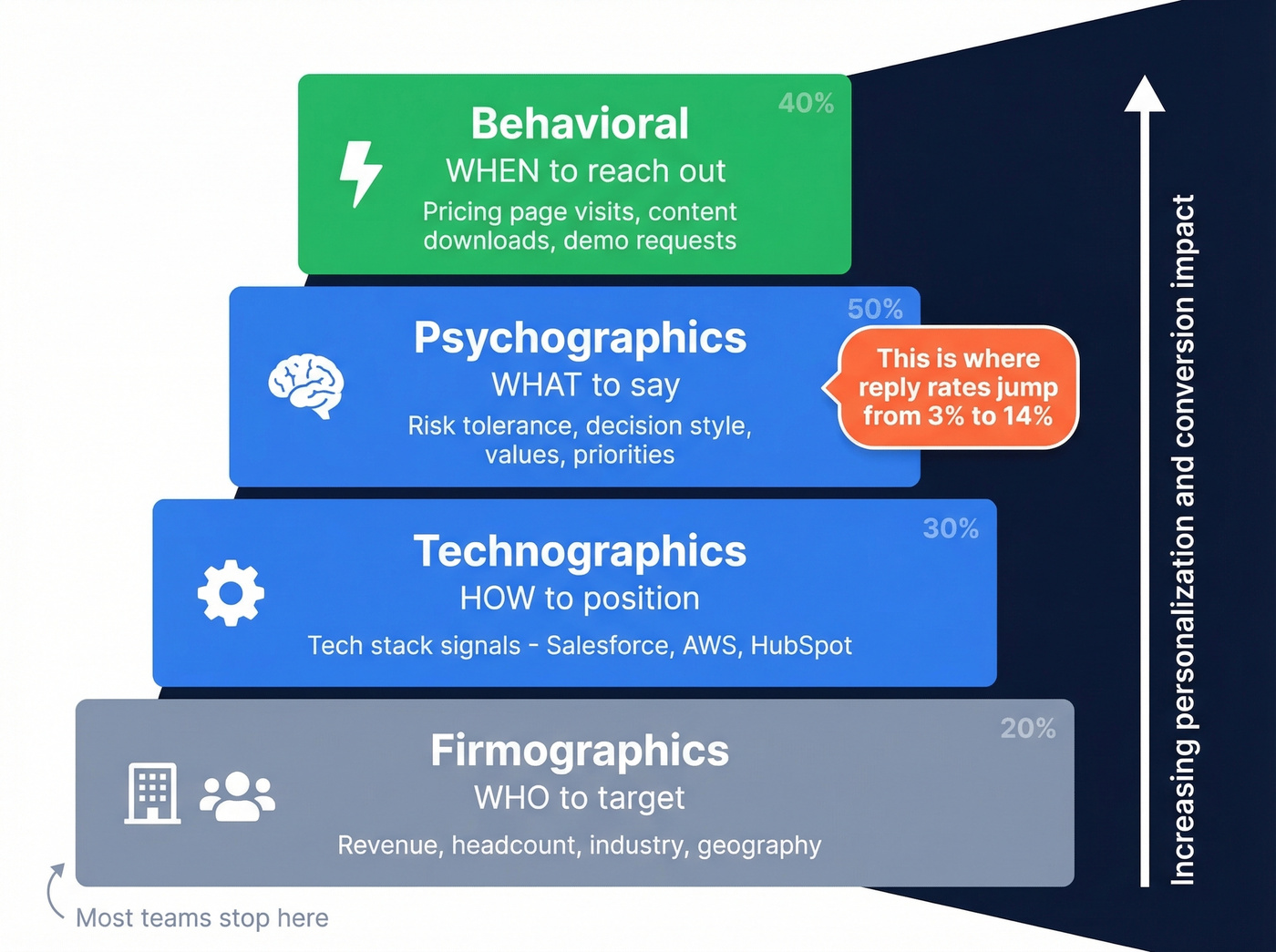
| Firmographics | Psychographics | Technographics | Behavioral | |
|---|---|---|---|---|
| Definition | Company attributes | Decision-maker attitudes | Tech stack signals | Actions taken |
| Examples | Revenue, headcount | Risk tolerance, innovation | Uses Salesforce, AWS | Pricing visit, whitepaper DL |
| Primary use | ICP definition | Message personalization | Competitive positioning | Timing & scoring |
| Collection | Enrichment tools | Surveys, intent signals | Tech providers | CRM, MAP, analytics |
Most teams stop at firmographics. The ones that layer psychographics on top see dramatically different response rates because they're saying different things to different people instead of blasting the same pitch to an entire ICP.

You just built psychographic segments. Now you need to reach them. Prospeo's 30+ search filters - including buyer intent, job change signals, and department headcount - let you layer psychographic messaging onto firmographic targeting. 98% email accuracy means your CFO-specific hook actually hits a CFO inbox, not a bounce log.
Stop crafting perfect messages for bad data. Start with emails that land.
10 B2B Psychographic Segments
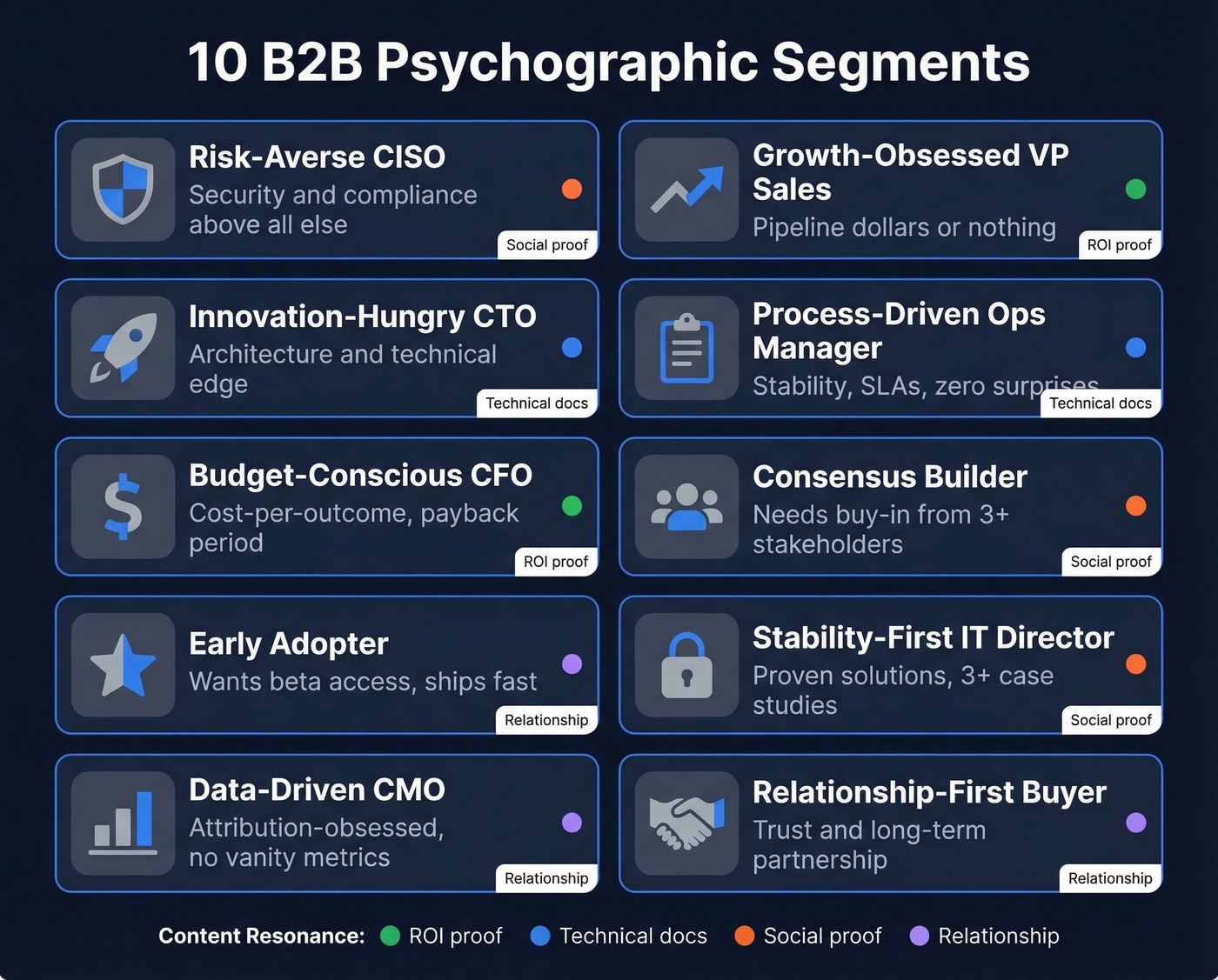
These aren't theoretical. Each archetype maps to a real buying behavior pattern we see across SaaS and tech sales. For each one: the psychographic traits, the content they respond to, and a messaging angle you can steal.
1. The Risk-Averse CISO
Traits: security-first, compliance-driven, deeply skeptical of new vendors, needs proof before even taking a demo. They respond to third-party audits, SOC 2 reports, and case studies with security outcomes. Your messaging angle is risk reduction, never feature innovation.
Email hook: "We passed [competitor]'s security review in 11 days. Here's the full audit."
2. The Growth-Obsessed VP Sales
This persona is revenue-focused, impatient, and measures everything in pipeline dollars. They don't care about features that don't move quota. Lead with ROI calculators, customer revenue case studies, and speed-to-value proof points. If your email doesn't mention a number, they won't read past the subject line.
Email hook: "Snyk's AEs added 200+ new opportunities/month after switching their data source. 4-minute walkthrough?"
3. The Innovation-Hungry CTO
This is the person who'll read your changelog before your homepage. Early adopter who tolerates bugs for beta access, reads Hacker News and technical blogs, evaluates architecture before business case. Send them API docs, technical differentiation posts, and architecture diagrams - never a marketing one-pager.
Email hook: "Our API returns enrichment in <200ms with 92% match rate. Docs here - no demo required."
4. The Process-Driven Ops Manager
Values stability above all else, hates surprises, needs a clear implementation plan before they'll champion anything internally. Preferred content: onboarding timelines, SLA documentation, integration guides. Skip this persona if your product doesn't have a documented onboarding flow yet - you'll lose them at the first ambiguous answer.
Email hook: "Here's our 14-day implementation checklist - including the Salesforce sync your team asked about."
5. The Budget-Conscious CFO
Your champion just forwarded your email to the CFO. She opens it and sees... what? If it's a feature list, you've already lost. This persona thinks in cost-per-outcome, needs ROI justification for every line item, and compares total cost of ownership across vendors. Send pricing comparison sheets, payback period analysis, and competitive breakdowns.
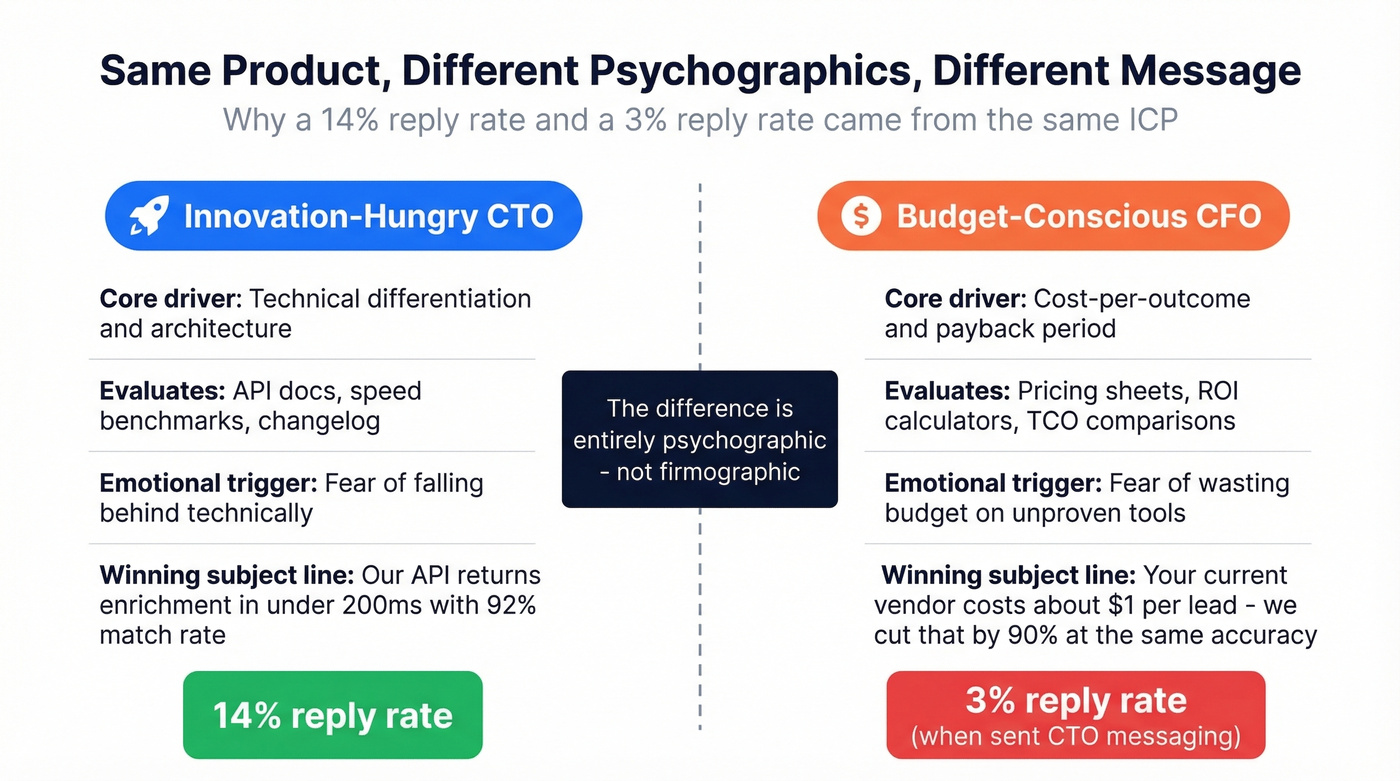
Email hook: "Your current data vendor costs ~$1/lead. We cut that by 90% at the same accuracy. Here's the math."
6. The Consensus-Builder
Avoids solo decisions, needs buy-in from three or more stakeholders, gravitates toward tools that are easy to demo internally. Give them multi-stakeholder ROI decks, "share with your team" CTAs, and group demo options.
Email hook: "I built a one-pager your team can review async - covers security, ROI, and implementation. Want it?"
7. The Early Adopter
Wants the newest thing, influenced by thought leaders and founder-led content, active in communities. Product roadmap previews and beta access invitations are their love language. In our experience, these buyers convert fastest but also churn fastest if your product stalls - so only target them if your shipping cadence backs it up.
Email hook: "We're opening our intent data beta to 50 teams this month. Your name came up - interested?"
8. The Stability-First IT Director
Proven solutions only. This persona needs three or more case studies before agreeing to a demo and evaluates uptime and migration support before features. Enterprise reference calls, uptime statistics, and migration playbooks are what move them. If you're a Series A startup with 18 months of uptime history, this isn't your buyer yet - and that's fine.
Email hook: "Three companies your size migrated from [competitor] last quarter. Here's what the first 30 days looked like."
9. The Data-Driven CMO
Attribution-obsessed and skeptical of vanity metrics, this buyer wants dashboards and reporting integrations before committing. If you can't show them how your product connects to their analytics stack, you won't get past the first call. Lead with analytics integration docs and measurable outcome case studies.
Email hook: "Our attribution dashboard shows pipeline by source, channel, and segment. 2-min video attached."
10. The Relationship-First Buyer
Values trust and long-term partnership over features, cares about who their CSM will be, asks about renewal flexibility early. Preferred content: customer advisory board invitations, dedicated CSM introductions, flexible contract terms. This persona is rare in PLG motions but dominant in enterprise deals above $50K ACV, where the relationship often outlasts the product evaluation itself.
Email hook: "Before we talk product - meet Sarah, who'd be your dedicated CSM. She worked with [similar company] for 2 years."
How to Build Psychographic Profiles
Discrete-Choice Surveys
The most reliable method for building a psychographic profile is forcing tradeoffs. Don't ask people to rate statements on a 1-5 scale - they'll rate everything a 4. Instead, use pairwise comparison: present two statements like "Prefers proven solutions" and "Prioritizes speed-to-value," then force a choice. Each statement gets a 0-100 score based on its win rate across all pairs.
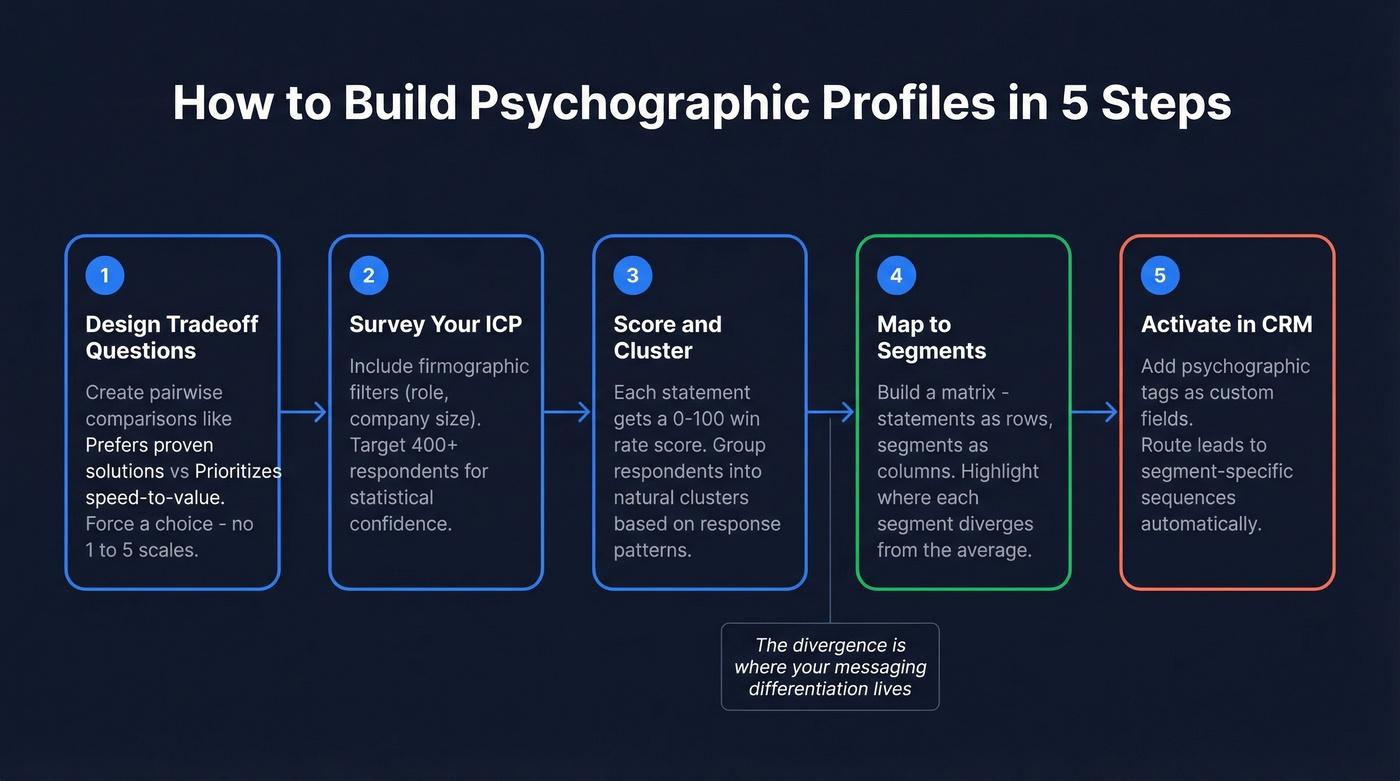
A practitioner on r/marketing laid out this exact methodology and noted it doesn't require data science or an agency - just structured tradeoff questions and a spreadsheet. Include multiple-choice self-ID questions so you can filter results by firmographic segment. Then build a segment matrix with statements as rows and segments as columns, highlighting where each segment diverges from the overall average. That divergence is where your messaging differentiation lives.
Qual-Quant-Qual Research
For teams with more budget, the three-phase approach works well: qualitative interviews first to discover the right questions, then a quantitative survey at scale with 400+ respondents, then follow-up interviews for nuance. One collaboration software company surveyed 600 designers to build psychographic personas - the insights refined their GTM and inspired 5,000+ community-built add-on apps.
Behavioral Clustering
When surveys feel too heavy, use cohort behavior as a psychographic proxy. Cluster accounts by content engagement patterns, feature usage, or buying velocity. The consensus on r/sales is that this lighter-weight approach gets you 80% of the value at 20% of the effort. Teams that download security whitepapers and ask about SOC 2 during discovery? That's your Risk-Averse CISO segment, inferred from behavior rather than surveyed.
Intent Data as a Proxy
Intent data is the most underrated psychographic proxy in B2B, and it scales in a way that surveys never will. What companies actively research reveals their attitudes and priorities - no survey required. If an account is researching "AI security compliance," that maps directly to the Risk-Averse CISO segment. If they're researching "sales automation ROI," that's your Growth-Obsessed VP Sales.
Instead of surveying every prospect, use intent signals to infer which psychographic segment an account belongs to and prioritize outreach accordingly.
15 Psychographic Survey Questions
Copy these into your next buyer research survey. Most force a tradeoff; the rest reveal decision-making patterns.
- When evaluating a new vendor, what matters most: proven track record, innovative features, or lowest total cost?
- How does your team typically make purchasing decisions: consensus, executive mandate, or champion-driven?
- What's your biggest concern when adopting new software: security, implementation time, or team adoption?
- Do you prefer vendors who ship fast and iterate, or vendors who prioritize stability and thorough testing?
- When a vendor's product has a major bug, what matters more: speed of fix or transparency of communication?
- How do you typically discover new tools: peer recommendations, analyst reports, or your own research?
- Would you pay a 20% premium for a vendor with a dedicated CSM and quarterly business reviews?
- When building a business case internally, do you lead with cost savings, revenue impact, or risk reduction?
- How important is it that a vendor integrates natively with your existing stack vs. offering a better standalone experience?
- Do you prefer annual contracts with discounts or monthly flexibility with higher per-unit cost?
- When evaluating competitors, do you weight feature depth or ease of use more heavily?
- How quickly does your team need to see ROI from a new tool: 30 days, 90 days, or 6+ months?
- Would you rather attend a live demo or explore a self-serve sandbox?
- How much does a vendor's company culture and values influence your purchasing decision?
- If two products are functionally identical, what breaks the tie: price, support quality, or brand reputation?
Adapt the wording to your industry. The goal isn't to ask all 15 - pick the 8-10 that map to your specific psychographic dimensions and force real tradeoffs.
Making Segments Targetable
Let's be honest: if your psychographic segments can't be filtered in your CRM, they're marketing theater. A beautiful persona deck that lives in a Google Doc and never touches a sales workflow is worth exactly nothing.
The workflow is straightforward. Define your segments using the methods above. Map each segment to firmographic and intent filters that serve as proxies - the Risk-Averse CISO maps to "CISO/VP Security title + researching compliance topics + enterprise company." Enrich your CRM data to fill the gaps. Then build segment-specific sequences. The key is surfacing the pain points in each buyer persona so your reps can address them directly in outreach rather than guessing.
Prospeo's 30+ search filters - buyer intent, job changes, headcount growth, technographics - let you turn psychographic archetypes into filterable prospect lists. The Risk-Averse CISO segment becomes a targetable list in minutes: security titles + compliance intent topics + enterprise headcount. That's a list your reps can actually sequence against, with enrichment returning 50+ data points per contact at an 83% match rate.

Hot take: if your deal size is under $10K, you don't need a research agency or a $50K segmentation study. You need 10 good survey questions, 200 responses, and a spreadsheet. Then a data platform that lets you turn those segments into lists your reps can work. We've found 200 responses is the minimum for reliable segments - below that, you're pattern-matching on noise.
If you're turning these segments into outbound, pair them with sales prospecting techniques and a tight B2B cold email sequence so each persona gets the right angle at the right time.
Each of these 10 psychographic archetypes needs different messaging - but they all need verified contact data underneath. Prospeo enriches leads with 50+ data points at 92% match rate, refreshed every 7 days. That means your CRM segments stay current and your personalized sequences reach real buyers, not stale records.
Activate your psychographic segments with data that's 7 days fresh, not 6 weeks stale.
FAQ
What's the difference between psychographics and demographics?
Demographics describe who someone is - title, location, company size. Psychographics describe why they buy: values, risk tolerance, and decision-making style. In B2B, two VPs at identical companies respond to completely different messaging because their psychographic profiles diverge. Demographics tell you who to target; psychographics tell you what to say.
How do you collect psychographic data in B2B?
Discrete-choice surveys that force tradeoffs are the gold standard - expect 200+ responses for reliable segments. Complement surveys with behavioral clustering from content engagement data and intent signals that reveal what accounts actively prioritize. For scale, tools like Prospeo track 15,000 intent topics via Bombora, letting you infer psychographic segments without surveying every prospect.
Can you use psychographics for ABM?
Absolutely - and with 14-23 stakeholders on a typical buying committee, it's essential. Map a psychographic profile to each stakeholder role and tailor messaging per person, not per account. The CISO gets risk-reduction messaging while the CTO gets innovation angles, even within the same deal. This multi-persona approach compounds across touchpoints and is often the difference between a stalled deal and a closed one.
What tools help with B2B psychographic segmentation?
For data collection, SurveyMonkey and Typeform both have free tiers, with paid plans starting around $25/month. For activation - turning segments into actual prospect lists - you need a platform that combines intent data with firmographic and technographic filters so your segments aren't stuck in a spreadsheet.