

Python Email Verifier: What Actually Works (And What Gets You Blacklisted)
One in six emails never reach the inbox - a global inbox placement rate of roughly 84%. If you've got a CSV of leads and you're thinking "I'll just write a quick Python script to clean this," you're asking the right question. But the answer depends entirely on what "verify" means to you.
What You Need (Quick Version)
- Syntax validation only? Use
emvaloremail-validator. Done in 3 lines of code. - Check if a mailbox exists? SMTP probing with
smtplibworks in testing, fails in production. Read on before you build it. (If you want the deeper mechanics, see SMTP probing.) - Verified emails for outbound at scale? Skip the scripts. Use a verification API that handles catch-all domains, spam traps, and deliverability infrastructure you don't want to maintain yourself. (Benchmarks here: email check APIs.)
Regex Validation (And Why It's Not Enough)
Most developers start here:
pattern = r"^[a-zA-Z0-9._%+-]+@[a-zA-Z0-9.-]+\.[a-zA-Z]{2,}$"
is_valid = bool(re.fullmatch(pattern, email))
This catches obvious garbage but rejects perfectly valid addresses. RFC 5322 allows characters like !#$%&'*+-/=?^_{|}~ in the local part, plus subaddressing and quoted strings. Nested comments make the grammar context-free - traditional regex literally can't parse it fully. Beyond deliverability, unvalidated email inputs in forms are a vector for injection attacks, which is another reason syntax validation belongs in every input pipeline.
Regex is fine as a first-pass filter. It isn't verification. If you’re unsure what “valid” even means, start with what is a valid email address.
Python Libraries Worth Using
Library Comparison
| Library | Checks | RFC Compliance | Speed | Notes |
|---|---|---|---|---|
emval |
Syntax, i18n | RFC 5322/6531 | 100-1000x faster | Rust bindings, actively maintained |
email-validator |
Syntax, DNS | RFC 5321/5322 | Baseline | Ecosystem standard, active |
verify-email |
Syntax, MX, SMTP | Partial | Moderate | Last release Oct 2022; stale |
validators |
Syntax only | Basic | Fast | Lightweight utility |
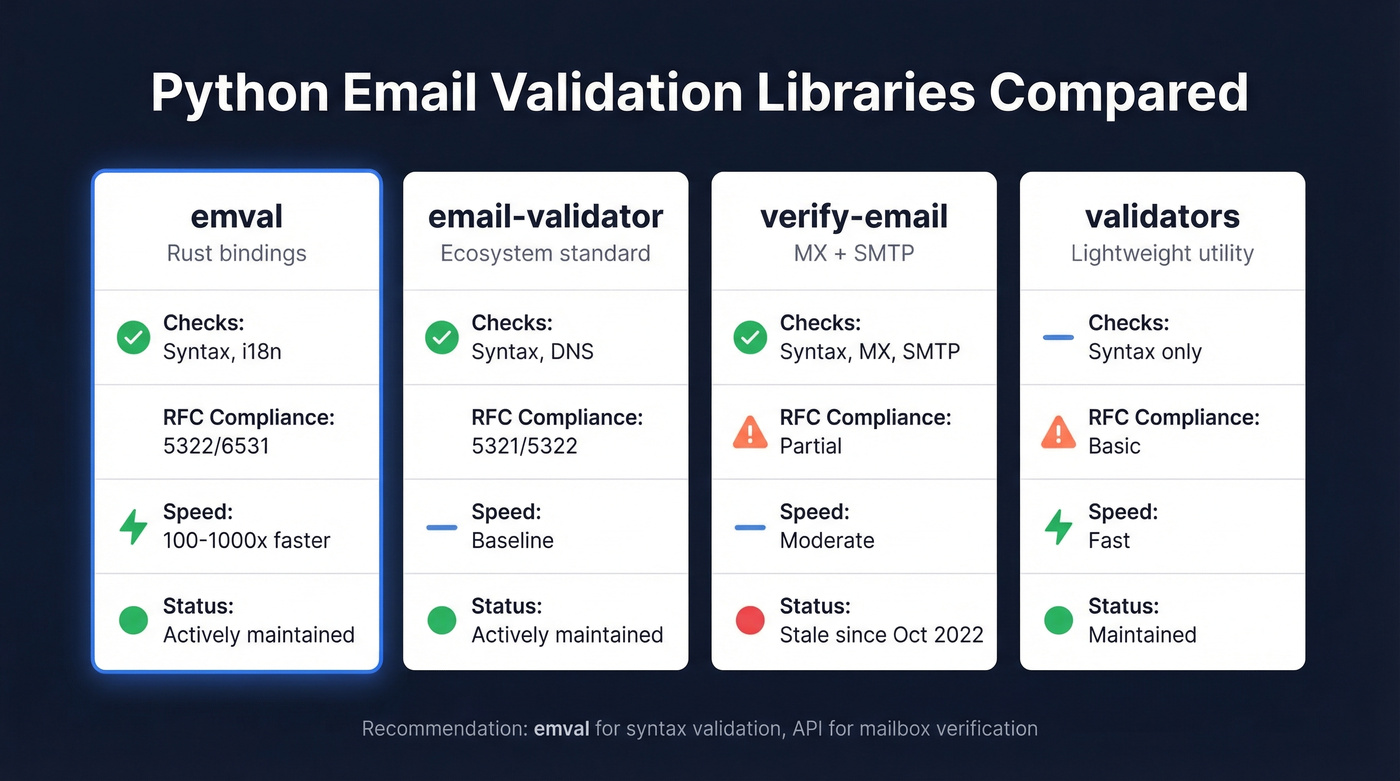
The standout is emval. It's written in Rust with Python bindings, handles internationalized domains and local parts, and ships with a Polars plugin for DataFrame-scale validation. There's an open Pydantic feature request to replace python-email-validator with it - that's how much faster it is. If you want an open-source path, emval paired with a lightweight FastAPI wrapper gets you surprisingly far for syntax-level checks (and it aligns well with stricter email validation rules).
verify-email does MX lookups and SMTP pinging, which sounds appealing until you realize the repo hasn't been updated since October 2022. We've seen teams adopt it, hit Gmail's walls, and abandon it within a week.

Building SMTP verification in Python means fighting catch-all domains, IP blacklists, and Gmail blocking your datacenter. Prospeo's 5-step verification handles all of it - 143M+ verified emails, 98% accuracy, 7-day refresh cycle. At $0.01 per email, it costs less than the engineering hours you'd spend debugging smtplib.
Replace your Python verification script with an API that actually works at scale.
SMTP Verification with Python
The Handshake
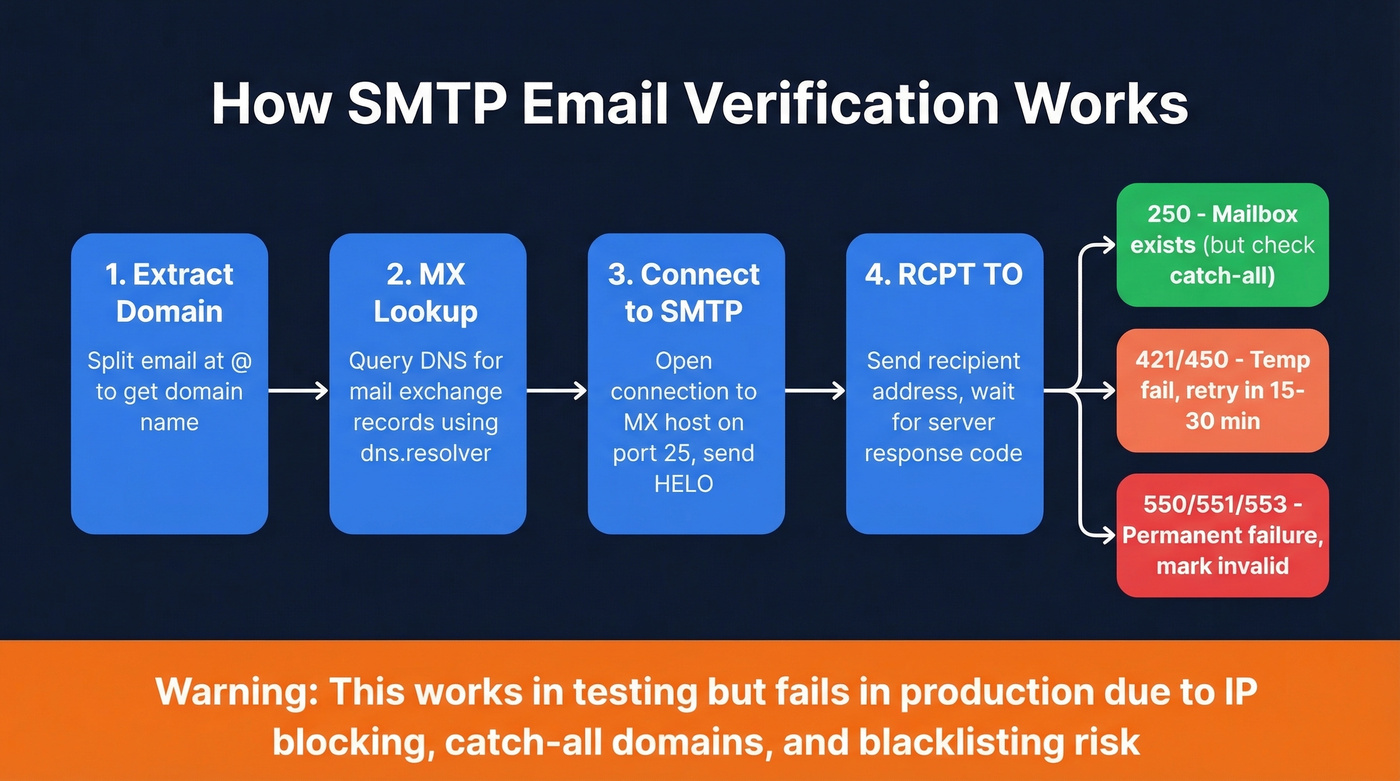
Here's the classic approach - MX lookup, then SMTP conversation:
def verify_email(email):
    domain = email.split("@")[1]
    records = dns.resolver.resolve(domain, "MX")
    mx_host = str(records[0].exchange)

    with [smtplib.SMTP](https://docs.python.org/3/library/smtplib.html)(mx_host, timeout=10) as smtp:
        smtp.helo("verify.example.com")
        smtp.mail("test@example.com")
        code, _ = smtp.rcpt(email)
        return code == 250
This works on your local machine against small mail servers. It doesn't work in production.
SMTP Response Codes
| Code | Meaning | Action |
|---|---|---|
| 250 | Recipient exists | Accept (but verify catch-all) |
| 421/450 | Temp fail or greylisting | Retry with 15-30 min backoff |
| 550/551/553 | Permanent failure | Mark invalid |

Why DIY Verification Fails in Production
Here's the thing: SMTP probing is a solved problem in theory and a disaster in practice. The failure modes stack up fast, and they compound at volume.
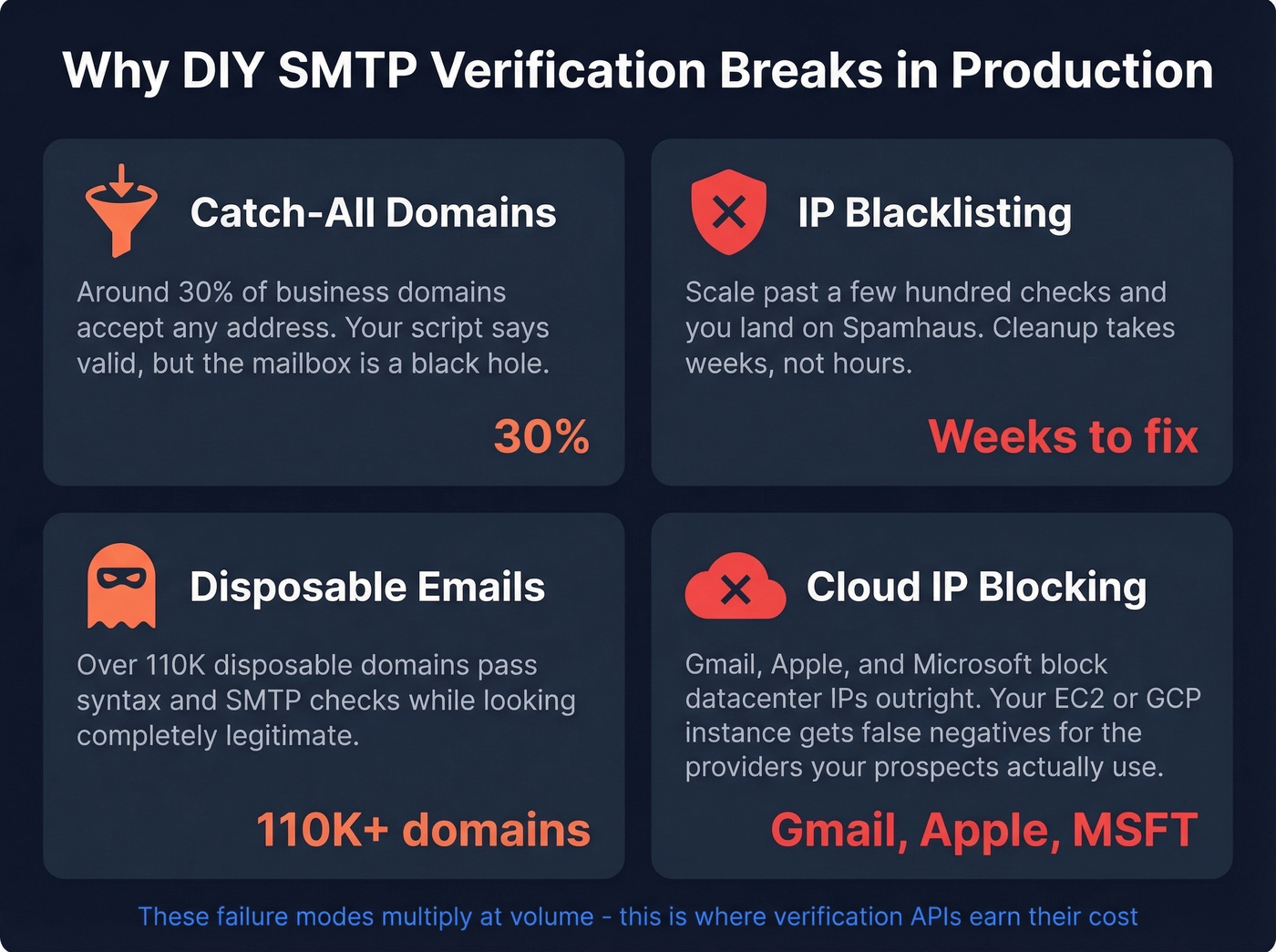
Catch-all domains. Around 30% of business domains accept any address at the SMTP level. Yahoo exhibits this behavior too. Your script returns "valid" for literally.anything@theirdomain.com, and you've got no way to distinguish real mailboxes from black holes. (More on this in our guide to domain email verification.)
Blacklisting. Do this at volume and you'll land on Spamhaus. That's not a hypothetical - it's the most common outcome we see from teams who try to scale DIY verification. Once you're on that list, the cleanup takes weeks. If you’re troubleshooting reputation issues, compare major lists in blacklisted domains.
Disposable emails. Over 110K disposable domains pass both syntax and SMTP checks, many looking completely legitimate. Without a maintained blocklist, they'll sail right through your pipeline. (See disposable email detection.)
Cloud IP blocking. Gmail, Apple, and Microsoft block datacenter IPs at the SMTP level. If you're running checks from EC2 or GCP, you'll get false "unverifiable" results for a huge chunk of your list - often the most important chunk, since those are the providers your prospects actually use.
For batch processing a CSV of thousands, every one of these failure modes multiplies. This is exactly where APIs earn their cost - especially once you’re doing ongoing email list hygiene instead of one-off cleanup.
Let's be honest: if your deal sizes are under five figures, you almost certainly don't need to build verification infrastructure. The engineering time alone costs more than a year of API credits.
When to Use a Verification API
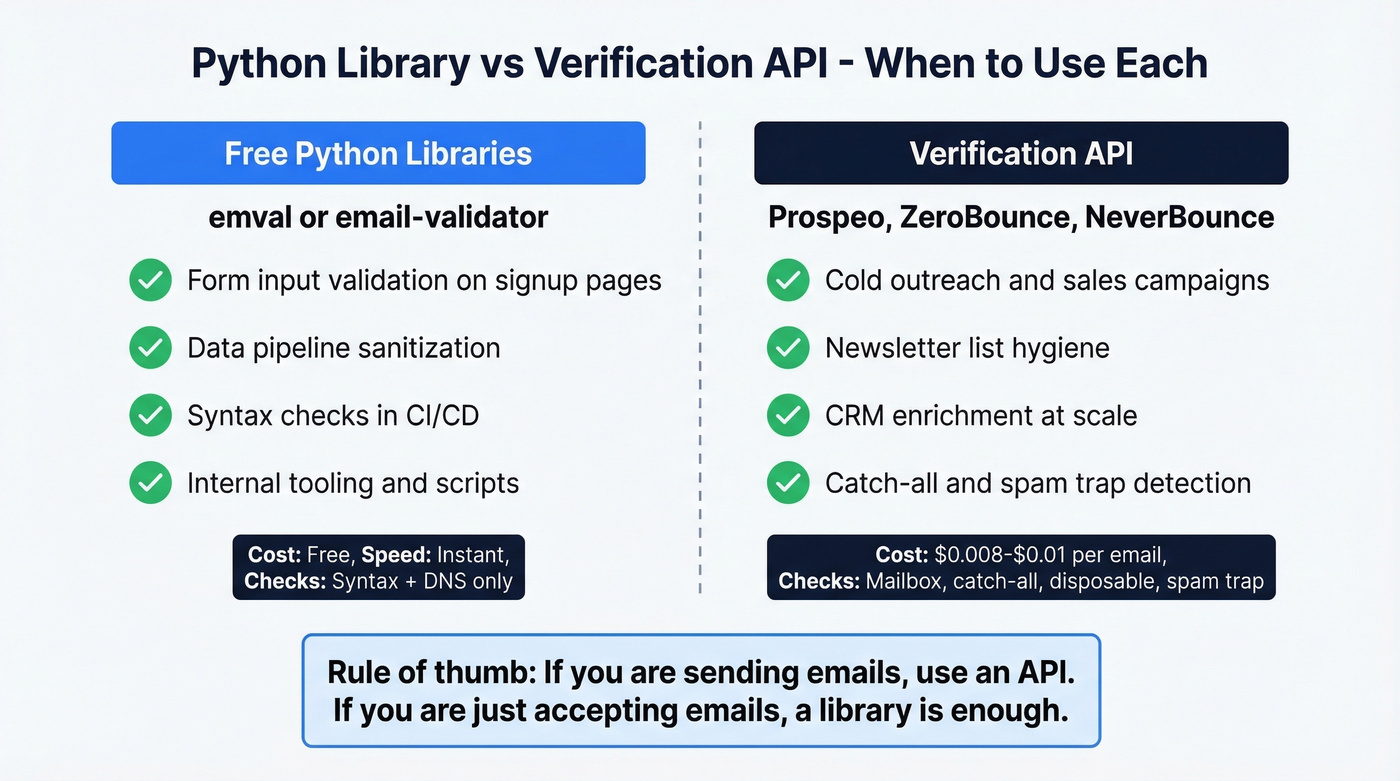
Use free Python libraries for syntax validation in forms, data pipelines, and input sanitization. Use a verification API for anything touching outbound email - cold outreach, newsletter hygiene, or CRM enrichment. (If you’re deciding between approaches, see email verification process.)
| Provider | Pricing | Model |
|---|---|---|
| Prospeo | ~$0.01/email | Credit-based, free tier |
| ZeroBounce | ~$0.008/email | Pay-as-you-go |
| NeverBounce | ~$0.008/email | Bulk pricing |
| BriteVerify | ~$0.01/email | Per-email |
| Hunter | From $49/mo | Monthly plan |
Skip this if you're just validating form inputs on a signup page. emval or email-validator will handle that perfectly. But the moment you're sending outbound at any real volume, the math on API verification is hard to argue with. A single bounced email costs more sender reputation than a penny per verification ever will. If you want a broader comparison set, see email verification tools.
Your Python script validates syntax. Prospeo verifies deliverability - catch-all handling, spam-trap removal, and honeypot filtering across 143M+ emails. 98% accuracy, free tier included, no contracts. One API call replaces the entire SMTP pipeline you were about to build.
Ship your product, not your own email verification infrastructure.
FAQ
Can Python verify if an email exists?
Via SMTP RCPT TO, technically yes. But Gmail, Apple, and Microsoft reject datacenter IPs outright, and catch-all domains return false positives for any address. For reliable mailbox-level checks at volume, you'll need a dedicated verification API. Some teams try Google Workspace APIs, but those only cover Google accounts and don't generalize.
What's the fastest Python email validation library?
emval - written in Rust with Python bindings, it runs 100-1000x faster than python-email-validator. It includes a Polars plugin for DataFrame-scale validation and handles full RFC 5322/6531 compliance. It validates syntax only, not mailbox existence.
Is a verification API worth the cost?
At $0.008-$0.01 per email, verification costs less than a single bounced email costs your sender reputation. In our experience, the teams that resist API verification the longest are the ones who've already burned a domain trying to do it themselves. The free tiers on most providers make it easy to test before committing any budget.