

7 Qualities of a Good Sales Team Leader - And How to Practice Each One
We've watched dozens of top closers flame out in their first year as managers. They got promoted because they crushed their number. Nobody taught them how to coach, nobody gave them a 1:1 template, and now they're expected to build a team that hits quota when only 16% of reps actually do - down from 53% in 2012.
Being a great closer doesn't make you a great leader. The standard advice is vague traits like "visionary" and "passionate." That's useless. Traits without frameworks are just personality descriptions.
The Cheat Sheet
- Coaching is the #1 quality. Use the 10/10/10 framework for 1:1s: 10 minutes on pipeline red flags, 10 on game tape, 10 on human roadblocks.
- Coach in this order: Results, then Pipeline, then Activity. Starting with activity metrics is how you become a micromanager.
- Spend 60% of coaching time on B-players. That's where the real gains live.
Leader vs. Manager
Most sales orgs confuse these roles, and it costs them their best people. Top performers don't stick around to be micromanaged.
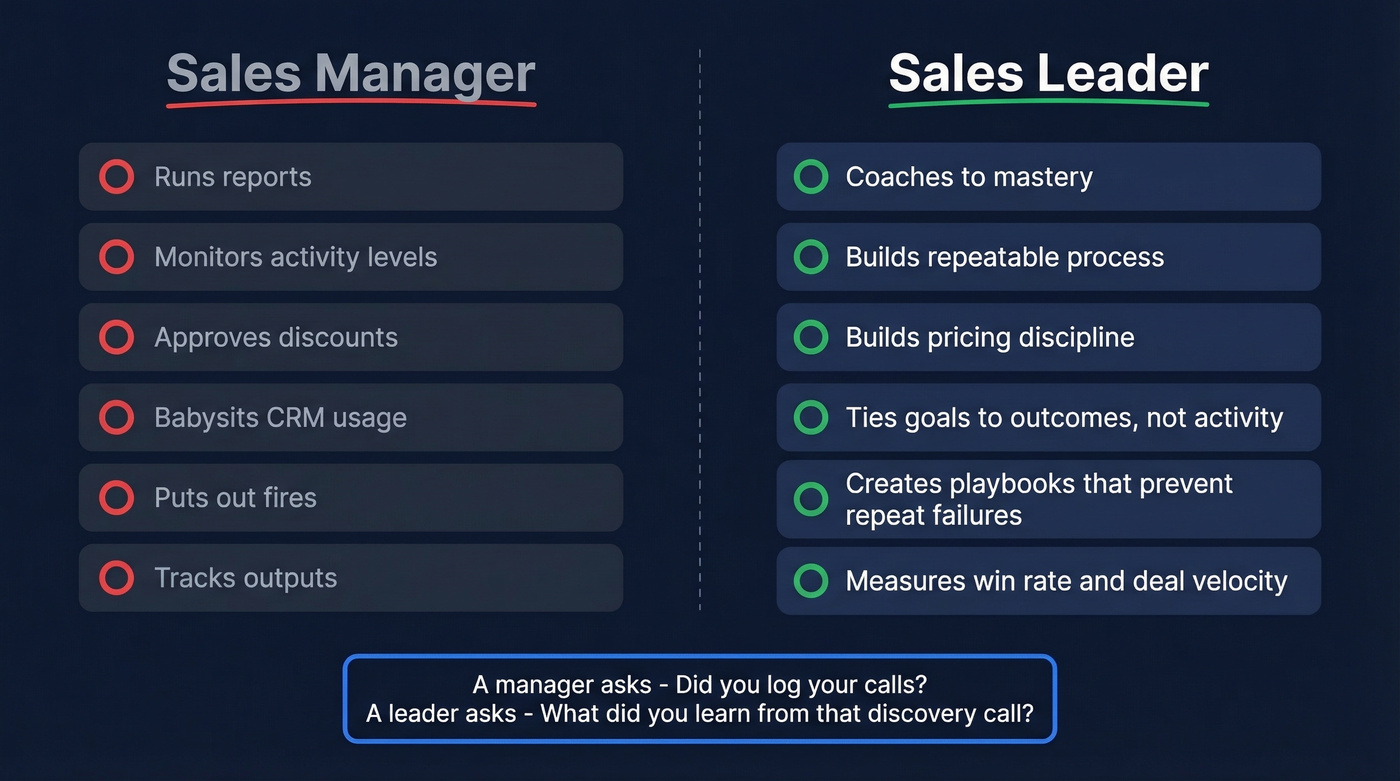
| Manager Does This | Leader Does This |
|---|---|
| Runs reports | Coaches to mastery |
| Monitors activity | Builds repeatable process |
| Approves discounts | Builds pricing discipline |
| Babysits CRM usage | Ties goals to outcomes, not activity |
| Puts out fires | Creates playbooks that prevent repeat failures |
| Tracks outputs | Measures win rate and deal velocity |
A manager asks "Did you log your calls?" A leader asks "What did you learn from that discovery call that changes how you'll run the next one?" The distinction matters because 56% of senior executives are likely to leave their role within the next two years - promoting your best rep without developing them as a leader just accelerates that churn.
The 7 Traits That Actually Matter
1. Coaching Ability
This is the lead quality, full stop. 75% of sales reps say they're more likely to hit targets with a coach or mentor - not a manager who reviews pipeline. Use the 10/10/10 rule for 30-minute 1:1s: pipeline red flags only (no deal-by-deal interrogation), then one call reviewed together, then the human stuff - roadblocks, motivation, career.
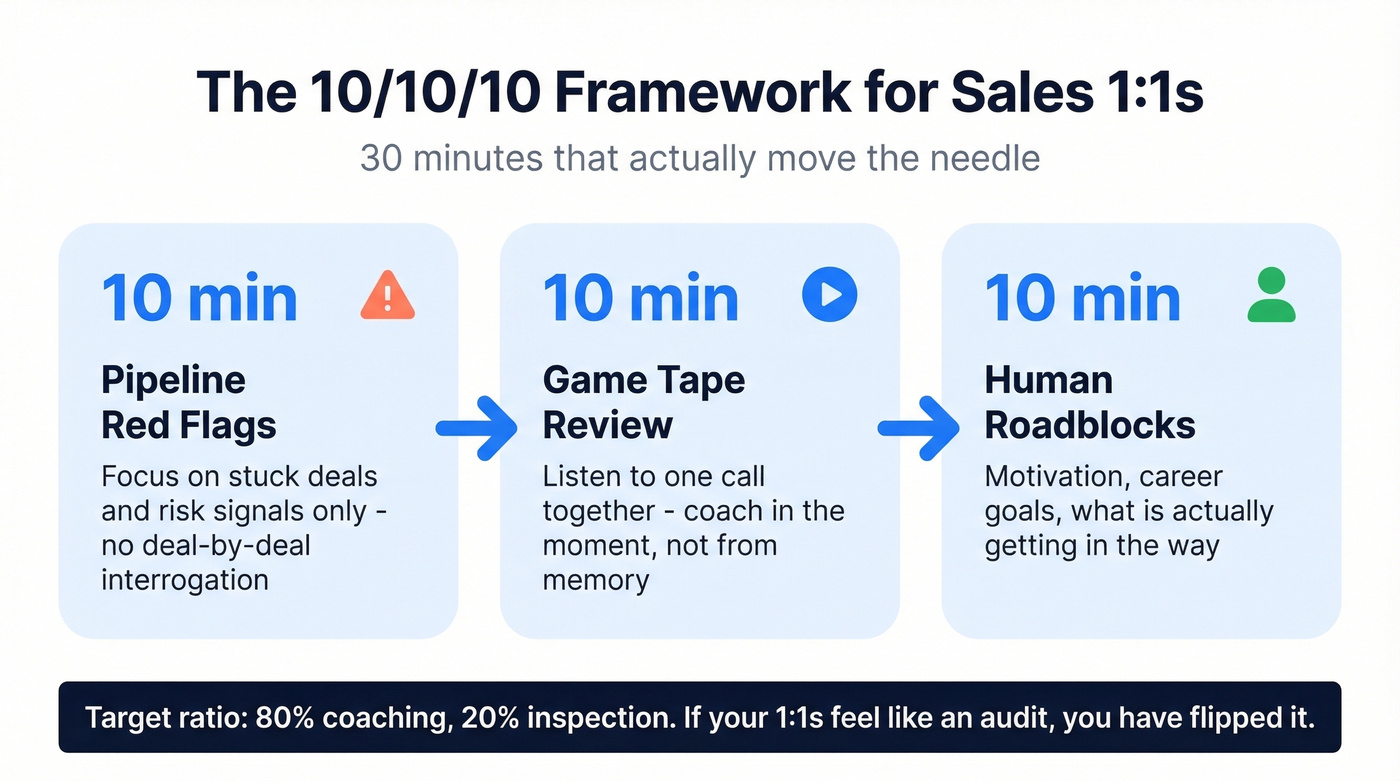
Keep the ratio at 80% coaching, 20% inspection. If your 1:1s feel like an audit, you've flipped it.
If you want a systems-first approach beyond 1:1s, start with sales leadership and build from there.
2. Emotional Intelligence
Picture this: your top rep goes quiet in the team meeting. A manager assumes disengagement. A leader recognizes she just lost a deal she'd been working for three months and doesn't want to dissect it in front of everyone.
That's EQ in a sales leadership context - not "being empathetic" in the abstract, but reading the room in a deal review and knowing when someone needs encouragement versus a direct performance conversation. Treat it as a diagnostic skill, not a personality trait. The reps who trust you enough to tell you what's actually going wrong are the ones you can actually help.
If you’re tightening how you deliver feedback and run tough conversations, use a sales communication framework so it’s consistent across the team.
3. Strategic Thinking
Good leaders coach in a specific order: Results, then Pipeline, then Activity. If results are strong, you don't need to dig into pipeline health. If pipeline is healthy, you don't need to interrogate activity volume. Only drill down when the upstream metric is off.
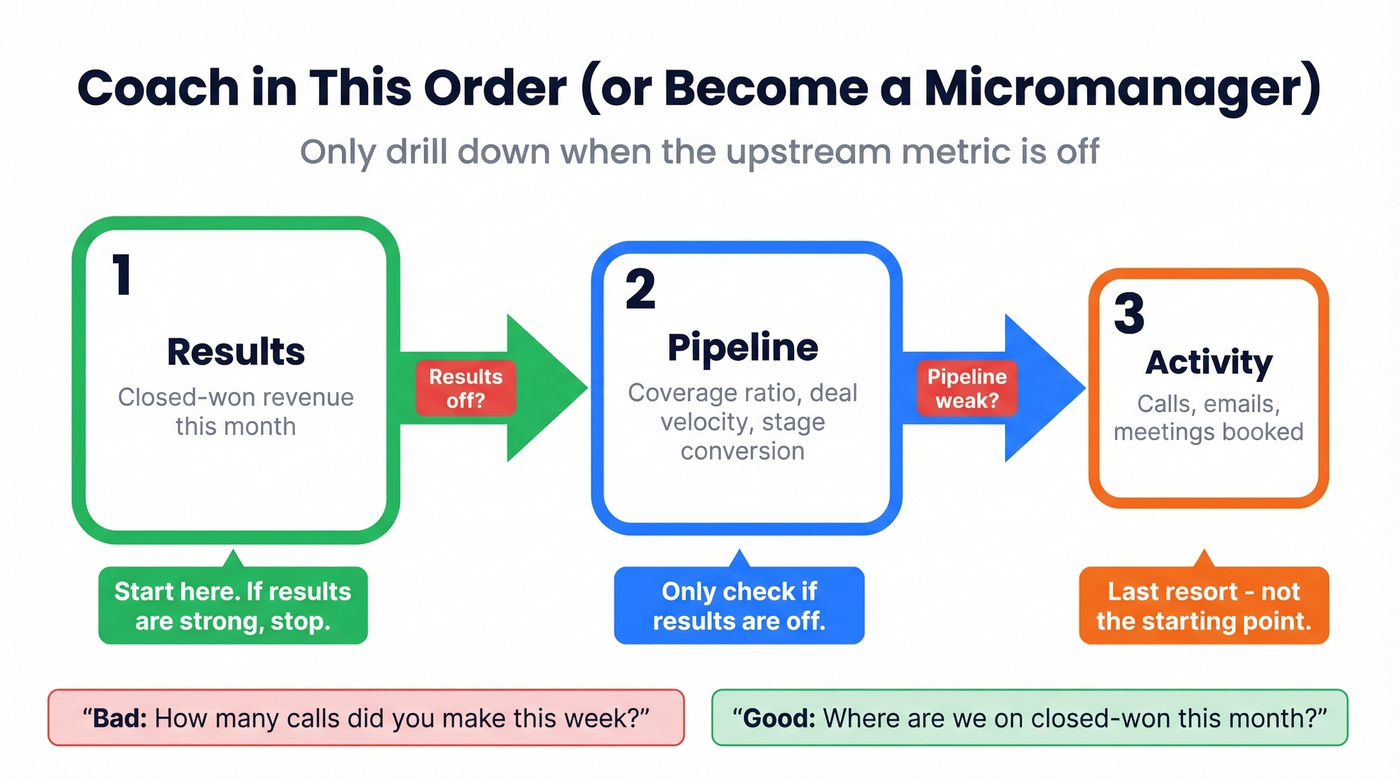
Leaders who start with "How many calls did you make?" are managing inputs. Leaders who start with "Where are we on closed-won this month?" are coaching to outcomes. The difference sounds subtle. It isn't.
To make this measurable, track pipeline health and coach off leading indicators - not vibes.
4. Team Investment Strategy
| Tier | Time Allocation | Why |
|---|---|---|
| A-players | 25% | Already performing - give stretch goals and career development |
| B-players | 60% | A 15-20% improvement here moves the entire team's number |
| C-players | 15% | Clear performance plan with a defined timeline, then act |
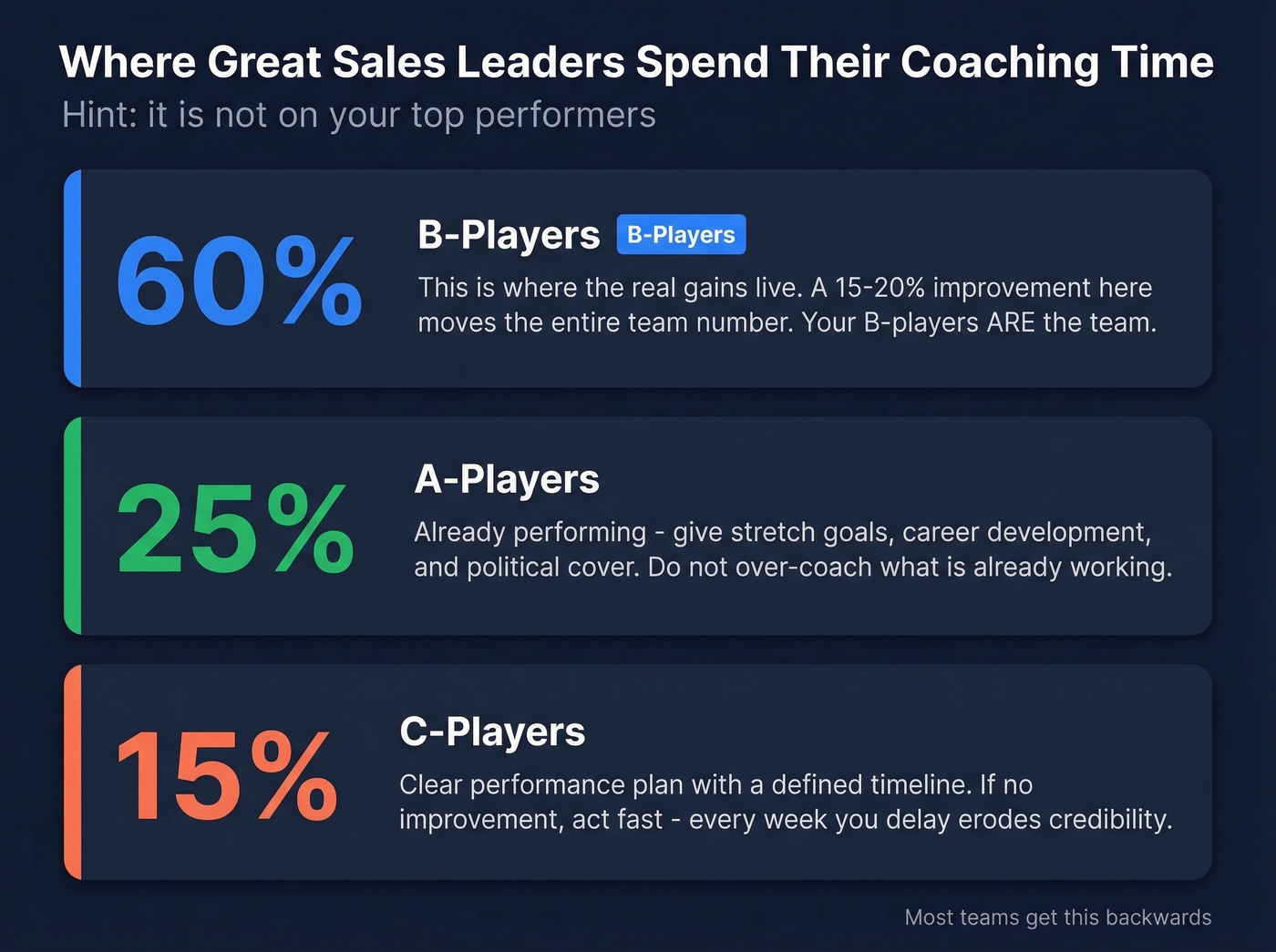
This is counterintuitive, but we've seen it play out repeatedly: teams that over-invest in coaching their middle tier outperform teams that pour attention into top performers or spend months trying to save underperformers. Your B-players are the team. Treat them that way.
If you’re building a repeatable ramp for that middle tier, a 30-60-90 day plan helps standardize expectations fast.
5. Accountability Without Micromanagement
Reps spend 60% of their time on non-selling tasks. A good leader's job isn't to add more inspection to that pile - it's to remove friction so reps can actually sell.
Set clear expectations, then audit the systems your reps work off. If emails are bouncing at 20%, that's not a rep problem - it's a data problem. Fix the system. Prospeo refreshes contact data every 7 days at 98% email accuracy, so your reps start Monday with a clean list instead of a cleanup project.
If bounce is a recurring issue, align on email bounce rate benchmarks and fixes before you “coach” activity.
Skip this section if your 1:1s are already 80%+ coaching. You don't need more frameworks - you need to protect the time you've already carved out.
6. Hiring Instinct and Fast Firing
Here's the thing: tolerating underperformance punishes your best reps. When a C-player stays six months past their expiration date, your A-players notice - they're picking up slack and wondering why leadership won't act. Hire for coachability and work ethic, develop skills, and when someone isn't working out after a fair ramp, move fast. Every week you delay erodes your credibility with the people who are actually performing.
To reduce “bad fit” hires, define your ideal customer profile and selling motion first - then hire reps who match it.
7. Transparency and Communication
72% of reps don't receive specific, actionable feedback. The fix is simple but uncomfortable: explain how quotas are set, share the math behind territory assignments, and give feedback that's specific enough to act on.
"You need to improve your discovery" is useless. "You're asking about budget too early - try moving it to the second call after you've established the pain" is coaching. One sentence changes behavior. The other just creates anxiety.
If you want to make feedback more actionable, standardize your discovery questions so coaching is tied to a shared rubric.

You just read that reps spend 60% of their time on non-selling tasks. A good sales leader removes friction - starting with bad data. Prospeo delivers 98% verified emails on a 7-day refresh cycle, so your team sells instead of cleaning lists.
Stop asking reps to prospect with garbage data. Give them a clean list every Monday.
What Bad Sales Leaders Do
If you recognize yourself here, that's actually a good sign.
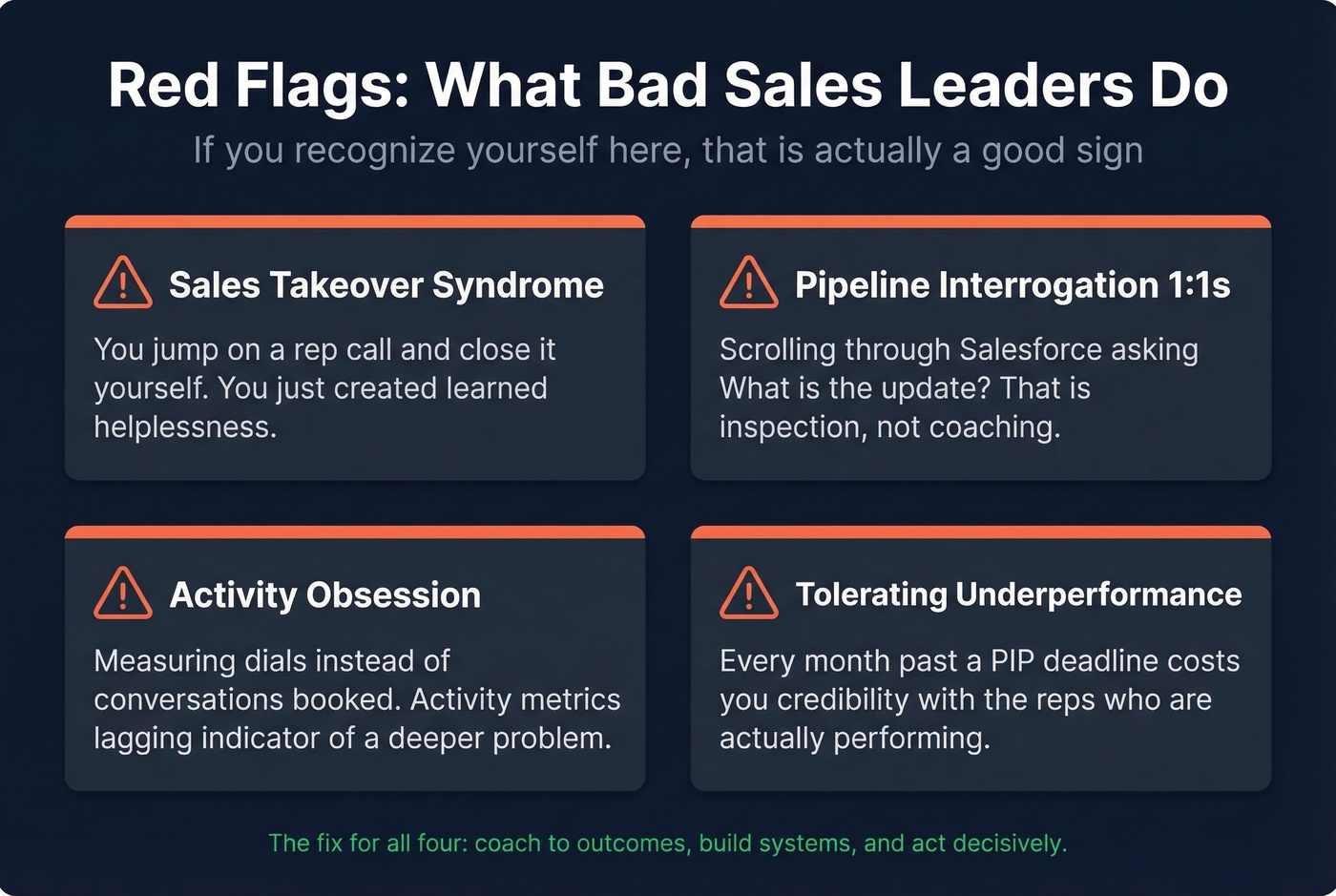
- Sales takeover syndrome. You jump on a rep's call and close it yourself. Congrats, you've just created learned helplessness.
- Pipeline interrogation 1:1s. Scrolling through Salesforce asking "What's the update?" is inspection, not coaching.
- Activity obsession. Measuring dials instead of conversations booked. Activity metrics are a lagging indicator of a deeper problem.
- Tolerating consistent underperformance. Every month past a PIP deadline costs you credibility with the rest of the team.
If you’re trying to replace “activity obsession” with better leading indicators, use these sales activities examples to define what actually moves pipeline.
The Uncomfortable Truth
Let's be honest: most sales teams don't have a talent problem. They have a leadership problem wearing a talent-problem costume.
If your average rep tenure is under 14 months and you're blaming the hiring market, look in the mirror first. In sales communities on Reddit, reps consistently praise leaders who give political cover, make quick decisions, and remove blockers - operational behaviors, not personality descriptors. The qualities above aren't abstract. They're daily choices.
If churn is showing up in rep tenure, treat it like a metric: run a simple churn analysis on why people leave.
Proof It Works
Boart Longyear's APAC division was in trouble - declining markets, lost key accounts, zero sales methodology. New leadership implemented structured coaching, customer segmentation, and process mapping. Within 8 months, the team was 16% ahead of budget and became the best-performing region globally for 22 consecutive months.
The tools were coaching, process, and accountability. Not a new CRM. Not a motivational offsite. The qualities of a good sales team leader - practiced daily, not just listed on a slide deck - turned a struggling region into the company's top performer.
Great coaching can't fix a 20% bounce rate. If your reps are burning hours on dead contacts, that's a leadership systems problem - not a talent problem. Prospeo gives your team 300M+ verified profiles at $0.01/email so you can coach to outcomes, not clean up data.
Lead your team to quota with data that actually connects to real buyers.
FAQ
What's the most important quality of a sales team leader?
Coaching ability. 75% of reps are more likely to hit targets with a coach or mentor. Use the 10/10/10 framework for 1:1s and maintain an 80/20 coaching-to-inspection ratio. Traits without actionable systems behind them are just personality descriptions.
What separates a sales leader from a sales manager?
Managers run reports, monitor CRM usage, and approve discounts. Leaders coach to skill mastery, build repeatable systems, and hold real accountability. The distinction matters because top performers leave micromanagers - confusing the two roles drives talent erosion and short-term thinking.
How can a sales leader improve team productivity with better data?
Clean data is a leadership decision - it's a system you choose, not a rep problem you manage. Reps waste hours on invalid contacts and bounced emails, and that's a systems failure. Fixing it means choosing tools with high accuracy and frequent refresh cycles so your team spends time selling, not troubleshooting bad contact info.