

ReachStream vs Apollo.io: Which B2B Data Tool Actually Delivers?
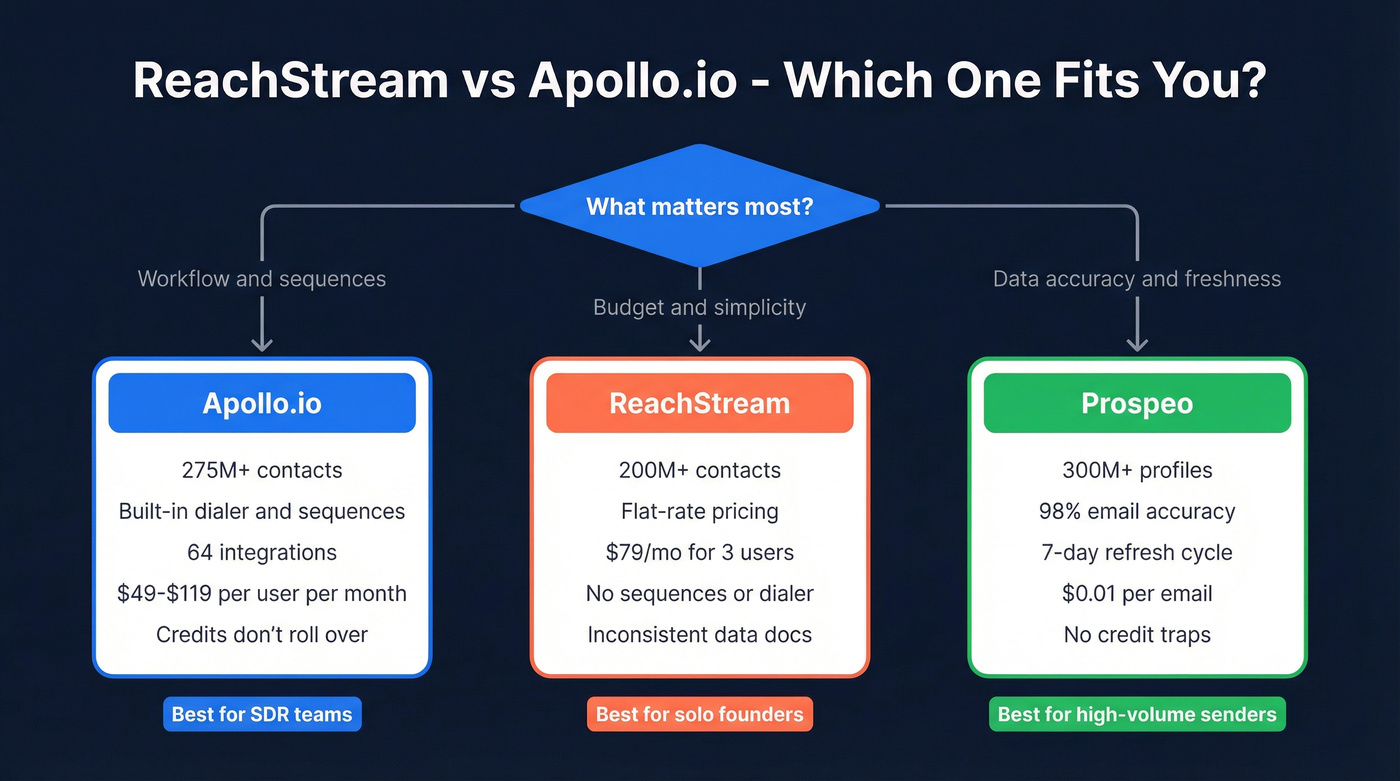
The ReachStream vs Apollo.io decision boils down to what you value more - workflow depth or cost predictability. Both solve the same core problem: getting contact data into your pipeline. But they approach it from completely different angles.
One's an all-in-one outbound platform with a credit system that can surprise you. The other's a flat-rate data source that keeps costs simple but skips the workflow tools entirely. We sell Prospeo, not ReachStream or Apollo, so we've got no reason to spin either direction. Here's how to pick between them.
30-Second Verdict
- Pick Apollo if you want sequences, a dialer, and a database in one platform and don't mind per-seat pricing.
- Pick ReachStream if you're a solo operator or small team that needs affordable, flat-rate data access without workflow tools.
- Skip both if bounce rates are killing your outreach - neither is built around a weekly refresh cycle for high-volume senders.
Why This Comparison Matters
B2B contact records decay at roughly 30% per year. People change jobs. Emails go dark. The tool you pick is a bet on how fresh and accurate that data stays over time - and how much you'll pay when it doesn't.
If you're building a repeatable outbound motion, it also helps to map this decision to your broader lead generation workflow and the sales pipeline challenges you're actually trying to fix.
Apollo.io: The All-in-One Play
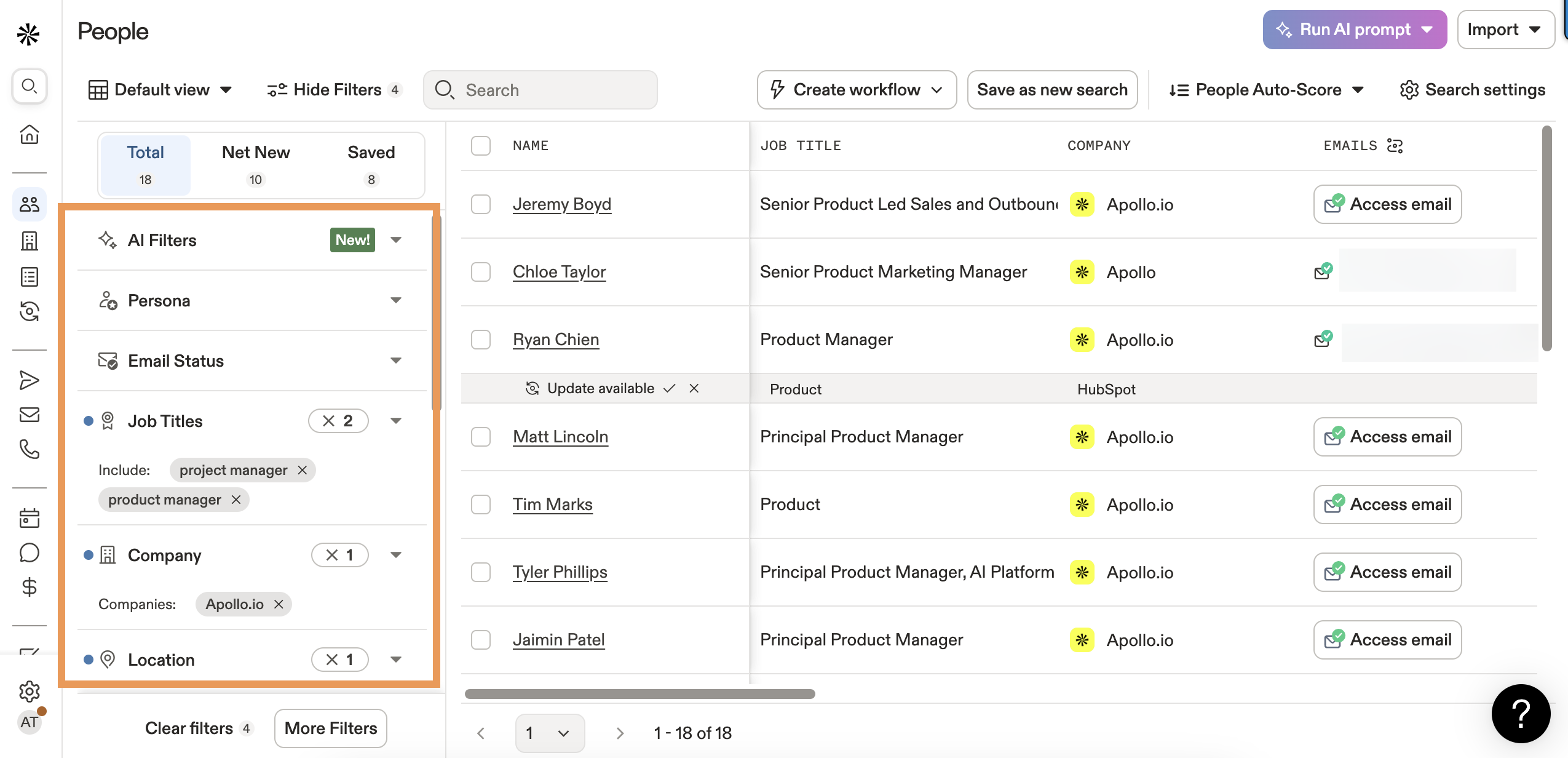
Apollo's biggest advantage isn't its database - it's the workflow. Search, export, sequence, and dial from one platform. A new SDR can be productive in 30 minutes. That's genuinely hard to replicate with a stack of point solutions.
The database covers 275M+ contacts, with 64 integrations listed on G2 and a 4.7/5 rating from 9,510 reviews.
Where it gets tricky: Apollo's credit system. Phone numbers typically cost 5 credits, and Apollo separates mobile credits from export credits - so you can run out of one before the other. Credits don't roll over. Overages run $0.20/credit with a 250-credit minimum. Plans land at $49-$119/user/month on annual billing (Basic $49, Professional $79, Organization $119). A 3-person team on Professional pays ~$237/month before overages, and in our experience, credit-based systems always cost more than the sticker price. Apollo has also restructured its pricing multiple times in recent years, which makes long-term cost planning a headache.
The #1 complaint on r/coldemail? "Verified" emails that still bounce, and contacts listed at companies they left months ago. Apollo doesn't publish a data refresh cadence. If you're trying to diagnose bounces, start with email bounce rate and the underlying email deliverability guide.

Apollo won't publish a refresh cadence. ReachStream can't agree on its own numbers. Prospeo refreshes 300M+ profiles every 7 days with 98% email accuracy - no credit traps, no per-seat pricing, just $0.01/email.
Stop paying for data that decays before you send.
ReachStream: The Budget Data Play
ReachStream flips the model entirely. Flat-rate pricing, multi-user access on higher tiers, and the Polar Peak plan runs $79/month on annual billing for up to 3 users with 20,000 exports/month. That same 3-person team paying $237/month on Apollo pays $79/month here. Big difference.

G2 reviewers give it a 4.8/5 - but from just 52 reviews, with 94% being 5-star. Impressive, but a tiny sample compared to Apollo's 9,510. Users praise accuracy and ease of use. The negatives: integration issues come up 5 times in G2's cons summary, along with missing emails in niche markets. ReachStream claims compliance with GDPR, CCPA, ACMA, EDPS, and CAN-SPAM. The free plan offers 200 email views and 100 export credits/month for evaluation.
Here's the thing, though: ReachStream's own pages can't agree on their numbers. The main data page says 200M+ profiles with a 45-day refresh . The API page says 150M+ contacts refreshed every 3 months. If you're a data company, your own data should be consistent. That inconsistency would give us pause.
Head-to-Head Feature Comparison
| Feature | Apollo.io | ReachStream | Edge |
|---|---|---|---|
| Database size | 275M+ | 200M+ | Apollo |
| G2 rating (reviews) | 4.7/5 (9,510) | 4.8/5 (52) | Apollo (sample size) |
| Email accuracy | Not published | Claims 95%+ | ReachStream |
| Data refresh | Not published | 45 days to 3 months | ReachStream |
| Pricing model | Per-seat + credits | Flat-rate | ReachStream |
| 3-person team cost | $147-$357/mo | $79-$99/mo | ReachStream |
| Free plan | Yes | Yes | Tie |
| CRM integrations | 64 listed | Fewer native; API + webhooks available | Apollo |
| Sequences/dialer | Built-in | No | Apollo |
| API | Full API access | Available but inconsistent docs | Apollo |
| Compliance | GDPR/CCPA + ISO 27001 + SOC 2 Type II | GDPR/CCPA/ACMA/EDPS/CAN-SPAM | ReachStream |
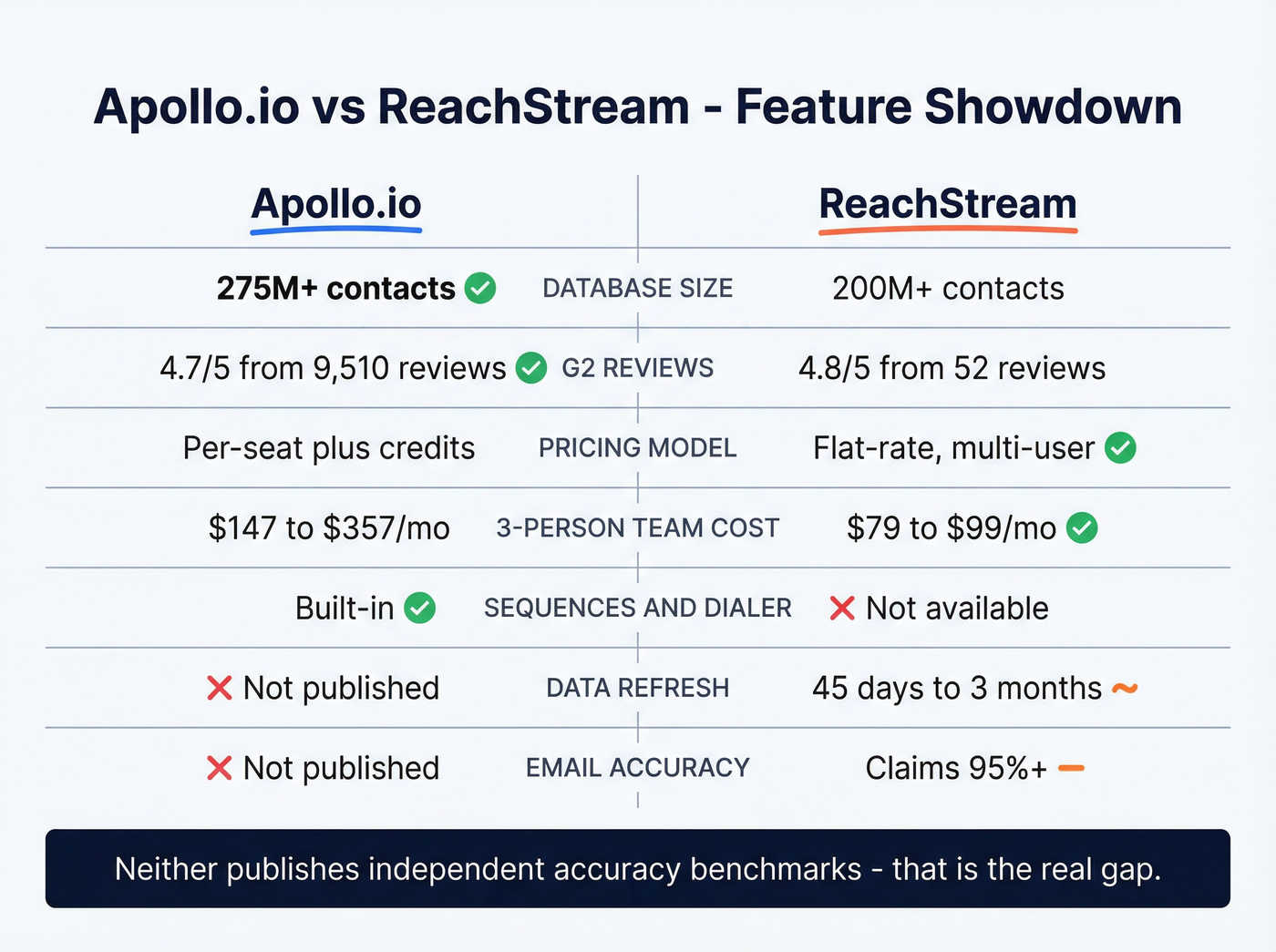
Apollo wins on workflow depth and integration breadth. ReachStream wins on price. Neither publishes independent accuracy benchmarks - and that's the real gap.
Our take: If your deal sizes sit below five figures, you probably don't need Apollo's all-in-one platform. A flat-rate data source paired with a $30/month sequencer will outperform it on ROI. (If you're evaluating the broader category, compare options in our guide to sales prospecting databases and data enrichment services.)
The Accuracy Gap Both Leave Open
Neither Apollo nor ReachStream solves the freshness problem well. Apollo won't publish a refresh cadence at all. ReachStream refreshes every 45 days to 3 months depending on which page you trust.
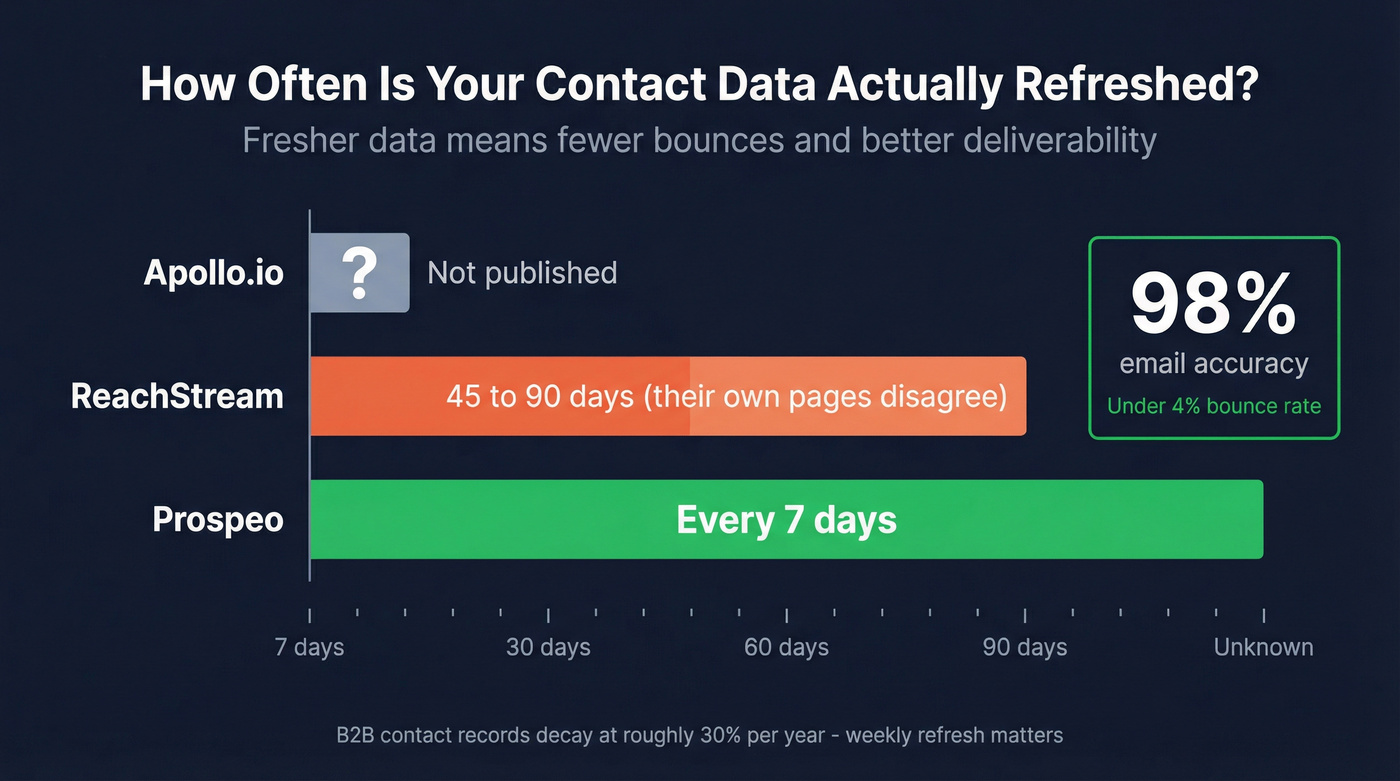
Let's be honest - for high-volume outbound, that's not fast enough. We've run the same prospect lists through multiple providers, and the difference between a weekly refresh and a monthly one shows up immediately in bounce rates. Prospeo runs a 7-day refresh cycle with 98% email accuracy across 300M+ profiles. Its 5-step verification process includes catch-all handling, spam-trap removal, and honeypot filtering, which is why teams report bounce rates under 4%. At ~$0.01/email with a free tier of 75 emails/month plus 100 Chrome extension credits/month, it slots into waterfall enrichment stacks alongside Clay or pairs with a sequencer like Instantly or Lemlist. If you're building that stack, see our breakdown of Clay list building and how to check if an email exists.

Meritt tripled pipeline to $300K/week and cut bounce rates from 35% to under 4%. Snyk's 50 AEs drove 200+ new opportunities per month. The difference wasn't workflow - it was weekly-refreshed, verified data.
Fix the data and the pipeline fixes itself.
Pick by Scenario
5-person SDR team with budget? Apollo. The built-in sequences and dialer save you from stitching together three tools, and the 275M+ database gives you broad coverage across industries and geographies. (If you're standardizing your stack, start with a shortlist of SDR tools.)
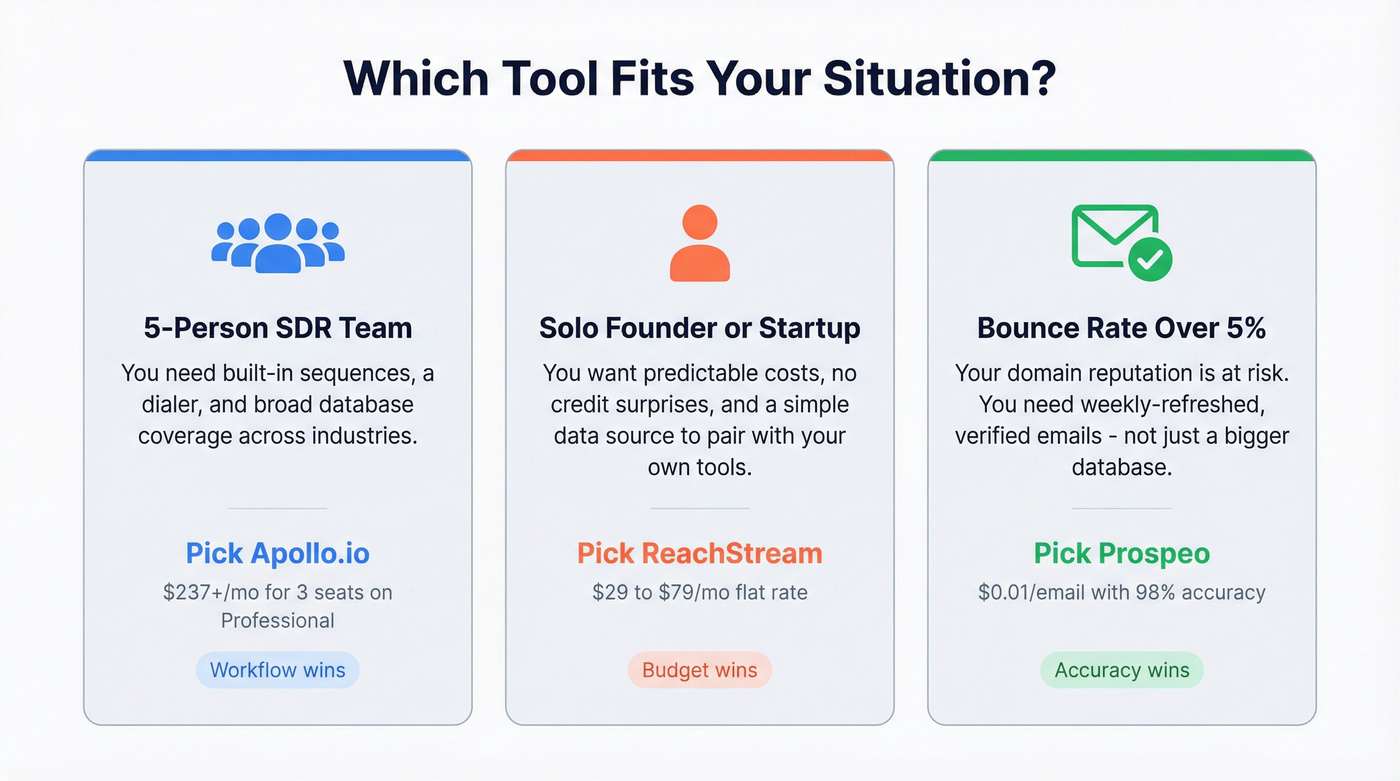
Solo founder or bootstrapped startup? ReachStream. Flat-rate pricing means no surprises, and $29/month gets you started without worrying about credit overages eating into your runway.
Bounce rate over 5%? Skip both. A 7-day refresh and 98% accuracy protect your domain reputation - the thing neither Apollo nor ReachStream prioritizes. Teams like Snyk cut bounce rates from 35-40% to under 5% after switching to a provider with weekly refresh cycles, and Meritt tripled their pipeline from $100K to $300K/week after fixing their data quality problem. If you're seeing deliverability issues, it’s usually a sender reputation problem first - use this guide on how to improve sender reputation.
When weighing ReachStream vs Apollo.io, the right answer depends less on features and more on where your pipeline actually breaks. If it's workflow, Apollo. If it's budget, ReachStream. If it's data quality, neither.
FAQ
Is ReachStream more accurate than Apollo?
ReachStream claims 95%+ email accuracy; Apollo doesn't publish a number. But ReachStream's 52 G2 reviews versus Apollo's 9,510 make the comparison lopsided. Neither offers independent benchmarks, and ReachStream's own pages show conflicting database sizes (200M vs 150M). For verified accuracy with published methodology, Prospeo delivers 98% on a 7-day refresh cycle.
How does Apollo's credit system work?
Phone numbers typically cost 5 credits, and Apollo separates mobile credits from export credits. Credits reset each billing cycle with no rollover. Overages cost $0.20 each with a 250-credit minimum purchase - that's a $50 floor every time you go over. Budget $150-400/user/month once overages are factored in.
Is there a tool with better data freshness than both?
Prospeo delivers 98% email accuracy on 300M+ profiles with a 7-day data refresh - significantly faster than either competitor. The free tier lets you test against your own lists before committing. Teams like Snyk cut bounce rates from 35-40% to under 5% after switching.