

Recruiter Introduction Email to Client: Templates That Get Replies
The average cold email reply rate across B2B sits at 5.8%. For a recruiter introduction email to client prospects, a realistic benchmark is 3-8% - meaning 92-97 out of every 100 emails get ignored. That's brutal. But the emails that do work follow a clear pattern, and it's learnable.
What You Need (Quick Version)
- Use the AIDA framework), not copy-paste templates. Structure beats scripts every time.
- Aim for under 200 words. Belkins found 6-8 sentences performs best for replies.
- Send Tue-Thu mornings, and run a 4-stage sequence. After that, returns flatten and you start burning goodwill. (If you need a cadence, borrow from these sales follow-up templates.)
- Verify the client's email before sending. A bounced intro wastes the lead and damages your sender domain.
Why Recruiting Intros Get Ignored
Only 23.9% of sales emails get opened. Recruiting intros can perform better because they're more targeted, but the failure modes are identical: generic messaging, walls of text, and no compelling reason to reply. If you want to fix the root cause, start with personalized outreach instead of “template-first” sending.
The biggest killer is copy-paste templates that read like they were sent to 500 people. Hiring managers can smell a mass email in two seconds - they're pitched constantly by competing agencies, and most of those pitches sound exactly the same. If your intro doesn't signal that you've done homework on their specific hiring pain, it's getting archived. Lead with the candidate and the role outcome, not your agency story. Nobody cares about your firm's history until you've proven you can solve their problem.
How to Structure Your Email (AIDA)
The AIDA framework - Attention, Interest, Desire, Action - maps perfectly to recruiter-to-client outreach. (If you want the sales version, see the AIDA sales funnel.)
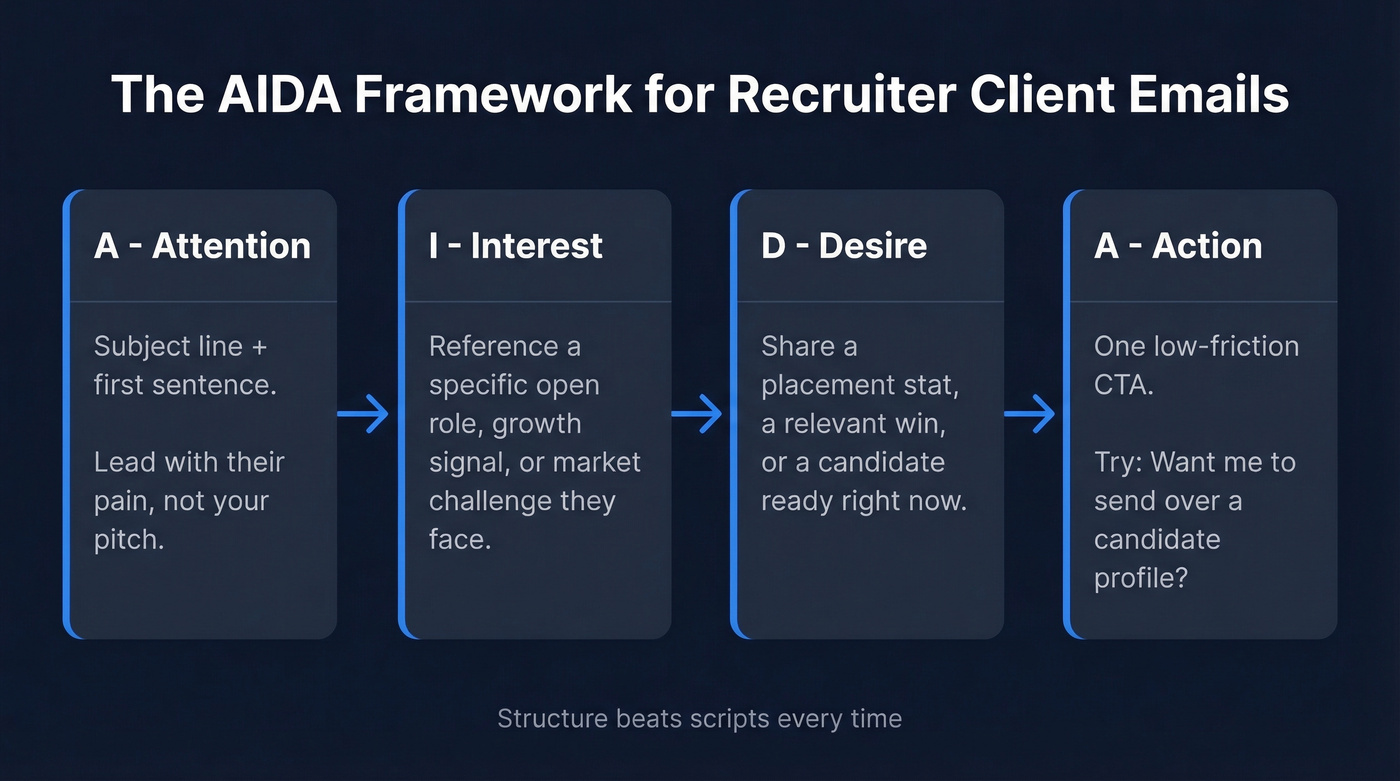
- Attention: Your subject line and opening sentence. Lead with a pain point, not your agency's history. For more ideas, pull from these cold email subject line examples.
- Interest: Reference a specific role they're hiring for, a growth signal, or a market challenge in their vertical.
- Desire: Give them a reason to reply - a placement stat, a relevant win, or a candidate ready now.
- Action: One low-friction CTA. Not "let's schedule a 30-minute call." Try "Want me to send over a candidate profile?" (More rules in this email call to action guide.)

Your recruiter intro email is useless if it bounces. Prospeo verifies emails through a 5-step process - catch-all handling, spam-trap removal, honeypot filtering - delivering 98% accuracy. Find the right hiring manager's direct email before you hit send.
A bounced intro kills the lead and your domain. Verify first.
Subject Line Rules
35% of recipients decide to open based on the subject line alone. Get this wrong and nothing else matters. If you want a deeper playbook, use these prospecting email subject lines.
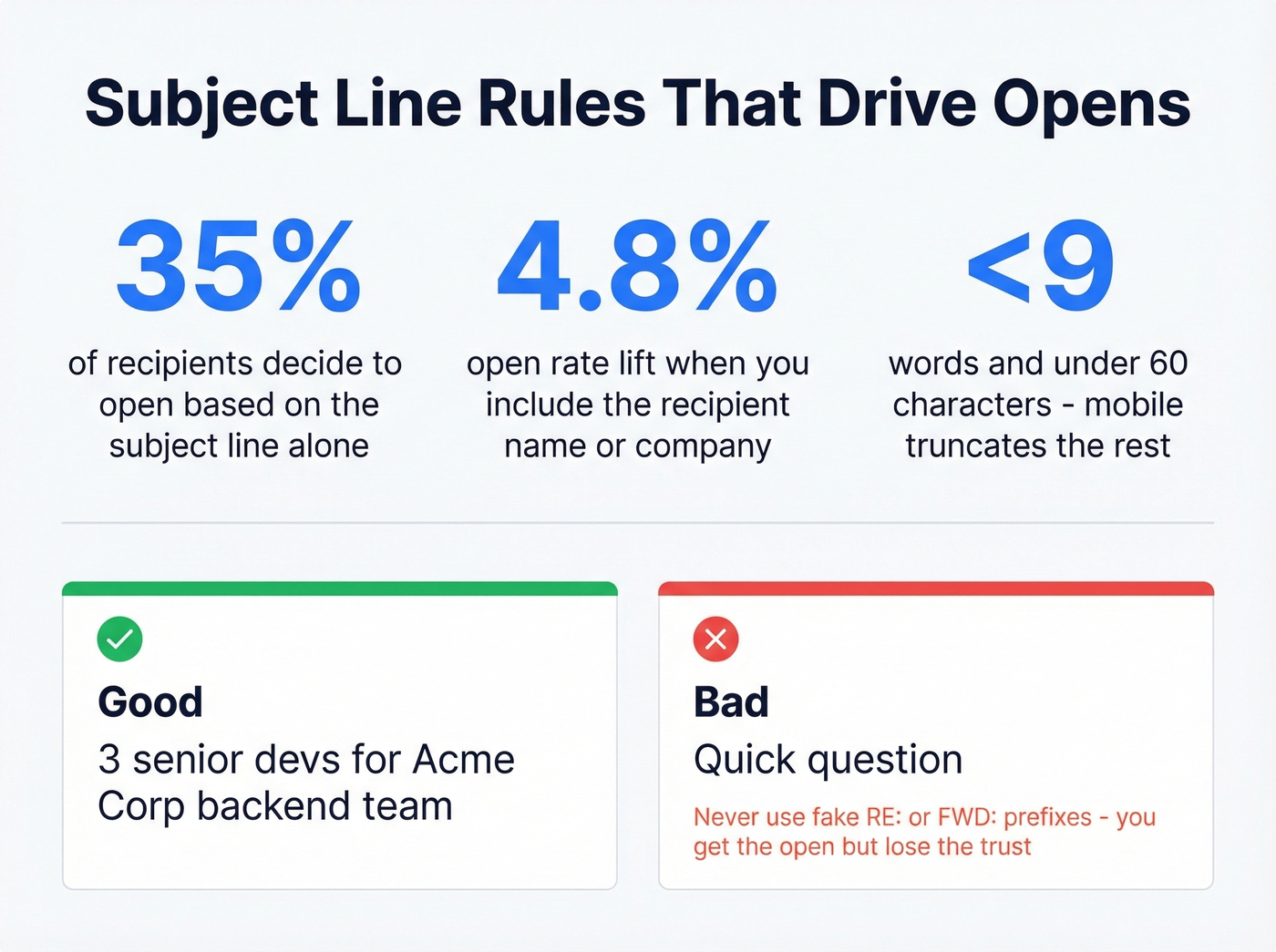
Keep it under 9 words and 60 characters - mobile screens truncate anything longer. Including the recipient's name or company can lift open rates by ~4.8%. Never use deceptive "RE:" or "FWD:" prefixes. You'll get the open but lose the trust immediately. Lead with relevance: "3 senior devs for [Company]'s backend team" beats "Quick question" every time.
Templates That Actually Get Replies
Adapt the structure, swap in your details, and keep every email under 200 words. Each template below follows the AIDA framework so you can customize without losing the structure that drives responses. (For more sequencing, see our B2B cold email sequence guide.)
Cold Intro to a New Client
Subject: [Company]'s [Role] search - can I help?
Hi [Name],
I noticed [Company] has had a [Role] listing open for [X weeks]. In [industry/vertical], that role often takes longer to fill through job boards alone.
We placed three similar roles last quarter for [comparable company or vertical], averaging 18 days to offer acceptance.
I have a shortlist of two candidates who'd be strong fits. Want me to send over their profiles?
Best, [Your name]
We've tested dozens of cold intro variations, and the ones that open with a specific observation about the client's hiring situation outperform generic pitches by a wide margin. The first two sentences are doing all the heavy lifting - they prove you've done your homework before asking for anything.
Warm Intro (Referral or Inbound)
The referral does the heavy lifting here, so the email can be shorter. Your job is just to make the next step easy.
Subject: [Mutual contact] suggested we connect
Hi [Name],
[Mutual contact] mentioned you're scaling your [department] team and suggested I reach out. We've worked with [similar company] on comparable hires.
Would it be helpful if I sent over a couple of candidate profiles to give you a sense of the talent we're seeing in the market?
Best, [Your name]
Warm intros with referrals often push reply rates above 15%, especially when the mutual contact is a recent placement or an existing client. If you have the referral, use it in the subject line - don't bury it in paragraph two.
Candidate Submission Email
When presenting candidates, use a structured talent letter format that gives the hiring manager everything at a glance. A common debate among recruiters: full CV or summary? For first submissions, the summary wins. Save the full resume for after they express interest.
Subject: Candidate submission - [Role] at [Company]
Hi [Name],
As discussed, here's a candidate for your [Role] opening:
- Role fit: [Title] with [X] years in [domain]
- Key skills: [Skill 1], [Skill 2], [Skill 3]
- Salary range: [X-Y]
- Availability: [Start date / notice period]
Resume attached. Happy to set up an intro call this week.
Always confirm candidate consent before submitting their details. Right-to-represent documentation protects both you and the client.
Follow-Up Email
Subject: Re: [Original subject line]
Hi [Name],
Wanted to circle back on my note from [day]. If the timing's off, happy to reconnect when [Role] becomes a priority again. If it's still active, I can have candidate profiles to you by [day].
Best, [Your name]
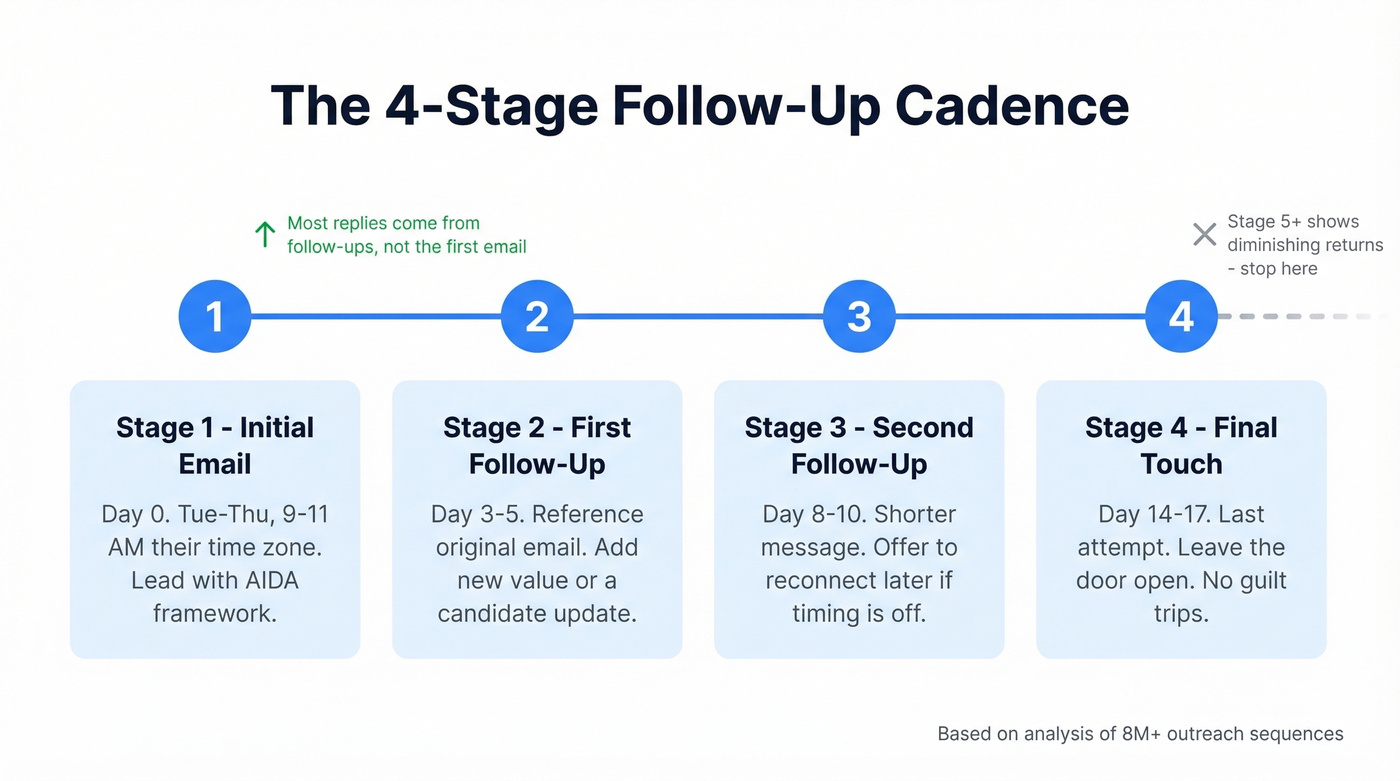
Send your first follow-up 3-5 days after the initial email, ideally Tue-Thu between 9-11 AM in the recipient's time zone. (More data here: best time to send cold emails.) Data across ~8M outreach sequences shows gains flatten after stage 5, and a 4-stage sequence is the sweet spot. Know when to stop.
Mistakes That Kill Your Reply Rate
- Copy-paste messaging. If your email could be sent to any company in any industry, it's not personalized enough. Full stop.
- Information overload. Your intro isn't a capabilities deck. Save the full pitch for the call.
- No follow-up. One-and-done sending is the most common mistake we see. Follow-ups drive a huge share of total replies. (If you need a system, use these cold email follow-up templates.)
- Weak CTA. "Let me know your thoughts" tanks booking rates. Ask a specific, interest-based question instead.
- Blasting too many contacts. Targeting 1-2 contacts per company yields a 7.8% reply rate vs. 3.8% when you email 10+. We've seen agencies torpedo their domain reputation this way. More emails doesn't mean more replies.
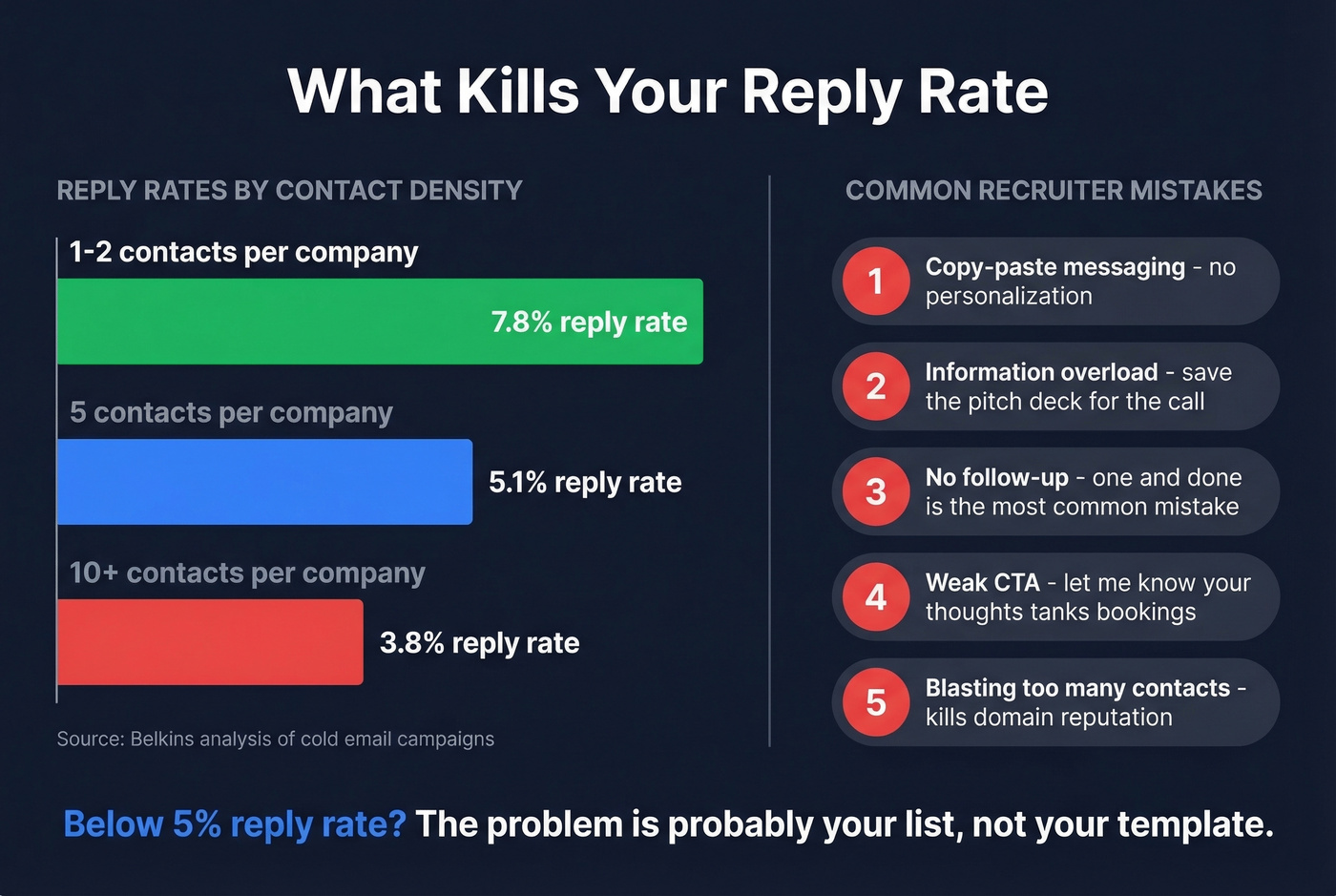
Here's the thing: if your reply rate is below 5%, the problem probably isn't your template - it's your list. A mediocre email sent to the right hiring manager at the right time will outperform a perfect email sent to a stale contact at a company that isn't hiring. If you’re rebuilding targeting, start with an ideal customer profile.
Deliverability: The Hidden Factor
None of these templates matter if your email bounces. Every hard bounce chips away at your sender reputation, and once your domain gets flagged, even your best recruiter introduction email to client prospects lands in spam. (If you want the full checklist, use this email deliverability guide.)
Before you send any client intro, make sure SPF and DKIM are configured on your domain. Disabling open-tracking pixels can improve response rates by ~3% - most recruiters don't know this, and it's one of the easiest wins available. Verify the hiring manager's email before you hit send. Prospeo checks addresses in real time with 98% accuracy, and the free tier gives you 75 verifications per month - plenty for a targeted outreach list. A two-second verification beats a bounced intro that burns a lead and your domain.
Once you're sending consistently, track two numbers: open rate and reply rate. Strong opens but flat replies means your subject lines work but your body copy needs rethinking. If both are low, you've got a deliverability problem, not a copywriting problem.
Building a client pipeline means finding decision-makers fast. Prospeo's 300M+ database lets you filter by company, department headcount growth, and job postings - so you reach hiring managers actively scaling their teams, not cold prospects with no openings.
Target companies that are actually hiring right now.
FAQ
How long should a recruiter introduction email be?
Under 200 words - that's 6-8 sentences. A study of 16.5M cold emails found this length delivers the highest reply rates across B2B outreach. Cut anything that doesn't earn the next sentence.
What's a good reply rate for recruiter cold emails?
Expect 3-8% on cold intros to new clients. Above 10% is strong. Highly personalized emails sent to verified contacts consistently outperform the 5.8% cross-industry average. Warm intros with referrals regularly push above 15%.
How do I verify a client's email before sending?
Use a real-time verification tool - paste the hiring manager's company domain or profile URL and get a verified address in seconds. Sending to unverified emails risks hard bounces that damage your domain reputation and tank deliverability for every future campaign.
Should I send a full CV or a candidate summary?
Lead with a structured summary - role fit, key skills, salary range, and availability in bullet form. Full resumes overwhelm busy hiring managers on first contact. Send the complete CV only after the client expresses interest in a specific candidate.
Skip the templates if...
You don't have a verified email address for the hiring manager. Seriously. The consensus on r/recruiting is that list quality matters more than email copy, and our experience backs that up. Build a clean, verified list first, then worry about perfecting your templates.