

Remote Sales Team Management: 7 Systems That Actually Work
A sales manager on r/sales described the exact moment remote sales team management breaks down: a new rep "acts like he understands" the training - qualification questions, email templates, Salesforce updates - but by end of day, hardly anything's logged. Three hours into a task that should've taken one, the rep's still not done, and the manager can't exactly sit in a video chat all day watching.
That's a systems problem, not a people problem. Only 43.5% of sales professionals hit quota, and reps spend roughly 70% of their time on non-selling tasks.
Here's the thing most "remote work is broken" takes miss: 68% of companies actually see productivity increase with distributed teams. Remote isn't the problem. Lack of systems is. Whether you're managing a sales team remotely for the first time or refining a process that already exists, these seven systems fix it.
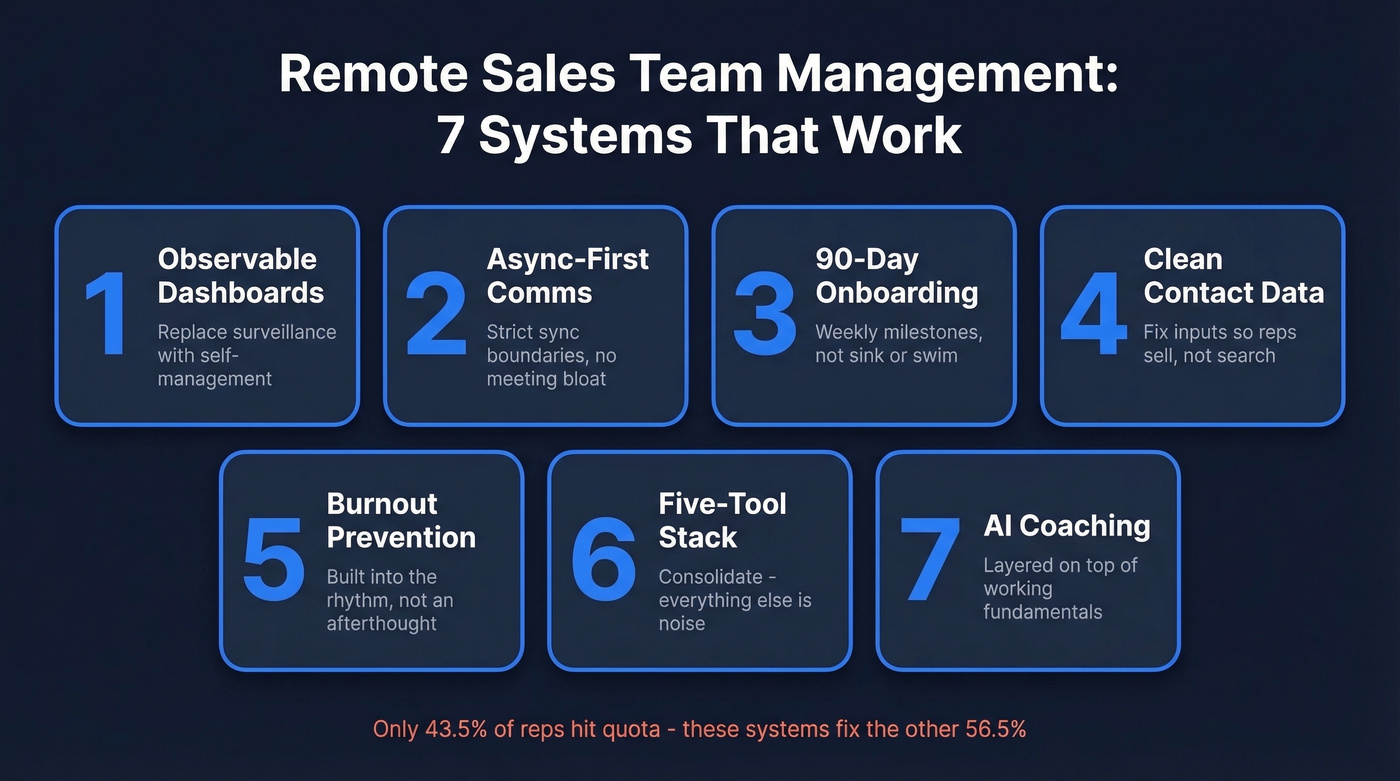
Seven Systems at a Glance
- Observable dashboards that replace surveillance with self-management
- Async-first communication with strict sync boundaries
- 90-day onboarding with weekly observable milestones
- Clean contact data so reps sell instead of searching
- Burnout prevention built into the operating rhythm
- A five-tool tech stack - everything else is noise
- AI coaching layered on top of working fundamentals
1. Replace Surveillance With Observable Dashboards
Only 7% of sales organizations achieve 90% forecast accuracy. Reps spend just 28% of their time actually selling. These aren't remote-specific problems, but distributed work amplifies them because managers lose the informal signals - overheard calls, body language, whiteboard pipeline reviews - that used to compensate for weak reporting.
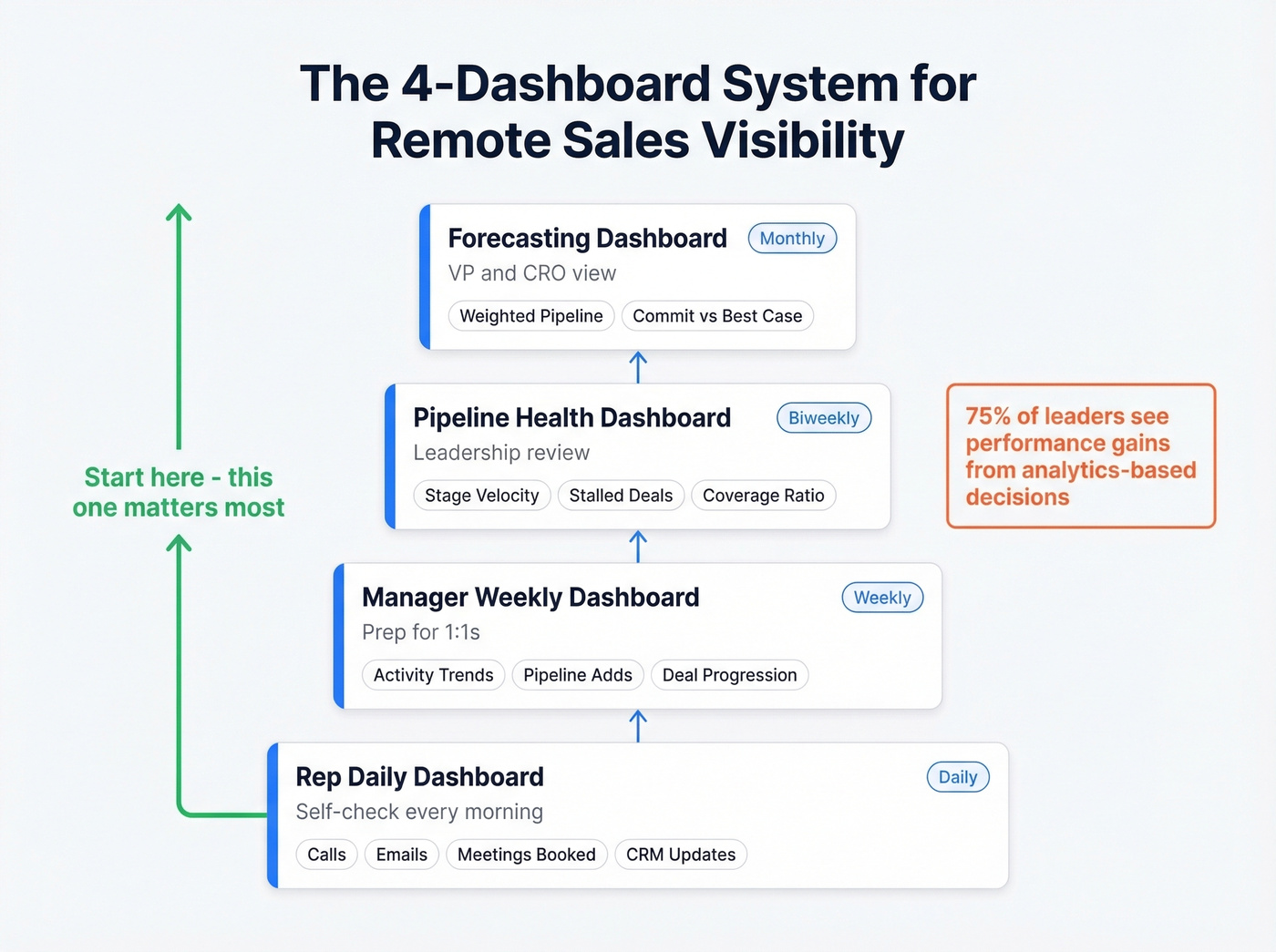
The fix isn't more check-ins. It's four dashboards, each serving a different audience.
| Dashboard | Who Uses It | Cadence | Key KPIs |
|---|---|---|---|
| Rep Daily | Individual reps | Daily self-check | Calls, emails, meetings booked, CRM updates |
| Manager Weekly | Frontline managers | Weekly 1:1 prep | Activity trends, pipeline adds, deal progression |
| Pipeline Health | Sales leadership | Biweekly review | Stage velocity, stalled deals, coverage ratio |
| Forecasting | VP/CRO | Monthly/quarterly | Weighted pipeline, commit vs. best case |
The rep daily dashboard matters most. When reps see their own activity metrics before their manager does, accountability shifts from external pressure to internal awareness. That's the difference between micromanagement and management. In our experience, teams that make the rep dashboard the default CRM view eliminate most "status update" meetings within a month.
75% of business leaders report performance improvements from analytics-based decision-making. Build these four dashboards, make them the default view, and watch how many check-in meetings become unnecessary.
2. Go Async-First With Communication
76% of employees report getting [more distracted on Zoom](https://www.atlassian.com/blog/teamwork/science-just-confirmed-what-you-already-knew-zoom-fatigue-is-real) compared to in-person meetings, and knowledge workers spend 3 hours and 43 minutes per day communicating. Nearly half the workday goes to talking about work instead of doing it.
Move async: Daily standups via a 2-minute Slack post, pipeline updates, deal questions, coaching feedback on recorded calls, competitive intel sharing, win/loss summaries.
Keep synchronous: Weekly 1:1s for 25 minutes, biweekly 45-minute team syncs, monthly pipeline reviews, deal strategy sessions for complex opportunities, role plays.
If your team spans time zones, establish a 3-4 hour daily overlap window and protect it for synchronous work. Everything outside that window is async by default.
Sample Weekly 1:1 Agenda - 25 Minutes
- Minutes 1-5: Rep shares top 3 deals and one blocker, pre-filled async before the call
- Minutes 5-12: Manager coaches on the blocker - one deal deep, not surface-level across five
- Minutes 12-18: Review one recorded call together with specific feedback
- Minutes 18-22: Pipeline movement since last week - what advanced, stalled, or entered
- Minutes 22-25: Rep states their #1 priority for the coming week; manager confirms or redirects
Copy this. Paste it into your calendar invite. The structure prevents 1:1s from drifting into therapy sessions or status recaps.
3. Build a 90-Day Remote Onboarding Plan
Remember that Reddit manager whose rep "acted like he understood" but couldn't execute? He's not alone - 74% of organizations still use a "sink or swim" approach to onboarding. That's how you get reps who nod along in training and produce nothing for months.
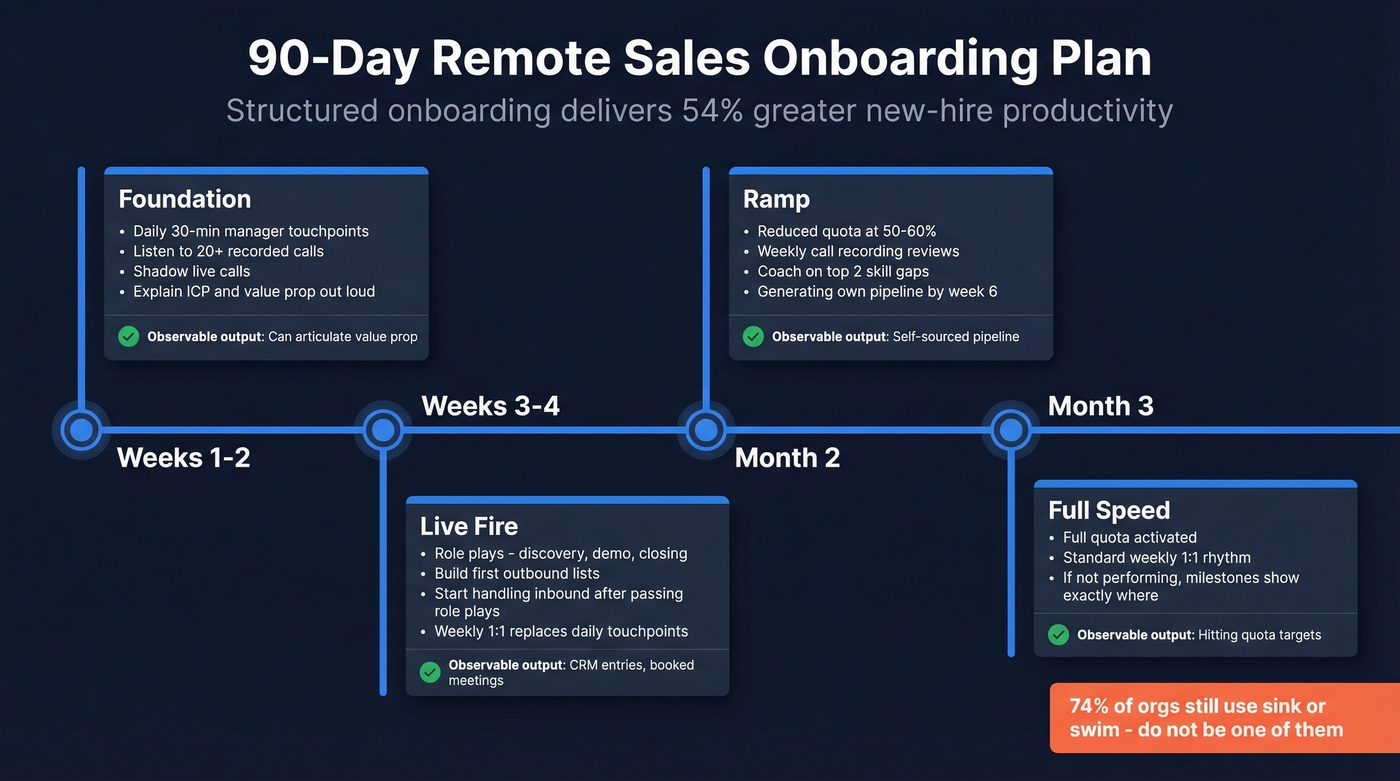
Structured onboarding delivers 54% greater new-hire productivity and reduces first-year turnover by 50%. Average ramp time sits at 4.5 months. You can compress that significantly with weekly milestones that make progress visible.
Weeks 1-2: Foundation. Daily 30-minute manager touchpoints. Deep-dive topics include org chart, products, pricing, sales playbook, comp plan, and tools. The rep listens to at least 20 recorded calls and shadows live ones. By end of week 2, they should explain your ICP and value prop out loud - not just nod along.
Weeks 3-4: Live fire. Role plays covering discovery, demo, and closing. Build first outbound lists. After passing role plays, start handling inbound and prospecting. Weekly 1:1 replaces daily touchpoints. The rep either demonstrates competence through observable outputs - CRM entries, booked meetings, call recordings - or you know exactly where the gap is.
Month 2: Ramp. Rep carries a reduced quota, typically 50-60% of full target. Manager reviews call recordings weekly and coaches on the two biggest skill gaps. The rep should be generating their own pipeline by week 6.
Month 3: Full speed. Full quota. The 1:1 cadence shifts to the standard weekly rhythm. If a rep isn't performing by day 90, the onboarding milestones tell you exactly where the breakdown happened - no guessing.
The key word is "observable." "They seemed to get it" killed that Reddit manager's first month. Don't let it kill yours.

Bad contact data is the invisible productivity killer on remote teams. When there's no colleague to ask for a better number, reps waste hours searching instead of selling. Prospeo gives your distributed team 98% accurate emails and 125M+ verified mobiles - refreshed every 7 days, not every 6 weeks.
Stop losing remote selling hours to dead contacts.
4. Fix Your Data Before Your Process
Every system above assumes your reps spend their selling time actually selling. Here's the silent killer: bad contact data.
When an office rep dials a disconnected number, they turn to a colleague for a better one. When a remote rep hits a dead number, they spend 5-10 minutes searching, get frustrated, and move on. Multiply that by 20-30 bad contacts a day and you've lost hours of productive selling time - invisibly, with no manager around to notice.
The results when you fix this are dramatic. Snyk had 50 AEs prospecting 4-6 hours per week with bounce rates running 35-40%. After cleaning up their data layer with Prospeo, bounces dropped under 5% and AE-sourced pipeline jumped 180%, generating 200+ new opportunities per month. GreyScout cut rep ramp time from 8-10 weeks to 4 weeks while growing their team from 2 to 5 reps - new hires started with contacts they could actually reach on day one, which made the 90-day onboarding plan above work in practice, not just on paper.
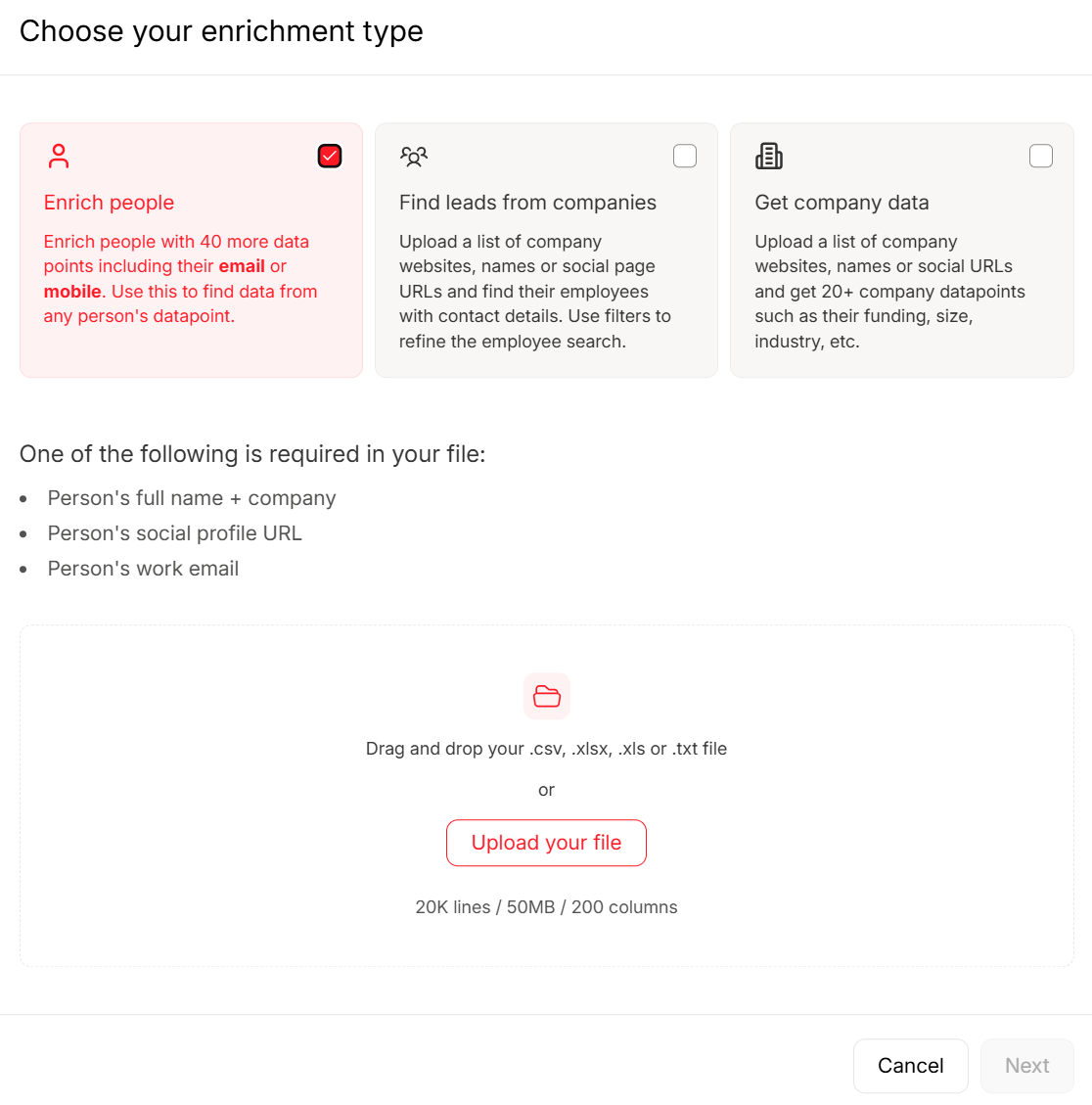
Look, if your reps are bouncing 20%+ of their emails and you haven't fixed the data layer, nothing else in this article matters. Fix the inputs first. (If you need a deeper breakdown of vendors and use cases, start with data enrichment and lead enrichment.)
5. Prevent Burnout Before the Resignation
89% of sales reps report at least one burnout symptom, and disjointed remote workforces see 33% higher turnover. Burnt-out employees are nearly 3x more likely to leave within the year. You won't see it coming in a distributed team - there's no visible exhaustion, no one leaving at 9 PM every night. By the time you notice performance dropping, the resignation letter is already drafted.
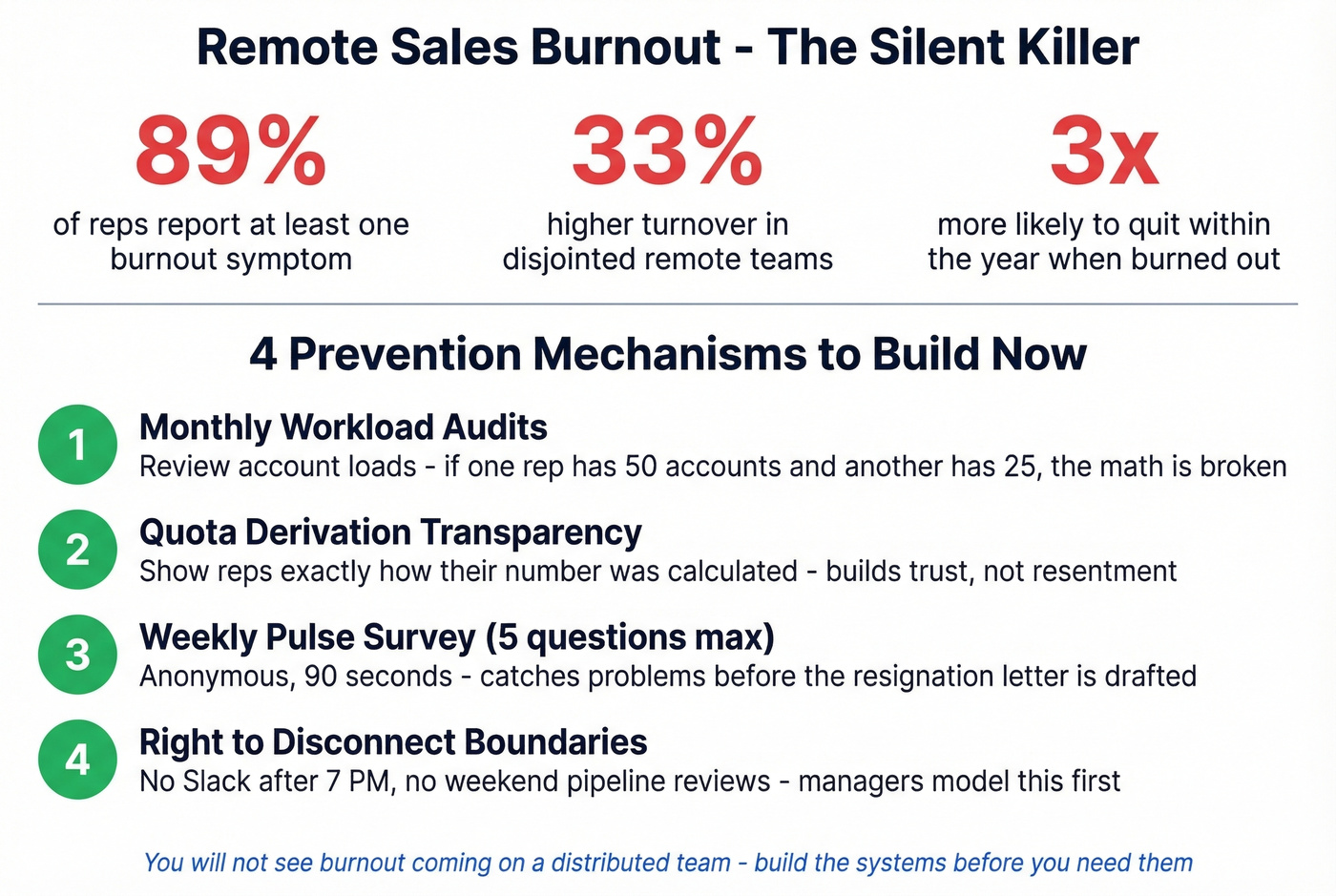
Build these four mechanisms before you need them:
Monthly workload audits. Review account loads and activity expectations. If a rep is working 50+ accounts while another has 25, the math is broken regardless of territory logic.
Quota derivation transparency. Show reps exactly how their number was calculated. "Your quota is $500K because..." builds trust. "Your quota is $500K" builds resentment.
Weekly pulse survey, five questions max. Anonymous, takes 90 seconds. "On a scale of 1-5, how sustainable is your current workload?" catches problems early. We've found that adding one bidirectional question - "What's one thing your manager could do differently?" - surfaces issues that reps won't raise in 1:1s.
"Right to disconnect" boundaries. No Slack messages after 7 PM. No weekend pipeline reviews. Model the behavior you want - if you send emails at midnight, your team will too. This is the easiest system to implement and the hardest to maintain, because it requires managers to change their own habits first. (If you want to formalize the operating rhythm, use a lightweight QBR cadence.)
6. Consolidate to a Five-Tool Stack
Reps use an average of 10 different tools to close deals, and 66% feel swamped by the fragmentation. Meanwhile, 90% of sales organizations plan to consolidate. Here's the five-tool core stack that covers everything a distributed sales team actually needs:
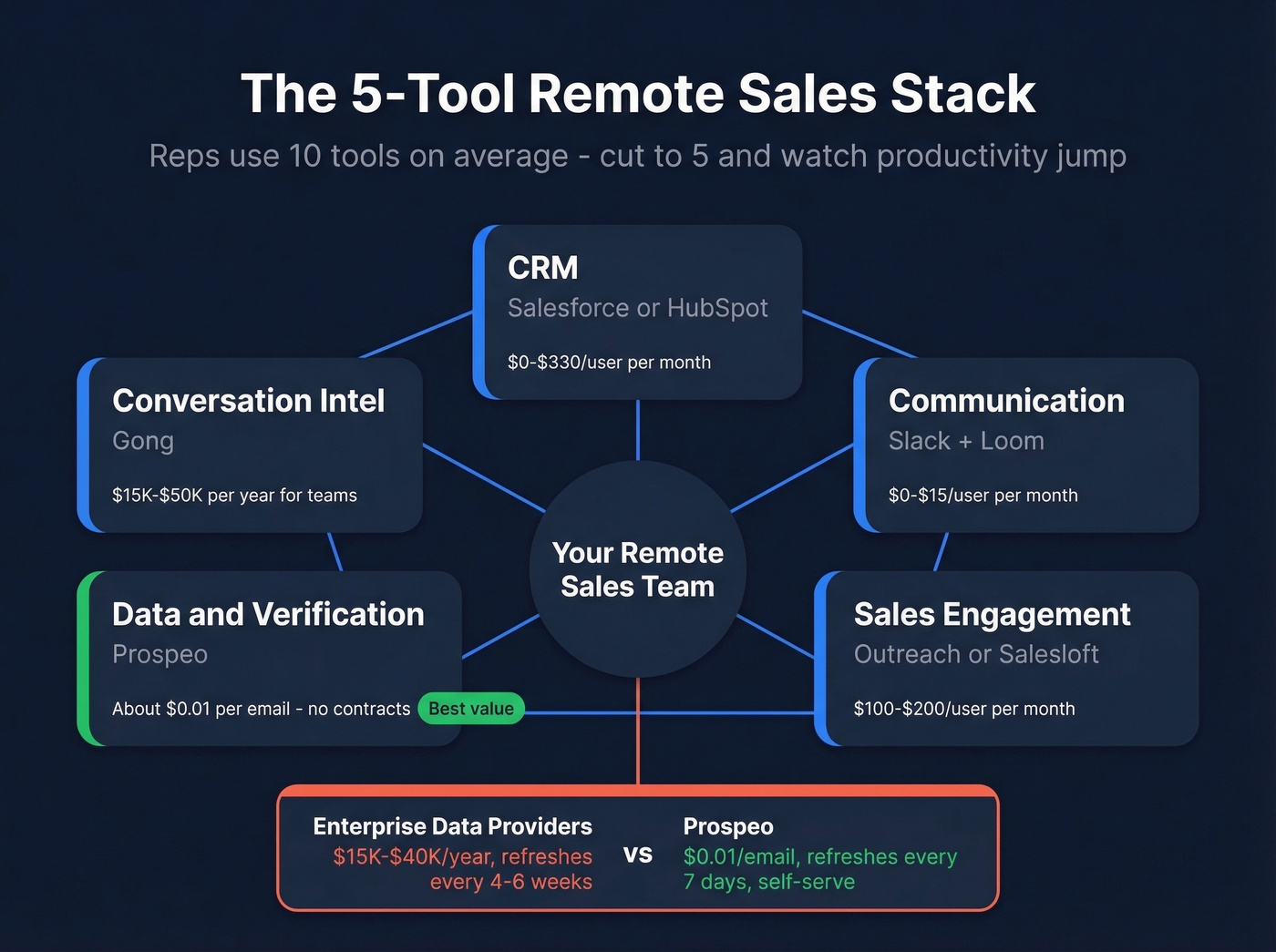
| Category | Example | Approx. Pricing |
|---|---|---|
| CRM | Salesforce / HubSpot | HubSpot free CRM available; paid ~$20-$150+/user/mo. Salesforce ~$25-$330+/user/mo. |
| Communication | Slack + Loom | Free tiers; ~$8-$15/user/mo on paid plans |
| Sales Engagement | Outreach / Salesloft | ~$100-$200/user/mo |
| Data & Verification | Prospeo | Free tier (75 emails/mo); ~$0.01/email |
| Conversation Intel | Gong | ~$15K-$50K/year for teams |
That's it. Five categories. Everything else is either a nice-to-have or a sign that one of these five isn't configured properly. If you're evaluating options, compare sales engagement and contact management software before adding more point solutions.
The pricing contrast on data deserves attention: Prospeo runs about $0.01 per email with no contracts and self-serve onboarding, while enterprise data providers typically cost $15K-$40K per year for data that refreshes every 4-6 weeks instead of weekly. For a remote team where every rep needs self-serve access to verified contacts, the math isn't close. (If you're troubleshooting bounces, use these email bounce rate benchmarks and fixes.)
Snyk armed 50 remote AEs with Prospeo and cut bounce rates from 35-40% to under 5% - generating 200+ new opportunities per month. When your distributed reps have clean data from day one, onboarding compresses and pipeline scales without adding headcount.
Give every remote rep enterprise-grade data at $0.01 per email.
7. Layer AI Coaching on Fundamentals
AI is starting to fill the gap that remote managers can't cover alone. AI coaching tools shave 11 days off sales cycles and boost win rates by up to 10 percentage points on deals over $50K. Already, 45% of teams use a hybrid AI-SDR model for prospecting and research.
The practical application: use conversation intelligence like Gong to auto-flag coaching moments instead of listening to every call. Use AI-generated call summaries to prep for 1:1s. Use AI-assisted prospecting to cut the manual research burden that eats into selling time. (For more repeatable outbound, standardize your sales prospecting techniques and keep a shared library of sales follow-up templates.)
But let's be honest - AI amplifies process. If the process is broken, AI scales the brokenness. Get your dashboards, onboarding, and data quality right first. Then layer AI on top. The teams that skip straight to AI tools without fixing fundamentals end up with faster bad habits. For leaders managing distributed sellers, AI is the accelerant, not the engine.
FAQ
How do I manage a remote sales team without micromanaging?
Build four dashboards - rep daily, manager weekly, pipeline health, and forecasting - and review them in structured 25-minute 1:1s. Reps who can see their own metrics self-correct before you intervene. Replace daily standup calls with async Slack posts to reclaim selling time.
What's the biggest mistake new remote sales managers make?
Adding more meetings instead of building better async systems. Replace the daily standup call with a 2-minute Slack post and redirect that time toward one meaningful weekly 1:1 with a structured agenda. Trust the process over constant check-ins.
How long should it take to onboard a remote sales rep?
Average ramp is 4.5 months, but structured 90-day onboarding with weekly milestones compresses that significantly. GreyScout reduced ramp from 8-10 weeks to 4 weeks by implementing documentation-first onboarding and fixing data quality from day one.
What tools does a remote sales team actually need?
Five categories: CRM, async communication, sales engagement, data verification, and conversation intelligence. Start with these five - 90% of sales organizations plan to consolidate - and add only when you can prove a gap none of them covers.
What's the hardest part of remote sales team management?
Visibility. In an office, you overhear calls, read body language, and catch problems early. Remotely, those informal signals disappear. Observable dashboards, structured 1:1s, and clean contact data replace those signals with something more reliable and scalable.