

How to Write a Meeting Request Email That Actually Gets a Reply
The average cold email reply rate is 3.43%. That means roughly 97 out of every 100 meeting request emails you send disappear into the void. The top 10% of campaigns hit 10.7%+, so the gap between a mediocre request mail for meeting and a great one isn't marginal - it's a 3x difference in results.
Most guides hand you a template and wish you luck. We've spent years testing what actually separates emails that book meetings from emails that get archived, and it comes down to a handful of data-backed decisions: word count, reading level, timing, follow-up cadence, and one step almost nobody talks about - making sure the email actually arrives.
Before You Write a Word: Verify the Email
Every other guide on requesting a meeting via email starts with the subject line. Wrong starting point. If your email bounces or lands in a catch-all black hole, the subject line doesn't matter. The copy doesn't matter. Nothing does.
Confirm you're sending to a real, active inbox before you draft anything. Prospeo's 5-step verification process handles this - 143M+ verified emails, catch-all domain handling, spam-trap removal, and a 7-day refresh cycle so you're not working with stale data. The free tier covers 75 verifications per month, enough to validate your highest-priority prospects before every send.

The Data Behind Emails That Get Replies
An analysis of [40M+ emails by Boomerang](https://blog.boomerangapp.com/2016/02/7-tips-for-getting-more-responses-to-your-emails-with-data/) by Boomerang found the sweet spot is 50-125 words - those emails pulled response rates above 50%. Instantly's 2026 benchmark data narrows it further for cold outreach: best-performing campaigns maintain under 80 words on first touches. That's five or six sentences. If your meeting request scrolls on a phone screen, it's too long.
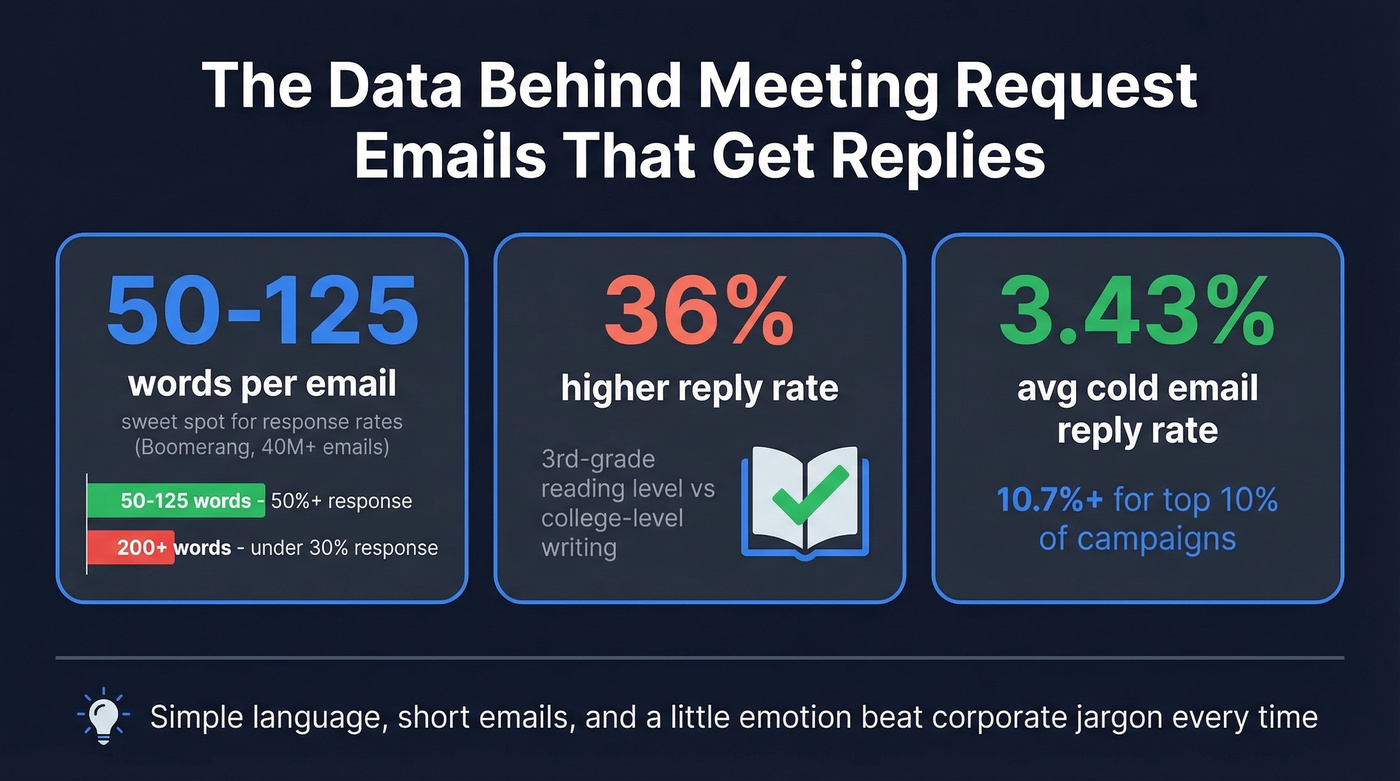
Reading level is the most counterintuitive finding. Emails written at a 3rd-grade reading level - short words, short sentences, zero jargon - produced a 36% higher response rate than college-level writing. You're not dumbing it down. You're removing friction. The VP you're emailing is scanning on their phone between meetings, half-distracted, deciding in two seconds whether your email deserves a reply or a swipe to archive. Simple wins.
Tone matters too. Slightly positive or slightly negative sentiment outperformed completely neutral emails by 10-15% in the same dataset. A little warmth ("excited to share") or a little tension ("this gap is costing you") beats flat corporate language every time. We've tested this across hundreds of campaigns, and the pattern holds regardless of industry.
Anatomy of a Meeting Request Email
Every effective email requesting a meeting has seven elements. Miss one and you create friction.
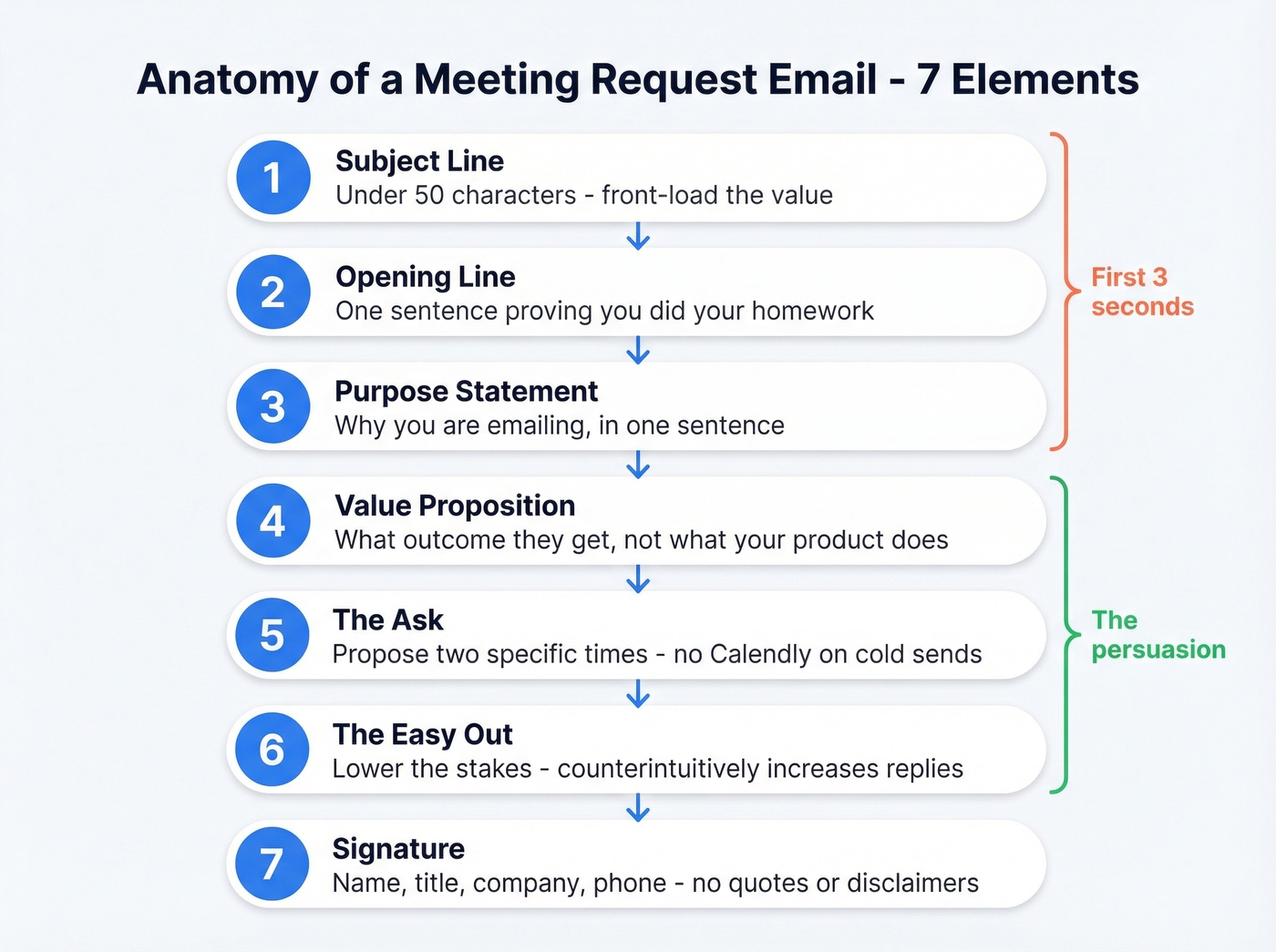
1. Subject line. Under 50 characters. Mobile devices show roughly 33 characters before truncating, so front-load the value. If you want more options, pull from these cold email subject line examples.
Here's what weak vs. strong looks like:
| Element | Weak | Strong |
|---|---|---|
| Subject line | "Meeting request" | "[Company] + 30% lower bounce rates" |
| Opening line | "I hope this email finds you well" | "I saw you're scaling the SDR team to 12 reps" |
| CTA | "Let me know your thoughts" | "Would Tuesday at 2pm or Thursday at 10am ET work?" |
2. Opening line. One sentence that proves you did your homework. Reference something specific: a recent hire, a funding round, a podcast appearance. "I saw you're scaling the SDR team" beats "I hope this email finds you well" by a mile. This is the core of personalized outreach.
3. Purpose statement. Why you're emailing, in one sentence. Don't bury the ask. "I'd like to set up a 20-minute call to discuss X" - that's it.
4. Value proposition. What's in it for them? Not what your product does - what outcome they get. "We helped [similar company] cut bounce rates from 35% to under 4%" is concrete. "We offer a best-in-class solution" is noise. If you need help tightening this, use a few of these sample elevator pitches.
5. The ask. Propose two specific times. "Would Tuesday at 2pm ET or Thursday at 10am ET work?" This eliminates the back-and-forth that kills momentum. Don't include a Calendly link on cold sends. Save the link for after they say yes.
6. The easy out. One sentence that lowers the stakes. "If the timing's off, happy to send over a quick summary instead" gives them a graceful way to engage without committing to a call. Counterintuitively, this increases reply rates.
7. Signature. Name, title, company, phone number. No inspirational quotes. No 15-line disclaimers.

You just spent 10 minutes crafting the perfect meeting request. If that email bounces, it was 10 minutes wasted. Prospeo verifies 143M+ emails with 98% accuracy and a 7-day refresh cycle - so your request lands in a real inbox, not a dead one.
Verify 75 emails free every month. No credit card required.
Meeting Request Email Templates That Work
Cold Outreach to a Prospect
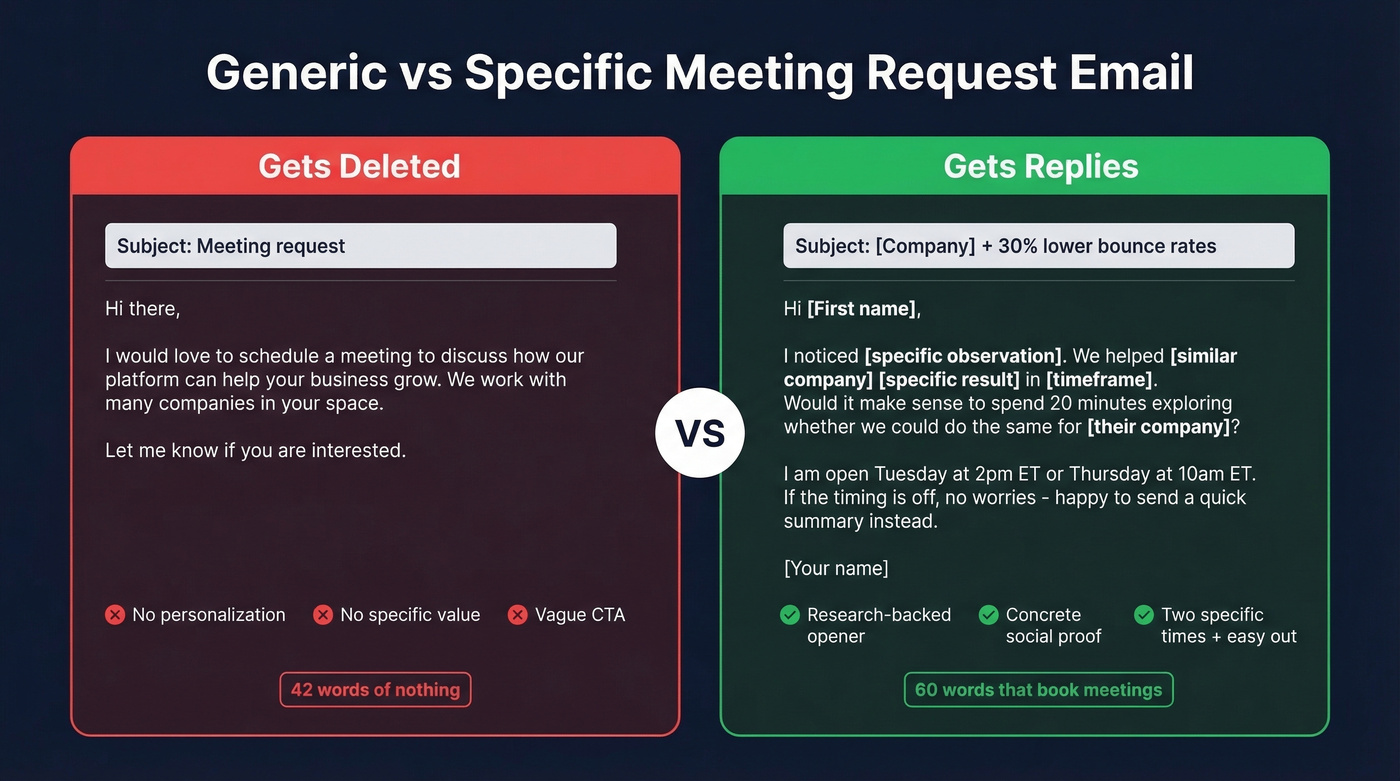
This is the hardest template to get right because you have zero trust built. Every word has to earn its place. Here's a before-and-after to show why specificity matters:
Generic version (gets deleted):
Hi there, I'd love to schedule a meeting to discuss how our platform can help your business grow. We work with many companies in your space. Let me know if you're interested.
Specific version (gets replies):
Subject: [Company name] + [specific outcome]
Hi [First name],
I noticed [specific observation about their company - hiring, funding, product launch]. We helped [similar company] [specific result] in [timeframe].
Would it make sense to spend 20 minutes exploring whether we could do the same for [their company]? I'm open Tuesday at 2pm ET or Thursday at 10am ET.
If the timing's off, no worries - happy to send a quick summary instead.
[Your name]
The generic version is 42 words of nothing. The specific version is 60 words that demonstrate research and a relevant result. For more options, borrow from these emails that get responses.
Warm Introduction (Mutual Connection)
When someone referred you, lead with that name. It's the most powerful opener you have - and the one people inexplicably bury in paragraph two.
Subject: [Mutual connection's name] suggested we connect
Hi [First name],
[Mutual connection] mentioned you're working on [specific initiative] and thought we should talk. We've helped teams in [their space] with [relevant outcome].
Could we grab 20 minutes this week? How's Wednesday at 11am or Friday at 2pm ET?
[Your name]
Internal Team Meeting
Internal requests fail when they're vague about the purpose. Respect your colleague's calendar by being specific about what you need and why it's time-sensitive.
Subject: Sync on [project/topic] - 30 min this week?
Hi [Name],
I'd like to align on [specific topic] before [deadline/milestone]. I've got a few questions about [specific area] that'll shape our next steps.
Does Thursday at 3pm or Friday at 10am work for 30 minutes?
Thanks, [Your name]
Client Check-In
Check-ins that feel like obligations get rescheduled forever. Frame it around value delivery.
Subject: Quick check-in - [specific metric or deliverable]
Hi [First name],
It's been [timeframe] since we last connected. I've pulled together [specific update - results, recommendations, new data] and want to walk you through it.
Would next Tuesday at 1pm or Wednesday at 3pm ET work for 20 minutes?
[Your name]
Executive / C-Suite Outreach
Executives scan faster and tolerate less fluff than anyone. Keep it tight and lead with a peer-level insight, not a product pitch.
Subject: [Their company] - [one-line insight]
[First name],
[One sentence: peer-level observation or data point relevant to their business]. I've seen [similar companies] address this by [brief approach].
Worth a 15-minute conversation? I'm open [two specific times].
[Your name], [Title]
No greeting fluff. No company description. The entire email assumes the reader is a peer, not a prospect. That framing shift is the difference between getting forwarded to a junior team member and getting a direct reply.
Partnership or Collaboration
Partnership emails need to answer "why us, why now" in the first two lines. Skip the flattery - go straight to the overlap.
Subject: [Your company] + [Their company] - potential fit
Hi [First name],
Our audiences overlap significantly - [brief evidence]. I think there's a [specific collaboration type] opportunity that benefits both sides.
Could we explore this over a 20-minute call? How's [two specific times]?
[Your name]
Post-Event Follow-Up
Follow up quickly while the conversation is fresh.
Subject: Great meeting you at [event name]
Hi [First name],
Enjoyed our conversation about [specific topic you discussed]. You mentioned [specific challenge or interest] - I've got a few ideas on that I'd love to share.
Would a 20-minute call work this week? I'm free [two specific times].
[Your name]
Rescheduling a Meeting
Skip this template if you're tempted to reschedule without offering new times. That creates unnecessary friction and signals you don't value their calendar.
Subject: Need to reschedule - two new options
Hi [First name],
Something came up and I need to move our [day/time] meeting. Apologies for the shuffle.
Would [new time 1] or [new time 2] work instead? Same agenda - shouldn't take more than [duration].
[Your name]
Post-Reply Confirmation
Here's the thing: this is the template nobody covers, and it's where deals quietly die. A prospect replies "sure, let's talk" - and then you drop a Calendly link and they ghost. Confirm the details directly and reduce the steps to zero.
Subject: Re: [original thread]
Great - let's lock in [specific day] at [specific time] [time zone]. I'll send a calendar invite with a Zoom link shortly.
Quick agenda: [one sentence on what you'll cover]. Should take about [duration].
Looking forward to it.
[Your name]
When to Send
Timing won't save a bad email, but it can boost a good one by a few percentage points.
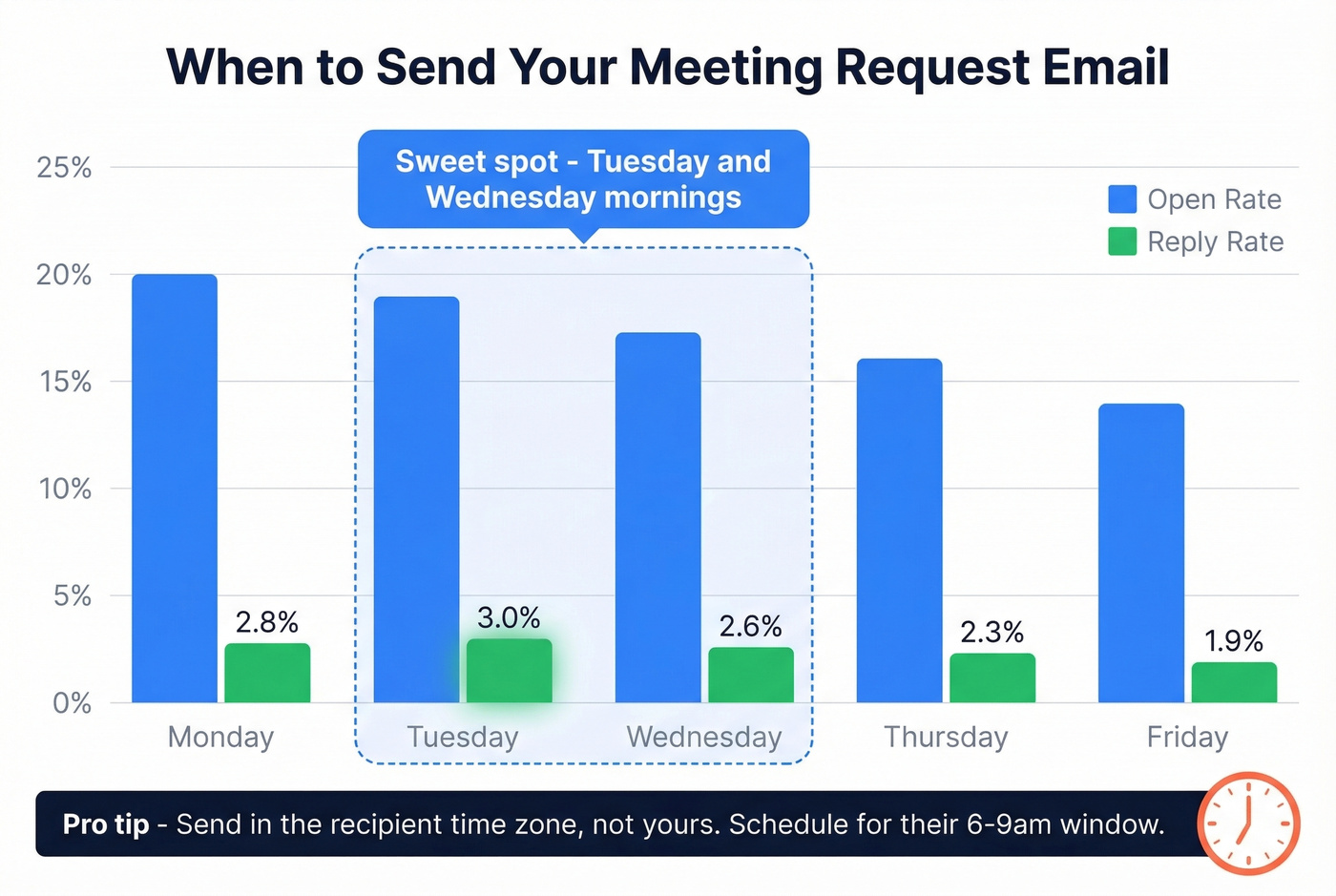
| Day | Open Rate | Reply Rate |
|---|---|---|
| Monday | ~20% | 2.8% |
| Wednesday | 17.2% | 2.6% |
A Siegemedia study of 85,000+ emails found Monday mornings between 6-9am PST performed best. Instantly's 2026 data points to Tuesday and Wednesday as peak days overall, with Wednesday pulling the highest reply rates in their dataset. Tuesday through Wednesday mornings are your safest bet. For a deeper breakdown, see our guide on the best time to send cold emails.
One practical tip: send in the recipient's time zone, not yours. If you're on the West Coast emailing someone in London, schedule for their morning. Most sequencing tools handle this automatically.
The 58/42 Rule for Follow-Ups
58% of replies come from the first email, and 42% come from follow-ups. Send one email and stop? You're leaving almost half your potential replies on the table.
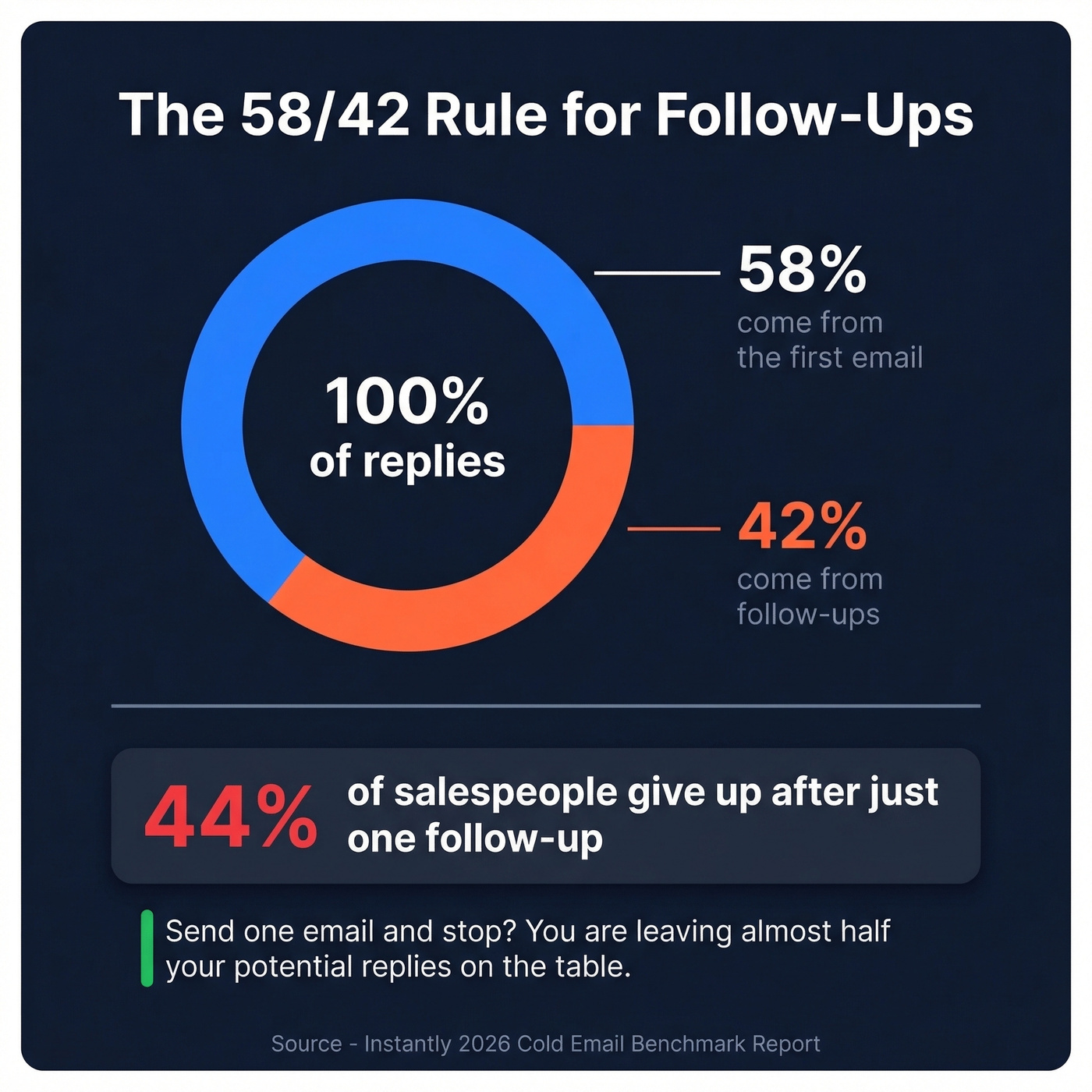
It gets worse. 44% of salespeople give up after a single follow-up. 92% quit after four. Meanwhile, 80% of deals close only after 5-12 touchpoints.
The gap between what reps actually do and what the data supports is enormous. The sweet spot is 4-7 touchpoints per sequence, and each follow-up needs to add something new - a relevant case study, a data point, a different angle on the same problem. Never write "just following up" or "circling back." Those phrases signal you have nothing new to say, and they get deleted instantly. If you need copy, start with these cold email follow-up templates or these sales follow-up templates.
Let's be honest about something: most reply-rate problems aren't copywriting problems - they're infrastructure problems. One founder on r/Entrepreneur doubled their reply rate from 3% to 6% by splitting sends across multiple domains, capping daily volume, and tightening list quality. No subject line tweak will fix bad deliverability. If you're running deals under $15k, you probably don't need an expensive data platform - but you absolutely need clean data and proper sending infrastructure. Start with the fundamentals in our email deliverability guide.
Mistakes That Kill Your Reply Rate
"Let me know when you're free." This puts all the work on the recipient. Propose two specific times instead. You're the one asking for the meeting - make it easy to say yes.
Calendly link on a cold send. It feels presumptuous before you've earned a reply. Save it for the confirmation email after they respond.
Emails over 100 words. Best-performing cold emails run under 80 words. Edit ruthlessly. If you can't say it in five sentences, you haven't figured out what you're actually offering.
Neutral, jargon-heavy tone. Slightly positive or negative sentiment outperforms flat corporate language by 10-15%. Write like a human talking to another human.
No clear CTA. Every email needs exactly one ask. "Would Tuesday at 2pm or Thursday at 10am work?" is a CTA. "Let me know your thoughts" is not. If you want to sharpen your ask, use these email call to action rules.
No follow-up sequence. You're leaving 42% of potential replies on the table. The sweet spot is 4-7 total touchpoints, and each one should add new value.
Sending to an unverified address. If the email bounces, nothing else in this article matters. Verify first, write second. Prospeo handles this in seconds with 98% accuracy - addresses go stale faster than most people realize, especially with job changers. If you're diagnosing issues, start with email bounce rate.
The templates above work - but only when paired with accurate contact data. Teams using Prospeo cut bounce rates from 35% to under 4% and tripled their pipeline. At $0.01 per verified email, bad data is no longer an excuse for empty calendars.
Stop sending meeting requests to inboxes that don't exist.
FAQ
How long should a meeting request email be?
50-80 words for cold outreach. An analysis of 40M+ emails found the 50-125 word range produced the highest response rates. Warm or internal requests can stretch to 100-125 words since you already have trust.
Should I include a Calendly link in a cold email?
No - propose two specific times instead. Scheduling links feel presumptuous before someone agrees to meet. Send the Calendly link after they reply with interest.
How many follow-ups should I send?
The sweet spot is 4-7 total touchpoints per sequence. 42% of replies come from follow-ups, yet 92% of reps quit after four attempts. Each message should add a new case study, data point, or angle.
What's a free tool to verify emails before sending?
Prospeo's free tier includes 75 email verifications per month with 98% accuracy and catch-all handling. That's enough to validate your top prospects before every outreach campaign - no credit card required.
What makes a great request mail for meeting?
A verified recipient address, a subject line under 50 characters, a specific opening that proves research, a one-sentence value proposition, and two proposed times. Keep the entire email under 80 words and follow up 4-7 times with new value in each touchpoint.