

Revenue Enablement Platforms: 2026 Buyer's Guide
"Every tool sounds the same." That Reddit buyer nailed it. Revenue enablement platforms have converged on identical buzzwords while pricing and contracts have gotten more aggressive - right as the market is consolidating fast. Pick the wrong platform in 2026 and you won't just waste budget; you'll lock in a workflow your reps quietly ignore.
Quick Recommendations by Team Size
- Enterprise (1,000+ reps): Seismic (post-combination) or Allego. Both scale, both integrate deeply, both survive enterprise complexity.
- Mid-market (50-500 reps): Mindtickle, Showpad, or Gong Enable. Choose based on your biggest pain: readiness, content, or call-driven coaching.
- SMB/startup: Dock (free tier) or GTM Buddy. Start lean, prove adoption, then expand.
One thing nobody mentions up front: enablement content doesn't matter if reps can't reach buyers. Clean your contact data first so your "best practices" don't bounce off invalid emails.
What Is a Revenue Enablement Platform?
Gartner defines revenue enablement platforms as systems that unify enablement across sales and other customer-facing revenue teams. In plain English: one place for content, training, coaching, and performance analytics that works across the full revenue org - not just AEs.
Most platforms cluster around five core capabilities:
- Content management - search, versioning, governance, sharing
- Learning and onboarding - courses, certifications, ramp paths (see ramp paths)
- Practice and coaching - role plays, feedback loops, manager workflows
- Engagement analytics - what gets used, what gets ignored, what moves deals
- Conversation intelligence + AI - call insights, recommendations, guided coaching
Here's a practical tell that you're looking at a true enablement system and not a "sales content library" with a new label: it supports partner enablement access controls and customer-facing portals without duct-tape permissions.
Buyers are right to be skeptical about perfect attribution in messy, multi-thread deals. The platforms that win aren't the ones with the prettiest dashboards. They're the ones reps actually open.
Revenue Enablement vs. Sales Enablement
The distinction isn't branding. Sales enablement optimizes sellers. Revenue enablement optimizes the customer experience across every revenue-facing team.
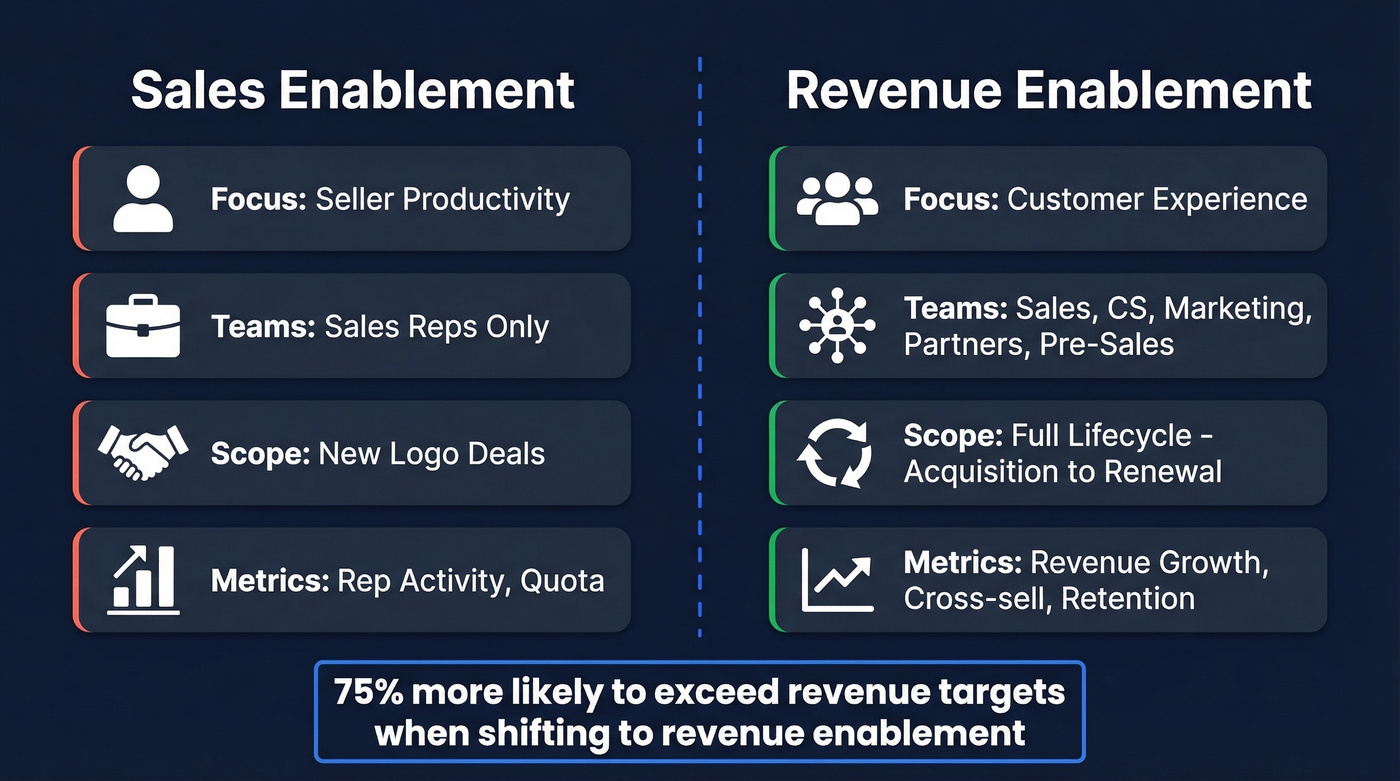
| Dimension | Sales Enablement | Revenue Enablement |
|---|---|---|
| Focus | Seller productivity | Customer experience |
| Teams | Sales reps | Sales, CS, Marketing, Partners, Pre-Sales, SEs |
| Scope | New-logo deals | Full lifecycle: acquisition through expansion and renewal |
| Metrics | Rep activity, quota | Revenue growth, cross-sell, retention |
Companies that make the shift are 75% more likely to exceed targets for seller revenue, cross-sell/upsell, and overall revenue growth, per Gartner research cited by Setvi. That's the gap between "enablement as a content team" and enablement as a revenue lever.
The 2026 Market Shakeup
Three moves reshaped the category in months, and they matter because they change roadmaps, support, and your negotiating leverage.
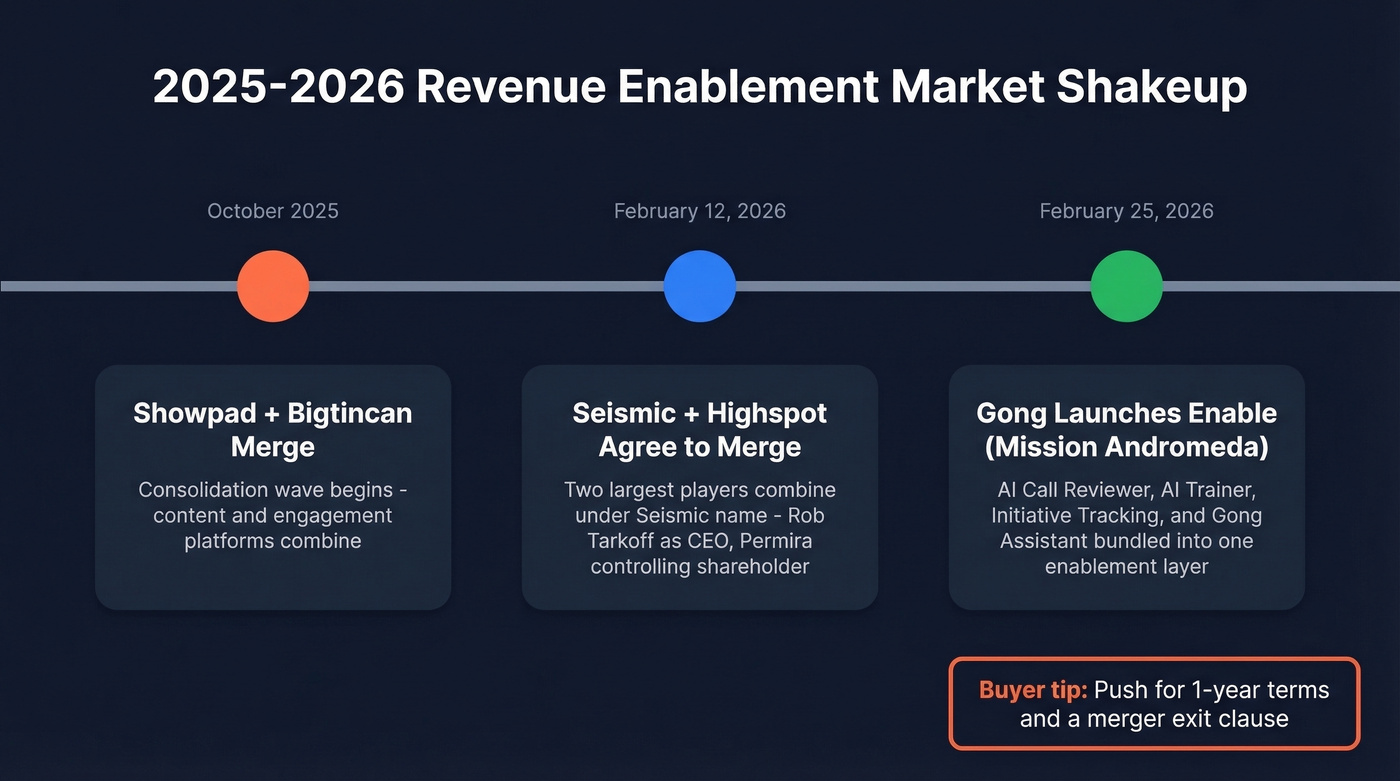
Seismic + Highspot signed a definitive agreement to merge. On February 12, 2026, the two companies agreed to combine under the Seismic name. Rob Tarkoff leads as CEO, Permira remains the controlling shareholder. The execution risk is obvious: integrating Highspot's Nexus AI and Seismic's Enablement Cloud without turning the UX into a Frankenstein. We've seen this movie before with other enterprise mergers, and the first 18 months are always bumpy.
Showpad completed its merger with Bigtincan in October 2025, continuing the consolidation wave.
Gong launched Gong Enable. On February 25, 2026, Gong announced Mission Andromeda - bundling AI Call Reviewer, AI Trainer, Initiative Tracking, and Gong Assistant. It's priced at "tens of dollars per seat per month," and it's the first enablement product that feels natively built from call data rather than bolted on.
Contract advice that's non-negotiable in 2026: push for one-year terms and a merger exit clause (use an anchor and define your walk away point). This market won't look the same in 12 months.

You can deploy Seismic, Allego, or Gong Enable - but none of it matters if reps are emailing dead addresses. Prospeo delivers 98% verified emails across 300M+ profiles, refreshed every 7 days. That's the foundation your enablement stack needs before a single piece of content gets shared.
Clean data first, enable second. Start free with 75 verified emails.
Top Platforms Compared
Seismic (Post-Combination with Highspot)
Best for: global enterprises that need heavyweight content governance, deep integrations, and analytics that survive complexity.
Use this if: you have 1,000+ reps, multiple business units, strict compliance needs, and a real enablement ops function.
Skip this if: you need stability right now. Mergers don't "settle" in a quarter; they settle in years. If your team is under 200 reps and you don't have a dedicated enablement ops person, you'll be paying for infrastructure you can't maintain.
Gartner Peer Insights ratings are strong - 4.7 stars for Seismic (303 ratings) and 4.7 for Highspot (164 ratings) - but those reflect pre-combination products. We'd wait for post-merger reviews before treating those numbers as gospel.

Pricing reality: budget $100K+/year as the floor for enterprise deployments. The upside of buying during integration is leverage - use it to lock in price protections and roadmap commitments.
Allego
If Seismic is the content-and-governance heavyweight, Allego is the "get it live, get it used" enterprise leader - especially for coaching and readiness at scale.
It holds a 4.7 on Gartner Peer Insights (83 ratings) and a 4.6 on G2 (673 reviews). G2 users report a 2-month average implementation and 13-month time to ROI, plus an average 11% discount off list price. The proof point we care about most: ChurnZero doubled close rates after deploying Allego. That's not a vanity metric.

Pricing reality: per-user, billed annually. For 50 seats, plan ~$60K-$120K/year depending on modules and services. Vendors love pushing 3-year terms here - don't accept that by default. Start with one year, prove ROI, then negotiate multi-year with concessions.
Showpad
Showpad is a common pick for content-heavy orgs running Salesforce + Marketo. It's also a frequent "we actually got adoption" choice in community threads because it makes content findable without forcing reps into a new universe.
Use this if: your biggest problem is content chaos - duplicates, outdated decks, reps sharing the wrong thing.
Skip this if: you're allergic to integration churn. The October 2025 Bigtincan merger means you're buying into an active roadmap transition.
Pricing reality: ~$35-60/user/month. A 50-seat deployment typically lands around $21K-$36K/year, meaningfully cheaper than enterprise Seismic deals.
Mindtickle
Mindtickle is a readiness engine: onboarding, certifications, coaching, and skill development. If ramp time is your KPI, this is the most direct path.
Pricing reality: $25-50/user/month, with many mid-market teams landing $30K-$80K/year depending on seats and packages. If your org already has content management handled elsewhere, Mindtickle pairs cleanly without overlap.
Gong Enable
Gong Enable is the most interesting new entrant because it starts with what reps actually do all day: calls. Mission Andromeda bundles AI Call Reviewer, AI Trainer, Initiative Tracking, and Gong Assistant into a single enablement layer.
Buy it if: you already run Gong and want enablement tied directly to call behavior and coaching.
Pricing reality: ~$30-60/seat/month. The tradeoff is maturity - this is new, and you're betting on Gong's roadmap execution. For teams already paying for Gong's conversation intelligence, the incremental cost to add Enable is lower than standing up a separate platform.
Dock
Dock isn't trying to be Seismic. It's a fast, lightweight way to run digital sales rooms and customer-facing deal collaboration without procurement drama.
Pricing reality (transparent): free for individuals, $350/month for 5 seats, $750/month for 10 seats. If you're early-stage, Dock is the easiest "start now" option on this list.
Also Worth Knowing
GTM Buddy puts enablement in the rep's workflow instead of making them hunt for it. ~$20-40/seat/month and typically quick to roll out.
Paperflite is the dark horse. One practitioner chose it over Highspot for native Salesforce integration, microsites, a cleaner UI, and pricing that didn't feel like enterprise theater. Expect ~$20-50/seat/month depending on plan and volume.
Pitcher is a Gartner MQ Challenger and reports 94% user adoption. If adoption is your make-or-break constraint, Pitcher deserves a serious demo. Expect ~$30K-$60K/year for mid-market deployments.
SalesHood is the budget-friendly option for smaller teams that need basics without enterprise overhead. Expect ~$20-40/seat/month.
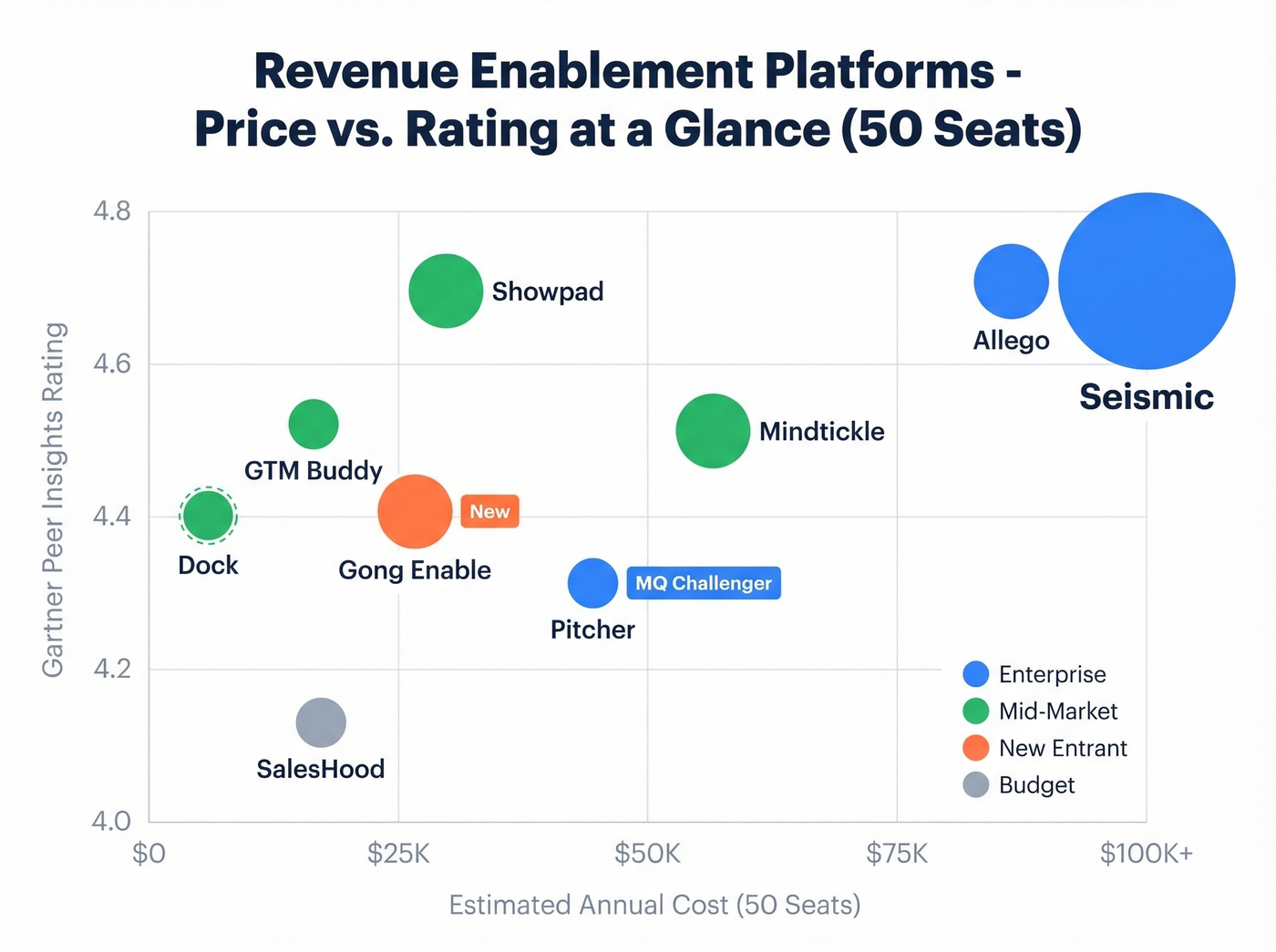
| Platform | Best For | Gartner Rating | Est. Annual Cost (50 seats) | Contract Terms |
|---|---|---|---|---|
| Seismic | Enterprise 1,000+ reps | 4.7 (303) | $100K+ | Custom, multi-year |
| Allego | Enterprise, fast deploy | 4.7 (83) | ~$60K-$120K | 1-3 year, annual billing |
| Showpad | Content-heavy orgs | 4.7 (286) | ~$21K-$36K | Annual |
| Mindtickle | Mid-market coaching | 4.5 (139) | ~$30K-$80K | Annual |
| Gong Enable | Existing Gong users | New | ~$18K-$36K | TBD |
| Dock | SMB/startup | N/A | Free-$9K | Monthly |
| GTM Buddy | In-workflow delivery | 4.5 (30) | ~$12K-$24K | Annual |
| Paperflite | SFDC-native content | N/A | ~$12K-$30K | Annual/flexible |
| Pitcher | High-adoption orgs | Gartner MQ Challenger | ~$30K-$60K | Custom |
| SalesHood | Budget teams | 4.1 (22) | ~$12K-$24K | Annual |
How to Evaluate the Right Platform
Feature checklists don't predict success. Adoption does. Let's be honest - most enablement platforms get abandoned after the first quarter because nobody evaluated around the moments that actually matter: what happens when a rep needs something mid-deal.
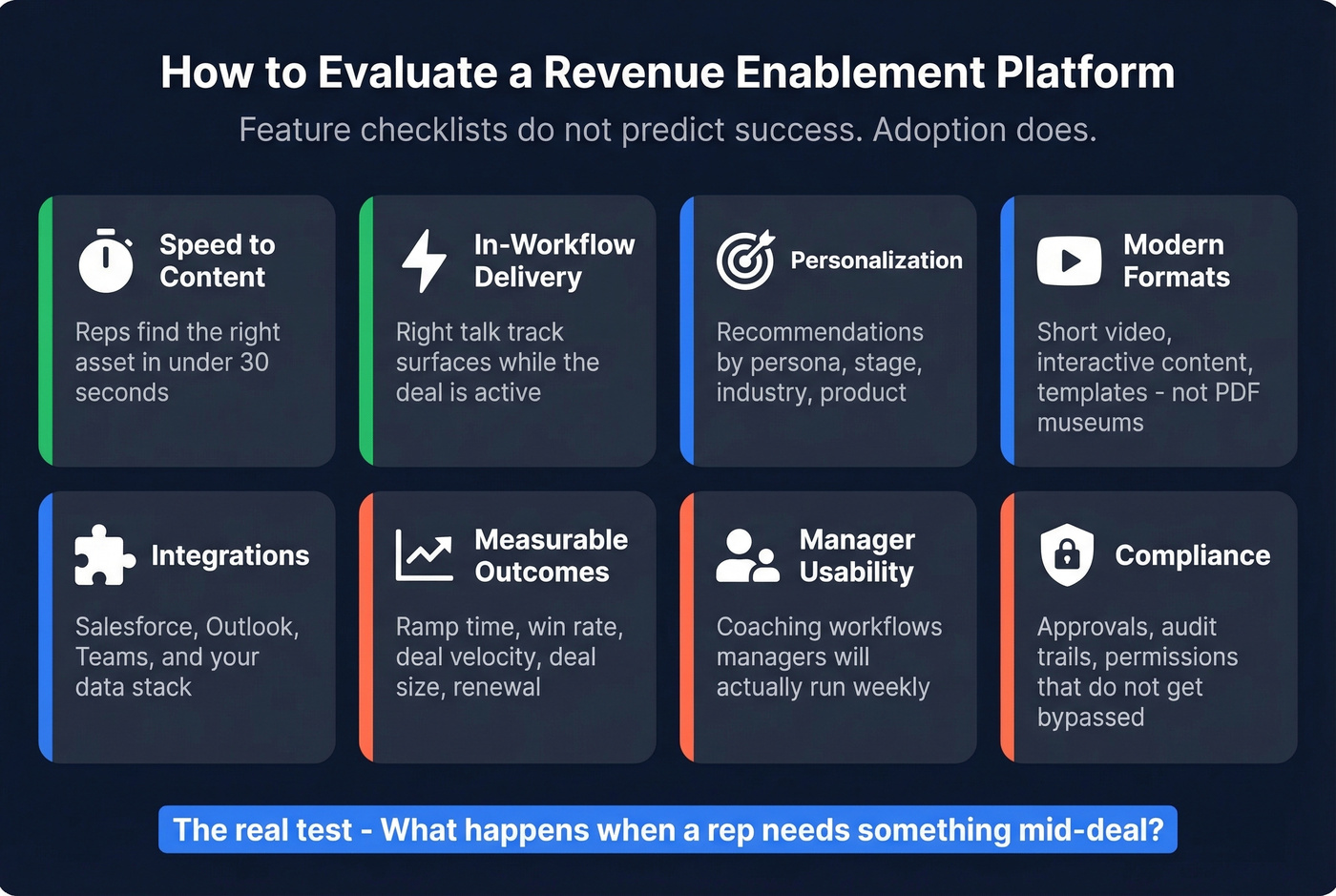
Evaluate around these:
- Speed to content: reps find the right asset in under 30 seconds, inside the tools they already live in.
- In-workflow delivery: the platform nudges the right talk track or asset while a deal is active, not two weeks later in a training module (see talk track examples).
- Personalization: recommendations by persona, stage, industry, and product line.
- Formats that match reality: short video, interactive content, templates - less "PDF museum."
- Integrations: Salesforce, Outlook, Teams, and your data stack.
- Measurable outcomes: ramp time, win rate, deal velocity, deal size, renewal/expansion (track pipeline health).
- Manager usability: coaching workflows that managers will actually run weekly.
- Compliance: approvals, audit trails, and permissions that don't get bypassed.
Here's the thing: if your average deal size is under five figures, you don't need a "platform." You need two things - content that's easy to find and coaching that's easy to run. Anything beyond that is enablement cosplay.
Why Enablement Platforms Fail
The platform with 200 features and 15% adoption loses to the one with 50 features and 90% adoption. Every time.
The most common failure isn't vendor selection - it's operating model. Enablement gets pulled in every direction, and 65% of CSOs say their enablement function is already stretched thin by cross-functional demands. When the team is overloaded, taxonomy rots, content piles up, and "AI recommendations" start recommending junk. We've watched this happen at three different companies our team has worked with, and the pattern is always the same: leadership buys the tool but doesn't sponsor the rollout, content doesn't match what reps sell, and managers never coach inside the system.
Forrester's implementation guidance is unglamorous and brutally effective:
- Name a taxonomy owner - one person accountable for findability
- Prune content monthly - kill duplicates and stale assets
- Audit quarterly - permissions, governance, analytics sanity checks
- Keep a structured cadence with your CSM - roadmap, adoption, enablement ops
Pilot with a small group of champions, prove usage and outcomes, then expand. Don't do a big-bang rollout.
The Data Quality Problem Nobody Talks About
Every revenue enablement platform assumes your reps can reach the right people. In a lot of CRMs, that's fantasy.
Stale data routinely drives 15-30% email bounce rates (see email bounce rate benchmarks), and unused marketing/sales content already costs enterprises ~$2.3M annually in missed opportunities. Bad data makes both problems worse and damages your domain reputation (fix email deliverability at the source). You can build the most beautiful enablement content in the world, but if 20% of your emails bounce, reps lose trust in the whole system - and they go back to winging it.
Tools like Prospeo fix the foundation: 98% email accuracy, a 7-day refresh cycle versus a 6-week industry average, and 125M+ verified mobile numbers with a 30% pickup rate. Clean data turns enablement analytics from "interesting" into actionable - and it means the content your enablement team builds actually lands in front of real buyers.
Revenue enablement spans sales, CS, partners, and pre-sales - every team needs accurate contact data to execute. Prospeo's 30+ search filters, intent data across 15,000 topics, and 125M+ verified mobiles give your entire revenue org the reach these platforms promise but can't deliver alone.
Stop enabling reps to reach the wrong people. Build lists that connect.
FAQ
What's the difference between revenue enablement and sales enablement?
Sales enablement focuses on sellers. Revenue enablement supports every revenue-facing team across the full customer lifecycle - sales, CS, partners, and pre-sales - so execution stays consistent from acquisition through renewal and expansion.
How much do revenue enablement platforms cost?
SMB tools range from free to under $1,000/month. Mid-market platforms typically run $25-65/user/month billed annually. Enterprise deployments often start around $100K/year and climb with integrations, governance, and professional services.
How long does implementation take?
Expect 4-8 weeks for a clean mid-market rollout and 3-6 months for enterprise complexity. The real timeline is adoption: if managers aren't coaching in the platform by month two, you're already in trouble.
Who leads the Gartner Magic Quadrant for revenue enablement?
The inaugural Gartner Magic Quadrant (dated November 10, 2025) named Highspot and Allego as Leaders, with Pitcher as a Challenger. With Highspot now in a definitive agreement to merge into Seismic, the next MQ will likely reshuffle things significantly.
How do I keep enablement data accurate for AI recommendations?
Run monthly CRM cleanup, quarterly permission audits, and assign strict taxonomy ownership. Pair that with ongoing email verification - Prospeo's free tier gives you 75 credits/month - so personalization, analytics, and AI-driven content recommendations aren't built on stale or invalid contacts.