

RocketReach vs Thomson Data: Two Very Different Products
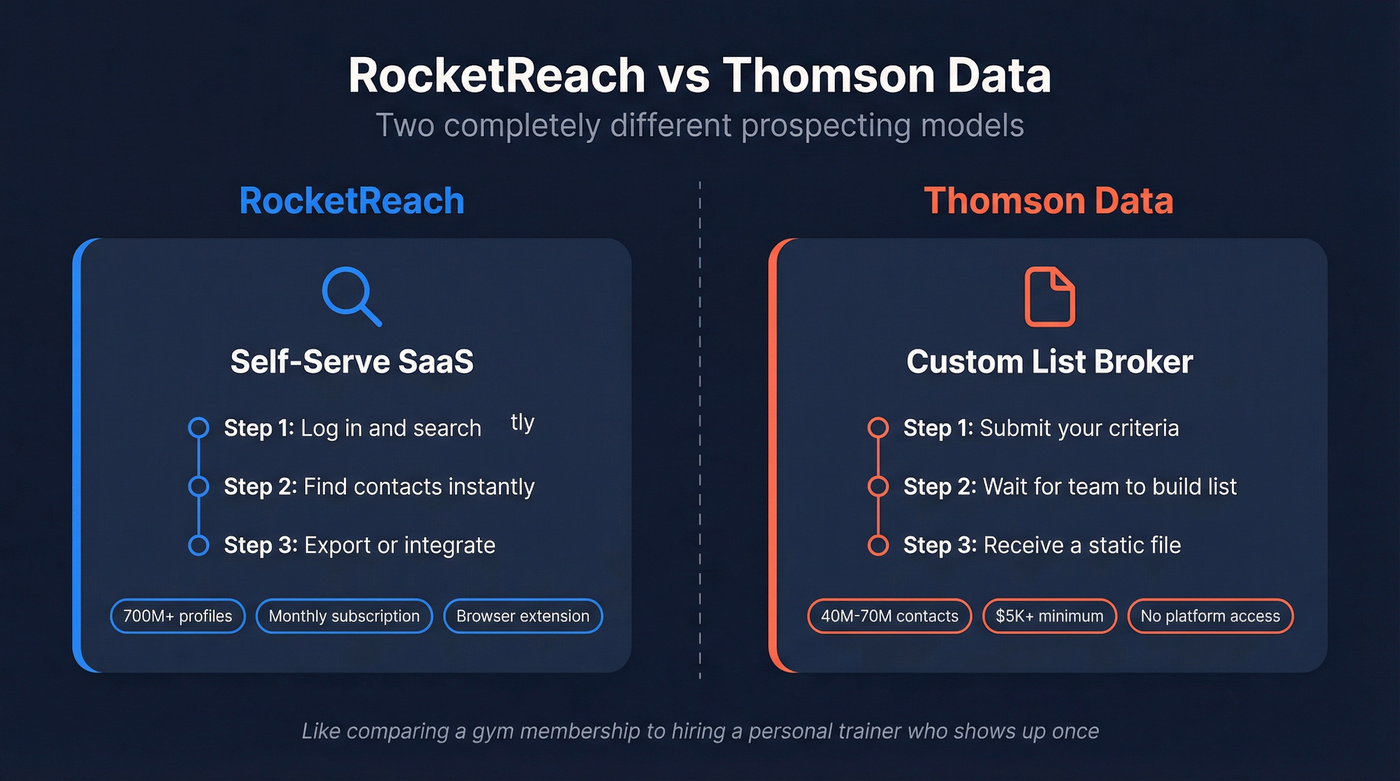
These two tools get compared like they're in the same category. They're not. RocketReach is a self-serve SaaS contact finder you log into and search. Thomson Data is a list broker - you tell them what you need, they build it, and they send you a file. Comparing RocketReach vs Thomson Data is like comparing a gym membership to hiring a personal trainer who shows up once. Both help you prospect, but the model is completely different.
What Is RocketReach?
RocketReach is a self-serve contact intelligence platform covering 700M+ professional profiles. You search by name, company, or title, and it returns emails, phone numbers, and social links. There's a browser extension for grabbing details on the fly, and the whole thing runs on a subscription model with tiered lookup limits.
On G2, it holds a 4.4/5 rating across 1,212 reviews - a large enough sample to trust the patterns. Users consistently praise ease of use and fast prospecting. The recurring complaint? Inaccurate and outdated data.

What Is Thomson Data?
Thomson Data isn't a platform you log into. It's a list broker - you submit targeting criteria (industry, job title, geography, company size, technographics), and their team builds a custom list and delivers it as a file. Founded in 2010 and based in Plano, TX, they market 40M+ contacts across 13M+ companies with customization using 150+ data points per record. Datarade profiles them at 70M B2B contacts and 75+ specialized segments, with targeting that commonly includes SIC/NAICS codes, technology tracking, and mailing addresses.
They also promote a 90%+ delivery guarantee and offer replacement contacts for bounces. On Trustpilot, they carry a 4.4/5 rating from just 10 reviews. Datarade lists a 4.7/5 from 2 reviews and a 40% customer retention rate - a number that should give buyers pause.
The minimum engagement runs $5,000+ per Clutch. No pricing appears on their website.
Side-by-Side Feature Comparison
| Feature | RocketReach | Thomson Data | Prospeo |
|---|---|---|---|
| Model | Self-serve SaaS | Custom list broker | Self-serve SaaS |
| Database | 700M+ profiles | 40M-70M contacts | 300M+ profiles |
| Email accuracy | Not published; reviews cite issues | 90%+ delivery guarantee | 98% verified |
| Data access | Search + export | Quote, then file delivery | Search + export |
| Pricing | ~$33-$249/mo/user | $5K+ minimum, quote-based | Free tier; ~$0.01/email |
| Compliance | CCPA; GDPR stance less explicit | GDPR, CAN-SPAM, CCPA | GDPR compliant |
| CRM integrations | Salesforce (Ultimate tier only) | None (file delivery) | Salesforce, HubSpot, + more |
| Best for | On-demand prospecting | One-time campaign lists | Verified data, no contracts |

RocketReach gates phone numbers behind Pro and Salesforce behind Ultimate. Thomson Data charges $5K+ before you see a single contact. Prospeo gives you 300M+ profiles, verified mobiles, and CRM integrations on every paid plan - starting at roughly $0.01 per email.
Stop overpaying for data that bounces. Start with 75 free verified emails.
Pricing Breakdown
RocketReach doesn't publish pricing on their own site, but third-party snapshots for 2026 commonly show per-user plans with annual-billing discounts and heavy feature gating:
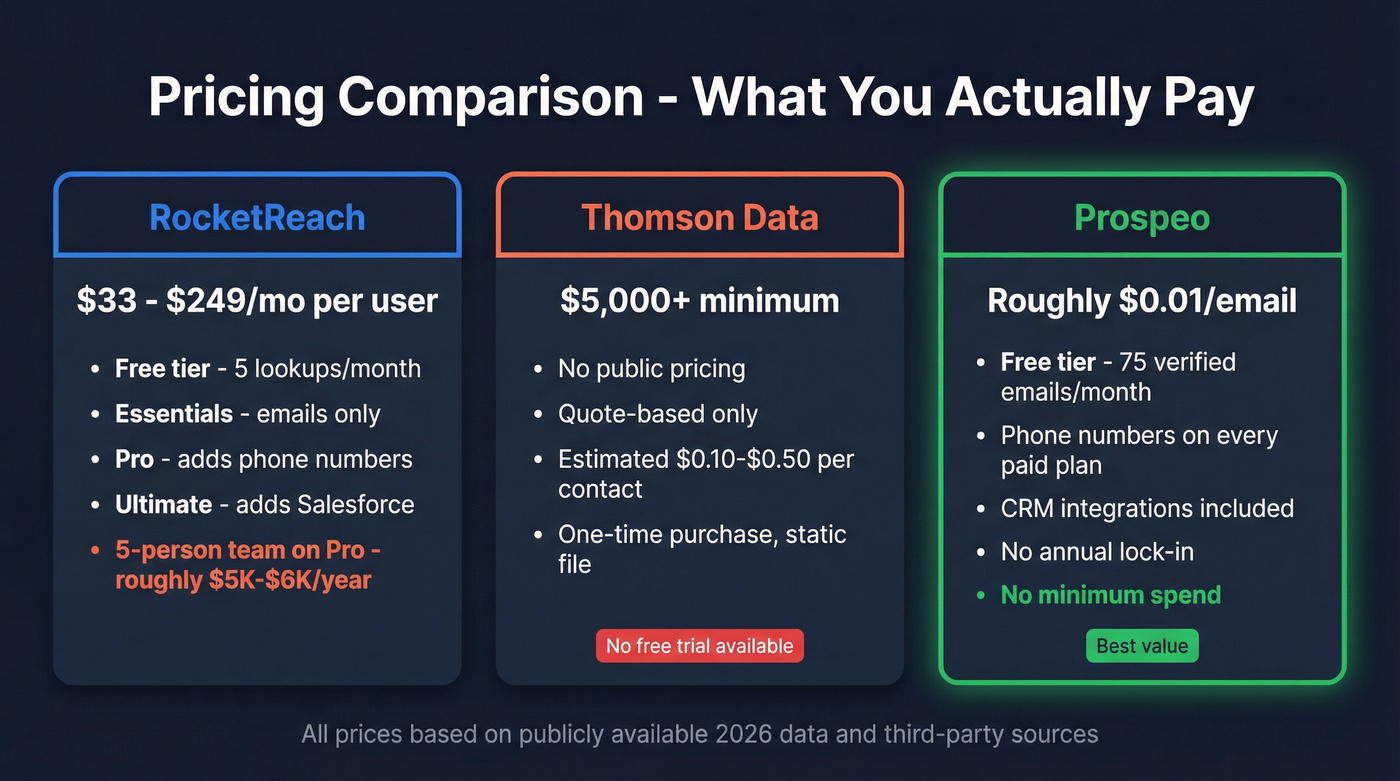
| Plan | Monthly Cost | Lookups/Year | Includes |
|---|---|---|---|
| Free | $0 | 60 (5/mo) | Basic search |
| Essentials | ~$33-$39 | ~1,200 | Email only |
| Pro | ~$83-$99 | ~3,600 | Email + phone |
| Ultimate | ~$207-$249 | ~10,000 | API + Salesforce |
Here's the thing: phone numbers are locked behind Pro, and Salesforce integration requires Ultimate. For a 5-person team on Pro, you're looking at roughly $5,000-$6,000/year before you've sent a single email.
Thomson Data publishes no pricing anywhere. Everything is quote-based. Based on industry norms for custom list brokers, expect $0.10-$0.50 per contact depending on fields and specificity, with that $5K+ minimum as the floor.
Data Quality Compared
RocketReach's 1,212 user reviews tell a clear story: people love the interface and hate the data. "Inaccurate" and "outdated" are the most common negative themes. We've tested both self-serve and broker models extensively, and tools with massive databases almost always sacrifice freshness for coverage - it's the classic tradeoff. RocketReach also doesn't highlight DNC/TPS screening the way some compliance-first databases do, which matters if your team calls internationally.
If you're trying to reduce bounces and protect deliverability, it's worth understanding your email bounce rate and using an email deliverability guide to fix the root causes (not just swap providers).
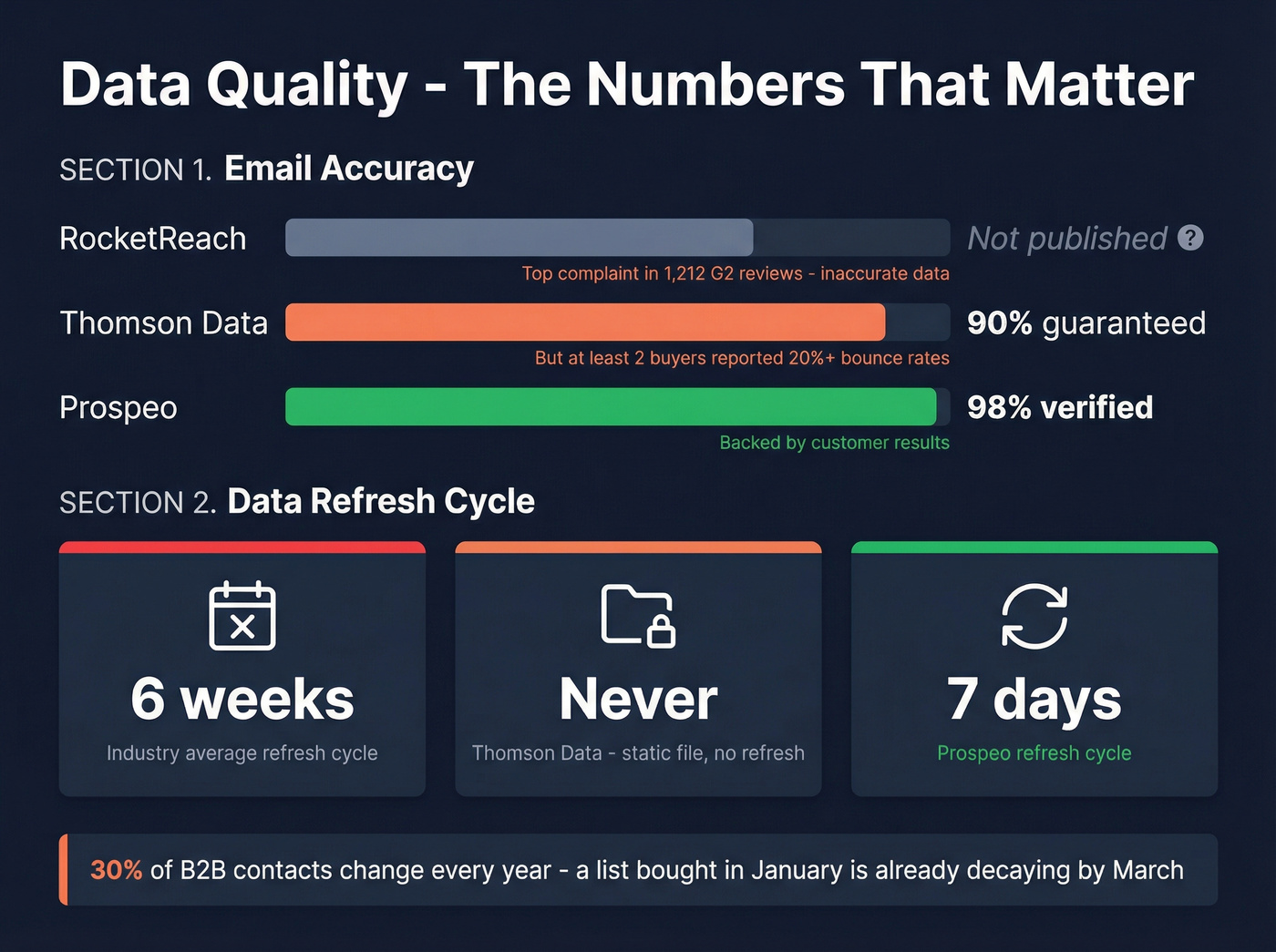
Thomson Data buyers praise data quality and responsive support. But at least two Trustpilot reviewers reported 20%+ hard bounce rates on delivered lists. Thomson Data replaced the contacts both times, which is the right move - but a 20% bounce rate on a $5K+ purchase is a rough first impression.
Let's be honest: if your team prospects daily, you shouldn't be buying static lists at all. Data decays fast. Roughly 30% of B2B contacts change annually, which means a list you bought in January is already degrading by March. A list broker model only makes sense for one-off campaigns where you'll never re-use the data.
If you're building outbound lists in-house, a repeatable lead generation workflow and clear firmographic filters usually beat one-time file buys.
Which Should You Choose?
Use RocketReach if you need on-demand prospecting today, have a per-user SaaS budget, and primarily need emails. The free tier lets you test before committing. If you're comparing more tools in this category, start with best sales prospecting databases and outbound lead generation tools.
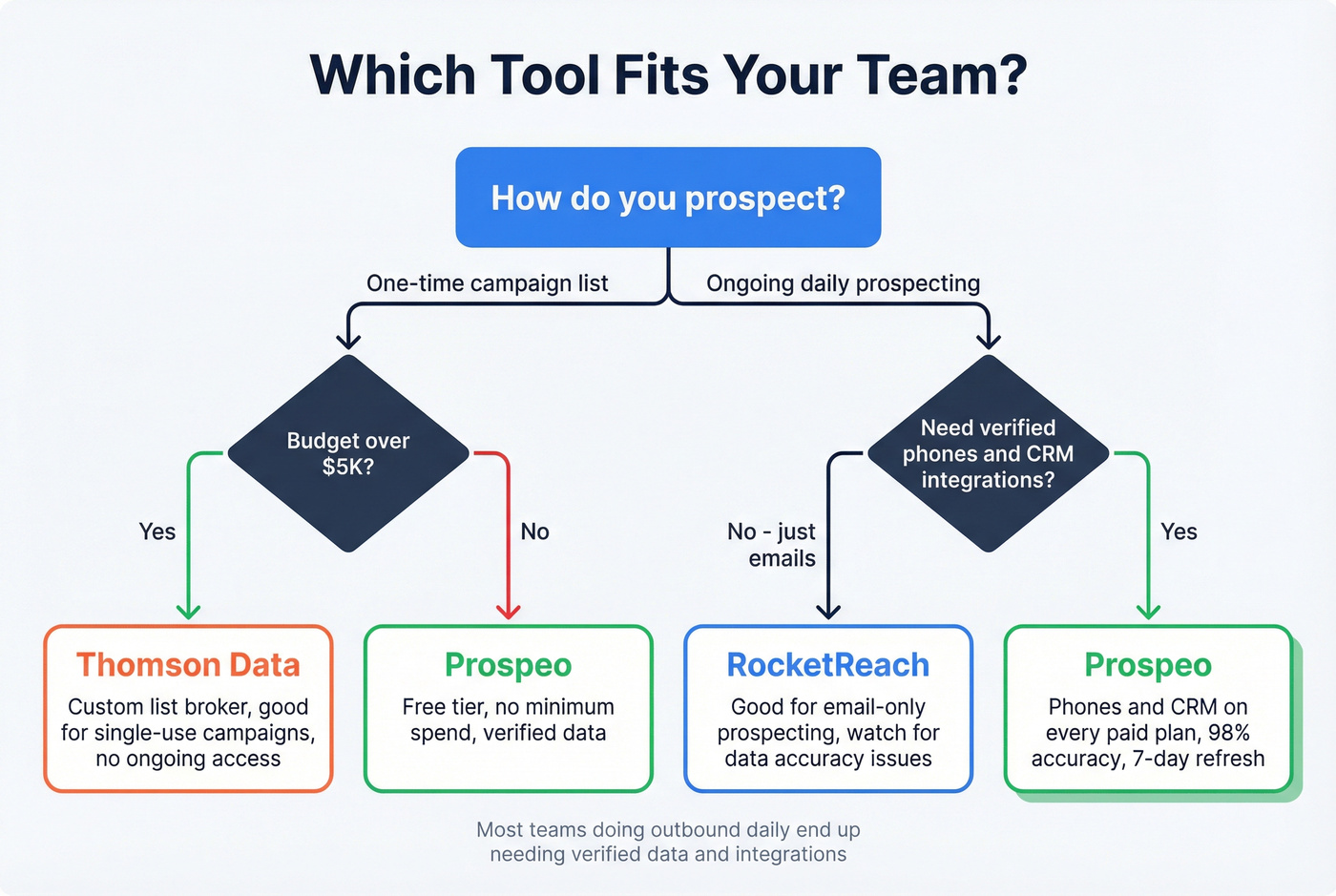
Use Thomson Data if you're buying a one-time list for a specific campaign - say, every VP of IT at manufacturing companies in the Midwest - and you have $5K+ to invest. Skip this if you need ongoing, refreshed data or if your budget is under five figures.
For teams that want self-serve access with verified data, no minimum spend, and no annual lock-in, Prospeo covers 300M+ profiles with 98% email accuracy and a 7-day data refresh cycle compared to the 6-week industry average. Phone numbers and CRM integrations aren't gated behind expensive tiers, and paid plans run roughly $0.01 per email. We've seen teams cut bounce rates from 35%+ down to under 4% after switching - Meritt, for example, tripled their pipeline from $100K to $300K/week after making that move.
If you're also enriching existing records (not just finding net-new contacts), compare data enrichment services and set up a lightweight lead enrichment process.

Static lists decay fast - 30% of B2B contacts change every year. Prospeo refreshes its entire database every 7 days, not every 6 weeks. Teams like Meritt cut bounce rates from 35% to under 4% and tripled pipeline to $300K/week after switching.
Fresh data wins deals. Stale lists lose them.
FAQ
Is Thomson Data a SaaS platform like RocketReach?
No. Thomson Data is a list broker - you submit criteria, their team builds and delivers a file. RocketReach and self-serve SaaS platforms let you search, filter, and export contacts on demand without waiting for a sales team.
Can I try Thomson Data without a large budget?
Unlikely. Clutch lists their minimum engagement at $5,000+, and all pricing is quote-based with no public rate card. If you need to test before committing, self-serve tools with free tiers are lower-risk starting points. RocketReach offers 5 lookups/month on its free plan, and Prospeo gives you 75 verified emails/month at no cost.
Which tool has more accurate email data?
Thomson Data markets a 90%+ delivery guarantee and is profiled at 90% accuracy on Datarade, but Trustpilot includes at least one buyer who experienced 20%+ hard bounces twice before getting replacements. RocketReach doesn't publish a clear accuracy figure, and its biggest recurring complaint across 1,212 G2 reviews is inaccurate or outdated data. Prospeo's 98% verified accuracy with a 7-day refresh cycle leads both on measurable email deliverability - and we've got the customer results to back it up.