

The SaaS CAC Formula (And Why Most Companies Calculate It Wrong)
You're prepping for a board deck. You divide last quarter's ad spend by new signups, drop the number into a slide, and feel pretty good about it. Then your VP of Finance asks whether you included SDR salaries, CRM costs, and the content team - and the whole number falls apart.
The SaaS CAC formula is simple: Total S&M Costs / New Customers Acquired. But most companies get it wrong by undercounting costs or mixing in retention spend. Benchmarkit's median New CAC Ratio is now $2.00 to acquire $1.00 of new customer ARR, up 14% year-over-year. If your number looks better than that, you're probably leaving costs out.
How the Formula Actually Works
CAC = Total Sales & Marketing Costs / New Customers Acquired
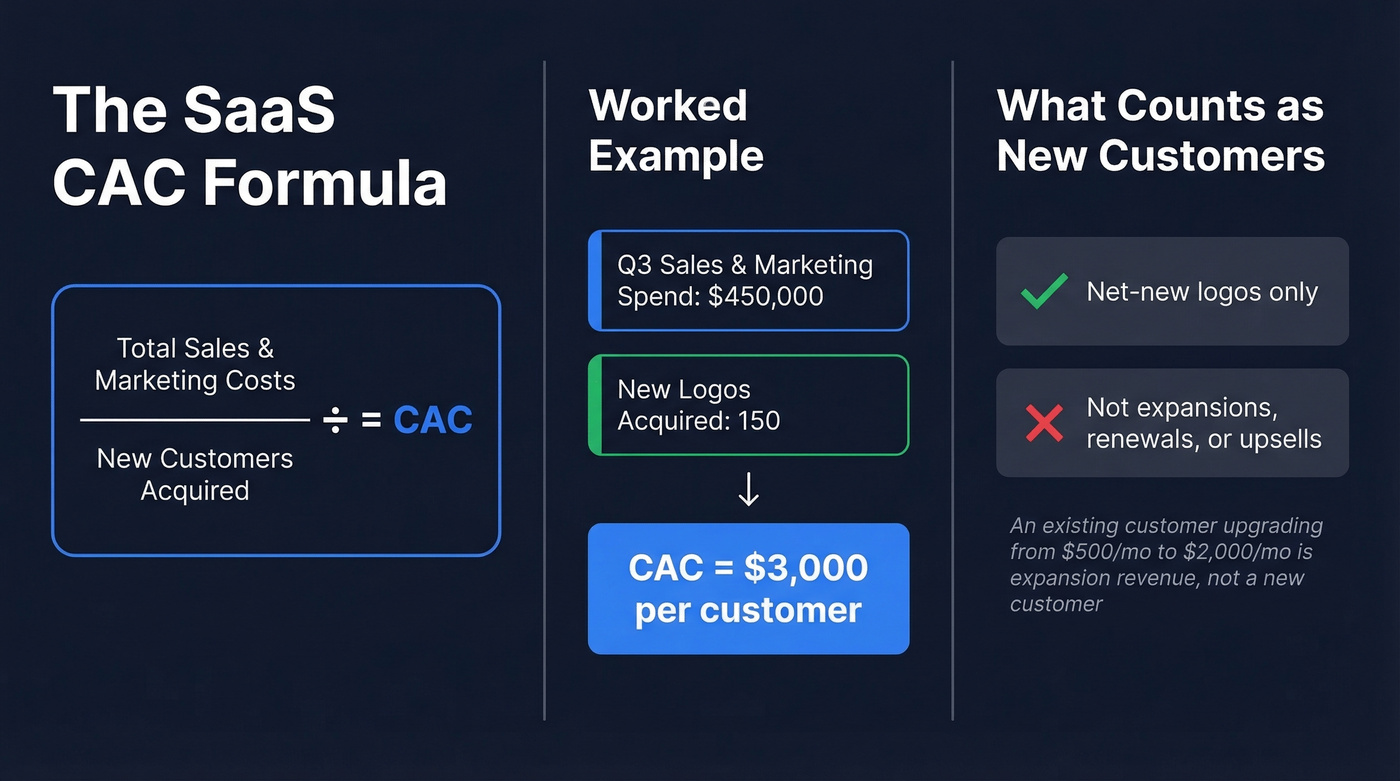
"New customers" means net-new logos - not expansions, not renewals, not upsells. If an existing customer upgrades from $500/mo to $2,000/mo, that's expansion revenue and doesn't belong in this denominator.
A worked example: your company spent $450,000 on sales and marketing last quarter and acquired 150 new customers. CAC = $3,000. The hard part isn't the math. It's deciding what goes into that $450,000.
What to Include (And Exclude)
Include in CAC: paid media, content and SEO team salaries, SDR and AE salaries plus commissions and benefits, CRM and sales engagement tools, events and webinars, and outsourced lead gen agencies. If you're auditing your stack, it helps to map costs to the exact sales activities that create pipeline.
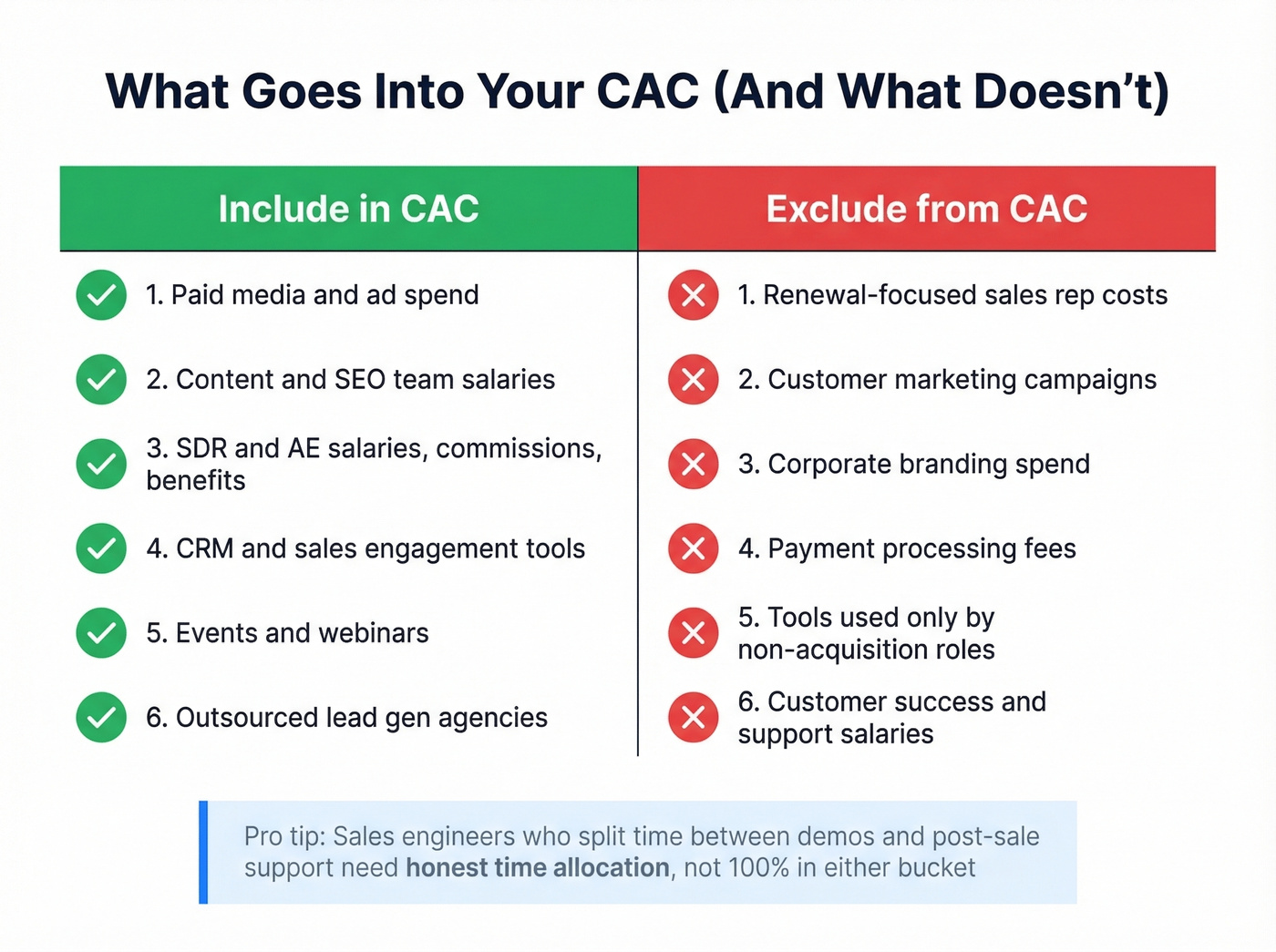
The exclusion side is where we've seen the most mistakes. Fully loaded personnel costs for sales reps focused on renewals, customer marketing campaigns, corporate branding, payment processing fees, and tools used exclusively by non-acquisition roles all stay out. Sales engineers who split time between demos and post-sale support need honest allocation - if you're lumping everything into one bucket, your acquisition cost calculation is lying to you. OpEx Engine's exclusion list covers the full breakdown, and it's worth bookmarking for your next finance review.
CAC Ratio vs Logo-Based CAC
Logo-based CAC tells you cost per customer. But if one customer pays $5k/year and another pays $500k/year, that number hides more than it reveals. This is why many teams pair CAC with funnel metrics to see where spend actually converts.
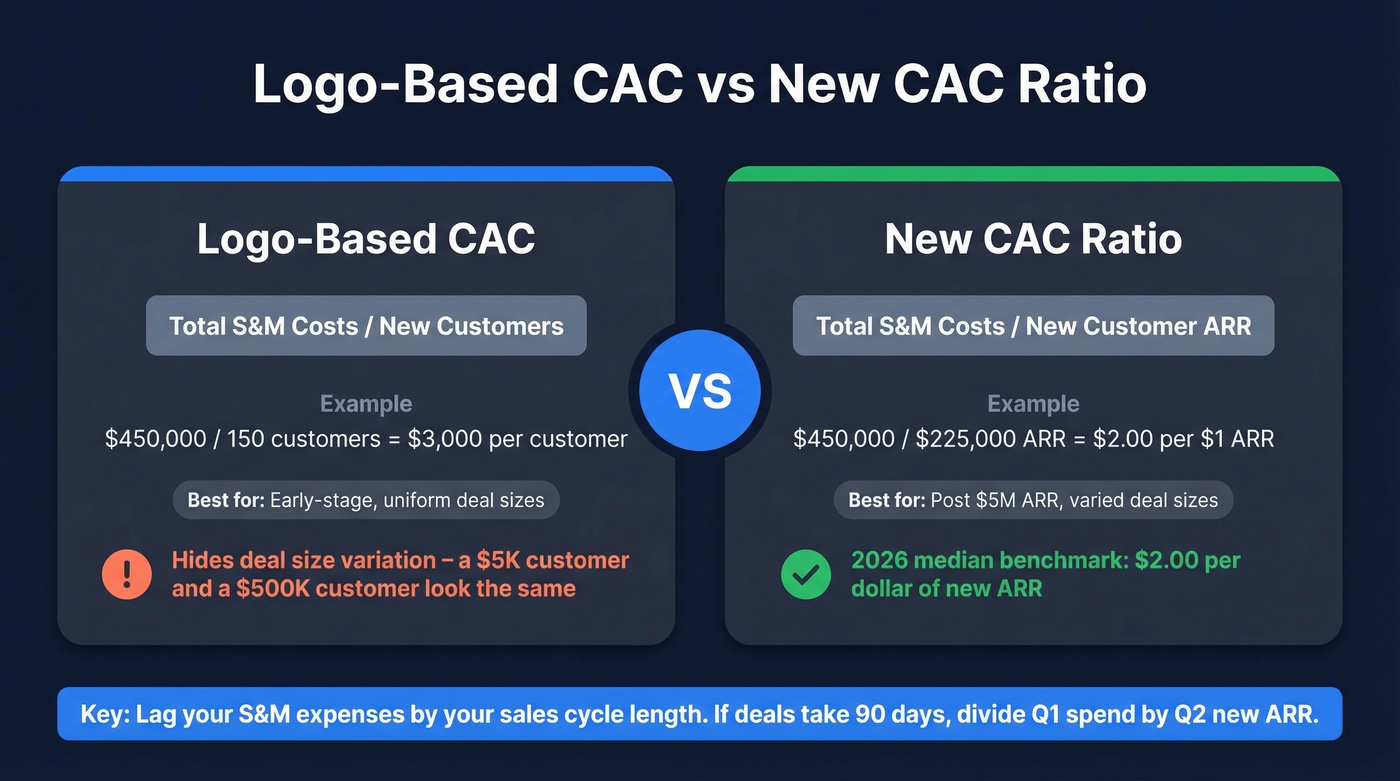
New CAC Ratio = Total S&M Expenses / New Customer ARR
Benchmarkit's most recent data shows the median New CAC Ratio at $2.00 - meaning companies spend $2.00 in S&M for every $1.00 of new customer ARR. Fourth-quartile companies spend $2.82 per dollar.
One nuance most articles skip: you need to lag your S&M expenses by your sales cycle length. If your average deal takes 90 days to close, divide Q1's S&M spend by Q2's new ARR. Otherwise you're comparing spend to revenue it didn't generate, and the resulting number is meaningless. If you want a clean handoff between marketing and sales, align this with your lead generation workflow.

Your CAC ratio includes every dollar your SDRs waste on bad data. Bounced emails, disconnected numbers, outdated contacts - they all inflate S&M costs without adding a single new logo to the denominator. Prospeo's 98% email accuracy and 7-day refresh cycle mean your outbound spend converts into pipeline, not bounce reports.
Cut the waste inflating your CAC - verify before you send.
CAC Payback Period
The simplified payback formula (CAC / MRR per customer) overstates efficiency because it ignores delivery costs. Use the gross-margin-adjusted version:
CAC Payback = CAC / (Monthly Revenue per Customer x Gross Margin %)
If your CAC is $3,000, monthly revenue per customer is $500, and gross margin is 80%, your payback is 7.5 months. That's healthy for SMB. General benchmarks: under 12 months for SMB, under 18 for mid-market, under 24 for enterprise. This formula doesn't factor churn - if customers leave before payback, you've got hidden CAC debt piling up. To pressure-test payback, pair it with a basic churn analysis.
SaaS CAC Benchmarks in 2026
LTV:CAC Ratio
| LTV:CAC Ratio | What It Means |
|---|---|
| 0.5:1 | Overspending badly |
| 2:1 | Needs improvement |
| 3:1 - 4:1 | Ideal range |
| 6:1 | Stable, but could invest more |
| 8:1+ | Sacrificing growth |
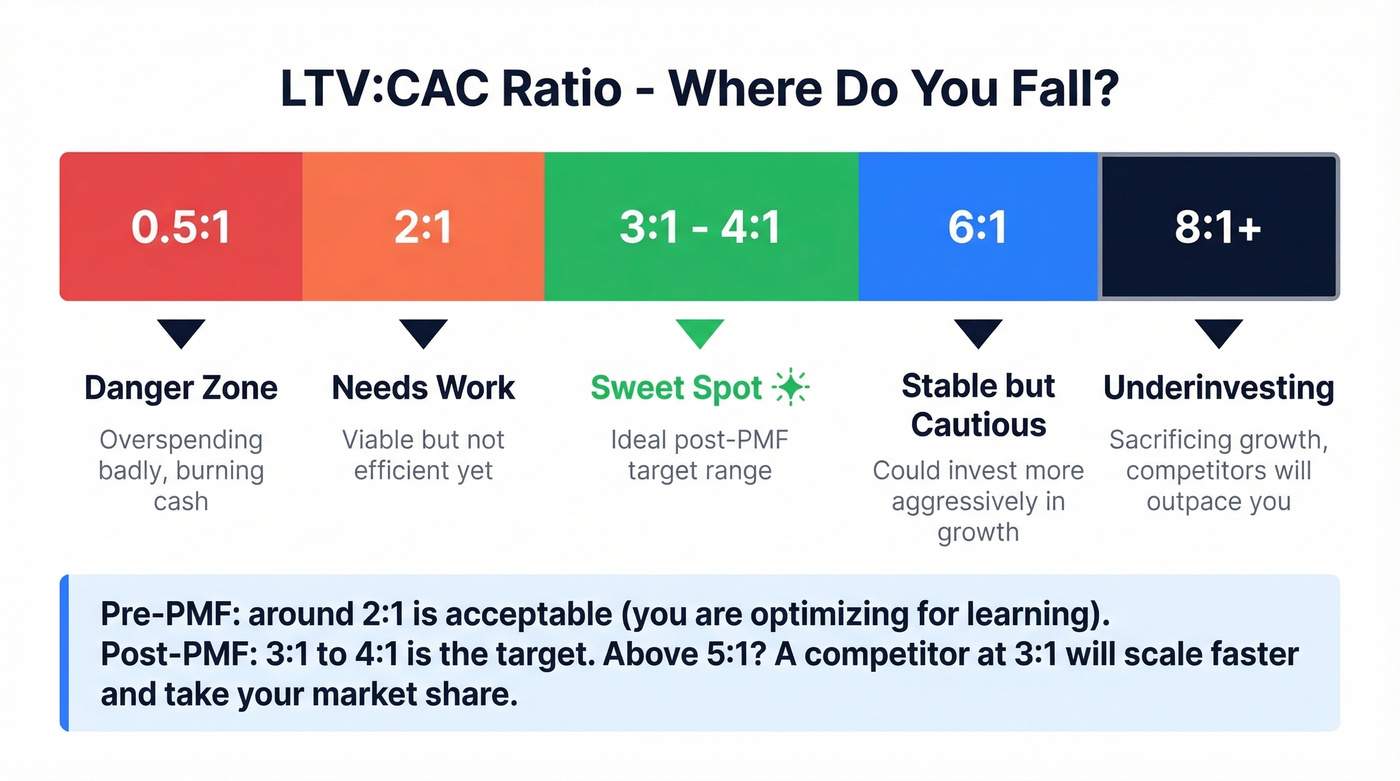
Here's the thing: a 7:1 ratio isn't something to celebrate. One Reddit thread nailed it - a founder's "perfect" 7:1 LTV:CAC looked great on paper while a competitor at ~3:1 scaled faster and took market share. Pre-PMF, ~2:1 is acceptable because you're optimizing for learning. Post-PMF, 3:1 to 4:1 is the sweet spot. Above 5:1, you're almost certainly underinvesting in growth. If you're building a board narrative, it helps to tie this back to pipeline health instead of a single ratio.
Benchmarks by Segment
Acquisition costs vary wildly by vertical and deal size. These are realistic ranges:
| Industry | SMB | Mid-Market | Enterprise |
|---|---|---|---|
| eCommerce | $274 | $1,406 | $2,190 |
| Education | $806 | $2,814 | $6,659 |
| Security | $805 | $5,287 | $10,221 |
| Project Mgmt | $891 | $2,925 | $7,430 |
| Medtech | $921 | $4,326 | $11,021 |
If your enterprise security SaaS has a $3,000 CAC, you're doing exceptionally well. If your SMB eCommerce tool has the same number, something's broken.
Common CAC Mistakes
Counting only ad spend. This is the most common error - and it's rampant on Reddit, where founders routinely share "CAC" numbers that are just ad spend divided by signups. Your board will figure out the real number eventually. Better to get ahead of it. If you need a deeper baseline, start with a full cost to acquire customer breakdown.
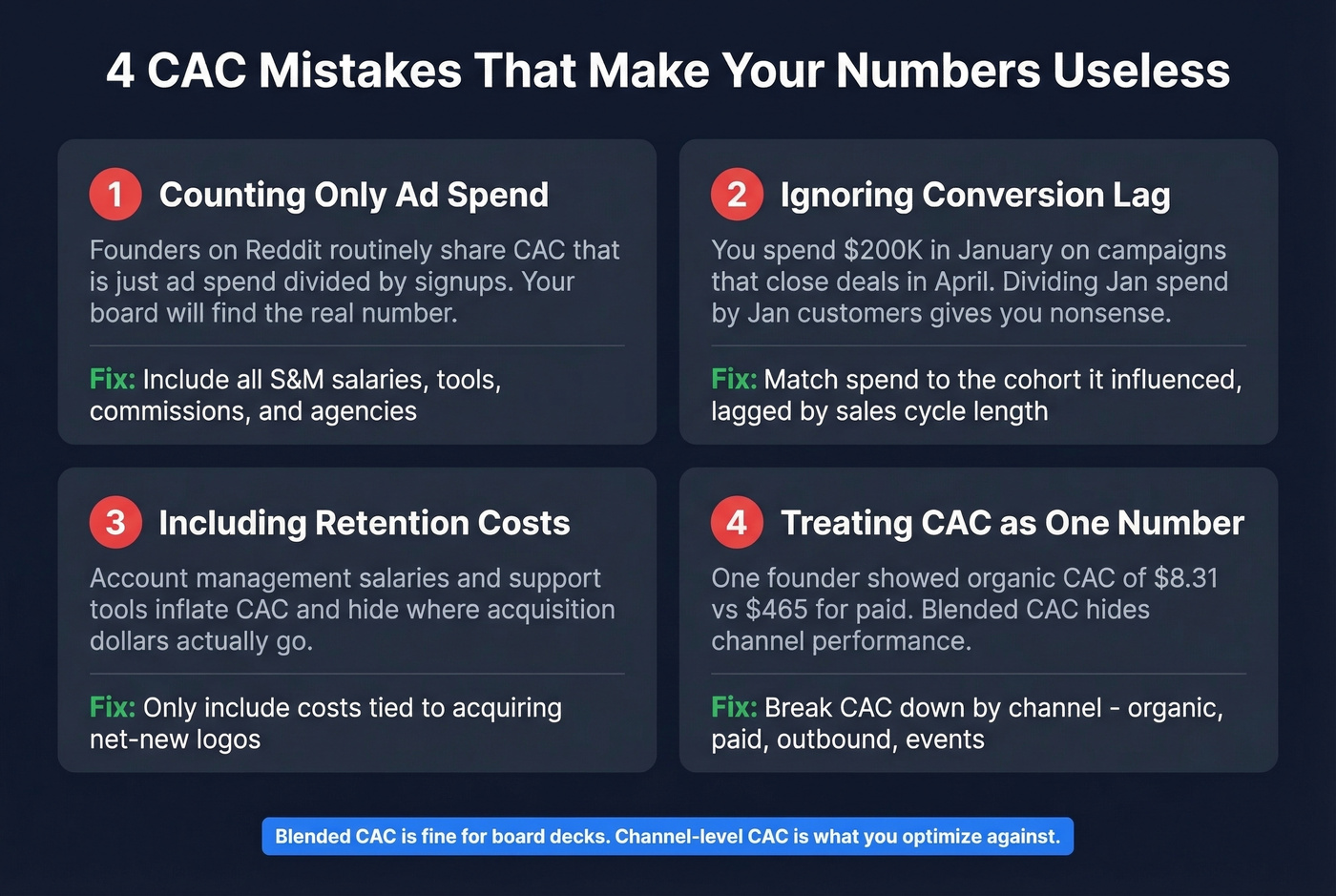
Ignoring conversion lag. In our experience, this is the #1 reason board-reported CAC is wrong. You spend $200k in January on campaigns that close deals in April. If you divide January's spend by January's new customers, you get nonsense. Match the spend to the cohort it actually influenced.
Including retention costs. Account management salaries and support tools don't belong in CAC. They inflate the number and obscure where acquisition dollars actually go.
Treating CAC as one number. One SaaS founder shared their channel breakdown on r/SaaS showing an organic CAC of $8.31 versus $465 for paid. Blended CAC is fine for board reporting, but channel-level cost per acquisition is what you optimize against. If you aren't splitting by channel, you're flying blind.
How to Reduce Your CAC
The highest-leverage move is investing in organic channels. Organic customers typically carry 25-30% lower acquisition costs and 10-15% higher LTV than paid-acquired customers. Companies with over 40% organic acquisition show more consistent growth during downturns. If you're rebuilding the engine, start with proven sales prospecting techniques that compound over time.
Tighter ICP targeting is the second lever. Every dollar your sales team spends on prospects who'll never convert is wasted acquisition cost. Better filters, better scoring, better disqualification - all of it compounds. A lightweight Ideal Customer Profile rubric makes this measurable.
Let's be honest about the lever most teams ignore: contact data quality. Every bounced email and disconnected phone number is wasted spend that inflates your cost per customer silently. We've watched teams cut their effective outbound CAC by 20-30% just by switching to verified data. Prospeo delivers 98% verified emails on a 7-day refresh cycle, so every outbound touch reaches a real person - at roughly $0.01 per verified email, it's one of the cheapest ways to bring acquisition costs down. If you're evaluating options, compare categories like data enrichment services and your outbound stack of SDR tools.
When you're calculating CAC by channel, outbound is often the most inflated - because bad contact data silently burns budget. Teams using Prospeo's verified emails at ~$0.01 each have cut effective outbound CAC by 20-30%. That's the difference between a $2.00 and a $1.40 New CAC Ratio.
Stop subsidizing your competitor's growth with wasted acquisition spend.
FAQ
What's a good CAC for a SaaS company?
It depends on ACV and market segment. SMB CAC typically falls between $274 and $921, mid-market between $1,406 and $5,287, and enterprise between $2,190 and $11,021. The better metric is your LTV:CAC ratio - aim for 3:1 to 4:1 post-product-market fit.
Should I include salaries in my CAC calculation?
Yes - all sales and marketing salaries tied to new customer acquisition belong in the SaaS CAC formula. This includes SDRs, AEs, content marketers, and demand gen. Exclude salaries for account managers, customer success, and anyone focused on existing customers.
What's the difference between CAC and CAC Ratio?
CAC measures cost per new customer (Total S&M / New Customers). CAC Ratio measures cost per dollar of new ARR (Total S&M / New Customer ARR). CAC Ratio is more useful above $5M ARR because deal size variation makes per-customer averages misleading.
How does bad contact data affect CAC?
Every bounced email and wrong number wastes SDR time and ad retargeting budget, directly inflating cost per acquired customer. Teams using verified data sources typically see 25-35% lower bounce rates, which translates to more pipeline per dollar of S&M spend.