

SaaS Sales Models: The 2026 Guide With Benchmarks and a Decision Framework
The median private B2B SaaS company sells at an ACV of $26,265. That puts most founders squarely in no-man's-land - too expensive for pure self-serve, too cheap for a full enterprise sales team. And yet every article about the SaaS sales model framework gives you the same three buckets: self-serve, transactional, enterprise. Pick one.
That framework is incomplete.
There are six distinct models worth separating in 2026, and many companies above $5M ARR run more than one simultaneously. The model you choose - or more accurately, the combination you choose - determines your team structure, your CAC math, and ultimately whether you hit efficient growth or burn cash chasing deals that don't close. Under $5K ACV? Lead with PLG. $5K-$50K? Hybrid PLG plus sales-assist. $50K and up? Sales-led. The rest of this guide gives you the numbers to operationalize that choice.
How to Route Your Model Decision
Here's the routing logic we use:
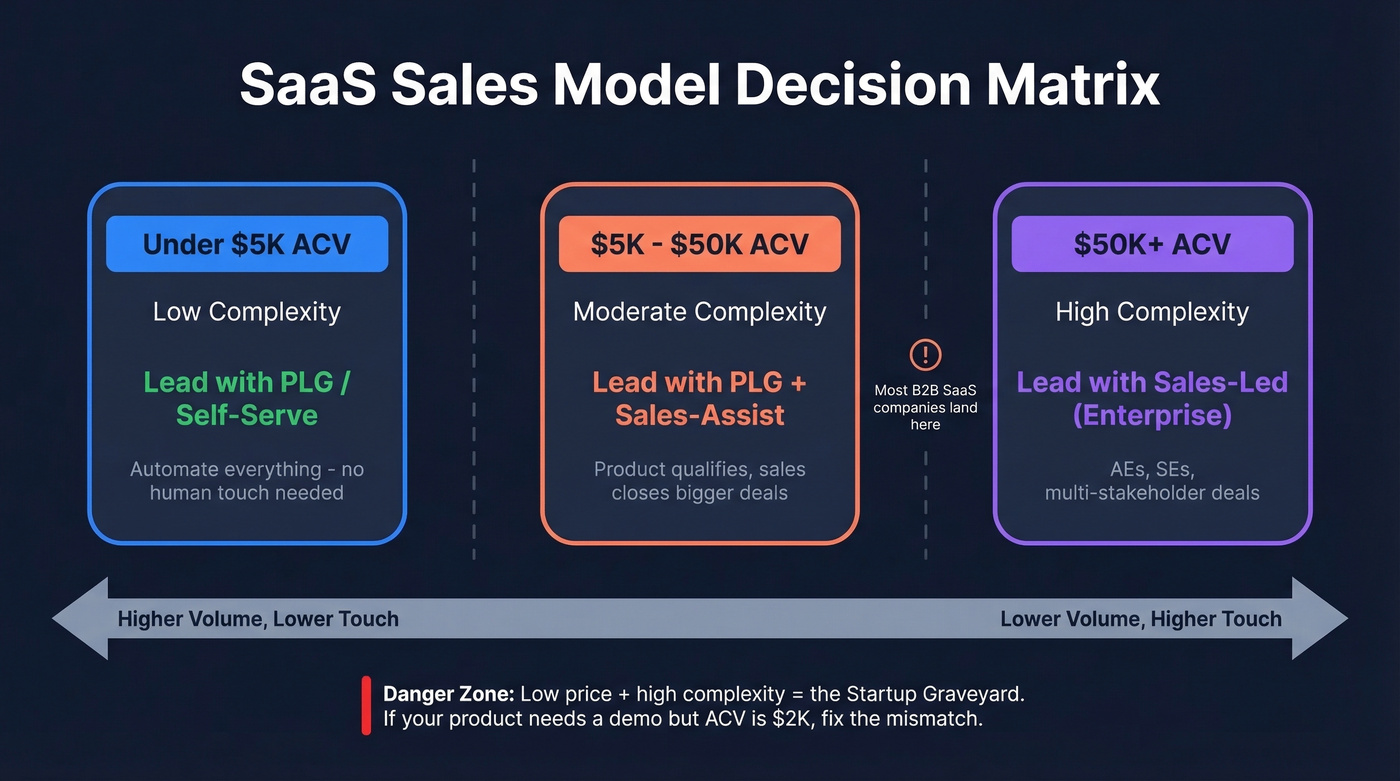
| ACV Range | Complexity | Lead With |
|---|---|---|
| Under $5K | Low | PLG / Self-Serve |
| $5K-$50K | Moderate | PLG + Sales-Assist |
| $50K+ | High | Sales-Led (Enterprise) |
If your ACV sits in the $5K-$50K range and you're running pure self-serve or pure enterprise sales, you're leaving money on the table. The $15K-$40K ACV range is one of the hardest to staff efficiently, which is exactly why the hybrid model exists.
The 6 SaaS Sales Models Explained
Self-Service
Use this if: Your ACV is under $1K, your product is intuitive enough to sell itself, and you can reach a massive addressable market. Mailchimp and Dropbox built empires here. This is the purest subscription-based software sales approach - customers sign up, swipe a card, and start using the product without ever talking to a human.
Skip this if: Your product requires any configuration, onboarding, or explanation. The math is unforgiving. At a $1K ASP, you need 10,000 customers to hit $10M in revenue. That means your acquisition engine needs to be almost entirely automated. Human touch at this price point kills your margins.
Free trial length matters here. If you can't convert within your trial window, the problem is activation, not trial length.
Key metrics: Free-to-paid conversion (around 5% is typical for freemium), time-to-value, monthly churn rate. High churn means the bucket leaks faster than you can fill it.
Product-Led Growth (PLG)
PLG isn't just self-serve with a better name. The distinction matters: self-serve means "no humans involved," while PLG means "the product is the primary acquisition and expansion engine" - but humans often close the bigger deals.
Cursor hit $500M ARR before hiring its first enterprise rep. Lovable reached $100M ARR in 8 months. And 27% of AI application spend now flows through PLG motions, compared to just 7% for traditional SaaS. Those numbers aren't flukes - they reflect a fundamental shift in how buyers want to evaluate software.
But PLG has a brutal filter: time-to-value. The expectation in 2026 is under 60 seconds to first value. Not 60 minutes. Not "schedule an onboarding call." Sixty seconds. And even when you nail activation, retention is the real challenge - for half of all products, over 98% of new users are inactive two weeks after their first action. If you can't get users to core value in under 10 minutes, PLG isn't your primary motion.
Key metrics: Activation rate, time-to-value, free-to-paid conversion, expansion revenue per account.
Transactional / Inside Sales
The transactional model is the classic SDR-to-AE handoff, and it works best when your ACV falls in the $5K-$25K range with a single decision-maker or a small buying committee. Sales cycles at this price point typically run 30-60 days. If yours stretches past 60, something's wrong with either your ICP or your qualification process (use an Ideal Customer Profile to tighten targeting).
Here's a stat that should frustrate every sales leader: reps spend only about 39% of their time actually selling - roughly 13 hours per week. The rest disappears into CRM updates, internal meetings, and prospecting for contacts that bounce.
At this ACV, every wasted hour is a deal that didn't close.
Key metrics: Pipeline coverage (3-5x is standard), win rate (20-30% for inside sales), average sales cycle length, SDR-to-AE conversion rate (track pipeline health to spot slippage early).
Enterprise / Field Sales
Enterprise sales is a different sport entirely. You're selling $50K+ contracts to buying committees of around seven stakeholders, navigating procurement, legal, and security reviews. Sales cycles for $100K+ ACV deals average around 170 days - nearly six months per deal, which means a single blown quarter can cascade through your entire year.
The team structure reflects the complexity: AEs, solutions engineers, sales managers, and often dedicated customer success from day one. Methodologies like MEDDIC and Challenger aren't optional at this level - they're survival tools (see MEDDIC sales qualification for a practical breakdown). Salesforce's pricing spectrum ($25-$500/user/month across editions) illustrates how enterprise models monetize through tiered complexity and add-on modules.
Key metrics: Pipeline coverage (4-6x at this ACV), multi-threading depth, win rate by deal stage, average contract length, expansion rate. CAC payback in enterprise fintech can stretch to 18-24 months, which is fine if NRR is above 120% (more on enterprise B2B sales execution here).
Channel / Partner Sales
Channel sales is overlooked in SaaS because everyone's obsessed with direct motions. That's a mistake. Partners increasingly cover the full LAER lifecycle - Land, Adopt, Expand, Renew - not just initial sales.
The enablement gap is real, though. 69% of partners say customer success plans are the most valuable enablement asset, but fewer than 25% of vendors actually share them. If you're launching a channel program, tiered structures with 10-30% commission ranges are common. Invest in PRM tooling and co-marketing resources, or your partners will prioritize vendors who do.
Skip this if: You don't have a repeatable direct sales motion yet. Channel amplifies what works. It doesn't fix what's broken.
Hybrid PLG + Sales-Assist
Let's be honest: in 2026, PLG doesn't mean no sales team. It means the product generates demand and qualifies buyers, and sales closes the bigger deals. HubSpot and Atlassian both run this motion at scale.
The mechanics hinge on PQL (Product-Qualified Lead) and PQA (Product-Qualified Account) triggers. Concrete PQA thresholds that work: 5+ weekly active users in the same domain, 3 power features used by 2 different roles, or 1,000+ events created. When those signals fire, sales engages with context the buyer already trusts - because they've experienced the product.
Monetization gates preserve the free activation while creating natural upgrade pressure. Collaboration limits, scale limits, and governance features like SSO, RBAC, and audit logs sit behind paid tiers. The free user gets real value. The team or enterprise buyer hits a wall that only money solves.
We've seen this pattern repeatedly: companies that nail the PLG-to-sales handoff grow faster than either pure PLG or pure sales-led competitors. The hard part is org design - separate comp plans, separate metrics, and a RevOps team that can stitch the data together (a strong RevOps function is usually the difference).
All 6 Models Compared
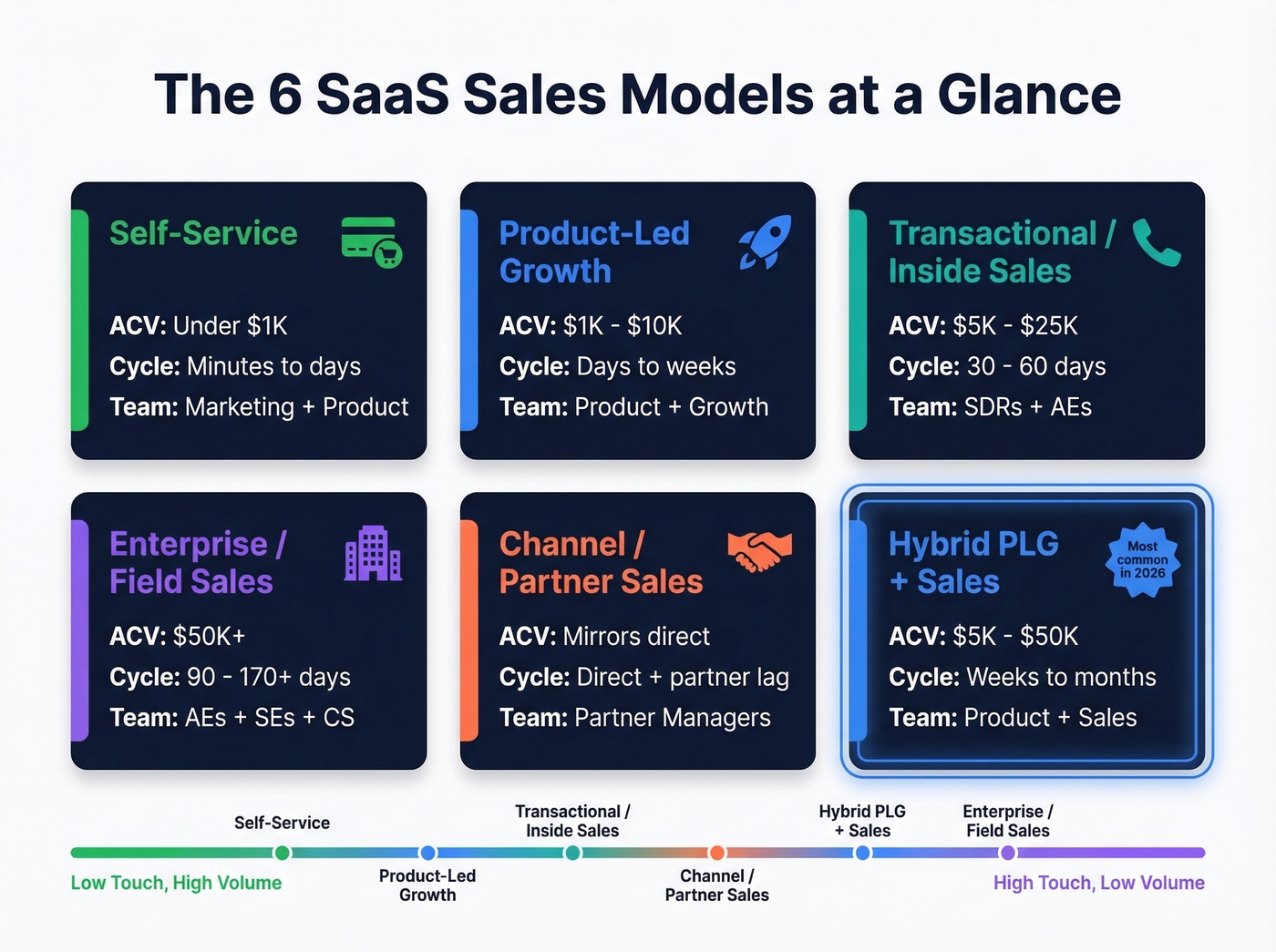
| Model | ACV / Cycle | Team Structure | CAC | Best For |
|---|---|---|---|---|
| Self-Service | Under $1K / Minutes-days | Marketing + product | Very low | High-volume, simple products |
| PLG | $1K-$10K / Days-weeks | Product + growth | Low | Fast time-to-value tools |
| Transactional | $5K-$25K / 30-60 days | SDRs + AEs | Moderate | Mid-market, single buyer |
| Enterprise | $50K+ / 90-170+ days | AEs + SEs + CS | High | Complex, multi-stakeholder |
| Channel | Mirrors direct ACV / Direct cycle + partner lag | Partner managers | Variable | Scale without headcount |
| Hybrid PLG+Sales | $5K-$50K / Weeks-months | Product + sales | Moderate | Most B2B SaaS in 2026 |
One critical failure mode: low price combined with high complexity. That's the "Startup Graveyard" - your ASP can't fund the sales effort your product requires. If your product needs a demo and your ACV is $2K, something has to change. Either simplify the product until it sells itself, or raise the price until the CAC math works.

Reps spend only 39% of their time selling. Bad contact data makes it worse. Prospeo gives your transactional and inside sales teams 98% accurate emails and 125M+ verified mobiles - so every hour spent selling actually connects to a real buyer.
Stop burning sales cycles on bounced emails. Start closing.
How Pricing Shapes Your Go-to-Market
Your go-to-market structure and your pricing model are deeply intertwined, and pricing is shifting fast. Per-seat pricing still dominates - 67% of SaaS companies use tiered models with per-seat components. But IDC forecasts 70% of vendors will refactor away from pure per-seat by 2028.
If you want a deeper view of how this impacts your go-to-market structure, start with the pricing constraints first.
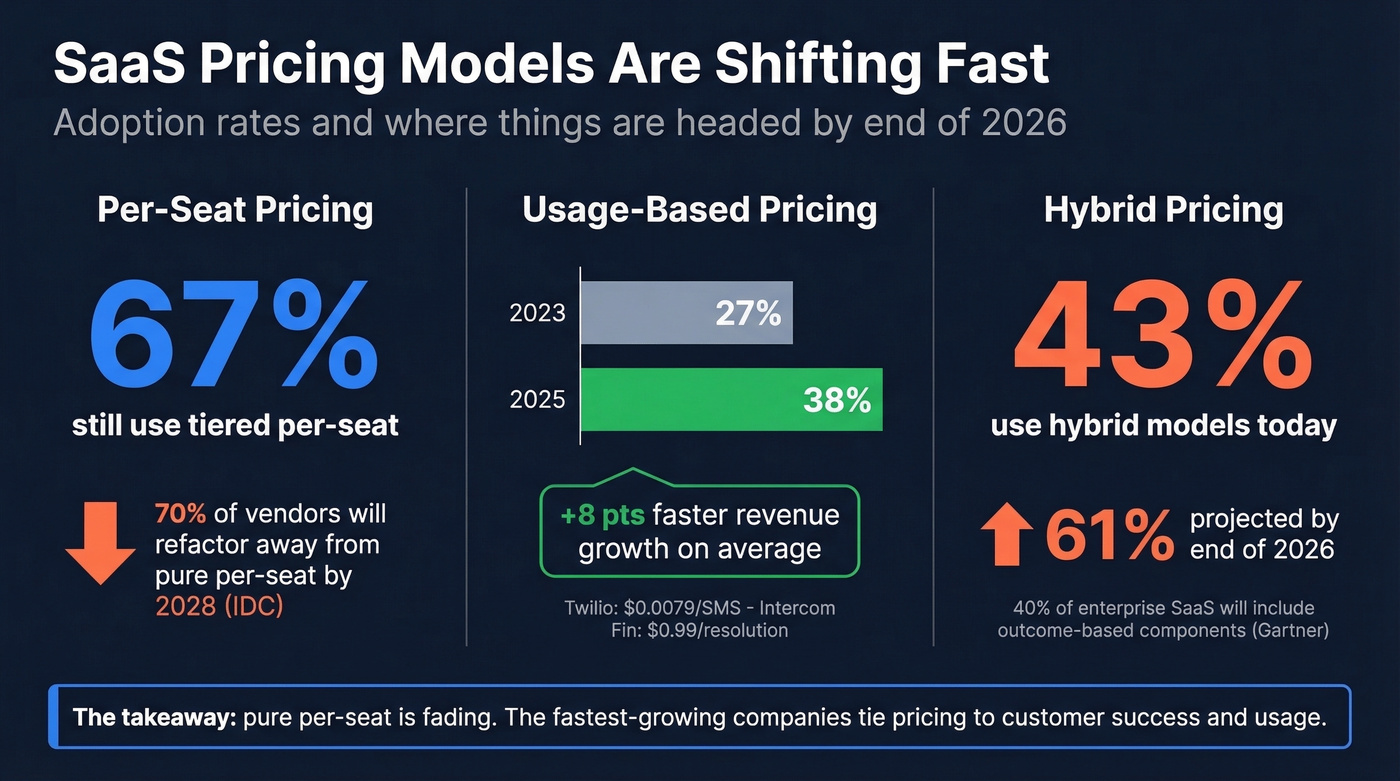
Usage-based pricing has climbed to 38% adoption, up from 27% in 2023. Companies running consumption-based models grew revenue roughly 8 percentage points faster on average. Twilio at $0.0079/SMS and Intercom's Fin at $0.99/resolution are the poster children - you pay for what you use, and the vendor's incentives align with yours.
The real trend is hybrid pricing. 43% of SaaS companies now use hybrid models, projected to hit 61% by end of 2026. Gartner forecasts 40% of enterprise SaaS will include outcome-based components by 2026. That means your sales motion needs to accommodate variable revenue per account, which complicates forecasting but improves NRR.
Look, if you're running a transactional model with pure per-seat pricing, you're leaving expansion revenue on the table. And resist the urge to discount your way to growth - discount-seeking SaaS buyers churn at higher rates, often before you recover CAC (see churn analysis to quantify the damage). The companies growing fastest in the latest benchmarks are the ones where usage naturally scales with customer success.
Unit Economics by Model
Benchmarkit's latest benchmarks paint a clear picture: median growth rate sits at 26%, with the top quartile hitting 50%. NRR has compressed to 101% - expansion is getting harder across the board.
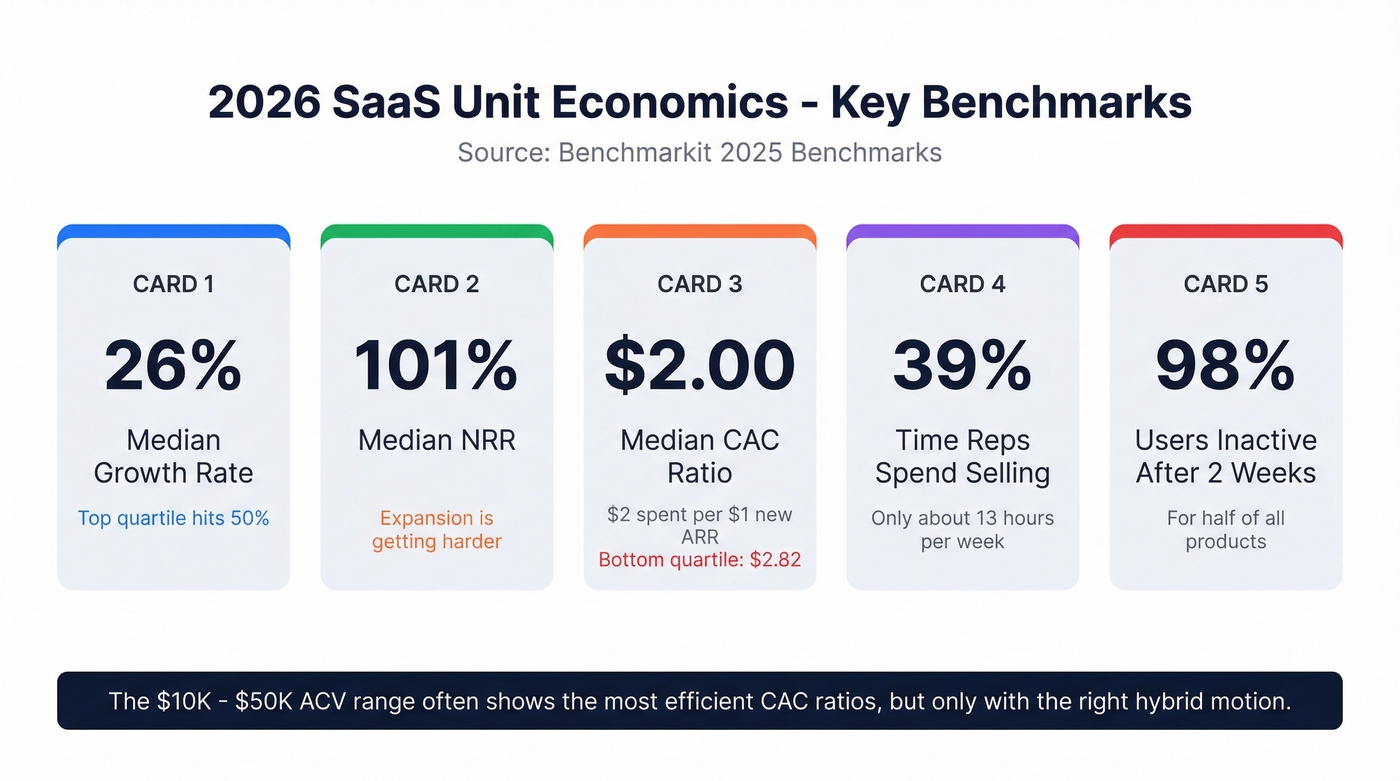
The CAC ratio is where it gets interesting. The median company spends $2.00 in sales and marketing to acquire $1.00 of new customer ARR. Bottom quartile? $2.82. And here's a counterintuitive finding: $10K-$50K ACV solutions are often more expensive to acquire than $50K-$100K deals. The mid-market is a grind because you need enterprise-grade sales effort at mid-market prices (break down your cost to acquire customer by segment to see this clearly).
Expansion ARR now represents 40% of total new ARR at the median, climbing above 50% for companies past $50M ARR. That's not a nice-to-have - it's the growth engine.
The Efficient Growth matrix from Kyle Poyar's benchmarks study makes the stakes clear. Companies with high NRR and low CAC payback average 71% growth and 47% Rule of 40. Flip both metrics - low NRR, high payback - and you're looking at 10% growth and 5% Rule of 40. AI-native companies are growing roughly 3x faster than traditional SaaS, though with 5 points lower gross margins.

Your chosen model also signals to investors. VCs funding PLG companies expect low CAC and viral growth coefficients; enterprise-focused investors expect higher ACV and longer payback periods. A mismatched structure - say, enterprise-level burn rates on a $10K ACV product - raises red flags in diligence faster than a missed quarter.
Here's our hot take: most SaaS companies don't have a sales model problem. They have a data quality problem disguised as one. If 30% of your emails bounce, your CAC ratio balloons regardless of which motion you run (use email bounce rate benchmarks to sanity-check your baseline). We've watched teams obsess over model selection while ignoring the execution layer - and execution starts with reaching the right people. One customer, Meritt, saw their bounce rate drop from 35% to under 4% and their pipeline triple from $100K to $300K per week after switching to Prospeo. That wasn't a model change. It was a data quality change that made their existing model actually work.
How to Evolve Your Model Over Time
The question isn't "which model?" It's "which combination, and when do you layer the next one?"
Almost every successful SaaS company follows a progression. Zoom started as self-serve for individuals, layered PLG for teams, then built an enterprise motion for large organizations. Stripe began with developer self-serve, added sales-assist for mid-market, and now runs a full enterprise operation. The model evolves as the customer base and ACV expand.
The transition points are predictable. When your PLG motion starts generating accounts with 10+ users organically, it's time to add sales-assist. When deals start involving procurement and security reviews, you need enterprise reps. When you've saturated your direct channels, partners extend your reach.
Running multiple models simultaneously is hard. It requires separate teams, separate comp structures, and a RevOps function that can attribute revenue correctly. But the alternative - staying locked into a single SaaS sales model - caps your growth. Expansion revenue, at 40% of new ARR at the median, is the component most teams underinvest in.
The companies that scale fastest aren't the ones with the cleverest go-to-market strategy. They're the ones that operationalize the transition between models without breaking what's already working (tight sales execution is what makes the handoffs real). Get the model right, get the data right, and the math takes care of itself.
Running a hybrid PLG + sales-assist model? Your PQL-to-close rate depends on reaching the right stakeholders fast. Prospeo's 30+ filters - buyer intent, technographics, headcount growth - let you route PQAs to reps with full context and verified direct dials.
Turn product-qualified accounts into pipeline 26% faster than ZoomInfo.
FAQ
What is a SaaS sales model?
A SaaS sales model is the go-to-market structure a software company uses to acquire, convert, and expand customers - defining who sells, how deals close, and what resources each stage requires. The six main types are self-service, PLG, transactional, enterprise, channel, and hybrid, each mapping to different ACV ranges and buyer complexity levels.
What's the difference between a sales model and a methodology?
A model is your go-to-market structure - self-serve, PLG, enterprise, hybrid. A methodology is the selling technique reps use within that structure: SPIN, MEDDIC, Challenger. You choose the model first based on ACV and complexity, then pair the right methodology to your sales cycle.
Can a SaaS company run multiple models at once?
Yes, and most mature SaaS companies do. HubSpot runs freemium, inside sales, and enterprise simultaneously. The challenge is org design - separate teams, comp plans, and metrics. Without clear boundaries, models cannibalize each other instead of compounding.
What ACV triggers hiring enterprise reps?
$50K+ ACV with multi-stakeholder buying committees. Below that threshold, CAC rarely supports field sales. The $10K-$50K range is best served by inside sales layered on PLG signals, where product usage data gives reps context before the first call.
How does data quality affect model performance?
Bad contact data inflates CAC across every model. If 30%+ of emails bounce, outbound sequences fail and PQL follow-up stalls. Fixing data quality is often the highest-ROI move before any model redesign - one team we work with tripled their weekly pipeline just by getting bounce rates under 4%.