

SaaS Tech Sales in 2026: What It Pays, How It Works, and How to Break In
Only 43.14% of sales reps hit quota. Enterprise AEs can earn $265k+ OTE - but about 59% miss their number every year. Most SaaS tech sales guides are written by marketers who've never carried a bag, so they skip the uncomfortable parts. This one won't.
The Short Version
OTE ranges from $85k for SDRs to $300k+ for Strategic AEs - but fewer than half of reps hit quota at any level. OTE is a ceiling, not a guarantee. (If you want the math behind it, see OTE.)
The fastest entry path is an SDR seat at a Series B-D startup with a clear promotion track. Learn MEDDIC before your first interview (use these MEDDIC discovery questions to practice). And your outbound is only as good as your data - bounced emails destroy domain reputation before new reps even get a chance to build pipeline (here’s how to improve sender reputation).
What Is SaaS Tech Sales?
SaaS tech sales means selling subscription software - companies like HubSpot, Salesforce, CrowdStrike, and Datadog. You're not selling a one-time license or a piece of hardware. You're selling recurring revenue, and that reshapes the entire job.
Broader B2B sales technology sales includes hardware, IT services, telecom, and cybersecurity appliances. The distinction matters because SaaS flips the incentive structure: in traditional tech sales, you close a deal and move on. In SaaS, the customer can churn next quarter, so retention and expansion are baked into every rep's reality. That single difference changes how you prospect, how you demo, and how you get paid.
| SaaS Sales | Broader Tech Sales | |
|---|---|---|
| Revenue model | Recurring (MRR/ARR) | One-time or project |
| Post-sale focus | Adoption, expansion, NRR | Implementation, support |
| Cycle length | 30-120 days typical | 3-18 months |
| Key metric | Net revenue retention | Deal margin |
The go-to-market motion shifts by deal size. Under ~$10k ACV, product-led growth dominates - users sign up, try the product, and convert on their own. Between $50k and $500k, sales-led growth takes over with dedicated AEs running multi-stakeholder deals. Above that, you're in ABM territory with account teams, custom proposals, and 6-10 stakeholders per deal.
The global SaaS market is expected to reach $307 billion by 2026. For B2B tech sales professionals, that growth means a lot of seats to fill.
The Sales Process in 2026
The SaaS sales cycle averages about 84 days, involves 6-10 stakeholders, and typically requires 15-20 touches before a deal closes. Here's how the five stages actually play out.
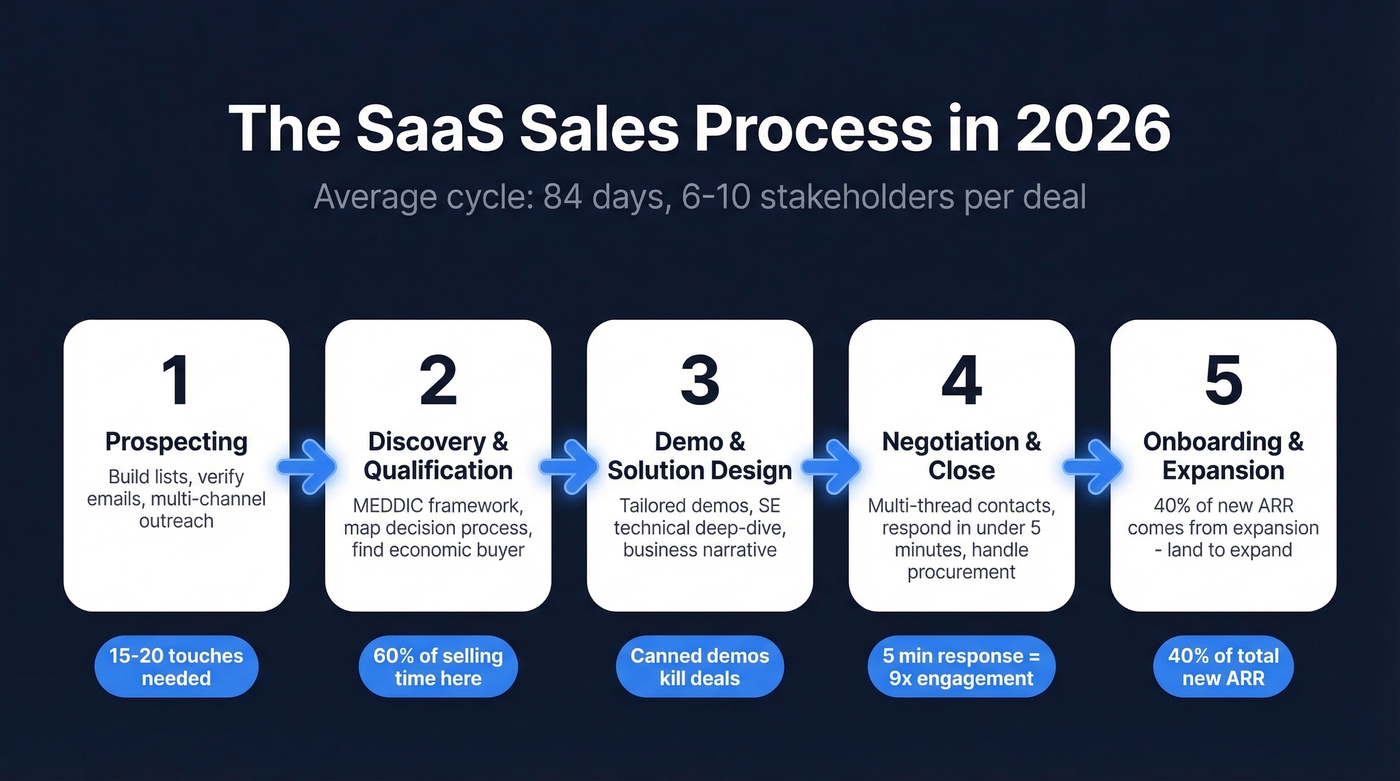
1. Prospecting. You build a list of target accounts and contacts, then reach out via email, phone, and social. Before you send a single outbound email, verify your list. Bad data is the silent killer of outbound campaigns - high bounce rates torch your domain reputation, and once that's gone, it takes weeks to recover (see email bounce rate). We've seen reps burn through their entire sender domain in the first month because they skipped this step.
2. Discovery and qualification. This is where MEDDIC earns its reputation as the dominant qualification framework in SaaS. You're mapping the decision process, identifying the economic buyer, quantifying the pain, and figuring out whether this deal is real or a time sink. Other frameworks like Challenger and Sandler have their advocates, but MEDDIC is the one you'll encounter most in interviews. Most reps rush through discovery. The best ones spend 60% of their selling time here (use a discovery questions framework to stay structured).
3. Demo and solution design. Tailor the demo to the pain you uncovered in discovery. Canned demos are a career killer - we'll get to that in the mistakes section. For enterprise deals, Sales Engineers handle the technical deep-dive while AEs manage the business narrative (use a product demo checklist to avoid missing basics).
4. Negotiation and close. Multi-threading matters here. If you've only been talking to one champion, you're one reorg away from a dead deal. Responding within 5 minutes increases engagement by 9x - and over 99% of companies don't hit that window.
5. Onboarding and expansion. In SaaS, the sale doesn't end at signature. Expansion ARR represents 40% of total new ARR across the industry, and for companies above $50M ARR, it's 50%+. Your job as a rep is to land the deal in a way that sets up the expand.
Roles and Career Path
Entry: SDR/BDR
The SDR role is pipeline generation - booking qualified meetings for AEs through cold outreach. Expect 6-18 months here before an AE promotion. Startups move faster, sometimes in 6 months, while enterprise orgs often gate promotions behind 12-18 months of tenure.
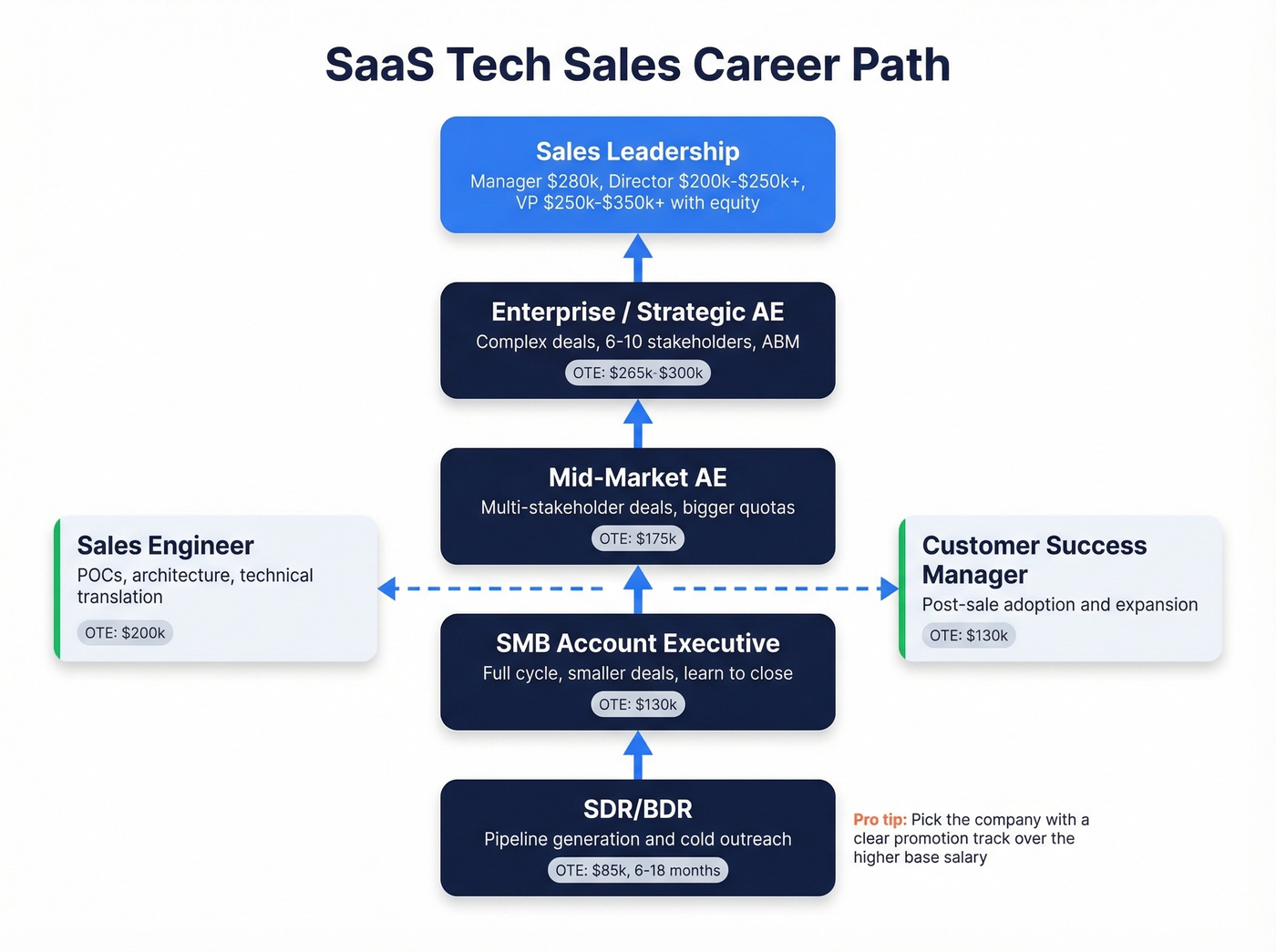
SDR commissions tie to qualified meetings booked or pipeline generated. Median OTE is $85k, but top performers clear $127,955. The real currency at this stage isn't money - it's learning how to prospect, handle rejection, and understand your product deeply enough to earn a promotion. If you're picking between a $90k SDR offer at a company with no promotion path and an $80k offer at one with a clear 9-month track to AE, take the lower number every time.
Mid-Level: Account Executive
AEs own the full sales cycle from qualified opportunity to close. You'll progress through segments - SMB, mid-market, enterprise - with each jump bringing higher quotas, bigger deals, and more complex buying committees.
Here's the thing: startups often offer faster SDR-to-AE paths but less structure and more chaos. Enterprise companies provide better training and more stability, but you might wait two years for a segment promotion. Neither path is wrong. It depends on your risk tolerance and how much ambiguity you can stomach.
Reps spend only 30% of their time actually selling. The rest is CRM updates, internal meetings, proposal writing, and admin. The reps who advance fastest ruthlessly protect their selling time.
Specialist: SE and Customer Success
Sales Engineers run POCs, answer architecture questions, and translate product capabilities into business outcomes. CSMs own the post-sale relationship, driving adoption and expansion. Both roles offer strong comp - $200k OTE for SEs and $130k for CSMs - with higher quota attainment than most AE segments. Skip these roles if you hate technical detail or post-sale relationship management, respectively. They're not consolation prizes for people who couldn't close - they're different skill sets entirely.
Leadership Track
Sales Managers earn $280k OTE at the median. Directors land $200k-$250k+ and VPs $250k-$350k+ with equity. But the job changes completely - you're managing team quotas, hiring, and strategy rather than closing individual deals.
2026 Compensation Benchmarks
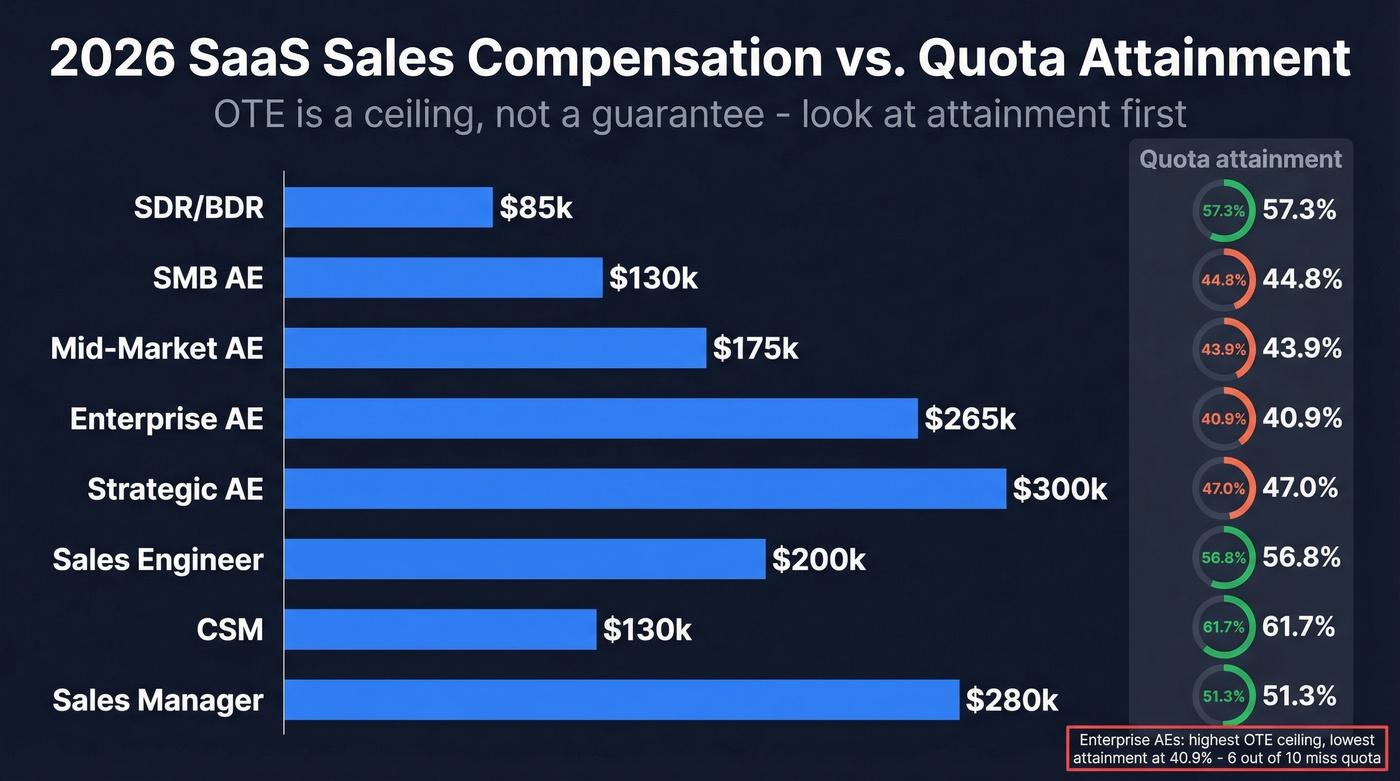
Most salary guides show OTE. We're including quota attainment too, because OTE without context is a lie. This data comes from RepVue's 2026 salary guide, which aggregates self-reported comp from thousands of SaaS reps.
| Role | Median Base | Median OTE | Top Performers | Quota Attainment |
|---|---|---|---|---|
| SDR/BDR | $60k | $85k | $127,955 | 57.3% |
| SMB AE | $70k | $130k | $269,489 | 44.8% |
| Mid-Market AE | $90k | $175k | $391,399 | 43.9% |
| Enterprise AE | $135k | $265k | $627,527 | 40.9% |
| Strategic AE | $150k | $300k | $705,215 | 47.0% |
| Sales Engineer | $145k | $200k | $327,388 | 56.8% |
| CSM | $100k | $130k | $225,299 | 61.7% |
| Sales Manager | $150k | $280k | $508,044 | 51.3% |
The top-performer column is eye-catching, but look at quota attainment first. Enterprise AEs have the highest OTE ceiling and the lowest quota attainment at 40.9%. That means roughly six out of ten enterprise reps don't hit their number in a given year.
Commission structures typically run a 50/50 base-variable split for AEs, with accelerators kicking in at 1.5-2x above 100% quota. SDR teams increasingly see team-based bonuses layered on top of individual commissions.
The 2023-2024 layoff wave hit software sales hard. 2025 was a hiring freeze for most companies. 2026 is showing modest recovery, but the days of "any SDR can get three offers in a week" are over. Companies lose an estimated $200k in ARR for every 60 days an AE seat sits empty - which means hiring managers are more motivated to fill roles than they let on. Use that in your negotiations.

The article says it clearly: bounced emails destroy domain reputation before new reps even get a chance. Prospeo's 5-step verification delivers 98% email accuracy - compared to 87% from ZoomInfo and 79% from Apollo. At $0.01 per email, even SDRs on startup budgets get enterprise-grade data.
Protect your sender domain from day one - verify before you send.
Metrics Every SaaS Rep Should Know
Your CFO cares about a handful of numbers. Understand them and you'll speak the language of the people who approve your deals - and your headcount.
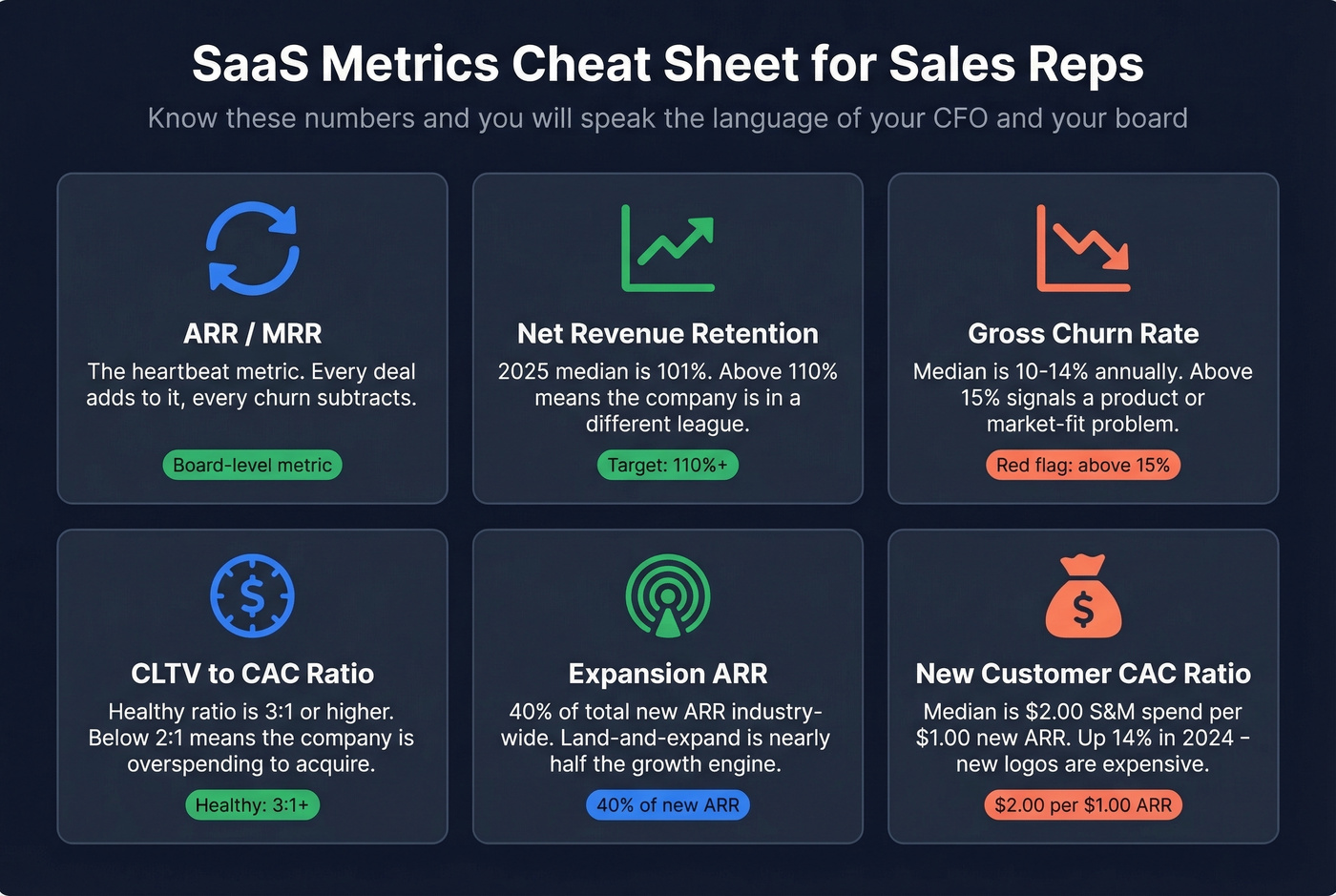
ARR and MRR are the heartbeat metrics. Annual Recurring Revenue is what the board sees; Monthly Recurring Revenue is what ops tracks for forecasting. Every deal you close adds to these numbers, and every churn event subtracts.
Net Revenue Retention measures whether existing customers are growing or shrinking. The 2025 median is 101% - meaning the average SaaS company barely grows from its existing base after accounting for churn. Companies with NRR above 110% are in a different league, and they're the ones you want to work for.
Gross Churn Rate is NRR's ugly cousin. Median gross churn runs 10-14% annually for SaaS companies. If you're evaluating a potential employer, ask about their gross churn. Anything above 15% signals a product or market-fit problem that'll make your quota harder to hit.
CLTV tells you how much a customer is worth over the full relationship. A healthy CLTV-to-CAC ratio is 3:1 or higher. Below 2:1, the company is spending more to acquire customers than those customers are worth - a red flag for reps who want stable comp plans.
Expansion ARR now represents 40% of total new ARR industry-wide, up 5% year-over-year. Your ability to land-and-expand isn't a nice-to-have. It's nearly half the growth engine.
New Customer CAC Ratio sits at a median of $2.00 in S&M spend per $1.00 of new customer ARR. That number increased 14% in 2024, which means acquiring new logos is getting more expensive. When your VP asks why expansion matters, this is why.
How AI Is Reshaping the Role
Reps spend 70% of their week on tasks that aren't selling. AI is coming for that 70%.
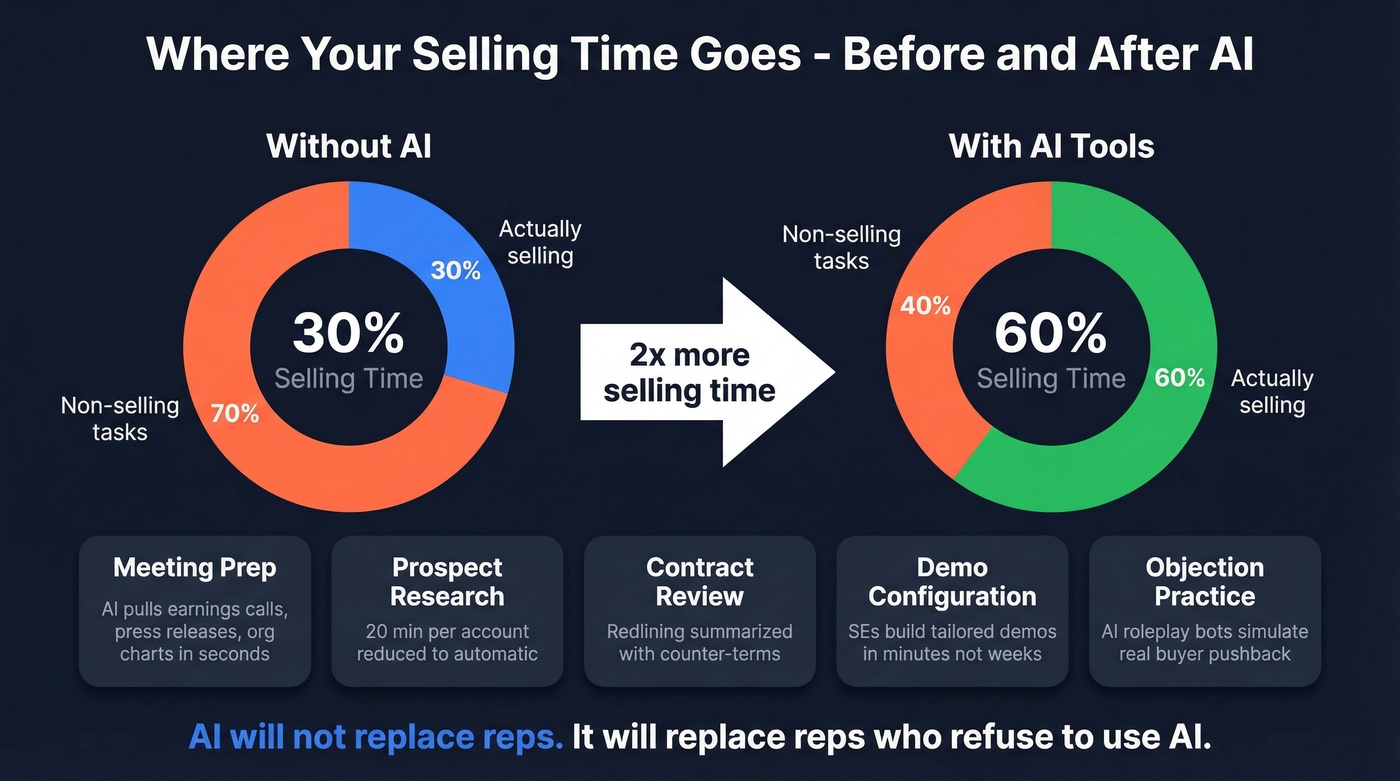
The use cases are practical, not sci-fi. AI agents now handle meeting prep summaries - pulling earnings calls, press releases, and org charts into a pre-call brief in seconds. Prospect research that used to take 20 minutes per account happens automatically. Contract redlining gets summarized with suggested counter-terms. Sales Engineers use AI to configure tailored demos in minutes instead of weeks. And reps practice objection handling against AI roleplay bots that simulate real buyer pushback, a training method that barely existed 18 months ago.
Let's be honest: AI won't replace reps. It'll replace reps who refuse to use AI. The relationship-building, the creative problem-solving, the ability to read a room on a discovery call - those are human skills that matter more as AI handles the commodity work. But if you're still manually researching every prospect and typing up call notes by hand, you're competing against reps who aren't. The consensus on r/sales is pretty clear on this - the reps who adopted AI tools early in 2025 are the ones getting promoted now.
The Modern Sales Tech Stack
Top-performing sales teams use 3x more tools than underperformers. Given that 74% of rep time goes to non-selling tasks, the right stack isn't a luxury - it's how you buy back the hours that actually generate revenue.
Data and Intelligence
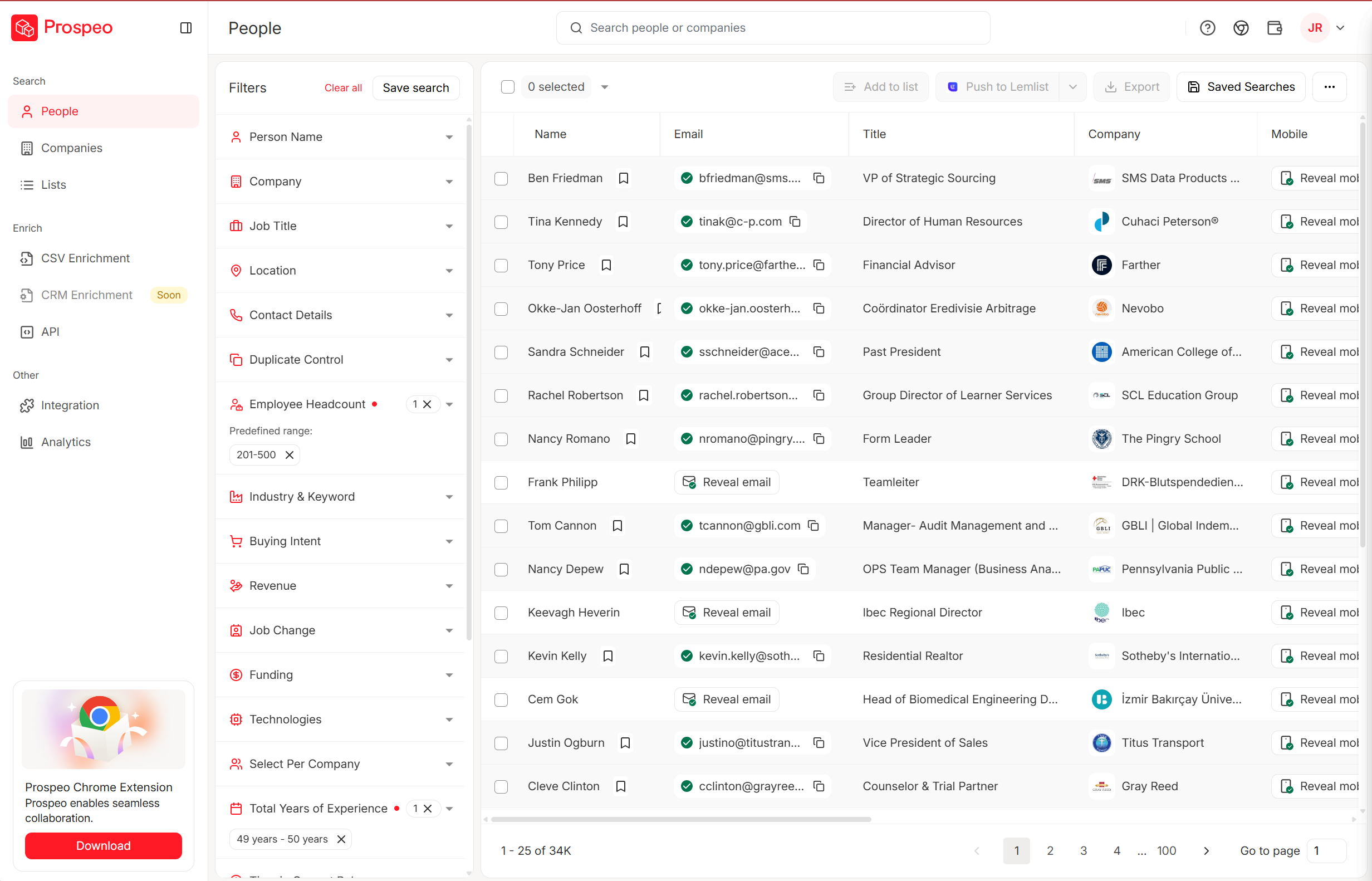
For verified contact data, Prospeo covers 300M+ professional profiles with 98% email accuracy and 125M+ verified mobile numbers. The 7-day data refresh cycle means you're not prospecting with stale records from last quarter, and at roughly $0.01 per lead, it's accessible for teams at any stage. Free tier gives you 75 verified emails per month plus 100 Chrome extension credits - enough to test outbound without spending anything.
ZoomInfo remains the enterprise default with 100M+ direct contact records, intent signals, and deep workflow integrations. Starting around $15k/year, it's a serious investment - but for large teams running ABM and intent-driven plays, the breadth is hard to match. Apollo offers a free plan with 50 credits/month and paid tiers from $49-$99/mo, making it the go-to for bootstrapped teams who need a CRM and prospecting tool in one. Cognism wins for EMEA-focused teams needing GDPR-compliant mobile numbers, starting around $15k-$25k/year.
CRM and Pipeline
Salesforce runs $25-$100/user/mo and remains the standard for mid-market and enterprise. HubSpot's free CRM tier is genuinely useful for early-stage teams, with paid Sales Hub tiers available as you scale. Pipedrive at $14-$69/seat/mo is the lightweight option for teams that want pipeline management without the Salesforce learning curve.
Engagement and Sequencing
Outreach and Salesloft dominate the enterprise sequencing market at ~$100-$150/user/mo. Lemlist starts around $39/mo and Instantly from $30/mo, serving the SMB and agency segment with strong deliverability features. Your sequencing tool is only as good as the data feeding it - which is why the data layer matters so much.
Conversation Intelligence
Gong and Chorus at ~$100-$150/user/mo record, transcribe, and analyze sales calls. For managers, these tools are a step change - you can coach based on actual call data instead of rep self-reporting. For reps, they're a cheat code for improving discovery skills.
How to Break Into SaaS Tech Sales
The playbook that works is more systematic than most people expect. In our experience, the reps who land strong first roles follow a version of these steps almost without exception.
Step 1: Build a target list. Use RepVue, Glassdoor, and Crunchbase to identify Series B-D companies with clear SDR-to-AE promotion paths. Look for companies with NRR above 100% and proven product-market fit. Stop obsessing over getting in - obsess over getting into the right company.
Step 2: Network with intent. Connect with VPs of Sales, current AEs, and SDRs at your target companies. Ask what their team's biggest challenge is, what their stack looks like, and what makes their top SDR different from their average one. These conversations give you interview ammunition and internal referrals, which are worth more than any cold application.
Step 3: Learn MEDDIC before your first interview. Every hiring manager asks about qualification methodology. Knowing MEDDIC - Metrics, Economic Buyer, Decision Criteria, Decision Process, Identify Pain, Champion - signals that you've done your homework. It also gives you a framework for structuring your own interview answers (go deeper on MEDDIC sales qualification).
Step 4: Optimize your resume for ATS. Quantify everything. "Booked 45 qualified meetings in Q3" beats "responsible for outbound prospecting." Use keywords from the job description - most SaaS companies run applicant tracking systems that filter before a human ever sees your resume.
Step 5: Expect a ramp. Average ramp time is 3.2 months for new salespeople. Free and paid SDR bootcamps like Aspireship or Generation can accelerate your ramp if you're coming from a non-sales background. Don't panic if month one feels like drinking from a firehose. It does for everyone (a 30-60-90 day plan for sales reps helps).
| Factor | Startup (Series B-D) | Enterprise |
|---|---|---|
| SDR-to-AE timeline | 6-12 months | 12-24 months |
| Training | Minimal, learn by doing | Structured programs |
| Risk level | Higher (product/market) | Lower (established) |
| Comp ceiling | Higher with equity upside | More predictable |
Mistakes That Kill Sales Careers
Jason Lemkin's top five from SaaStr hold up in 2026:
- Not being a product expert. If a prospect knows your product better than you do, you've already lost.
- Not listening. Canned demos and scripted pitches signal that you don't care about the buyer's actual problem.
- Overdiscounting. Dropping price signals desperation. Price is rarely the real objection - dig deeper.
- Treating small customers poorly. SMB deals compound. The startup you dismiss today might be your biggest enterprise account in three years.
- Fear. Fear of rejection, fear of asking hard questions, fear of pushing back on a prospect's timeline. Fear kills more deals than competitors do.
Two more that deserve the list: slow lead follow-up - the 5-minute response window is real, miss it and engagement drops 9x - and failing to map all stakeholders in multi-stakeholder deals. If you're single-threaded into one champion, you're one reorg away from a dead opportunity.
Reps spend only 30% of their time selling. Prospeo gives you 300M+ profiles with 30+ filters - buyer intent, technographics, headcount growth, funding - so you build targeted lists in minutes, not hours. Data refreshes every 7 days, not the 6-week industry average.
Stop wasting selling time on stale lists and manual research.
FAQ
How much do SaaS sales reps actually make?
SDR OTE starts around $85k. Mid-market AEs earn $175k, enterprise AEs hit $265k+, and top enterprise performers clear $600k+. Only 41-57% of reps hit quota depending on segment, so OTE is a ceiling, not a guarantee.
Do I need a technical background?
No. You need to become a product expert, not an engineer. The best reps understand their product's value deeply enough to map it to business problems. Sales Engineers handle deep technical questions during complex deals.
What's the fastest way to break in?
Apply for SDR roles at Series B-D startups with clear promotion paths. Network directly with VPs of Sales for internal referrals - they're worth more than any cold application. Learn MEDDIC before your first interview.
What prospecting tools do new reps actually need?
Start with a CRM (HubSpot's free tier works), a verified data source like Prospeo for clean emails, and a sequencing tool such as Lemlist or Instantly. Top-performing teams use 3x more tools than underperformers, but nail the data layer first - bad emails destroy deliverability before your sequences get a chance.
Is SaaS tech sales still worth it after the 2023-2024 layoffs?
Yes, but be selective. The correction eliminated bloated teams, not the profession. 2026 hiring is recovering, and AI is reshaping roles - reps who adopt AI tools will thrive. Choose companies with NRR above 100% and proven product-market fit over hype-stage startups burning cash.