

Sales and Marketing: How the Best Teams Actually Work Together in 2026
A RevOps lead we know ran a pipeline audit last quarter. Marketing had generated 4,200 MQLs in Q1. Sales had followed up on 1,100 of them. The other 3,100? Sitting in a CRM queue, aging out. The CMO thought the funnel was healthy. The VP of Sales thought marketing was sending garbage. Both were wrong - the handoff between sales and marketing was just broken, and nobody owned it.
That disconnect isn't unusual. It's the norm. 65% of sales and marketing professionals report a lack of alignment between their teams, and companies burn an estimated $1 trillion annually because of it. Not from bad strategy. From bad plumbing between two departments that should be running as one revenue engine.
The Short Version
If you're pressed for time, here's the operational core:
- Enforceable SLAs, shared KPIs, and behavior-based handoffs - not "alignment workshops." Companies with strong cross-functional alignment see 2.4x higher revenue growth.
- 53% of companies have a broken handoff where reps follow up with under 35% of marketing-engaged prospects. Fix that one thing and pipeline moves.
- None of it works if your contact data is bad. Reps need verified emails and direct dials - not dead ends.
Sales vs. Marketing - Core Differences
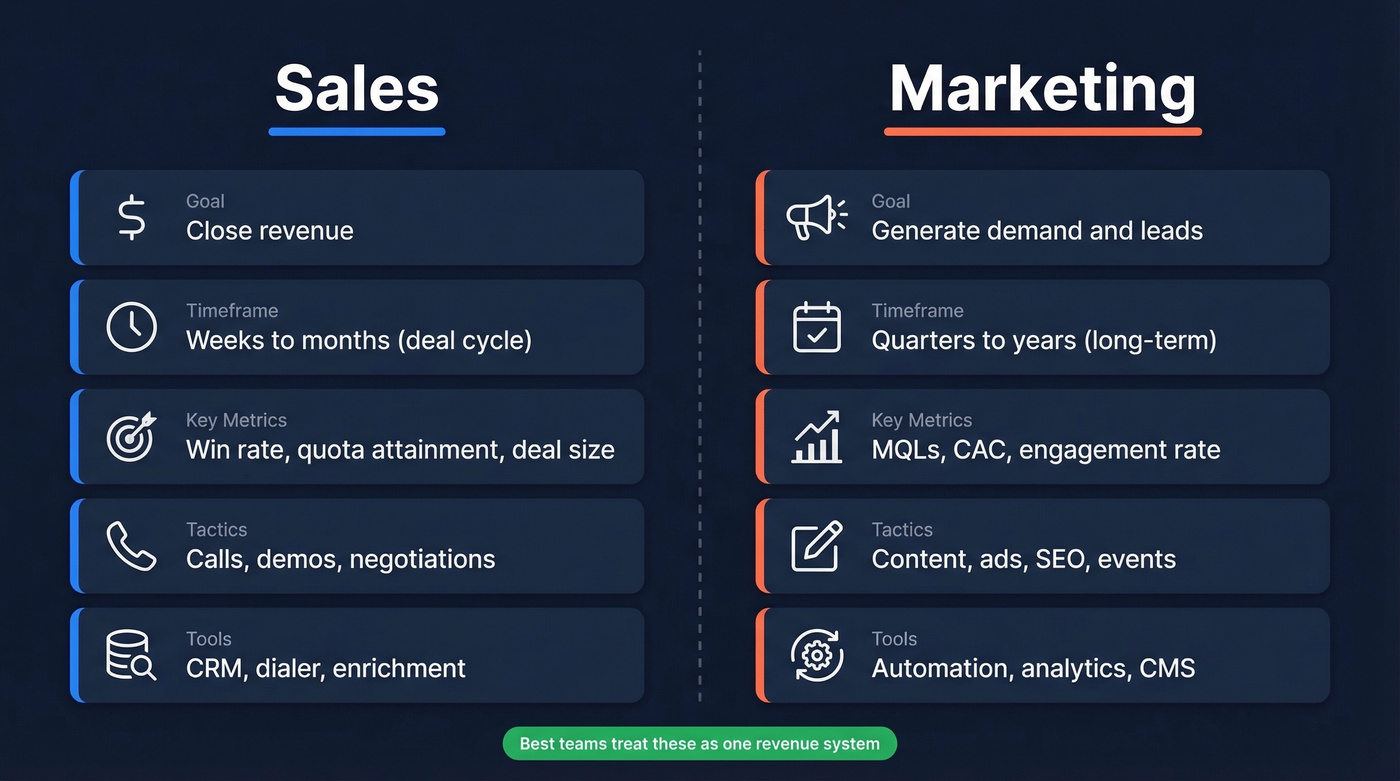
Let's be precise about what each function actually does. The overlap has grown enormously - 80% of B2B interactions now happen digitally, with buyers using 17+ sources before contacting a rep - but the core mandates remain distinct.
| Dimension | Sales | Marketing |
|---|---|---|
| Primary goal | Close revenue | Generate demand + leads |
| Timeframe | Deal cycle (weeks-months) | Long-term (quarters-years) |
| Key metrics | Win rate, quota, deal size | MQLs, CAC, engagement |
| Tactics | Calls, demos, negotiations | Content, ads, SEO, events |
| Tools | CRM, dialer, enrichment | Automation, analytics, CMS |
| US manager jobs (BLS, 2024) | 619,500 | 407,000 |
There are about 52% more sales managers than marketing managers in the US, reflecting how companies have historically staffed these functions. That gap is narrowing as marketing becomes more revenue-accountable and selling becomes more data-driven.
As one r/marketing poster put it after spending time in both roles: doing sales work "gave me more compassion for sales people" - and made them a better marketer. The best operators in 2026 have spent real time on both sides of the aisle.
Here's the thing: the best teams don't treat these as separate funnels anymore. They treat them as one revenue system with different operators at different stages. The distinction between "sales work" and "marketing work" matters less than whether both teams are working on a shared pipeline with functioning handoffs.
How Sales and Marketing Work Together
The Lead Lifecycle - MQL to SAL to SQL
The operational connection between the two teams lives in the lead lifecycle. Three stages matter.
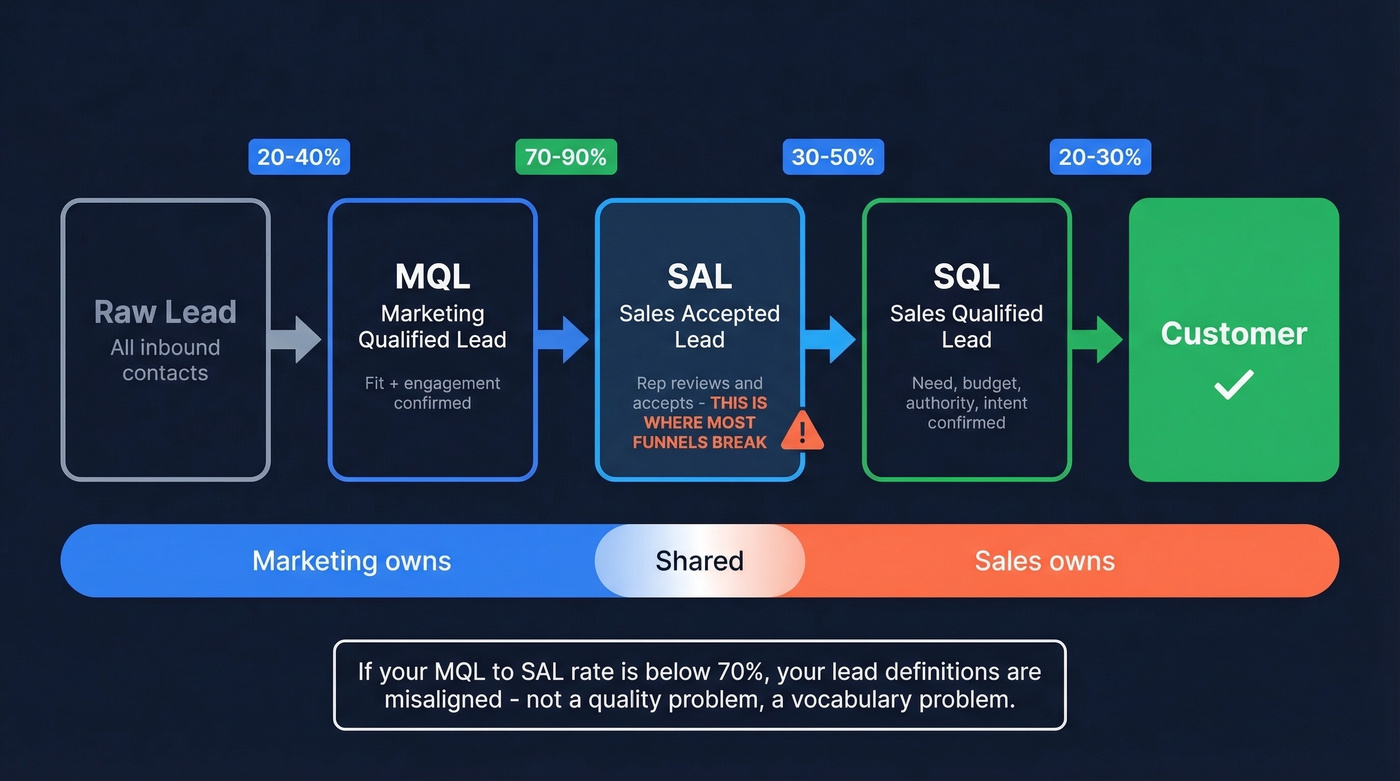
MQL (Marketing Qualified Lead): Marketing has vetted this person based on fit and engagement - they match the ICP and they've done something meaningful like downloading a guide, attending a webinar, or visiting the pricing page twice. This is typically automated via lead scoring.
SAL (Sales Accepted Lead): The rep has reviewed the MQL and formally accepted it. This is the handoff moment - it signals a commitment to follow up within a defined timeframe. Most broken funnels break right here.
SQL (Sales Qualified Lead): The rep has confirmed there's a real opportunity - need, budget, authority, and intent are all present. Demo requests and quote requests usually land here automatically.
The conversion benchmarks, per industry data, break down like this:
| Stage | Conversion Rate |
|---|---|
| Lead to MQL | 20-40% |
| MQL to SAL | 70-90% |
| SAL to SQL | 30-50% |
| SQL to Customer | 20-30% |
If your MQL-to-SAL rate is below 70%, your lead definitions are misaligned. That's not a lead quality problem - it's a vocabulary problem between two teams using different dictionaries.
A practical lead scoring model assigns +20 points for a director-level title, +15 for webinar attendance, and +10 for a pricing page visit. Set your MQL threshold at 50, and you've got a repeatable, auditable handoff trigger that both teams can point to when disagreements arise about what counts as "qualified."
From Funnel to Flywheel
The traditional funnel model - awareness, consideration, decision - treats the customer as an output. The flywheel model puts the customer at the center. Revenue, demand gen, and customer success all create momentum around that center, and friction anywhere slows the whole system.
This matters because 69% of B2B buyers report inconsistent information between a vendor's website and its sellers. That inconsistency is friction. When marketing promises one thing on the website and the rep pitches something different on the demo, the flywheel grinds. Alignment isn't just about lead volume - it's about message consistency across every touchpoint.
The Broken Handoff Problem
An analysis of 105 B2B companies found that 53% have a broken handoff - reps follow up with fewer than 35% of marketing-engaged prospects. Only 11% of companies show both effective handoff and strong audience overlap.
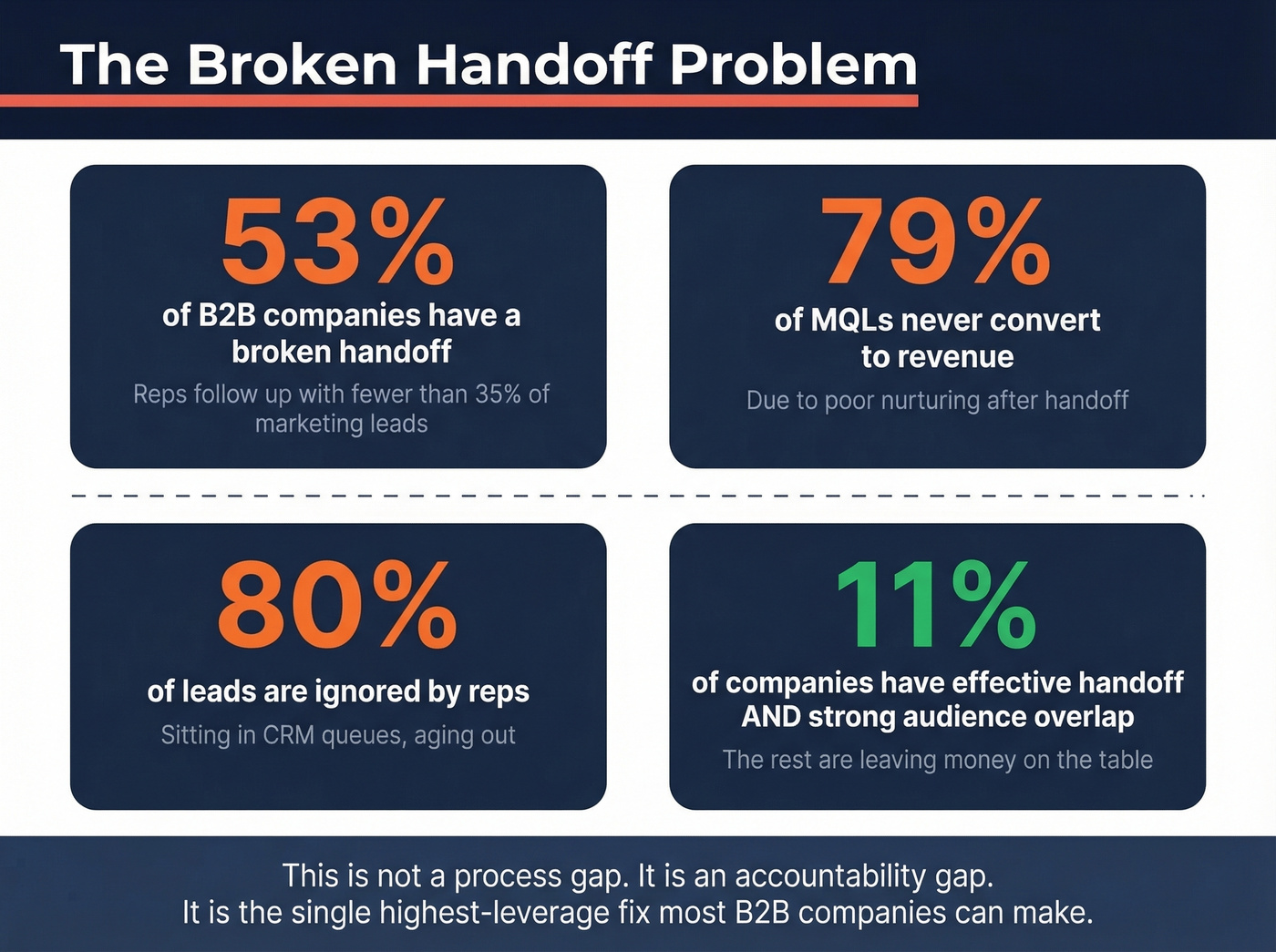
The downstream damage is severe. 79% of those MQLs don't convert into revenue due to poor nurturing. Reps ignore up to 80% of leads. And high-performing B2B teams convert 10-30% of MQLs into SQLs - anything below 10% signals a structural problem, not a lead quality problem.
Both teams think they're doing their job. Marketing points to MQL volume. The closers point to win rates on self-sourced deals. Nobody's looking at the 3,000 leads rotting in the middle.
The handoff isn't a process gap. It's an accountability gap. And it's the single highest-leverage fix most B2B companies can make.
Look - if your average deal size is under $15K, you probably don't need a fancier tech stack or another SDR. You need a 30-minute meeting where both teams agree on what a qualified lead actually looks like, and then you need to enforce that definition in your CRM. That one meeting will outperform any six-figure platform purchase.
Why Alignment Drives Revenue
Companies that get this right close 38% more deals and generate up to 208% more revenue from their marketing efforts. Meanwhile, 96% of sales and marketing professionals admit to alignment issues - so nearly everyone knows the problem exists, yet almost nobody has fixed it.
Aligned organizations are 67% better at closing deals, achieve 20% average annual growth, and are 103% more likely to exceed their goals. Pipeline conversion rate increases 65% when marketing actively contributes to outreach beyond just generating leads - providing air cover throughout the deal cycle with targeted content, retargeting, and account-based campaigns that keep prospects warm while reps work the relationship.
A 2.4x revenue growth multiplier makes cross-functional alignment the highest-ROI initiative a B2B company can pursue. Higher than hiring more reps. Higher than buying better tools. Higher than optimizing ad spend.

53% of companies have a broken handoff. But even perfect handoffs fail when reps reach out and emails bounce. Prospeo delivers 98% verified email accuracy and 125M+ direct dials - so the leads marketing fights to generate actually connect.
Stop letting good leads die in the handoff. Give reps data that connects.
How to Align Both Teams
Share an ICP and Update It Quarterly
Alignment starts with agreeing on who you're selling to. We've seen teams where marketing targets mid-market SaaS companies and reps are cold-calling enterprise manufacturing firms. The ICP needs to be a shared, living document - not a slide from last year's kickoff.
If you need a starting point, use an ICP template and scoring rubric so both teams are working from the same definitions.
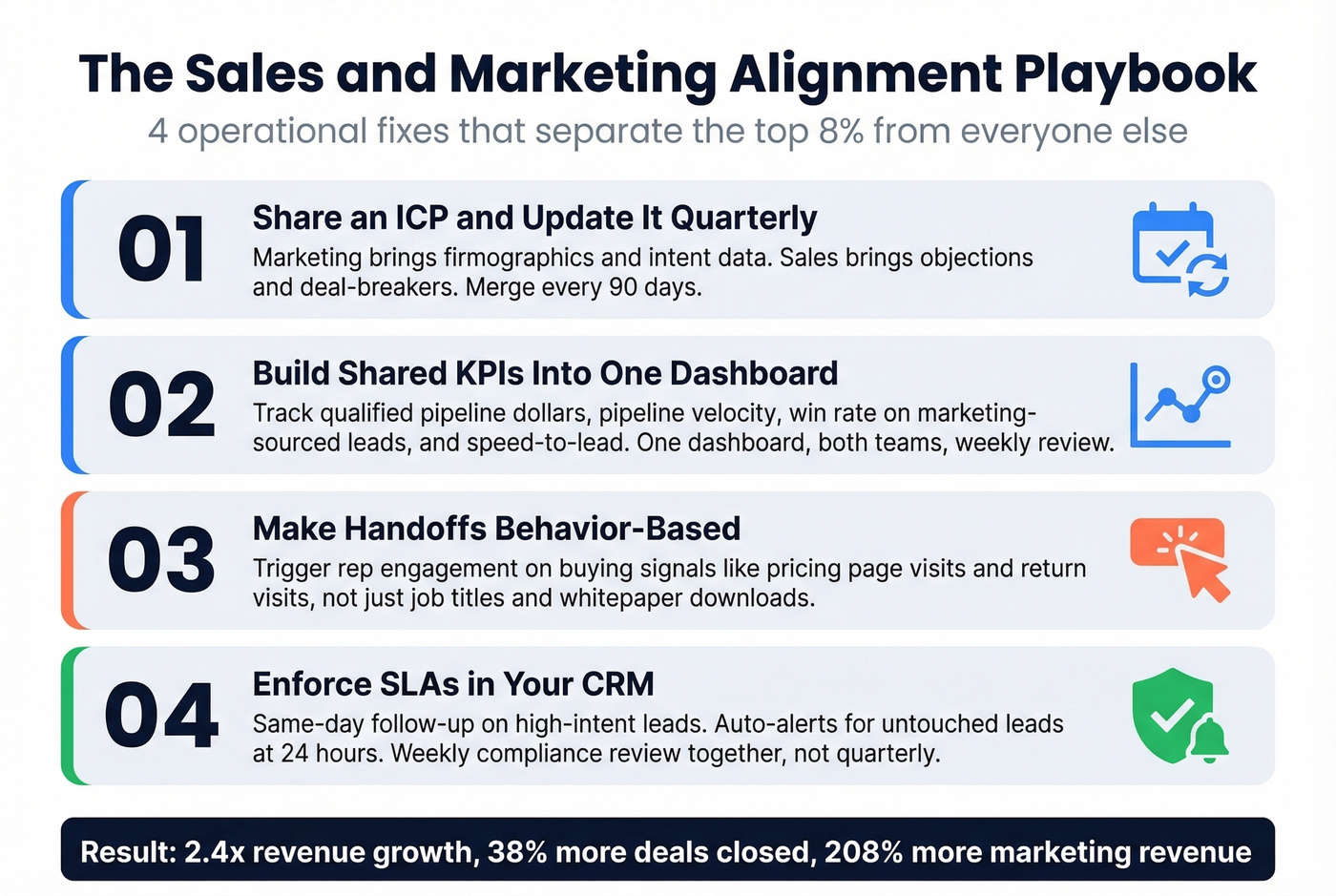
The cadence matters: update buyer personas quarterly based on what reps learn from actual conversations. Marketing brings the data - firmographics, intent signals, engagement patterns. Reps bring the qualitative reality - objections, competitive mentions, deal-breakers. Merge them every 90 days.
Build Shared KPIs Into One Dashboard
Separate dashboards create separate realities. Marketing celebrates MQL volume while reps complain about lead quality - and both are looking at different numbers that tell different stories.
The KPIs that actually force alignment: qualified pipeline dollars (not MQLs), pipeline velocity, win rate on marketing-sourced leads, lead-to-opportunity conversion, speed-to-lead, and attribution accuracy. Put all of these in one dashboard that both teams review weekly. When the CMO and CRO are looking at the same numbers, the finger-pointing stops.
If you want a clean baseline, start with a standard set of funnel metrics and add only what you can operationalize.
Make Handoffs Behavior-Based
Traditional lead scoring assigns arbitrary points to job titles and content downloads. A VP who downloaded one whitepaper gets the same score as a manager who visited the pricing page three times and attended a live demo. The VP looks better on paper. The manager is actually buying.
The shift to behavior-based handoffs means triggering rep engagement based on buying signals - pricing page visits, mid-funnel content engagement, return visits within a short window - rather than demographic fit alone. Only 8% of companies have strong alignment, and this is one of the key operational differences between that 8% and everyone else.
To make this work, teams need a shared definition for buying signals and how they map to routing rules.
Enforce SLAs in Your CRM
Here's a quick SLA checklist that makes alignment enforceable, not aspirational:
- Marketing commits to a specific volume of qualified leads per month
- Reps commit to same-day follow-up on high-intent leads, under 24 hours for all MQLs
- High-intent leads untouched for 24 hours trigger an automatic alert to the manager
- MQL volume below the committed threshold surfaces in the weekly dashboard
- Both teams review SLA compliance together - weekly, not quarterly
Making alignment enforceable through workflows and reporting is what separates the 8% from the 92%.
The Rise of RevOps
The organizational answer to misalignment has a name: Revenue Operations. Gartner forecasts that by 2026, 75% of the highest-growth companies will adopt a RevOps model - an end-to-end framework unifying customer engagement across functions by integrating people, processes, and technology.
If you're hiring for it, the RevOps manager role is often the first "owner" of the handoff.
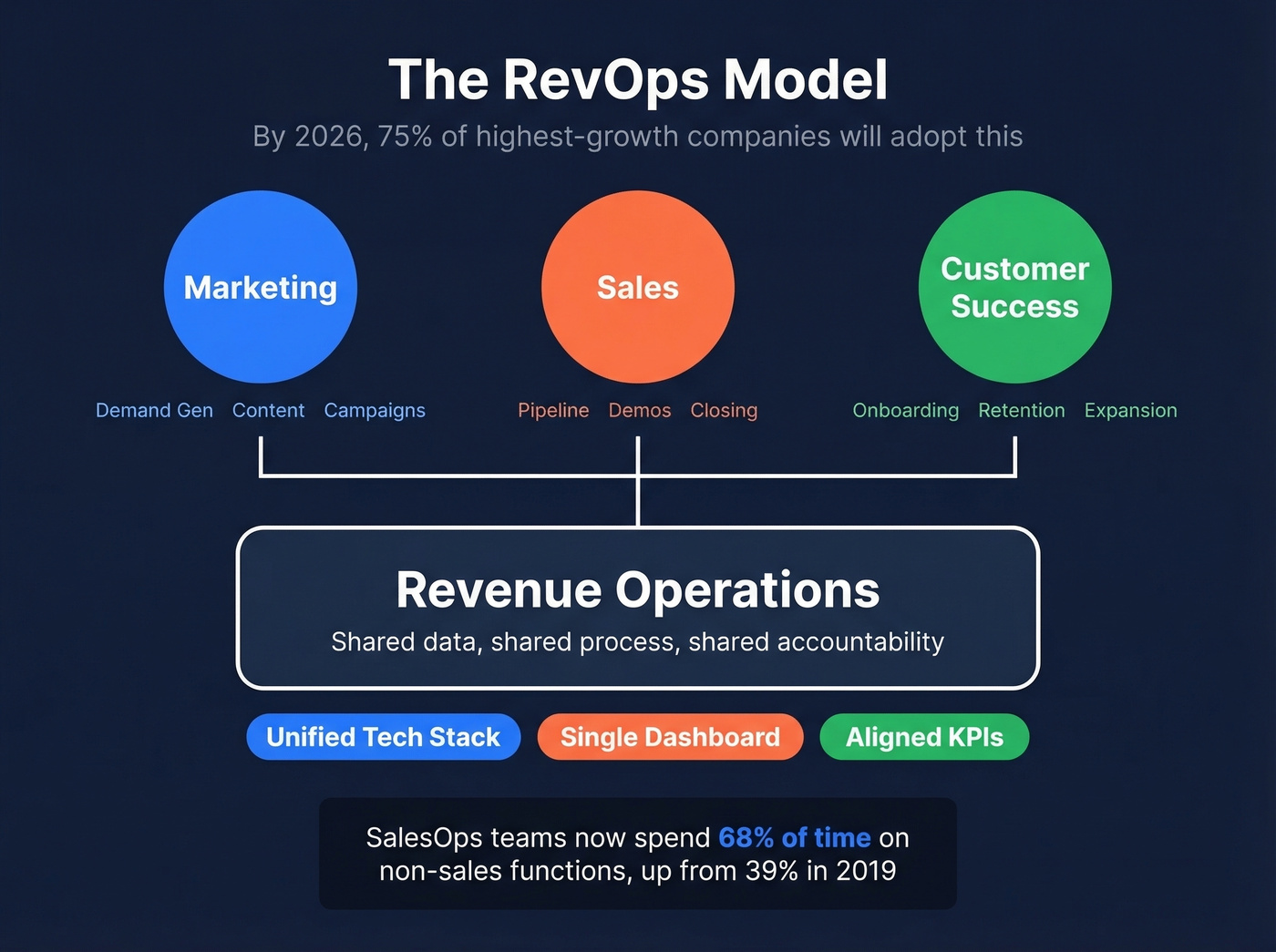
The shift is already visible. Gartner found that SalesOps teams now spend 68% of their time on non-sales functions, up from 39% in 2019. They're already doing RevOps work - most companies just haven't formalized it yet.
Staffing benchmarks from a PeerSignal analysis of 2,500 B2B SaaS companies show a 12:1 ratio of reps to RevOps personnel. At ~$50M ARR, expect 4-5 RevOps headcount. At $100M, that scales to 7-10. At $200M, you're looking at 14-19. The metrics RevOps owns tell the story of its scope: CAC, ARR, churn, CLV, ARPU, and pipeline velocity. These aren't marketing metrics or closing metrics - they're revenue metrics. That's the whole point.
The Revenue Tech Stack
Three layers matter. Get these right before you add anything else.
Layer one: CRM. HubSpot has a free CRM that's a common starting point for small teams, with paid Marketing Hub tiers running from hundreds to thousands per month depending on contact volume. Salesforce starts around $25/user/month for entry tiers and scales up from there. Pick one, commit to it, and make it the single source of truth for both teams.
If you're standardizing your stack, it helps to review a few examples of a CRM and what they’re best at.
Layer two: Marketing automation. ActiveCampaign covers email marketing, lead scoring, and automation workflows with a free 14-day trial. HubSpot bundles automation into its Marketing Hub. The goal is automated lead scoring, nurture sequences, and closed-loop reporting back to the CRM.
Layer three: Data quality. This is where alignment frameworks collapse. If your SDRs are calling dead numbers and emailing bounced addresses, no SLA will save you. Prospeo verifies emails at 98% accuracy and refreshes records every 7 days - versus the 6-week industry average. Its 125M+ verified mobile numbers deliver a 30% pickup rate, meaning your team actually reaches the people marketing identified.
If you’re evaluating vendors, start with a shortlist of data enrichment services and compare refresh cadence + verification methodology.

What can wait: ABM platforms, intent data overlays, and dedicated engagement tools. Get the three layers above working first. One stat that should haunt every marketing leader: 80% of content created by marketing is never used by sales. Tech won't fix that. But getting the data layer right means the content that does get used actually reaches real people at real companies.
Your MQL-to-SQL conversion rate won't improve if contact data is stale. Prospeo refreshes every record every 7 days - not the 6-week industry average - so sales always reaches real buyers at current roles. At $0.01 per email, alignment finally has an ROI.
Align your teams on data that's actually accurate. Start in two minutes.
How AI Is Changing Sales and Marketing
A neuroscience study by Dr. Carmen Simon found that AI-coached sellers remembered 50% more information after 48 hours compared to human-coached sellers. But human coaching improved motivation and emotional well-being. The takeaway is elegant: let your AI coach the deal, let your manager coach the rep.
In live polling, about half of professionals said AI improved efficiency and increased activity. A smaller share said it actually improved performance. AI makes reps faster, but faster isn't always better - especially when the buyer is doing more homework independently.
As Lauren Bailey put it: "With AI, sales cycles and self-paced buying are increasing. The customer can get further and faster on their own now." Marketing's role in educating buyers before they ever talk to a rep is more critical than ever. The teams getting the most value from AI aren't using it to replace human judgment - they're using it to eliminate the busywork that keeps reps from actually selling.
If you’re applying AI to outreach, focus on systems that improve sales follow-ups without spamming your market.
Careers in Sales vs. Marketing
For those evaluating career paths, here's where the two tracks stand based on BLS May 2024 data:
| Role | Median Salary | US Jobs (2024) | Growth (2024-34) |
|---|---|---|---|
| Marketing Manager | $161,030 | 407,000 | 6% |
| Sales Manager | $138,060 | 619,500 | 5% |
| Ad/Promotions Mgr | $126,960 | - | - |
Marketing managers earn a higher base, but closing roles often include variable compensation - commissions, accelerators, and bonuses - that can push total earnings well above the median. A top-performing enterprise AE at a SaaS company can clear $300K+ in a good year. A marketing director rarely has that upside.
The fastest-growing roles sit at the intersection: revenue operations, growth marketing, and enablement. These hybrid positions didn't exist at scale five years ago. Now they're some of the most sought-after hires in B2B, precisely because companies have realized that the gap between sales and marketing is where revenue goes to die - or to thrive.
FAQ
What's the difference between sales and marketing?
Marketing generates awareness and qualified leads through content, ads, and campaigns. Sales converts those leads into customers through direct conversations and negotiations. In 2026, the mid-funnel is increasingly shared territory, with both teams collaborating on pipeline progression.
What does "alignment" actually mean?
Both teams share the same ICP, KPIs, and lead definitions - with enforceable SLAs built into the CRM. Aligned companies see 2.4x higher revenue growth. Only 8% of B2B organizations achieve strong alignment today.
What is RevOps?
Revenue Operations unifies marketing, sales, and customer success under one operational model. Gartner forecasts 75% of high-growth companies will adopt RevOps by 2026, replacing siloed ops teams with shared revenue metrics like CAC, ARR, and pipeline velocity.
How do you fix a broken handoff?
Define MQL and SQL criteria together, build behavior-based triggers into your CRM, and enforce follow-up SLAs with automated alerts. Enrich leads with verified contact data so reps get records they can actually use - bounced emails and disconnected numbers are the silent killer of every alignment initiative.
Do sales or marketing managers earn more?
Marketing managers earn a median $161,030/year versus $138,060 for sales managers per BLS data. That said, closing roles include variable compensation that can push total earnings past $300K for top performers at SaaS companies.