

Sales and Marketing Alignment Statistics for 2026
82% of C-level executives say their sales and marketing teams are aligned. Meanwhile, 65% of the people actually doing the work say alignment doesn't exist. That gap between what the C-suite believes and what practitioners experience explains almost everything about why alignment initiatives stall, fail, or never get funded.
The sales and marketing alignment statistics below prove the chasm is wider, and more expensive, than most leaders realize.
Key Stats at a Glance
If you're short on time, here's what the numbers say:
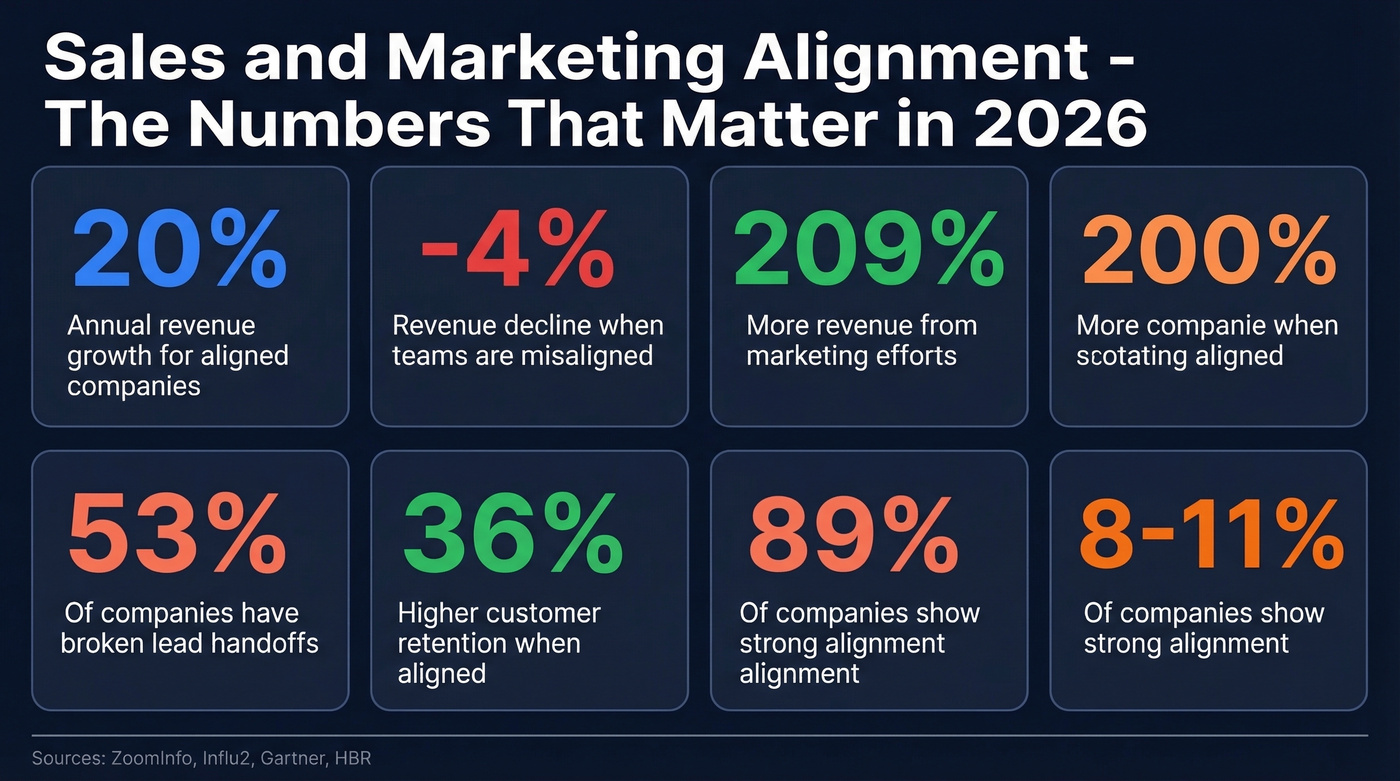
- Aligned companies grow 20% annually, while poorly aligned companies see a 4% revenue decline
- 53% of companies have broken handoffs - sales follows up with fewer than 35% of marketing-engaged prospects
- Alignment drives 209% more revenue from marketing efforts
- Customer retention jumps 36% when teams are aligned
- U.S. companies spend over $900B annually on sales forces, yet deliver only 50-60% of the financial performance their strategies promise
- Only 8-11% of companies show strong alignment, depending on how it's measured
Jump to the [action steps](#how-to-start-aligning - five-concrete-steps) if you want the playbook.
Revenue and Growth Impact
The revenue case for alignment isn't subtle. Companies with strong sales and marketing alignment achieve 20% annual revenue growth. Companies with poor alignment see a 4% revenue decline. That's a 24-point swing from the same starting position.
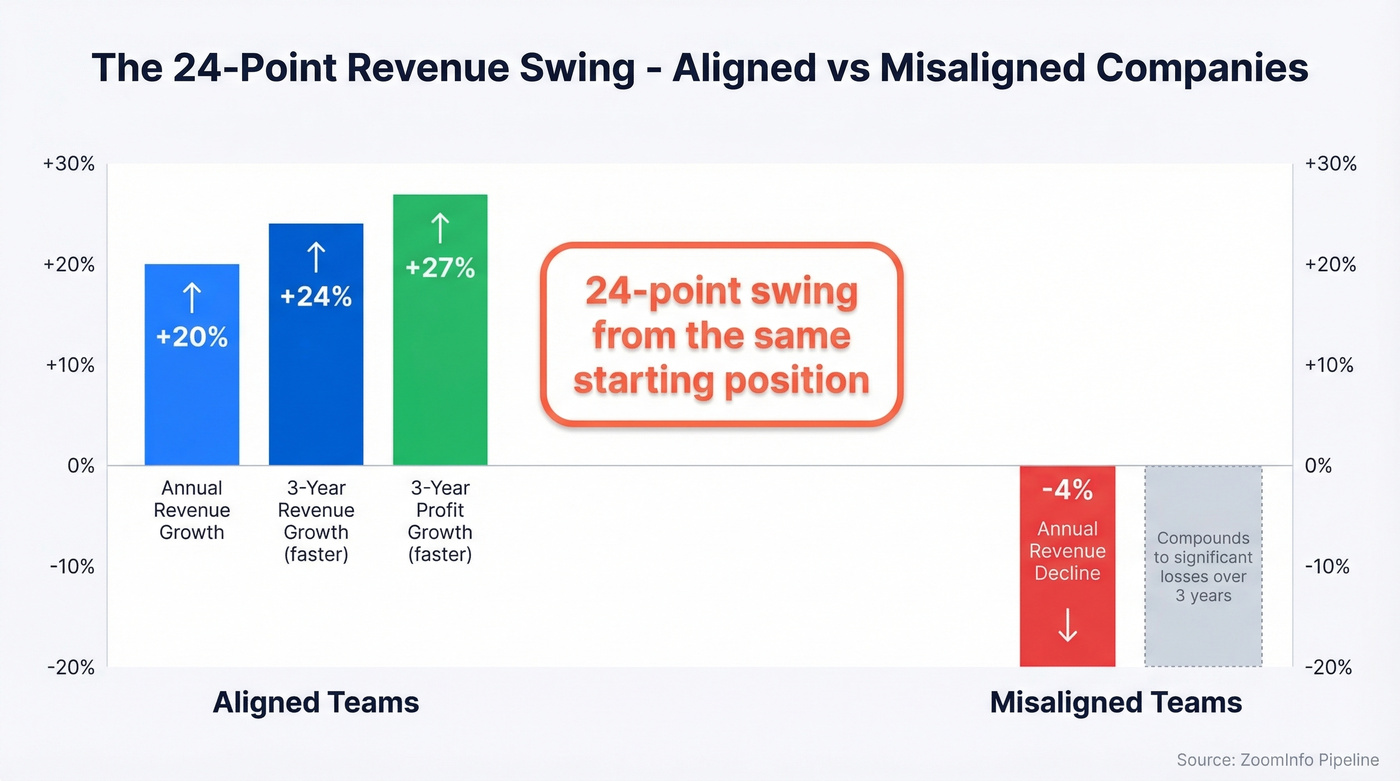
The compounding effects are even more dramatic: aligned organizations see 24% faster three-year revenue growth and 27% faster three-year profit growth. These aren't marginal improvements - they're the difference between a company that hits plan and one that misses it consistently.
The most-cited stat in this category? Aligned teams generate 209% more revenue from marketing efforts. The mechanism is straightforward. When sales actually works the leads marketing generates, marketing ROI goes up. If you're trying to operationalize that, start with lead scoring and a clean definition of what “high intent” actually means.
For a named example, SuperOffice's Benelux division aligned their sales and marketing teams starting in 2016. Within two years, they reported a 34% increase in new business revenue. That's a real company, a specific timeframe, and a measurable outcome - which is more than most alignment case studies offer.
Win Rates, Conversion, and Retention
Aligned organizations are 67% better at closing deals and see 38% higher win rates.
Customer retention is where alignment pays off in ways that don't always make the headline stats. Aligned companies see 36% higher customer retention rates. When marketing and sales tell the same story, customers don't feel like they bought one thing and received another. That consistency compounds over years, not quarters. If you want to quantify the downstream impact, a simple churn analysis will usually surface where the story breaks.
HubSpot's 2025 State of Sales Report adds fresh context: 68% of sales teams say lead quality improved year-over-year. That's a signal that alignment efforts - or at least better targeting - are starting to move the needle for a majority of teams.
The Real Cost of Misalignment
Companies with poor alignment don't just grow slower. They actively shrink. The data shows a 4% annual revenue decline for misaligned organizations, which compounds painfully over a three-year window.
The waste gets concrete fast. A large share of B2B marketing content never gets used in actual sales conversations. Marketing spends months building case studies, battle cards, and one-pagers that sales never opens. Nobody agreed on what sales actually needs before marketing built it.
Harvard Business Review reports that U.S. companies spend over $900 billion annually on their sales forces - three times what they spend on advertising. Yet companies deliver only 50-60% of the financial performance their strategies and forecasts promise, and 56% of executives say their biggest challenge is ensuring daily decisions align with strategy.
The "$1 Trillion" Myth - Let's Set the Record Straight
You'll see dozens of articles claiming that "sales and marketing misalignment costs companies $1 trillion per year." That number doesn't trace back to any primary source we've found. The HBR article most often cited talks about $900B+ in total sales force spending and a 50-60% strategy execution gap - it never calculates a "$1 trillion misalignment cost." The actual waste is enormous. You don't need to inflate it.

Broken handoffs cost you pipeline. When sales ignores marketing-engaged leads, it's often because the contact data is wrong or missing. Prospeo returns verified emails at 98% accuracy and direct dials with a 30% pickup rate - so every lead marketing hands off is actually reachable.
Stop losing leads at the handoff. Give sales contacts they can actually reach.
Where Alignment Dies: The Handoff Problem
Alignment isn't an attitude. It's a handoff. And the handoff is where most companies fail.
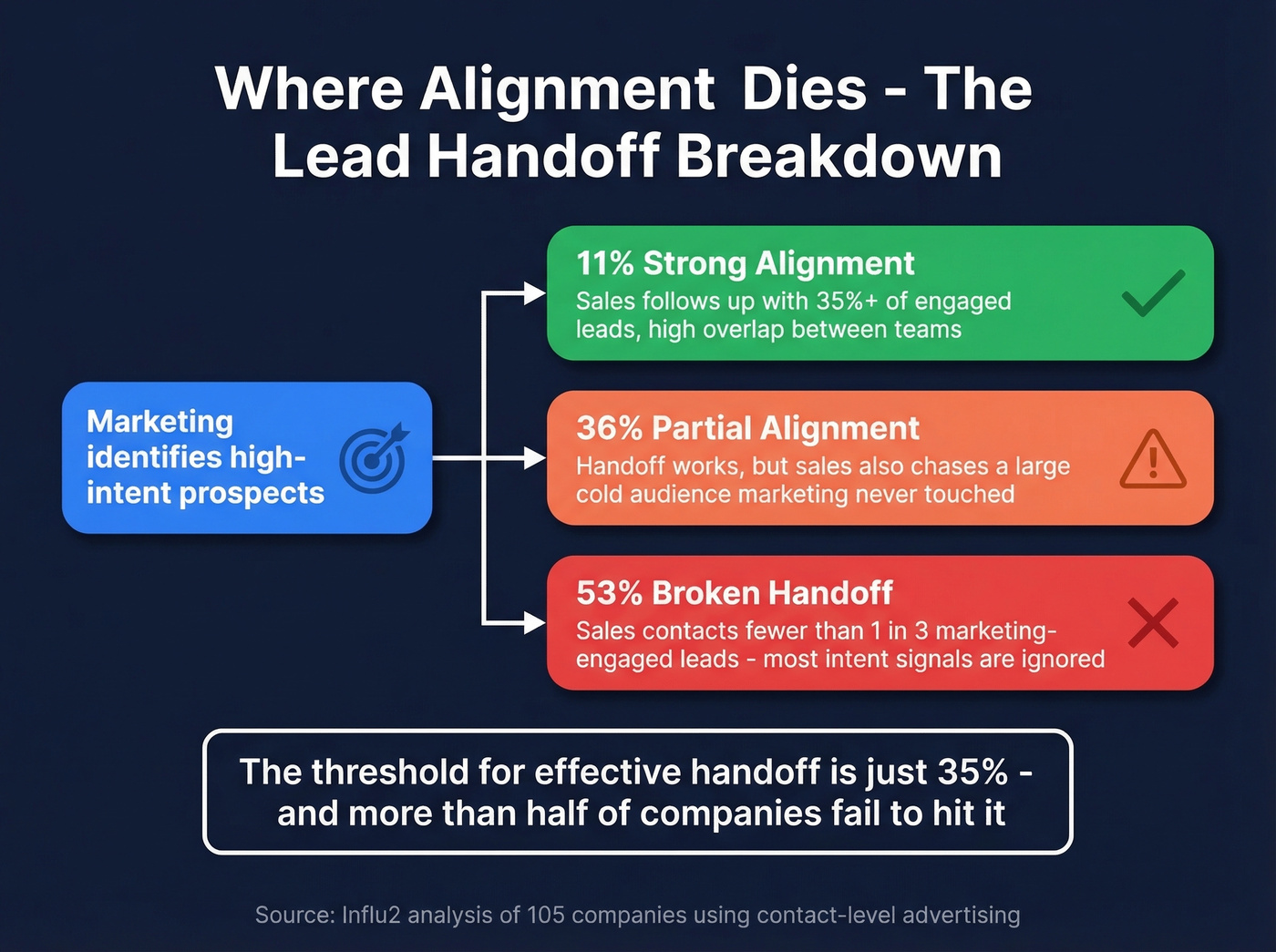
Influ2 analyzed 105 companies using contact-level advertising and measured something specific: what percentage of prospects who clicked marketing ads were subsequently contacted by sales. They set the threshold for an "effective handoff" at 35% - meaning sales follows up with at least 35% of the prospects marketing identified as high-intent.
The results are bleak.
| Alignment Level | % of Companies | What It Means |
|---|---|---|
| Strong alignment | 11% | Effective handoff + high overlap |
| Partial alignment | 36% | Effective handoff, large cold audience |
| Broken handoff | 53% | Sales contacts <35% of engaged leads |
More than half of companies have a fundamentally broken handoff. Marketing generates intent signals, and sales ignores more than two-thirds of them. The 36% in the middle are interesting too - they hand off leads effectively, but sales is also working a large "cold" audience that marketing never touched. That's a coordination gap, not a process gap.
If your sales team follows up with fewer than one in three marketing-engaged prospects, you don't have an alignment problem. You have a handoff problem. Those are easier to fix. Tightening the follow-up motion with proven sales follow-up templates can remove a lot of “we’ll get to it” ambiguity.
Why Alignment Initiatives Fail
Even when companies try to align, most fail. Gartner's 2024 survey of 234 heads of sales and senior sales leaders found that only 11% of sales organizations drive commercial success while executing a transformation. The other 89% either stall or regress.
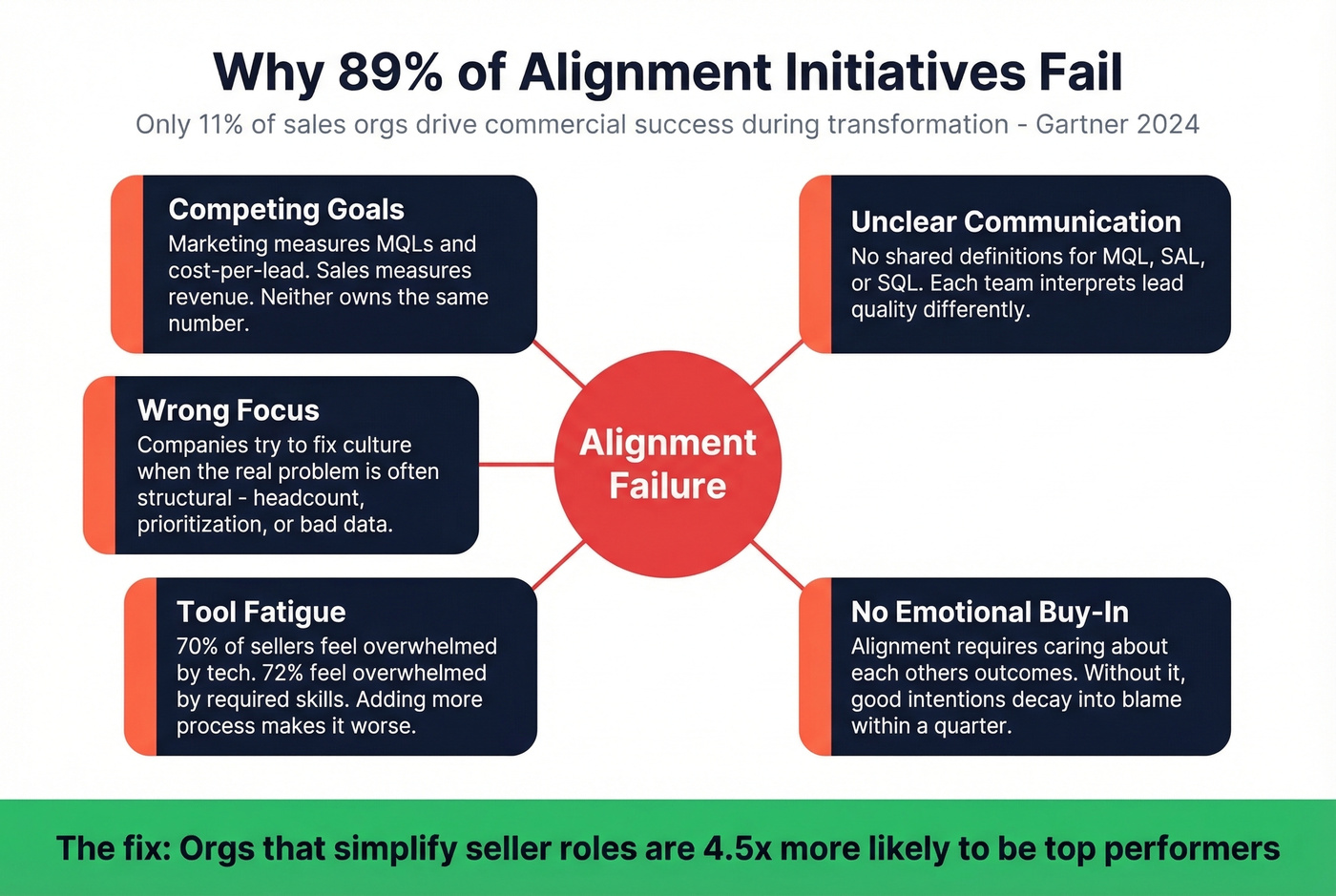
Part of the problem is sheer overwhelm. Gartner's Seller Skills Survey of 1,026 B2B sellers found that 70% feel overwhelmed by the number of technologies they're expected to use, and 72% feel overwhelmed by the number of skills required. You can't align two teams when both are drowning in tool fatigue. Organizations that simplify seller roles are 4.5x more likely to be top performers - suggesting that alignment succeeds when it reduces complexity, not when it adds another process layer.
The common barriers break down into five categories: competing goals, unclear communication, lack of time, wrong focus, and no emotional buy-in. That last one matters more than people admit. Alignment isn't a Salesforce dashboard - it requires people to actually care about each other's outcomes. Without feedback loops between teams, even good intentions decay into finger-pointing within a quarter. This is also where a clear RevOps Manager mandate can help keep ownership from bouncing between functions.
The practitioner perspective on r/sales is even more direct. The consensus: MQLs are "garbage" because marketing gets measured on visitor volume and cost-per-lead, which incentivizes quantity over quality. Sales ends up chasing leads that don't remember filling out a form. The fix, according to the thread, is simple - shift marketing KPIs to SQLs and revenue. But that requires marketing leadership to accept a metric they can't fully control, which is where the emotional buy-in breaks down.
One r/b2bmarketing thread captures the capacity side perfectly. A solo marketer describes growing company revenue from $6.2M to $14M while burning out because the sales leader demands hyper-segmented, rep-by-rep email campaigns that one person can't deliver. Alignment isn't just a process problem - it's a headcount and prioritization problem.
The Future Is a Structural Choice
Here's the thing: most companies are trying to solve the wrong problem. They want "better alignment" when they should be choosing a structural model.
John Arnold and Rick Bradberry's October 2024 Forrester report argues that the future of sales-marketing relationships isn't a single "aligned" ideal - it's a choice among four paradigms: siloed (separate but coordinated), assimilated (merged into one team), subservient (one function reports to the other), or proportionate (resources shift dynamically based on deal complexity). Each represents a deliberate organizational design, not a failure to be fixed.
The Data Quality Problem Nobody Talks About
We've seen teams spend months redesigning their lead handoff process, building shared dashboards, and running "alignment workshops" - only to discover that the real problem was simpler and uglier. The contact data was bad.
Think about what that 53% broken-handoff stat actually means in practice. Marketing runs a campaign, identifies high-intent prospects, and passes them to sales. Sales opens the lead, tries to email the contact - and it bounces. Tries the phone number - disconnected. The lead goes cold, sales marks it as "bad lead," and the blame cycle starts.
Marketing says "we sent you 200 qualified leads." Sales says "your leads are garbage." Neither team checked whether the contact data was accurate.

Before you restructure your entire GTM org, check whether the problem is simpler than you think. Prospeo covers 300M+ professional profiles with 98% email accuracy and a 7-day data refresh cycle - compared to the six-week industry average. If your bounce rate is above 5%, bad data is actively sabotaging your handoff before strategy even gets a chance. Use email bounce rate benchmarks to sanity-check what “normal” looks like for your channel.
How to Start Aligning - Five Concrete Steps
Stats are useful for making the case. But the case doesn't matter if you don't do anything. Here are five steps that actually move the needle, drawn from what we've seen work and what practitioners consistently recommend.
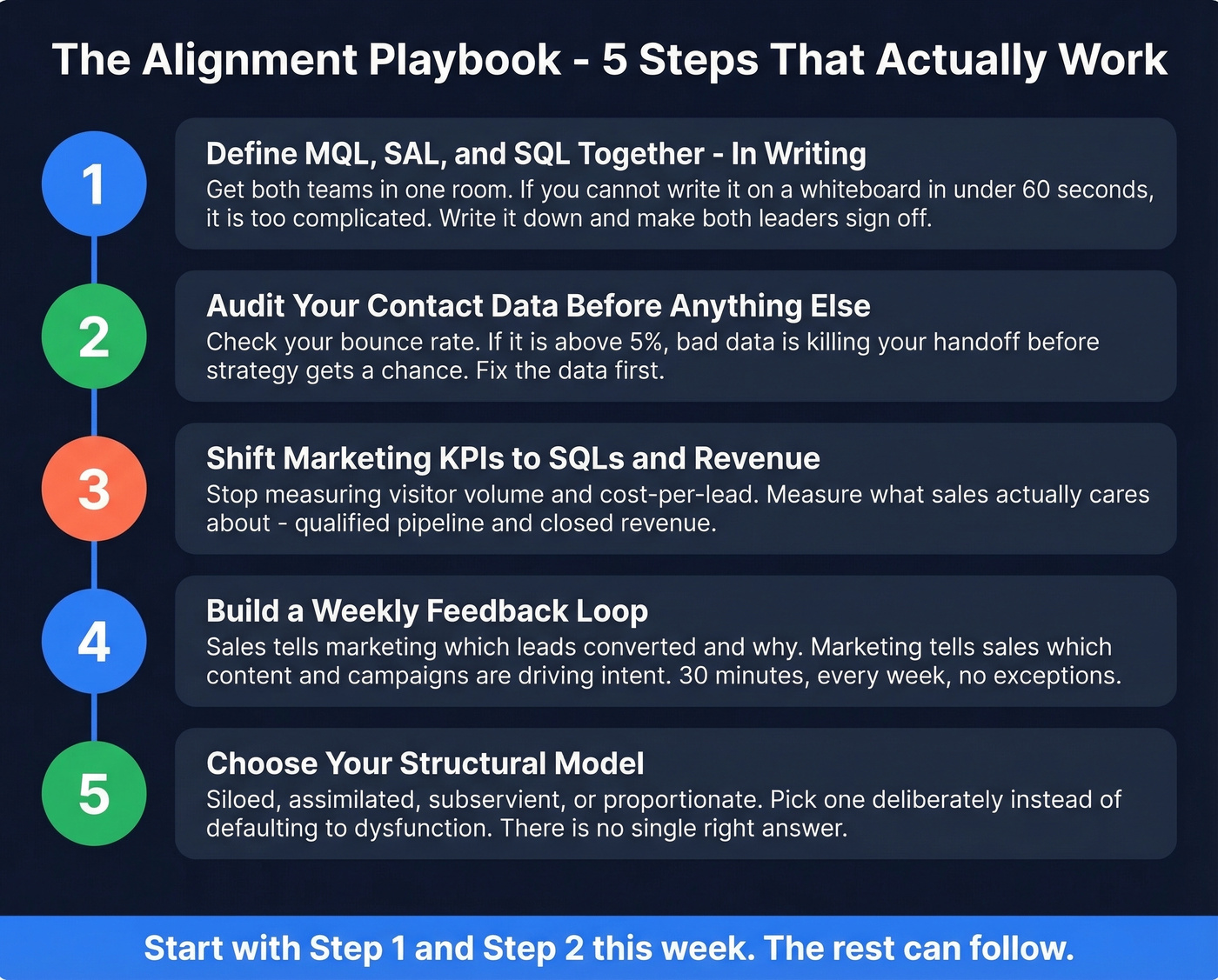
1. Define MQL, SAL, and SQL together - in writing. Get sales and marketing in the same room and agree on what each stage means. If you can't write it on a whiteboard in under 60 seconds, it's too complicated. The jargon trap - where marketing talks in campaign metrics and sales talks in pipeline language - kills more alignment efforts than anything else.
2. Set a 24-hour follow-up SLA and measure it. An accepted lead that doesn't get contacted within 24 hours is a wasted lead. Track this weekly. Make it visible. This single metric exposes handoff failures faster than any dashboard. If you need a system for what “follow up” actually includes, map it to concrete sales activities.
3. Audit your contact data. If your email bounce rate is above 5%, that's your problem - not your process, not your messaging. Run a sample of your current lead list through an email verification tool and compare bounce rates. If there's a gap, you've found your bottleneck. (If you’re evaluating vendors, start with this shortlist of data enrichment services.)
4. Run monthly joint pipeline reviews, not "alignment meetings." Nobody wants another meeting about alignment. Instead, review actual pipeline together: opportunities x average deal size x win rate / cycle length = pipeline velocity. Which deals came from marketing? Where did they stall? What does sales need that marketing isn't producing? Keep it operational and build the feedback loop that prevents drift. A lightweight pipeline health scorecard makes this much easier to repeat.
5. Shift marketing KPIs toward SQLs and revenue. MQL volume and website traffic are vanity metrics when they don't convert. This is the hardest step because it requires marketing to accept accountability for outcomes they can't fully control. But it's the single biggest lever for fixing the misaligned incentives that practitioners on Reddit consistently identify as the root cause.
Aligned teams generate 209% more revenue from marketing efforts - but only when sales can act on the leads. Prospeo enriches your CRM with 50+ data points per contact at a 92% match rate, so every marketing-qualified lead arrives with a verified email and direct dial attached. No more excuses for unfollowed leads.
Bridge the gap between marketing intent signals and sales conversations for $0.01 per email.
FAQ
What percentage of companies have aligned sales and marketing teams?
Only 8-11%, depending on the study. Influ2 found just 11% of 105 companies had both effective handoffs and high audience overlap. 53% had fundamentally broken handoffs where sales contacted fewer than 35% of marketing-engaged leads.
How much revenue does alignment generate?
Aligned companies grow 20% annually and generate 209% more revenue from marketing efforts. SuperOffice Benelux reported a 34% increase in new business revenue within two years of aligning their teams.
What's the biggest cause of misalignment?
Competing KPIs. Marketing optimizes for volume and cost-per-lead; sales wants high-intent buyers. Forrester's perception gap - 82% of executives think teams are aligned while 65% of practitioners disagree - shows how deep this disconnect runs.
How do you measure sales-marketing alignment?
Start with handoff rate - Influ2's 35% follow-up threshold is a useful benchmark. Then track lead response time, MQL-to-SQL conversion rate, and shared pipeline contribution. These four metrics surface breakdowns faster than any qualitative assessment.
Can bad contact data cause misalignment?
Yes - it's one of the most overlooked causes. When emails bounce and phone numbers are dead, sales can't follow up regardless of lead quality. Cleaning your data before blaming your process is the fastest way to tell whether you have an alignment problem or a data problem.