

The Sales and Marketing Organizational Chart Guide Nobody Else Got Right
Only 8% of companies have strong alignment between their sales and marketing teams. Eight percent. Meanwhile, 53% report misalignment at the handoff stage, and fewer than 35% of engaged contacts ever get a follow-up. A broken sales and marketing organizational chart isn't the only reason, but it's where the rot starts. Bad structure creates bad handoffs, which create lost revenue nobody can trace back to its source.
Most org chart advice is either too generic or too rigid. Your structure should evolve predictably as you scale, and there are specific headcounts, ratios, and reporting lines that work at each stage. We've spent enough time watching teams stumble through this to know what actually holds up.
Quick Reference
- Series A (~50 employees): VP Sales and Director of Marketing, both reporting to CEO. No CRO yet.
- Series B (~125 employees): Introduce a CRO and a CMO. First dedicated ops hire (often RevOps).
- Series C (~400 employees): Full departmental specialization. RevOps becomes a team.
Ratios that hold across stages: 1 SDR per 2 AEs, 1 Sales Ops per 10 AEs, 1 manager per 5-10 direct reports.
How Your Org Chart Evolves by Stage
At 1-10 employees, everything is flat. Founders sell, market, and close. At 11-50, you formalize - defined roles emerge and you separate sales from marketing. At 51-200, specialization takes over with dedicated teams and managers running pods. Past 200, you're layering management and splitting by segment or region.
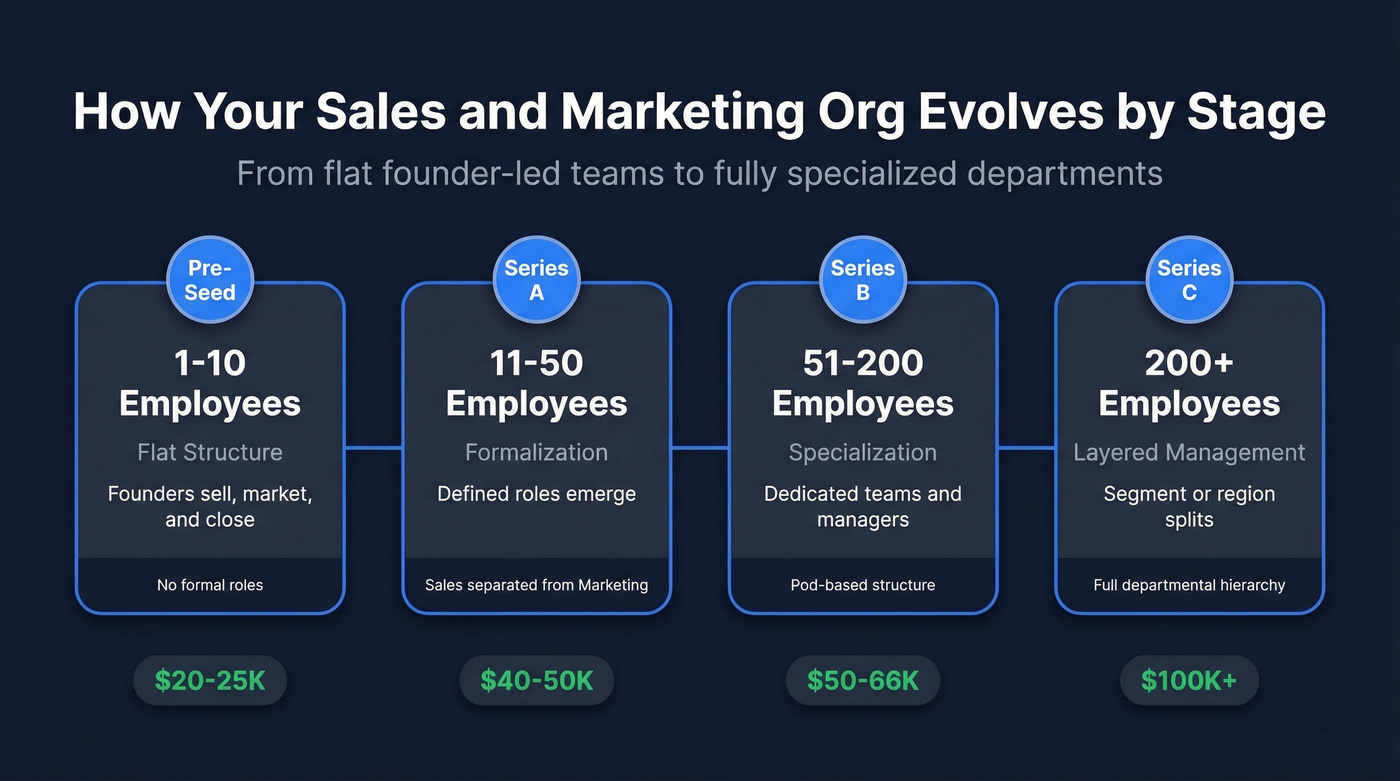
The ARR-per-employee benchmarks track this well:
| Stage | ARR per Employee |
|---|---|
| Series A | ~$20-25K |
| Series B | ~$40-50K |
| Series C | ~$50-66K |
| IPO | ~$100K |
If your revenue-per-head lags these numbers, your org is probably over-hired or under-structured - often both. Finance teams use these benchmarks to model headcount budgets against revenue targets, so they're worth pinning to your planning wall.
Stage-Specific Org Charts
These frameworks draw heavily from David Sacks' SaaS org chart model, the most actionable stage-by-stage template we've found. Hierarchical charts remain the standard for revenue team alignment because they make reporting lines - and accountability gaps - explicit.
Series A (~50 Employees)
Two revenue leaders report directly to the CEO. No CRO. Adding one now creates an unnecessary management layer.
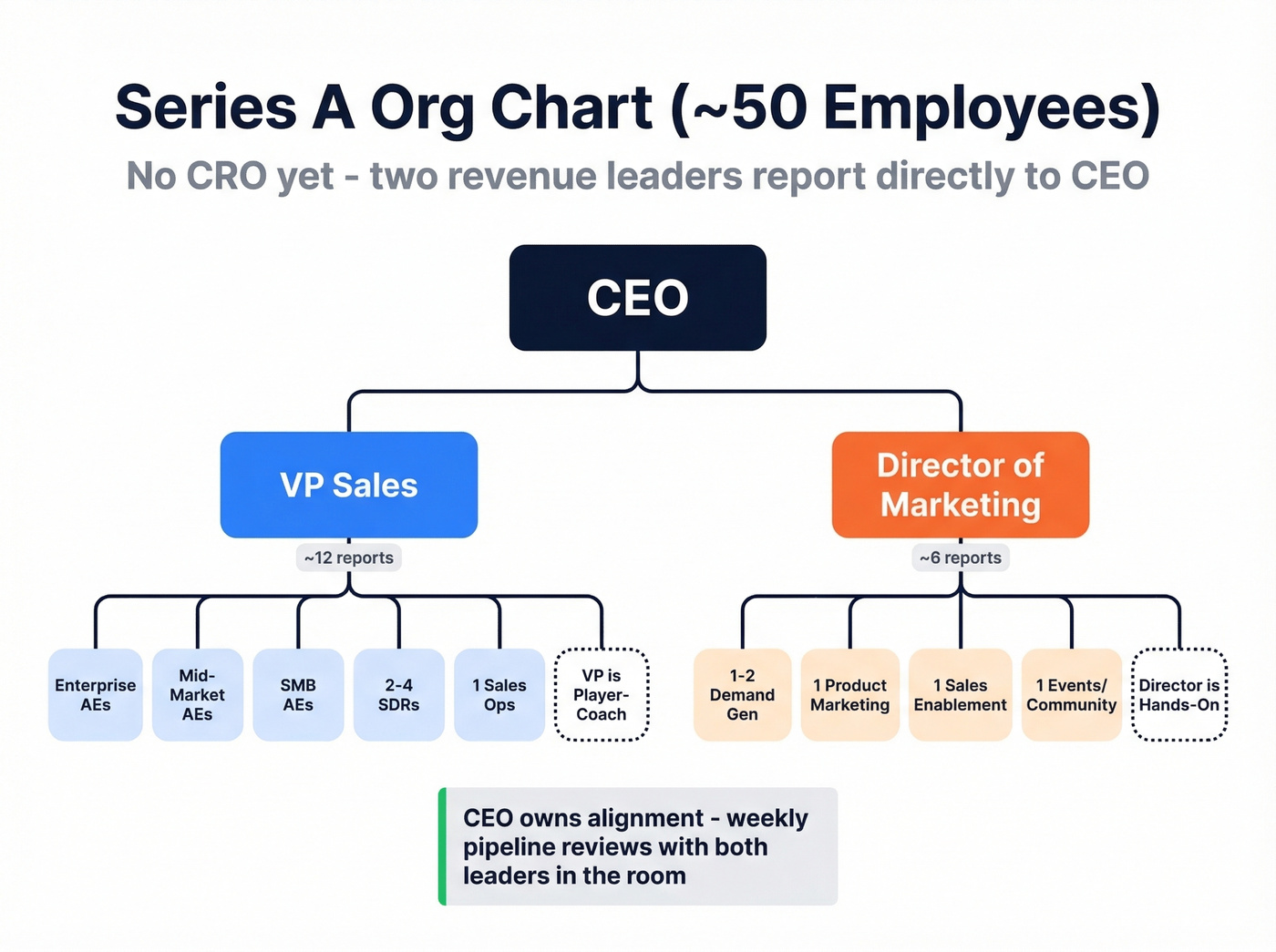
VP Sales manages ~12 people: Enterprise, Mid-Market, and SMB AEs, plus 2-4 SDRs and 1 Sales Ops person. The VP is player-coach, closing deals and building process simultaneously. This person writes the first sales playbook, runs the first QBRs, and probably still demos the product three times a week.
Director of Marketing manages ~6 people: 1-2 Demand Gen specialists, 1 Product Marketing Manager, 1 Sales Enablement marketer, and 1 Events/Community person. The Director is hands-on - writing copy, running campaigns, building the first attribution model.
The CEO owns alignment. Weekly pipeline reviews with both leaders in the room aren't optional; they're the mechanism that prevents silos from forming before you even realize they exist.
Series B: The Inflection Point
Forget the clean progression from Series A. Series B is where everything breaks if you don't restructure deliberately.
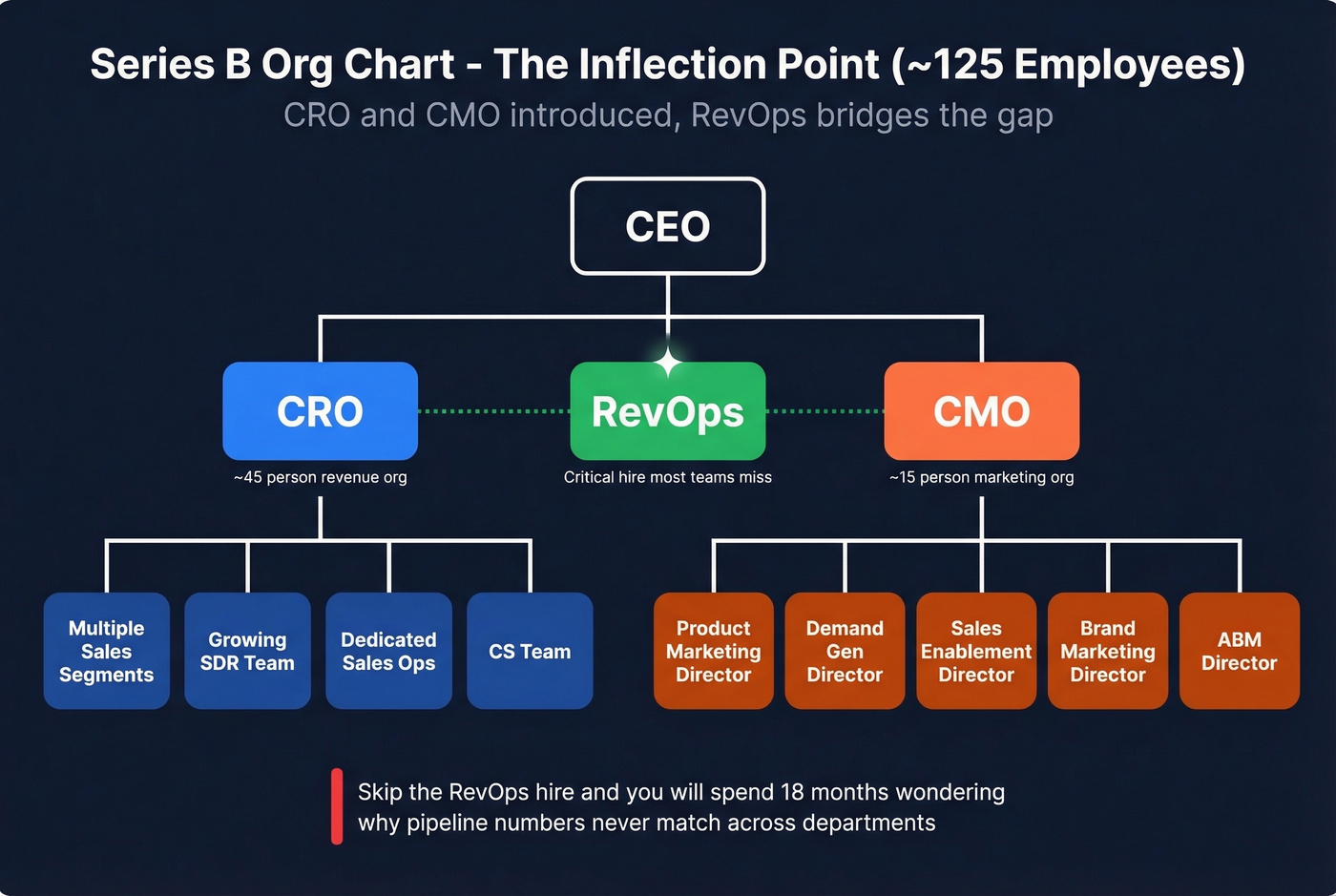
You introduce a CRO overseeing a ~45-person revenue org and a CMO leading ~15 people. The CMO now has directors for Product Marketing, Demand Gen, Sales Enablement, Brand Marketing, and ABM - marketing becomes a real department with functional grouping, not a handful of generalists wearing four hats each. The CRO's org expands to include multiple sales segments, a growing SDR team, and dedicated Sales Ops.
Here's the critical hire most teams miss: your first dedicated RevOps person. Someone who sits between sales, marketing, and CS to enforce shared definitions, unified reporting, and clean handoffs. Skip this hire and you'll spend the next 18 months wondering why your pipeline numbers never match across departments.
Series C (~400 Employees)
What actually changes at scale isn't the roles. It's the management layers. Both orgs are fully specialized, but the real complexity is coordination across dozens of people who've never worked together before.
- CRO oversees segment-specific sales managers, an SDR org with team leads, Sales Ops, and training/enablement
- CMO's org spans Product Marketing, Demand Gen, Sales Enablement, Corporate Marketing, PR/AR, Events, Community, and Creative
- RevOps is a team: VP or Director, functional leads for Sales Ops, Marketing Ops, and CS Ops, plus analysts handling dashboards, attribution, and CRM admin
| Stage | Employees | Sales HC | Mktg HC | Revenue Leader | Key Hire |
|---|---|---|---|---|---|
| Series A | ~50 | ~12 | ~6 | CEO (direct) | Sales Ops |
| Series B | ~125 | ~30-35 | ~15 | CRO + CMO | RevOps |
| Series C | ~400 | ~80-100 | ~30-40 | CRO + CMO | RevOps team |
Key Ratios and Benchmarks
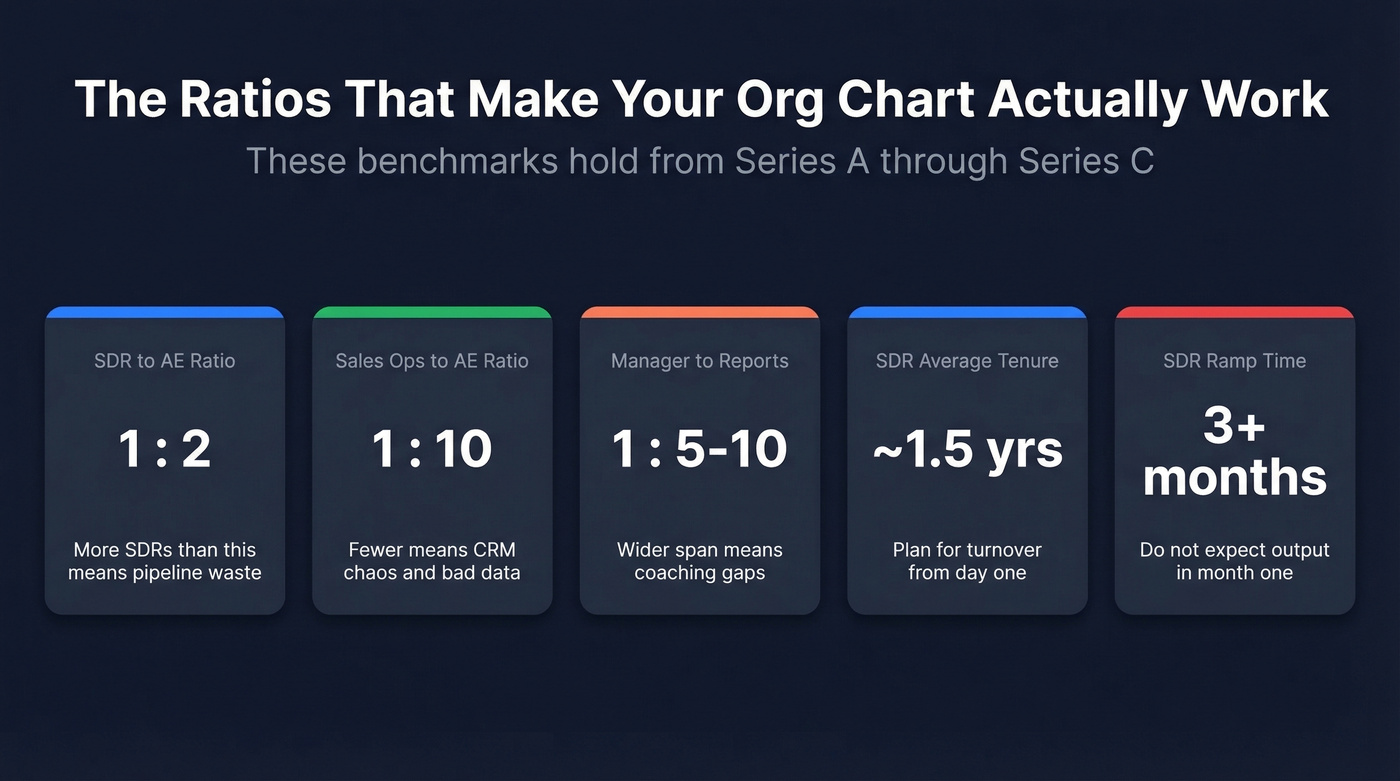
The headcounts above only work if the ratios underneath them hold.
| Ratio | Benchmark | Why It Matters |
|---|---|---|
| SDR : AE | 1 : 2 | More SDRs than this = pipeline waste |
| Sales Ops : AE | 1 : 10 | Fewer = CRM chaos, bad data |
| Manager : Reports | 1 : 5-10 | Wider = coaching gaps |
| SDR tenure | ~1.5 years | Plan for turnover |
| SDR ramp | 3+ months | Don't expect output in month one |
Only about 25% of companies use a strict inbound/outbound SDR split. Most run blended models before Series B. Don't over-engineer the SDR structure too early.
That 1-to-2 SDR-to-AE ratio only works if those SDRs have accurate contact data to work with. We've seen teams running 35%+ bounce rates before fixing their data stack, which effectively shrinks the team by a third. You're paying for headcount that's emailing dead addresses. Tools like Prospeo, with 98% email accuracy and a 7-day data refresh cycle, keep your headcount math honest instead of leaking pipeline through bad data.

A perfect SDR-to-AE ratio means nothing if a third of your emails bounce. Prospeo delivers 98% email accuracy with a 7-day refresh cycle, so every rep on your org chart actually reaches real buyers - not dead inboxes.
Stop paying for headcount that's emailing into the void.
The CRO Question
Let's be honest: the CRO role is overhyped for companies under 100 employees.
Use a CRO when you're past Series B with 100+ employees across sales, marketing, and CS, you need a single executive accountable for the full revenue lifecycle, and the person has genuine marketing background - not just a VP Sales with a new title.
Skip the CRO when you're under 100 employees. A strong VP Sales and Director of Marketing sharing KPIs will outperform a premature CRO hire. Also skip it if your marketing team needs independence to build long-term brand, or the candidate is a career sales leader who'll treat marketing as a lead factory.
The core tradeoff is optimization horizon. Marketing under a CRO tends to optimize for short-term revenue at the expense of long-term brand building. If your CRO is a former CMO, this risk drops significantly. If they're a career closer, it doesn't.
Where RevOps Fits
RevOps sits between sales, marketing, and CS. It owns the shared data layer, the tech stack, and the process alignment that prevents revenue leaks. Where it reports matters enormously.
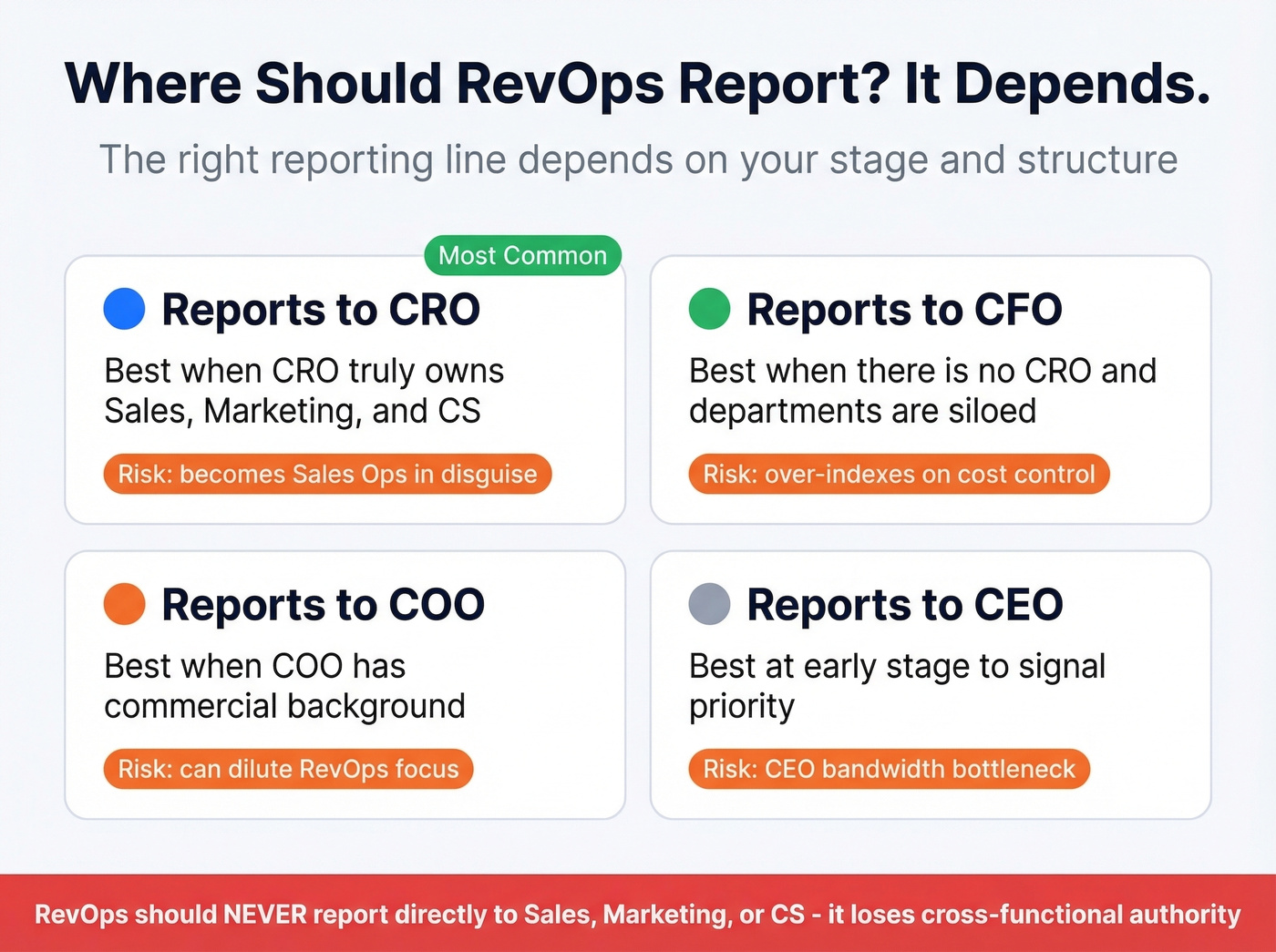
A LinkedIn poll of 102 RevOps professionals found the CRO is the most common reporting line. But "most common" doesn't mean "always right."
| Reports To | Best When | Watch Out For |
|---|---|---|
| CRO | CRO truly owns Sales + Mktg + CS | Becomes Sales Ops in disguise |
| CFO | No CRO; departments siloed | Over-indexes on cost control |
| COO | COO has commercial background | Can dilute RevOps focus |
| CEO | Early stage; signaling priority | CEO bandwidth bottleneck |
For PLG companies, RevOps under the CPO makes sense - the product is the growth engine and marketing is essentially product marketing.
RevOps should never report directly to Sales, Marketing, or CS. The moment it does, it loses the cross-functional authority that makes it valuable.
Org Chart Mistakes That Kill Alignment
Asking reps to do everything. Prospecting, qualifying, closing, account management - all in one role. Openers and closers are different skill sets, and forcing reps to do both slows everything down. We watched one team try this through 40 reps before finally splitting the roles. Their close rate jumped 22% in the first quarter after the change.
Not training reps 3-10. Your first two hires learned by osmosis. Reps three through ten won't. Build onboarding before you need it, or you'll build it in a panic while new hires sit idle. A simple 30-60-90 day plan prevents most of the early chaos.
No shared CRM or source of truth. Sales uses Salesforce, marketing uses HubSpot, CS uses a spreadsheet. Nobody agrees on what "qualified" means. This is how teams end up in that 53% handoff-misalignment bucket. If you need to standardize, start with clear lead status definitions and a basic lead generation workflow.
Redesigning the org chart every quarter. Most alignment problems aren't structural - they're operational. Before you shuffle reporting lines, fix your lead definitions, your handoff process, and your shared dashboards. The consensus on r/sales threads about reorgs is pretty clear: constant restructuring tanks morale faster than it fixes pipeline.
Making Your Org Structure Work
On the sales side, the core roles are SDRs (inbound qualification), BDRs (outbound prospecting), AEs (closing), AMs/CSMs (retention and expansion), and Sales Managers overseeing pods. On the marketing side: Demand Gen, Product Marketing, Content/Brand, and Marketing Ops. Each function maps to a specific stage of the buyer journey.
If you're building the top of funnel, it helps to standardize your sales prospecting techniques and track the right lead generation metrics from day one.
One pattern from r/marketing worth noting: a practitioner shared their structure where the Senior Marketing Manager reports to the VP of Operations, not a marketing executive. It's more common than you'd think at smaller companies, and it works - until the marketing team outgrows the ops leader's bandwidth. If you're running this setup past 10 marketing hires, it's time to rethink.
The org chart is the blueprint, but execution depends on data quality. When your outbound data bounces at 35%+ - which is what most teams experience before fixing their data stack - every ratio in this guide breaks down. You're effectively running a smaller team than you're paying for. If you want to diagnose it properly, start with email bounce rate and an email deliverability guide.
Scaling from Series A to Series C means more reps, more segments, more pipeline to fill. Prospeo gives your growing revenue org 300M+ verified profiles, 30+ filters for targeting, and CRM enrichment that returns 50+ data points per contact - at $0.01 per email.
Scale your org chart without scaling your bounce rate.
FAQ
What's the difference between a sales org chart and a marketing org chart?
A sales org chart maps revenue-generating roles like SDRs, AEs, and Sales Managers. A marketing org chart maps demand-creation roles like Demand Gen, PMM, and Content. A combined chart shows both under shared leadership - typically the CEO at early stage or a CRO post-Series B. The combined view matters most because handoff problems live in the gap between the two.
When should a B2B company hire a CRO?
Most B2B companies don't need a CRO until Series B, around 125 employees and $1-5M ARR. Before that, a VP Sales and Director of Marketing sharing KPIs and a single CRM will outperform a premature CRO hire. Adding a management layer without enough organizational complexity to justify it just slows decisions down.
How do I keep sales and marketing aligned as the team grows?
Three non-negotiables: shared pipeline KPIs, a single CRM as the source of truth, and agreed-upon definitions of "qualified lead." RevOps enforces this operationally. Both teams also need the same verified contact records - stale data breaks handoffs faster than any org chart problem.
What's the ideal SDR-to-AE ratio?
The standard benchmark is 1 SDR for every 2 AEs. Going above that - say 1:1 - usually signals pipeline waste or poor SDR targeting. Below Series B, most teams run blended inbound/outbound SDRs rather than splitting the function, which keeps the ratio efficient without over-specializing too early.