

The Best Sales and Marketing Tools in 2026 (And the Ones You Can Skip)
There are 15,384 martech solutions on the market right now, feeding a $465B industry where marketing teams dedicate 31.4% of their budgets to technology. Your team probably uses a handful of those sales and marketing tools, and at least two do the same thing. The average revenue org manages 4-6 disconnected tools that make coordination harder, not easier - and sales reps still spend 72% of their time on activities that aren't actually selling.
A startup founder on Reddit summed it up: they're "paying for multiple tools that have now all evolved to essentially do the same thing." This article isn't an exhaustive catalog. It's the stack we'd actually build from scratch, with real pricing, honest opinions, and a framework so you don't end up with a $60K/year Frankenstein of overlapping subscriptions.
Our Picks at a Glance
If you're starting fresh or auditing what you've got, here's the short version:
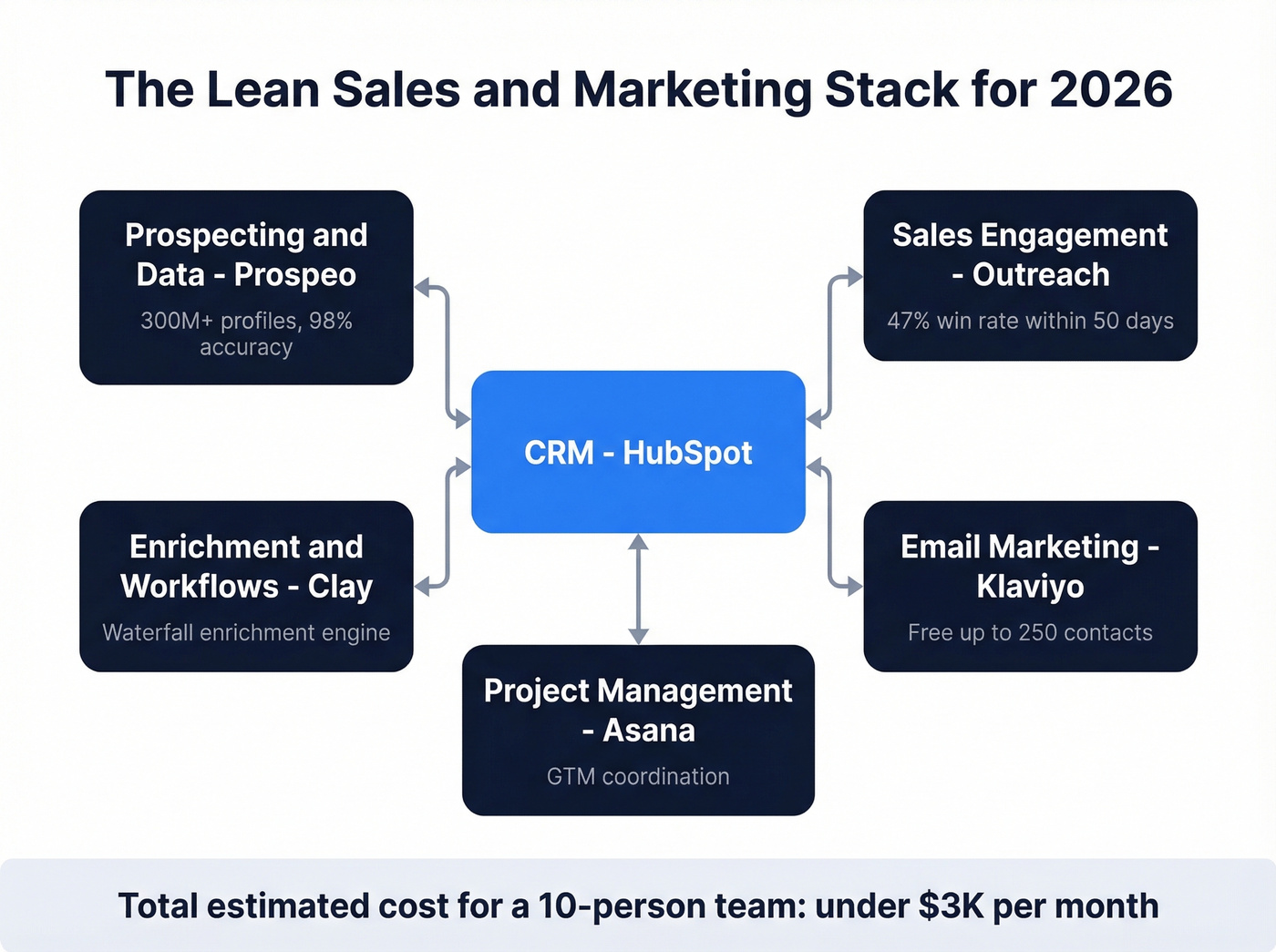
| Category | Pick | Starting Price |
|---|---|---|
| CRM | HubSpot | Free (Starter ~$45/user/mo) |
| Prospecting & Data | Prospeo | Free (75 emails/mo) |
| Sales Engagement | Outreach | ~$1,200/user/yr |
| Email Marketing | Klaviyo | Free (up to 250 contacts) |
| Enrichment & Workflows | Clay | $134/mo |
| Project Management | Asana | Free (Premium ~$11/user/mo) |
This isn't a "best of everything" list. Each tool earns its seat.
Why Alignment Matters More Than Tools
You can buy every tool on this list and still fail if sales and marketing aren't aligned. 96% of professionals admit to alignment issues between the two teams. That's not a rounding error. It's nearly everyone.
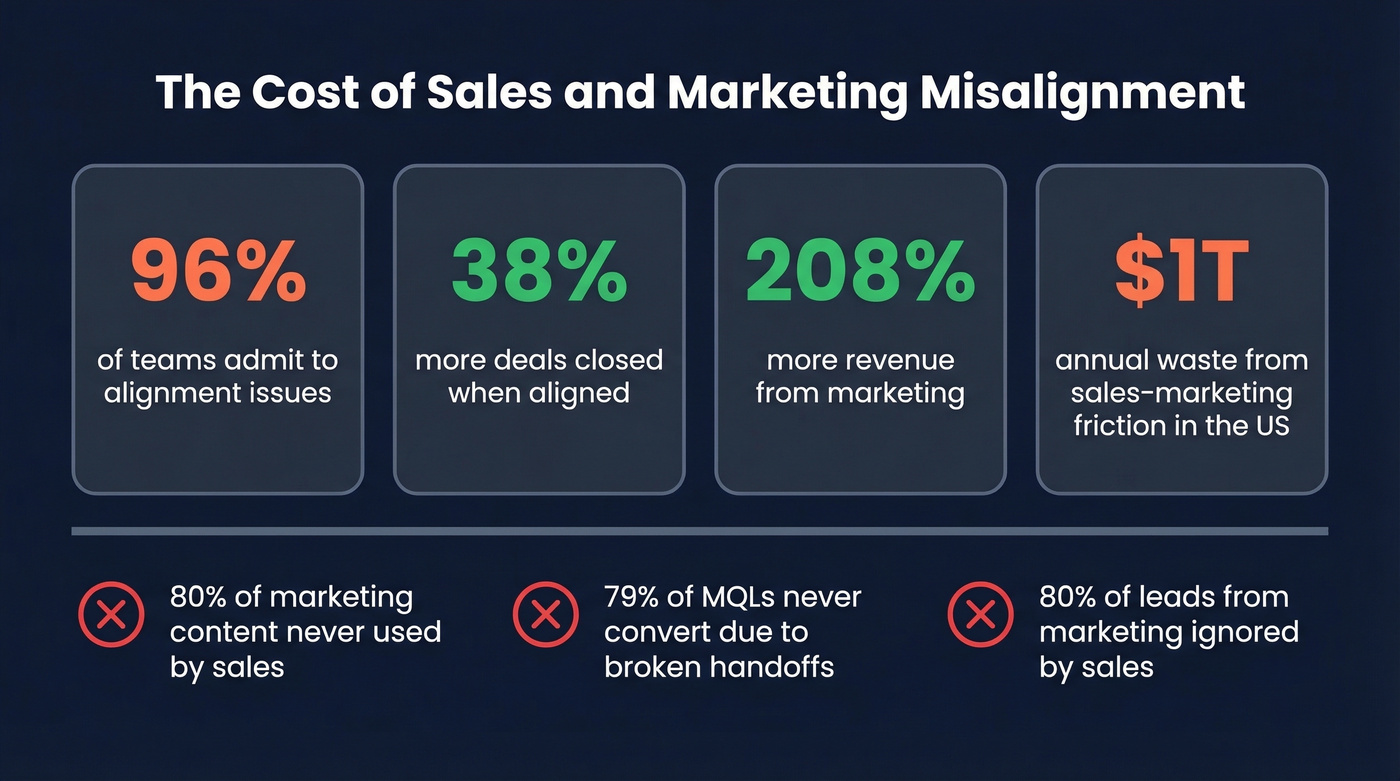
The cost is measurable. Companies that get alignment right close 38% more deals and generate up to 208% more revenue from marketing efforts. Companies that don't contribute to an estimated $1 trillion in annual waste across the US economy from sales-marketing friction - a number that sounds made up until you see it broken down: 80% of content marketing creates never gets used by sales, 79% of MQLs never convert because nurturing breaks down in the handoff, and sales ignores up to 80% of the leads marketing sends over.
No software fixes a broken process. But the right stack - one where CRM, prospecting, engagement, and analytics share the same data - makes alignment structurally easier. That's the lens we're using for every recommendation below.

Best Tools by Category
CRM - Where Everything Lives
Your CRM is the foundation. Everything else feeds into it or pulls from it. Get this wrong and you'll spend the next two years migrating data.
Here's what a 10-person team actually pays over three years:
| Zoho CRM | HubSpot | Salesforce | |
|---|---|---|---|
| Starting price | $14/user/mo | Free (Starter $45/user/mo) | $25/user/mo |
| 3-year TCO (10 users) | ~$7,040 | ~$51,600 | ~$61,800 |
| Hidden costs | Minimal | Pro tier: $2,250+/mo | Adds 2-3x sticker price |
Salesforce is the right CRM for enterprises and the wrong CRM for everyone else. The advertised $25/user/month is a mirage - real-world cost runs 2-3x the sticker price once you add Einstein AI at $50/user/month, Marketing Cloud at $1,250/month, and the consultant hours ($150-250/hr) you'll inevitably need. One Reddit user put it plainly: "stuck with Salesforce." If you're already locked in at the enterprise level, fine. If you're choosing today, keep reading.
HubSpot is the sweet spot for growth-stage teams. The free CRM is genuinely useful, and Starter at $45/user/month keeps costs reasonable. Just know that the jump to Professional - $450/user/month with a 5-user minimum - is steep. Most businesses end up paying $2,250+/month at that tier, which catches a lot of teams off guard.
Zoho CRM is the budget pick that punches above its weight. At $14/user/month for Standard, a 10-person team pays less in three years than HubSpot or Salesforce charge in one. The Zoho One bundle at $45/user/month gets you 40+ apps. The tradeoff is a less polished UI and a smaller integration ecosystem, but for cost-conscious teams, it's hard to argue with the math.
Prospecting & Email Data
This is where your pipeline starts - and where bad data kills it. If you want a deeper breakdown of sources, accuracy, and fit, start with sales prospecting databases.
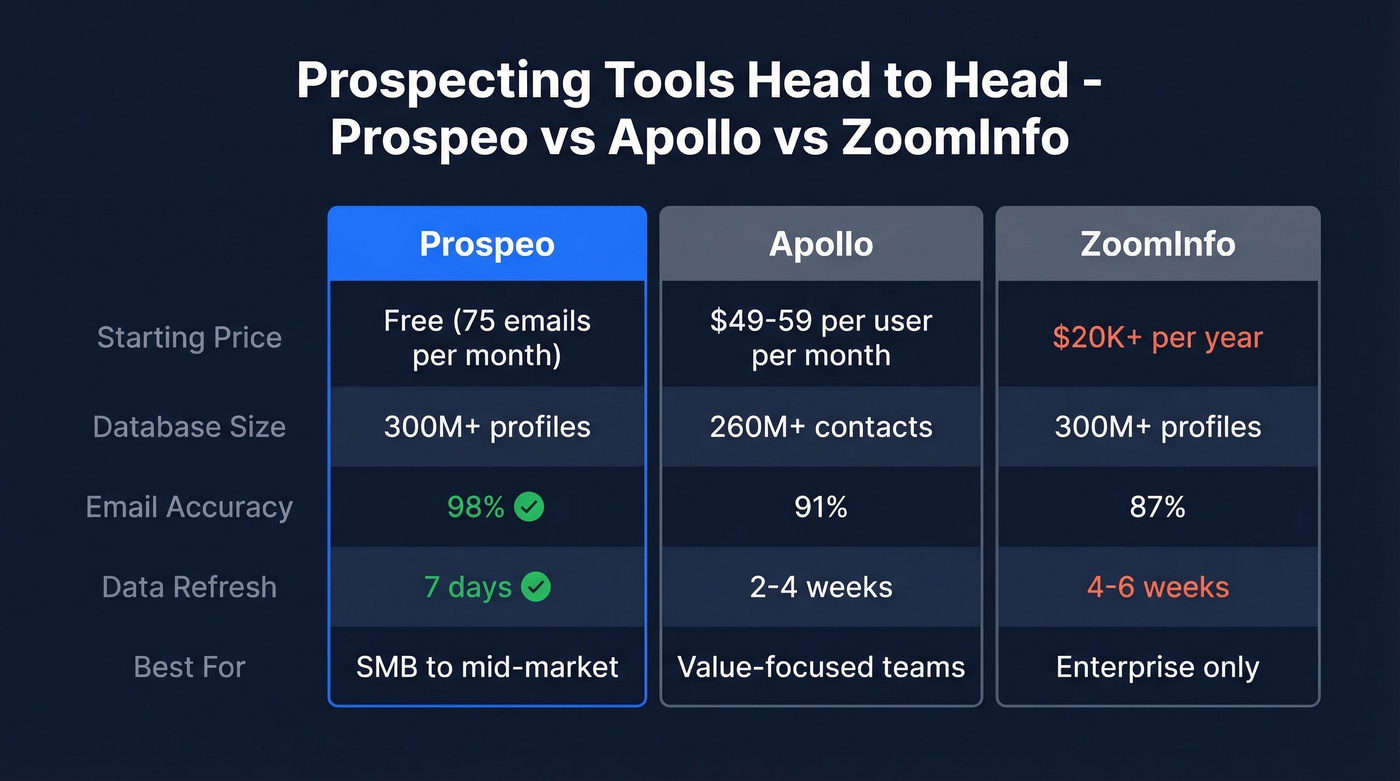
Prospeo is what we'd pick first. 300M+ professional profiles, 143M+ verified emails, 98% email accuracy, and 125M+ verified mobile numbers with a 30% pickup rate. The database refreshes every 7 days - the industry average is six weeks - which means you're not sending sequences to people who changed jobs a month ago. The 30+ search filters include buyer intent powered by 15,000 Bombora topics, technographics, job changes, funding signals, and more. The Chrome extension has 40,000+ users and works across company websites and CRMs. Native integrations push directly into Salesforce, HubSpot, Smartlead, Instantly, Lemlist, Clay, Zapier, Make, n8n, and Outreach. Pricing starts free at 75 emails/month, and paid plans run roughly $0.01 per email - no contracts, no sales calls.

Apollo is the other strong contender, starting around $49-$59/user/month depending on plan, with higher tiers offering unlimited email credits. With 260M+ contacts, it's the obvious value play. A practitioner on r/marketing called it a "mashup of ZoomInfo and Gong for a fraction of the price." That's accurate. The caveat? The same user added that Apollo's "data dashboards are absolutely horrible. Like unusable." If you can live with rough reporting, Apollo delivers.
Skip unless enterprise: ZoomInfo. At $20K+/year - and that's the starting conversation - ZoomInfo's pricing model feels like a relic. Data refreshes every 4-6 weeks. For a 500-person sales org running intent, ABM, and engagement from one platform, it makes sense. For a Series A company? That's real money for data you can get elsewhere at higher accuracy.
Pair with a data provider: Clay. Clay runs on credits starting at $134/month and excels at enrichment workflows - waterfall enrichment, multi-source data stacking, automated research. It's not a database; it's a workflow layer. Pair it with a strong data source and you've got an enrichment engine that rivals anything enterprise teams build internally. If you're building this out, see data enrichment services and lead enrichment.
| Tool | Starting Price | Database | Email Accuracy | Refresh Cycle |
|---|---|---|---|---|
| Apollo | ~$49-$59/user/mo | 260M+ contacts | 91% | 2-4 weeks |
| ZoomInfo | ~$20K+/yr | 300M+ profiles | 87% | 4-6 weeks |
| Clay | $134/mo | Aggregator | Varies by source | Depends on workflow run |
Engagement & Conversation Intelligence
Outreach is the category leader at ~$1,200/user/year. The ROI data backs it up: opportunities closed within 50 days hit a 47% win rate versus 20% or lower after that window. Sellers using Outreach's AI tools report cutting research and personalization time by 90%, and their Kaia AI shaves 11 days off sales cycles while boosting win rates by up to 10 points on deals over $50K.
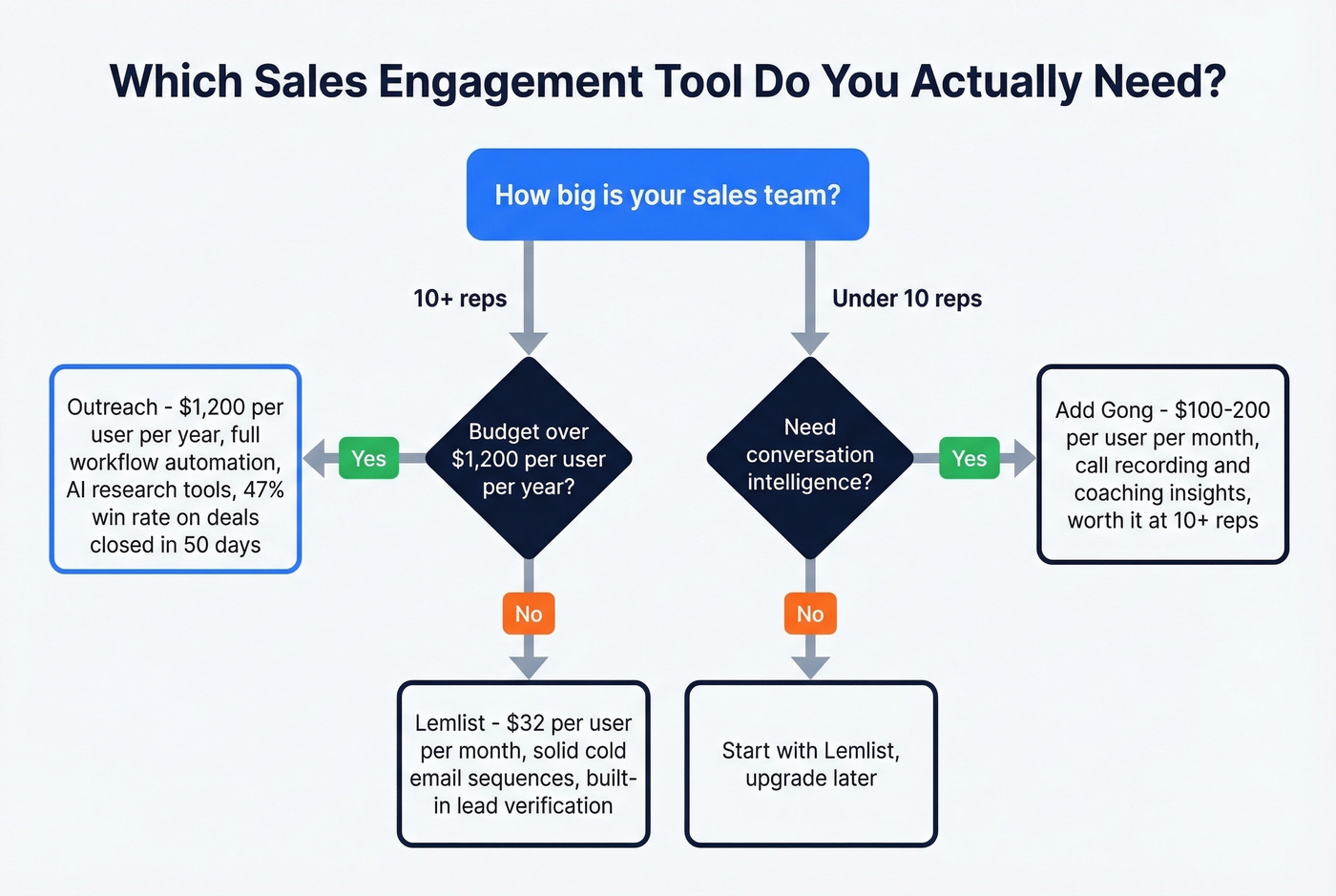
The downside? It's built for mid-market and enterprise. If you're a 5-person SDR team, it's overkill. (If you want a full shortlist, see SDR tools.)
Lemlist is the SMB alternative, starting at $32/user/month with free lead exporting and verification baked in. It won't match Outreach's workflow depth, but for teams running straightforward cold email sequences, it gets the job done without the enterprise price tag.
Gong owns conversation intelligence. It records and analyzes sales calls to surface coaching insights and deal risk signals - the kind of pattern recognition that turns average reps into top performers. Pricing typically runs $100-200/user/month on annual contracts. Worth it if you have 10+ reps; skip it for smaller teams.
Email Marketing & Automation
Klaviyo is the standout here. A practitioner with 15 years of experience called it the "best marketing email platform for the money," praising its "unbelievable" automation features and transparent pricing. Free up to 250 contacts, then $20-150/month covers most SMBs. Klaviyo's workflow builder handles everything from lead nurturing sequences to post-purchase campaigns without requiring a separate tool.
If you're already on HubSpot CRM, HubSpot's Marketing Hub makes sense for the unified data - but you'll pay for it at the Professional tier. Mailchimp still works as a budget option with a free plan and paid plans from around $13/month, though it's increasingly outclassed on automation. If you're optimizing outbound too, keep cold email marketing in mind.
Analytics & SEO
GA4 is free and unavoidable. One marketer summed up the consensus: "I actually hate GA4, but it is what it is... it's the standard." You don't have to love it. You do have to use it.
For SEO, Ahrefs (from $99/month) and Semrush (from $139.95/month) are the two serious options. Pick one based on which UI you prefer - they're closer in capability than either fanbase admits. Hotjar fills the behavioral analytics gap if you need heatmaps and session recordings, with a free basic tier and paid plans from $32/month.
Project Management for GTM
Asana wins this one for GTM coordination specifically. Free for small teams, Premium at around $11/user/month. A marketer who'd tried "Jira, Trello, Monday, Notion, and ClickUp" called them all "lackluster compared to Asana." We've seen the same pattern - Asana's workflow automation and cross-team visibility make it the best fit for go-to-market teams running campaigns alongside sales sprints.
Notion is a solid runner-up if your team is docs-heavy and wants a wiki plus project board in one place. It starts free for individuals, with Team plans at $10/user/month.

You just read that 72% of sales reps' time goes to non-selling activities and 80% of marketing leads get ignored. The fix isn't more tools - it's better data connecting your stack. Prospeo gives you 300M+ profiles, 98% accurate emails, and 125M+ verified mobiles on a 7-day refresh cycle, with native integrations into HubSpot, Salesforce, Outreach, Clay, and every sequencer on this list.
Replace your Frankenstein stack with one data platform that actually connects.
Email Verification - The Step Everyone Skips
It takes three months to warm up a domain and three seconds to burn it with a bad list.
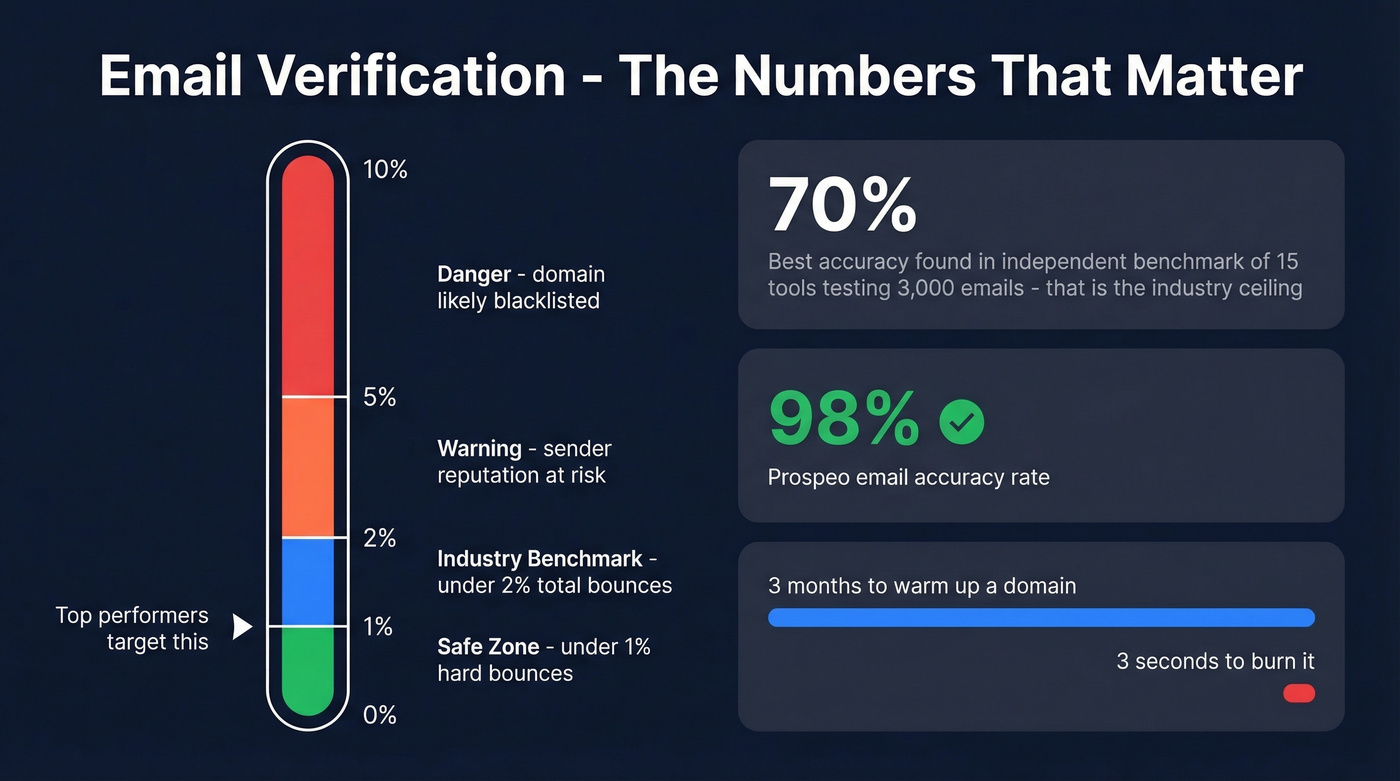
The industry benchmark is clear: keep total bounces below 2%, with top performers targeting hard bounces under 1%. Most teams don't think about verification until they've already torched their sender reputation. An independent benchmark of 15 email verification tools testing 3,000 real emails found the top performer at just 70% accuracy - which tells you how low the bar is across the industry.

Prospeo's 98% accuracy rate comes from a 5-step process that includes catch-all domain handling, spam-trap removal, and honeypot filtering - the edge cases that cheaper verifiers miss entirely. The 7-day refresh cycle means you're verifying against current data, not a snapshot from six weeks ago. Teams using this verification layer have seen bounce rates drop from 35% to under 4%. (If you're troubleshooting deliverability, start with email bounce rate and the email deliverability guide.)
Here's the thing: if your average deal size is under five figures, you probably don't need ZoomInfo-level data. But you absolutely need email verification regardless of deal size. A burned domain costs you every deal in the pipeline, not just one.
How to Build Your Stack
Most revenue orgs manage 4-6 disconnected tools that create more friction than they solve. Data professionals spend roughly 44% of their time just on data preparation and integration. Here's how to avoid that trap.
Audit for overlap first. Before buying anything new, map what you've got. If your CRM, your engagement tool, and your prospecting platform all offer email sequences, you're paying three times for the same capability. We've seen teams cut $15K+ in annual spend just by identifying redundant features across their existing stack.
Buy AI embedded in existing tools, not standalone. This is the biggest shift in 2026 tool selection. Agentic AI workflows - where AI autonomously researches prospects, drafts personalized outreach, and updates CRM records - are real, but only when they're woven into platforms you already use. Gartner predicts over 40% of standalone agentic AI projects will be scrapped by 2027. The AI features built into your CRM and engagement platform will deliver more value than a shiny point solution that doesn't integrate with anything. 45% of sales teams now run hybrid AI-SDR models, and the ones succeeding are using AI as a capability layer across their existing stack, not bolting on a separate tool. If you're building sequences around this, keep AI cold email outreach handy.
Consolidate around 5-7 core tools. CFOs want ROI. RevOps wants governance. Both get what they need when you run fewer, better-integrated tools instead of 15 point solutions. The stack we outlined above - CRM, prospecting, engagement, email marketing, enrichment, project management - covers the full revenue cycle without the sprawl.
Let data quality be the foundation. Every workflow downstream depends on clean data upstream. Start with accurate contacts, verify before sending, and enrich continuously. The rest is execution. (If you need a process map, use a lead generation workflow.)
This article estimates ZoomInfo costs $20K+/year with 87% email accuracy and 4-6 week refresh cycles. Prospeo delivers 98% accuracy, weekly data refreshes, and buyer intent across 15,000 topics - starting at $0.01 per email with no contracts. Teams using Prospeo book 26% more meetings than ZoomInfo and 35% more than Apollo.
Get enterprise-grade prospecting data without the enterprise invoice.
Sales and Marketing Tools FAQ
How many tools does a revenue team actually need?
Five to seven core tools that integrate well is the sweet spot. More than that adds data fragmentation, training overhead, and overlapping costs. Audit for duplicate capabilities before adding anything new.
What's the most important tool in a sales stack?
Your CRM - everything else feeds into or pulls from it. Get the CRM right first, then layer prospecting, engagement, and analytics on top. A great prospecting tool paired with a bad CRM just creates expensive chaos.
How much should a 10-person team budget for their stack?
Expect $15K-30K/year for a mid-market stack covering CRM, prospecting, engagement, and email marketing. Enterprise CRMs alone can exceed $60K over three years. Start with free tiers where possible - Prospeo, HubSpot, and Klaviyo all offer usable free plans - and upgrade as usage justifies the cost.
What's the best free prospecting tool?
Prospeo's free tier gives you 75 verified emails and 100 Chrome extension credits per month with 98% accuracy, no contract required. Apollo also offers a generous free plan, though email accuracy runs lower at 91%.
Is ZoomInfo worth the price?
For enterprise teams with 100+ reps and budget to match, ZoomInfo's breadth of features justifies the cost. For startups and mid-market teams, self-serve alternatives deliver higher email accuracy at a fraction of the price. The $20K+ annual minimum is hard to justify when you're not using half the platform.