

The 10 Best Sales Assist AI Tools That Actually Move Pipeline
There are 616 listings in G2's "AI Sales Assistant" category. Most do roughly the same thing - automate tasks, surface insights, write emails - with varying degrees of competence. The real problem isn't finding a sales assist AI tool. It's finding one that doesn't feed your reps garbage data and call it intelligence.
Sales reps spend roughly 70% of their time on non-selling activities. AI assistants promise to claw that time back, but here's the thing: if the data going into your AI is stale or wrong, you're just automating bad outreach faster. The AI sales assistant market is projected to hit $67.36B by 2030, up from $18.58B in 2023, and most of that money will be wasted by teams that skip the data layer entirely.
Our Picks (TL;DR)
| Category | Winner |
|---|---|
| Data accuracy | Prospeo |
| SMB all-in-one | Apollo |
| Conversation intel | Gong |
| Sequencing engine | Outreach |
| CRM-native AI | HubSpot Sales Hub |
What the ROI Data Says
An Optifai benchmark across 938 B2B companies found AI-augmented reps generated $1.75M in revenue per rep versus $1.24M for traditional reps - a 41% lift. They did it with fewer activities (178/month vs 217), which means the AI wasn't making reps busier. It was making them more precise.
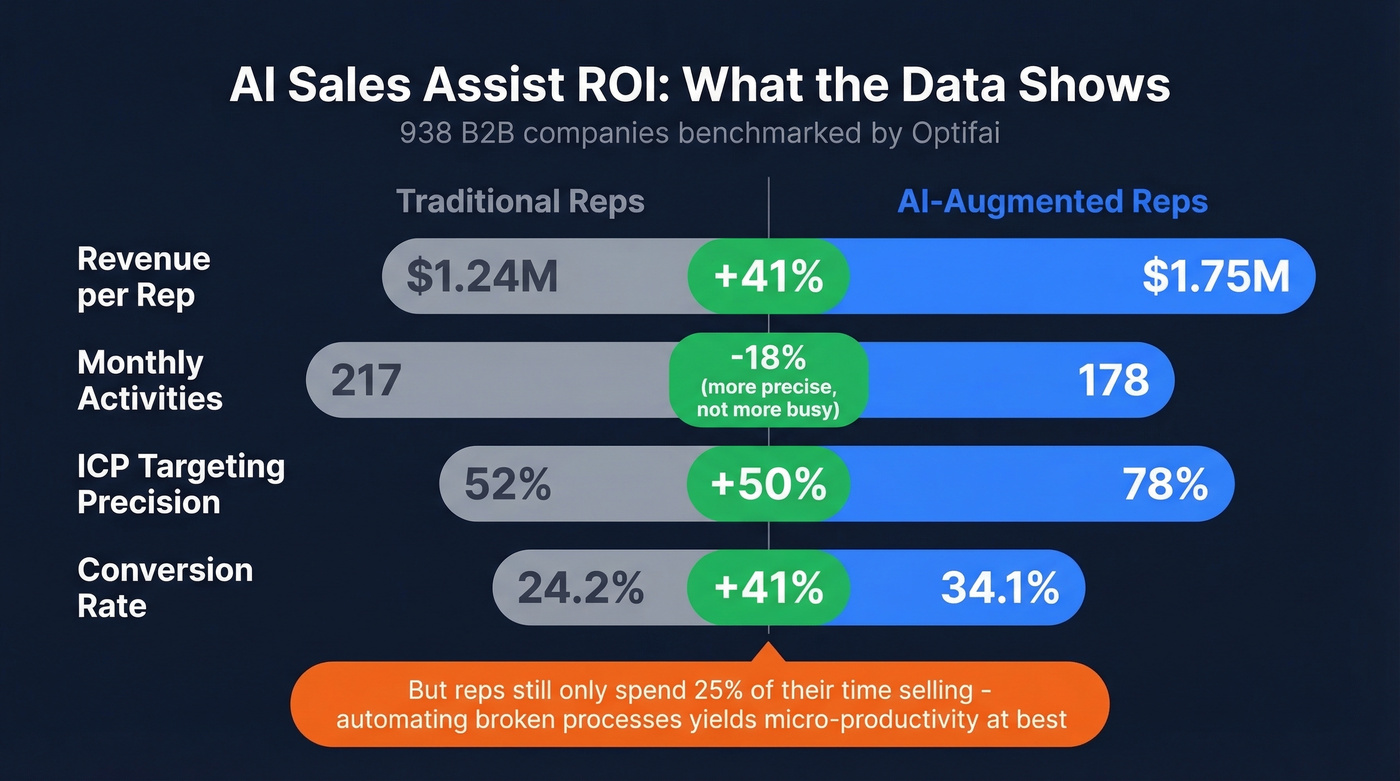
ICP targeting precision jumped from 52% to 78%. Conversion rates went from 24.2% to 34.1%. Bain's 2026 technology report corroborates this, citing 30%+ improvement in win rates among early adopters. But Bain also found that reps still spend only about 25% of their time actually selling - and automating broken processes yields micro-productivity at best. You need clean data and redesigned workflows, not a shiny new tool bolted onto a messy CRM.

10 Best AI Sales Assistants for 2026
Prospeo - Best for Data Accuracy
Every AI sales assistant is only as smart as the data it runs on. Prospeo is the data layer that makes the rest of your stack work.
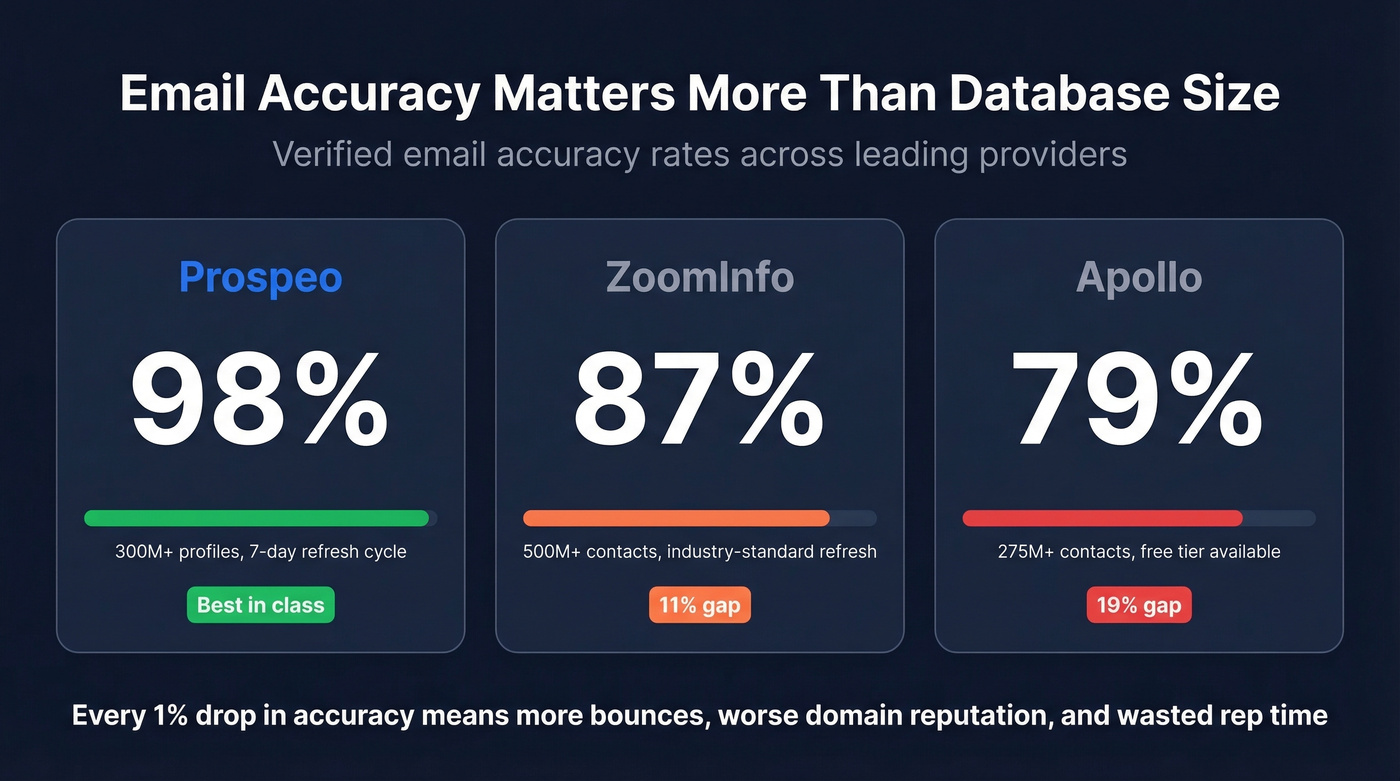
The database covers 300M+ professional profiles, 143M+ verified emails, and 125M+ verified mobile numbers with a 30% pickup rate. Email accuracy sits at 98%, compared to 87% at ZoomInfo and 79% at Apollo. But the 7-day data refresh cycle is the real differentiator - the industry average is six weeks, which means most databases are serving you contacts who changed jobs a month ago. If you're evaluating providers, start with a B2B database comparison that prioritizes accuracy.
Snyk's sales team is a good proof point: 50 AEs were prospecting 4-6 hours per week with bounce rates of 35-40%. After switching, bounces dropped under 5% and AE-sourced pipeline jumped 180%. That's not a marginal improvement - that's a different business.
Intent data covers 15,000 Bombora topics, and the Chrome extension has 40K+ users pulling verified contacts from any website. Pricing starts free (75 emails/month), with paid plans running ~$0.01 per email. No contracts, no sales calls required.
Use this if: You need verified emails and direct dials that won't torch your domain reputation. Pair it with any sequencer. If deliverability is a priority, align this with your outbound email automation setup.
Apollo - Best All-in-One for SMB
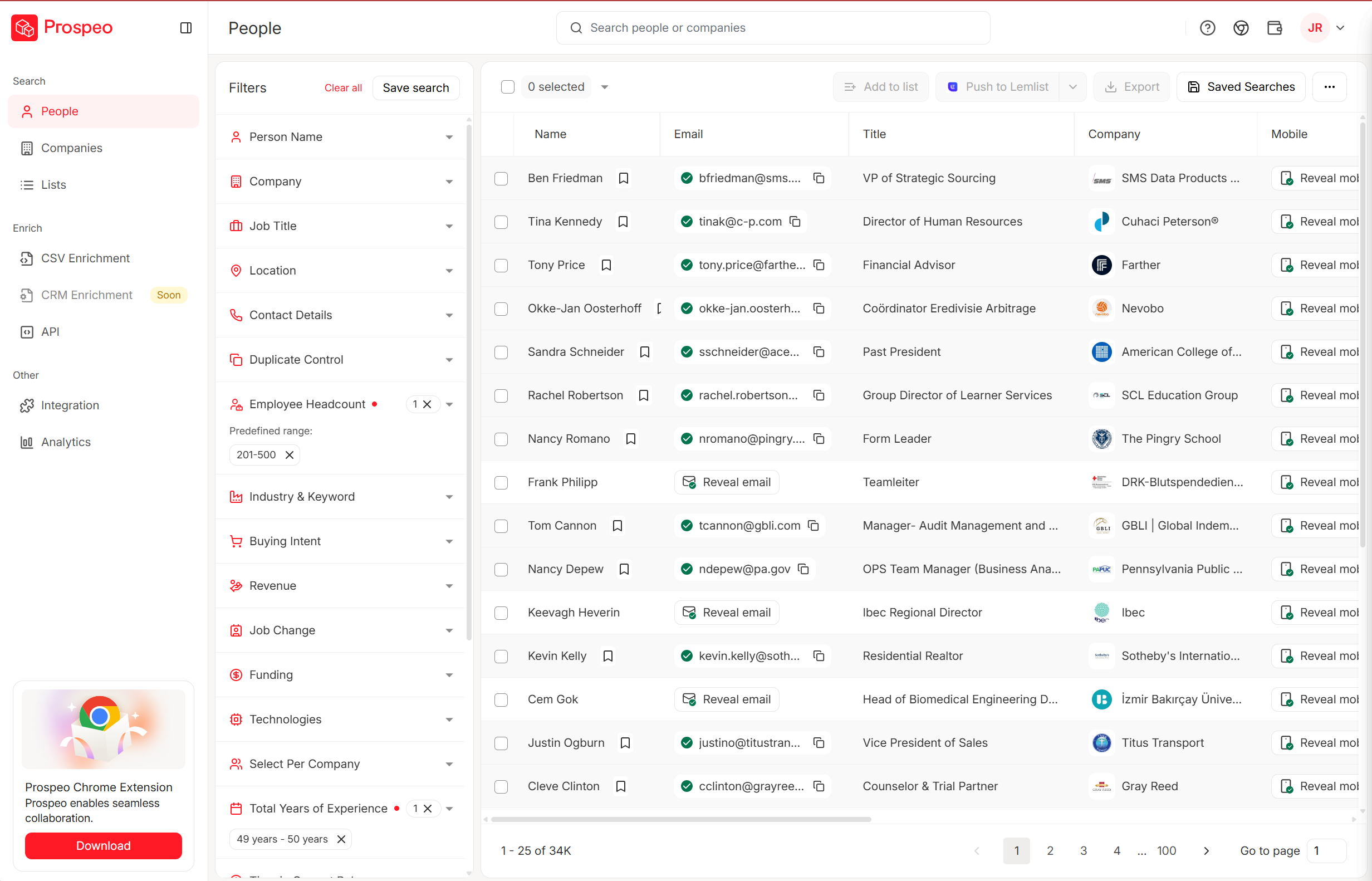
Apollo is the obvious starting point for most SMB teams because it bundles data, sequences, and a lightweight CRM into one platform - and the free tier is genuinely usable. You get basic sequences and access to a 275M+ contact database without spending a dollar. Paid plans run $49-$99/user/month.
Use this if: You're a small team that wants prospecting, sequences, and CRM in one place. If you're still building your outbound motion, use these pipeline generation ideas to pressure-test what you automate. Skip this if: Email deliverability is mission-critical and you're running high-volume outbound.
Gong - Best for Conversation Intelligence
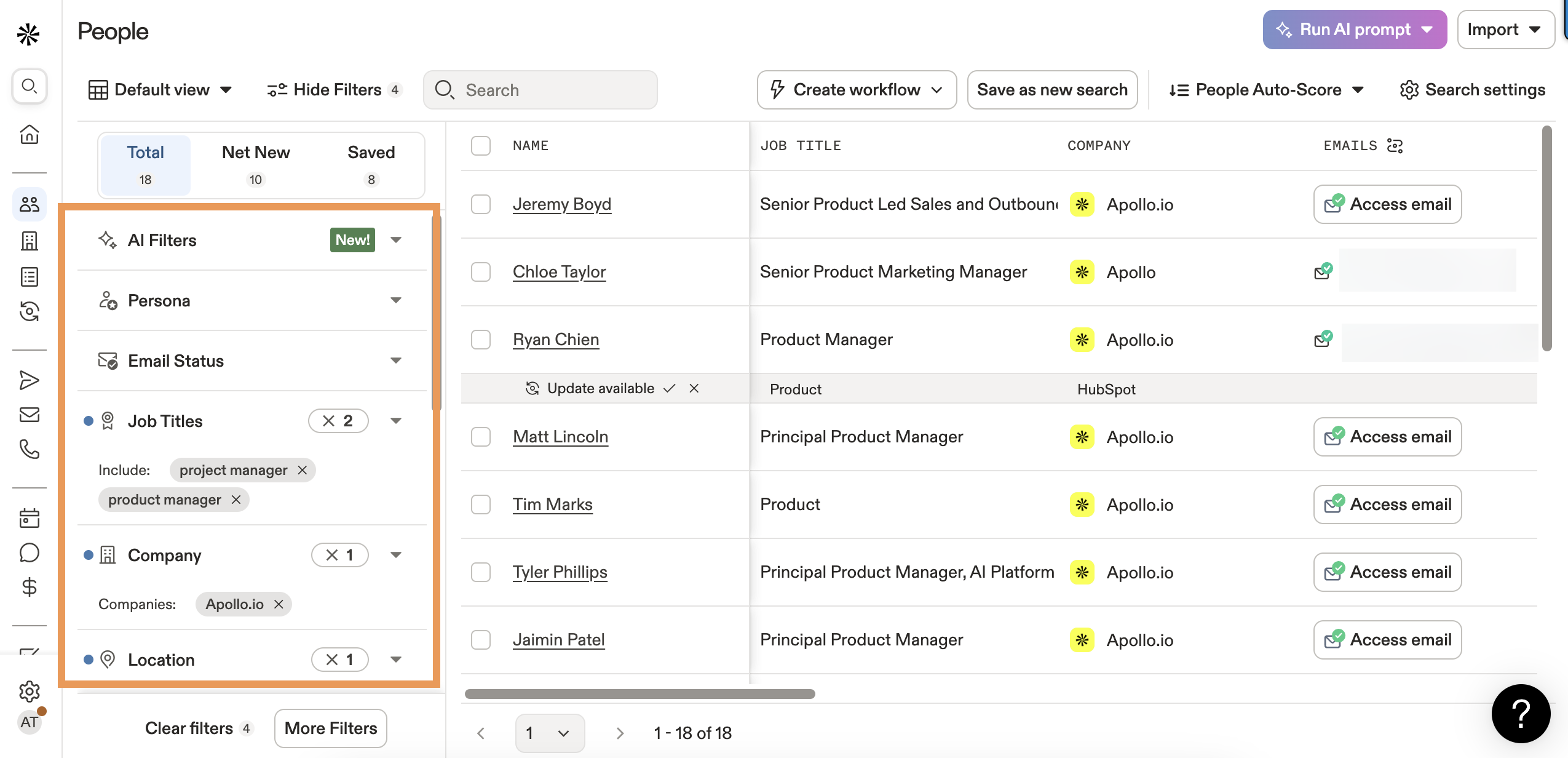
Gong doesn't help you find prospects. It helps you close the ones you've already got. The platform records calls, analyzes talk patterns, surfaces deal risks, and coaches reps based on what top performers actually do differently. We've seen teams justify Gong's cost within a single quarter when they have 15+ reps and an inconsistent close rate. (If your team is phone-heavy, these phone sales skills pair well with conversation intel.)
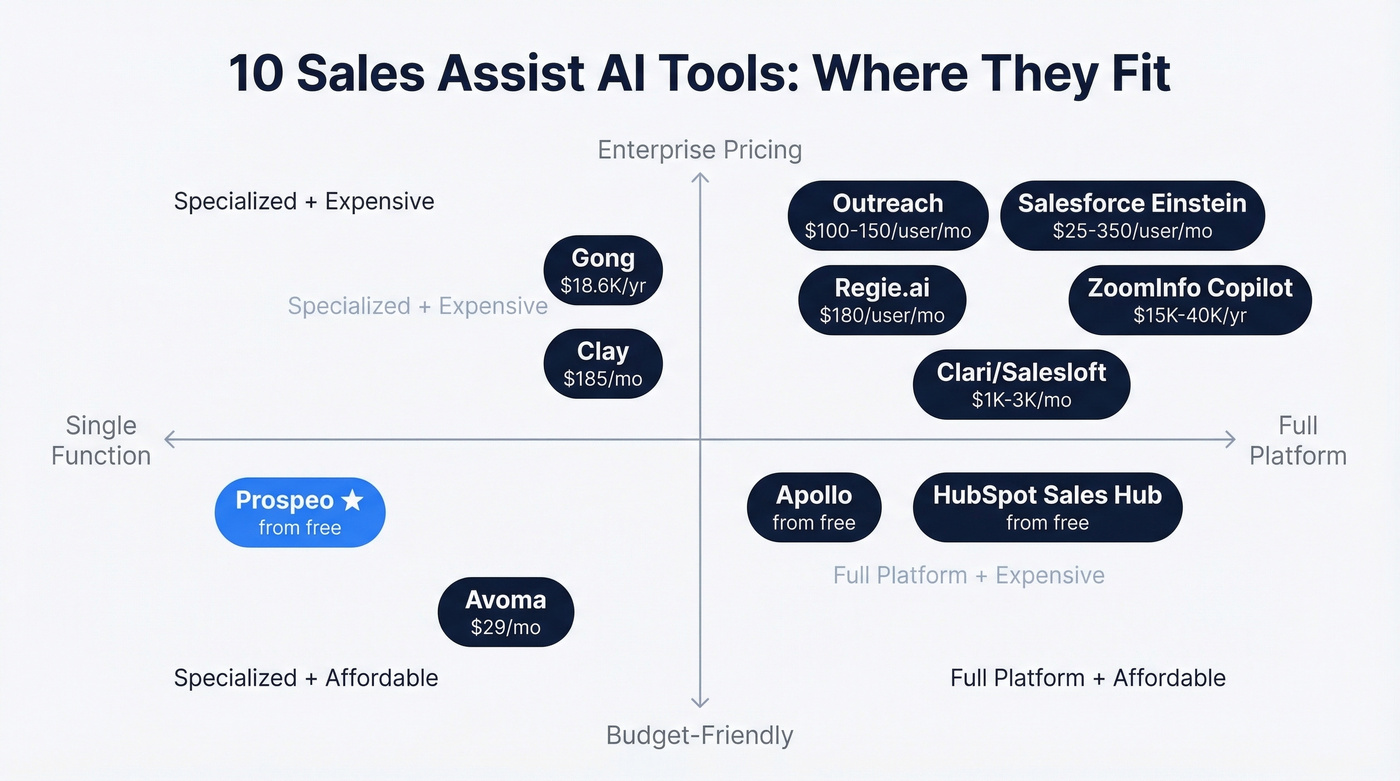
That cost isn't trivial. Expect a ~$5,000/year platform fee plus $1,360-$1,600 per user annually. A 10-person team runs $18.6K-$21K/year. The consensus across G2 reviews and r/sales threads is consistent: Gong is expensive but delivers.
Use this if: You have 10+ reps and need to systematize coaching and deal inspection. Skip this if: Your team is under 10 reps - the platform fee makes per-seat economics brutal at small scale.

Outreach - Best Sequencing Engine
Outreach has 3,500+ G2 reviews and a 4.3/5 rating for a reason: its multi-step sequences, deep Salesforce integration, and analytics are best-in-class. But the pricing is famously opaque. Expect $100-$150/user/month on annual contracts, plus add-on modules ($30-$50 each for Meet, Deal, Forecast). Some buyers report an additional $2K-$5K annual platform fee, and implementation runs $5K-$25K. If you're standardizing engagement, it helps to follow a clear framework for choosing a sales engagement platform.
The #1 complaint across review analysis is cost stacking - you sign up for sequences and end up paying for five modules you didn't plan on.
Skip this if you're under 20 reps. The implementation overhead and contract minimums don't make sense for smaller teams.
HubSpot Sales Hub - Best CRM-Native AI
If your team already lives in HubSpot, Sales Hub is the path of least resistance. The free CRM is legitimately useful, and Professional at $90/seat/month is a clean upgrade path without forcing a new tool into the stack. The AI features aren't as deep as standalone tools like Gong or Outreach, but the adoption curve is nearly flat - reps actually use it because it's already where they work. If you're trying to reduce manual work, compare it against other CRM automation software.
Best for teams of 5-50 who want AI enhancement without another login.
Clay - Best for Enrichment Workflows
Clay isn't a traditional sales assistant. It's a workflow builder for data enrichment - you chain together data sources, enrichment providers, and AI prompts to build custom prospecting flows. Powerful and deeply flexible, but not for everyone. If you're evaluating vendors, start with the broader landscape of data enrichment tools.
Clay restructured pricing in March 2026. The new tiers are Launch at $185/month and Growth at $495/month, with a free plan offering 100 data credits and 500 actions. The credit-based model separates data lookups from workflow actions, and Clay no longer charges for failed lookups. Best for RevOps teams building custom enrichment pipelines who enjoy tinkering with Lego-like data workflows.
Salesforce Einstein - Best Enterprise Platform
Einstein AI lives inside Salesforce, which means it has access to every deal, contact, and activity your org has ever logged. It surfaces deal predictions, recommends next steps, and automates routine CRM tasks. If you're tightening process, map this to your B2B sales pipeline management rules so AI isn't forecasting chaos.
Salesforce Sales Cloud pricing is tiered: Starter Suite at $25/user/month, Pro Suite at $100/user/month, Enterprise at $175/user/month, and Unlimited at $350/user/month. Agentforce runs $550/user/month billed annually, or $2/conversation on a usage model. Impressive technology locked behind enterprise pricing and enterprise complexity. Under 100 reps, you're probably better served by simpler tools.
Regie.ai - Most Aggressive Pricing
Regie.ai offers a full AI sales engagement platform with 220M+ contacts, parallel dialer, and AI-orchestrated prospecting. The Force Multiplier plan genuinely automates outbound sequences end-to-end.
The commitment is steep, though. AI SEP runs $180/user/month with a 10-seat minimum - that's $21,600/year before add-ons. Force Multiplier jumps to $499/user/month with a 5-seat minimum. A fully loaded 10-seat deployment can clear $80K+/year. You'd better be sure about ROI before signing. If you're comparing autonomy vs assist, use this AI SDR software breakdown.
ZoomInfo Copilot
ZoomInfo's AI layer sits on top of the largest B2B database in the market - 500M+ contacts. Copilot surfaces buying signals, prioritizes accounts, and automates outreach triggers. Custom pricing typically runs $15K-$40K/year. Best for mid-market and enterprise teams who want AI and data from one vendor, though we've found the email accuracy (87%) leaves room for improvement compared to specialized providers.
Clari / SalesLoft - Best for Revenue Intelligence
Clari specializes in revenue forecasting and pipeline inspection. Salesloft handles engagement. Together they cover the full revenue lifecycle. Custom pricing typically runs $1K-$3K/month. Best for forecasting-obsessed orgs where pipeline accuracy matters more than prospecting volume. If forecasting is a pain point, start by diagnosing common sales pipeline challenges.
Avoma - Best Budget Meeting Intelligence
Avoma is a lightweight Gong alternative for teams that can't justify Gong's pricing. Meeting Assistant starts at $29/month, Revenue Intelligence at $99/month. It won't replace Gong for a 50-rep team, but for a 5-person startup, it's 90% of the value at 20% of the cost.

AI-augmented reps generate 41% more revenue - but only when the data layer is clean. Prospeo delivers 98% email accuracy, 125M+ verified mobiles, and a 7-day refresh cycle so your sales assist AI tools aren't automating stale outreach.
Stop feeding your AI garbage data. Start with the layer that matters.
Side-by-Side Comparison
Every tool here solves a different slice of the sales workflow. This table helps you narrow the field before you demo anything.
| Tool | Best For | Starting Price | Rating |
|---|---|---|---|
| Prospeo | Data accuracy | Free; ~$0.01/email | 4.8/5 (G2) |
| Apollo | SMB all-in-one | Free; $49/user/mo | 4.8/5 (G2) |
| Gong | Conversation intel | ~$18.6K/yr (10 seats) | 4.4/5 (Gartner) |
| Outreach | Sequencing | ~$100-$150/user/mo | 4.3/5 (G2) |
| HubSpot Sales Hub | CRM-native AI | Free; $90/seat/mo | 4.4/5 (G2) |
| Clay | Enrichment workflows | Free; $185/mo | 4.5/5 (G2) |
| Salesforce Einstein | Enterprise platform | $25/user/mo+ | 4.4/5 (Gartner) |
| Regie.ai | AI-orchestrated outbound | $180/user/mo | 4.3/5 (Gartner) |
| ZoomInfo Copilot | Data + AI (enterprise) | ~$15K-$40K/yr | 4.3/5 (Gartner) |
| Clari / Salesloft | Revenue intelligence | ~$1K-$3K/mo | 4.3/5 (Gartner) |
How to Pick the Right Tool
Don't start with features. Start with your bottleneck.
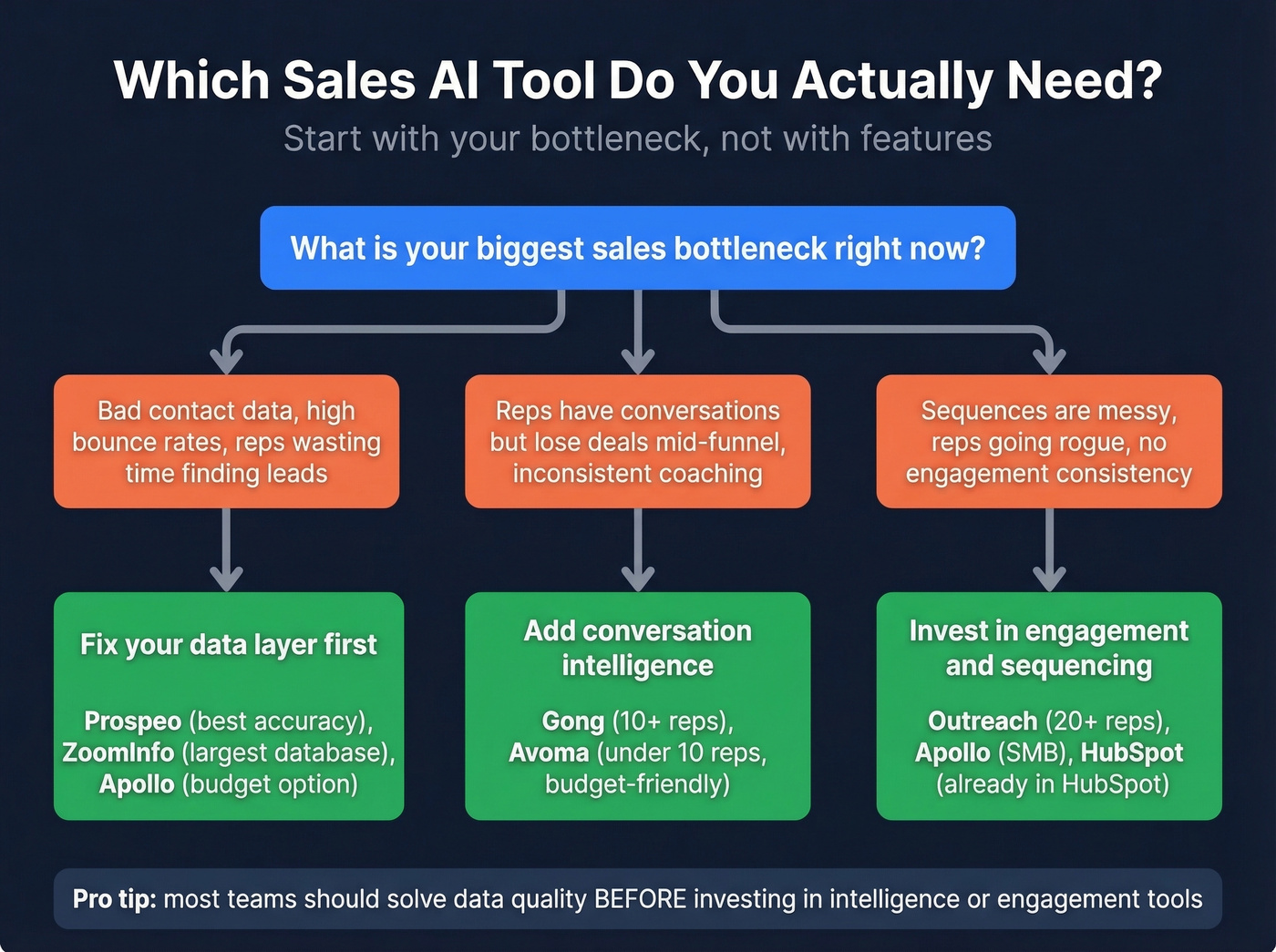
Is your team struggling to find accurate contact data? That's a data problem - solve it first, then layer engagement and intelligence tools on top. Are reps having great conversations but losing deals mid-funnel? That's a coaching problem, and Gong or Avoma will help. Are sequences inconsistent and reps going rogue? That's an engagement problem - Outreach or Apollo.
Let's be honest: most teams buying AI sales tools are solving the wrong problem first. They invest in conversation intelligence or sequencing before they've fixed the data underneath. In our testing, teams that fix data quality first see pipeline results 2-3x faster than those who start with engagement tools. A $150/month sequencer running on stale contacts will always lose to a $39/month sequencer running on verified data.
Check compliance requirements too. If you're selling into the EU or handling sensitive data, confirm SOC 2 compliance and GDPR readiness before you sign anything. Most listicles skip this, and most buyers regret it later. (If compliance is a gating factor, use this B2B compliance guide to sanity-check vendors.)
The Bain research is clear: piecemeal AI adoption doesn't move the needle. That doesn't mean you need to buy everything at once. Pick 2-3 tools that address your specific bottleneck, integrate them properly, and measure results before expanding.
Mistakes That Kill AI Sales ROI
Automating broken processes. If your sales process doesn't work manually, AI will execute the broken version faster. Redesign workflows before you automate them.
Feeding AI bad data. Stale emails, wrong titles, outdated company info - AI recommendations are only as good as the inputs. A 7-day refresh cycle isn't a luxury; it's a requirement.
No adoption plan. Buying Gong doesn't mean reps will watch their call recordings. Budget for training, build it into onboarding, and track usage weekly. We've watched teams spend $50K on tooling and then wonder why nothing changed because nobody enforced the new workflow.
Tool sprawl. Five overlapping tools create data silos, conflicting insights, and admin nightmares. Two well-integrated tools beat five poorly connected ones every time.
Skipping human-in-the-loop checkpoints. AI-generated emails that go out unchecked will eventually say something embarrassing. Build review steps into every automated workflow.
Snyk's 50 AEs cut bounce rates from 35% to under 5% and grew AE-sourced pipeline 180%. The difference wasn't a better AI assistant - it was verified data at $0.01/email with no contracts and no sales calls required.
Every tool on this list works better when the data underneath it is accurate.
FAQ
What is an AI sales assistant?
Software that automates repetitive sales tasks - data entry, email drafting, lead scoring, follow-ups - using machine learning and generative AI, integrated with your CRM. The best platforms go beyond task automation to surface actionable insights that help reps prioritize the right deals.
How much do AI sales assistants cost?
Free tiers exist at Apollo, HubSpot, and Prospeo (75 emails/month). Most mid-market tools run $50-$150/user/month. Fully autonomous AI SDR platforms like Regie.ai reach $500+/user/month, while enterprise solutions like ZoomInfo Copilot start at $15K/year.
What's the difference between an AI sales assistant and an AI SDR?
An AI assistant augments human reps as a copilot. An AI SDR operates autonomously - writing, sending, and following up with minimal human input. Copilots surface the right information at the right time; AI SDRs handle execution independently.
Do AI sales assistants integrate with my CRM?
Most integrate natively with Salesforce and HubSpot. Confirm the integration is bidirectional - one-way syncs create data gaps fast. Tools like Apollo and Outreach all offer native CRM connectors, as does Prospeo.
How do I fix data accuracy before deploying a sales assist AI tool?
Use a provider with real-time verification and a weekly refresh cycle - not the 6-week industry average. Upload your CRM list, verify it, remove bounces, and only then feed clean records into your AI tools. Starting with accurate data typically yields 2-3x faster pipeline results than layering AI on top of stale contacts.